
Reverberatory furnace
A puddling furnace looks odd to anyone who has run a bloomery. The fire is in one room and the iron in another, a wall stands between them, a low brick roof runs over both, and a tall chimney stands at the far end with no bellows anywhere. How to build and run one in the game is in the furnaces and heat guide. This page is about the real furnace and how the game's follows it.
Why the fire is in another room
In a hearth or a shaft furnace the fuel lies against the metal. That is simple and hot, but the metal takes up what is in the fuel. Fairbairn says it of the refinery, the hearth that came before puddling: the iron, "being placed in contact with fuel at a high temperature, is liable to be deteriorated by the admixture of sulphur and other impurities of the fuel" (Fairbairn Iron p. 105). A hearth also needs a blast, driven through the fuel by bellows or blowing cylinders.
The reverberatory removes both needs at once. The metal is heated "by flame", and "thus all contact between the metal and solid fuel is avoided, and the necessity of blowing machinery is dispensed with" (Percy p. 627). The fuel can then be whatever burns with a good flame, even raw coal.
How each part earns its place
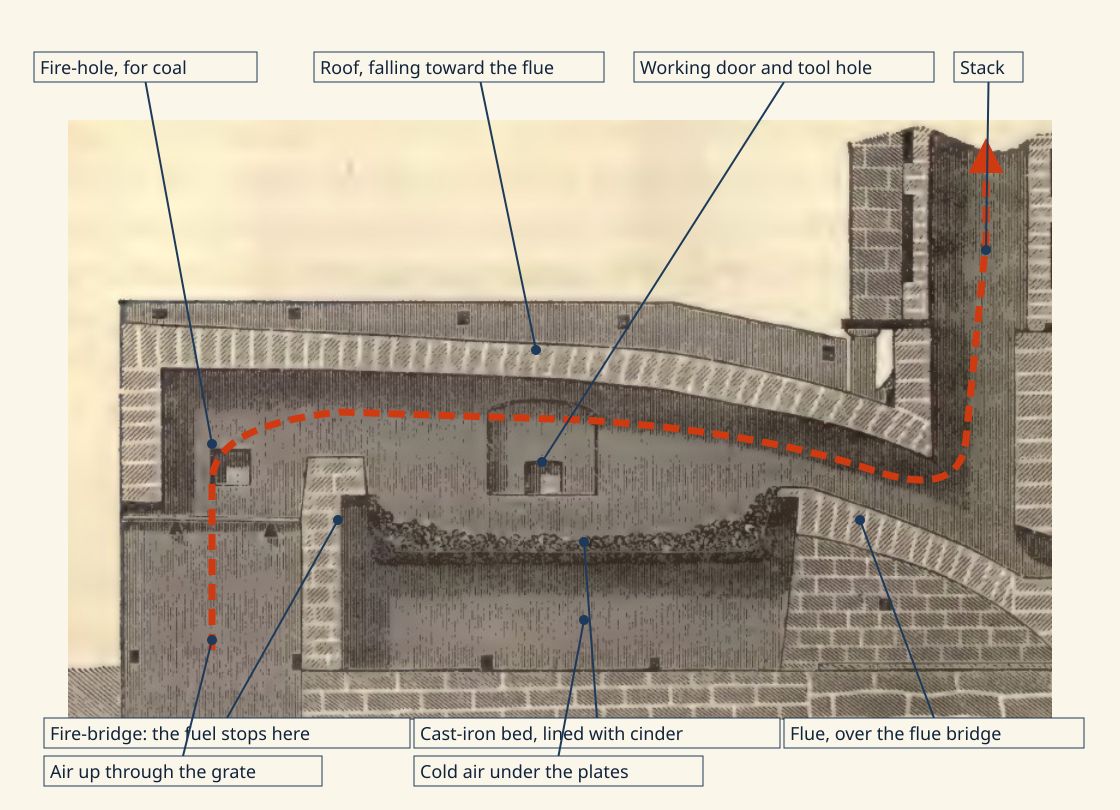
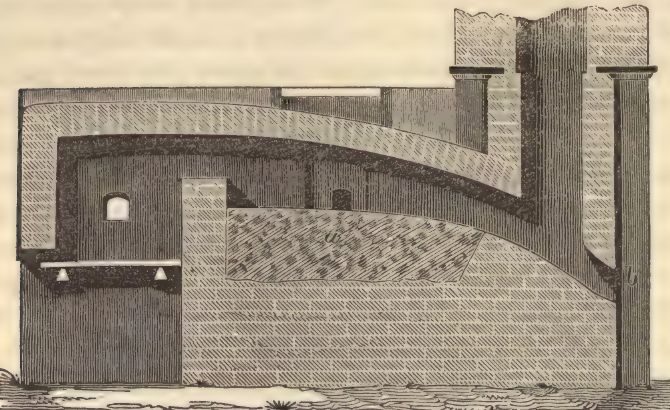
The fire burns in what Overman calls "a separate chamber, designed for nothing else than the combustion of fuel" (Overman p. 263). The grate is sized to the fuel: three feet by two served western bituminous coal, and anthracite needed far more (Overman pp. 263-264). Anthracite packed deep also defeated the chimney, because "a chimney cannot draw through a high column of coal an amount of air sufficient" (Overman p. 272), and it was given a fan.
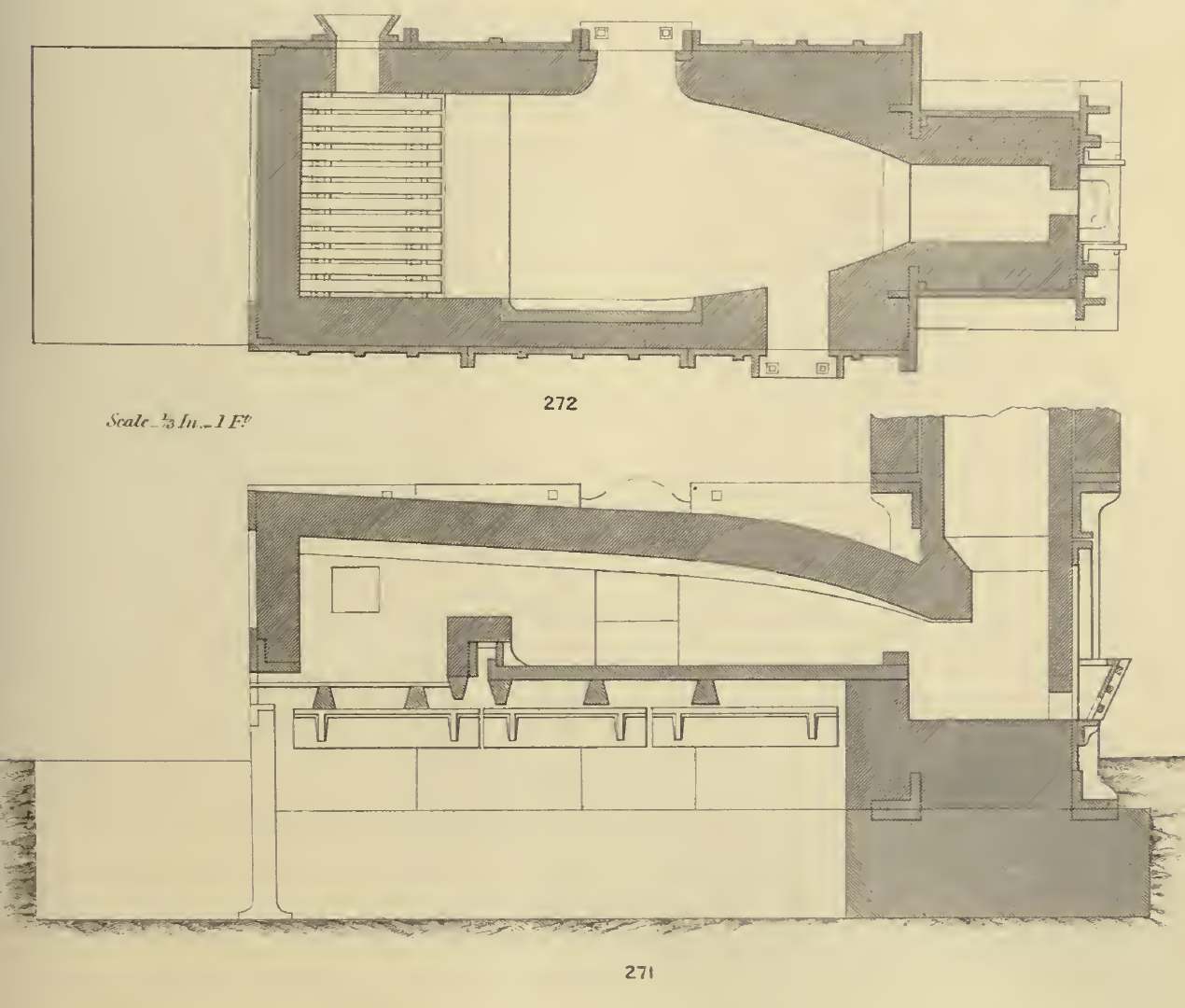
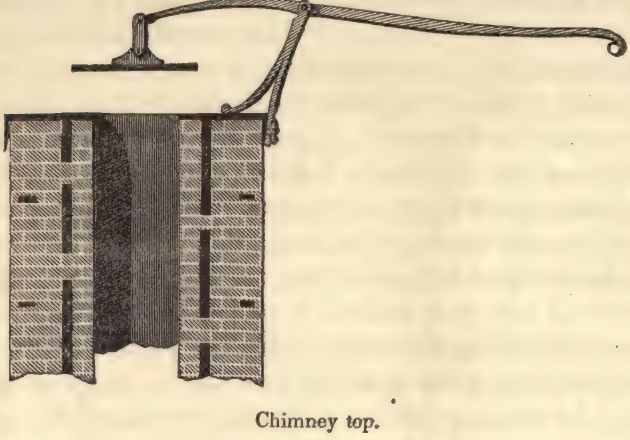
Between grate and metal stands the fire-bridge, a wall of brick 14 or 15 in. thick carried up to within 10 or 12 in. of the roof (Truran p. 206). Only the flame and hot gas pass over it, "though the deleterious portions of the fuel cannot mix with the iron" (Fairbairn Iron p. 105). It stands in the hottest place in the furnace, so it was cooled from inside: at Bromford an air channel ran through it (Percy p. 643).
The roof does the heating. A puddling furnace had seldom more than 20 in. between bottom and roof (Overman p. 270), and the roof falls toward the chimney end until it is within 10 in. of the bottom (Truran p. 206). The brick is not a mirror: the flame heats the roof white hot, and the roof radiates down onto the metal from close by, along with the flame itself. Fairbairn stresses the flame playing on the surface and Overman the roof (Fairbairn Iron pp. 105-106; Overman p. 263); both are at work.
At the far end a second, lower bridge held the metal back from the flue (Truran p. 206). Cinder crept over it anyway, so a small fire was often kept at the foot of the stack to keep that cinder fluid (Overman p. 264; Truran p. 206).
Molten iron and cinder attack brick. Where iron meets a siliceous hearth, "the iron wasted ... is combined with the silex of the hearth, and forms a very fusible cinder" (Overman p. 372). So the puddling bed was a dish of cast-iron plates with open air under it to keep them from melting (Overman p. 263; Percy p. 646), lined with melted cinder (Overman pp. 265-266), with roasted tap-cinder, called bull-dog, round the sides and a layer of iron oxide 2 in. thick on the bottom (Percy p. 643). The door is a cast-iron frame filled with fire-brick and raised on a counterpoised lever (Percy p. 641). Its small hole let the tools in while most of the heat stayed behind it, and it sloped inside so that every part of the hearth could be reached (Overman p. 262).
What the workers did with it
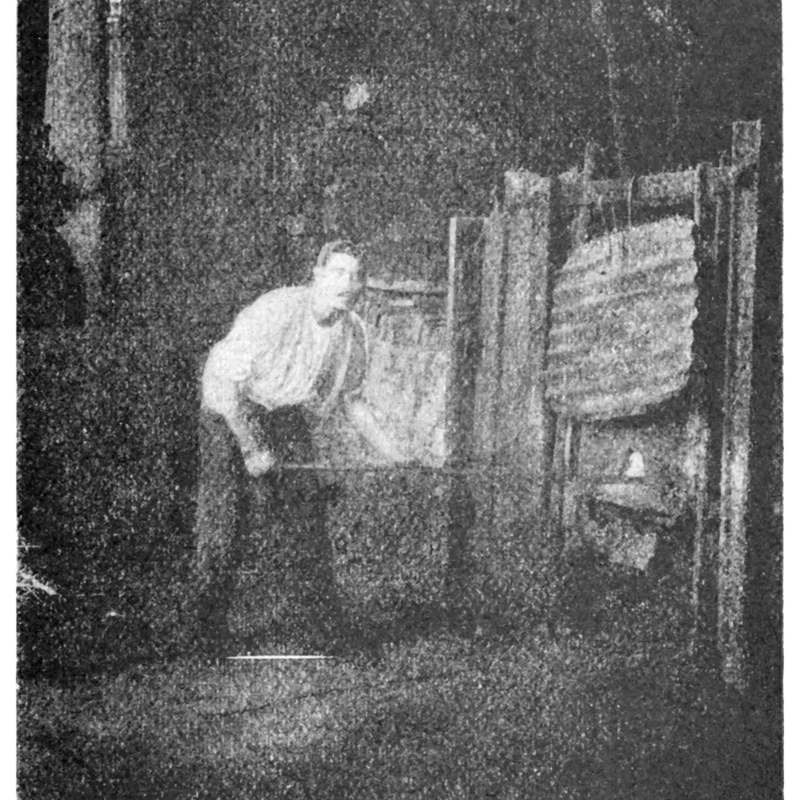
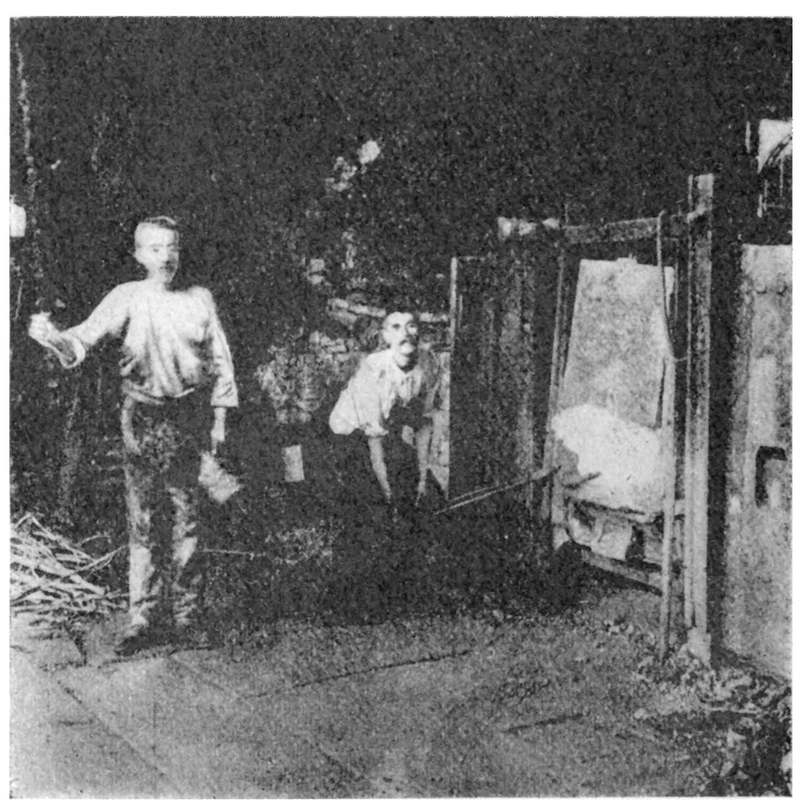
The furnace's reason for being was puddling: turning pig iron, which has too much carbon to forge, into wrought iron. Percy timed a heat at Bromford on 21 July 1859 (Percy pp. 655-656), and it shows the damper at work. The pig was charged and the door wedged shut with the damper up. The charge melted in about 35 minutes and the damper came down. Then it was raised, the stirring got harder, and the charge began to boil, "jets of blue flame escaping everywhere from its surface". Those flames are carbon leaving the iron, burned "partly by the direct action of the oxygen of the air, and partly by the action of that contained either in the cinder formed, or the oxidized compounds of iron added" (Percy p. 658). This is why the bed and the slag are iron oxide: the furnace burns the carbon with oxygen it carries in its own cinder.
As carbon goes, the melting point of the metal goes up, since carbon is what lowers the temperature of fusion (Truran p. 246). The furnace is hot enough to keep pig iron liquid but not hot enough to keep nearly pure iron liquid, so the iron "comes to nature": it stiffens where it stands and grows into pasty grains in the liquid cinder (Percy p. 656). The puddler gathered these into balls. Once the first ball was out the damper was partly let down again, because the finished iron could now only burn away: "The body of the furnace should be full of smoky or reducing flame to prevent this effect" (Percy p. 656). The last of six balls came out at 3.14 and the cinder was tapped off through a hole under the door (Percy pp. 641, 656; Overman p. 270). The charge had gone in at 1.50.
What it cost, and what else it did
A reverberatory is wasteful, and the period knew it. The chimney only works if the gas leaving the furnace is still very hot, so much of the heat of the fuel goes up the stack by design. Percy's Bromford figures come to about 24 cwt of coal, at 120 lb to the cwt, for 20 cwt of puddled bar at 112 lb to the cwt (Percy p. 657), roughly 1.3 lb of coal for each pound of bar. Fairbairn says the air furnace "requires an inordinate supply of fuel" (Fairbairn Iron pp. 111-112). Ironworks led the waste flame under boilers to raise steam (Percy pp. 691-692). The furnaces themselves wore out fast: about 1500 fire-bricks, rebuilt about every six months and patched every week (Percy p. 647).
Founders melted cast iron in reverberatories as well and called them air furnaces (Truran p. 246). Copper smelters used large versions: the Welsh furnace had a large fire-place, a bridge with a cast-iron plate, and a bed of sintered sand (Percy 1861 pp. 318-322).
The type is older than puddling. Biringuccio, printed at Venice in 1540, describes a "fornace a reverbero" for melting bronze for bells and cannon with wood flame, under a low vault that held the heat close to the metal (Biringuccio, De la pirotechnia, Book VII, ch. 1, leaves 101-103). On pig iron the books date it to the late eighteenth century. Thomas and George Cranage, workmen at Coalbrookdale, patented converting pig iron with raw coal in a reverberatory in 1766 (Percy p. 636). Henry Cort patented puddling in February 1784 (Fairbairn Iron p. 12; Percy pp. 627-629), naming the "reverberatory or air furnace" with a bottom "hollow or dished out", and claiming the work could be done without "any blast by bellows or cillinders" (Percy pp. 627, 629). Percy weighs the two claims: Coalbrookdale did not carry the process on and Cort "unquestionably did succeed" (Percy p. 636).
Period basis, and what is the game's own
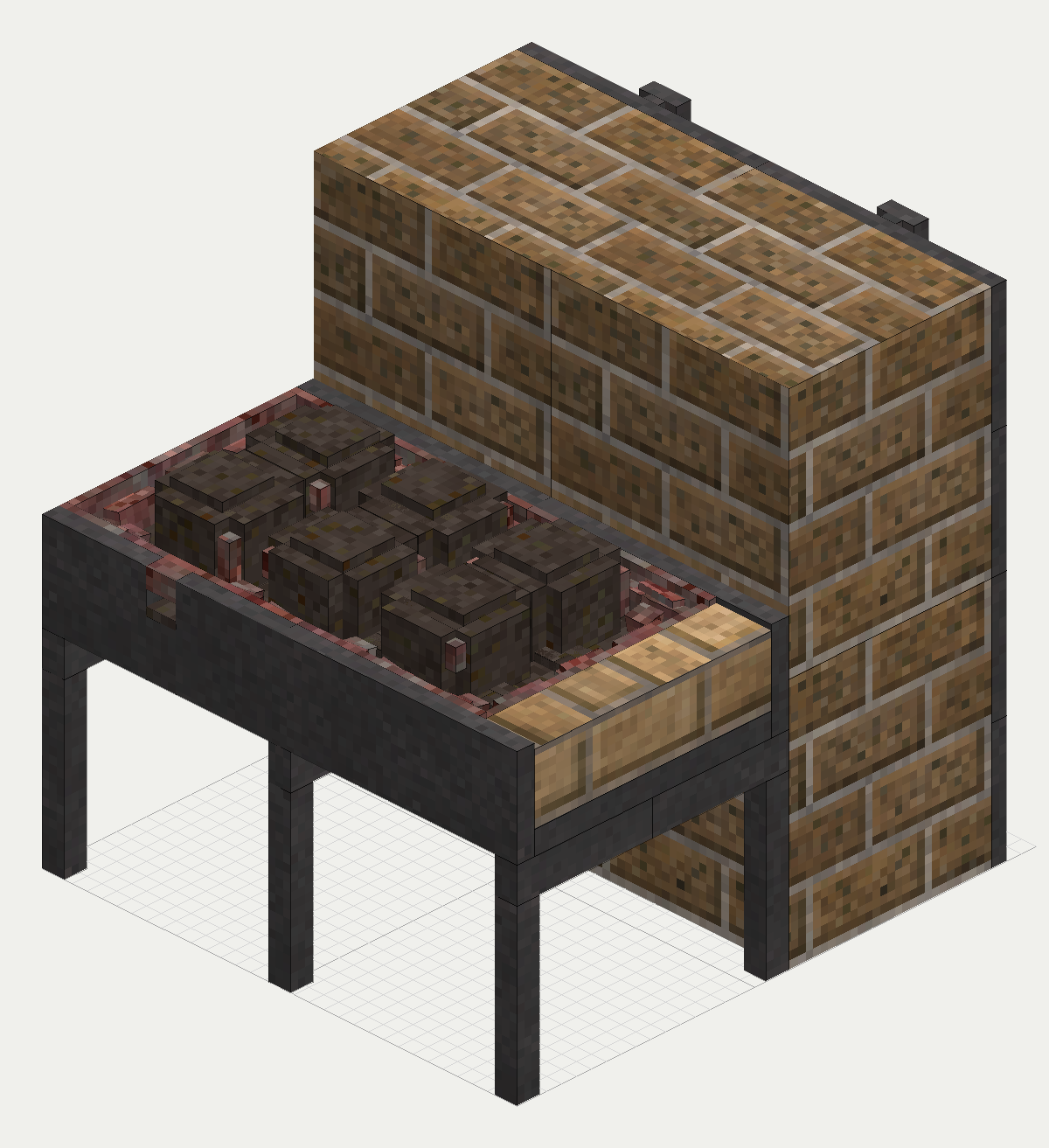
- Period: a fire on its own grate, a bridge, a low roof falling to a flue, and a stack with a damper at the top (Overman pp. 261-264; Truran p. 206). The game builds the puddling and heating furnaces from these parts, in this order from the stoking door to the chimney, with a sprung brick roof of falling arches.
- Period: the fuel never touches the work (Percy p. 627). The game keeps this. The fuel burns in a firebox of its own, and the trip over the bridge costs the flame some heat.
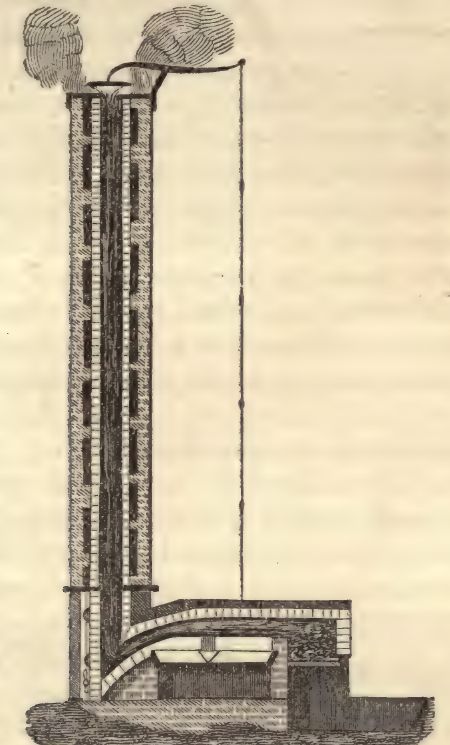
- Period: draught by chimney alone, with the damper as the control (Fairbairn Iron p. 106). The game keeps this. Without its stack a puddling furnace cannot reach working heat, and the player throws the damper by a pull at hand height on the stack.
- Period: the damper changes both the heat and the kind of flame, oxidising or smoky and reducing (Percy pp. 655-656). The game's own: the damper changes the draught and so the heat. The game does not track what the flame is made of.
- Period: raw coal was the usual fuel (Percy pp. 627, 657). The game's own: the firebox takes coke, bituminous coal, anthracite or charcoal, and a reverberatory hearth refuses lignite for want of a working heat.
- Period: a heat was an hour or more of hard stirring by two men (Percy p. 657). The game's own: one player charges by hand, stirs with a rabble and draws balls with a paddle through the door. See scale and units.
- Period: a reheating bed was sand sloped to the flue (Overman pp. 371-372). The game plans this hearth; the heating furnace in play takes stock on its bed, and the piece never heats past its own melting point.
- Period: bed wear, bridge cooling and six-monthly rebuilds (Percy pp. 643, 647). The game's own: linings do not wear, and bridges need no cooling.
- Period: copper smelted in large Welsh furnaces (Percy 1861 pp. 318-322). The game plans a copper reverberatory on the same principle. It is not built.
- The game's own: the base game's bloomery holds its fuel and its ore together, as set out in vanilla against reality. The mod leaves that bloomery alone. These furnaces are where the game first keeps the fuel off the metal, and the fuels page says what burns where.
The numbers
Heat here is the game's own balance rather than a period figure, and output goes by the scaling page. Sizes are in scale and units. "Planned" is design; values without that word are what the game has now.
| In the game | Period figure | How it was scaled | Game value |
|---|---|---|---|
| Working heat, puddling | Given by colour; Percy and Overman name no degrees in the passages used here | The game's own, between cast iron at 1200 C and iron at 1482 C | 1400 C |
| Working heat, reheating | None used | The game's own, the rolling heat | 900 C |
| Puddling with stack, full fire, damper open | Draught by chimney alone (Fairbairn Iron p. 106) | The game's own heat balance | 1421.6 C, just over the line |
| Puddling with no stack | Not done | The same balance | 1192.5 C: cannot work |
| Puddling, damper shut | Damper down "to exclude atmospheric air" (Overman p. 269) | The same balance | 907.1 C |
| Heat lost over the bridge | None given | The game's own | 100 C |
| Stack | 30 to 40 ft (Overman p. 261) | The game's own draught curve, in courses of brick | Puddling 4 courses, reheating 2 |
| Charge | 4.5 cwt of refined metal (Truran p. 210) | Whole pigs on the drawn bed | 9 pigs, 675 u; planned 3 pigs, one on each row |
| Ball | About 80 lb (Percy p. 656), six to a heat at Bromford | A ball of whole units | 3 balls of 200 u; planned a ball of 50 u, the period size |
| Iron that does not come out as ball | Roasted tap-cinder lined the next bed (Percy p. 643) | Split into tap cinder | 75 u of 675 u, returned as tap cinder |
| Length of a heat | 1 to 1 3/4 hours (Percy p. 657) | Period rate times the make factor (the scaling page) | Planned 32 to 44 game minutes |
| Fuel | About 1.3 lb of coal per lb of bar, read from Percy p. 657 | Items per hour, to match a forge | Planned about a forge's items per hour |
Open, and what you can tell us
The books at hand do not date the invention of the reverberatory for any metal, and Biringuccio is the oldest account among them. They also disagree on the boil. Overman has the damper shut through it, "to exclude atmospheric air", with the furnace "dark and smoky" and raised only slightly near the end (Overman p. 269), where Percy's Bromford man raised it for the boil (Percy pp. 655-656). If you know a source that dates the furnace or settles which damper practice was usual in a district, we would like to read it.
Picture credits
- Figs. 82, 84, 85 and 122: Overman, The Manufacture of Iron, pp. 262, 263, 264 and 372, Library page; Fig. 85 labelled for this site with the path of the flame.
- Figs. 271 and 272: Truran, The Iron Manufacture of Great Britain, Plate 47, Library page, cropped.
- Puddler rabbling a charge: Walter Macfarlane, The Principles and Practice of Iron and Steel Manufacture (1917), public domain, cropped.
- Drawing puddled ball from furnace: Walter Macfarlane, as above, public domain, cropped.
- The game's hearth: the mod's planned drawing.
Comment or suggest something in the Expanded thread on the Vintage Story Discord