
Ladles
A ladle is an iron pot with a clay skin, and it is how liquid iron got from where it was melted to where it was wanted. It carries, it holds and it pours, and each of those jobs changes its shape. How to fill and pour one in the game is in the molten metal guide, and the carried ladle is in the catalogue. This page is about the real ones and how the game's follow them.
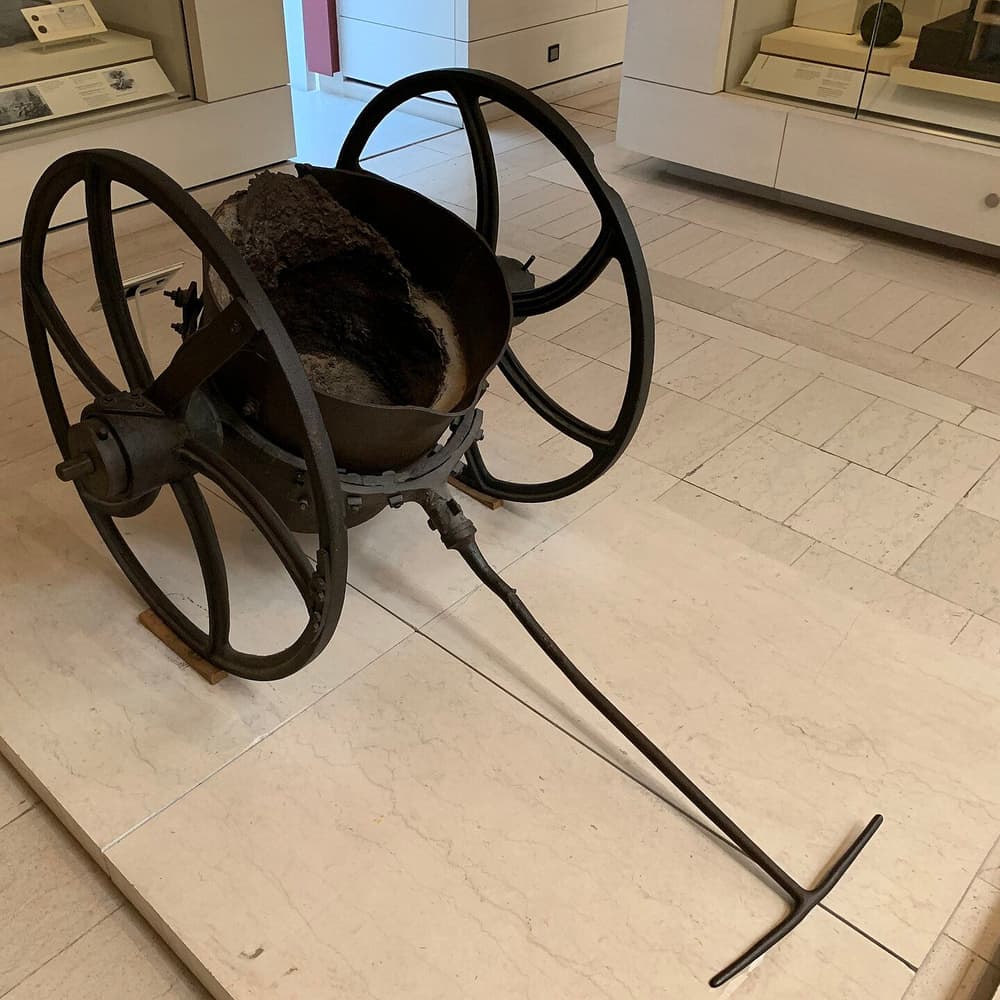
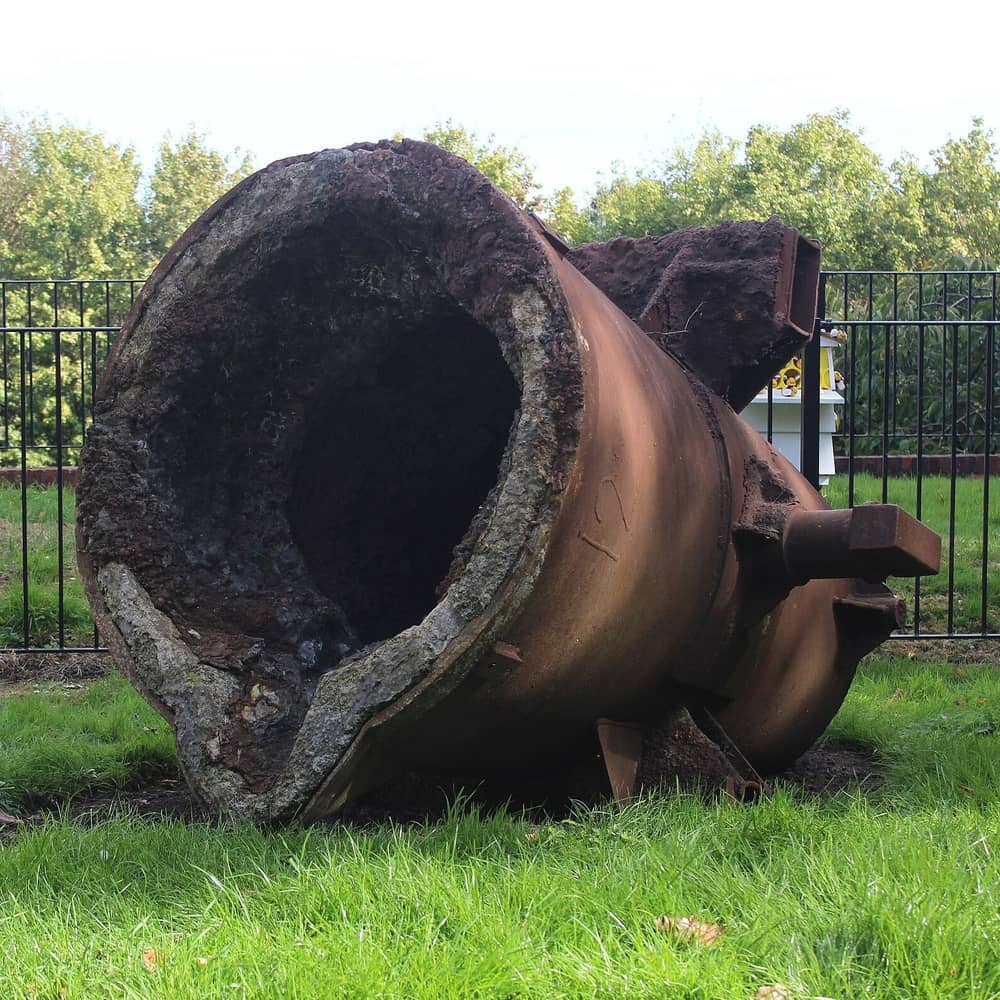
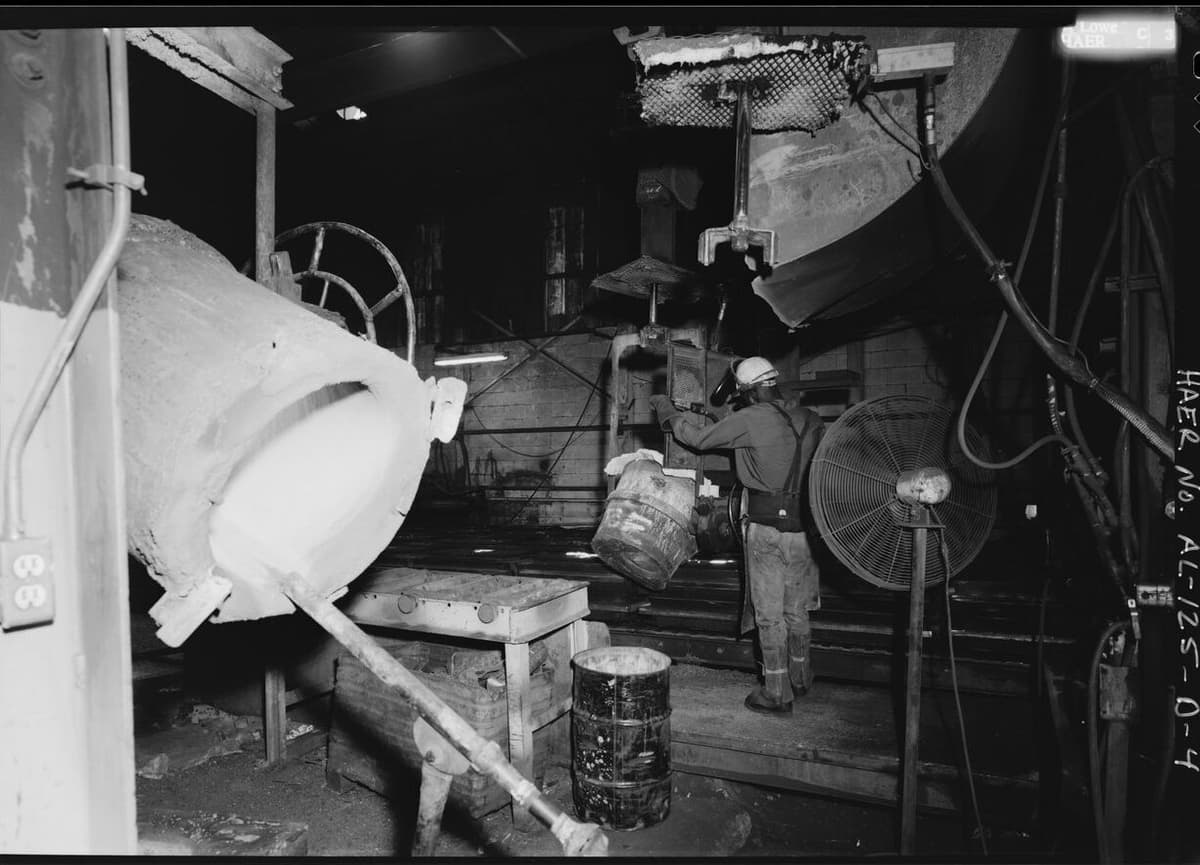
Why iron goes into a ladle at all
A cupola makes iron a little at a time, and iron cannot wait in it. Held in the bottom of the furnace it goes dull, and Kirk is blunt that "Molten iron should be handled in a ladle and not in a cupola" (Kirk p. 52). Nothing is gained by holding it there, for it "can be kept as hot in a ladle as in a cupola" (Kirk p. 88), and large bodies of molten iron stay hot and fluid longer in a ladle covered with charcoal to shut out the air than they do in the furnace (Kirk pp. 51-52).
So the iron was drawn as fast as it melted, and the ladle did the waiting. The spout was laid to throw the stream near the centre of the ladle (Kirk p. 17), and the foundry was arranged around the catching. For hand work the ladle stood on a hollow pedestal eight or ten inches high, so it could be moved under the stream and anything spilled in changing ladles fell inside (Kirk p. 3). Six 40-pound hand ladles a minute was all that could safely be taken from one spout (Kirk p. 74).
Why a ladle is dried, and then warmed
A ladle is iron on the outside and clay on the inside, and the clay goes on wet. Foundry costs counted the "fire clay, loam and sand for cupola and ladles" (Kirk p. 231), the labour of "daubing ladles" and the "wood for lighting up and drying ladles" (Kirk p. 232). The drying was not a nicety. "A damp ladle causes iron to boil, and if the daubing is very thick may cause it to explode. A wet daubing or water in a ladle explodes the iron the instant it touches it" (Kirk p. 262). Water under liquid iron turns to steam at once and has nowhere to go but through the metal. Kirk tells the story against himself: a boy put a red-hot skimmer in the snow and thrust it dripping into a ladle, the iron went off like shot through a thick felt hat, and he still carried the scars when he wrote (Kirk p. 259).
Dry is not yet hot. A cold ladle takes heat out of the first iron it receives, so the first iron of a heat was tapped off to warm the ladles and then run to the pig bed (Kirk p. 87). Ladles that stood empty too long between catches "get so cold between catches that they chill the iron before it can be poured", and the melter took the blame (Kirk p. 88).
Pouring from the lip, and pouring from the bottom
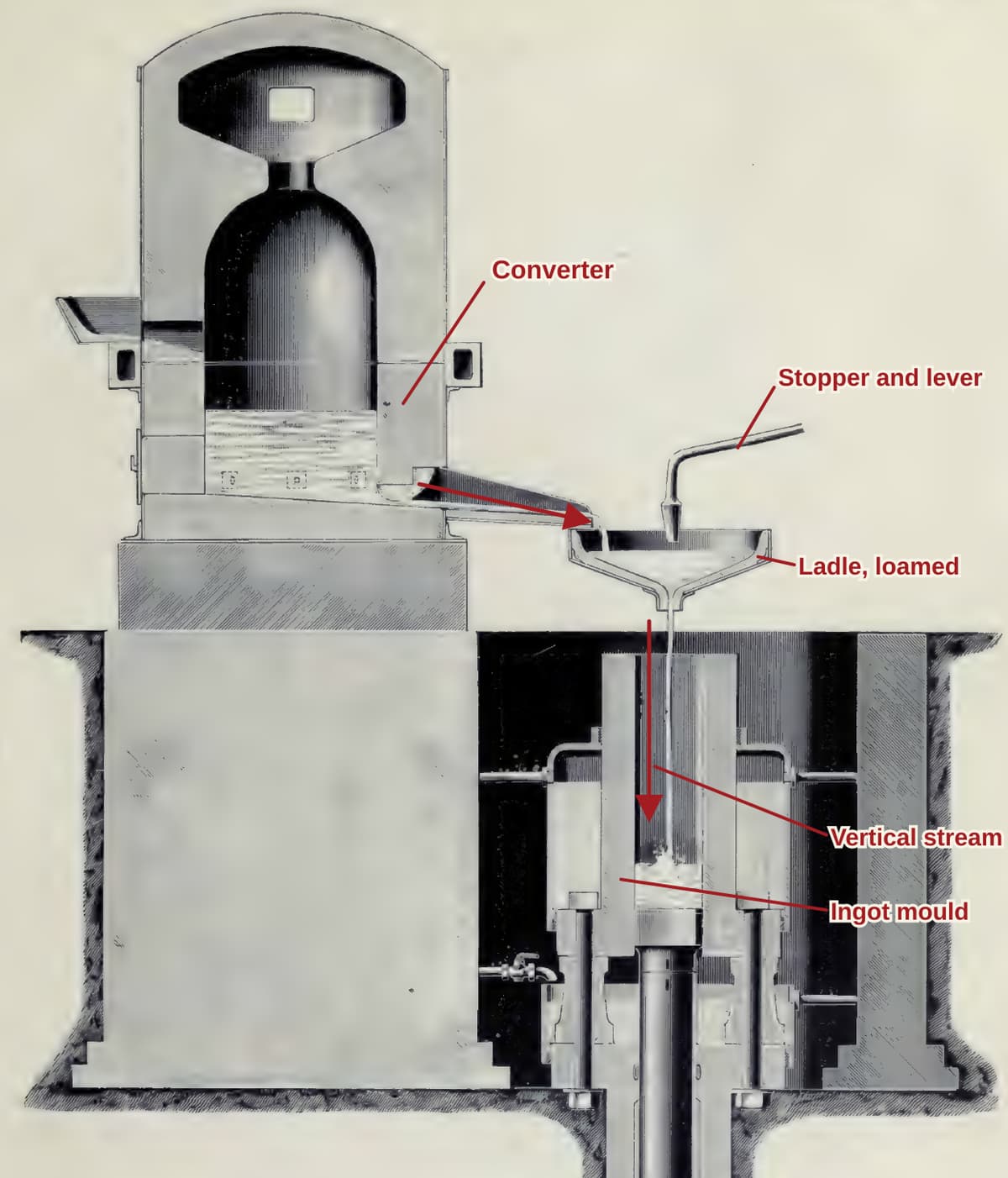
A hand ladle is tipped and poured over a lip. Its lip does two things badly. A stream poured from the lip flies out in a curve, and in a narrow mould it strikes the far wall, melts into it and welds the ingot to the mould; and the slag floating on the metal comes over the lip with it (Bessemer p. 149). In a foundry the iron was skimmed by hand before pouring (Kirk p. 259). In a steelworks, where the mould was a tall narrow box and the metal was steel, Bessemer changed the ladle instead.
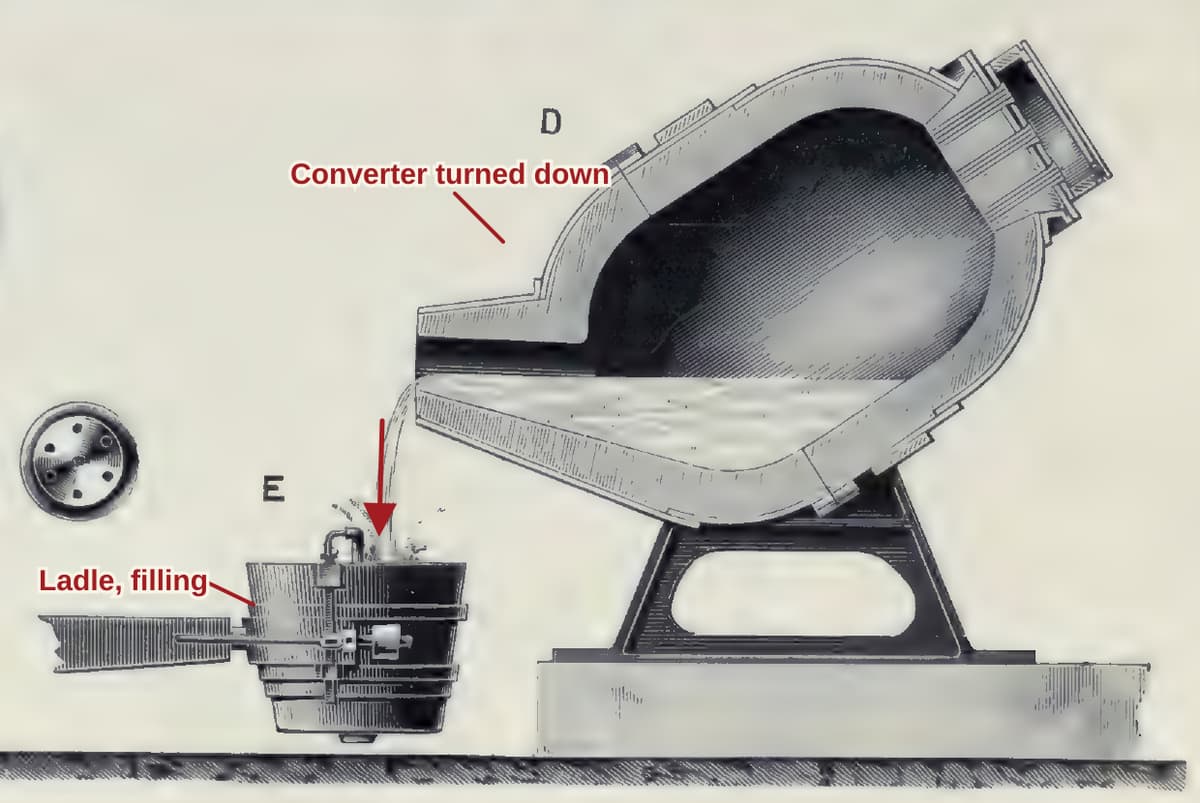
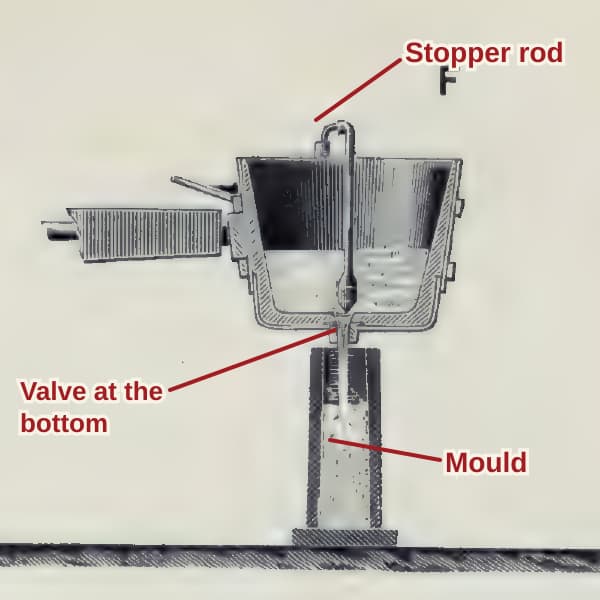
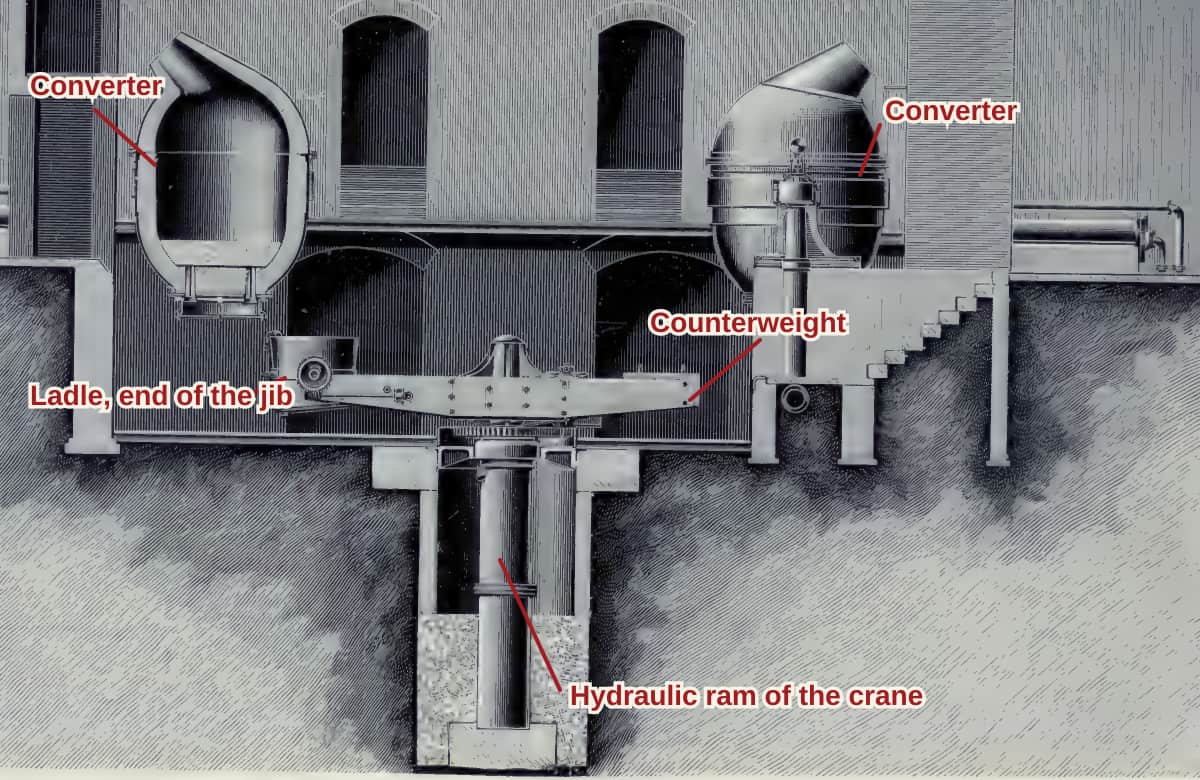
Bessemer's linings were ganister, the same material as the converter's (Bessemer p. 203). Campbell records the last step in the holding of metal: a large receiver, "often called a mixer", into which iron from all the tributary furnaces was poured and averaged, and "an enlargement of the old American receiving ladle" (Campbell p. 110). Kirk's foundry has the receiving ladle's job in small: large ladles filled from several taps of one melt, with a tap held back until enough had melted not to chill in the bottom of the ladle (Kirk p. 87).
How the game models them
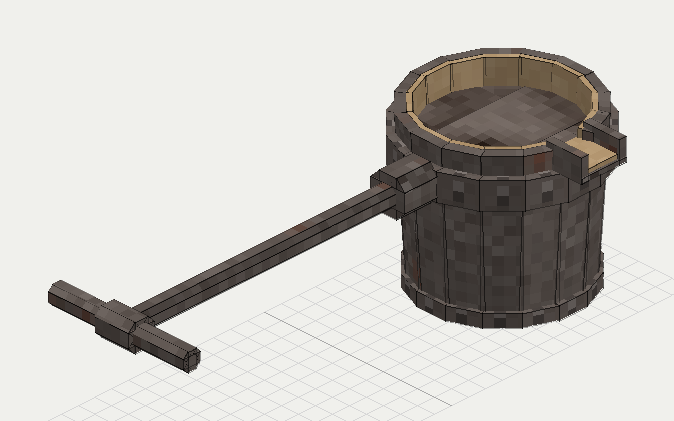
The shank ladle is a carried vessel, between vanilla's crucible and the canal. It fills under a canal tap, walks to a flask or a mould the canal does not reach and pours at the lip into the runner cup. It holds 600 units and cools on game time, faster the hotter it is, about 45 degrees C a game hour at iron heat. That gives some four minutes of pouring on a 100 degree margin. Its metal cannot be set back to liquid: what freezes in the bowl is a skull, chipped out with a chisel, and nothing is lost. Two ladles can fill one cavity in turn, the game's form of Bolland's two ladles to one casting (Bolland p. 232).
It comes off the bench daubed and wet, and a wet ladle refuses metal outright. Dried over a firepit of the heat that fires a raw crucible, 600 degrees C for 45 seconds, it takes metal for the rest of its life. Kirk's explosion is not modelled, and neither is the warming heat; the game keeps the rule and drops the danger.
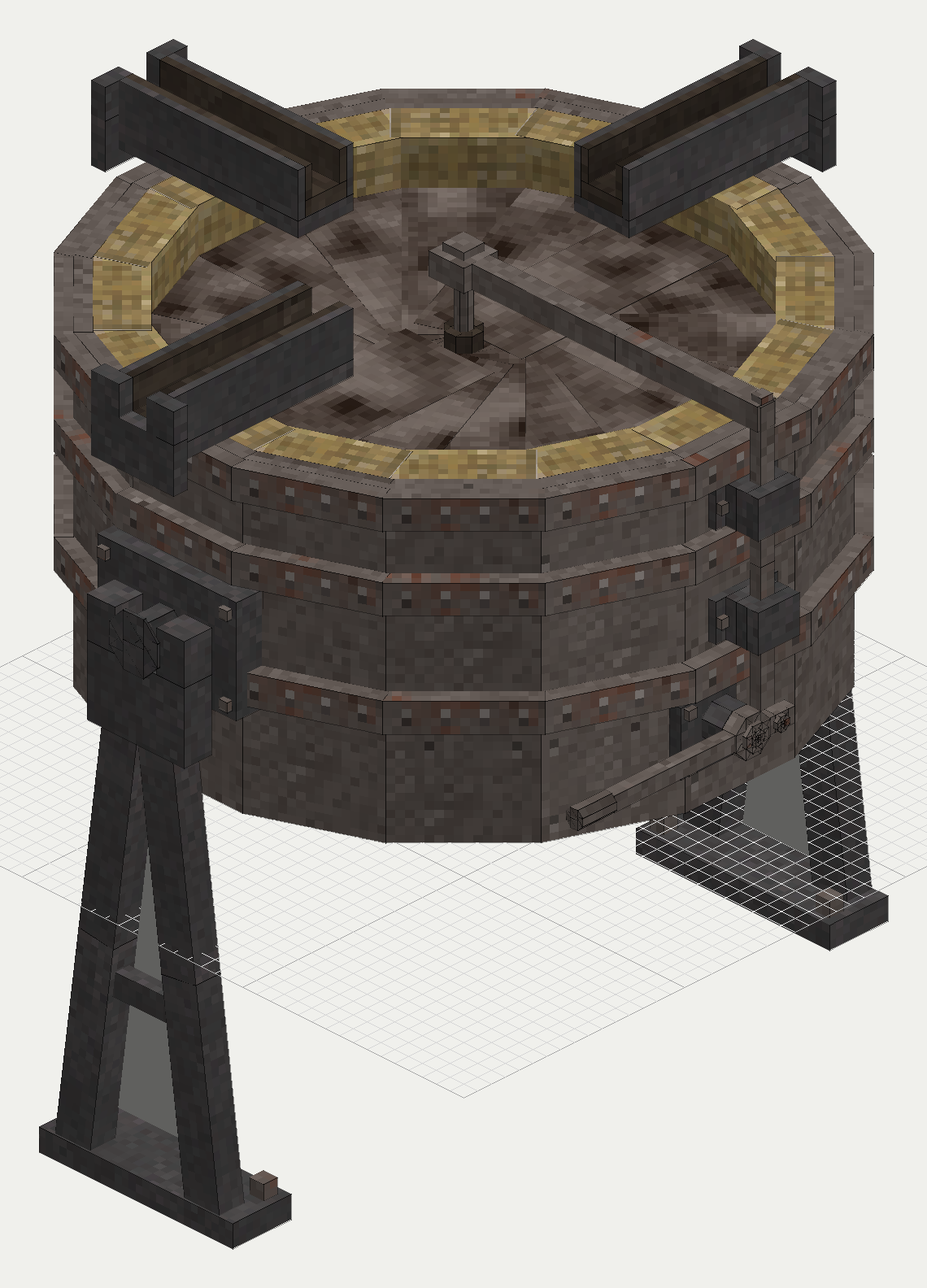
The holding ladle is planned and not built. It stands at the cupola spout, takes several taps of one melt, and pours from the bottom through a stopper worked by a lever, into a canal. Its roles follow what the mixer and the casting ladle did: hold iron between the rhythm of tapping and the rhythm of casting, and pour with the slag left behind. Later, in the steel tier, the same block is planned to take alloys.
Period basis, and what is the game's own
- Period: hand, bull and crane ladles, in that order of size (Kirk pp. 8, 11). The game keeps one carried ladle, the shank ladle, and one big vessel, the bottom-pouring holding ladle.
- Period: a daubed ladle, dried with wood before iron, because a wet one explodes the iron (Kirk pp. 231-232, 262). The game requires the drying and refuses a wet ladle.
- Period: a lip pour for hand work, a stopper and bottom valve for the big ladles of the steelworks (Bessemer pp. 148-149). The game keeps both: the shank ladle tips, the planned holding ladle does not.
- Period: iron held in a ladle and not a furnace, with charcoal to keep it hot (Kirk pp. 51-52); the game's cover for the holding ladle is planned.
- The game's own: the base game carries metal in a one-ingot crucible and has no ladle. See vanilla against reality.
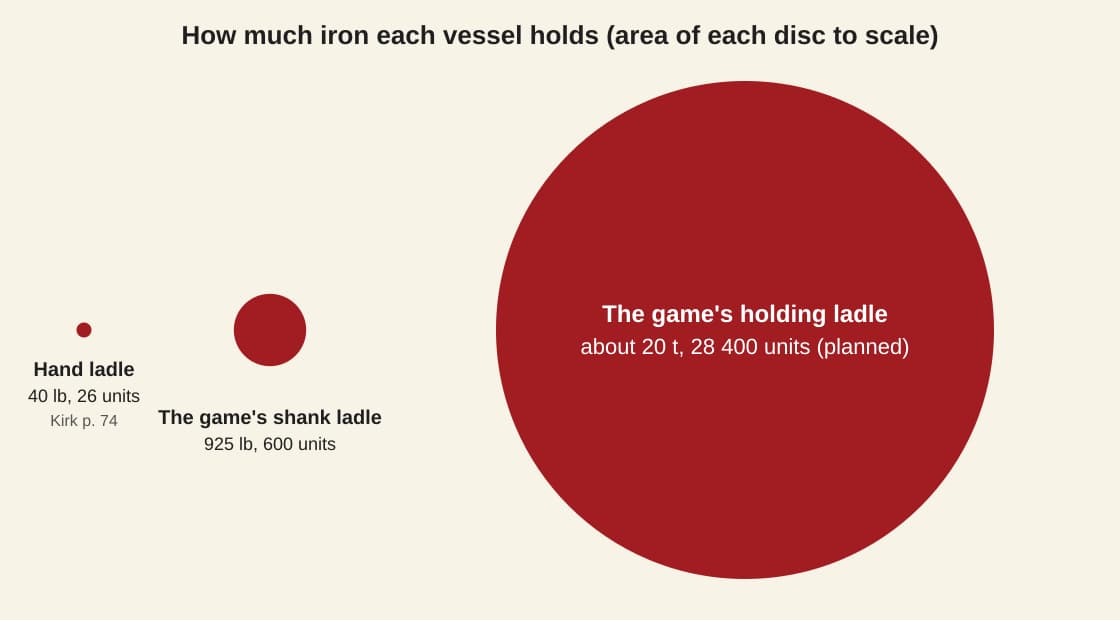
- The game's own: one player walks with 925 lb of iron, where the books' hand ladle held 40 lb (Kirk p. 74) and the big ones went on cranes (Kirk p. 11).
- The game's own: the shank ladle holds a single metal, so no skimmer. The furnace tap separates iron from slag, and nothing floats in the bowl.
- The game's own: daubing does not wear, a dried ladle stays dried, and a ladle does not need warming with the first iron of a heat.
- The game's own: the cooling speed of the holding ladle is derived from the shank ladle's, by the square-cube law: heat goes out through the surface and stays in the volume, so a bigger vessel cools more slowly, with no special number for the big ladle. Plain physics.
The numbers
The ladles are sized by what they have to do in the game, and carry period shapes rather than period weights (see the scaling page). A unit is 0.4 voxel cubed, about 0.70 kg of iron (scale and units).
| In the game | Period figure | How it was scaled | Game value |
|---|---|---|---|
| Shank ladle, capacity | Hand ladle 40 lb (Kirk p. 74) | The game's own: three small flask fills in one carry | 600 units, about 420 kg, 925 lb |
| Holding ladle, capacity | Mixer, "an enlargement" of the receiving ladle (Campbell p. 110) | The game's own: the bath set wide enough to reach its runners | Planned about 28 400 units, about 20 t |
| Fill under a tap | Six 40 lb ladles a minute from one spout (Kirk p. 74) | The canal's own drain rate | 20 units a second; 600 units in 30 s |
| Lip pour | None given in the books at hand | The game's own, to match the flasks | 50 units a second; 600 units in 12 s |
| Drying | "Wood for ... drying ladles" (Kirk p. 232) | A vanilla firepit cook | 600 degrees C for 45 s |
| Shank ladle, cooling | None given | A twentieth of the vanilla crucible's rate | About 45 degrees C a game hour at 1500 C |
| Holding ladle, cooling | None given | Square-cube from the shank ladle: 47 times the mass, 3.6 times the size | Planned 6/3.6, about 1.7, about 23 game hours from 1585 to 1300 C against 6.6 for the shank ladle |
Open, and what you can tell us
The books at hand say little about the ladle itself as a piece of ironwork. None of them gives a shank's length, a pouring rate or the minutes iron stays fluid in a ladle, or describes how a foundry's plate ladle was built, and the game's riveted plate bowl is the game's own choice. They also do not settle who first used a stopper in a ladle, or how long a receiving ladle would hold iron before it was too cold to use. If you know a foundry handbook that covers this, we would like to read it.
Picture credits
- Foundry barrow ladle, J & T Boyd, Shettleston: Alf van Beem, public domain, cropped.
- Stanton Iron Ladle: Martinvl, CC BY-SA 4.0, cropped.
- Filling molds from a mobile ladle, empty bull ladle in foreground: Jet Lowe, Historic American Engineering Record, public domain, cropped.
- Figs. 42, 43 and 45, Plates XIV, XV and XVII: Bessemer, An Autobiography, pp. 146, 148 and 150 (facing pages), Library page; labelled for this site.
- The relative sizes of the ladles: drawn for this page from Kirk p. 74 and the game's values.
- The game's ladles: the mod's drawings; the holding ladle is a planned drawing.
Comment or suggest something in the Expanded thread on the Vintage Story Discord