
Jet condenser
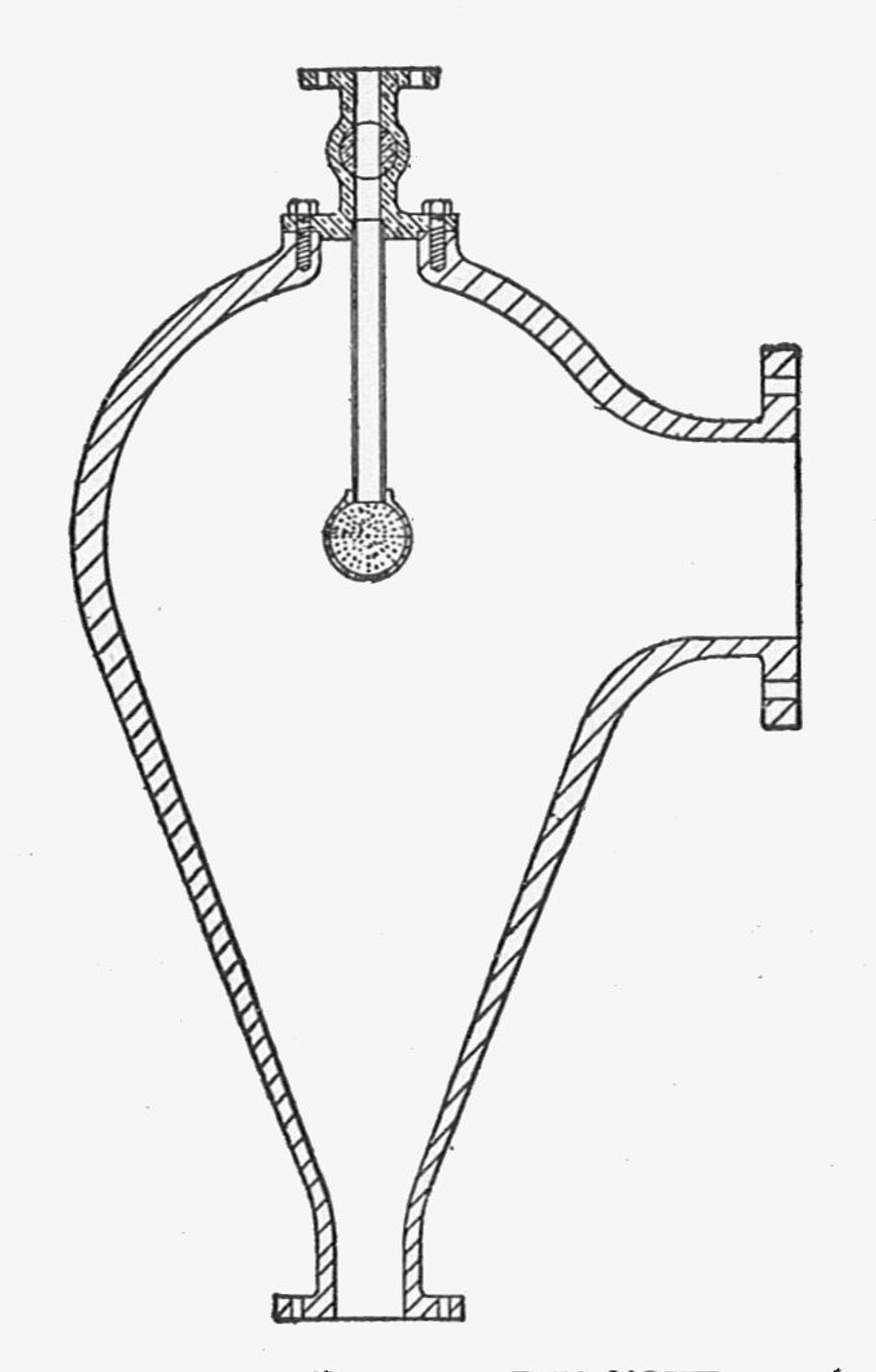
A condenser takes the steam an engine has finished with and turns it back to water, leaving nearly nothing behind the piston to push against. The jet condenser does it by spraying cold water straight into the steam. How an engine is piped and run in the game is in the steam engines guide, and the block is in the catalogue. This page is about the real apparatus and how the game's follows it.
Why steam is condensed at all
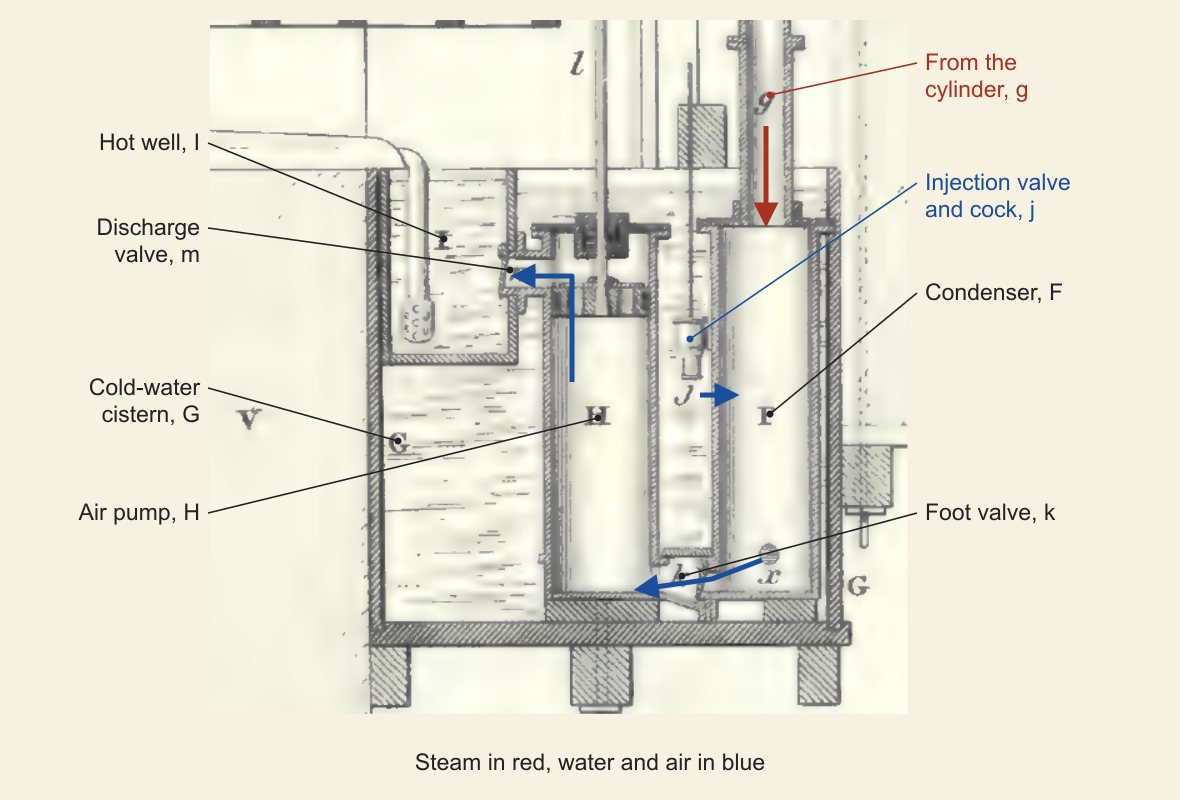
Atmospheric air presses on everything with about 30 inches of mercury. If the far side of a piston is open to the air, that pressure is lost to the engine; if it opens onto an empty space, the pressure is won as work. Steam turned back to water occupies almost no room: Farey reckons a cubic foot of steam to a cubic inch of water (Farey p. 375). Condensing it is the way of making the empty space.
Newcomen's engine did this by spraying water into the cylinder itself (Farey p. 111). The cylinder was cooled every stroke, and had to be heated again by fresh steam before it could hold any. The water was also left hot, and the vapour above hot water still has pressure: in the old engines that remaining pressure "was never less than one-fourth of the atmospherical pressure, and therefore took away one-fourth of the power" (Farey pp. 315-316).
Watt's conclusion was that a cylinder had to be kept as hot as the steam, about 212 degrees, and the condensed water brought down to 100 degrees or lower, and "that such complete heating and cooling could not be performed in the same vessel" (Farey p. 313). In 1765 he moved the cold into a vessel of its own, joined to the cylinder by a pipe. The steam in the cylinder then rushed of its own accord into the vacuum next door, and the cylinder stayed hot (Farey p. 313). His patent of 1769 names condensers by that word and asks that they be kept "as cold as the air in the neighbourhood" (Farey p. 316).
Why a jet, and why the pump
Watt first condensed by cold alone on the outside of tubes, as the steam's own water could then be pulled out by a small pump (Farey pp. 314-315). It worked, and it was the method of his first engines. It was too slow and too bulky for large ones: the tube condenser "would have been very voluminous", and bad water crusted over the tubes, thickening them and stopping the heat (Farey p. 325).
He went over to a jet of cold water in the condenser, and accepted the price: the water injected has to be taken out again, along with the air that comes in with it and the leaks of the engine. The action was so much improved that it paid for the extra work of a larger pump (Farey p. 325).
The pump that does that is the air pump, and it is why no condenser stands alone. It keeps the vessel empty of water and air, the two things that do not condense away. It must be of large dimensions (Farey p. 379). Watt's rule gave it one-ninth of the cylinder's effective capacity (Farey p. 592), and Bourne gives one-eighth for the proportions of condenser and air pump alike (Bourne p. 215). Its bucket was worked from the engine's great lever (Farey pp. 325, 678).
How it was worked
The cold water was forced in by the atmosphere itself: the vacuum drew it through the injection cock (Farey p. 594). In a single-acting engine the jet was opened each stroke by a valve on the plug rod, with a cock to set the amount (Farey p. 325). In a double-acting engine the steam comes every stroke, so there was no valve at all: the cock stayed open and the attendant used it to set the quantity or to stop the jet (Farey p. 447).
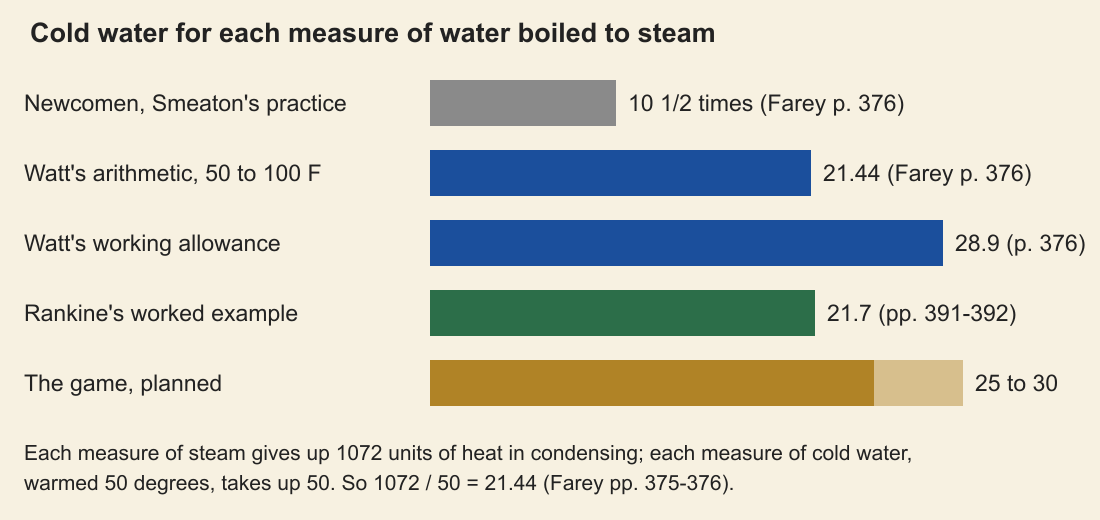
The man at the cock aimed at the temperature of the outflow. The water should leave the air pump at about 96 degrees, blood warm; 102 was a fair average and 110 the limit, beyond which the vacuum was not good (Farey pp. 325, 375). Too little water and the vacuum failed. Where the water was short and warm, more of it was no cure: Farey says it is better to run an imperfect vacuum than to have the air pump lift a great quantity of injection water (Farey p. 375). The sum above was also a test of the engine. Watt held that if the injection measured more than that proportion to the water evaporated, "we are certain that steam is wasted by leaks or by condensation in some improper place" (Farey p. 376).
The vacuum was read on a barometer: a glass tube about 32 inches long, its foot in a bason of mercury and its top piped to the condenser. In good order, with a 30-inch weather glass, it stood at 28 inches; each stroke it fell to 26 1/2 or 27 when the steam came in and rose back before the next (Farey pp. 377-378). The remaining 2 inches is the pressure of the thin steam left over, not quite a pound on the square inch, and Watt reckoned it cheaper to leave it than to cool it further (Farey p. 375).
The hot well is a small division of the cistern that kept the warm water from the cold (Farey p. 355). The hot-water pump took feed for the boiler from it (Farey p. 453), so a condensing engine's boiler drank water already warmed by the steam it had raised.
What the jet costs
A plant with a jet condenser must have water by the ton. Watt's allowance came to about 0.6 of a cubic foot of cold water a minute for each horse-power (Farey p. 594). Rankine's worked example of an unjacketed engine takes 21.7 lb of feed and 471.4 lb of injection per indicated horse-power an hour (Rankine pp. 391-392). The same water could be used again if it was cooled, but when it was short and hot, the vacuum suffered (Farey p. 375). The cold-water pump itself was sized at one-24th of the cylinder (Farey p. 592), and a little always ran away to waste to carry off the heat of the cistern (Farey p. 374). The pumps page has more on those pumps.
Period basis, and what is the game's own
- Period: a separate vessel, a jet of cold water, an air pump, a warm hot well (Farey pp. 313, 325, 354-355). The game's planned condenser has all four, and the exhaust is piped to it by a main.
- Period: the condenser and air pump stood inside a cold cistern (Farey p. 374). The game brings the injection water by a pipe instead of standing the set in a tank, and its hot well is one iron casting, as the cast cisterns that replaced wooden ones were (Farey p. 700).
- Period: a barometer on the condenser (Farey pp. 377-378). The game plans the same tube and bason of mercury, its column showing the vacuum, in place of the dial on the drawing.
- Period: the injection cock set by hand to the engine's load (Farey pp. 325, 447, 593). The game plans a lever with five marks, shut to full open; a shut cock draws no water and pulls no vacuum, and the engine then runs as a non-condensing one.
- Period: a blow valve let air and steam out while the engine was being started (Farey p. 324). The game plans that valve as the way out for exhaust when the cock is shut. It lifts on the pressure beneath it and puffs for as long as uncondensed steam arrives; the continuous use is the game's own.
- The game's own: the air pump has a small steam head and lever of its own, in the bell-crank order of Murdock's engine (Farey pp. 678-681). In Farey's engines that lever is the great lever of the engine, and the air pump is worked from it. A condenser block that serves whichever engine is piped to it needs its own drive.
- The game's own: the base game has no steam and no vacuum, and its condenser is a still for liquids. See vanilla against reality.
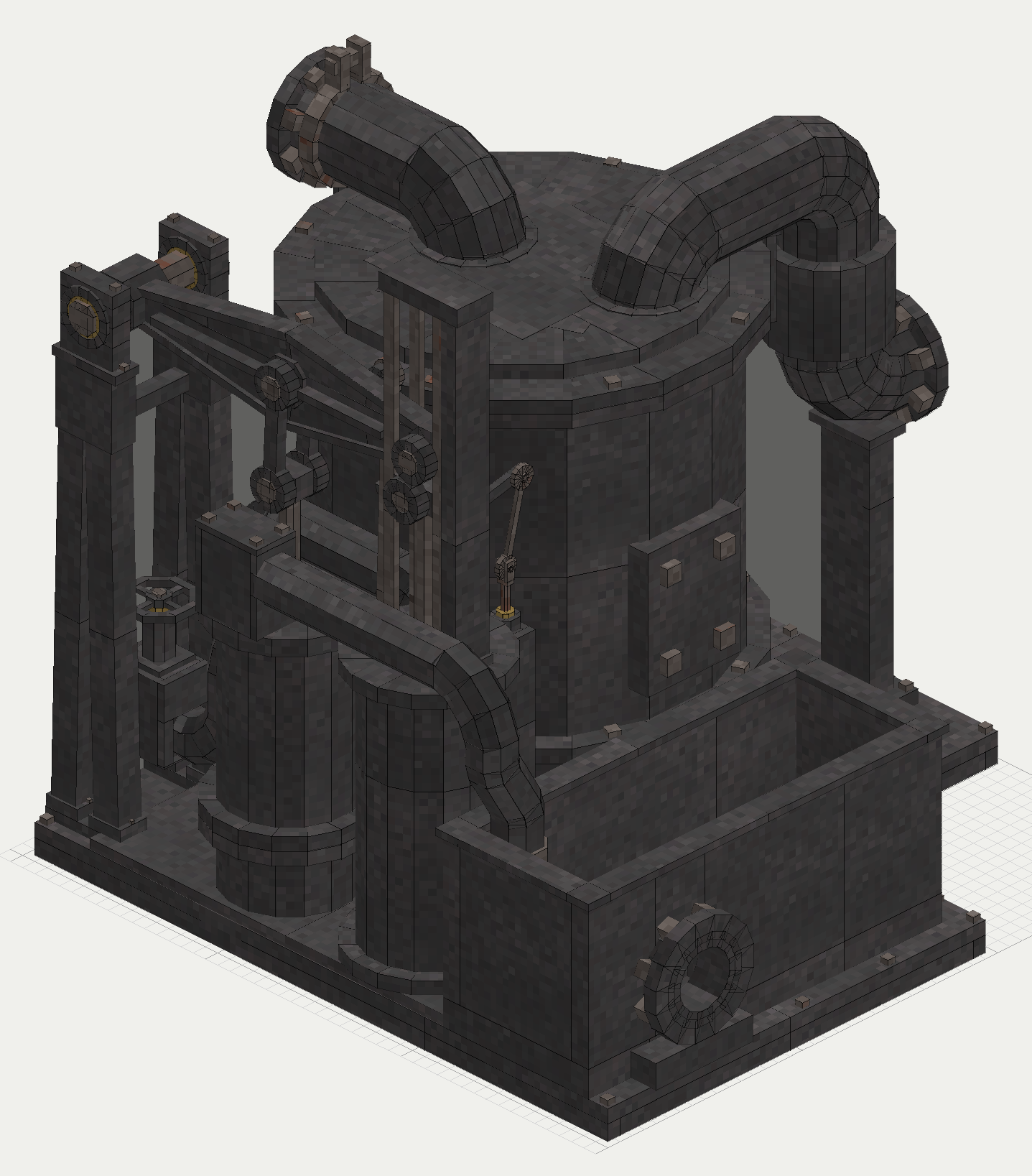
- The game's own: today the condenser is a block with its shape and no process. The vacuum, the water it draws and the hot well are planned.
The numbers
Steam machines keep period figures rather than a fuel factor (see the scaling page), drawn at true size (scale and units). "Planned" is the rating in design.
| In the game | Period figure | How it was scaled | Game value |
|---|---|---|---|
| Work gained by the vacuum | About 41% to 49% more at 0.3 to 0.4 cut-off, 68% at 1/4 (Rankine pp. 410-411) | The computed back-pressure tables at face value | Planned about half again more; a fifth to a quarter by the block's present description; on the horizontal engine at 1/4, 94.8 kW against 56.4 kW vented |
| Cold water per measure of steam | 21.44 by the sum, 28.9 Watt's allowance (Farey p. 376); 21.7 by Rankine's worked example (Rankine pp. 391-392) | A margin over the worked figures | Planned 25 to 30 times the steam's mass at full cock |
| Air pump sweep | One-ninth of the cylinder's capacity (Farey p. 592), one-eighth (Bourne p. 215) | 77 cu ft a minute at a ninth of one Watt engine's 689 | Planned 77.9 cu ft a minute, 1.02 of a Watt's need at a ninth |
| Hot well | 96 to 110 degrees F, 102 a fair average (Farey pp. 325, 375) | The game's heat balance is not yet set | Planned warm; temperature to be set |
| Vacuum read | 28 in on a 30 in barometer (Farey p. 377) | Mercury column true to height | Planned column of 0.76 m at a perfect vacuum |
Open, and what you can tell us
The engines Farey describes work the air pump from the engine's own lever (Farey pp. 325, 678), and the passages read for this page show none with a steam head of its own of the kind the game plans. If you know a period example of a separately driven air pump before about 1850, we would like to read it. The books also do not say how common a sprayed rose was against a plain jet, or when the rose came in.
Picture credits
- Plate X, given on the plate as page 353, cropped, its parts labelled for this site from the key on Farey pp. 354-355: Farey, A Treatise on the Steam Engine, Library page.
- Jet condenser, New Catechism of the Steam Engine: Hawkins, 1904 edition of the 1897 book, public domain, scanned by Andy Dingley.
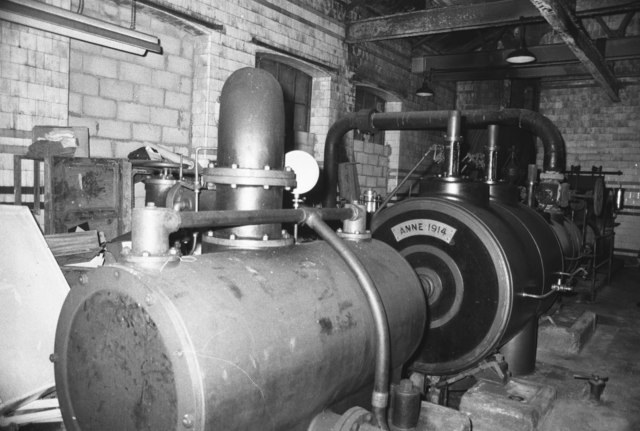
- Steam engine at Craven Mills: Chris Allen, CC BY-SA 2.0.
- The cold-water chart: drawn for this page from Farey p. 376 and Rankine pp. 391-392, with the game's planned figure.
- The game's condenser: the mod's planned drawing.
Comment or suggest something in the Expanded thread on the Vintage Story Discord