
Engine ratings
An engine's size was stated in three different ways in the period, and the three did not agree. A Birmingham maker sold a nominal horse-power, a Cornish mine captain read off a duty, and an engineer with an indicator measured what the steam did on the piston. The machines are on their own pages and shaft power is taught in the shaft power guide. This page is about what those figures meant and how the game comes to its own.
A unit named after a horse
Boulton and Watt's horse-power is the raising of 33,000 lb one foot in a minute (Farey p. 438), which is 745.7 W. It was generous on purpose. Farey sets Smeaton's observations against it: a good horse working eight hours a day manages about 22,000 lb a foot a minute, "only two-thirds of the estimated horse-power", so it took "30 horses to act in concert, to perform the work of a 20 horse-power engine", and 90 in three relays to keep that up as long as the engine could (Farey p. 439). He advises reading the term "as a determined measure of mechanical power", with no reference to any horse (Farey p. 439).
Nominal: a size, and what it hid
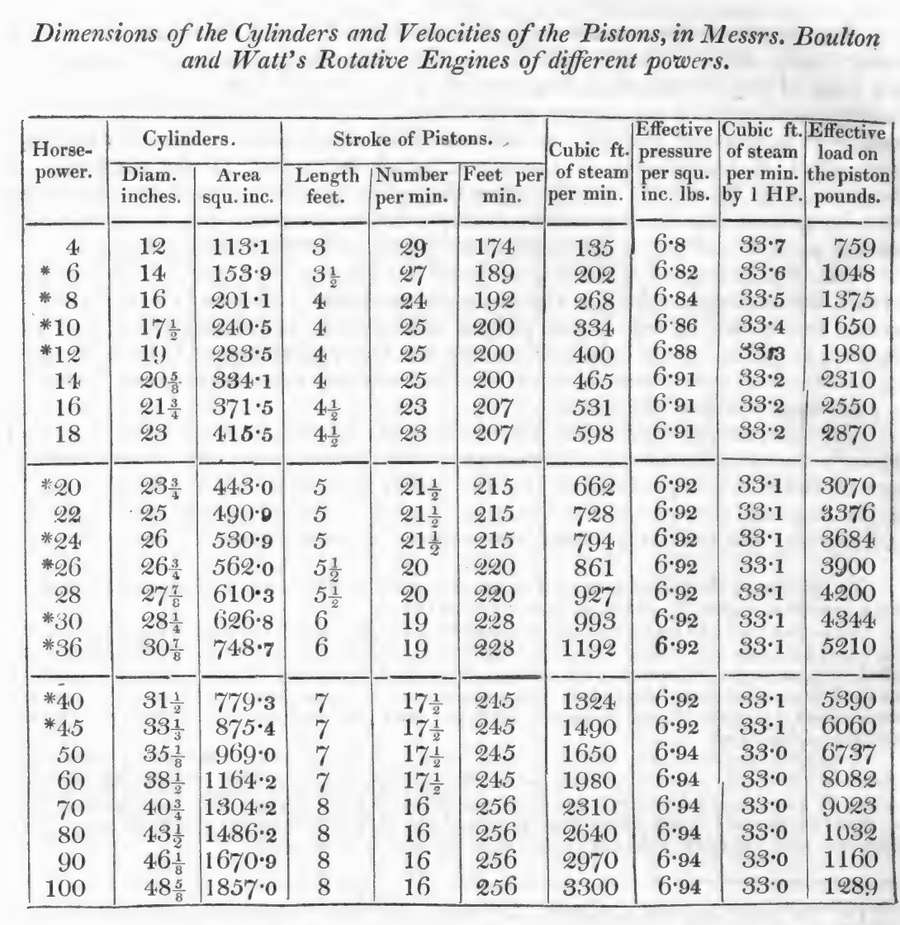
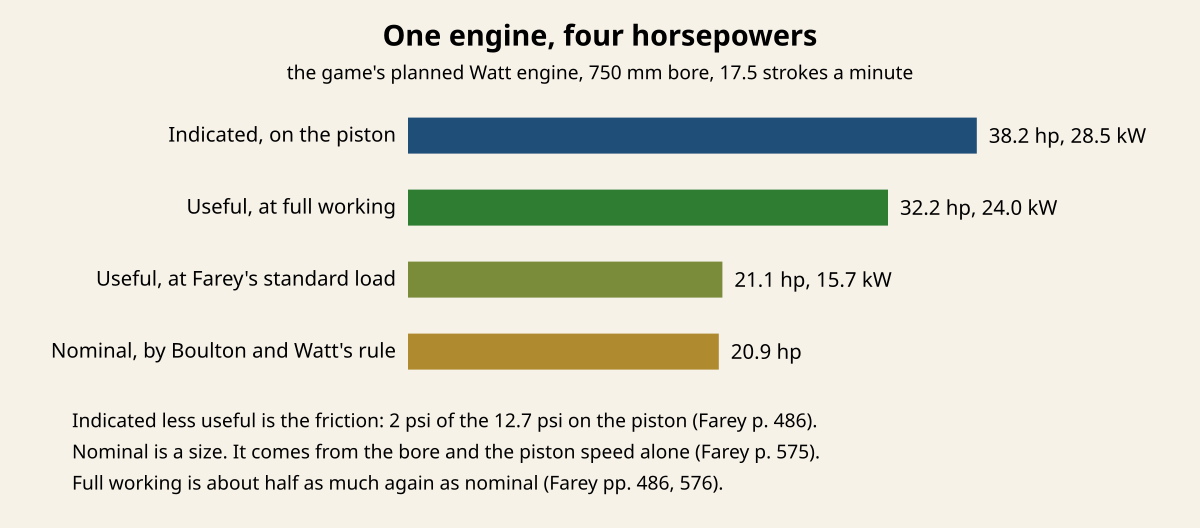
Nominal horse-power came from a rule. The bore squared, in inches, times the piston's speed in feet a minute, divided by 6050, gives the horse-power (Farey p. 575), and the rule has a fixed load of 6.944 lb per square inch built in (Farey p. 440). Since nothing about the steam enters it, a nominal figure says how big the cylinder is. Farey is plain that a good engine does more: Watt's engines were "capable of working effectually, and at their full speed, when they are loaded with a resistance which requires half as much more as their nominal horse-power" (Farey p. 486), so "a 20 horse engine can exert 30 horse power" (Farey p. 576).
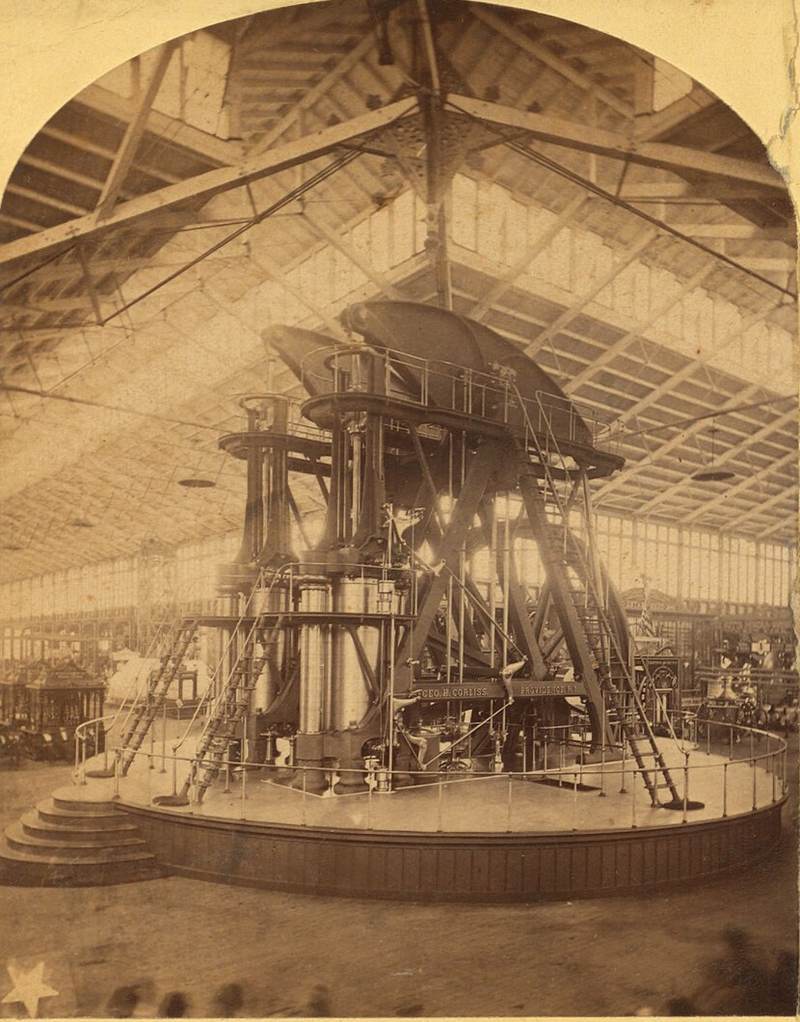
The gap went on widening. By 1865 Bourne found the actual power of steamers to be "about 4 or 4 1/2 times" the nominal (Bourne p. 376). A buyer who compared two engines by nominal horse-power was comparing their cylinders. The rating of the Centennial engine of 1876 shows the same thing at the other end of the century: 1400 hp nominal and rated up to 2500 (Sandhurst pp. 362-368).
Indicated: a pen on a card
The indicator recorded the pressure in the cylinder against the position of the piston, so the outline it drew was the work of the stroke. Bourne describes reading one: the mean pressure is got "by taking a number of ordinates", adding the pressure at each and dividing by their number (Bourne p. 342). Multiply that mean by the piston's area and its speed, and divide by 33,000, and the result is the indicated horse-power (Shillitto p. 134).
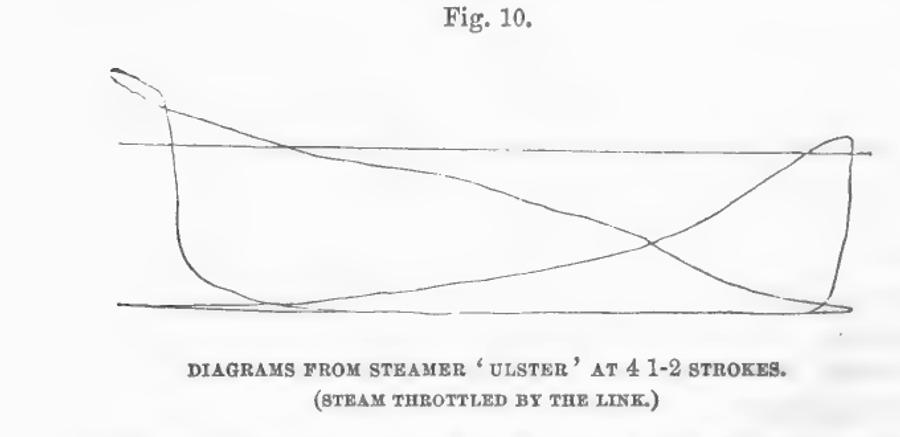
Indicated power is what the steam did to the piston, and what reaches the shaft is less. Farey's figure for a Watt engine at full working is 12 3/4 lb a square inch on the piston, 2 lb of it friction (Farey p. 486). Bourne's water-works engines lost 12 to 15% of their indicated power (Bourne p. 367).
Duty: a Cornish yardstick
In Cornwall the coal was "brought by sea from Swansea" (Farey p. 337) and an engine was judged by what it burned. Watt's own measure was the weight of water raised one foot by a bushel of coal, and from 1811 Lean's reports published it for every engine that took part, so that the reports became "the test by which engineers must submit to be judged" (Lean p. 3). The water was not weighed. It was reckoned from "the capacity of the pumps" (Lean p. 3), and the count of strokes supplied the rest.
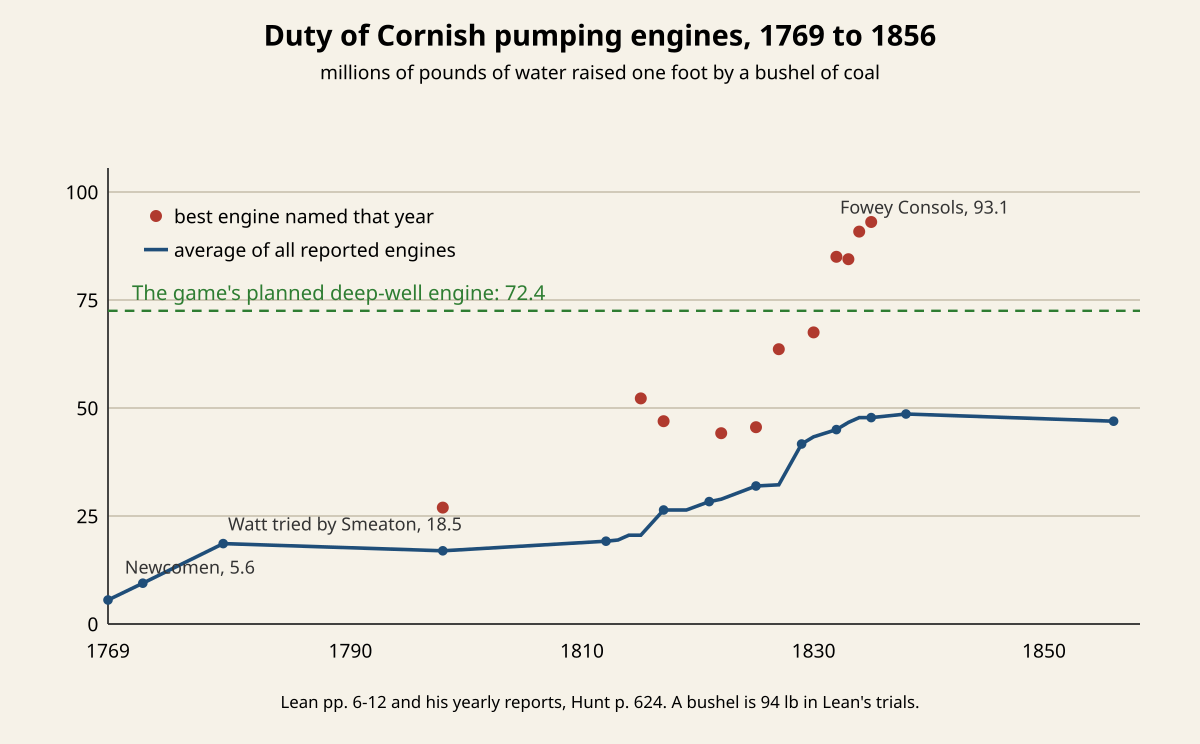
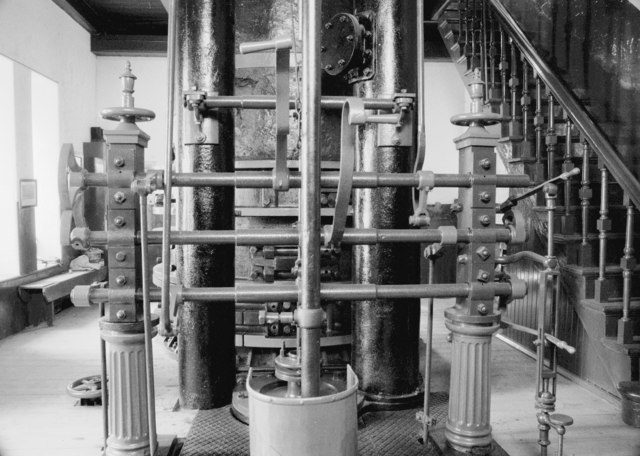
Duty measures coal, so it took in the boiler and the man firing it as well as the engine. Hunt says of the term that it "was first employed by James Watt to signify the nett effect resulting from the consumption of a given weight of coal" (Hunt p. 625).
Steam and coal per horsepower
Coal per horse-power an hour is the same measure in another unit, and it shows how far the period went. Watt's engines burned 10 1/2 lb on average and 9.07 at best (Farey p. 488). A Cornish engine at East Wheal Rose burned 3.6 lb (Hunt p. 642), and Bourne's efficient steamers no more than 2 1/2 lb (Bourne p. 376). The compound mill engine tested at Bristol burned 1 1/3 lb (Denton p. 2). Condensing Corliss engines generally took 2 1/4 to 3 1/2 lb (Shillitto pp. 132-133).
How the game rates an engine
Today's engines have a fixed draw and an on-off gate. The Watt takes 30 L/s of steam for 0.3 of power and runs at any pressure from 2 to 4 atm, the same at either end. The Cornish that ships in the later mod costs 40 L per unit of power to the Watt's 100, and runs from 5 to 8 atm.
The planned rule is one that Boulton and Watt would recognise. Each engine is rated from what it uses, on its drawn sizes, with a period figure for each term, and no power is set by hand. Indicated power is mean effective pressure times piston area times piston speed; useful power takes off the engine's friction. The steam it draws is its swept volume up to the cut-off, at the density of the steam its valve admits. These engines are rated in real kilowatts on real steam, so the scaling factors the furnaces use (the scaling page) are not applied.
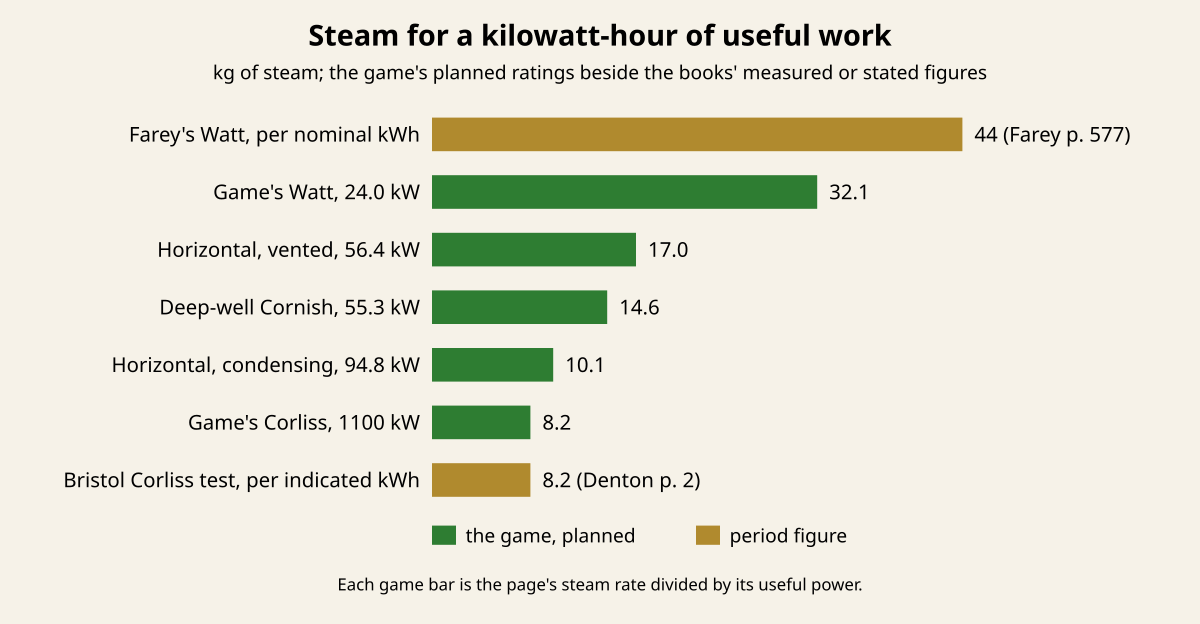
Three things follow, and they are period behaviour. A boiler pressed above an engine's working pressure gives no more power, since the valve admits only that pressure. A cut-off makes the same work from less steam, which is why the horizontal needs about half the steam of the Watt per kilowatt. And a condenser is worth a great deal to an engine that uses it: the same horizontal engine at the same cut-off gives 94.8 kW condensing against 56.4 kW vented. A planned Cornish boiler open makes 0.264 kg/s, which feeds a Watt at 0.81 of the boiler and a horizontal at just over one boiler.
See pipe bore and flow for how that steam reaches the engine and work rates for what a horse-power of shafting does in a shop.
Period basis, and what is the game's own
- Period: Boulton and Watt's horse-power of 33,000 lb a foot a minute (Farey p. 438), the 745.7 W the game counts in.
- Period: mean effective pressure, friction and piston speed for each planned engine are taken from its source. The Watt uses Farey's 12 3/4 lb less 2 (Farey p. 486), the Corliss the Bristol test (Denton p. 2).
- Period: the planned deep-well engine's cut-off, steam and duty follow Lean's working Cornish engines (Lean pp. iii-iv, Table VII).
- The game's own: the Watt keeps a 30 in bore on a stroke of 4.14 ft, the bore of a makers' 30 horse on the stroke of a 10 horse (Farey p. 575), at 17.5 strokes a minute (Fairbairn pt. II p. 101). Its piston runs at 145 ft a minute, where Farey's table runs 174 to 256.
- The game's own: the network unit, 35 kW planned, 50 kW today. Nothing in the books fixes it.
- The game's own: a planned engine has no starting pressure. It turns once the steam beats its friction.
- The game's own: cylinder condensation, which Bourne puts near 37% in one engine (Bourne p. 367), is not modelled in the horizontal.
- The game's own: the base game has no steam at all. See vanilla against reality.
The numbers
Engines keep true sizes and real steam, with one voxel 62.5 mm (scale and units), and the furnace factors on the scaling page are not applied to them. The kg/kWh figures are worked out, from each rate and power shown. Unmarked values are what the game has now; pressures are gauge.
| In the game | Period figure | How it was scaled | Game value |
|---|---|---|---|
| The horsepower | 33,000 ft-lb a minute (Farey p. 438) | True value | 745.7 W |
| Watt, today | None | The game's own | 0.3 of power, 30 L/s, runs 2 to 4 atm; 13 kW at the network's 50 kW a unit |
| Watt, nominal | d^2 v / 6050 (Farey p. 575) | His rule on the drawn bore and speed | Planned 20.9 hp |
| Watt, speed | 17.5 strokes a minute (Fairbairn pt. II p. 101) | True value | Planned 35 rpm at the shaft, 3.67 rad/s |
| Watt, mean pressure | 12 3/4 lb on the piston (Farey p. 486) | True value, 12.7 psi | Planned indicated 38.2 hp, 28.5 kW |
| Watt, friction | 2 lb a square inch (Farey p. 486) | True value | Planned 2 psi, useful 32.2 hp, 24.0 kW |
| Watt, at standard load | 7 psi useful (Farey p. 487) | True value | Planned 21.1 hp, 15.7 kW |
| Watt, steam | 33 cu ft a minute a nominal hp (Farey p. 439) | Swept volume x strokes x density | Planned 0.214 kg/s, 32.1 kg/kWh useful |
| Watt, working pressure | 2 psi in the cylinder, 4 to 4 1/2 lb at the boiler (Farey pp. 486-487, 576) | True value | Planned 2 psi; breaks above 12 psi |
| Horizontal, piston speed | 300 ft a minute (Fairbairn pt. II p. 101) | True value | Planned 73 rpm, 7.7 rad/s |
| Horizontal, steam | 49 lb, Allen's engine (Bourne p. 356) | Round 50 psi | Planned 50 psi, 3.4 atm; breaks above 100 psi |
| Horizontal, friction | 12 to 15% of indicated (Bourne p. 367) | 15% | Planned indicated 66.4 kW |
| Horizontal, cut-off 1/4, vented | Back pressure 18 psi absolute (Rankine p. 409) | True value | Planned 56.4 kW, 75.7 hp, 0.267 kg/s, 17.0 kg/kWh |
| Horizontal, cut-off 1/4, condensing | Back pressure 4 psi absolute (Rankine p. 409) | True value | Planned 94.8 kW, 10.1 kg/kWh |
| Horizontal, cut-off 2/3, vented | None | The latest the governor gives, the game's own | Planned 117 kW, 0.712 kg/s |
| Deep-well engine, speed | 7.4 to 7.7 strokes a minute, the Great Work (Hunt p. 625) | True value | Planned 7.5 strokes |
| Deep-well engine, steam | 50 lb, cut-off 1/5 to 1/6, United Mines (Lean pp. iii-iv) | Rounded to the cut-off the measured steam gives | Planned 50 psi, cut-off 0.162, 0.225 kg/s |
| Deep-well engine, work | Friction with imperfect vacuum "not to exceed 3 1/2 lbs." (Hunt p. 639) | 13.2 psi of load for a 48 m lift, on a 60 in cylinder | Planned 55.3 kW of water, 69.9 kW indicated, 14.6 kg/kWh |
| Deep-well engine, duty | 64.4 million for 70 to 80 in, best 85 to 91 (Lean Table VII) | Follows from the steam and boiler | Planned 72.4 million a 94 lb bushel |
| Cornish, today (later mod) | None | The game's own | 8, 16 or 32 L/s; runs 5, 6 or 7 to 8 atm; 40 L for a unit of power |
| Corliss, size and steam | 30 and 56 x 72 in, 65.2 rpm, 125 lb, 0.30 cut-off, 1592 ihp (Denton pp. 1-2) | True value | Planned 1187 kW indicated, 1100 kW useful, 2.51 kg/s, 8.2 kg/kWh; the test measured 2.71 kg/s |
| Network unit | None | The game's own | 50 kW today; planned 35 kW, 7 kN*m at 5 rad/s |
Open, and what you can tell us
The books at hand give coal per horse-power and Farey's 1.165 cubic feet of water, but none weighs the feed water of a Watt rotative engine or a period horizontal in a test. The game's Watt steam is the volume the cylinder sweeps, and the real engine lost some of that to condensation. If you know of a period feed-water test of a double-acting condensing engine, we would like to read it.
Picture credits
- Dimensions of the cylinders: Farey, A Treatise on the Steam Engine, p. 574, Library page.
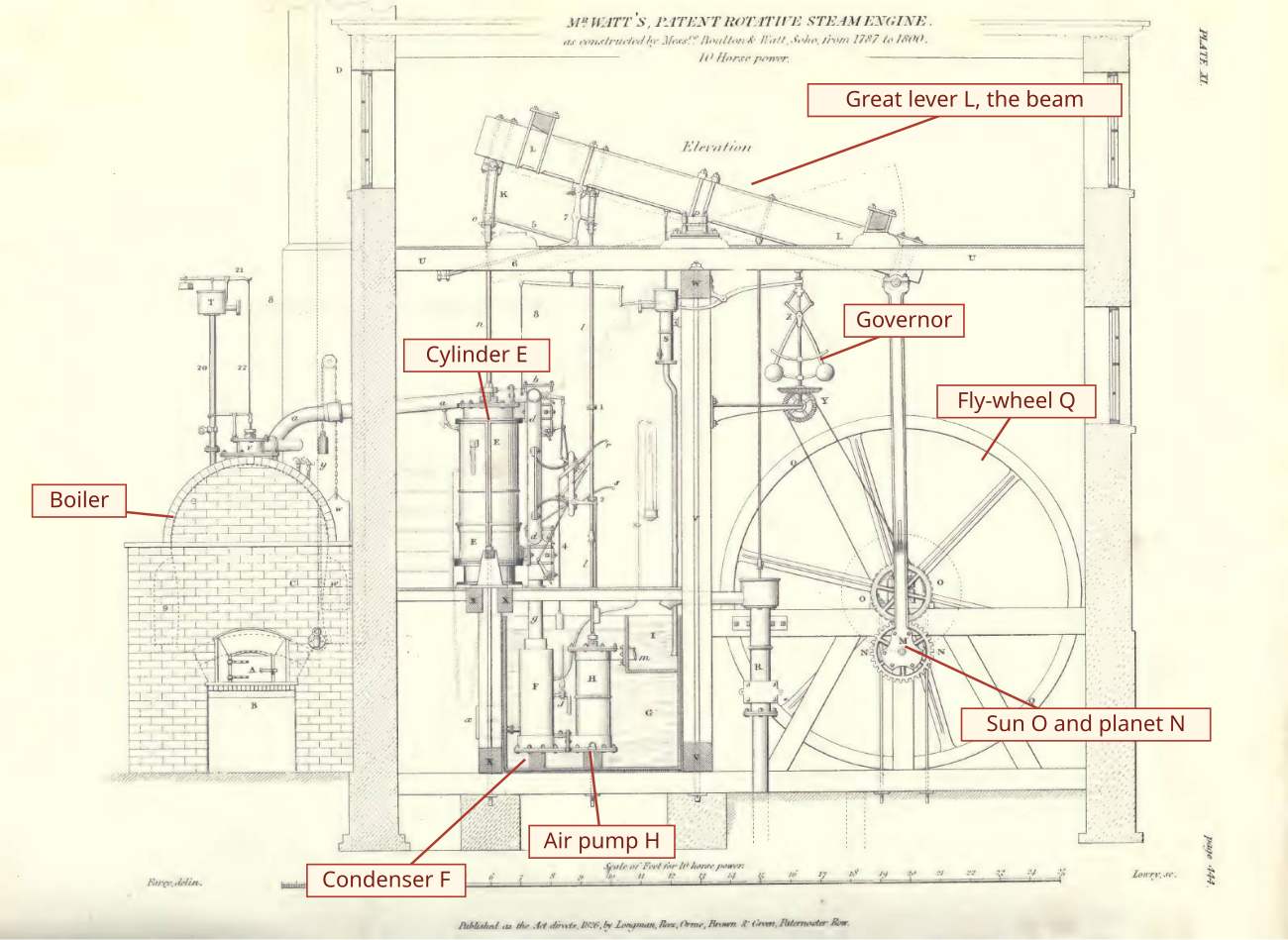
- Plate XI, labels added: A Treatise on the Steam Engine, Farey p. 444 (the plate faces it), Library page.
- Fig. 10: Bourne, Handbook of the Steam-Engine, p. 342, Library page.
- The Corliss engine at the Centennial Exhibition: Centennial Photographic Co., 1876, public domain, cropped to the left half of the stereograph.
- Cornish beam engine, Prestongrange: Chris Allen, CC BY-SA 2.0.
- One engine, four horsepowers: drawn for this page from Farey pp. 486-487, 575-576 and the game's planned figures.
- Duty: drawn for this page from Lean pp. 6-12 and his yearly reports, and Hunt p. 624.
- Steam for a kilowatt-hour: drawn for this page from Farey p. 577, Denton p. 2 and the game's planned figures.
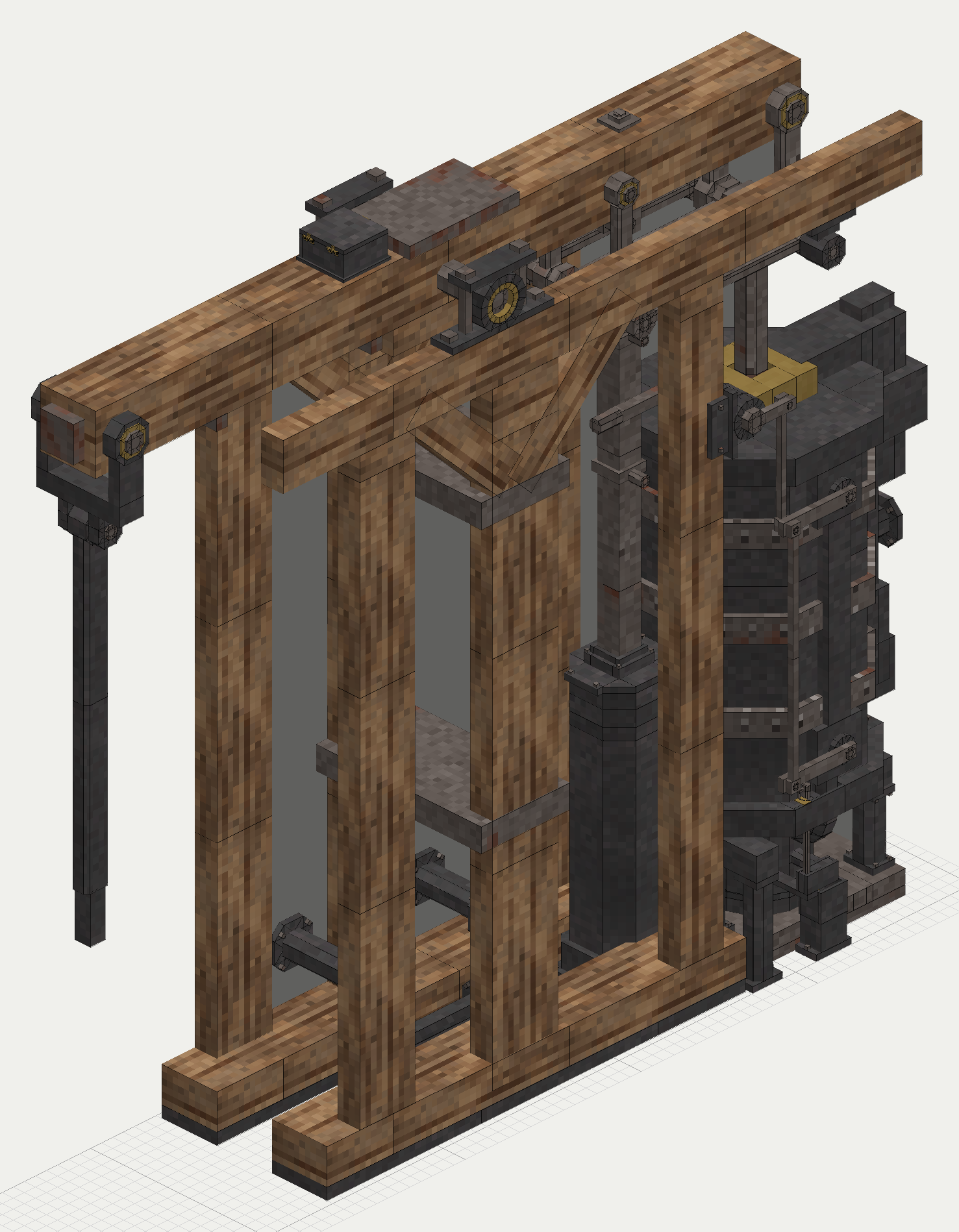
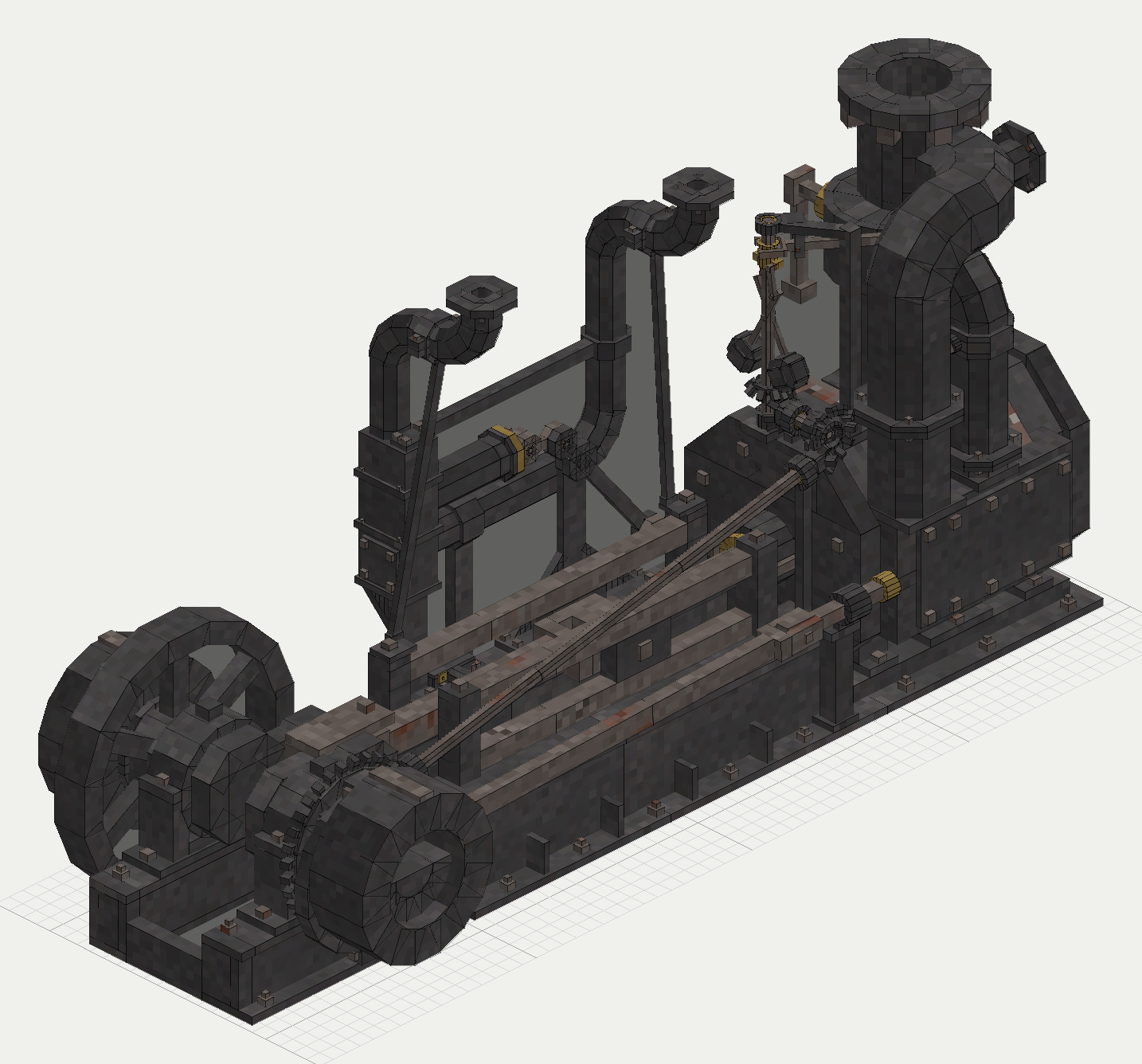
- The game's Watt and horizontal engines: the mod's planned drawings.
Comment or suggest something in the Expanded thread on the Vintage Story Discord