
Cast anvil
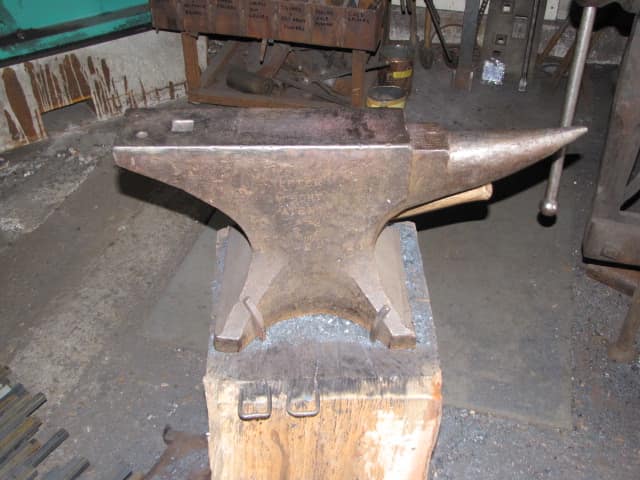
"Anvil" named two very different things in an ironworks. A smith's anvil is a tool, shaped by a smith and worked at by hand. The anvil under a forge hammer is a lump of cast iron whose job is to be heavy and stay put. The game's cast anvil takes something from each. Its parts are in the catalogue. This page is about the real things and how the game's follows them.
The block under the hammer
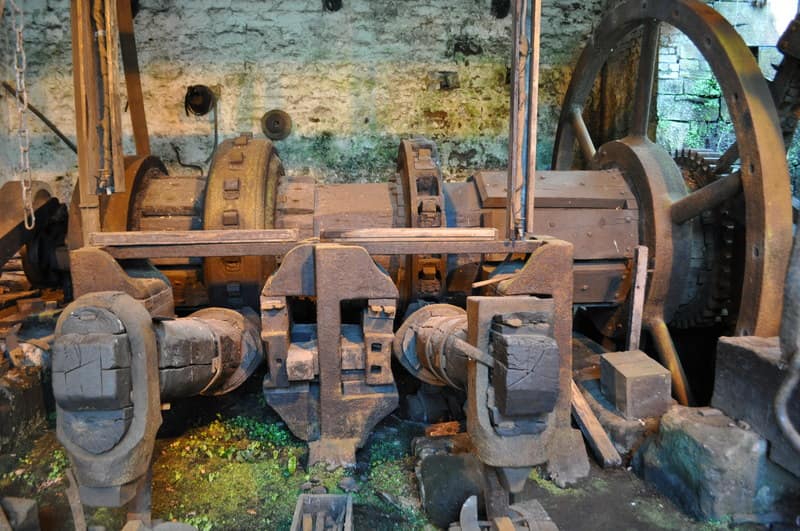
A water-driven forge hammer of 7 cwt fell from 2 ft about 100 times a minute (Percy p. 595). A horn and a pritchel hole have no part in that work. The books describe a mass of iron under the blow and a face that can be replaced.
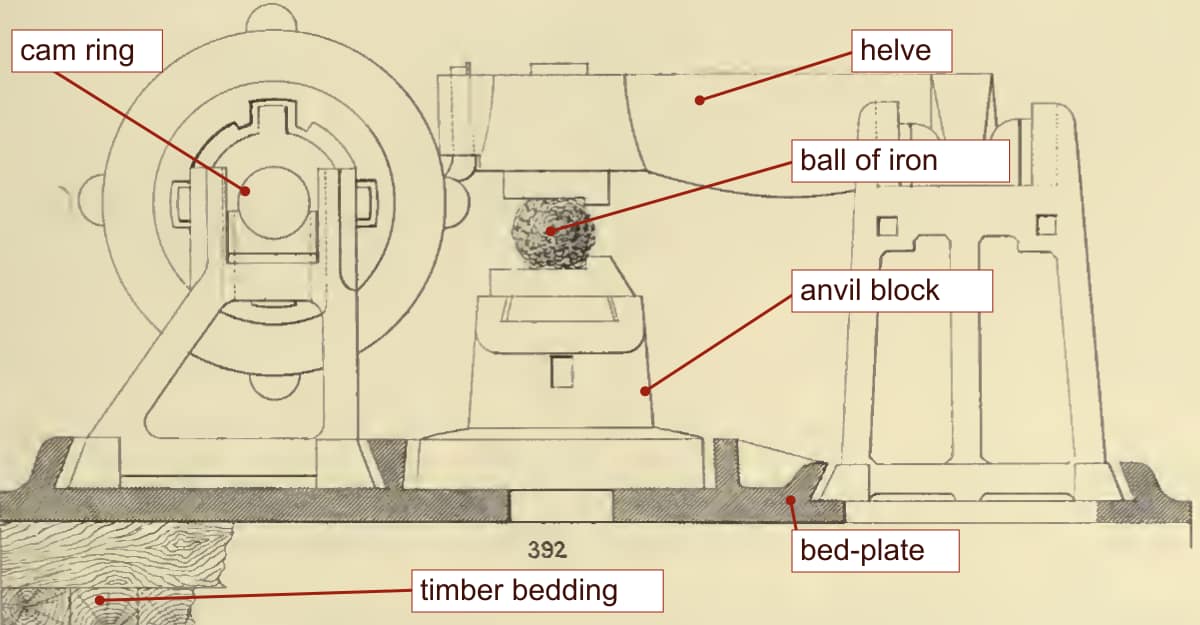
The block was commonly a casting. Percy calls the anvil of a water-driven Lancashire hammer "a solid block of white cast-iron" (Percy pp. 594-595), and Overman's helve anvil is "a cast iron block, about the weight of the hammer" (Overman p. 336). In charcoal forges making horseshoe iron, tire and heavy bar, cast iron hammers and anvils, "if made of good cast metal, are sufficiently hard and smooth" (Overman p. 383). For the final straightening of rails, a "very heavy cast iron anvil" stood between the platforms, and men swung sledges of twenty to thirty pounds on it (Overman p. 365).
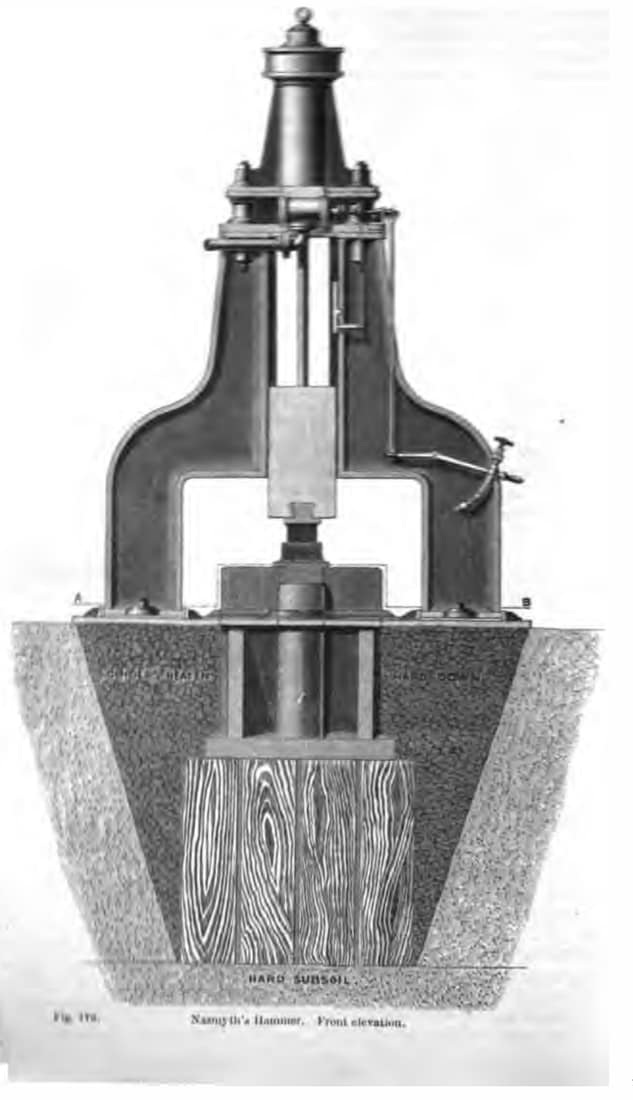
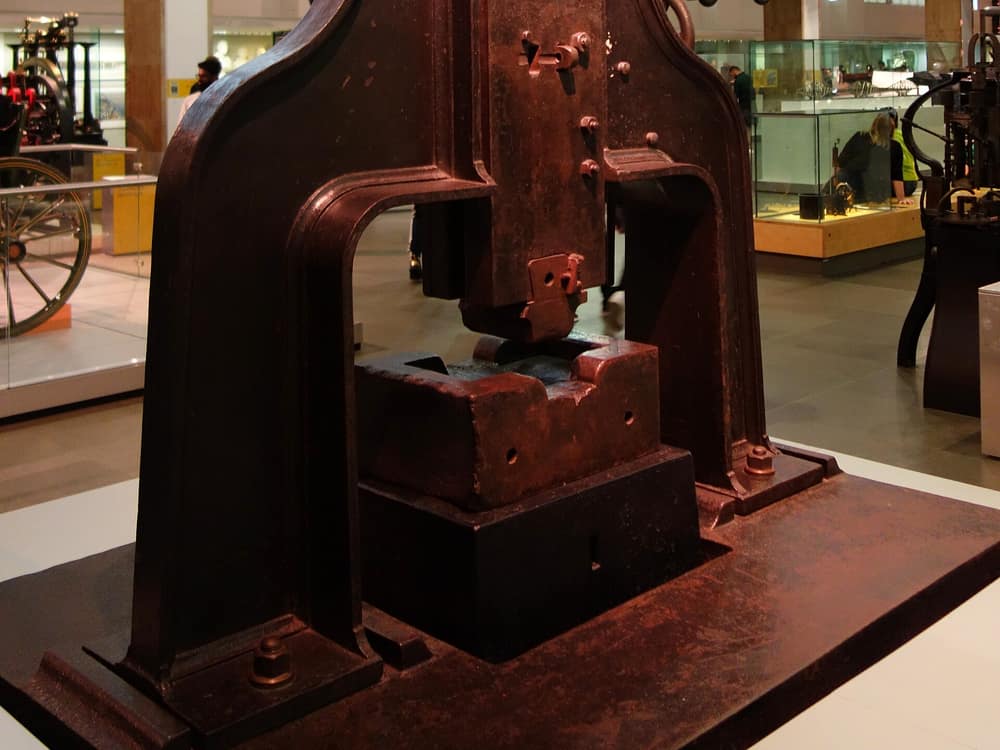
The block was not meant to sit rigidly on something hard. Percy's Lancashire anvil stands on a bundle of four timbers with the fibre upright, bound in hoops, over a bed of horizontal timbers "forming an elastic bed and acting as a spring, without which the iron would break on being hammered out into bars" (Percy p. 595). Overman's stands on a log six to eight feet long and frequently four feet through, on timber over piles, "because rock, or the most solid ground, forms at best but an insufficient base" (Overman p. 336).
Nasmyth's account starts from a limit of the older machines. A tilted hammer gained little height, so a large piece on the anvil left it "gagged": the clear space for the fall was taken up by the work (Nasmyth pp. 239-240). His answer lifted a ponderous block straight up and let it fall (Nasmyth p. 240). He showed it to the Lords of the Admiralty with white-hot iron on the anvil block and an eggshell in a wine-glass under the same hammer (Nasmyth p. 270).
Why the face comes off
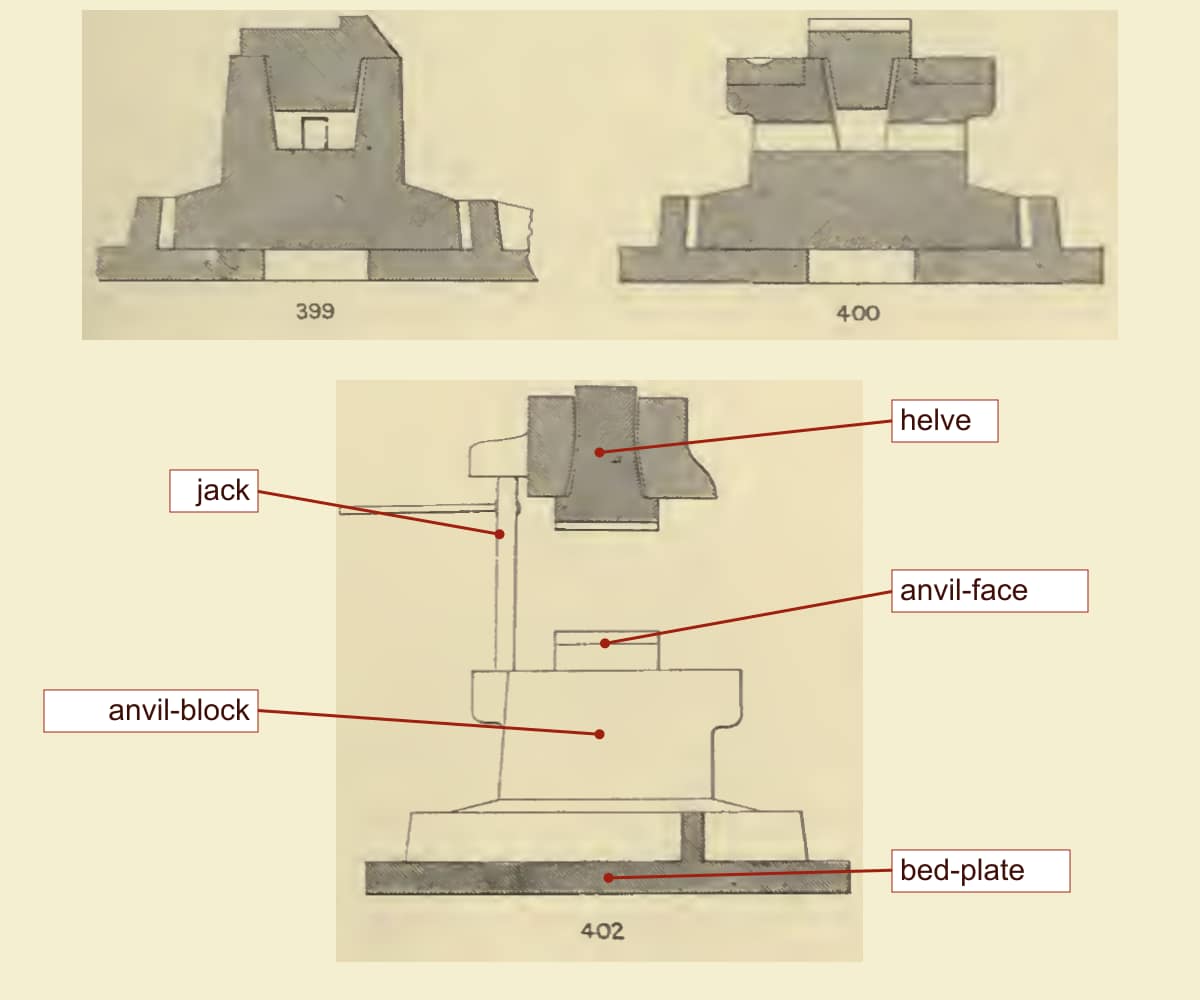
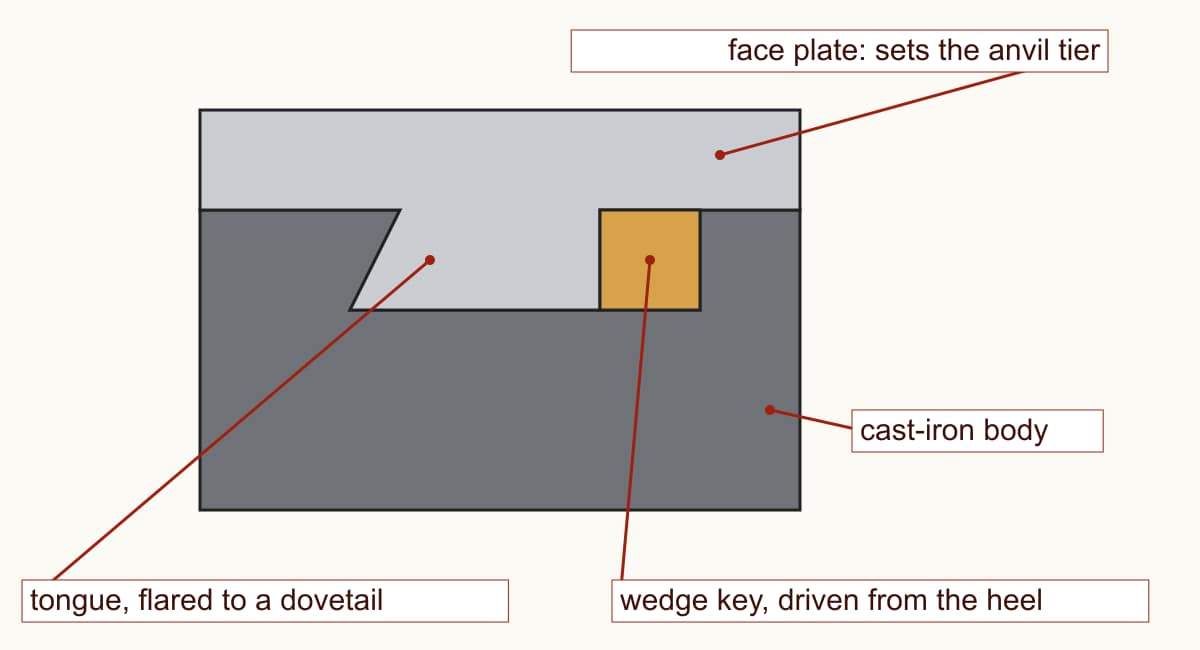
The face wore out long before the block. "An ordinary hammer face in constant work will only last from three to seven days ... and the anvil face, under similar conditions, will last about the same time" (Percy p. 695). So the block stayed and the face was changed. At the Mersey works the hammer face was wrought iron "attached to the helve by a dovetail-groove and wedge; the anvil is faced in a similar manner" (Percy p. 694). Overman has a movable plate three inches thick on the anvil of a lever machine, which "if injured, can be exchanged for another" (Overman p. 342), and for fine iron he has steel set "into a groove made in the hammer face, and in the anvil" and held with wedges, because welding steel to a large piece of iron risks spoiling the steel (Overman pp. 383-384). A steam hammer's flat face piece could be swapped for a swage face to forge round bars (Percy p. 698).
Those fastenings are the origin of the game's wedge key. It is the power hammer's arrangement put on a hand anvil, and that is the game's own step.
The hand anvil in cast iron
Overman asks for steel faces once the work is fine iron or steel (Overman pp. 383-384), and the smith's anvil at the top of this page is steel faced. Cast-bodied anvils with a steel face did exist. The evidence does not come from the books in this site's library: the 1842 Britannica (no page to hand) says "For some purposes anvils are made of cast iron", and a mark of "Patent Oct 16th 1847" is known on anvils of Fisher & Norris of Trenton, a secondary source; patents give the method from 1875 (Donovan, US 160,816; Fisher, US 189,892, 1877; Vare, US 419,088, 1890). In those the steel was fused to the body in the mould and could not be renewed.
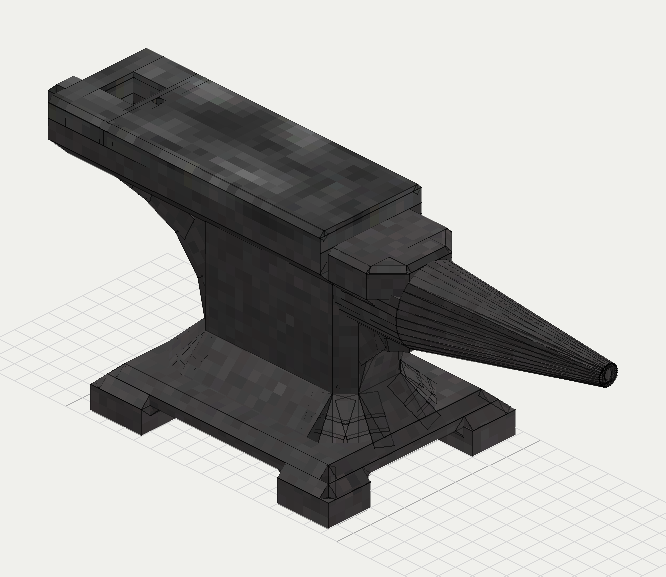
In the base game an anvil is two large parts forged by hand, a base and a top, welded together with borax at 800 C: ten ingots and a flux that can be hard to find. The cast anvil moves the bulk to the casting plant. The body is poured, the small face and key are forged, and the face alone sets what the anvil can work. A bare body works nothing, for the same reason a plain cast face would not last.
Planned, not built yet: the casting comes from the sand rough, is chipped and filed flat at the bench, or planed by a machine, and has its small round hole drilled. Also planned, the horn becomes the place to bend hot strap and plate into hoops, bands and a ladle's bowl, its real use on a smith's anvil.
Period basis, and what is the game's own
- Period: cast-iron blocks under power hammers, faced with a separate piece held by dovetail and wedge (Percy pp. 594-595, 694; Overman pp. 336, 383-384; Truran p. 218 and Plate 63).
- Period: a cast-iron hand anvil with a steel face, known from the 1840s and from patents of the 1870s and later (see above; those sources are not in this site's library).
- Period: a working face "wedged into a dovetailed slot" on Condie's hammer (Scientific American, 4 June 1853, p. 299).
- The game's own: the removable face on a hand anvil. Every period cast anvil found had its face fused on and could not be renewed.
- The game's own: the face's metal sets the anvil's tier. Wrought or meteoric iron gives tier 3 and steel tier 4, using the base game's tiers.
- The game's own: the horn stays bare cast iron, and the hardy hole is left out, since it has no use in the game.
- The game's own: the anvil under the belly helve is its own casting and no part of this block. See the belly helve.
- Base game: the anvil is forged in two parts and welded. See vanilla against reality.
The numbers
"Planned" is in design; values without that word are what the game has now. The base game's own scale of ingots and voxels applies (scale and units); the anvil's costs are the game's own, set against the base game's anvil rather than scaled from a period figure (the scaling page).
| In the game | Period figure | How it was scaled | Game value |
|---|---|---|---|
| Metal in the hand-forged parts | None: no book at hand gives an anvil's forging cost | The game's own, against the base game's anvil | Face 3 ingots (126 voxels), key 1 ingot (17 voxels); the base game's anvil 10 ingots (196 + 210 voxels) |
| Body | Hand anvil: none in the books at hand. Hammer anvils 5 to 6 tons (Truran p. 218) | The drawn casting; the game's own | 1856 units of cast iron a piece, at 2.5 units a cubic voxel |
| Face tier | None | The game's own, on the base game's tiers | Bare none, wrought or meteoric iron 3, steel 4 |
| Driving the key | None | The game's own | 3 blows, about 1.5 s |
| Horn bending | A man's work at 480,000 ft lb a day (Rankine, A Manual of Applied Mechanics, p. 626), 22.6 W | Bending energy over that power, one swing a blow, then 1/16, the game's own factor, set against the base game's 12-hit weld | Planned 5 blows a hoop, 7 a band, 7 the cupola hat's cone, 10 a ladle bowl, 2 the receivers |
Open, and what you can tell us
The books in this site's library describe the hammer's anvil closely and the cast hand anvil hardly at all. They do not say how an anvil block was cast (pit or open sand, face up or down), how the dovetail was formed or finished, or give a section of a period hand anvil's face. If you know a founder's account of casting anvil blocks, or an early source for cast hand anvils, we would like to read it.
Picture credits
- London pattern anvil: Southshoresmith, CC BY-SA 3.0.
- Fig. 392: Truran, The Iron Manufacture of Great Britain, Plate 62, Library page, cropped, labels added.
- Figs. 399, 400 and 402: Truran, Plate 63, Library page, cropped and arranged, labels added.
- Fig. 176: Percy, Metallurgy: Iron and Steel, p. 696, Library page, cropped.
- Nasmyth Steam Hammer, c. 1850, Science Museum, London: Daderot, CC0, cropped.
- Abbeydale Industrial Hamlet, Tilt Hammers: Ashley Dace, CC BY-SA 2.0.
- The face in section: drawn for this page from the game's drawing.
- The game's anvil: the mod's drawing.
Comment or suggest something in the Expanded thread on the Vintage Story Discord