
Pig iron
Pig iron is what a blast furnace makes, run out into bars a man can lift and broken for the next furnace. The grades and weights below are the trade's, and the game keeps some of them and drops others. How it is made in the game is in the iron grades guide and the sand bed's page. The furnace it comes from is in running a blast furnace.
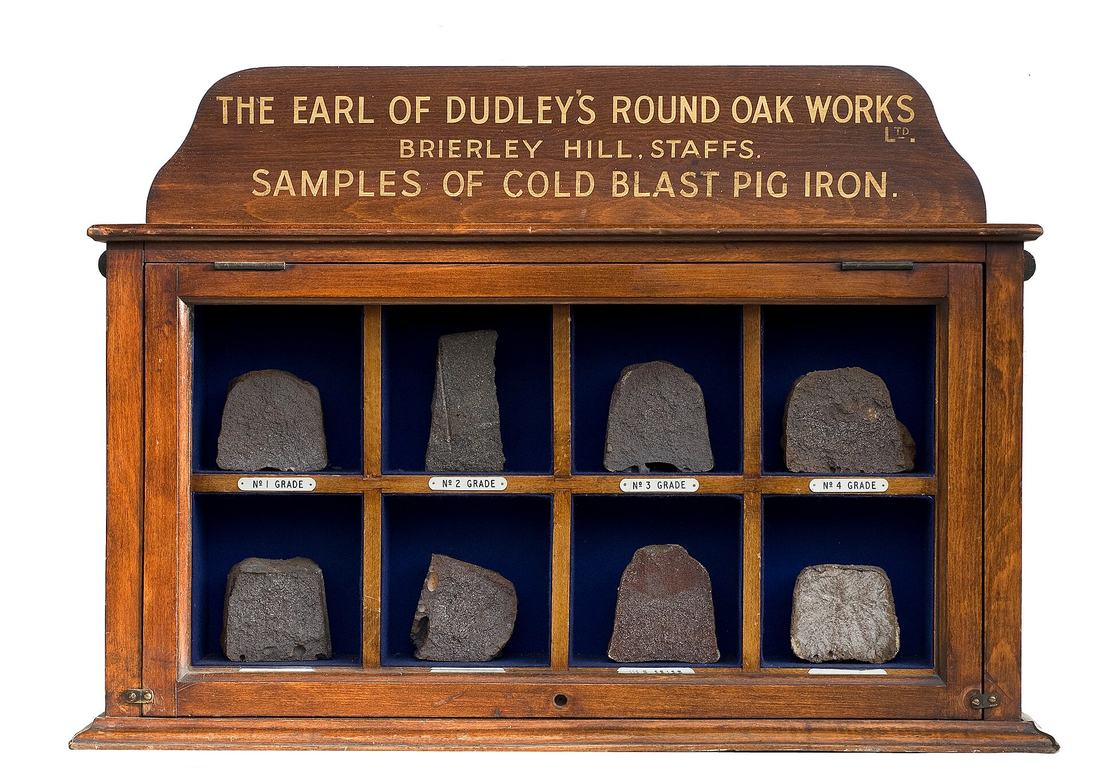
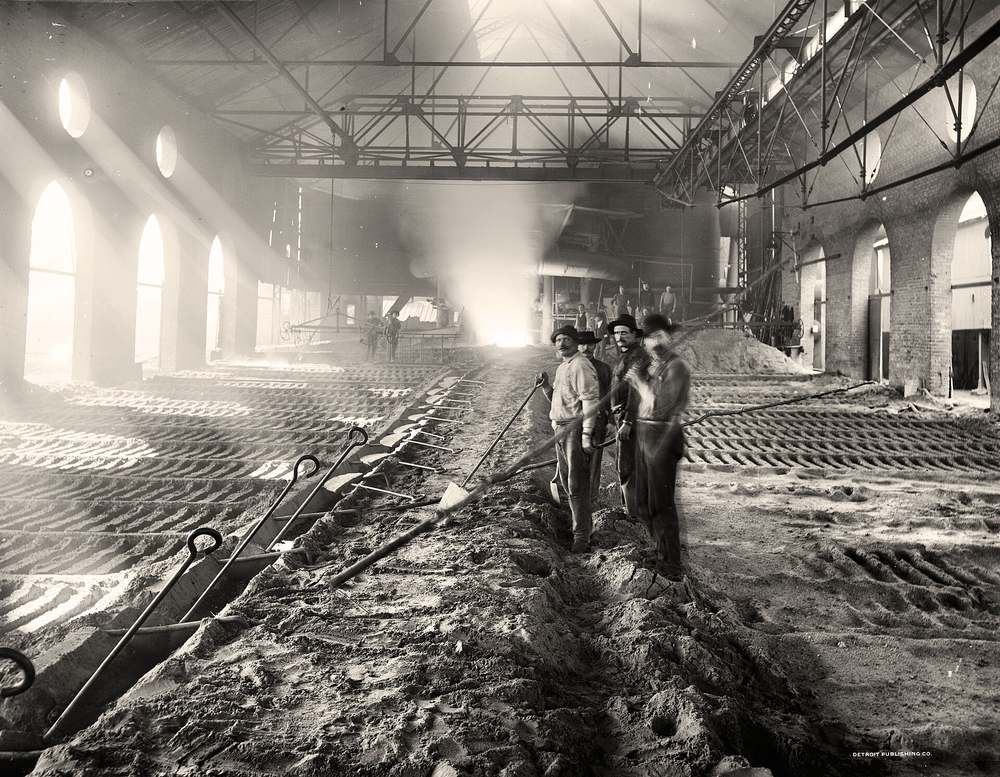
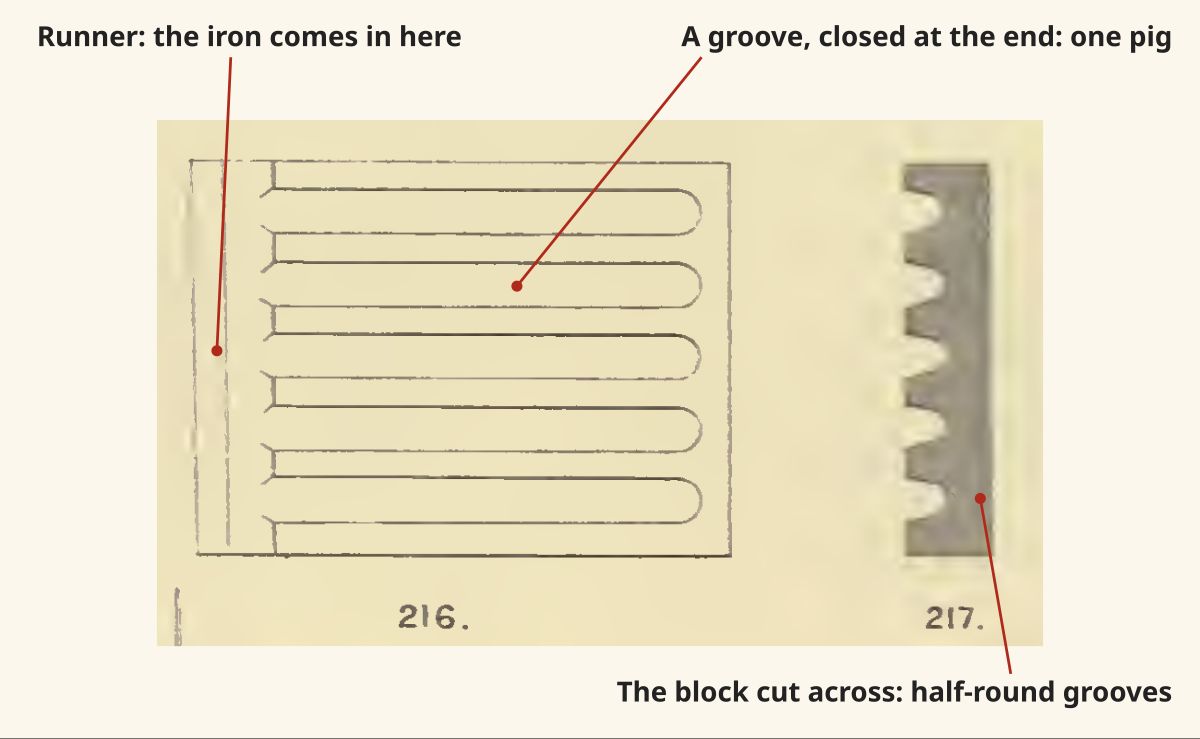
Why iron is run as pigs
A furnace does not make one casting at a time. It collects metal in the hearth and lets it out in a rush: about 5 tons at each cast by the fourth week of a new furnace (Truran p. 41), every twelve hours in South Staffordshire and every four at Ebbw Vale (Percy p. 494). Five tons of liquid iron has to go somewhere at once, and nobody yet has a use for it in that form.
The answer was a floor of sand. The keeper or his helper moulded the bed (Overman p. 201), and the iron ran down a general runner into moulds about 4 feet long that branched off it (Encyclopaedia of Chemistry p. 257). At Cwm Celyn the bed had 6 rows of 28 furrows (Percy p. 493). After the cast the pigs were carried off and weighed, and the sand was dug up, wetted and made ready for the next one (Overman p. 206).
The names came from the look of it. The channels were the sows: "The names of pig and sow are fancifully suggested by a sow feeding her litter" (Percy p. 493). Johnson uses the same picture for an American bed in 1917 (Johnson Construction p. 328).
The books do not say why a pig is the size it is. They do show what was wanted of one. The puddler took his iron in pieces, "30 to 40 lbs. is best, and the more uniform the better" (Truran p. 208), and a foundry counted its iron by the piece, "four pieces to the hundred weight" (Kirk p. 243). What they do show is a pig that a man could handle, could be broken into pieces easier still to handle, and could be counted.
How a pig was broken
Hot pig iron is weak. The pigs were broken off the sow while red hot, with the point of a long bar forced between two of them and used as a lever: "At a red heat the iron is comparatively weak and easily broken" (Encyclopaedia of Chemistry p. 257). In America a crowbar went under the junction, and later the men walked the cold bed with sledges and crowbars, breaking the iron from the sow and each pig in two (Johnson Construction p. 331). Cold, a pig could be dropped across an A-shaped anvil (Encyclopaedia of Chemistry p. 257).
Breaking it was also how it was judged.
The grades
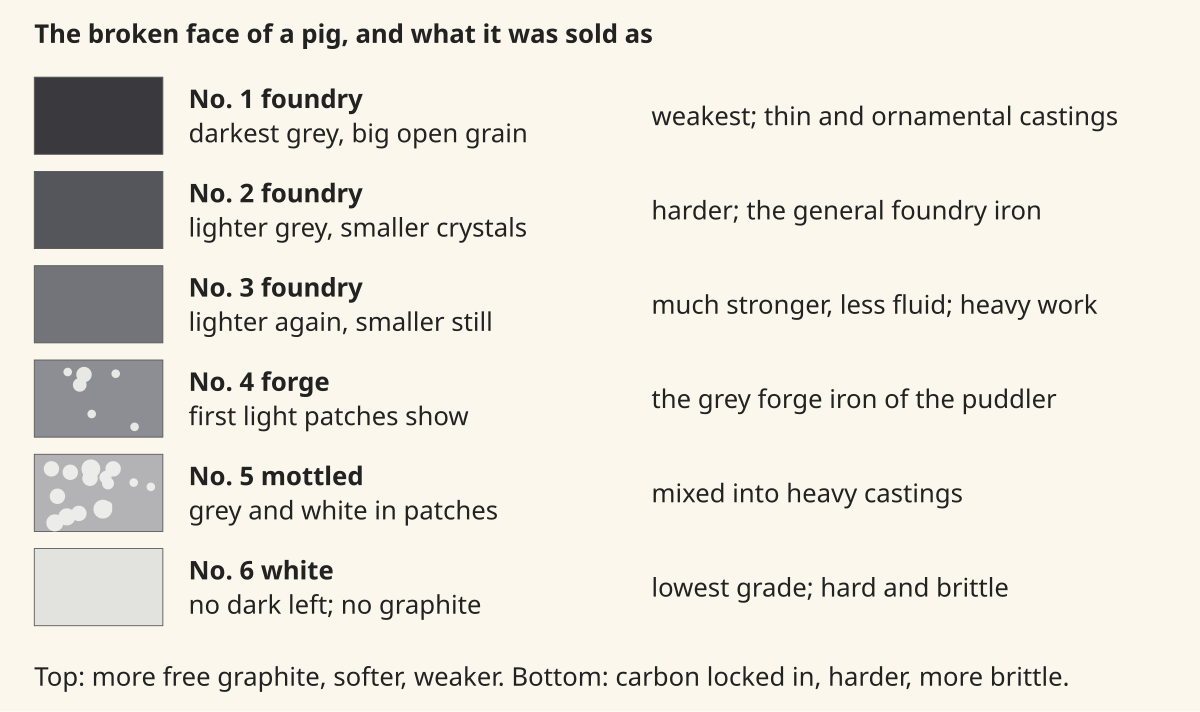
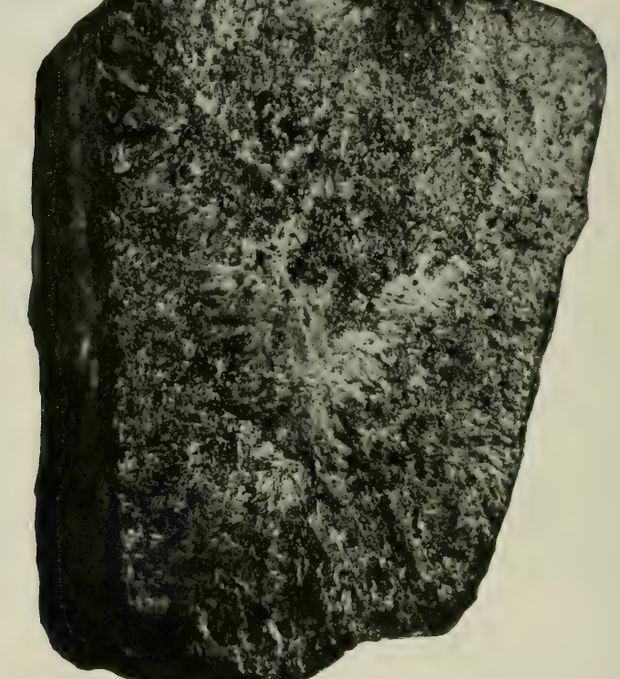
The grade was a reading of where the carbon had gone. Iron that sets slowly lets its carbon out as graphite and comes out grey; iron cooled very fast can lock the carbon up and stay white, and then it is "much harder, and more brittle" (Encyclopaedia of Chemistry p. 241). Rapid chilling can turn some grey irons white or mottled, and long holding at a yellow heat can turn white iron grey (Bolland p. 69).
No. 1 is the darkest, with the most graphite, and is fit for light ornamental work and thin castings; No. 2 is the most useful for general work; No. 3 is less fluid when melted but much stronger, for heavy structural work (Bolland p. 68). The higher numbers, up to white iron, are the forge irons, serviceable for puddling (Bolland p. 68). Johnson names No. 4 "gray forge", No. 5 "mottled" and No. 6 "white" (Johnson Principles p. 444), and gives gray forge as the established puddling grade of the old days (Johnson Principles p. 440).
Which grade came out depended on the furnace's work. Overman wants a hearth of its own shape for gray iron (Overman p. 167). Dowlais blew one furnace on foundry iron for up to 130 tons a week and a like furnace on forge iron for 170 (Truran pp. 83-84), so the forge-iron furnace made more metal.
Until about twenty years before Johnson wrote, foundry iron was graded and chosen "entirely on the fracture and appearance of the pigs" (Johnson Principles pp. 256-257). The trade then turned to silicon and sulphur analysis (Johnson Principles p. 444), so the numbers in a late price list are no longer quite the same thing as the numbers of the 1850s.
How heavy a pig was
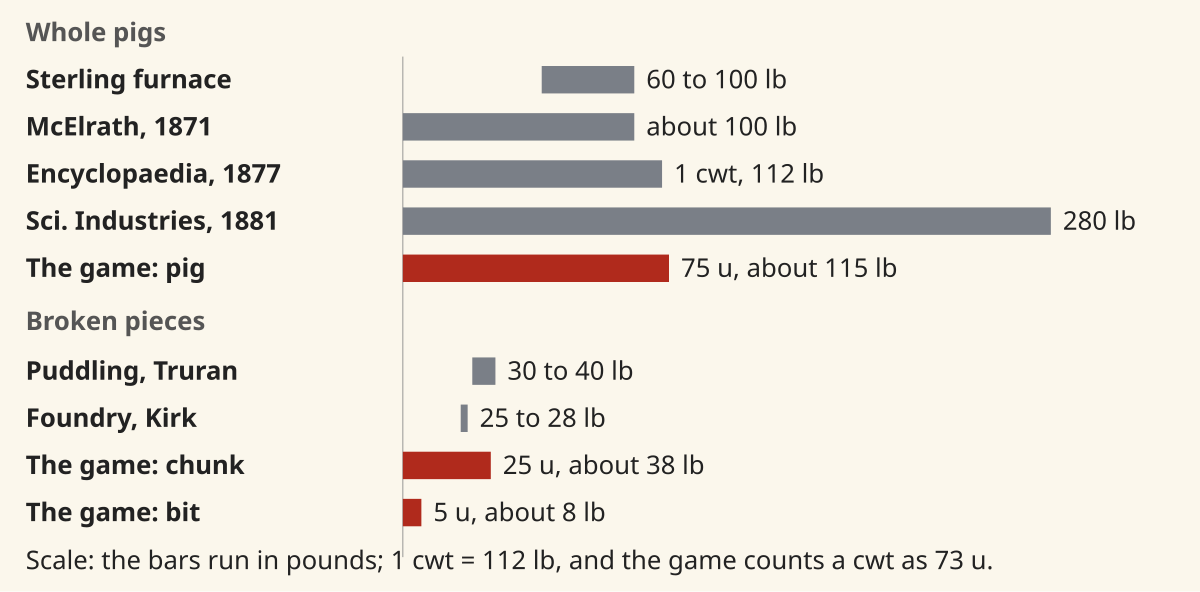
The game's pig is 75 u. A cwt is 73 u on the game's scale, so a pig is a little over a hundredweight, the most often cited figure among the books. It was set at 75 rather than 73 because 75 divides: 3 chunks of 25 u, or 15 bits of 5 u, each piece whole. A chunk sits close to Truran's puddling piece.
The bit has no period counterpart. A bed pour never lands on a whole number of pigs, so the bit is there to keep the remainder from being lost or invented.
Period basis, and what is the game's own
- Period: iron run from the furnace into a sand bed, main runner, sows and furrows, and the pigs broken off the sow (Percy p. 493, Encyclopaedia of Chemistry p. 257). The game casts into a sand bed fed by a canal. The planned bed has the period's sows and furrows, with the sow iron broken from the pigs.
- Period: cast-iron moulds at Dowlais and Ebbw Vale instead of sand (Percy p. 494, Truran Pl. 36). The game has sand only.
- Period: pigs weighed about a hundredweight, with a range of 60 lb to 2.5 cwt (McElrath p. 389, Encyclopaedia of Chemistry p. 257, Scientific Industries p. 94, Swank p. 140). The game's pig is one weight.
- Period: pig iron was broken cold by sledge or by dropping it (Johnson Construction p. 331, Encyclopaedia of Chemistry p. 257). In the game a helve hammer breaks a cold pig into smaller pieces of itself.
- Period: six grades, sold by the fracture (Johnson Principles p. 444). The game's own: there is one pig iron. The furnace makes it, and the puddling furnace and the cupola both take it. No grade is read from a broken face, and a foundry and a forge do not want different numbers. See the metal ladder for what the game's grades are instead.
- The game's own: the slag bricks come from the same mould as the pigs, which no book shows on a pig bed.
- The game's own: the pig is brittle and unforgeable and can be worked at any temperature, because the break is the only smithing done to it. A real pig broke far more easily red hot (Encyclopaedia of Chemistry p. 257).
- The game's own: the bit, and the exact 1 to 3 to 15 division of a pig.
The numbers
The conversion is at 73 u to the cwt, on the game's rule for metal (scale and units, how we scale). "Planned" is in design and not built.
| In the game | Period figure | How it was scaled | Game value |
|---|---|---|---|
| Pig | About 1 cwt or a little more (Encyclopaedia of Chemistry p. 257); about 100 lb (McElrath p. 389); 2.5 cwt (Scientific Industries p. 94) | The most cited figure, 73 u, raised to a number that divides | 75 u |
| Chunk | 30 to 40 lb for the puddler (Truran p. 208); four to the cwt for the foundry (Kirk p. 243) | One third of the pig, the puddler's piece | 25 u |
| Bit | None | The game's own, one fifteenth of a pig | 5 u |
| Pigs a bed | Cwm Celyn, 6 rows of 28 furrows, 168 pigs (Percy p. 493) | Planned on the period form, fewer furrows | 20 castings today; planned 5 sows of 18 furrows, 90 pigs |
| A cast | About 5 tons (Truran p. 41) | At 73 u the cwt | Planned 7,500 u a tap from one shaft, about 5 tons |
| Puddling charge | 4 1/4 to 4 1/2 cwt a heat (Truran p. 208) | Today's charge is the game's own | 9 pigs, 675 u; planned to be checked against the period's, about 4 pigs |
Open, and what you can tell us
No book of 1841 to 1869 held here states the weight or section of a British blast-furnace pig. The figures are later, and they differ by more than two to one. Nor do the books say how many men carried one, or whether a Welsh ironmaster and a Staffordshire one meant the same thing by No. 3. If you know an earlier weight, a surviving pig from a dated furnace, or a price list that fixes the grades in a district, we would like to read it.
Picture credits
- Samples of cold blast pig iron, Round Oak Works: Stourley Kracklite, CC BY-SA 3.0.
- Casting pig iron, Iroquois smelter, Chicago: Detroit Publishing Co., public domain.
- Figs. 216 and 217, labelled for this site: Truran, The Iron Manufacture of Great Britain, Plate 36, Library page.
- Fig. 141: Johnson, Principles, Operation and Products of the Blast Furnace, p. 462, Library page.
- The grades and the weights: drawn for this page from the books named in their captions.
Comment or suggest something in the Expanded thread on the Vintage Story Discord