
Pipe bore and flow
How much a pipe carries depends on how wide it is, how long it is, and how much pressure can be spared to push through it. The working guide is pipe networks, and the pipes themselves are on pipes and the steam main. This page is about how the period sized a pipe and where the game's numbers come from.
Sizing by speed
The rules in the books set a speed and make the pipe wide enough that the steam or air need go no faster.
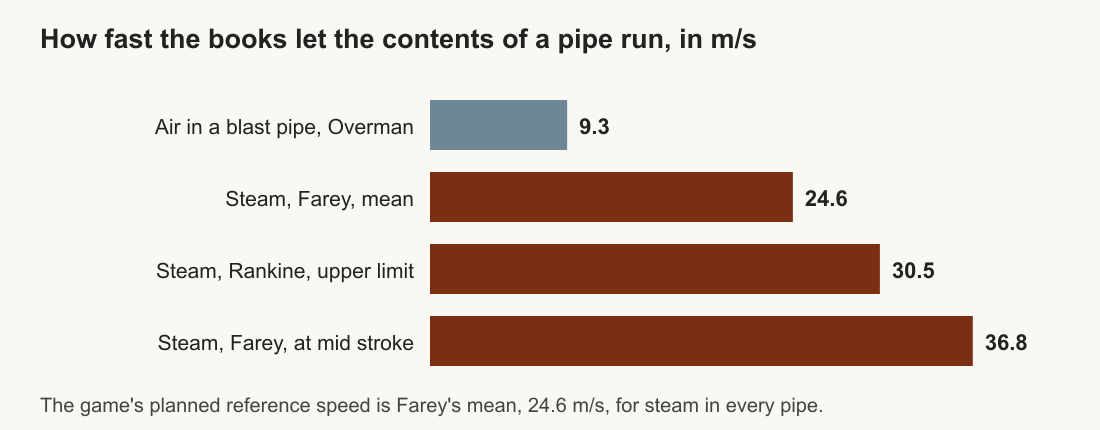
Farey's rule of 1827 gives a steam pipe 1 1/4 circular inches of area for each horse-power (Farey p. 589), which is a bore of 5 in for 20 horse-power and 7.9 in for 50 (Farey p. 590). He worked out what that means: the steam goes through at 80.6 feet a second on average and 120.6 at mid stroke, when the piston is moving fastest (Farey p. 590). Rankine, writing later, sets the limit at about 100 feet a second (Rankine pp. 413-414), and says a pipe of a tenth of the piston's area, for a piston at up to 600 feet a minute, loses nothing appreciable (Rankine p. 413).
Bourne gives the engineer's other way of saying it: 0.66 of a square inch of steam pipe per nominal horse-power, and a main serving two engines "nearly, but not quite," double a branch (Bourne pp. 216, 218). He also says why a pipe should not simply be made huge: "an increased external surface causes increased loss of heat from radiation" (Bourne p. 218). Steam that cools in the pipe turns to water, and the fire has paid for it.
Blast mains: wide because the pressure is small
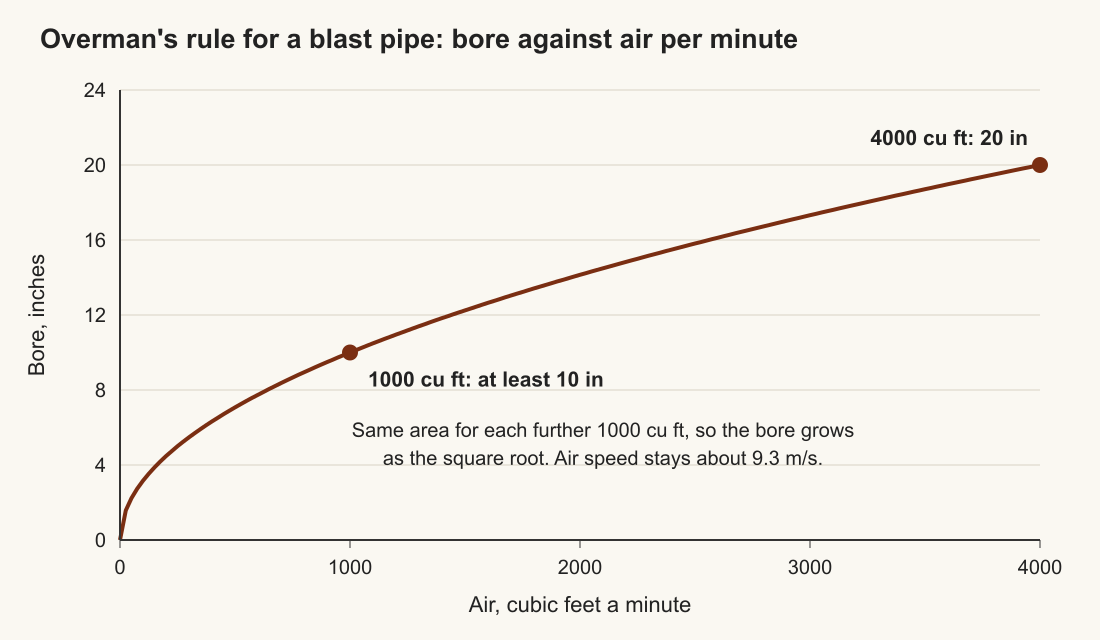
Overman adds that past 100 feet the pipe must grow, and "may be doubled with each additional 100 feet, in consequence of the friction of the air", since "a very appreciable loss of blast results from narrow pipes" (Overman p. 414). Corners were worse: "the loss of power of the blast, when suddenly turning round a corner, is very great" (Overman p. 415). Truran wants the blast main's area at least a seventh of the blowing piston's, better a fifth, so that it acts "as a magazine" and evens out the strokes (Truran p. 187), and his Dowlais table lists mains of 24 to 60 inches (Truran pp. 187, 191).
So the largest pipes in an ironworks carried the lowest pressures, the reverse of what a pressure ladder suggests. A wall of the same thickness also holds less pressure the wider the pipe is, which is plain physics: hoop stress follows pressure times radius. In a steam plant the small pipe is the strong one.
Doubling a pipe's bore for every 100 feet is a generous margin. By friction alone, the loss per metre falls as the fifth power of the bore, so a 15% wider pipe already makes up for a doubled length.
Cast pipe and its joints
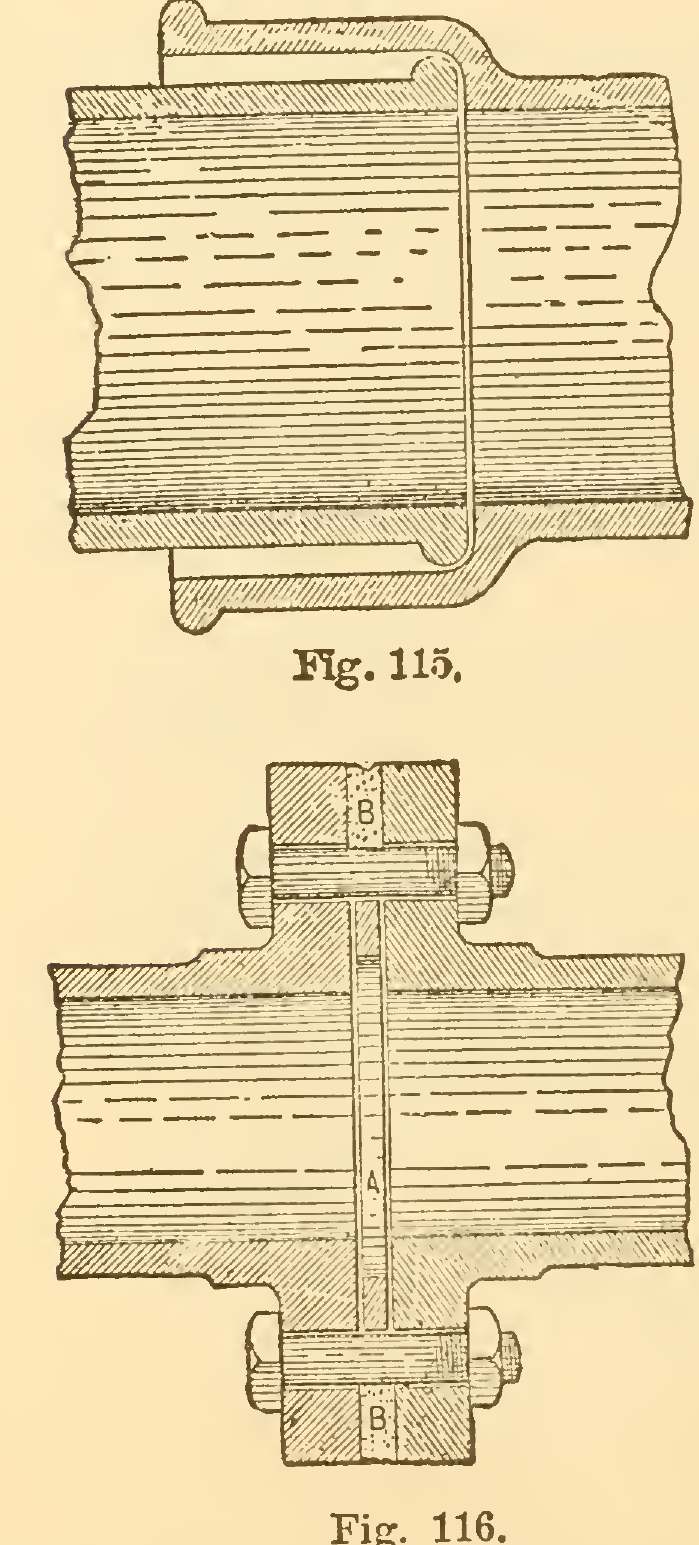
Cast iron was "almost invariably used, except with marine boilers, for pipes to carry the steam to the engine cylinders at the full boiler pressure" (Wilson p. 27). Wilson records vertical cast pipes of 4 or 6 inches worked at 80 or 90 lb (Wilson p. 27). Hawkins, later, says welded wrought-iron pipe "has diminished the use of cast-iron pipes for many purposes" (Hawkins p. 249), and records the trade's dividing line: pipe of 1 1/4 in and smaller was butt-welded, 1 1/2 in and larger lap-welded (Hawkins p. 248). For blast, Overman allows sheet iron 1/8 in thick or cast iron, and prefers muffs to flanges where hot air would work the joints (Overman pp. 413-414).
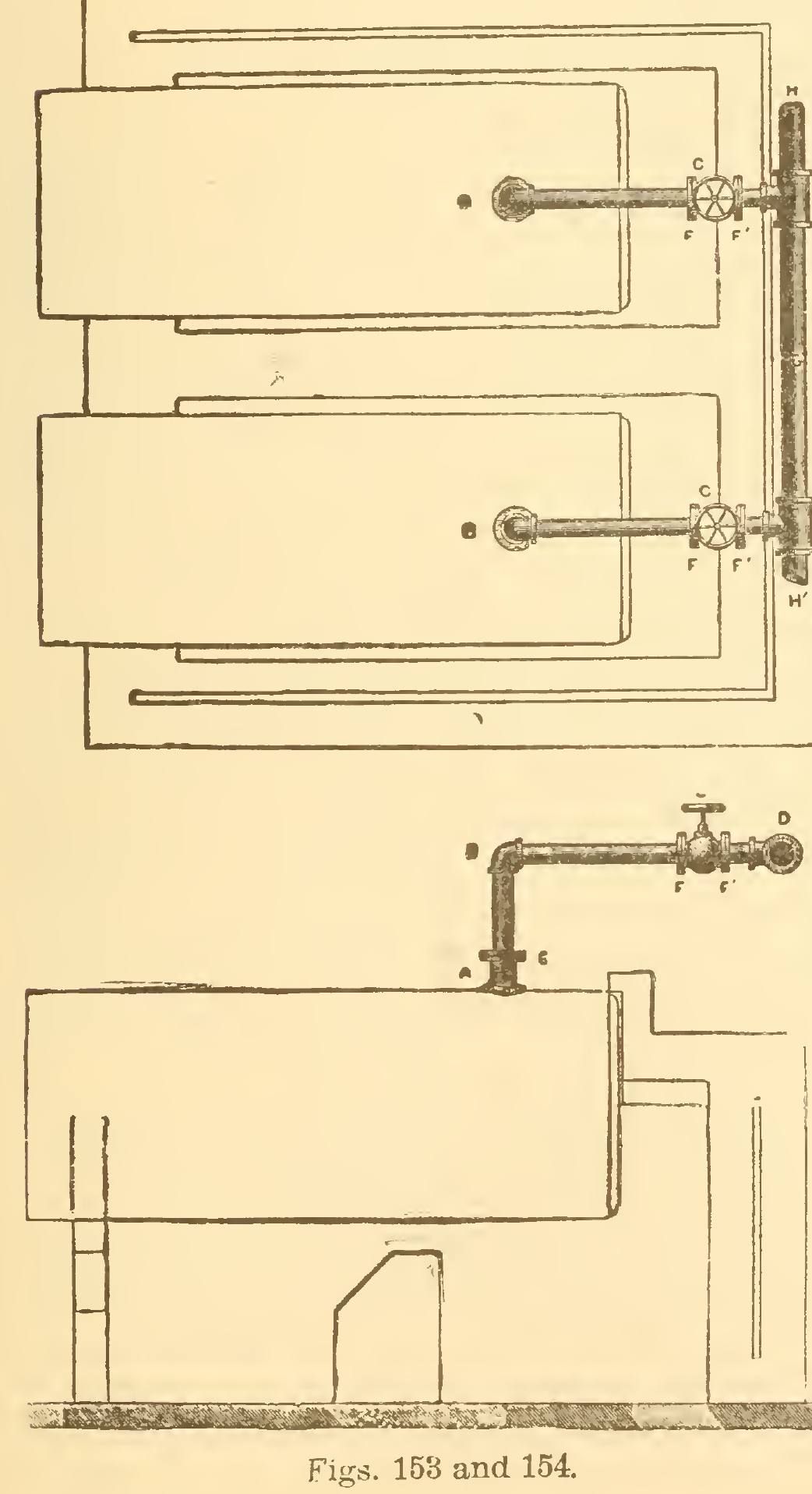
Covering a steam pipe was understood as a matter of degree. Hawkins lists the materials by their relative worth, wool felt at 1.000 and asbestos at 0.363 (Hawkins p. 270), and gives an inch of sawdust and starch paste as equal to "the most costly non-conductors" (Hawkins pp. 269-270).
How the game sizes a pipe
The network that ships today has no bore. A run of pipes is one pool of pressure, and each kind of pipe has a rating: the weakest piece in the run limits what passes through it. The rating is a plain cap with no formula behind it, so length and pressure do not change it.
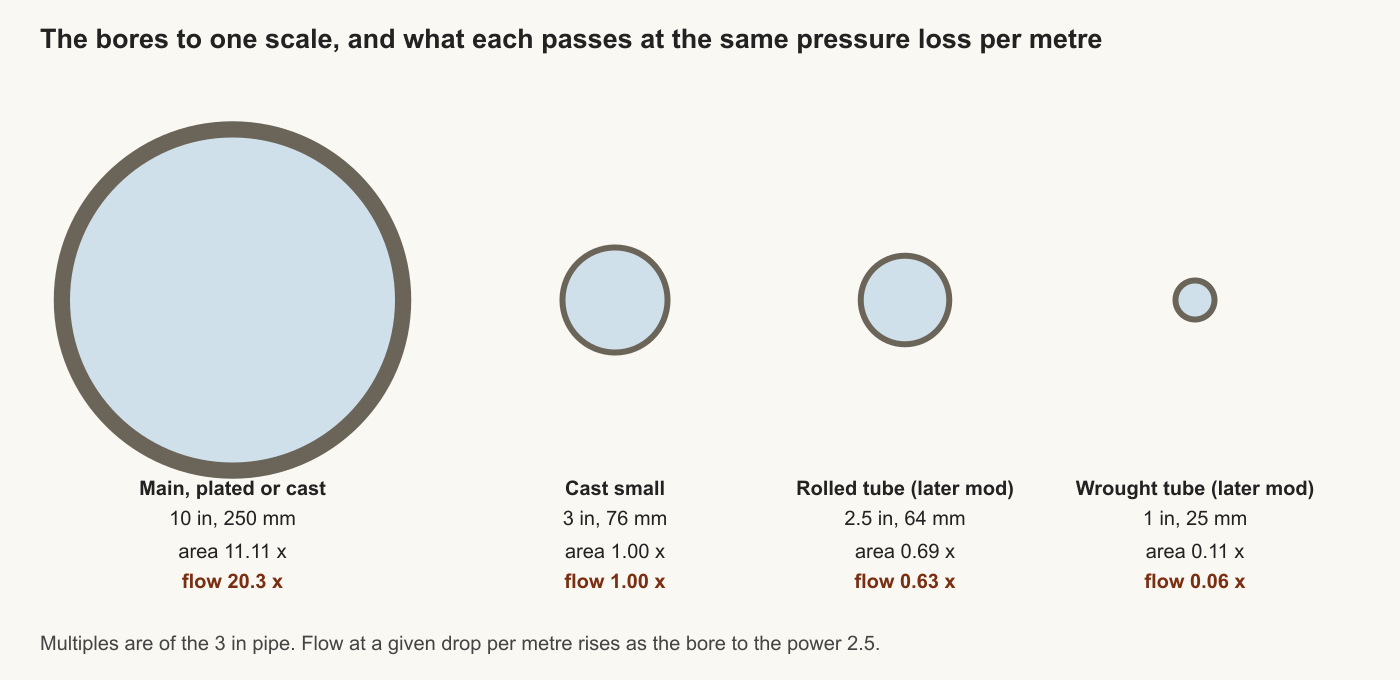
The planned network gives each piece its own pressure, temperature and contents, and flow between pieces follows the difference in pressure and height. Flow is turbulent, rising as the bore to the power 2.5 at a given drop per metre, as in the first picture. The caps go away and each pipe's real volume counts: 49.1 L in a block of main, 4.56 L in a block of 3 in pipe.
Steam is counted by mass in that model, and "at period velocity" is the game's reference for a pipe's carrying power: Farey's 24.6 m/s, or 80.6 feet a second. At that speed the mass passing follows the steam's density, so pressure buys flow. The 3 in pipe carries 0.27 kg/s at 3.6 atm and only 0.074 kg/s at 0.14 atm. That is why low-pressure steam needs wide pipe: at the Watt engine's pressure the 3 in pipe cannot feed it.
A planned Cornish boiler at usual firing makes 0.192 kg/s of steam, which the 3 in pipe carries at 3.6 atm. Farey's rule, written for engines at little above atmospheric pressure, would have asked 6.8 in for that boiler's 440 sq ft of heating surface, and Bourne's about 4.8 in for its 26.9 nominal horse-power. Denser steam is the difference.
The feed side uses the same pipes for far smaller flows. See pumps and blowing machines for what pushes water and air through them.
Period basis, and what is the game's own
- Period: steam pipes were sized for a speed of steam, about 80 to 100 feet a second (Farey p. 590, Rankine pp. 413-414). The planned game uses Farey's speed as its reference for a pipe's capacity.
- Period: blast pipes were sized by air per minute, 10 in for 1000 cubic feet (Overman p. 414). The game's 10 in main takes this first point of the rule.
- Period: cast iron for steam and flanged joints (Wilson p. 27, Hawkins p. 248), screwed or welded wrought tube for small work (Hawkins pp. 248-249). The game keeps the same split: cast mains and cast small pipe, with rolled and wrought tube later.
- The game's own: mains are one size. The books give blast mains of 24 to 60 inches (Truran pp. 187, 191); the game has one 10 in main.
- The game's own: today's ratings of 50, 120 and 250 L/s are round steps, one per kind of pipe, with no book behind them.
- The game's own: the friction factors planned for flow, 0.03 for cast, 0.025 for plated and 0.02 for rolled and wrought, are chosen for the model. The books at hand give no measured friction for a period main.
- The game's own: a planned pipe's flow pays nothing for a bend, where Overman warns the loss is "very great" (Overman p. 415).
- The game's own: the base game has no pipes that carry pressure at all. See vanilla against reality.
The numbers
Pipes are drawn at true size, one voxel 62.5 mm (scale and units), and they keep period figures rather than a fuel factor (the scaling page). The small pipes are the exception: their 1-voxel bore is a drawn stand-in, and the model uses the real bore. Pressures are gauge. "Planned" is the design; values without that word are what the game has now.
| In the game | Period figure | How it was scaled | Game value |
|---|---|---|---|
| Plated pipe, what passes | None | The game's own round step | 50 L/s; planned a bore of 10 in sets it |
| Cast pipe, what passes | None | The game's own round step | 120 L/s; planned a bore of 10 in sets it |
| Rolled pipe, what passes (later mod) | None | The game's own round step | 250 L/s; planned a bore of 2.5 in sets it |
| Main bore | At least 10 in for 1000 cu ft a minute (Overman p. 414) | True size | Planned 10 in, 250 mm, 49.1 L a block |
| Cast small bore | 4 or 6 in cast pipes at pressure (Wilson p. 27) | Game's choice of size | Planned 3 in, 76 mm, 4.56 L a block |
| Air in a plated main | 9.3 m/s from Overman's rule (Overman p. 414) | His rule at 250 mm | Planned 472 L/s at 9.6 m/s for reference |
| Steam speed for reference | 80.6 ft a second, 24.6 m/s (Farey p. 590); upper limit about 100 ft a second, 30.5 m/s (Rankine pp. 413-414) | His mean at face value | Planned 24.6 m/s |
| Cast main, steam | Follows from speed and density | Bore x 24.6 m/s x density | Planned 2.88 kg/s at 3.6 atm, 0.80 at 0.14 atm |
| Cast small, steam | Follows from speed and density | Bore x 24.6 m/s x density | Planned 0.27 kg/s at 3.6 atm, 0.074 at 0.14 atm |
| Cast main, water | None | The model's reference | Planned 49 L/s |
| Cast small, water | None | The model's reference | Planned 4.6 L/s |
| Cast main, working pressure | 80 to 90 lb, 5.4 to 6.1 atm, 4 or 6 in cast pipes (Wilson p. 27) | Rough to the boiler's working pressure, faced from Wilson | Planned rough 3.6 atm, faced 6.0 atm |
| Cast main, burst | No book gives one | 1.25 x working, the game's own | Planned rough 4.5 atm, faced 7.5 atm; a pipe bursts today at 5.0 atm absolute |
| Plated main, working | Blast at about 1 1/2 to 3 lb (Truran pp. 113, 116) | Set to blast pressures, the game's own | Planned 1.5 atm working, 1.9 burst, to be tuned; a pipe bursts today at 2.5 atm absolute |
| Cast small, working | No book gives one | 1.25 x working for burst, the game's own | Planned 7 atm working, 8.75 burst |
| Heat lost by a bare 3 in pipe at 152 C | Relative figures only (Hawkins p. 270) | The game's own heat model | Planned about 1.1 kg of steam an hour per metre; lagging cuts it to a fifth |
Open, and what you can tell us
The books at hand give rules for sizing a pipe but no measured pressure loss in a period main, and none gives a working or bursting pressure for cast pipe as such; Wilson's 80 to 90 lb is what one kind of boiler was worked at. Overman's doubling with length is much more than friction asks for, and he does not say where it came from. If you know a period test of pressure loss in a cast main, or a maker's rated pressure for flanged cast pipe, we would like to read it.
Picture credits
- Figs. 115 and 116, and Figs. 153 and 154: Hawkins, Maxims and Instructions for the Boiler Room, pp. 248 and 277, Library page.
- Bores to scale: drawn for this page from the game's planned pipe sizes.
- Pipe speeds: drawn for this page from Farey p. 590, Rankine pp. 413-414 and Overman p. 414.
- Overman's rule: drawn for this page from Overman p. 414.
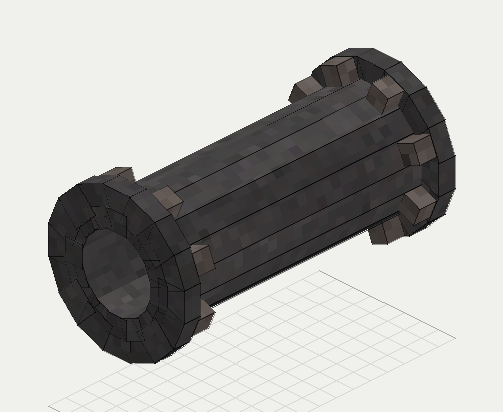
- The game's cast main: the mod's planned drawing.
Comment or suggest something in the Expanded thread on the Vintage Story Discord