
Hand work rates
How long a hole takes by hand, and why a water wheel changes everything, both come down to one number: how much work a person can sustain through a day. The plain version is in why the numbers are what they are, and wheels and shafts are taught in the shaft power guide. This page is about where that number comes from and how the game uses it.
What the books measured
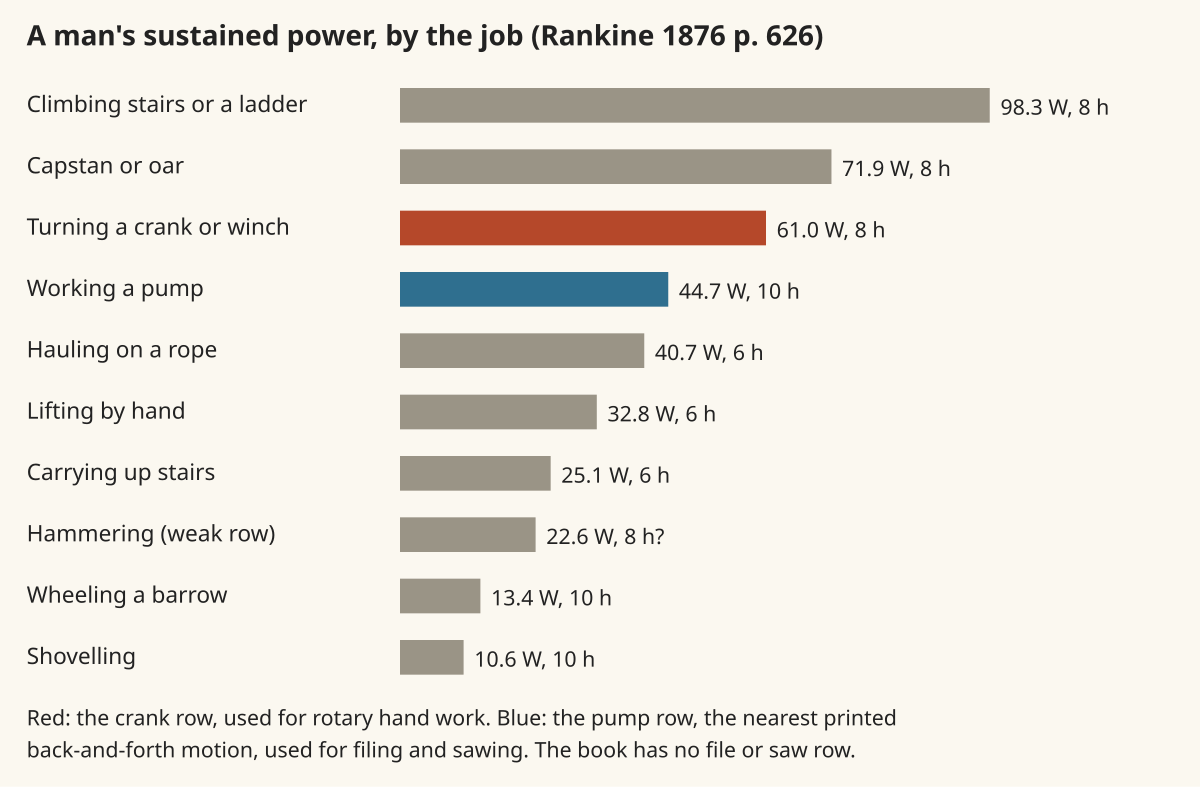
The period's answer is a table of three things multiplied together: "the useful resistance, the velocity with which that resistance is overcome, and the number of units of time per day during which work is continued" (Rankine 1876 pp. 625-626). Each man has one set of the three that gives the most, and "any departure from that set of values diminishes the daily effect" (Rankine 1876 p. 626). Pull harder and he walks slower; go faster and he stops sooner.
So one job has several figures. The same crank row in Rankine gives 45 ft lb a second for eight hours, a higher 62.5 with its hours printed only as a query, and 288 for two minutes (Rankine 1876 p. 626). In watts, 61.0 for the working day and 390 for a burst. The game uses the sustained one.
A day at the crank is 1,296,000 ft lb (Rankine 1876 p. 626), worked out as 1.76 MJ, or about 0.49 kWh. A 2 kW kettle spends that in a quarter of an hour.
Hand work at the bench
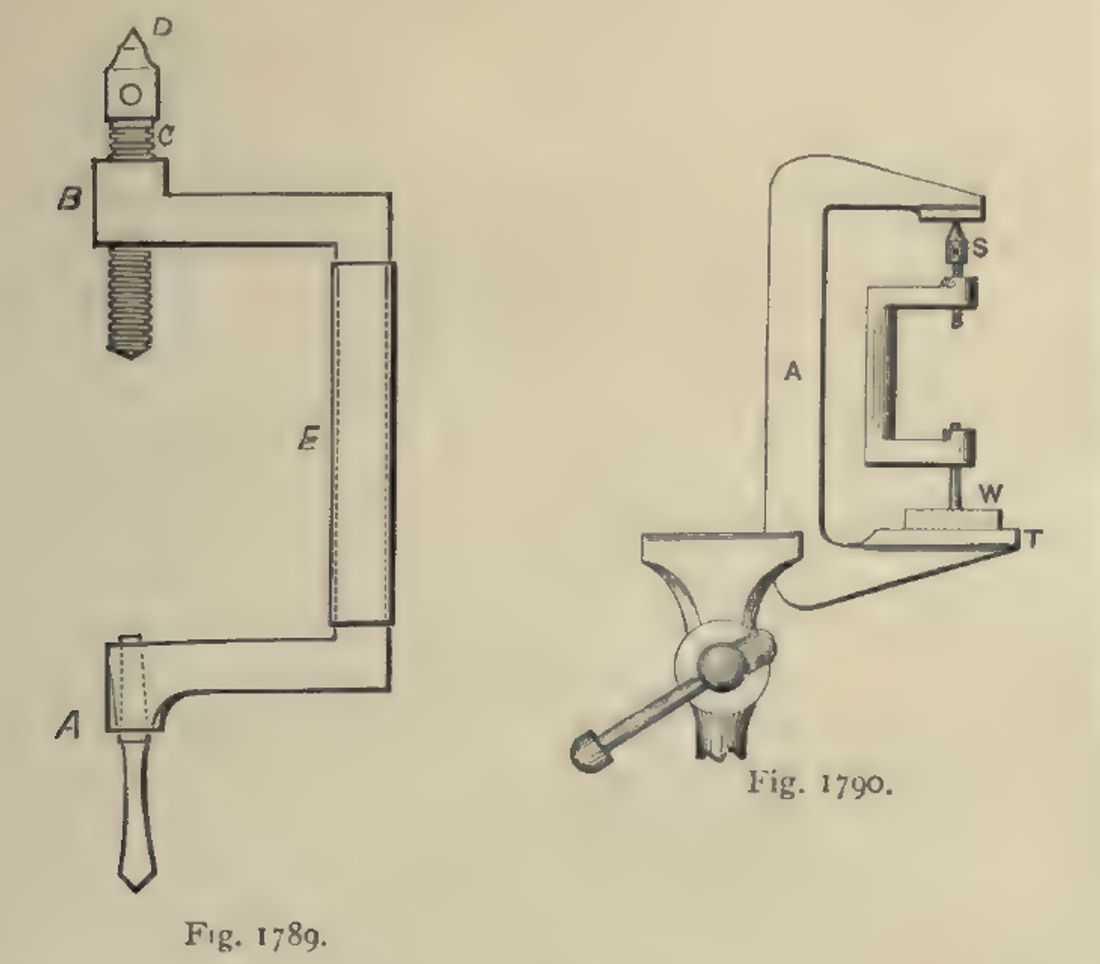
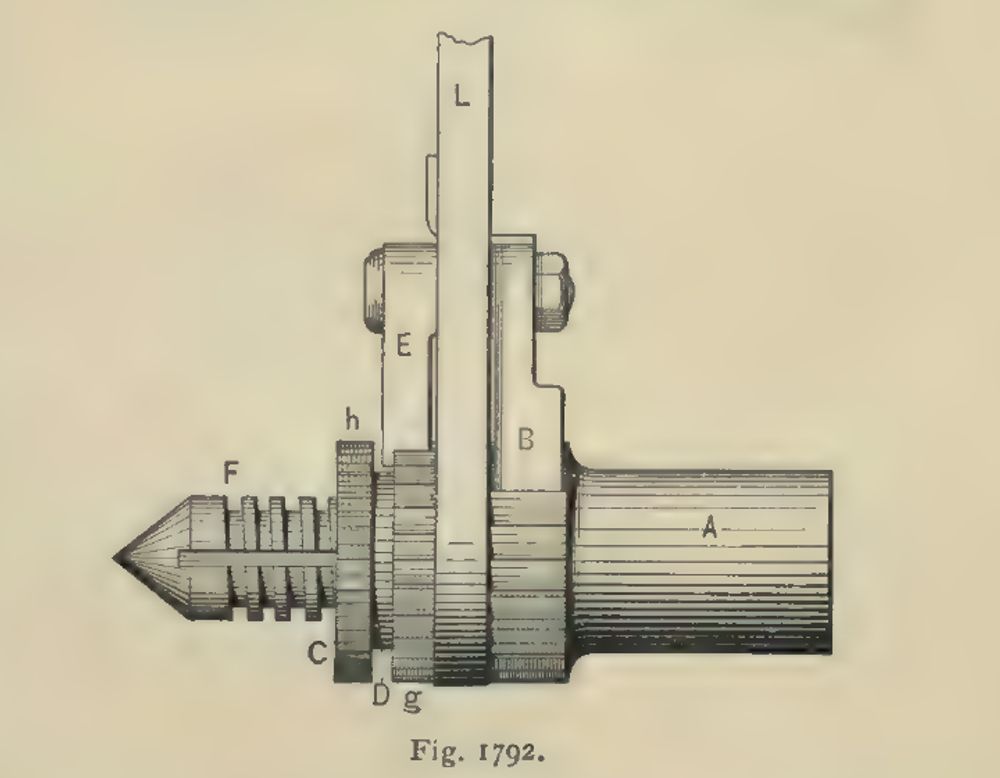
Shops still drilled by hand where a machine could not reach. Rose describes the tools in order of size: a drill crank in a frame held in the vice, for holes "of about half inch and less" (Rose p. 457); a drilling frame with a weighted lever for the feed, up to about two inches (Rose p. 457); and the ratchet brace, for holes "too large a bore to be drilled by tread drills" and away from a drilling machine (Rose p. 457).
The game times this work from the energy the cut takes. Rose gives Hartig's measured figures for metal removed on machine tools (Rose p. 273): 193,500 J to turn a kg of wrought iron away, 307,800 J by a reciprocating cut. A job's energy is the mass removed times that figure. A machine has a power of its own; a person has the crank's 61.0 W or the pump's 44.7 W, and the job takes energy over power. The period prints no file or saw row, and no figure for a skilled hand at a tool: the pump is the nearest back-and-forth motion, and that match is an inference.
Worked out on those figures, a day at the crank would cut about 9 kg of wrought iron, and ten hours at the pump motion about 5 kg by a reciprocating cut. That is only the cut: marking out, sharpening and shifting the work are not in a tool energy figure.
The clock then compresses it. A running machine counts 30 period seconds in each second on the clock (see scale and units), so a job that cuts 1.5 kg of wrought iron is 290,250 J, 79 minutes at the crank in the period, and 159 real seconds in play. The drilling machine at 360 W does the same in 27. All of this is planned. That gap of six to one is the drill press's reason to exist in the game.
What a horse could do, and what it was called
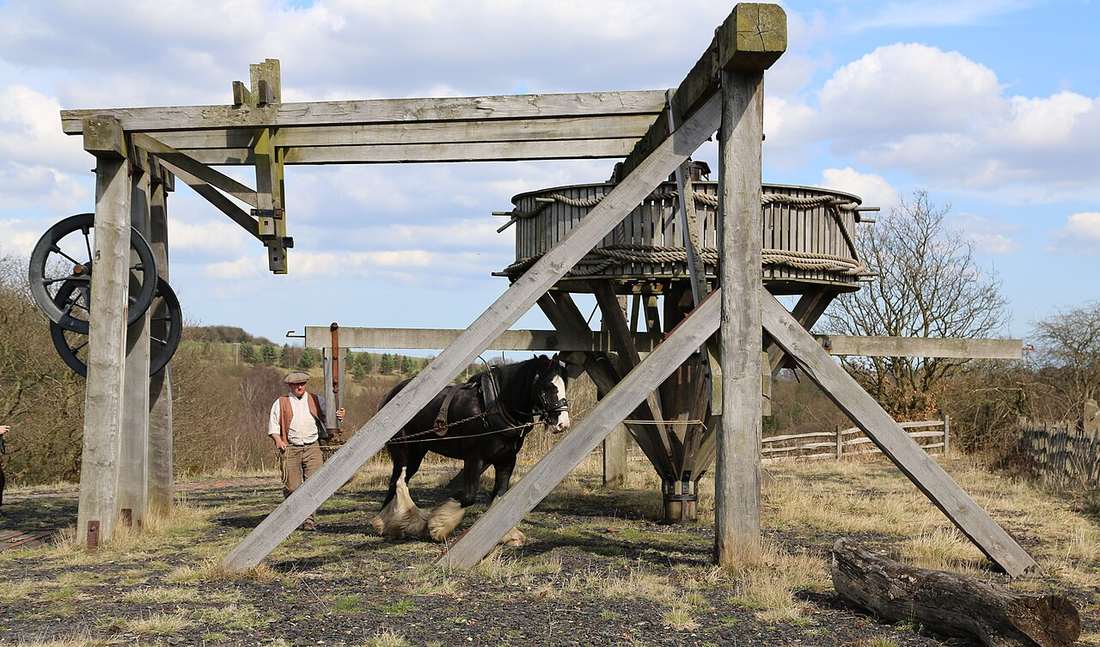
A strong mill horse at 2 1/2 miles an hour is "assumed to be able to raise a weight of 150 pounds, by a rope passing over a pulley", 33,000 lb a foot a minute (Farey p. 573). That is the horse-power, 746 W in modern terms. "Ordinary mill horses cannot do above two-thirds of this" (Farey p. 573), about 497 W. Rankine's working draught horse is 120 lb at 3.6 ft a second for eight hours (Rankine 1876 p. 626), 586 W, between the two. The horse-power was already a generous horse.
Rankine's table has no ox row, and no source used here gives one. The mod has no animal drive: the horse is here because it is the unit every engine and wheel is still measured in.
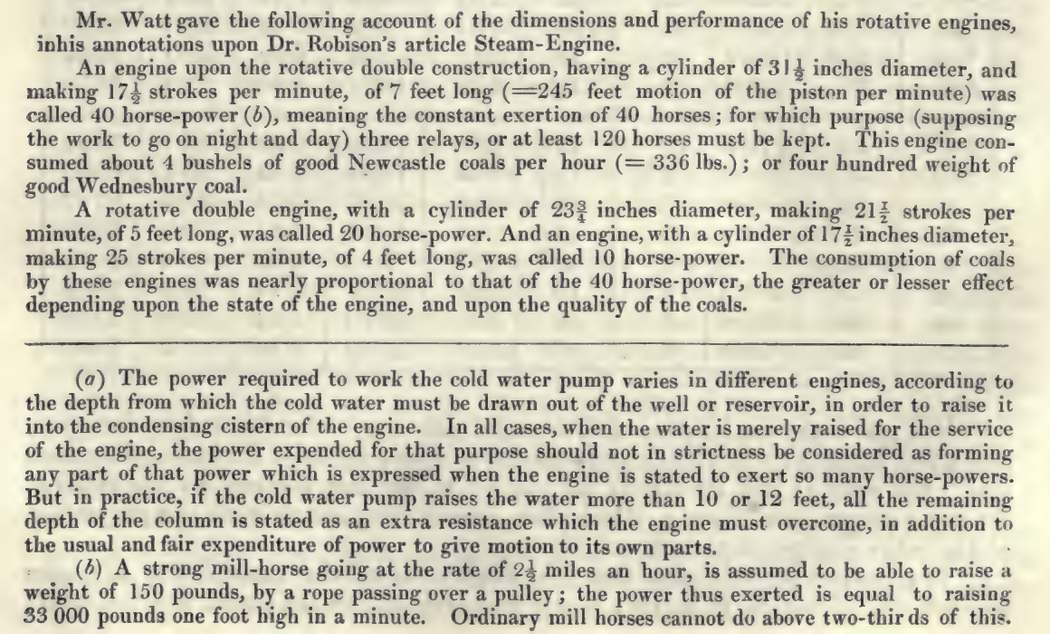
That note is the argument for the machine, printed plainly. A wheel or an engine is rated by what it does while running, and it runs all shift.
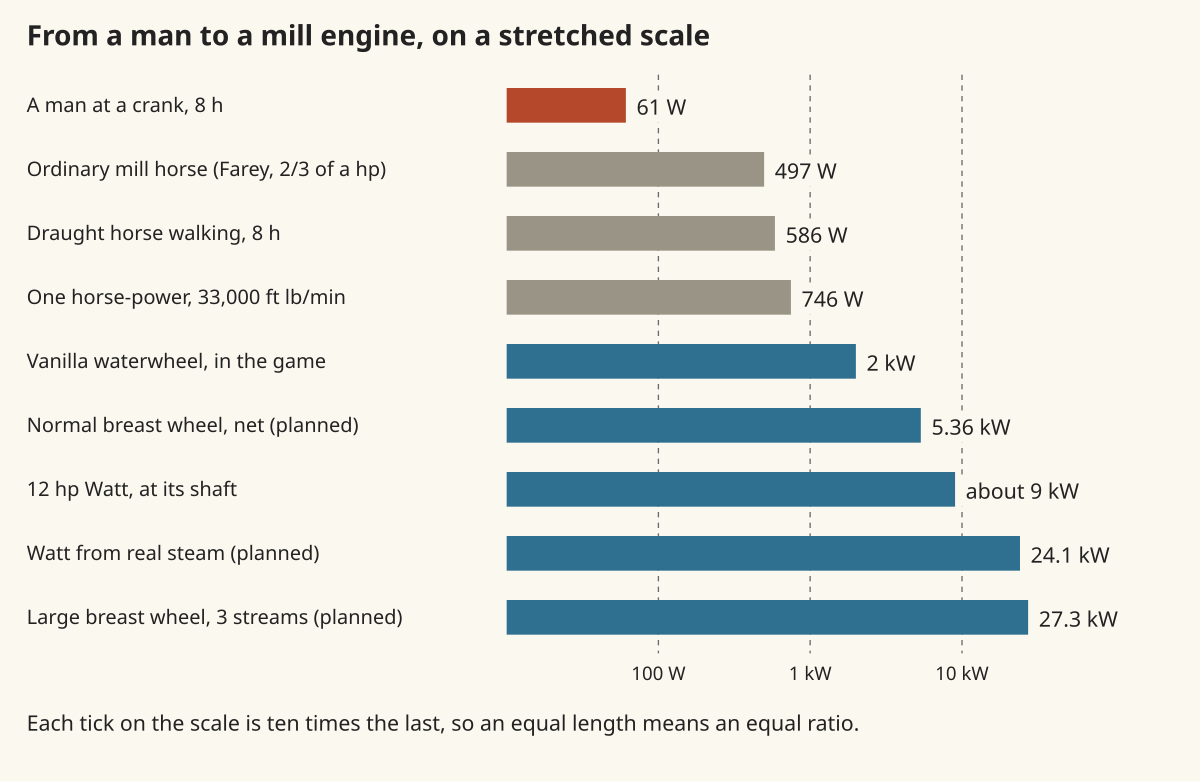
Worked out on the planned ratings, the normal iron breast wheel at 5.36 kW net is about 88 men at the crank, the Watt engine from real steam at 24.1 kW about 395. Those are the numbers behind the line shaft: one wheel does the steady work of a large gang, without relays. See the water wheel, the Watt engine and engine ratings.
Fairbairn gives the water side: an ordinary overshot wheel returns about 60% of the water's power and an improved iron high-breast wheel "75 per cent." (Fairbairn Mills I p. 126). The game's normal wheel takes 7.36 kW of water and delivers 5.36 kW net (planned), 73% of it.
Period basis, and what is the game's own
- Period: a man's work is resistance times speed times the hours of a day, each with one best value (Rankine 1876 pp. 625-626). The game uses the sustained crank row, 61.0 W, and the pump row, 44.7 W, for the bench's rotary and back-and-forth work (planned).
- Period: Hartig's figures are the energy a machine tool spent removing metal (Rose p. 273). The game applies them to hand tools too, on the same energy, because the books give no measured rate for a file or a brace.
- Period: holes by hand were drilled with a crank, a frame or a ratchet brace (Rose p. 457). The game's hand drill is the ratchet brace, and a hole over 1.2 voxels (75 mm) is not offered to it (planned). Rose's frame stops at about two inches, 51 mm, so the game's limit is its own.
- Period: a horse-power is 33,000 ft lb a minute, nominally one strong mill horse (Farey p. 573). The game has no animal drive; horse-power appears only as the unit of a rating.
- The game's own: a person is not modelled as a power source or tired. The figure sets how long a hand job takes, and nothing limits how many hours of it the player does. The real day's limits, ten hours of pump work and six of hauling (Rankine 1876 p. 626), are not kept.
- The game's own: the time is compressed by 30, as a running machine's is. See how we scale.
- The game's own: tool lives. The wooden pattern takes 240 impressions in the game today; the hand drill is planned at 120 holes iron and 300 steel, and a machine cutter's life is modelled on the pattern's. The sources used for this page give no tool life in comparable terms. Planned too, a spent machine tool breaks up and returns 80% of its metal as bits and 20% as mill scale, the machine's frame never wearing.
The numbers
Rates are period figures kept as they stand, and only the clock is scaled (how we scale, scale and units). "Planned" is the value in design, the game's value otherwise.
| In the game | Period figure | How it was scaled | Game value |
|---|---|---|---|
| Rotary hand work | Crank or winch, 18 lb at 2.5 ft/s, 8 h, 45 ft lb/s (Rankine 1876 p. 626) | Kept, in watts | Planned 61.0 W |
| Back-and-forth hand work | Pump, 13.2 lb at 2.5 ft/s, 10 h, 33 ft lb/s (Rankine 1876 p. 626); no file or saw row | Kept, in watts; the row is an inference | Planned 44.7 W |
| A man's day at the crank | 1,296,000 ft lb (Rankine 1876 p. 626) | Worked out | Planned 1.76 MJ, not enforced |
| Energy to cut wrought iron | Rotary .0327, reciprocating .0520 hp per lb of cuttings an hour, Hartig (Rose p. 273) | Converted to J/kg | Planned 193,500 and 307,800 J/kg |
| Energy to cut cast iron | Rotary .0314 (Rose p. 273); no planer figure | Reciprocating is wrought iron's ratio applied | Planned 185,800 and 295,500 J/kg |
| Hand hole, 1.5 kg wrought iron | Energy over a man's power | Divided by 30 for the clock | Planned 159 real s |
| Same job, drilling machine | Rose's 1/2 in hole through 2 3/4 in in 1 min 20 s, about 170 W (Rose p. 278) | Same energy at the machine's power | Planned 360 W, the game's own, 27 real s |
| Largest hand-drilled hole | Frame to about 2 in (Rose p. 457) | The game's own | Planned 1.2 voxels, 75 mm |
| Hand drill life | None given in the sources used | The game's own | Planned 120 holes iron, 300 steel |
| Wooden pattern life | None given in the sources used | The game's own | 240 impressions |
| One horse-power | 33,000 ft lb/min (Farey p. 573) | Unit only | 746 W |
| Normal breast wheel | "75 per cent." of the water (Fairbairn Mills I p. 126) | Rated from water and fall | Planned 7.36 kW of water, 5.36 kW net |
| Large breast wheel, three streams | As above | Rated from water and fall | Planned 36.8 kW of water, 27.3 kW net |
| Vanilla water wheel | No period figure | Vanilla's own, on the mod's power scale | About 2 kW |
Open, and what you can tell us
The biggest soft spot is the back-and-forth figure. No book at hand has a row for filing, sawing or chipping, so a pump handle stands in. A hand filer's sustained output, or a day's output of a fitter in filed metal, would be better evidence than the arm motion of a pump. Rankine's table has horses but no oxen, and if you know a period rate for oxen at a whim or a mill, we would like to read it.
Picture credits
- A man's sustained power by the job: drawn for this site from Rankine 1876 p. 626, A Manual of Applied Mechanics.
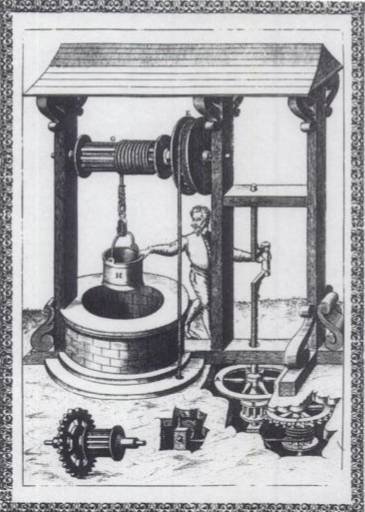
- Ramelli windlass well: Ramelli, 1588, public domain.
- Figs. 1789 and 1790, and 1792: Rose, Modern Machine-Shop Practice, p. 457, Library page.
- Whim gin, Beamish: geni, CC BY-SA 4.0.
- The note on Watt's rotative engines: Farey, Treatise on the Steam Engine, p. 573, Library page.
- The ladder from a man to a mill engine: drawn for this site from Rankine 1876 p. 626, Farey p. 573 and the game's planned ratings.
Comment or suggest something in the Expanded thread on the Vintage Story Discord