
Cupola furnace
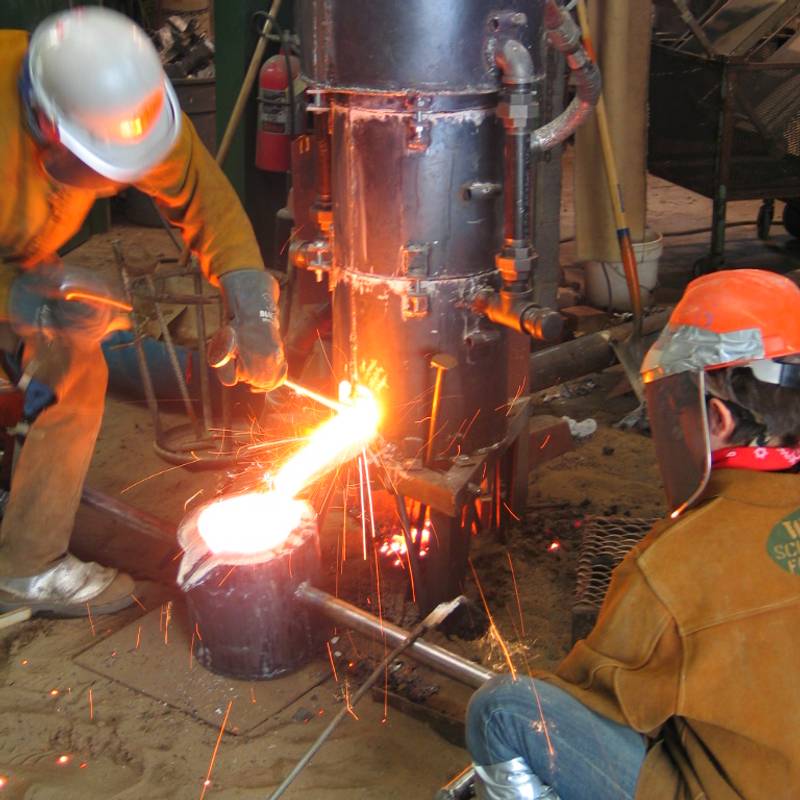
A cupola is a small upright shaft, lined with fire-brick, filled from a door near the top with alternate layers of fuel and iron, and blown with air near the bottom. It does not make iron from ore. It melts iron that already exists, for the foundry. How to build and run one in the game is in the furnaces and heat guide, and the structure is in the catalogue. This page is about the real one and how the game's follows it.
What it was for
A foundry wants liquid iron at a moment of its choosing and in the quantity the moulds need. Kirk puts the case in one paragraph: it "melts iron with less fuel and more cheaply than any other furnace", it stands being run intermittently, large or small quantities cost about the same share of fuel, and it "can readily be put in and out of blast" (Kirk p. 1).
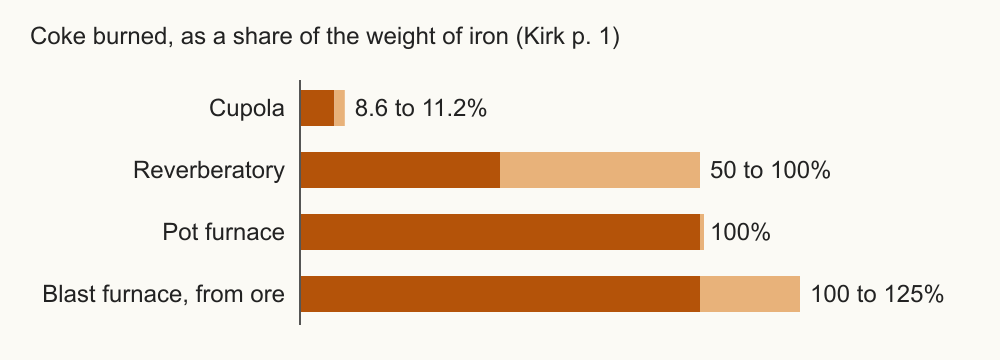
The saving comes from contact. The fuel and the iron lie together in the shaft and the hot gas has to climb through the iron to get out, so it gives up its heat to the stock on the way. A high cupola melts more with less fuel for that reason, because the escaping heat warms the stock (Kirk p. 13). Kirk goes further: "The blast furnace is a cupola furnace, and is constructed upon the same general principle" (Kirk p. 136). The difference is the job: the blast furnace has to reduce ore to metal, and the cupola has only to melt it.
Contact has a price. What touches fuel takes up what is in the fuel: "Iron melted with poor coal or coke is injured by the impurities in the fuel" (Kirk p. 143).
What a charge is
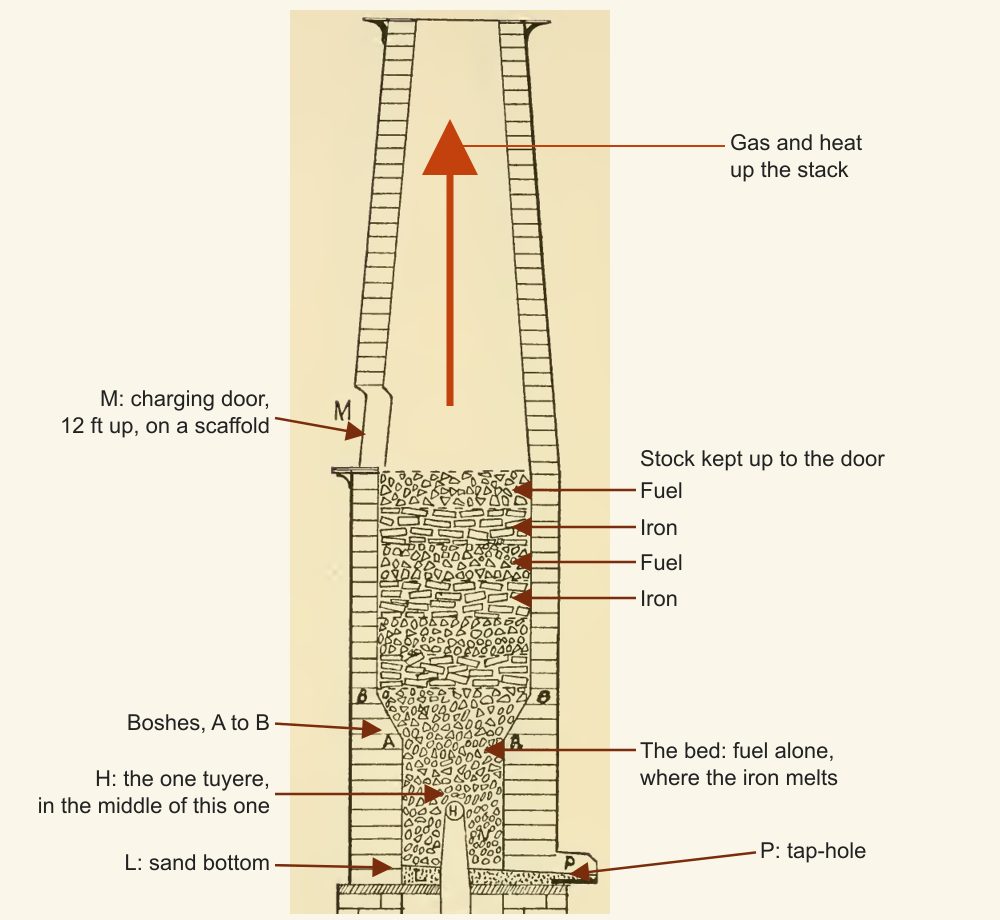
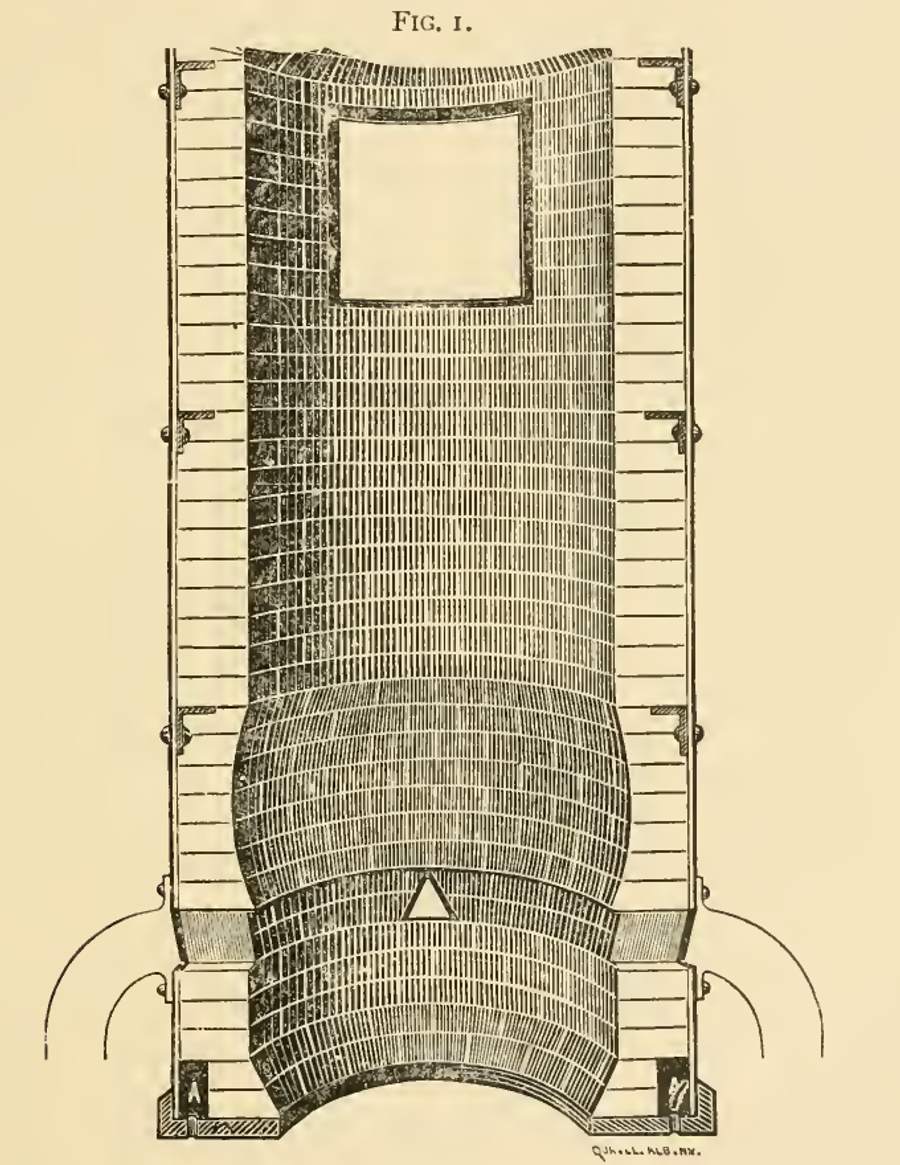
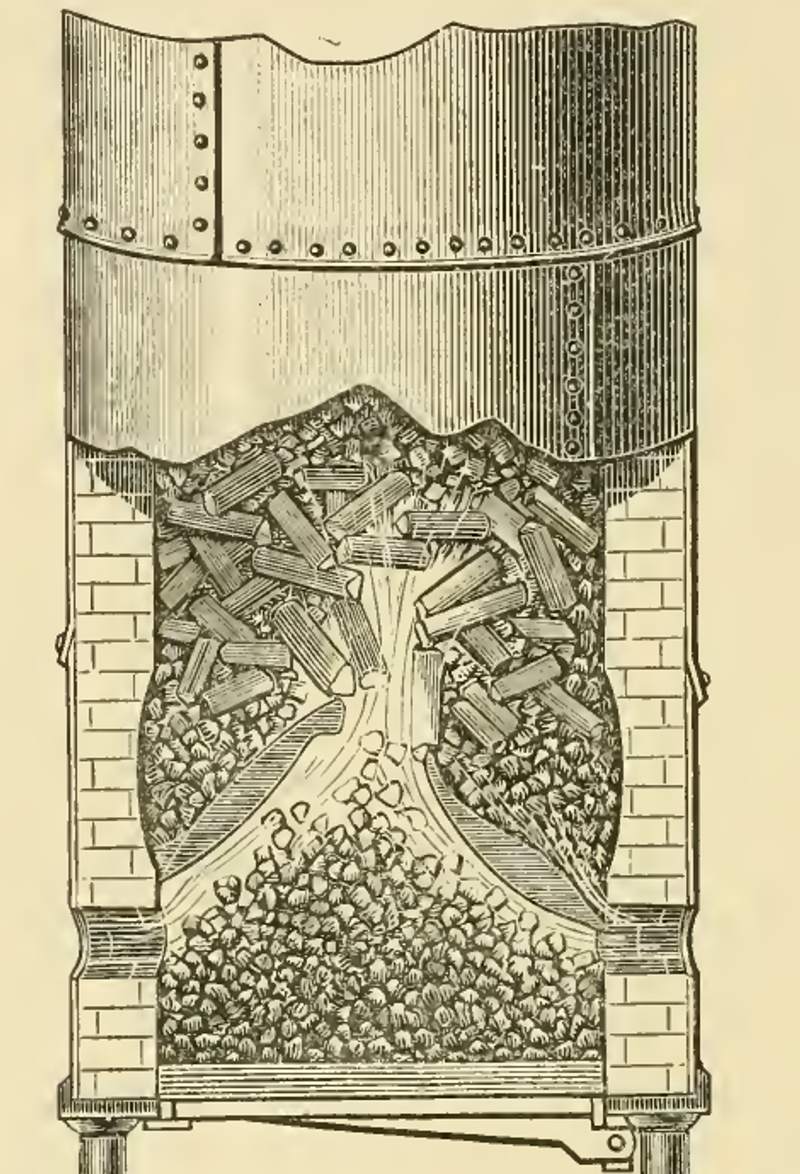
"Charging the cupola" meant building it up in layers, each layer of fuel separated from the next by a layer of iron (Kirk p. 80). Charged that way it melted "about one-half greater" than when the two were mixed (Kirk p. 80).
The layers make sense once you see where the iron melts. There is a melting zone only 6 to 8 inches deep in practice, just above the tuyeres (Kirk p. 77). Below the zone sits the bed, a column of fuel alone, its top 18 inches above the tuyeres on hard Connellsville coke (Kirk p. 78). Iron arrives on top of the bed and melts there, while the bed burns down beneath it. The next layer of fuel then arrives to raise the bed back to where it was. So the iron of each charge must be "the exact amount of iron the fuel will melt while settling from the melting point to the bottom of the melting zone" (Kirk p. 81). Too much iron and the bed sinks until "iron melts dull, or sinks below the bottom of the zone, and melting ceases" (Kirk p. 128). Too much fuel and the iron is held up above the zone (Kirk pp. 128, 336-337).
Kirk's rule of thumb is three pounds of iron on the bed for each pound of fuel there, and ten pounds of iron on each later charge of fuel (Kirk p. 333). His reported charges ran 6 to 15 lb of iron to the pound of coke (Kirk p. 82), and good melting was 8 (Kirk p. 343). In his trial cupola the charges were 4 to 8 hundredweight of iron, and the most even melting came with 4 and 5 (Kirk pp. 125-127).
The charge was weighed, and Kirk is scathing on the alternative. "There is nothing more essential to the good melting and mixing of iron, than an accurate weighing scale upon the scaffold near the cupola charging door" (Kirk p. 211). No melter can "accurately estimate the weight of pig iron by counting the pigs" (Kirk p. 212), and counting shovels or baskets of fuel is "the greatest fallacy of all" (Kirk pp. 212-213); an old basket holds a third more than a new one (Kirk p. 230). Nor was it tipped in: "the iron must all be thrown in with the hands, and the fuel with a shovel or fork" (Kirk p. 84), the pig broken short and set end to the lining, because anything dumped falls on one side.
How a heat ran
The door was too high to reach from the floor, so a scaffold was built level with it, usually behind the cupola, large enough for the scale and the iron and fuel of several heats. "Nine-tenths of the scaffolds are too small" (Kirk p. 7).
Once the blast was on it stayed the same to the end: "never vary the blast in different parts of a heat" (Kirk p. 85). The melter read the furnace at the tap-hole. If the bed had burned too far, the first iron came fast and dull; if it was too high, the first iron was a long time coming; iron charges too heavy came dull at the end of each charge (Kirk p. 98). One tap-hole "runs all the iron a cupola is capable of melting" (Kirk p. 17). The slag hole lay below the tuyeres, as far from the tap-hole as could be, and was needed only on a long heat (Kirk pp. 17-18). Iron was meant to be held in a ladle, since "iron can be kept hotter in a ladle than in a cupola" (Kirk p. 20).
At the end the blast was stopped, the tuyere doors opened, the iron drawn off, and the props knocked from under the iron bottom doors. They fell and "a sheet of flame and dust instantly shoots out ten feet or more" (Kirk p. 99). The white-hot dump was chilled with buckets of water, and the fuel left in it was taken back to the scaffold (Kirk pp. 99, 101). A cupola could also be kept for the next day: with the iron drawn off and the tuyeres rammed shut, one held from 4 p.m. to 8 a.m. and melted well (Kirk p. 276).
Size had a limit. Side tuyeres could not carry air to the centre of a shaft much over 60 in, and above that melting did not rise with diameter (Kirk pp. 297-298). For a casting too large for one, "two or more cupolas were run at the same time" (Kirk p. 30), and several could be tapped into one channel for large work such as anvils and bedplates (Kirk p. 194). The answer to "more iron" was more cupolas, as it is in the game.
Period basis, and what is the game's own
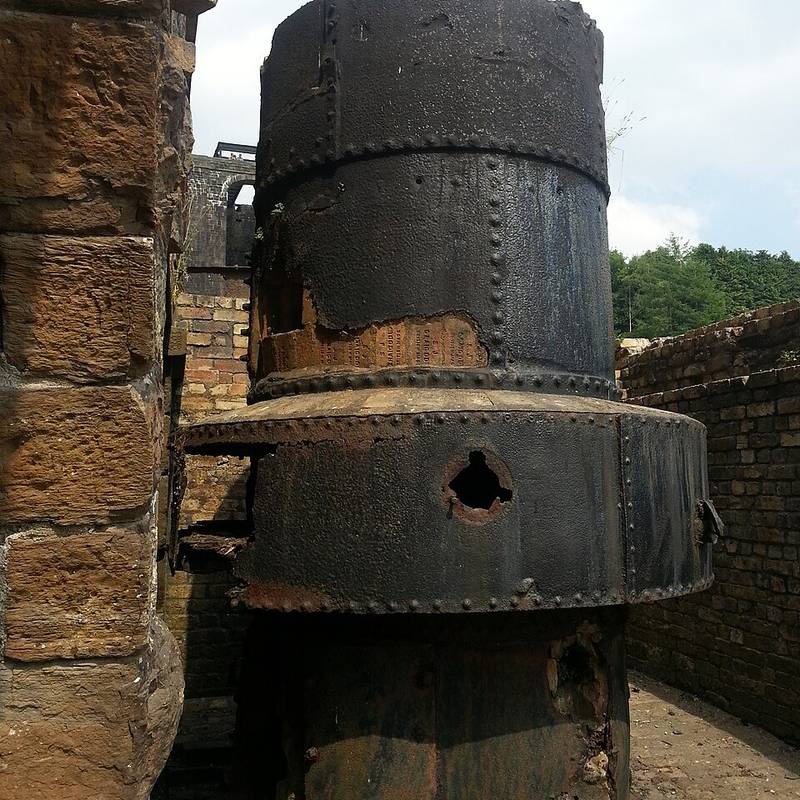
- Period: a brick-lined shaft, charged at a door with alternate layers of fuel and iron, blown by tuyeres in opposite walls, tapped at the bottom for iron and higher for slag (Kirk pp. 2, 17-18, 54, 80). The game builds this: a round hooped tower of brick, one shaft, two tuyeres, an iron tap and a slag tap on opposite sides of a single hearth. The hoops are the wrought-iron bands of Overman's round stack (Overman p. 163). The same book records the name running the other way, round brick stacks called "cupola furnaces, from their resemblance to the cupola of the foundry" (Overman p. 162).
- Period: metal already made. Pig, scrap and old castings went in (Kirk pp. 82-83, 212). The game charges pig, chunks, bits and iron and steel scrap directly, with no remelt stock of its own, and ore charged into a cupola burns without ever converting. It is the game's only route to cast iron.
- Period: the charge was weighed against a scale and thrown in by hand (Kirk pp. 84, 211-212). The game plans a sheet-iron box filled to a set weight of metal, tipped in at the door against a tally of boxes. Kirk gives no such box or board, and condemns dumping from a box (Kirk p. 84); the box is the game's own and stands in for the scale.
- Period: the door stood at the top of the stock and was reached from a scaffold (Kirk p. 7). The game charges today through a hopper at the top; a charging door level with a platform the player builds is planned.
- Period: a banked cupola held its fire overnight (Kirk p. 276). The game plans it: a cupola whose blast stops keeps its heat, and melts again when the blast returns.
- Period: flux was added only to draw off slag on a long heat, and loss of iron rose when it was (Kirk pp. 84, 137-138). The game plans a heat cost for a charge off its flux band; scrap carries no flux and reads as a standard charge, so an all-scrap cupola pays nothing.
- The game's own: vanilla has no remelting furnace of this kind; see vanilla against reality. The cupola here is the blast furnace running different data.
- The game's own: the bottom does not drop. When the fire goes out the pool sets where it stands, and what is left in the shaft is dug out with a shovel. Linings do not wear, and a shaft does not bridge.
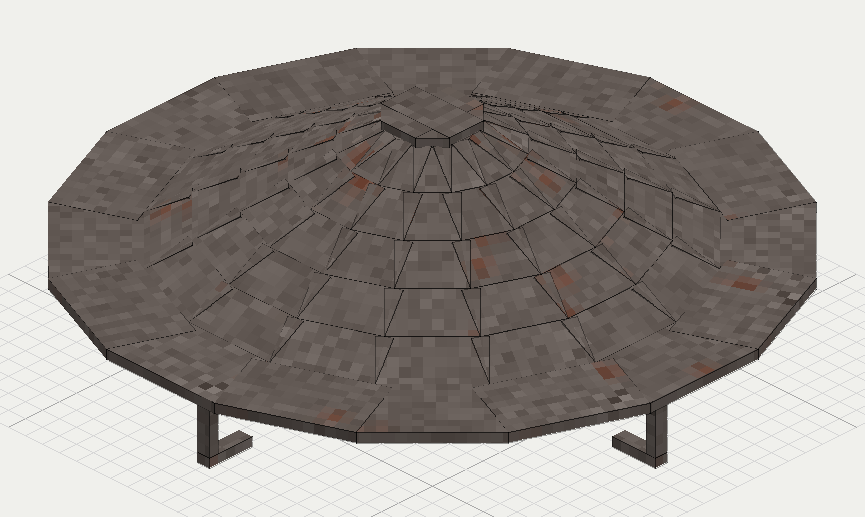
- The game's own: the cupola will not form without its hat, though Kirk preferred a wide stack to any cap (Kirk p. 269).
- The game's own, planned: melting ferromanganese for the steelmaker's ladle, where carbon from the fuel does no harm. Not built.
The numbers
Sizes follow Kirk's 40 in cupola at true size (scale and units); the fuel and air are period ratios against the game's other furnaces (the scaling page). "Planned" is design; values without that word are what the game has now.
| In the game | Period figure | How it was scaled | Game value |
|---|---|---|---|
| Bore | 18 to 60 in, by cupola (Kirk p. 14) | One block | About 40 in |
| Height to the door | 12 to 15 ft for a 40 in bore (Kirk p. 14) | Whole blocks | 4 blocks, about 13 ft |
| Tuyeres | "At least two", opposite (Kirk p. 54) | The rule as it stands | Two, opposite |
| Melting rate | 4 to 8 tons an hour, 40 in bore (Kirk p. 14) | Period rate in metal units | 47 to 95 u/s the target; about 70 u/s today |
| Melting by air | 30,000 cu ft of air to the ton (Kirk p. 296) | Air from the blowers over that figure, by the make factor | Planned 39 to 48 u/s on the twin tubs, 80 to 93 u/s on the blowing cylinder and the Watt |
| Coke | Iron to coke 8:1 for good melting (Kirk p. 343); 172 to 224 lb a ton (Kirk p. 1) | Today the game's own carbon rate; planned the period ratio at the fuel factor | One coke item melts about 844 u; planned 5,830 u, 0.88 items for a 5,120 u heat |
| Metal lost | Slag holds 4 to 7% iron (Kirk p. 138); no figure for a whole heat | The game's own | 4%, 0.96 u of cast iron per unit charged |
| Hearth | No figure used; iron was not to be held in the cupola (Kirk p. 20) | The game's own, the one hearth cell | 5,120 u to the slag notch, 8,960 u to the tuyeres |
| Tap | One hole runs all the iron (Kirk p. 17) | Today throttled under the melt; planned over it, so the hearth fills only while the tap is shut | 30 u/s; planned 100 u/s, a full hearth in about 51 s |
| A layer of iron | 4 to 8 cwt in Kirk's trial cupola (Kirk pp. 125-127) | One box filled by weight | Planned 750 u, about 10 cwt: 10 pigs, 30 chunks or 150 bits |
| Melting point | None given | The game's own; wrought iron stands at 1482 C | 1200 C |
Open, and what you can tell us
The books at hand, searched for it, do not say who built the first cupola, or when. Those that mention a foundry cupola at all mention it as a place where iron was remelted. Kirk's dated designs include Ireland's, patented about 1856 (Kirk p. 157). If you know a source that dates the furnace or its name in foundry use, we would like to read it.
Picture credits
- Cupola Furnace Iron: Ab5602, public domain, cropped.
- Iron casting cupola furnace, Blaenavon ironworks: Andy Dingley, CC BY-SA 4.0, cropped.
- Figs. 1, 19 and 26: Kirk, The Cupola Furnace, pp. 23, 108 and 160, Library page; Fig. 26 labelled for this site.
- The fuel chart: drawn for this page from Kirk p. 1.
- The game's hat: the mod's drawing.
Comment or suggest something in the Expanded thread on the Vintage Story Discord