
Brick, lime and mortar
Every furnace, boiler setting and kiln of the period was a wall built around a fire. What the wall was made of, and what held it together, decided how long the fire could be kept in. How the game's furnaces take their heat is in the furnaces and heat guide. This page is about the brick itself, the mortar between the bricks, and how much of that the game keeps.
What a fire brick is
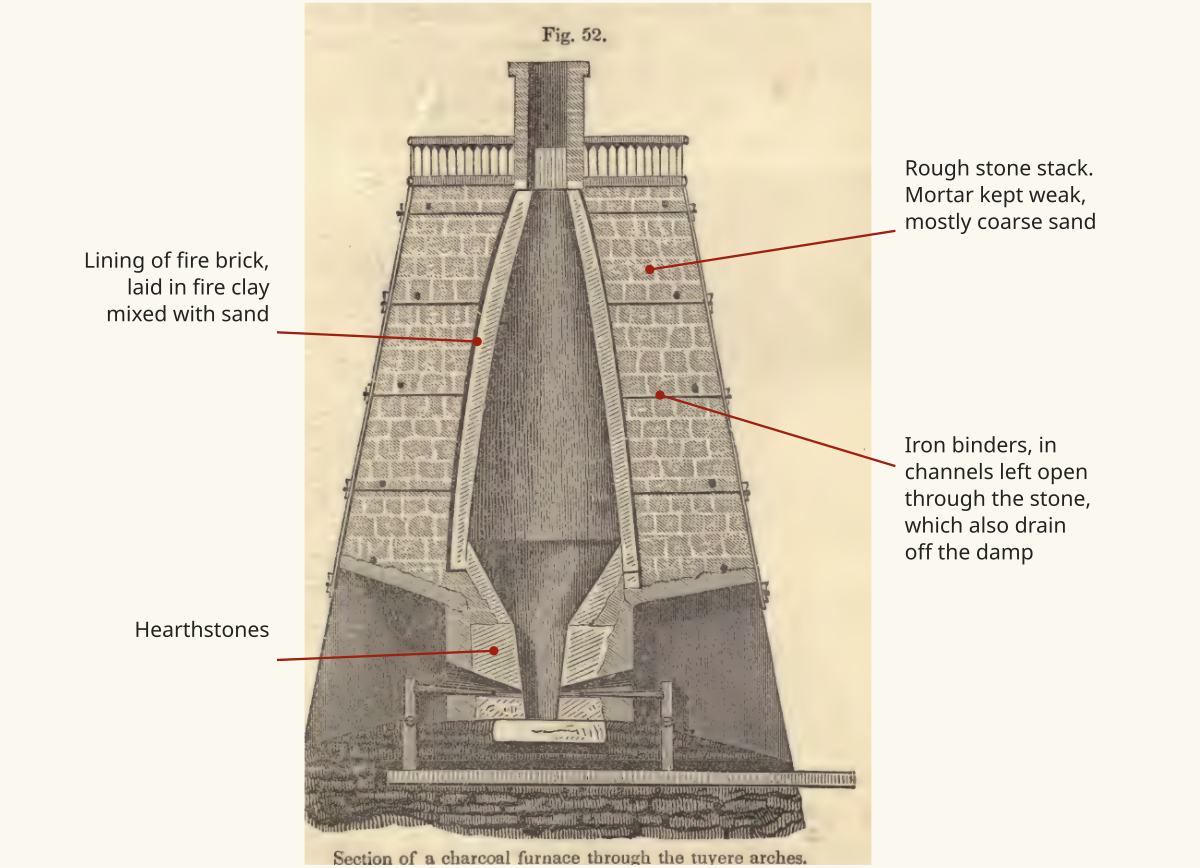
Overman opens his chapter on the subject by saying the obvious explanation is wrong: "It is not heat which destroys our furnace hearth or lining" (Overman p. 452). The chemical affinity of what is melted for what it is melted in does the damage. Silica and alumina are each infusible, and either melts readily once potash, soda or the oxides of iron and manganese get at it (Overman p. 452). The most refractory materials are the silicates of alumina, and common fire-clay ranks first among them (Overman p. 453).
A fire brick is made as an ordinary brick is, except that the clay is prepared with more care (Overman p. 454). Clay of a stony kind was ground under iron edge-wheels, driven by steam or a horse (Overman p. 455). The test of a clay needed only a smith: an hour or two in the strongest heat of a forge, and if the piece stayed white and did not glaze it was fire-proof (Overman p. 455).
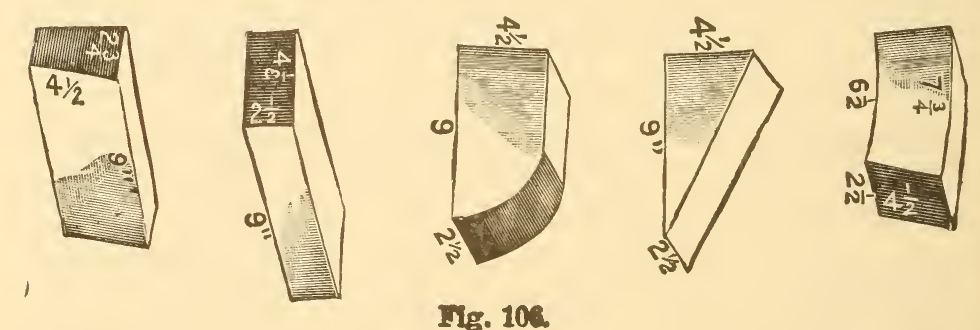
A good fire brick was expected to stand the highest temperatures for a long time without fusing, to take sudden changes of temperature, and to resist melted copper or iron slag (Hawkins p. 237). The slag is the hard part, for the reason Overman gives. Where the chemistry mattered most, the lining was chosen for it: the Bessemer vessel and its ladle were lined with ganister (Bessemer p. 203).
Why two kinds of brick, and two kinds of joint
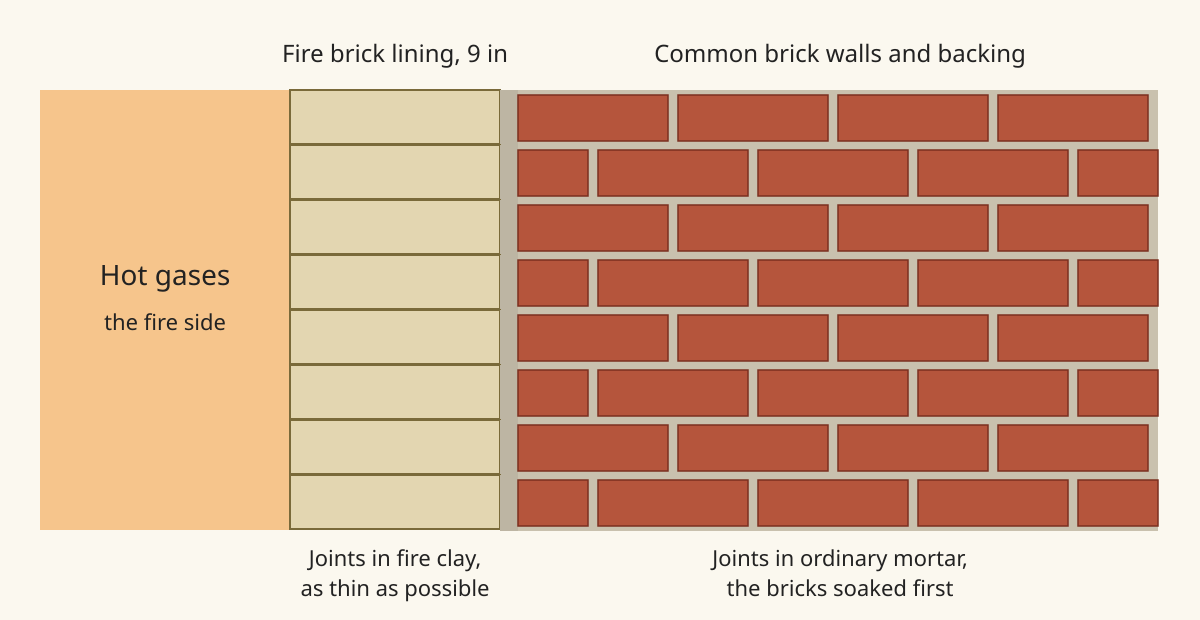
Fire brick went only where it had to. Hawkins wants it wherever hot gases touch the setting and common brick for the walls, foundations and backing (Hawkins p. 236). A lining is tied into the common brick unless it is thick enough to stand alone (Hawkins p. 236).
Lime mortar cannot go in the hot face. It is held together by carbonate of lime, which is exactly what a kiln takes apart, and lime is one of the bases that attack the clay of a brick (Overman p. 452). So a fire brick is laid in fire clay, "quite unlike the ordinary mortar which is most suitable for common brick" (Hawkins p. 237), and the joints are "as thin as possible" (Hawkins p. 237).
Clay alone does not do either. Pure fire clay cracks in drying and leaves spaces, so it was mixed with fine sand, not because the sand resists the heat but because the mix shrinks less. Better still was fire clay with finely pounded blast furnace cinder (Overman pp. 457-458). For a furnace lining Overman asks for fire clay with some sand or a little of the riddlings from the ore yard (Overman p. 156). The mortar may be more fusible than the brick, since it is "a kind of solder between one stone and another" (Overman p. 457).
Sometimes lime was kept out for a different reason. In a wood-charring oven the acetic acid of the wood dissolves the lime and leaves only sand in the joints, so Overman would use loam with coal tar or sea salt (Overman p. 111).
How lime becomes mortar and turns back to stone
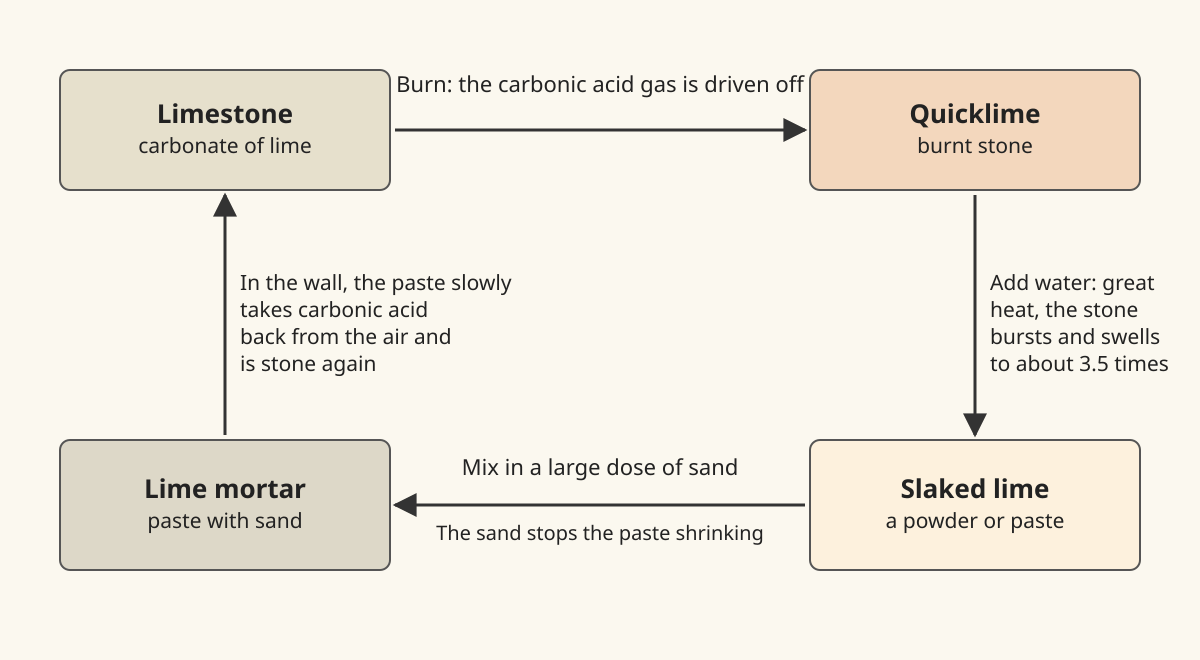
Fat lime on its own shrinks too much to be used as mortar, so it takes a large dose of sand (Gillmore p. 70). It will not harden under water or in a damp place shut off from the air (Gillmore p. 70); for that work Gillmore turns to hydraulic limes and cements. He keeps the word mortar for sand and a paste of the cementing substance alone (Gillmore p. 175).
Slaking was a skilled step that workmen were apt to spoil. Too much water makes the lime semi-fluid and hurts its binding power, and adding more once it has started chills it and leaves it lumpy (Gillmore p. 180). The vessel was covered up with boards or canvas, or with the sand that would go into the mortar afterwards (Gillmore p. 180).
Water matters in the wall as well. A dry brick absorbs a pound of water, taking from the mortar what the mortar needs to set, so bricks were well soaked before they were laid; and steam softens mortar faster than water does (Hawkins p. 241). A boiler setting was left to stand before any fire reached it, for the same reason (Hawkins p. 28): the Cornish boiler page gives the schedule.
Period basis, and what is the game's own
- Period: common brick for the walls and fire brick only where the fire or the hot gases reach (Hawkins p. 236). The game has both. Its furnaces build in brick, and the coke oven is fire brick throughout, the brick the base game already takes for coke ovens.
- Period: a lining's chemistry decided its life, and ganister lined the Bessemer vessel (Overman p. 452, Bessemer p. 203). The game plans to care about the lining's kind where the brick is a reagent, in the converter, the open hearth and the ladle. In a blast furnace, cupola, coke oven, crucible furnace, reheat furnace or puddling furnace the brick is an enclosure and any tier serves.
- Period: lime burnt in a kiln, slaked with water and mixed with sand (Gillmore pp. 67, 70, 180). The base game keeps this chain whole: lime is cooked to quicklime, the quicklime slaked in a barrel, and the slaked lime stirred with sand for mortar. See vanilla against reality.
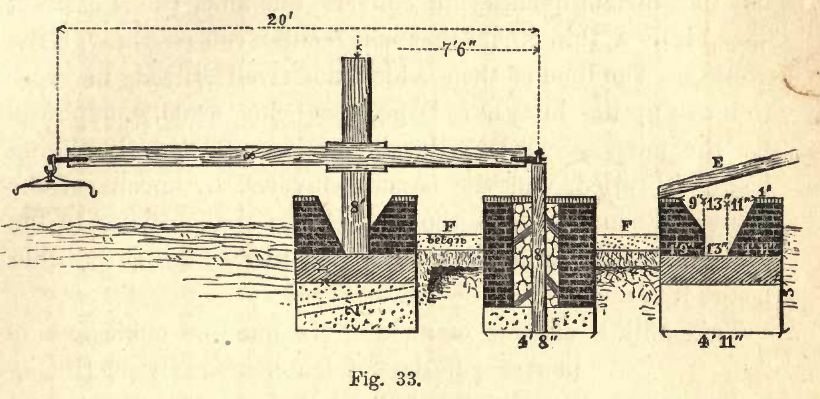
- Period: cinder pounded into a refractory mortar (Overman p. 458). The game plans powdered slag in place of the sand at the edge-runner mill. Mortar mills are period (Gillmore p. 193); the mill's mortar recipe is planned, and the mortar made today comes from the barrel.
- Period: bricks laid by a mason with a trowel. The game has an iron trowel for the masonry steps of a build. No book at hand covers the tool, and its form is the common one.
- The game's own: one mortar is one mortar. Fire clay and lime mortar are not separate joints in a wall, so a fire brick block takes the same mortar as a common one. Fire clay is a separate ingredient, in the canals and flasks that carry metal.
- The game's own: nothing cures. A wall is finished when it is laid, mortar does not need air or time, and no soaking, shrinkage or frost touches it. A real wall stood for weeks first (Hawkins p. 28).
The numbers
The brick counts are the base game's, kept as they stand (see the scaling page), with block sizes from scale and units. "Planned" is in design and not yet built.
| In the game | Period figure | How it was scaled | Game value |
|---|---|---|---|
| A fired brick item | 9 x 4 1/2 x 2 1/2 in, about 1.7 litres (Hawkins p. 237) | The game's own: a recipe item stands for the many bricks of a block's volume | Half a cubic metre of wall, about 300 period bricks; machine masonry planned at the same rate |
| A refractory brick item | Same brick (Hawkins p. 237) | The game's own, twice the bricks per block of fired brick | A quarter of a cubic metre of wall; machine masonry planned at the same rate |
| Mortar per wall | No figure per brick in the books at hand | The game's own, the base game's recipe | 1 mortar with 8 bricks: 4 fired brick blocks, or 2 refractory |
| Sand in mortar | 12 cu ft compacted sand, with 1 cask of cement and half a cask of lime, for 16 cu ft of brick mortar (Gillmore p. 205) | Not scaled; the base game's recipe | 1 L slaked lime and 1 sand make 4 mortar |
| Slaking | Volume grows about 3.5 times (Gillmore p. 67) | The game's own | 4 quicklime and 1 L water make 4 L slaked lime |
| Burning lime | No temperature in the books at hand | The base game's value, kept | 2 lime cook to 1 quicklime at 825 C |
| Lining thickness | 9 in in the fireplace, 4 1/2 in behind the bridge wall (Hawkins pp. 236-237) | Not scaled; the drawings use whole voxels | Drawn per machine |
| Trowel | None given | The game's own | 200 uses |
Open, and what you can tell us
The books at hand do not say how much mortar went to a thousand bricks. The closest figure is Gillmore's batch for a fort's brickwork (Gillmore p. 205), which does not count the bricks it laid. They also disagree a little on the hot-side joint: Hawkins says fire clay (Hawkins p. 237) and Overman that pure fire clay is not a good mortar (Overman p. 457). If you know a period source that counts mortar against brick, or what fire-clay mix a British furnace-builder actually used, we would like to read it.
Picture credits
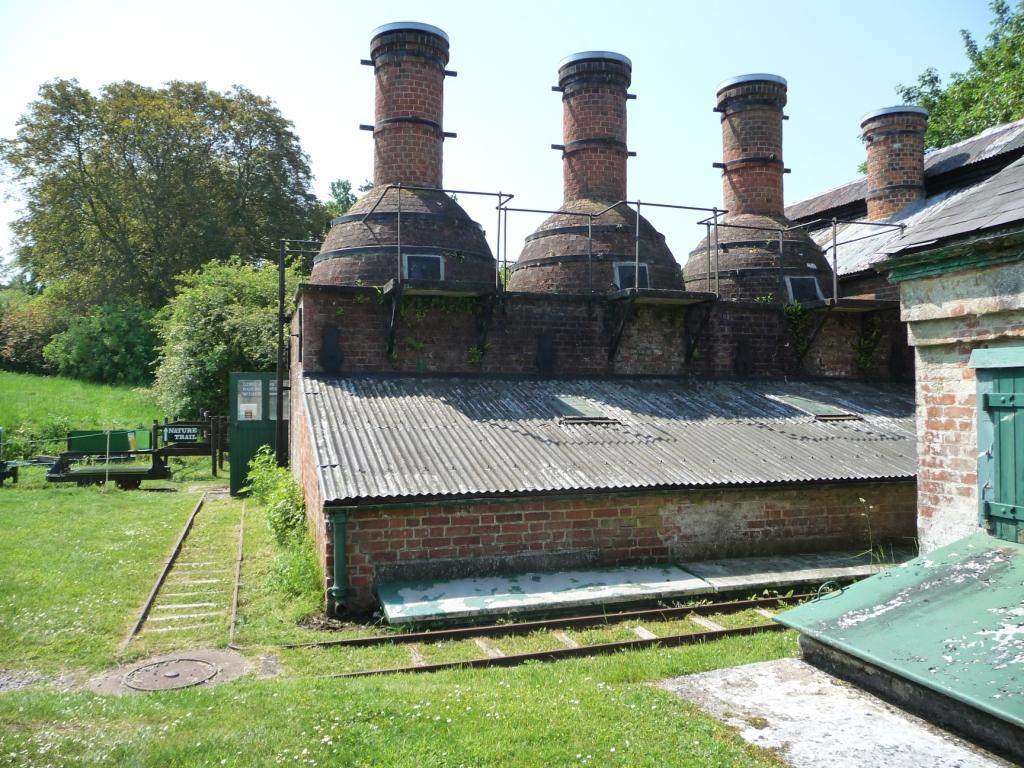
- Three lime kilns, Twyford Waterworks: Christine Johnstone, CC BY-SA 2.0.
- Section of a charcoal furnace, Fig. 52: Overman, The Manufacture of Iron, p. 153, Library page, labelled for this site from p. 156.
- Fire brick shapes, Fig. 106: Hawkins, Maxims and Instructions for the Boiler Room, p. 236, Library page.
- A boiler setting's wall: drawn for this page from Hawkins pp. 236-237 and 241.
- The lime cycle: drawn for this page from Gillmore pp. 67 and 70.
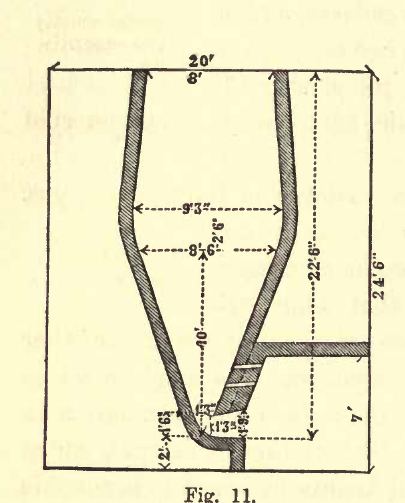
- Perpetual kiln, Fig. 11, and horse mortar mill, Fig. 33: Gillmore pp. 128 and 193, Library page.
Comment or suggest something in the Expanded thread on the Vintage Story Discord