
Puddling
Pig iron is hard and brittle. Puddling turned it into wrought iron by hand: a man stirred molten pig on an iron-oxide bed until the carbon had burned out, then gathered what was left into balls with a bar through a hole in the furnace door. How to run the game's furnace is in the furnaces and heat guide and its parts are in the catalogue. This page follows the real work in the order the workers did it, then says what the game keeps of it.
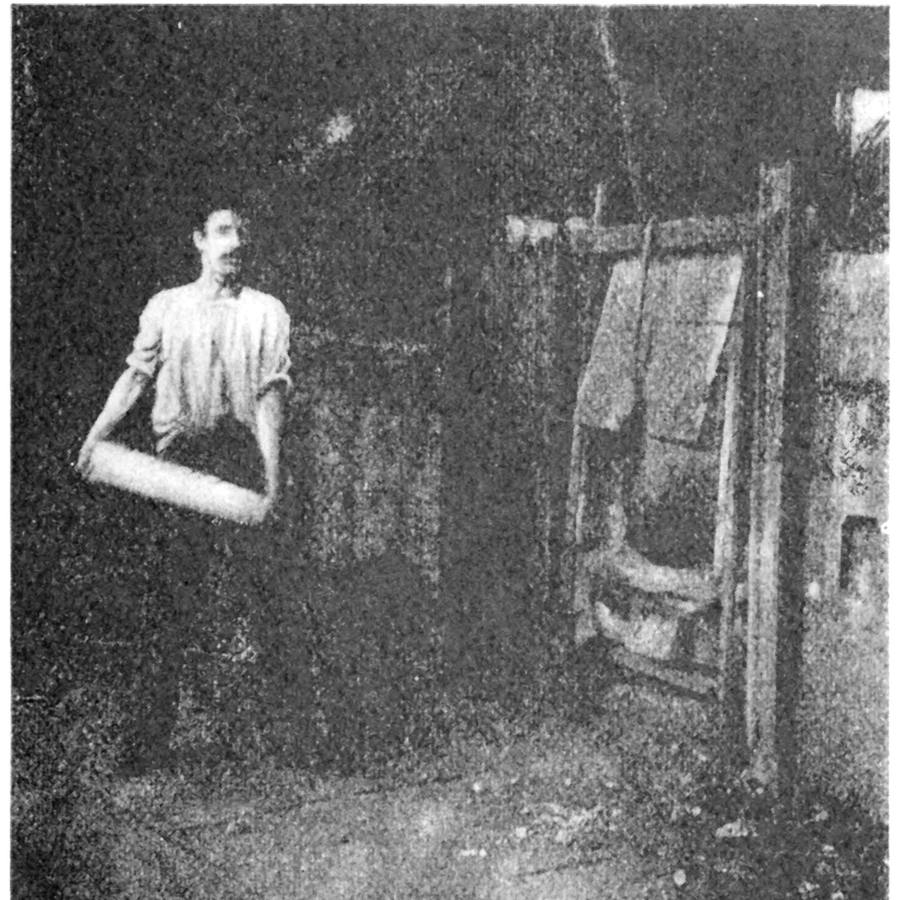
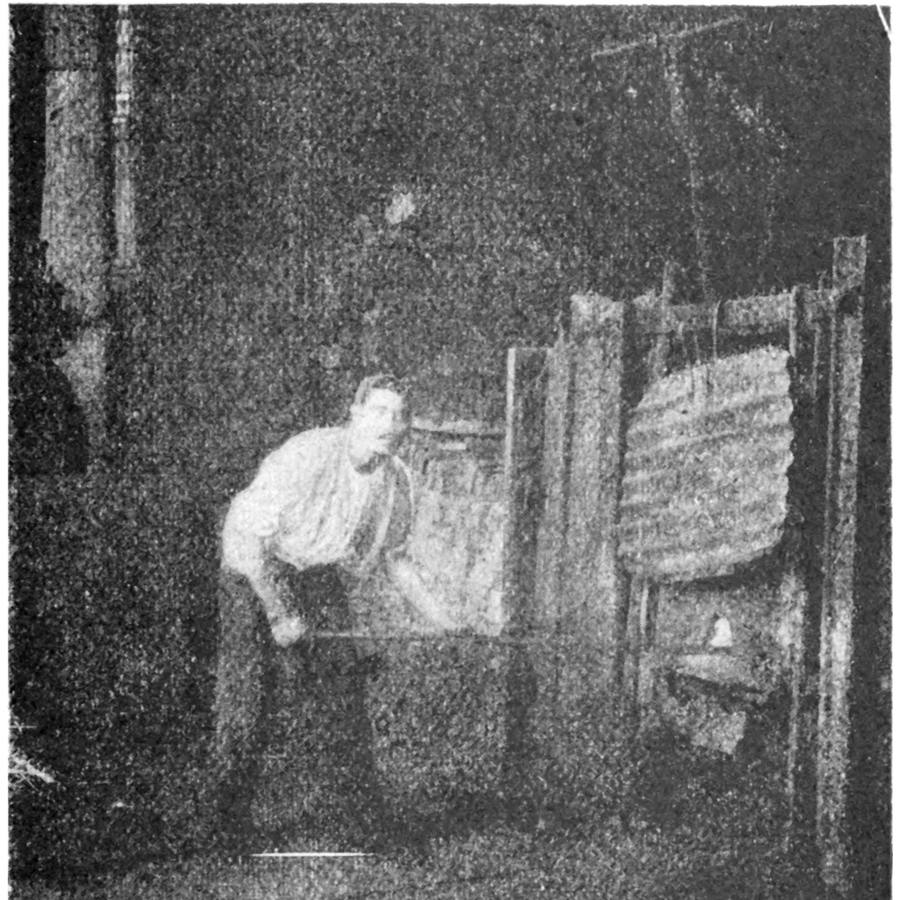
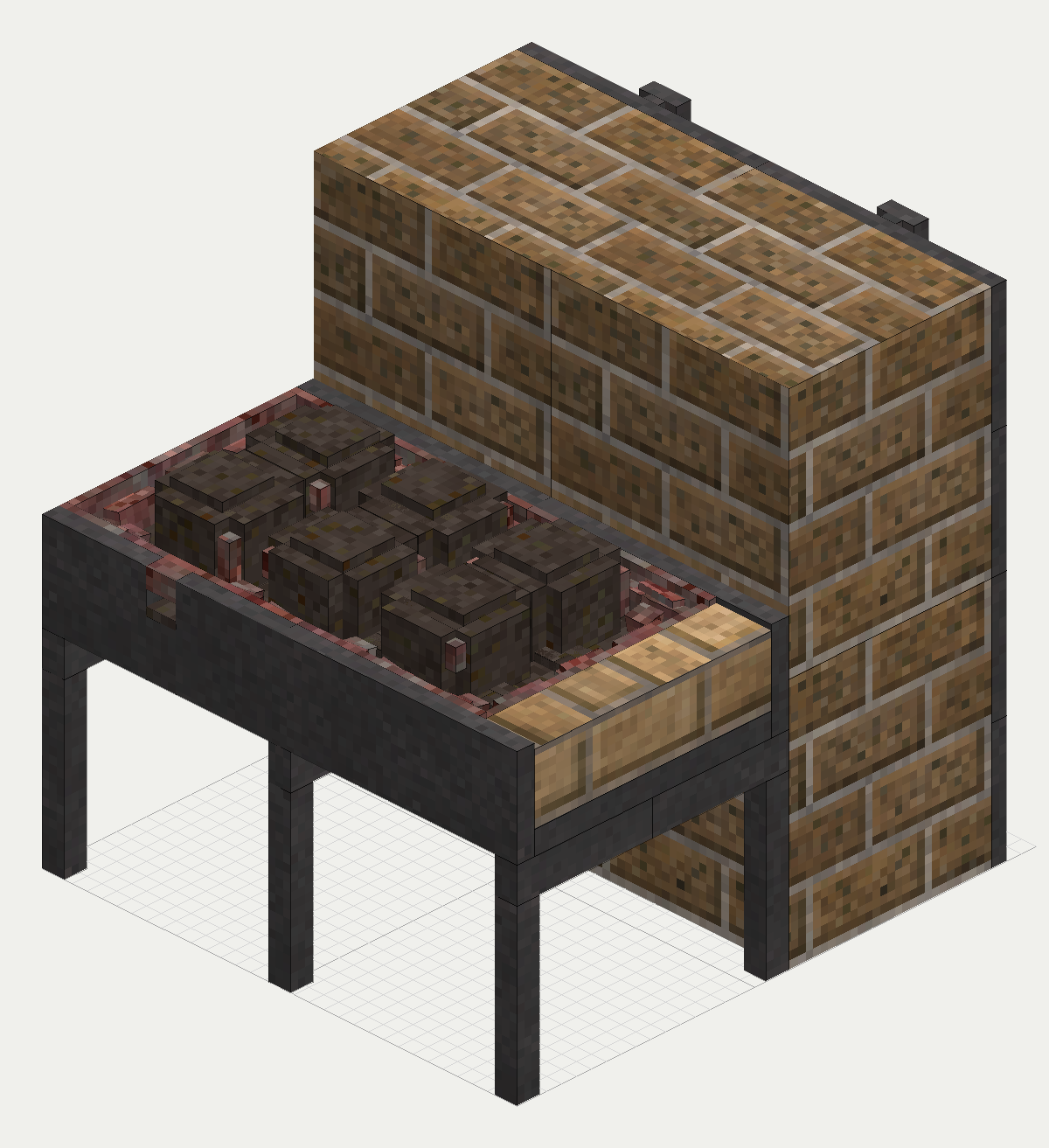
Laying the bed
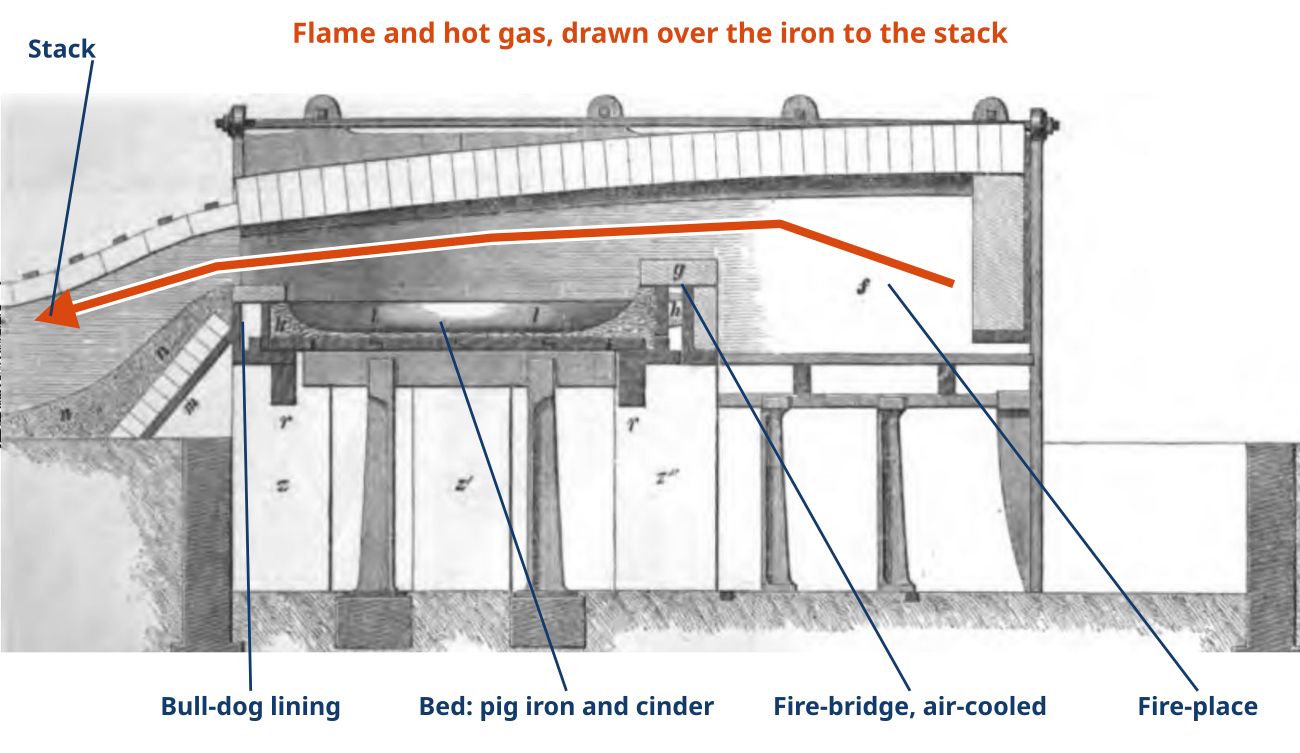
The bed comes before the iron. The bottom plates carried a lining of roasted tap-cinder, known in Staffordshire as "bull-dog" (Percy p. 643), and about 2 in of oxide of iron worked up from scrap (Percy p. 643). Truran's boiling furnace went in on broken cinder and mill scale, melted over the bottom so that it "protects it from the fused iron" (Truran p. 208).
The oxide was the point. It held the oxygen that burned the carbon out, and it was renewed heat after heat from the works' own waste: hammer-slag, scale from the rolls, and the cinder of earlier heats (Percy pp. 655, 658, Truran p. 208). Hammer-slag was said to improve by keeping and rusting (Percy p. 657).
Charging
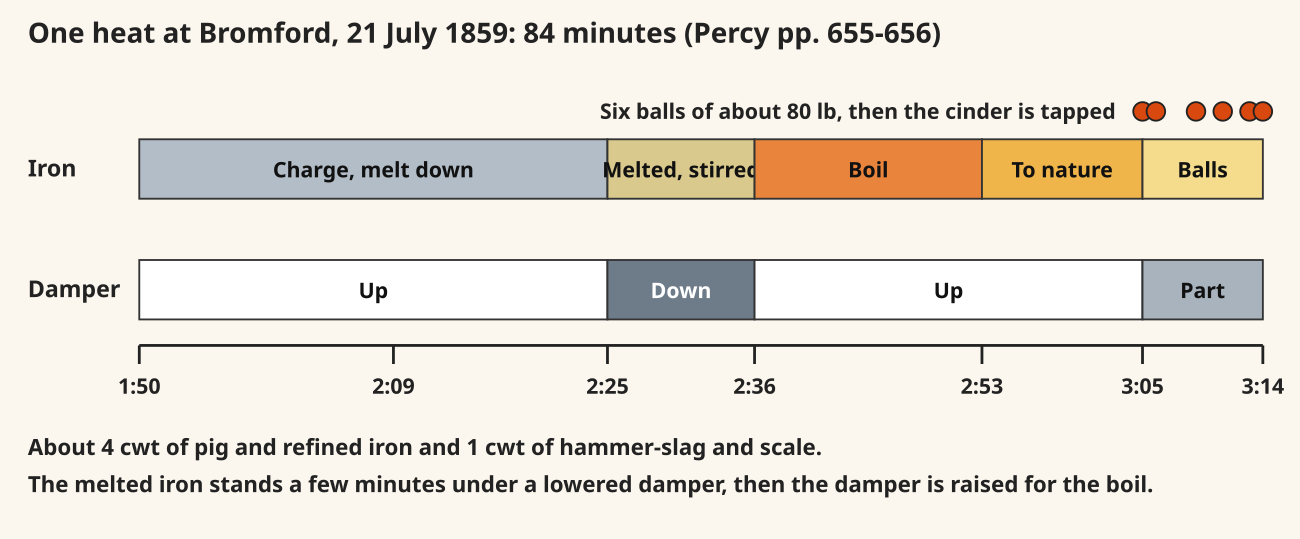
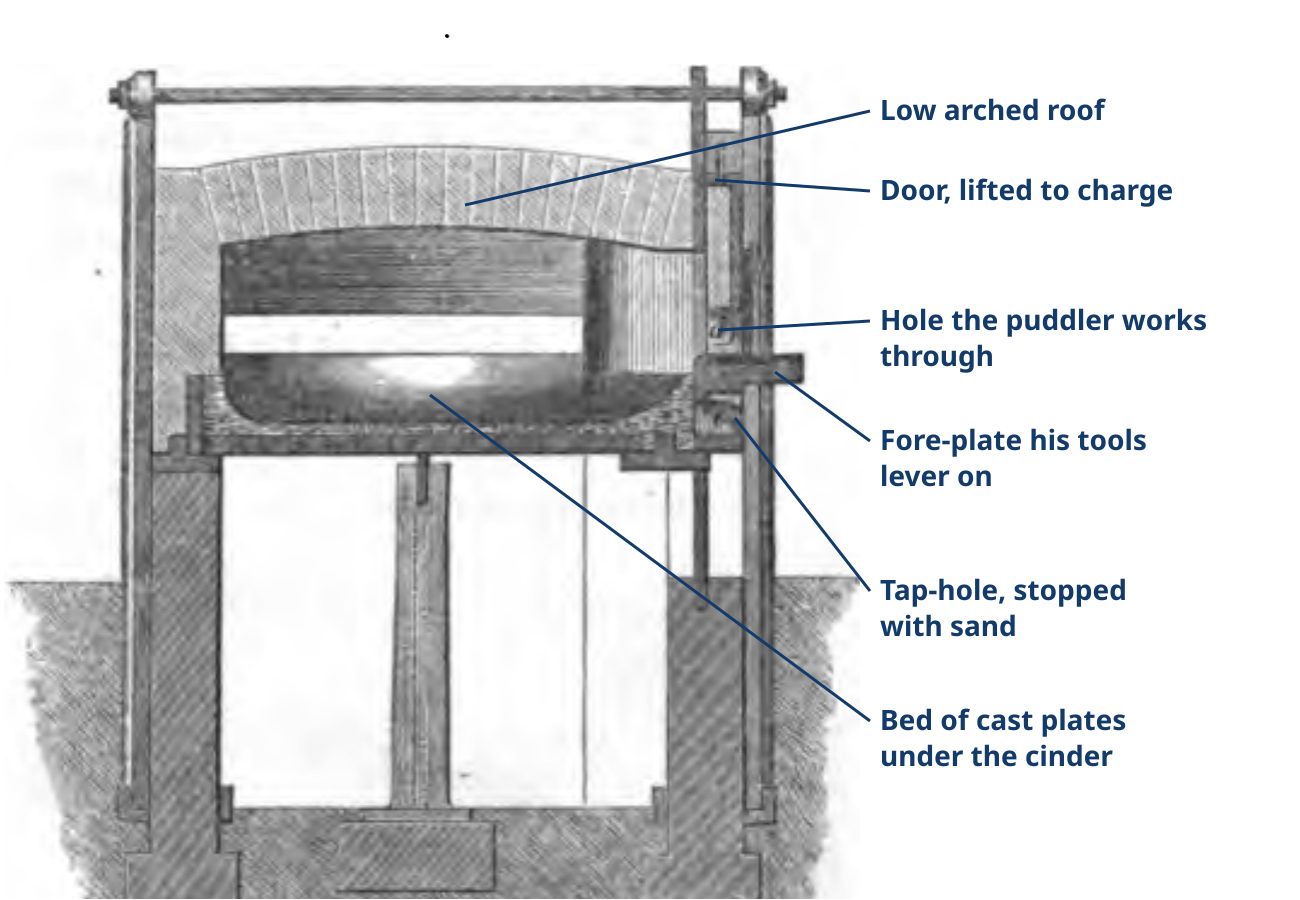
Truran's men charged the pig in pieces of 30 to 40 lb, distributed over the bottom; the charge was about 4.5 cwt (Truran p. 208). At Bromford it was 1 cwt of refined iron and 3 cwt of forge pig, with about 1 cwt of hammer-slag and scale (Percy p. 655). The door came down, was wedged, and the hole in it was stopped with a bit of bar iron; the tap-hole was stopped with sand (Percy p. 655).
Melting down
The fire was driven hard and the damper left full open. As the pieces reached a red heat the puddler moved those in the coolest part toward the hottest, and turned over the softening pieces so they would not weld together or to the bottom (Truran p. 208). The bottom was the coldest part of the furnace (Percy p. 655). The second hand kept the fire and the grate clean (Truran p. 208). Melting took about 35 minutes at Bromford (Percy p. 655) and 30 in Truran's account (Truran p. 208). Slow melting wasted iron; the men said they could "hear it frizzling" (Percy p. 657).
The boil
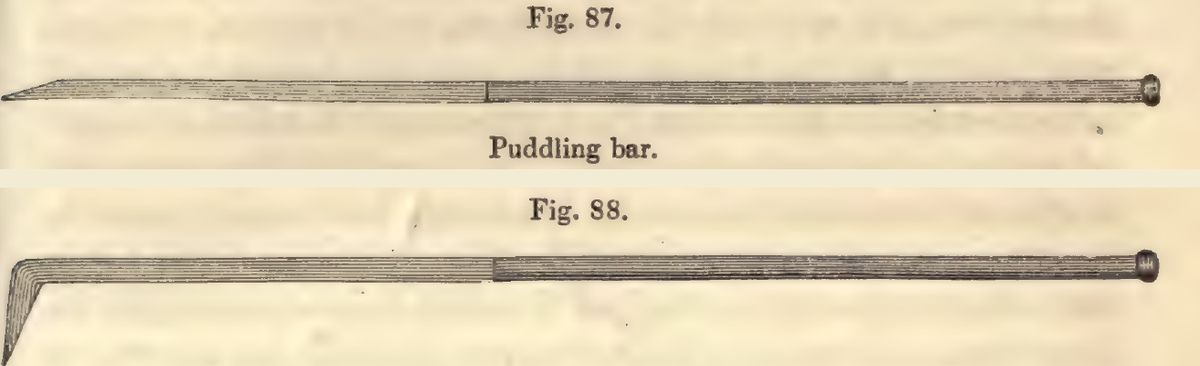
With the iron melted the labour began. The puddler raked the bath from the bottom to the surface, fore and aft, without stopping (Truran p. 209). The carbon in the metal met the oxygen of the slag, and the gas came off as jets of blue flame, carbonic oxide forming "deep below the surface" (Percy p. 655). The bath rose as it boiled, from 2 in to 10 or 12 (Overman p. 269), like "the boiling of corn" (Overman p. 269). The puddler worked stripped to the waist (Percy p. 655), and he and his underhand took the bar in turns (Percy pp. 655-656).
This was the most laborious part of the heat. Percy calls puddling "probably the severest kind of labour in the world" (Percy p. 656), and the puddlers' common deaths were of the lungs, with cataract from the furnace's light (Percy pp. 656-657).
Coming to nature
Burning off the carbon raises the melting point of what is left, until the iron no longer stays liquid at the furnace's heat. Puddlers called the moment "coming to nature" (Percy p. 656, Overman p. 268). The iron appeared first in grains the size of peas, swimming in the cinder (Overman p. 268); Truran's bath looked like "a quantity of dirty snow" (Truran p. 209). From there the skill was in judgement: too cold and the iron was "red-short" (Percy p. 657), too long and it wasted (Percy p. 656).
Balling up and drawing
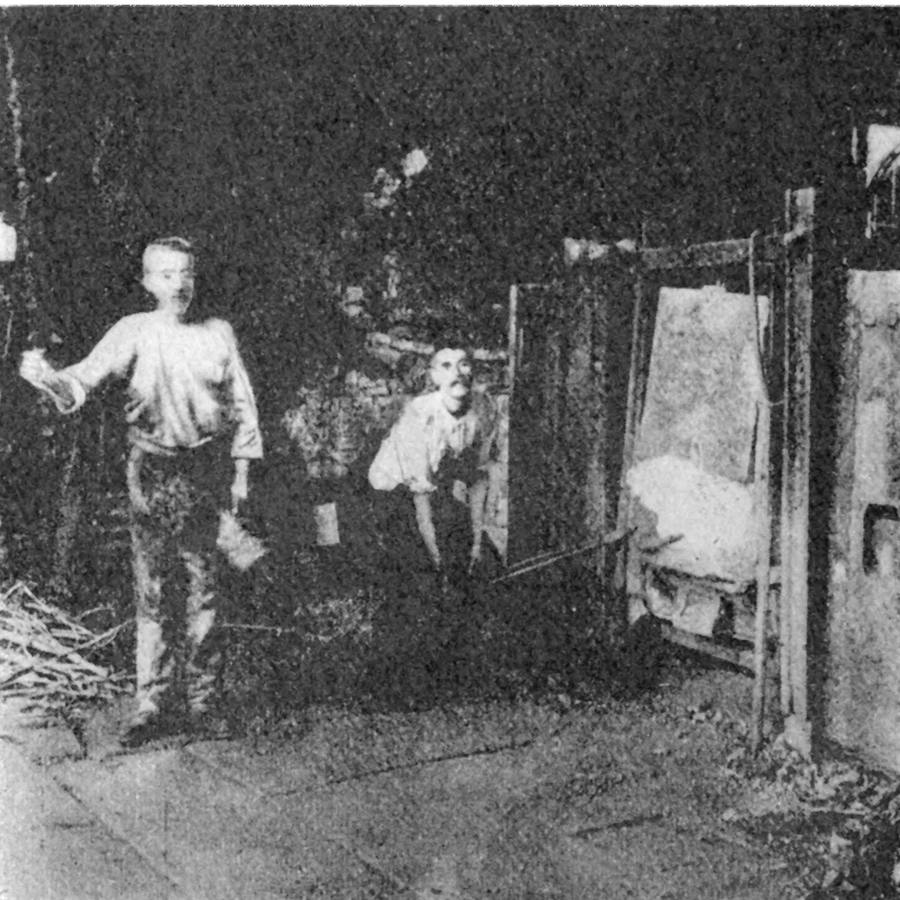
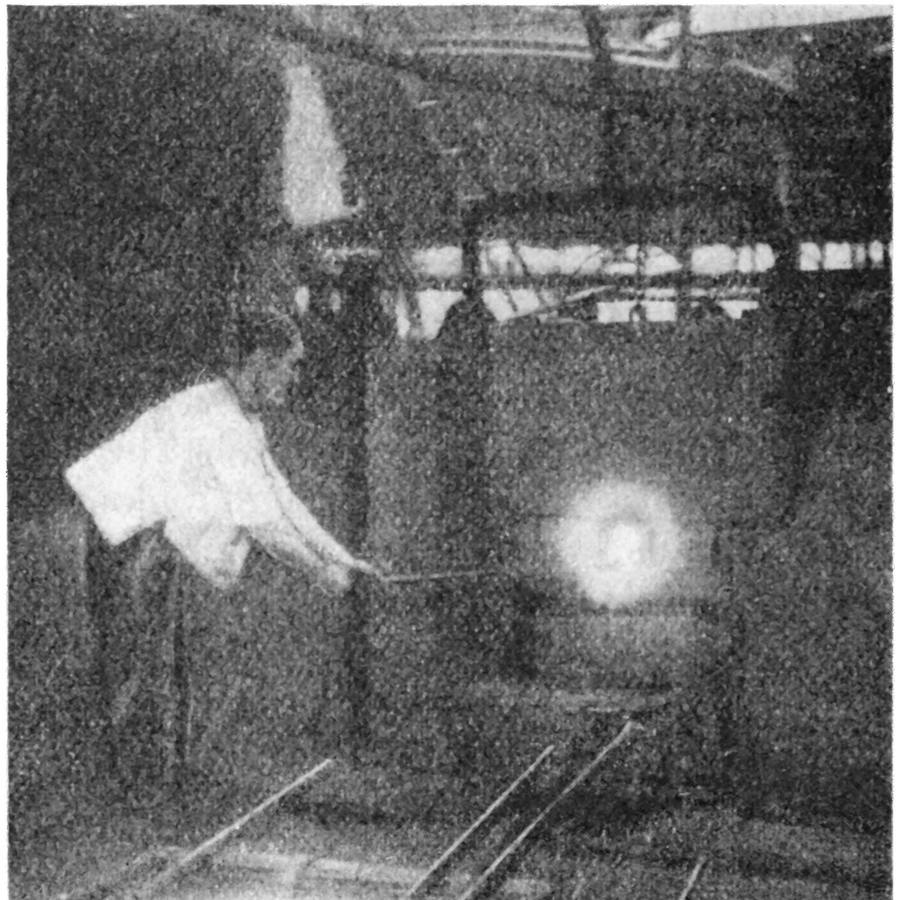
The puddler pushed the iron into lumps, then balls, using the door's slot as his fulcrum, and laid each aside in the furnace. Five or six balls was usual, seven or eight possible (Truran p. 209). The damper came down to keep the balls from softening and wasting (Truran p. 209), the body of the furnace "full of smoky or reducing flame" (Percy p. 656). A ball drawn too early and put back was a "cobble", and its maker "a cobbler" (Percy p. 657). Drawing took about four minutes (Truran p. 209), with tongs and an iron barrow or slope to the hammer (Overman p. 267).
Then the cinder was tapped. At Ebbw Vale that was every heat on grey pig, every other on white, once a turn on refined metal (Percy p. 658). The next charge went in on what remained. A whole heat took 1 h 20 min with good men and 1 h 50 min with poor ones (Truran p. 209); eight heats in a twelve-hour turn were possible (Truran p. 209). What the balls became is shingling and piling, and the furnace itself is the reverberatory furnace. Why the result behaves as it does is on cast and wrought iron.
Period basis, and what is the game's own
- Period: a reverberatory furnace with fuel and iron apart, the flame drawn over a fettled bed by a damper-controlled stack, puddling patented by Cort in 1784 (Percy p. 627), with pig-boiling, the cinder bottom and bull-dog credited to Joseph Hall (Percy p. 670). The game keeps these: fuel never touches the work, and the fire draws through the stack by natural draught.
- Period: oxide was the reagent and was charged every heat (Percy pp. 655, 658). The game keeps it as fettle: three fettle a heat, one to a bed row, made from crushed ore or tap cinder, so a works that is running fettles itself on its own waste. Roasting the fettle in a kiln is planned.
- Period: the cinder bed kept the fused iron from the plates (Truran p. 208). In the game a row that has not been fettled refuses pig.
- Period: the door was wedged and the iron worked through a hole in it, and a second, smaller door was already mostly given up by 1864 (Percy p. 641). The game has the two doors: the big one for the charge, the small one to work through. Working is refused with the small door shut, and the big door left open vents the furnace.
- Period: the cinder ran off through a sand-stopped hole under the door (Percy pp. 641, 646, Overman p. 270). In the game the tap below the door runs the cinder off liquid, into a ladle set in front of it, so the bed is clear for the next heat with the fire still lit.
- The game's own: dry puddling and boiling are one process, and the separate chemistry of silicon, phosphorus and manganese is one undifferentiated fettle.
- The game's own: rabbling gathers one ball a stroke from the melted bath rather than a watched, continuous change, with three seconds between strokes; the bar and paddle are the period's tools, but in the game the paddle draws the ball, where a real puddler drew it with tongs (Overman p. 267).
- The game's own: the balls are a fixed size and the count is forced by division, not the puddler's judgement.
- The game's own: if the fire fails on a standing bath the bath freezes, and what remains is lost to the clean-out. Nothing else spoils a heat: no red-short iron, no cobbles.
- The game's own: the base game has no puddling and no pig-to-wrought route; see vanilla against reality.
The numbers
A puddling heat keeps round game sizes with the period's figures as a check (how the numbers are scaled). Masses are in the game's units (scale and units). Planned is the settled redesign; values without that word are what the game has now.
| In the game | Period figure | How it was scaled | Game value |
|---|---|---|---|
| Charge | 4 cwt of iron and about 1 cwt of slag (Percy p. 655); about 4.5 cwt (Truran p. 208) | What the hearth holds today; planned one pig to a row, 4.5 cwt being about 4 pigs as a check | 9 pigs, 675 u; planned 3 pigs, 225 u |
| Pieces | 30 to 40 lb broken pig (Truran p. 208) | The game's pig, whole | One pig of 75 u |
| Balls a heat | Six (Percy p. 656); five or six, seven or eight possible (Truran p. 209) | Whatever the charge divides into, a forced result | 3; planned 4 |
| A ball | About 80 lb (Percy p. 656); 70 to 80 lb, 12 to 15 in across (Overman p. 268) | A round game size, with the period figure as a check | 200 u; planned 50 u |
| Iron from pig | 21 1/2 to 22 cwt of pig to 20 cwt of bar (Percy p. 657); 24 cwt with an unskilful man (Percy pp. 721-722); 21 cwt 20 lb on average (Truran p. 215) | Division: 675 less 600 u, nothing destroyed | 88.9% to balls, 11.1% returned as tap cinder |
| The cinder | Tapped or left for the next heat (Percy p. 658, Overman p. 270) | The remainder of the division | 75 u, 3 tap cinder; planned 25 u |
| Fettle | About 1 cwt of slag a heat (Percy p. 655) | One to a bed row, the game's own count | 3 a heat |
| The heat | 1 h 20 min to 1 h 50 min (Truran p. 209); 1 to 1 3/4 h (Percy p. 657) | The melt alone is paced, in game time; the working is by hand | Melt about 1.04 game hours; a stroke every 3 s |
| Process heat | The books give no figure | The game's own | 1400 C |
| The rabble | 8 ft long, 40 lb (Percy p. 646) | Tool of the game's own size, crafted from two rods and a plate | One rabbling bar, one paddle |
Open, and what you can tell us
The books at hand do not agree on the damper during the boil. Percy's man at Bromford raised it for the boil (Percy p. 655); Truran lowers it part way five or six minutes after the boil starts, and calls for it nearly shut as the balls are finished (Truran p. 209); Overman has it nearly shut while the iron mixes and raised, by degrees, as the iron comes to nature (Overman pp. 267-268). The difference may be between dry puddling and boiling, or between works and iron, and the sources at hand do not settle it. The game treats the damper as a draught control and asks nothing finer of it. If you know a source that compares the practice of the two systems, we would like to read it.
Picture credits
- Charging, rabbling, drawing a ball and tapping cinder: Walter Macfarlane, 1917, public domain, cropped.
- Figs. 133 and 139: Percy, Metallurgy: Iron and Steel, pp. 641 and 643, turned and labelled for this site, Library page.
- Figs. 87 and 88: Overman, The Manufacture of Iron, p. 267, Library page.
- The Bromford heat: drawn for this site from Percy pp. 655-656.
- The game's hearth: the mod's planned drawing.
Comment or suggest something in the Expanded thread on the Vintage Story Discord