
The machine shop
A casting comes out of the sand rough, oversize and with a hard skin. Before it can be part of an engine, the faces that meet, the holes that fit and the shafts that turn must be cut to size, and that was the work of the machine shop. The tools themselves are in the catalogue, from the lathe to the planer, and what drives them is in the shaft power guide. This page follows a casting through the shop as the workers did, then says what the game keeps of it.
Most of what follows comes from Rose's Modern Machine-Shop Practice (1901 printing of the 1887 work) and the Sellers catalogues of 1877 and 1895, so the practice they record is that of the end of the century.
The work in order
The first face. The first cut on a casting went under its skin, which dulls a tool (Rose p. 286). On a long casting the face that would rest on the foundation or the legs was planed first, with the casting supported evenly at each point so that it did not spring (Rose p. 420). Every later measurement could then start from a true face.
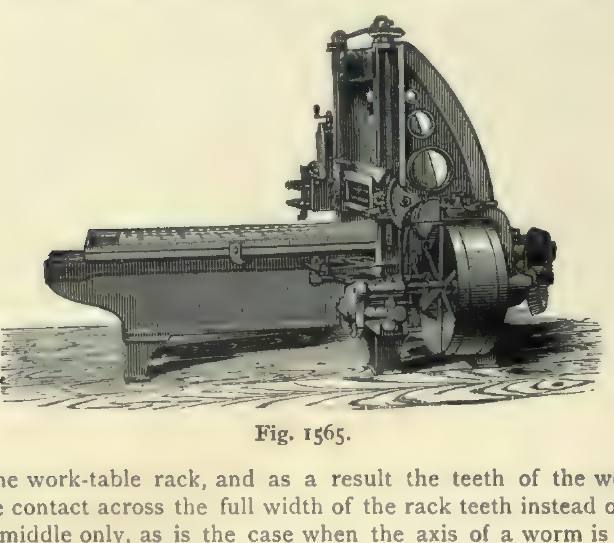
A planer's table ran at the same cutting speed for all work and all metals. The shaper took small pieces, and it was quicker on them because its stepped pulley could vary the speed (Rose p. 398). Two heads on a planer, one roughing and one finishing, doubled the output (Rose p. 405).
The bore. A hole that something must fit was bored, and heavy work stayed still. "When work of considerable weight requires to be bored ... it is more convenient that it remain fixed upon a table, and that the boring tools rotate" (Rose p. 218).
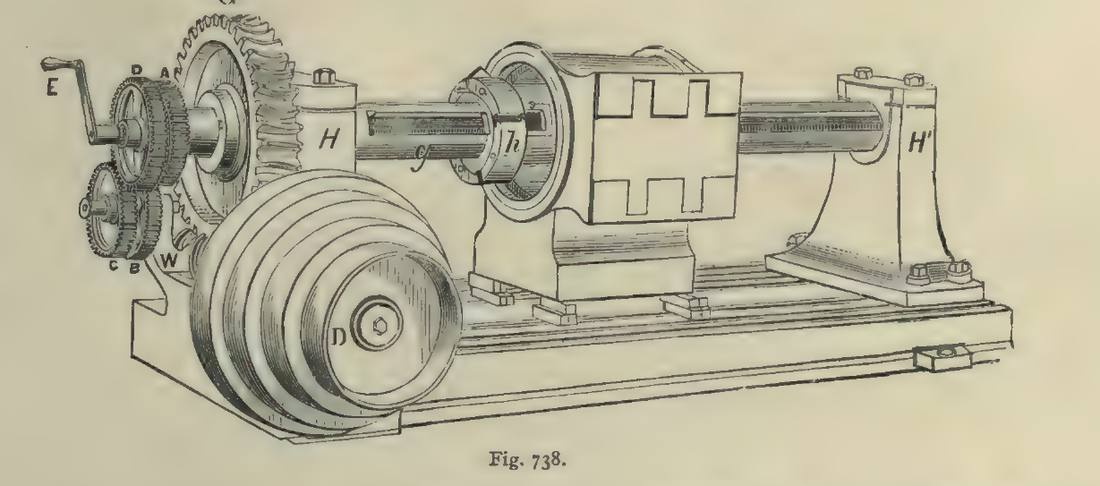
The cutter head had four cutters where it could: three bore out of round, and four fed four times as fast (Rose pp. 289-291). A dull tool bored a taper, so the finishing cut had to carry its whole length without a regrind (Rose pp. 286-287, 294).
What is round. Shafts, rods and pistons went on the lathe, and with them almost everything else.
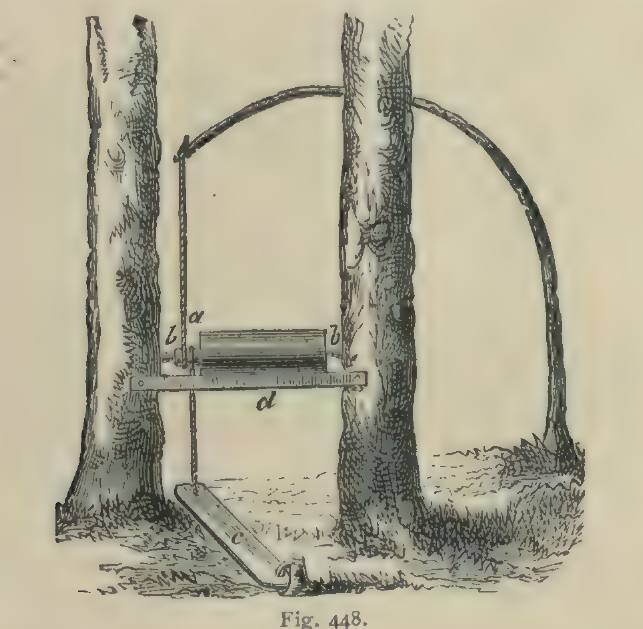
The lathe was more than one machine in the shop's own view. Drilling, boring and reaming were all done on it, some planing could be done as well, and a good lathe hand was thought able to run any other tool in the shop (Rose p. 119).
The cuttings told the man how the cut was going. Cuttings from wrought iron should come off almost too hot to hold, short uncoiled cuttings meant too little rake, and a tool that dulled fast had too much clearance (Rose p. 259). Workmen differed by 30% in speed and 50% in feed, and Hartnell's figures run wider still (Rose p. 295).
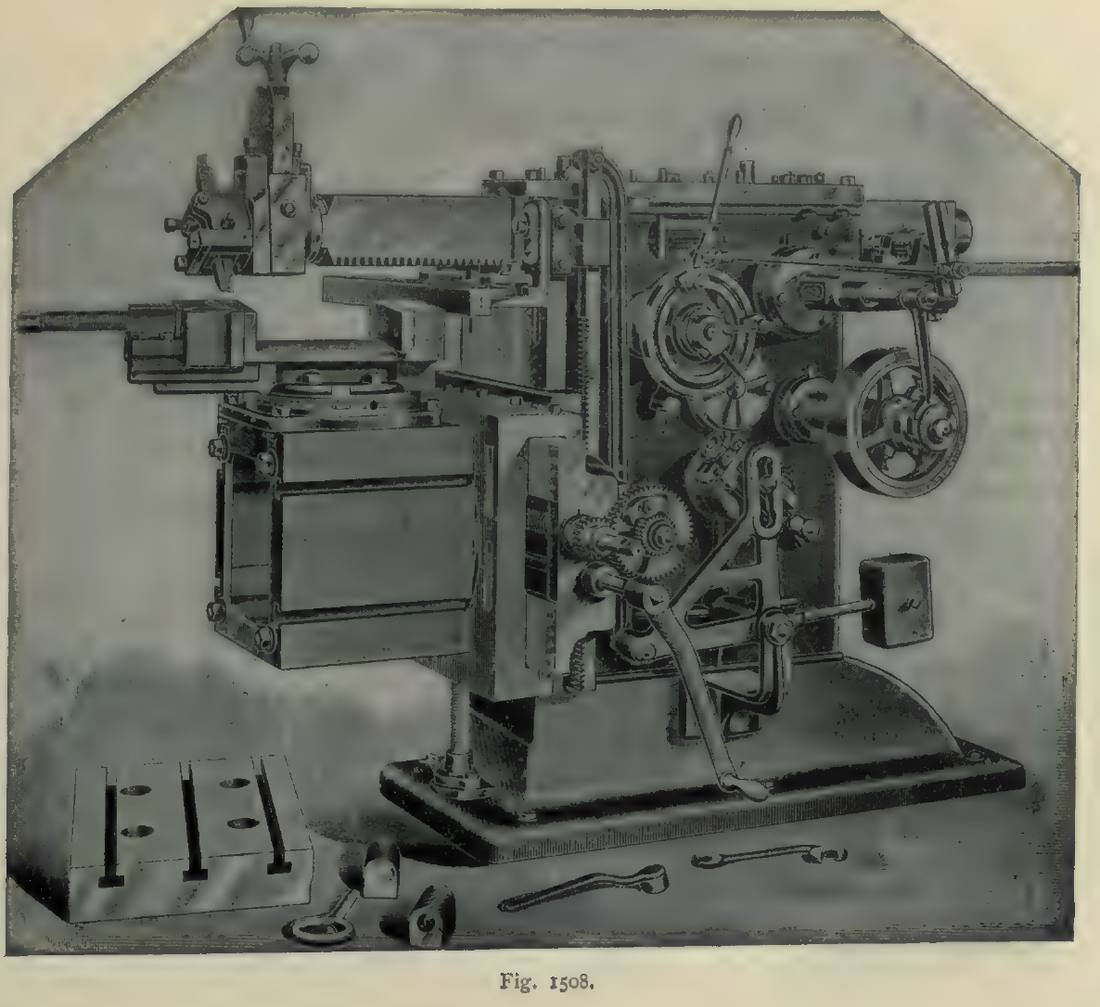
Flats, keyways and small work. The shaper's ram carried the tool across a piece held still, about 18 in at most and 12 on a small machine (Rose pp. 396-397). It cut keyways in shafting held in its chuck or between centres (Rose p. 397), and its return, by crank or link, was about 40% quicker than the cut (Rose pp. 398-401).
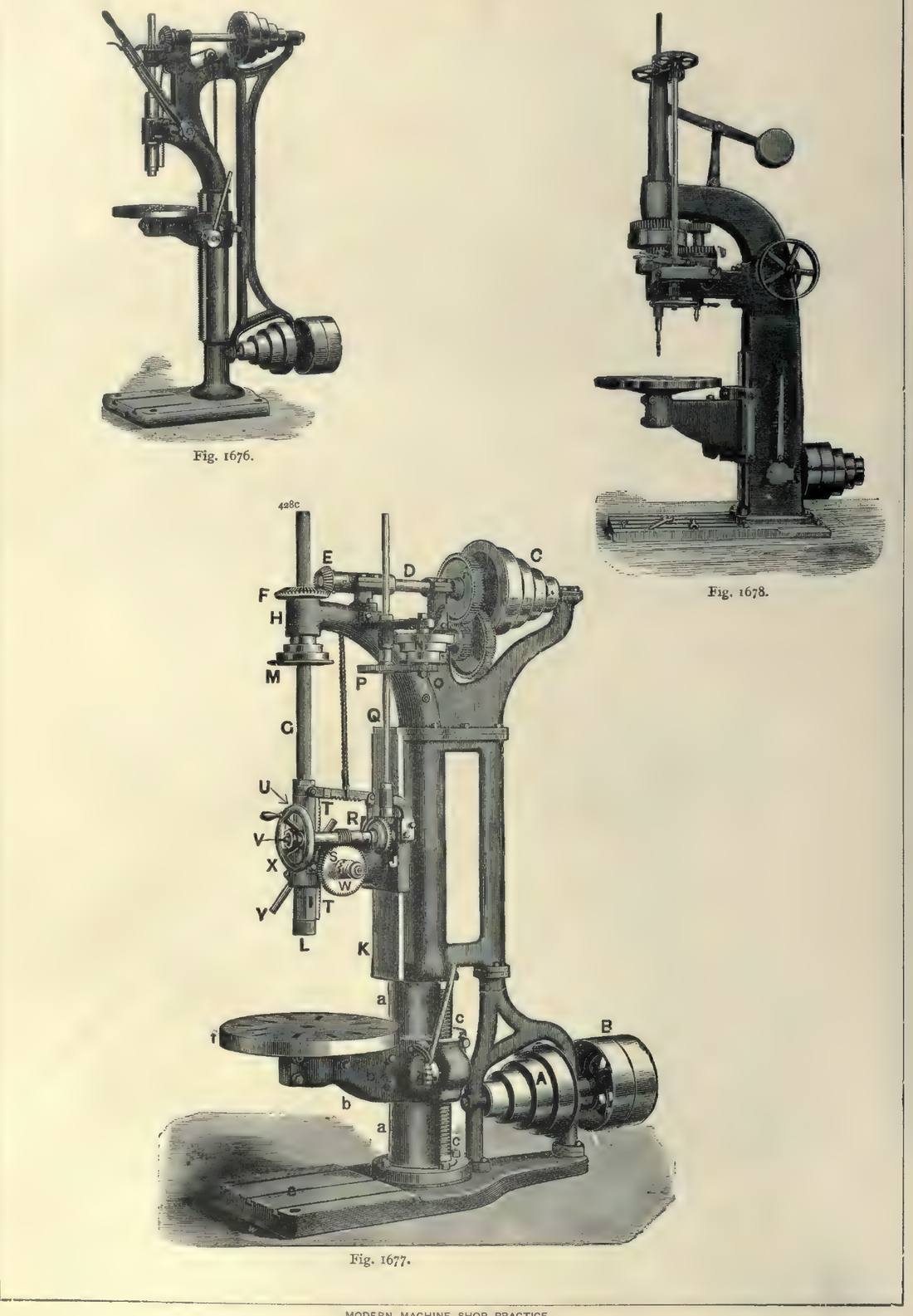
Holes in numbers. Where many holes had to match, a template did the laying out. A locomotive cylinder's cover and flange holes were drilled through a template ring, clearing holes first and tapping holes after (Rose pp. 440-442).
Why the shop grew in the order it did
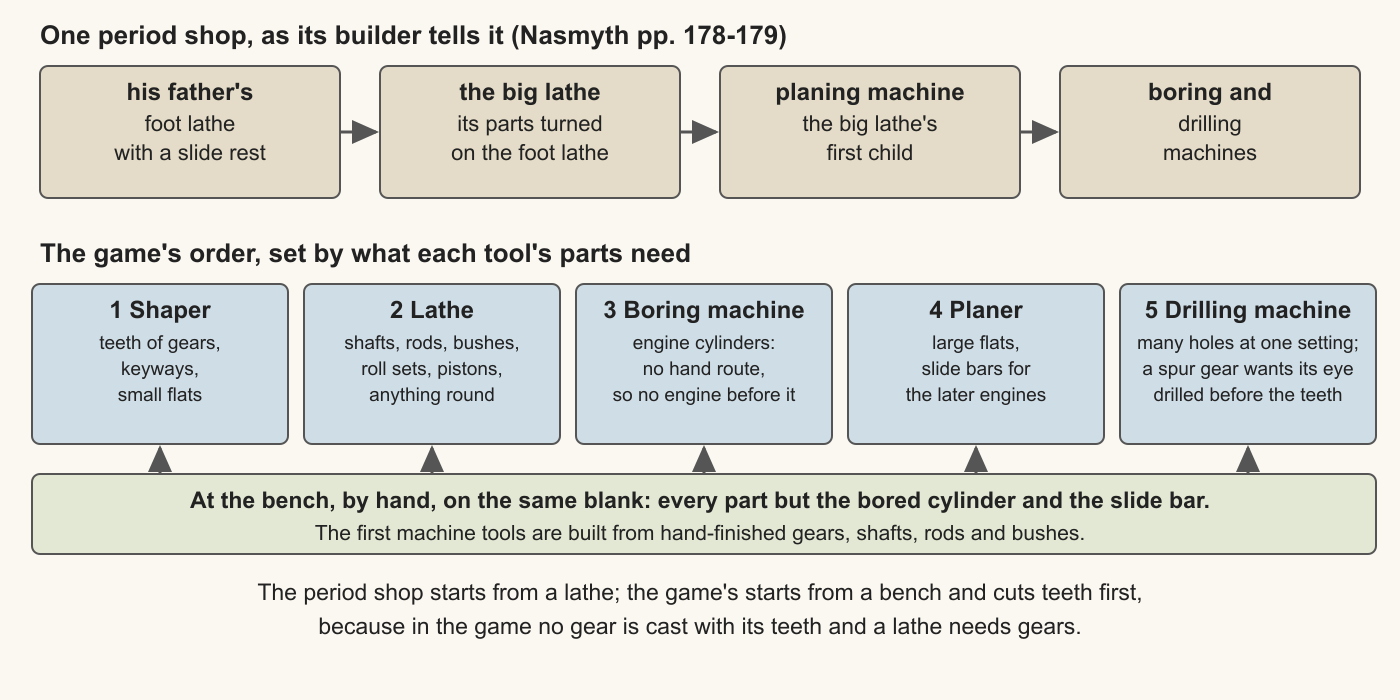
James Nasmyth set up on his own in 1831 and left the best account in the books of how a shop was bootstrapped. He began with his father's foot lathe, to which he had added a slide rest, and with castings for a big lathe. The foot lathe turned the big lathe's parts. The big lathe's "first child was a planing machine", 3 ft by 1 ft 8 in, and with those two "most important and generally useful tools" he added boring and drilling machines (Nasmyth pp. 178-179). He wrote that the lathe would be "the parent of a vast progeny", and in his shop it was. The shaper does not appear in that passage.
What drove the whole business was accuracy. William Fawcett, a Liverpool engine builder, called Maudslay "the great pioneer in the substitution of the unerring accuracy of machine tools, for the often untrustworthy results of mere manual labour" (Nasmyth p. 168).
Period basis, and what is the game's own
- Period: the shop's tools overlapped, and the lathe did everyone's work (Rose p. 119). The game gives each tool one verb: turn, bore, shape, plane, drill. The split keeps the number of machines to five and gives each a reason to be built.
- Period: a heavy cylinder stood still and the bar turned (Rose p. 218), and its outside stayed as cast (Rose p. 219). Planned for the game: every barrel bored with its ends faced at the boring machine, its outside as cast.
- Period: teeth were cut on gear-cutting engines by revolving or rack-form cutters (Rose pp. 34, 36), and the shaper cut flats and keyways (Rose p. 397). The game's own: the shaper cuts the teeth, one machine instead of a sixth, and the drilling machine the eye first.
- Period: tool steel, hardened and tempered, for every cutter in Rose (Rose p. 254). The game's own: a cutter of any iron or steel, its temper the gate and its metal the reach and life, so that the shop can start before steel does.
- Period: cuttings came off every machine (Rose pp. 259, 273), and a casting's skin dulled the tool (Rose p. 286). Planned for the game: every job returns what it removed as cuttings of that metal, to be melted again, and a remainder too small for a cutting leaves as scale.
- The game's own: the bench. Every part a machine tool makes has a hand route on the same blank at the bench, slower and more wasteful, so the first machines can be built before there are any. The exceptions are the bored cylinder and the slide bar.
- The game's own: a cut is one hold at the machine. Laying out, setting up and measuring are folded into it.
The numbers
Each job in the game costs energy for the metal removed, and takes as long as that energy lasts at the machine's power. Hartig's figures are used at face value, with no fuel factor (see the scaling page); game time follows scale and units. "Planned" is the rating in design.
| In the game | Period figure | How it was scaled | Game value |
|---|---|---|---|
| Energy to cut cast iron, rotary | .0314 hp per lb of cuttings an hour, lathe (Hartig in Rose p. 273) | 5.918 MJ/kg per hp/(lb/h) | 185,800 J/kg |
| Energy to cut wrought iron, rotary | .0327 hp, lathe (Rose p. 273) | The same | 193,500 J/kg |
| Energy to cut wrought iron, reciprocating | .0520 hp, planer (Rose p. 273) | The same | 307,800 J/kg |
| Energy to cut cast iron, reciprocating | None printed | The lathe's figure times wrought iron's planer-to-lathe ratio | 295,500 J/kg, derived |
| Energy to drill | None printed | Takes the rotary figure | The game's own |
| Drilling machine power | 1/2 in hole through 2 3/4 in of iron in 1 min 20 s (Rose p. 278), about 170 W | The same cut scaled to a 3/4 in hole | Planned 360 W; the game's own |
| Lathe power | Cast iron at 45 ft/min, feed 30 an inch (Rose p. 294) | With a 1/8 in cut, the depth the game's own | Planned 822 W |
| Boring machine power | A locomotive cylinder in 3 1/2 h (Sellers 1895 p. 74) | Bore and length of a 22 in by 36 in cylinder, the 3/8 in skin the game's own | Planned 1620 W |
| Planer power | 18 ft/min cut, 72 return (Sellers 1895 p. 187) | 0.8 of the time cutting; feed and depth the game's own | Planned 780 W |
| Shaper power | Return about 40% quicker (Rose p. 398) | The planer's cut at 0.583 of the time cutting | Planned 570 W |
| Hand work at the bench | Rankine's crank and pump rows (Rankine 1876 p. 626) | Sustained man's power, the pump row inferred for reciprocating work | 61.0 W rotary, 44.7 W reciprocating |
| Hand or machine, one 1.5 kg wrought-iron plate drilled | None given | Energy over power | 159 real seconds by hand, 27 at the machine |
Open, and what you can tell us
The books at hand describe the shop at the end of the century; Nasmyth's memoir is the one account here of a shop being built up, and it is one man's. They do not say what order a typical works bought its tools in, or whether a shaper usually came before a planer. Nor do they say how a shop of the 1830s cut the teeth of the wheels it wanted true: Rose only says cast wheels could not be (Rose p. 34). A source on either would be welcome.
Picture credits
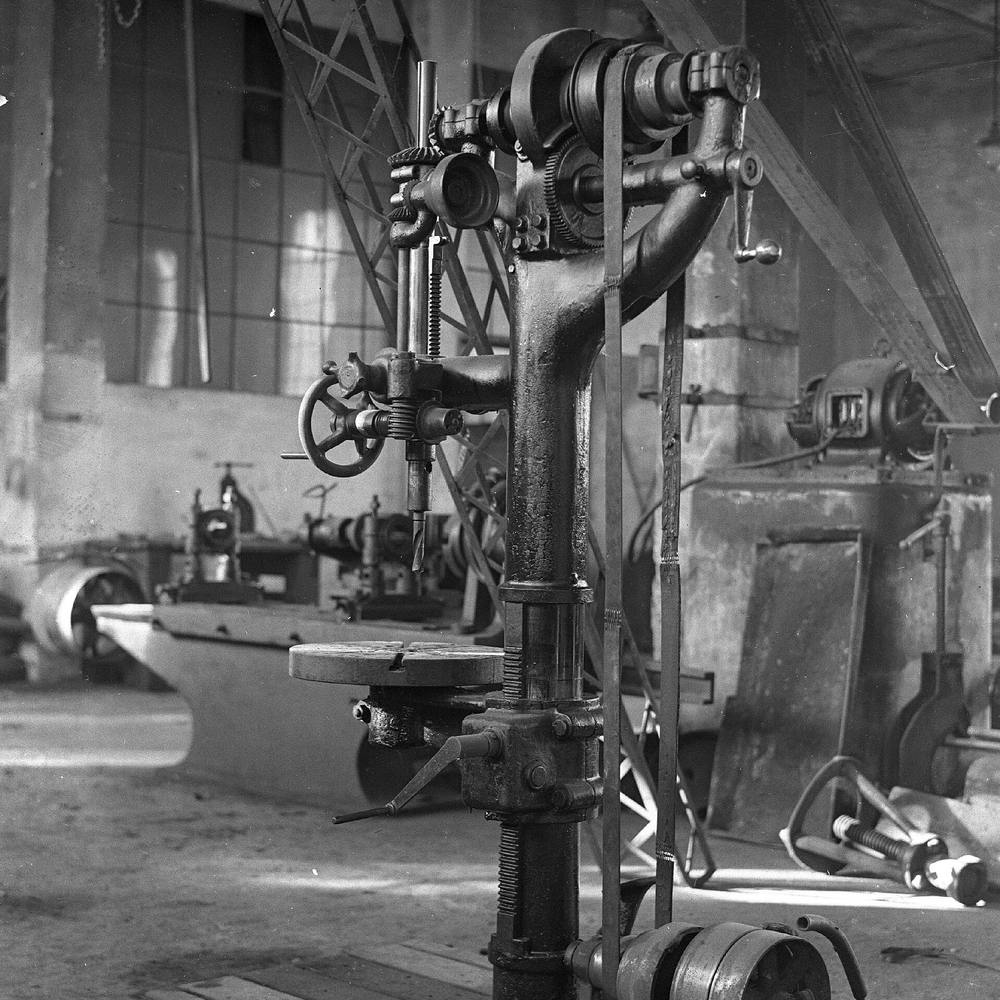
- Line shaft, boring machine, workshop, lathe, belt drive: Fortepan, ID 62666, public domain, cropped.
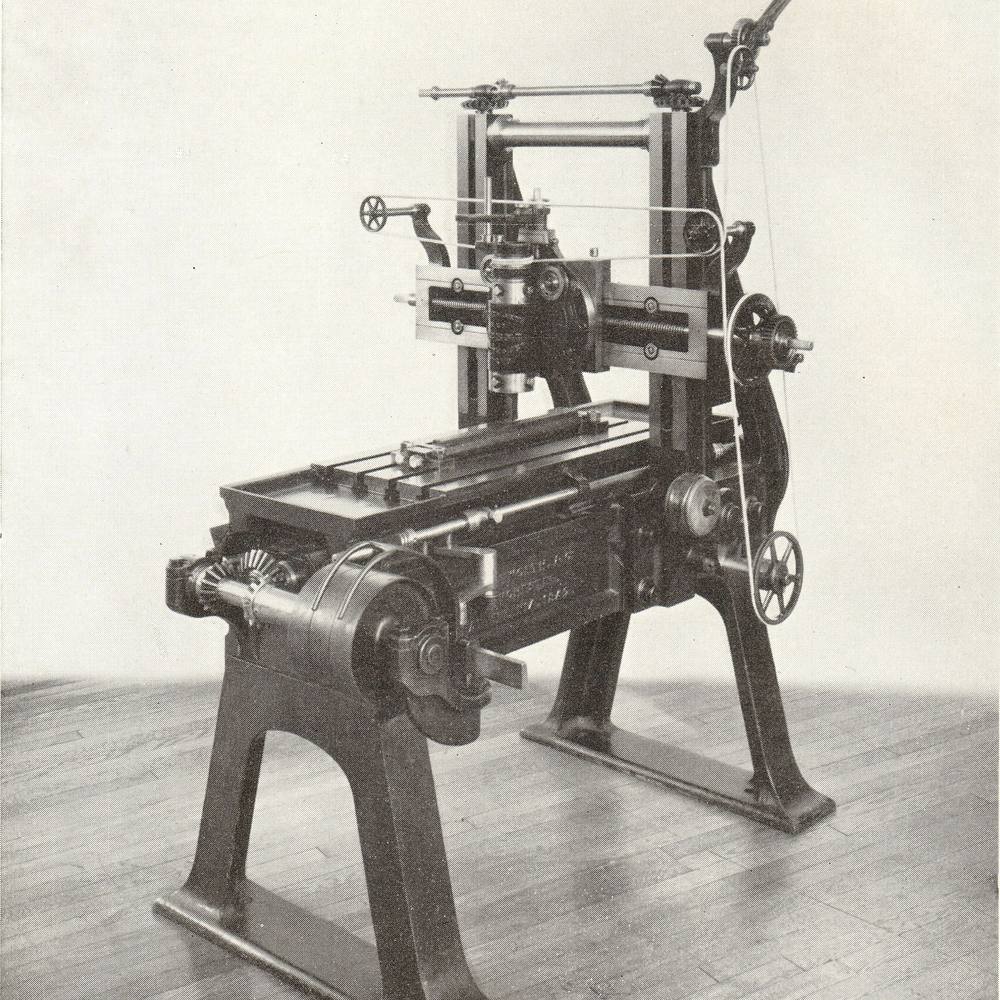
- Planing machine by J. Whitworth and Co., 1842: K. R. Gilbert, The Machine Tool Collection (1966), Plate 26, public domain, cropped.
- Figs. 448, 738, 1565 and 1508 and Plate XCV: Rose, Modern Machine-Shop Practice, vol. I, pp. 119, 219 and 406, Plate LXIX-B and Plate XCV, Library page.
- The order of the tools: drawn for this page from Nasmyth pp. 178-179.
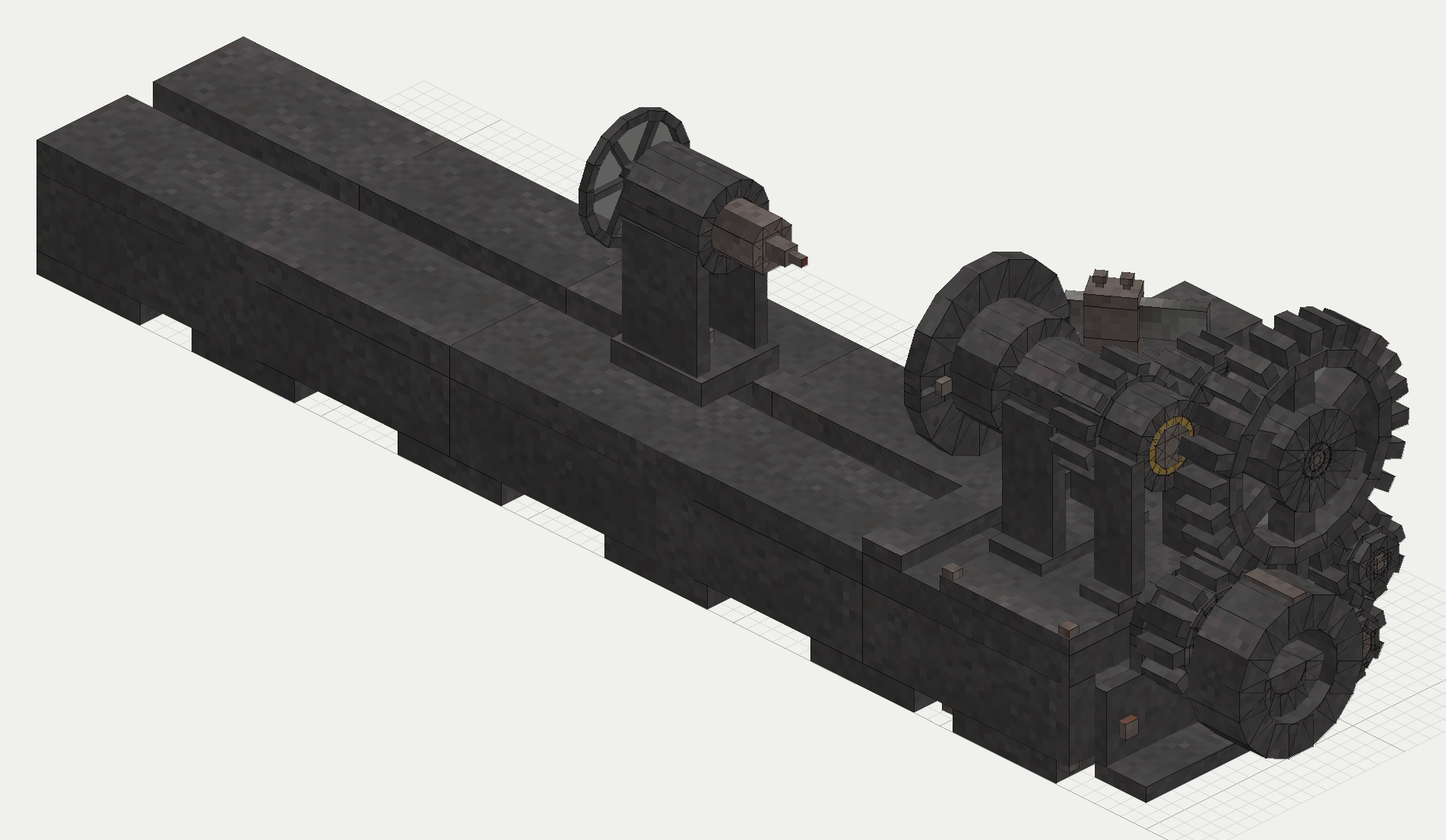
- The game's lathe: the mod's planned drawing.
Comment or suggest something in the Expanded thread on the Vintage Story Discord