
Calcining kiln and chutes
A calcining kiln is a brick shaft in which iron ore was burnt, gently, before it went to the blast furnace. The bins and chutes around it are how the ore got there and away again. In the game the kiln is planned and not built: the burden guide covers what a furnace is fed today, and this page is about the real kilns and how the planned one follows them. What the fire does to the stone is on the iron ore page.
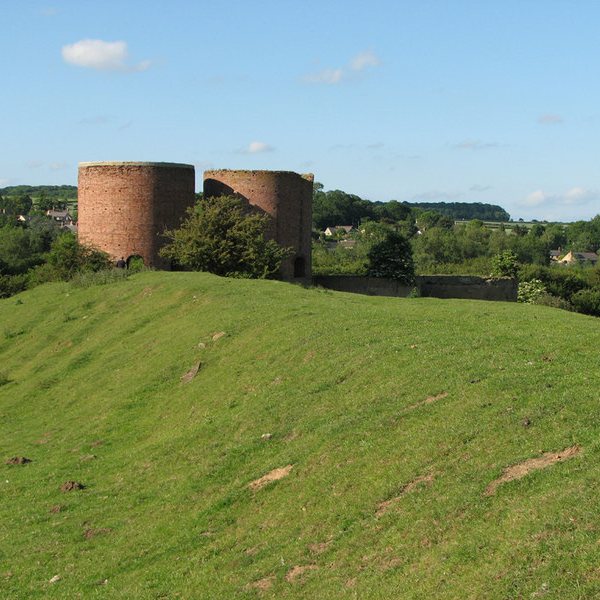
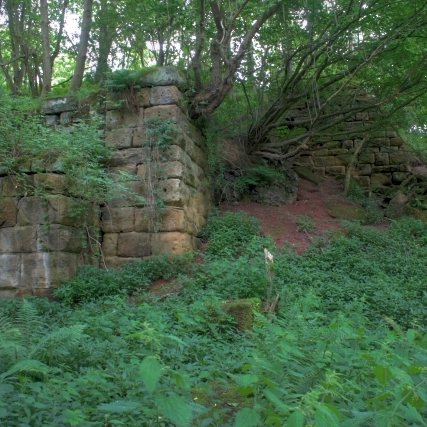
The game's kiln has no finished drawing yet, so this page shows no render of it.
A column of ore and a slow fire
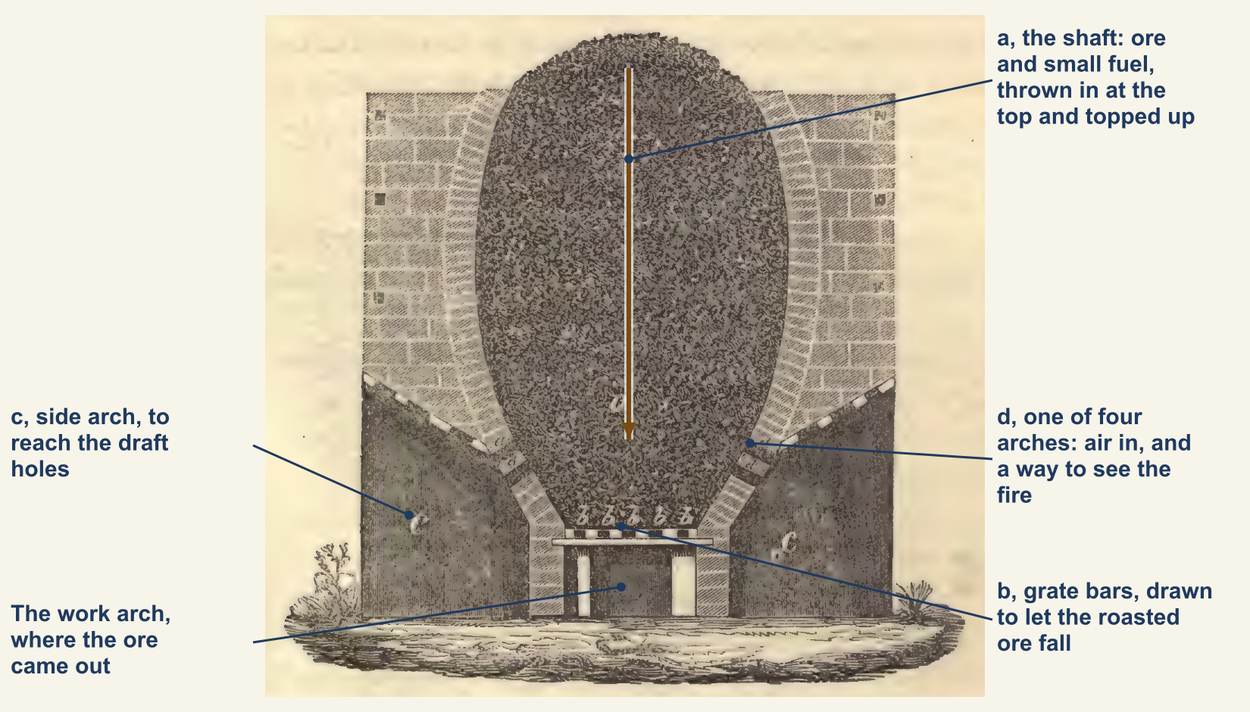
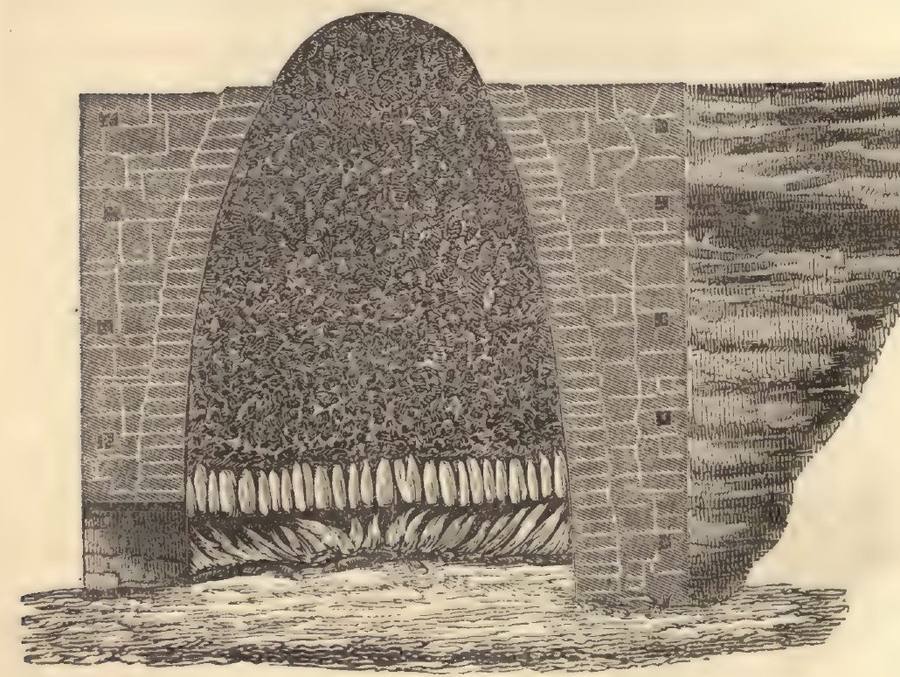
Overman reduces every roasting oven to "the blast furnace, or the limekiln", either "perpetual, or work by charges", 12 to 18 ft high and holding 50 to 100 tons of ore at once (Overman p. 41). A kiln of the perpetual kind is laid with wood or small fuel on the grate, then coal and ore alternately to the top, and then lit. "When the lower portions of ore are sufficiently roasted and cool, they are taken out", and what is not well done goes back in at the top (Overman pp. 41-42). Fifty tons of capacity "ought to yield thirty tons of well roasted ore in twenty-four hours" (Overman p. 42).
The fire sits in the column and the ore passes through it. Bauerman describes the same action: the ore is piled above a thin bed of fuel, the part roasted by the burning at the bottom is withdrawn, and "the next layer falls" (Bauerman p. 110). Nothing moves except by gravity and the draw.
Fuel is what made a kiln worth building. Dowlais kilns held about 70 tons of raw stone, passed 146 tons a week and burned about 5% of small coal by weight, 1 cwt to the ton, where roasting in clamps took 2 cwt of small and half a cwt of large (Bauerman p. 112). Stones were laid in on the fire in nine-inch layers as each one reached a dull red, and the lowest ore had cooled enough to draw by the time the kiln was full (Bauerman p. 112).
Why the shape changed
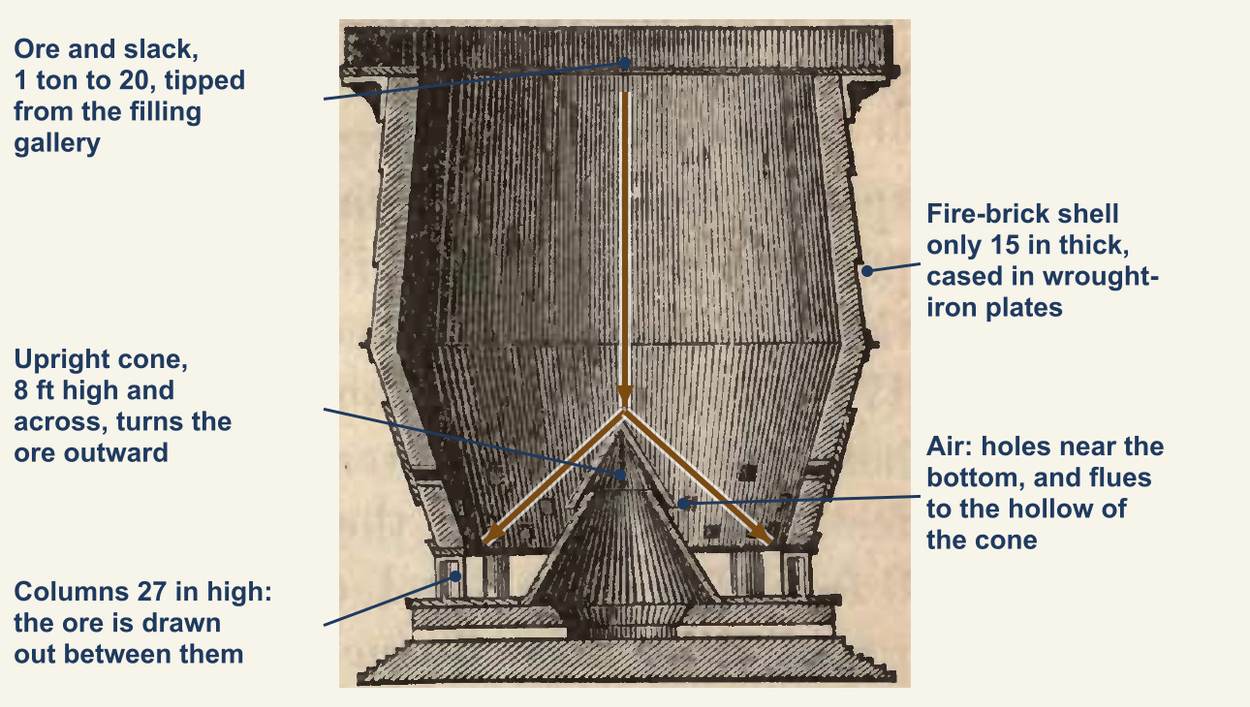
A large round kiln had a fault in its plan: the centre got too hot. Bauerman's cure was the shape, a flattened ellipse or rounded rectangle for big kilns (Bauerman p. 111), and Dowlais kilns were built oval (Bauerman pp. 111-112). The Gjers kiln kept the round shell and put the charge on a cone, "to cause the descending materials to pass outwards" (Turner p. 92). Air came in through holes near the bottom and by flues to the hollow of the cone, so the middle of the shaft got air as well (Bauerman p. 113).
Too much heat was the danger throughout. Ore over-fired in the kiln is "as bad as though they were not roasted at all; in fact ... worse" (Overman p. 172). Carbonates melt to a black cinder (Overman p. 40), and French kilns held their heat down "to prevent coagulation" (Percy p. 281). Good roasted ore was red or brown, stuck to the tongue and broke easily (Overman p. 172).
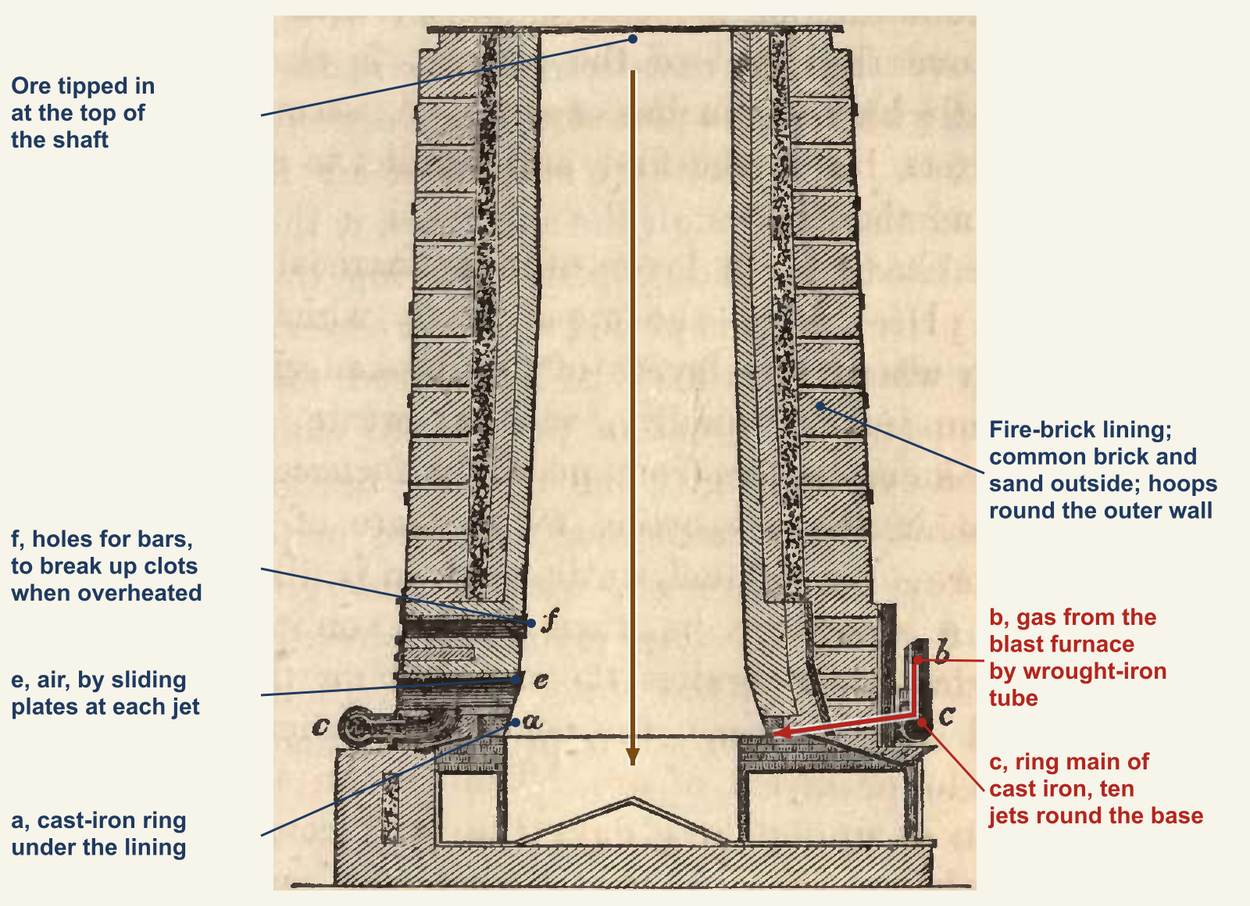
Sweden burned the furnace's waste gas in its kilns (Percy p. 374). A gas-fired kiln is left to the game's later steel mod, as planning only.
Why the ore was stored and chuted
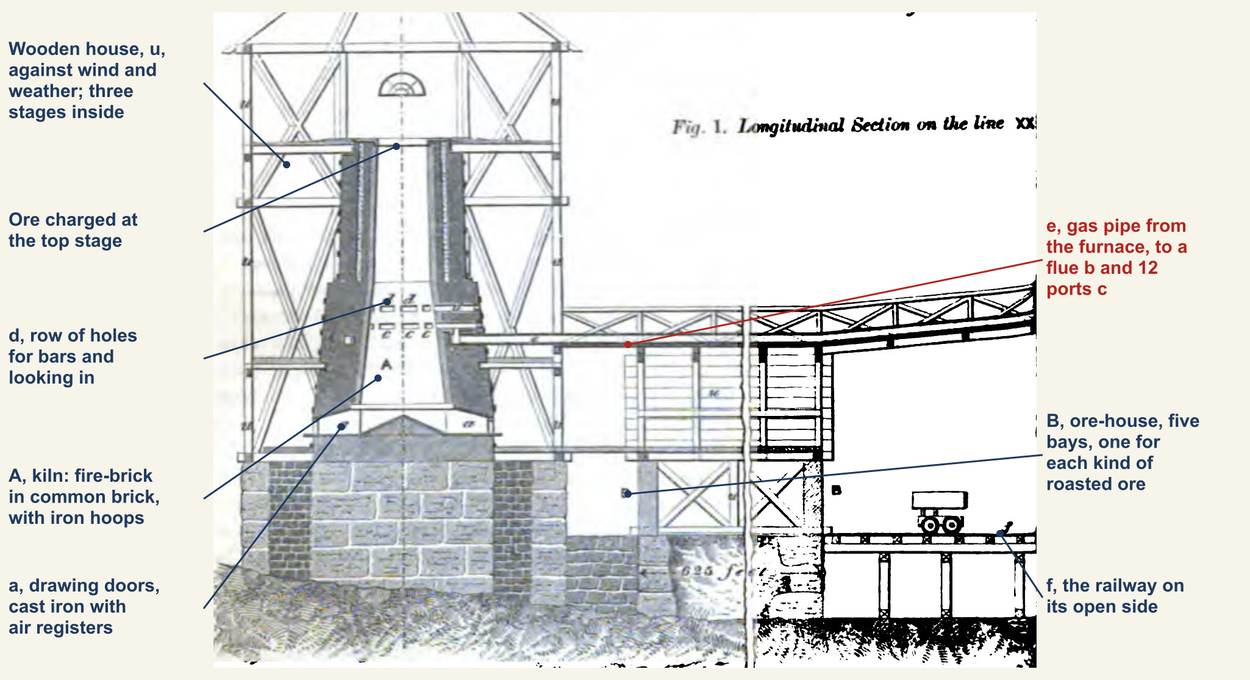
What the books show is a store between each pair of steps; the pages read here do not spell out why. A kiln drawn daily, a furnace charged by the round and a mine and railway on their own hours run to different rhythms, and a store takes up the difference. Sten kept a bay for each roasted ore (Percy pp. 369, 371). At several British works the kilns stood under an elevated tram-road so that the waggons discharged directly into them (Truran, Plate II, p. 20). A Cleveland plant raised its trucks by a hoist to the top of the calciners, where they ran down a gentle incline and tipped in, with five calciners serving three furnaces (Turner pp. 97-98). Ore-bins in hopper form, with separate bins for ore, coke and limestone (Turner pp. 114-115), fed the skips of the bigger furnaces later on.
Period ore was broken for the kiln and the furnace. Overman wants it at 2 to 3 inches (Overman p. 40), and at Sten the calcined ore was crushed between grooved rolls (Percy p. 371).
The game's line runs bin, chute, crusher, chute, bin, and then to the kiln. A bin is the store at either end of the crusher; an iron chute stands for the period barrow road and the tipping from a gantry. Vanilla's copper chute is left as it is, and an iron chute moves items at exactly vanilla's rate.
How the planned kiln follows this
The planned kiln is a brick shaft with a cast-iron cone at its foot and iron doors round it, the Sten and Gjers kilns put together. Air comes in at an open door and the fuel lowest in that column burns first, so the fire sits low and the charge sinks through it.
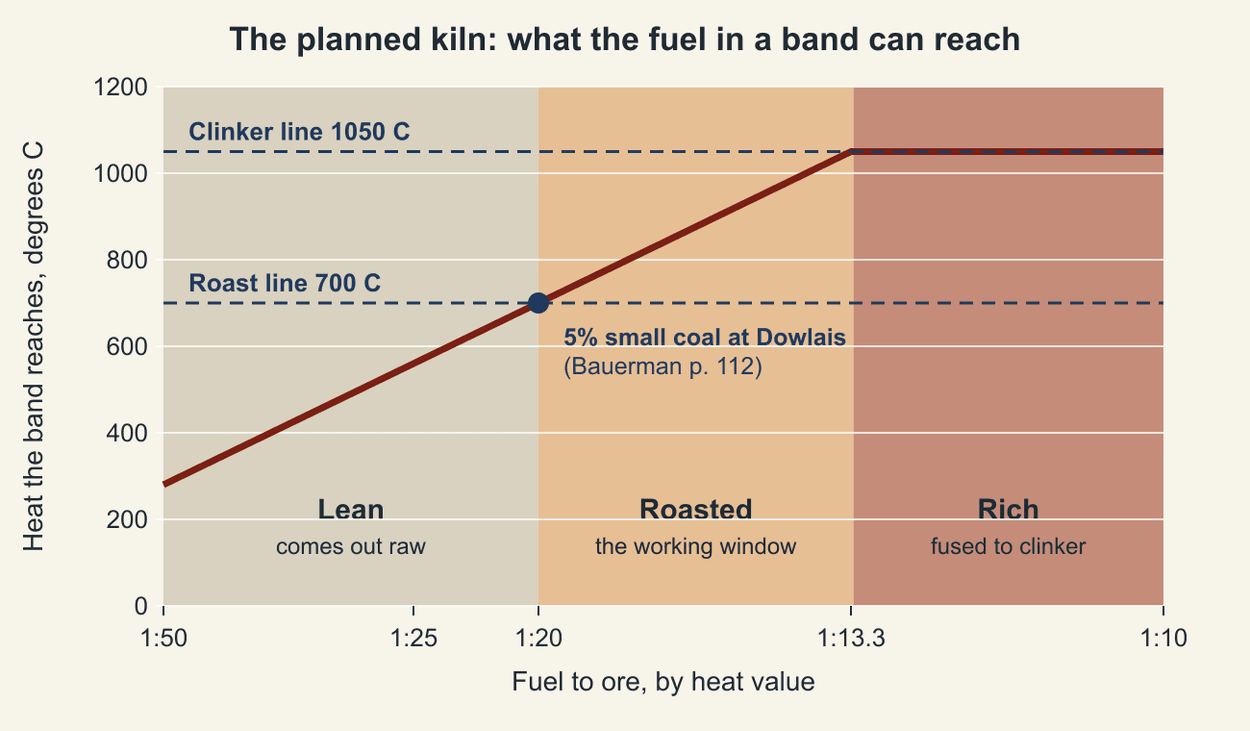
The player lays fuel over the ore on the bedding floor and digs them up together, standing in for the courses of ore and coal a real kiln was charged with, and the mix decides whether the band comes out roasted. The draw paces it. Drawn too fast, a band comes out under-roasted, and Overman's answer is to send it back to the top (Overman pp. 41-42); left undrawn, the fire climbs the column and goes out. Shutting a door banks that column, as a register controlled the air in Percy's Sten kiln (Percy p. 371). A chute under a door draws only ore that has finished roasting; a shovel through the door takes whatever is there.
Roasting always stays optional. A furnace takes raw ore too, so a player without a kiln is not locked out of iron. In the numbers below, the kiln's own fuel comes to about 0.4 bituminous coal for each pig, about what the low end of the saving in coke returns, so on good coal it pays mostly in ore. On lignite and peat, which no oven cokes and no shaft charges, it spends fuel the iron chain has no other use for.
Period basis, and what is the game's own
- Period: a shaft kiln worked as a column, charged at the top with ore and small coal and drawn at the foot (Overman pp. 41-42, Bauerman pp. 110-112). The game plans the same.
- Period: a cone or sloped floor turned the sinking charge out to the draw openings, and the air came through registers (Bauerman p. 113, Turner p. 92, Percy p. 371). The game plans a cone under a central pillar, and iron doors with registers.
- Period: over-firing fuses ore to clinker (Overman pp. 40, 172, Percy p. 281). The game plans a clinker line, and clinker must be crushed before it is any use.
- Period: a store of ore stood between each step (Percy pp. 369, 371, Turner pp. 114-115, Truran, Plate II, p. 20). The game plans bins, a single block with a lever-worked gate.
- The game's own: there is no kiln in vanilla and no roasting. See vanilla against reality.
- The game's own: fuel is mixed into the charge on the bedding floor and rides with it, and no book shows coal mixed into ore before it went in; the period kilns were charged in courses of ore and coal (Overman pp. 41-42, Bauerman p. 112).
- The game's own: a small hopper on a cast-iron seat at the centre of the mouth feeds the shaft. The books show charge tipped in from a stage or gallery (Percy p. 371, Bauerman p. 113) and no hopper on a kiln.
- The game's own: a chute under a door draws only finished ore, unattended. A real draw was judged by the people doing it (Overman pp. 41-42).
- The game's own: the temperatures of the lines, which no period book gives. See the table.
- The game's own: one roasted ore unit is one raw ore unit. A real kiln took out a quarter or more of the weight (see the iron ore page); the game instead raises the yield per unit.
The numbers
All kiln values are planned, nothing is built, and every number is a placeholder until playtesting sets it (see the scaling page and scale and units).
| In the game | Period figure | How it was scaled | Game value |
|---|---|---|---|
| Height of the charge | 12 to 18 ft (Overman p. 41), 18 ft at Dowlais (Bauerman p. 111) | Whole blocks at true size | Planned 16.4 ft |
| What it holds | 50 to 100 t (Overman p. 41), about 70 t at Dowlais (Bauerman p. 112) | Whole cells of ore | Planned 1280 ore units |
| Fuel in the charge | About 5% small coal by weight (Bauerman p. 112), 1 t to 20 t in the Gjers (Bauerman p. 113) | By heat value | Planned 1:20 |
| Roast line | "dull red", no temperature (Bauerman p. 112) | The game's own | Planned 700 C |
| Clinker line | Over-fired ore, no temperature (Overman p. 172) | The game's own | Planned 1050 C, at 1:13.3 by heat value |
| Time in the kiln | About 3.5 days printed; about 3.3 by 70 t held and 146 t a week (Bauerman p. 112) | Shortened by the make factor 3.608 | Planned about 22 game hours, top to door |
| What it passes | 146 t a week from 70 t held (Bauerman p. 112) | The same factor on the planned shaft | Planned about 58 ore units a game hour |
| Kilns to furnaces | Five calciners to three furnaces (Turner pp. 97-98) | Follows from the rate | Planned one kiln to about 2.4 furnaces |
| Yield of iron | Cleveland 29 to 32% raw, 40% calcined (Bauerman pp. 212-213) | The game's own recovery ladder | 8.5 u raw today, planned 9.2 u roasted, per ore unit |
| Bin | Sized to the works | The game's own | Planned 192 items a cell |
Open, and what you can tell us
The books at hand do not settle how a shaft kiln held its fire in the middle, or what one did when the draw stopped: the planned kiln's going out, undrawn, is the game's reading, and Overman p. 172 and Percy p. 281 name only the opposite fault, of clinkering when ore roasts too long. They also leave unsettled which ores a perpetual kiln could take. Overman says it "will not answer for carbonates, sulphurets, or even magnetic ore" (Overman p. 42), while the Dowlais and Gjers kilns roasted clay ironstone and Cleveland stone, in part carbonates, in just such a kiln (Bauerman pp. 111-113). If you know a source that gives a kiln's temperature, or records how a draw was judged at the kiln door, we would like to read it.
Picture credits
- Wakerley, remains of ironstone quarry calcining kilns: John Sutton, CC BY-SA 2.0, cropped.
- Remains of Ironstone Calcining Kilns, Scugdale: Mick Garratt, CC BY-SA 2.0, cropped.
- Figs. 1 and 2, roasting ovens: Overman, The Manufacture of Iron, pp. 41 and 42, Library page. Fig. 1 labelled for this page.
- Figs. 1 and 2, Gjers' calcining kiln and the Swedish gas calcining kiln: Bauerman, Treatise on the Metallurgy of Iron, pp. 113 and 115, Library page. Labelled for this page.
- Fig. 54, the Swedish blast-furnace at Sten, cropped to its kiln and ore-house: the plate after Percy p. 375, Metallurgy: Iron and Steel, Library page. Labelled for this page.
- The mix and the roast and clinker lines: drawn for this page from the planned values and Bauerman p. 112.
Comment or suggest something in the Expanded thread on the Vintage Story Discord