
Steam hammer
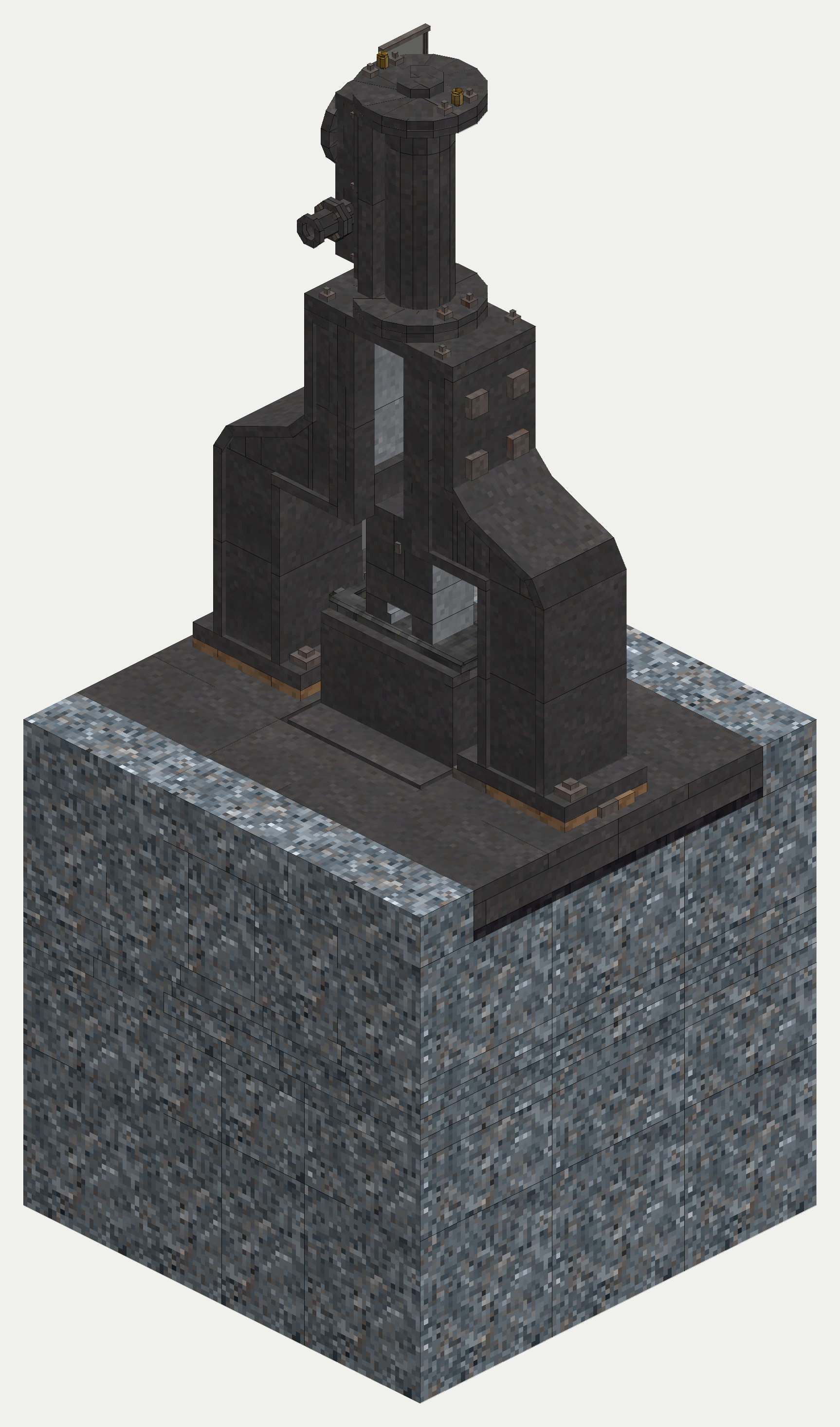
A steam hammer is a heavy iron block hung on the piston rod of an upside-down steam cylinder, with a man at a valve deciding how far it rises and how hard it comes down. Its parts in the game are in the catalogue. This page is about the real one, what a heavier hammer adds, and how the game's follows it. The game's hammer is planned: what stands in the game today is the placed machine, with no work behind it yet.
The problem it was built for
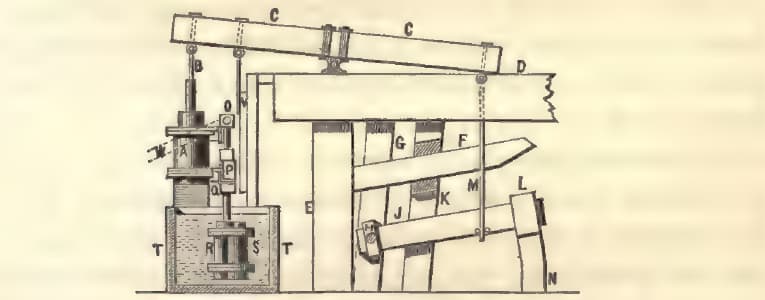
Until then the heavy hammers of a forge were helves and tilts: a beam on a pivot, raised by cams and dropped (see the belly helve). In November 1839 the engineer of the Great Britain wrote to James Nasmyth that there was not a forge hammer in England or Scotland powerful enough to forge the 30 in paddle shaft of the ship's engines, and asked whether he dared use cast iron (Nasmyth p. 239).
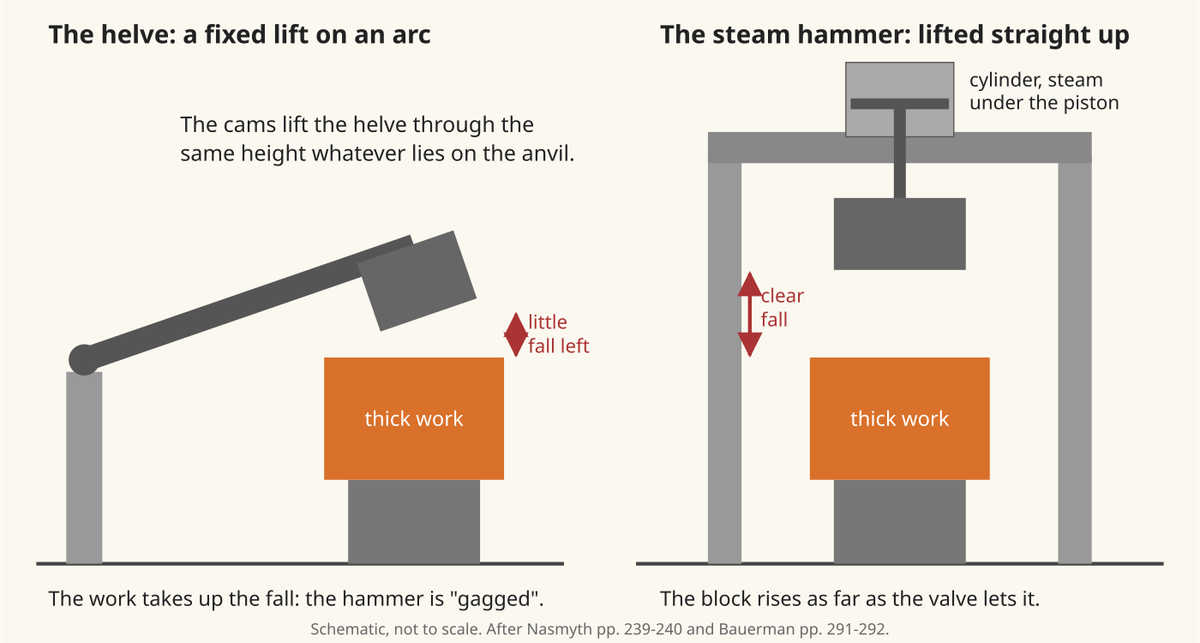
Nasmyth put the failure down to "want of compass, of range and fall", and to the clear space for the fall being almost entirely taken up by the work: when the forging most needed a heavy blow it got next to none (Nasmyth pp. 239-240). A lever can only be made to rise so far. The answer was to give up the lever.
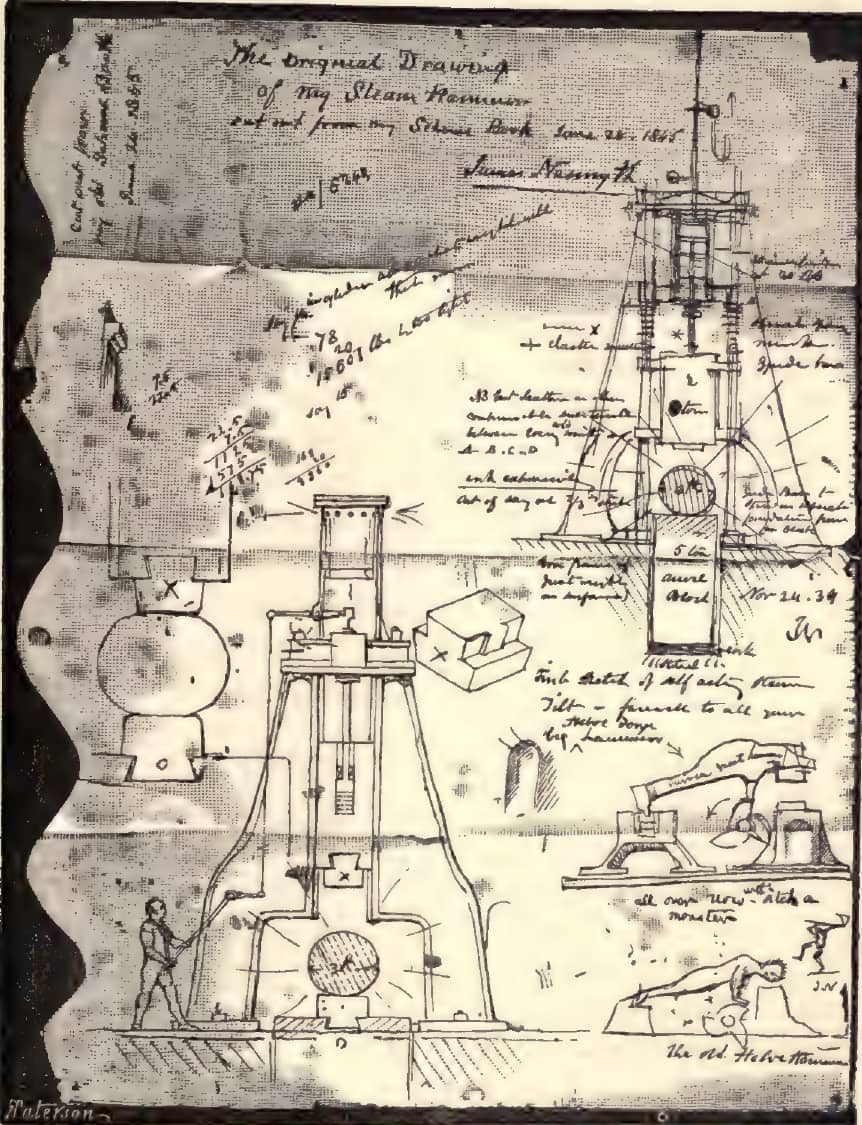
He wrote that the drawing already held all the essential elements of the invention (Nasmyth p. 242). The ship went over to the screw and the shaft was never forged, and no firm would then buy a hammer in a depressed trade (Nasmyth p. 243). The first one built was at Le Creusot, copied from his sketch while he was away; on a visit in 1842 he was shown a crank forged under it, the eye punched and drifted smooth, and told it was his own hammer that had made it (Nasmyth p. 246). He took out a patent that year and built one of 30 cwt with a clear fall of four feet (Nasmyth pp. 247-248).
What the valve gave the man at it
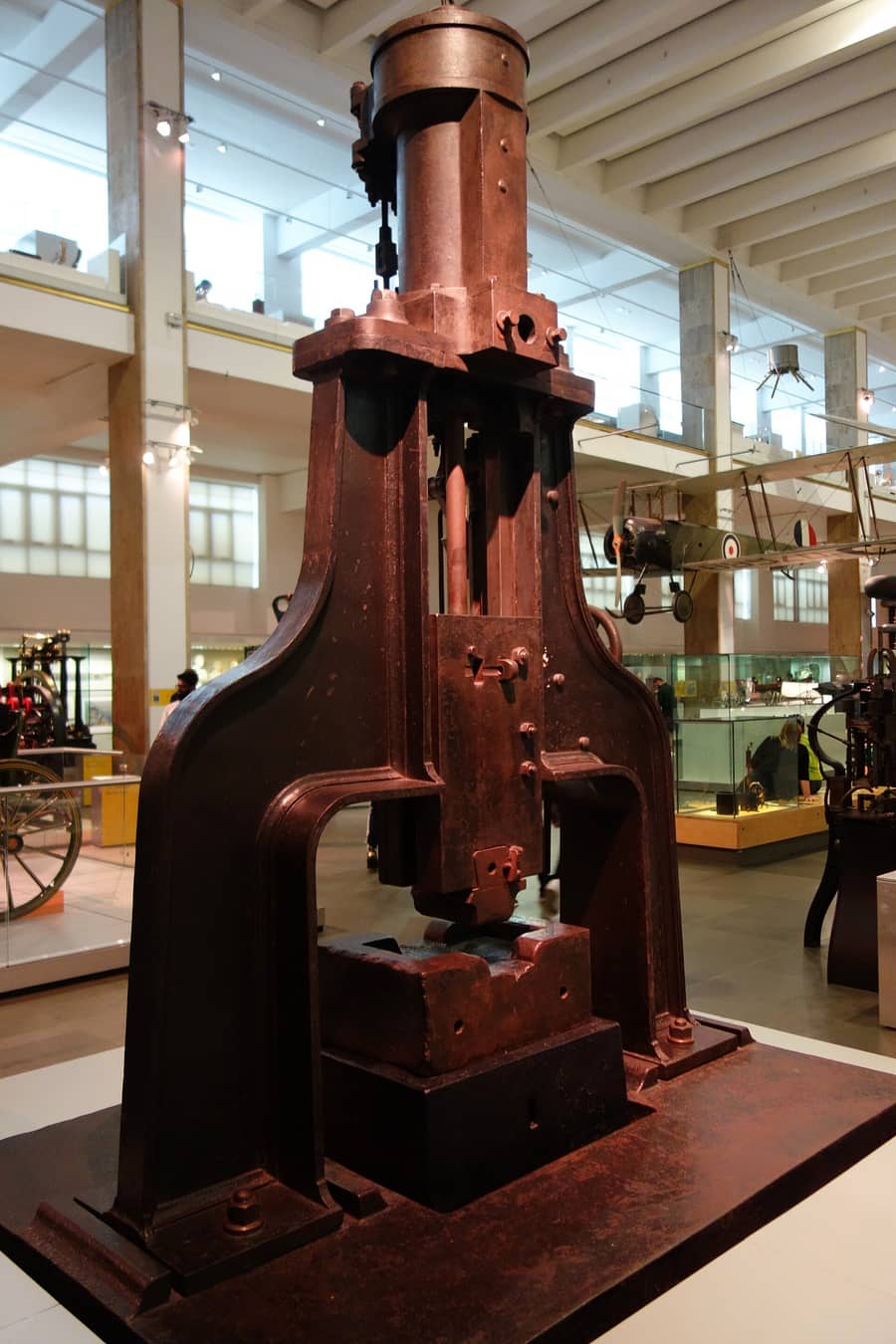
The machine is, as Bauerman puts it, an inverted vertical high-pressure engine standing on two cast-iron standards, the piston rod joined directly to the block (Bauerman p. 291). In the first form steam only lifted, and the blow was the fall alone. In 1843 Nasmyth let steam in above the piston as well, "to aid gravitation" (Nasmyth p. 249), and this double-acting or "top steam" form became almost universal (Percy p. 697).
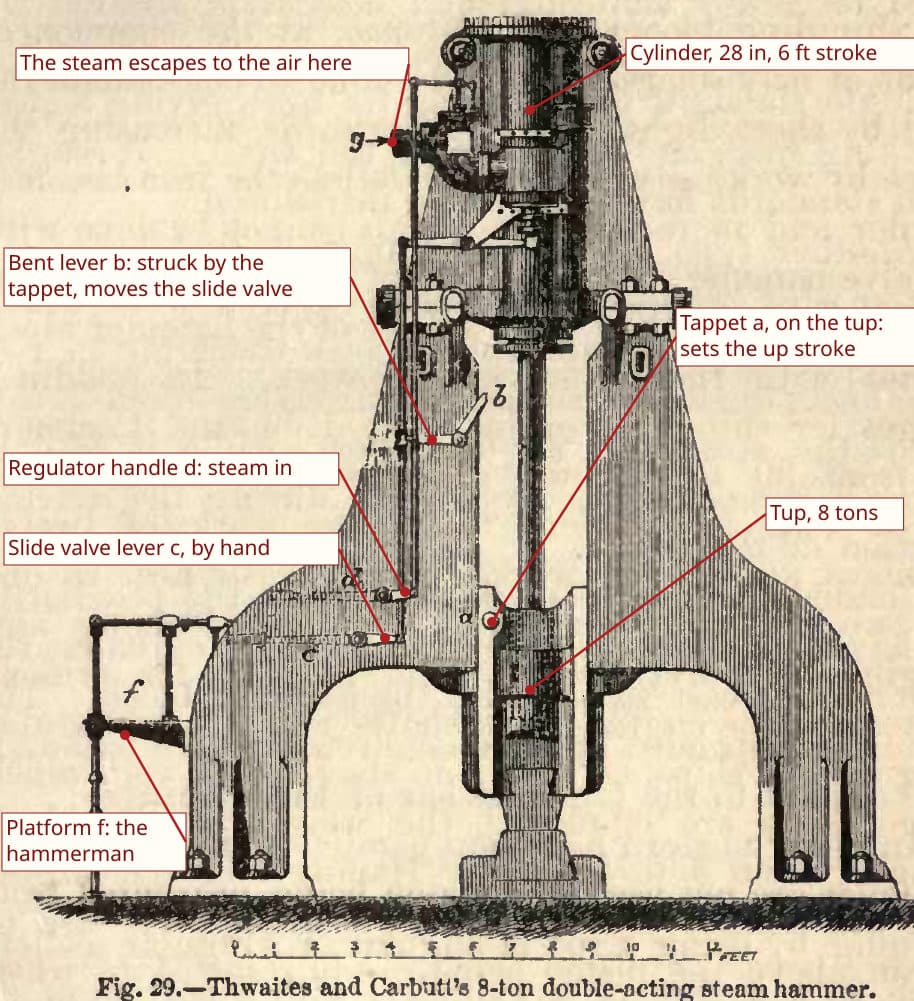
Because the valve can check the exhaust or hold steam under the piston, the block can be stopped anywhere in its stroke (Bauerman p. 292). Nasmyth's boast was that it could crack an egg in a wine glass and that the next blow "would shake the parish" (Nasmyth p. 249), and that its attendant could "think in blows" (Nasmyth pp. 242, 249). The early self-acting gear was dropped again, in favour of the hand (Nasmyth p. 249).
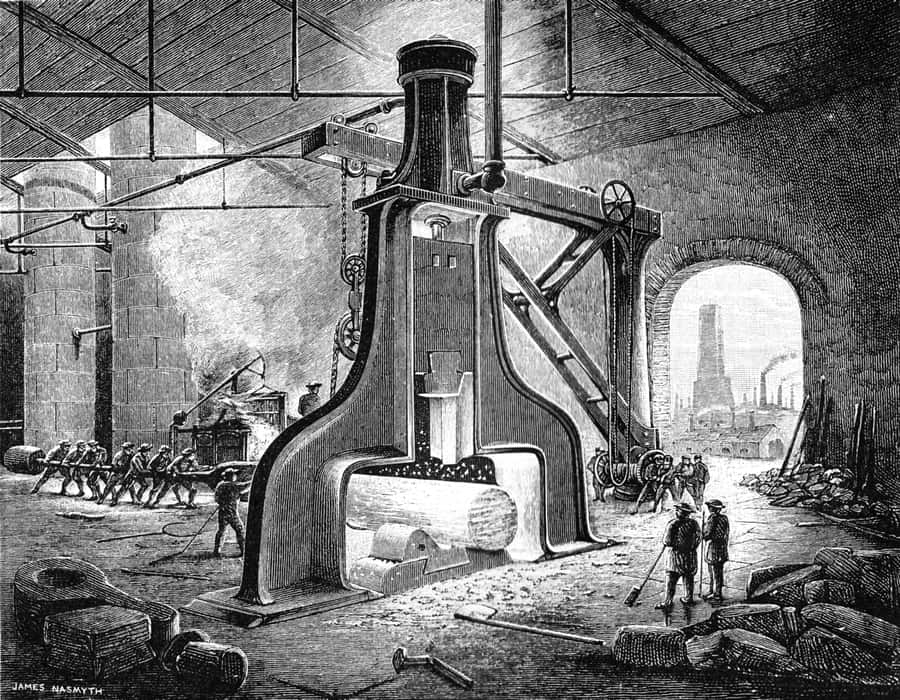
It mattered at the forge. A ball that would crumble under a helve could be coaxed into a sound bloom with gentle blows (Percy p. 695). Short light strokes closed it first, and the fall lengthened as it hardened (Bauerman p. 292). Whole masses could be welded and punched, so that an anchor was made in one piece where the "bit by bit" system had left flaws (Nasmyth p. 250). And with that control the die work of the Birmingham gun trade, stamping hot iron into a shaped die, grew to the largest class of forge work (Nasmyth pp. 250-251).
The hammer did not win everywhere. A helve costing a fifth or sixth as much did as well on ordinary bar iron, where every bloom wants the same blow (Truran p. 231), and the small steam hammers of 1850 were too slow for drawing bar, at 80 to 100 strokes a minute where 150 and up was wanted (Overman p. 337).
What holds it up, and what more weight adds
A hammer strikes its anvil as hard as it strikes the work, so the anvil stands apart from the frame.
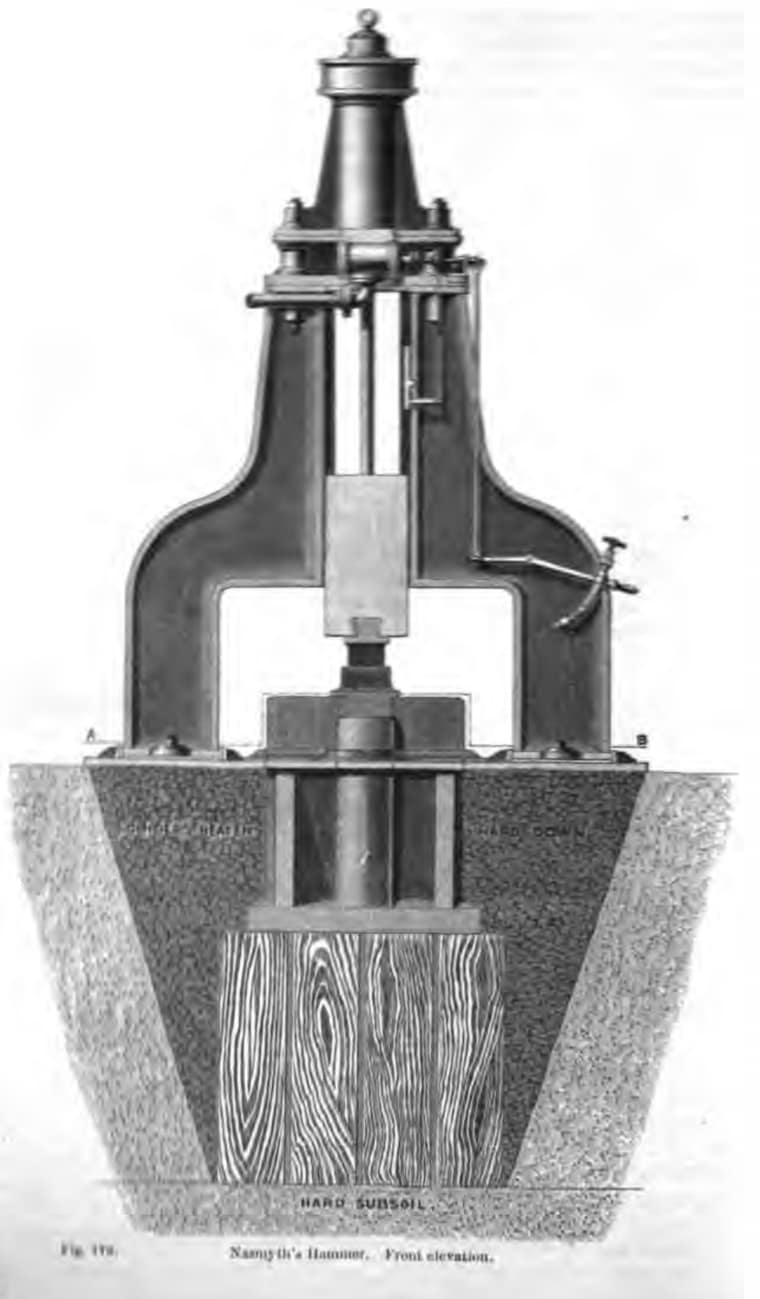
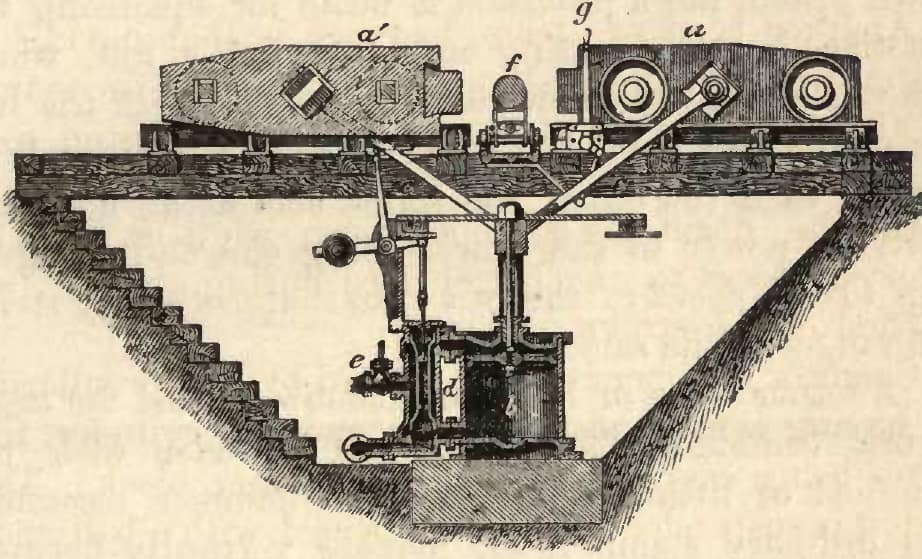
Sizes followed the work. Below 12 or 15 cwt, for heavy smithing, one standard could overhang the base and leave three sides of the anvil free (Bauerman p. 294). Blooms in a puddling forge took 30 to 60 cwt, and one of 50 cwt served twelve furnaces (Bauerman p. 292). Armour piles, marine cranks and steelworks took 5 to 50 tons, usually single-acting above 12 or 15 tons (Bauerman p. 292). Weight brought fall and foundations with it: Krupp's 50-ton hammer lifted ten feet and stood over a 185-ton anvil on a bed of cast iron blocks (Bauerman p. 295).
The game's two hammers sit at two points on this ladder. The planned iron-age hammer is the 15 cwt smithing size. The steel-age hammer of 3.78 t, also planned, is a forging hammer for cogging ingots, which were hammered smooth and swaged down for the first groove of the mill (Bauerman p. 378). Heavier work is what the extra tonnage buys.
Period basis, and what is the game's own
- Period: an inverted cylinder on two standards, block on the rod, steam on both sides of the piston, the anvil separate on upright timber (Percy p. 698, Bauerman pp. 291-294). The game plans exactly this machine, at true size.
- Period: the man at the valve set each blow (Bauerman p. 292). In the game the force is set a notch at a time, and pushes a blow through one to three layers of the work. The game's own reduction of a continuous lift to three settings.
- Period: the striking faces were removable and changed for the job (Bauerman p. 296). The game's set, plain face, flatter and hot set choose how wide the blow is, 1 x 1, 3 x 3 and 5 x 5 voxels or a cut line.
- Period: stamping hot iron in dies on the anvil (Nasmyth pp. 250-251). The game plans dies that stamp iron tool heads in batches, the flash coming back as bits.
- The game's own: the base game has no power hammer but its helve, which works only certain items and picks the voxels itself. See vanilla against reality. The steam hammer works any smithing recipe at the voxel the player picks, with the player holding the work in tongs.
- The game's own: work must be hot, and cold work rings and does not move, as at the hand anvil.
- The game's own: a ball's soundness is not modelled, so the coaxing of a crumbling ball has no counterpart. The hammer is not a shingling machine in the game: the belly helve does that job, and the shingling page says how.
- The game's own: steam comes from a Cornish boiler whose feed needs an engine's pump, so the hammer stands in a working plant.
The numbers
Machine sizes follow the period hammer rounded to whole voxels (see scale and units and the scaling page). All are planned; no steam hammer process runs today.
| In the game | Period figure | How it was scaled | Game value |
|---|---|---|---|
| Falling mass | 15 cwt (Percy p. 698) | Period figure | Planned 762 kg |
| Stroke | 40 in, 1.016 m (Percy p. 698) | Whole voxels at true size | Planned 1.0 m |
| Bore | Not given for this hammer; 28 in on the 8-ton (Bauerman p. 292) | The game's own: scaled by the square root of the mass to 8.6 in, then the nearest cast cylinder | Planned 9.8 in |
| Anvil | About 5 1/2 tons, on 16 baulks of about 84 cu ft (Percy p. 698) | Cast iron at true size | Planned 5.6 t |
| Working pressure | None given here | The boiler and cast main the game has | Planned 3.6 atm gauge; below 1.7 atm the block will not lift |
| Blow, full stroke | None given | Weight x fall, plus steam on the top face at full pressure | Planned 25.4 kJ: 7.5 fall, 17.9 top steam. The game's belly helve, 3.21 kJ |
| Steam a blow | None given | Both ends swept at working pressure | Planned 0.078, 0.156, 0.234 kg at force 1, 2, 3 |
| Blows a minute | 80 to 100 for small hammers (Overman p. 337) | Low end taken | Planned 80 at most |
| On one Cornish boiler | None given | Boiler's steam against the hammer's use | Planned full force 49 a minute at usual firing, 68 fired open; force 1 holds 80 |
Open, and what you can tell us
The books disagree about the date. Nasmyth dates his sketch to 1839 and his patent to 1842 (Nasmyth pp. 241, 247-248), Percy names the patent of 9 June 1842 (Percy p. 695), while Fairbairn gives 1833 (Fairbairn Iron p. 133) and Swank 1838 (Swank p. 63). How fast a small hammer really ran is also unsettled: Overman's 80 to 100 strokes a minute (Overman p. 337) is a generation before Fairbairn's light hammers at 250 (Fairbairn Iron p. 136). The bore of the Atlas Works hammer is not in Percy, so if you know a maker's table for hammers of this size, we would like to read it.
Picture credits
- Nasmyth Steam Hammer, c. 1850, Science Museum: Daderot, CC0.
- Steam hammer in full work, from a painting by James Nasmyth: James Nasmyth, ed. Samuel Smiles, 1883, public domain.
- First drawing of the steam hammer: Nasmyth, James Nasmyth, Engineer: An Autobiography, p. 241, Library page.
- Fig. 34, the Watt hammer: Thurston, A History of the Growth of the Steam-Engine, p. 123, Library page.
- Figs. 29 and 30: Bauerman, A Treatise on the Metallurgy of Iron, pp. 293 and 295, Library page. Fig. 29 labelled for this site from his text.
- Fig. 176: Percy, Metallurgy: Iron and Steel, p. 696, Library page.
- The helve and the hammer compared: drawn for this site from Nasmyth pp. 239-240 and Bauerman pp. 291-292.
- The game's hammer: the mod's planned drawing.
Comment or suggest something in the Expanded thread on the Vintage Story Discord