
Sand pig bed
A blast furnace makes more iron at one tapping than anything could carry away liquid, so the iron was let run out across the floor into shapes dug in the sand. How to lay and use one in the game is in the molten metal guide, and the block is in the catalogue. This page is about the real bed and how the game's follows it.
Where the names come from
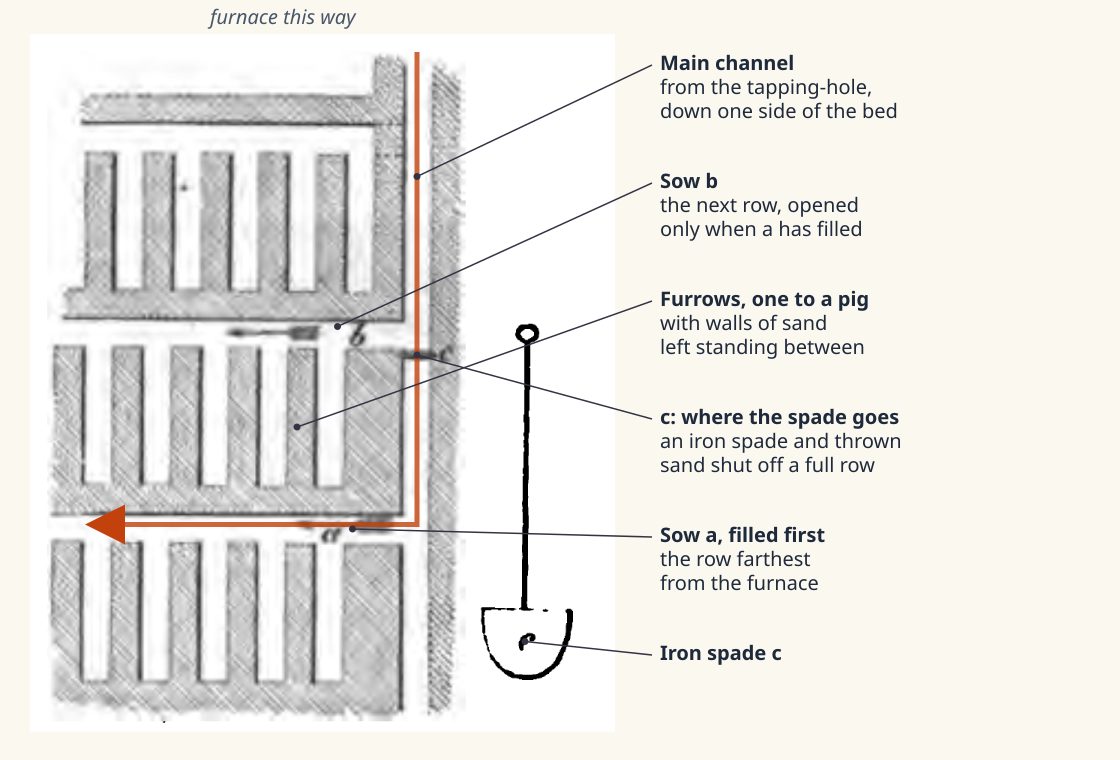
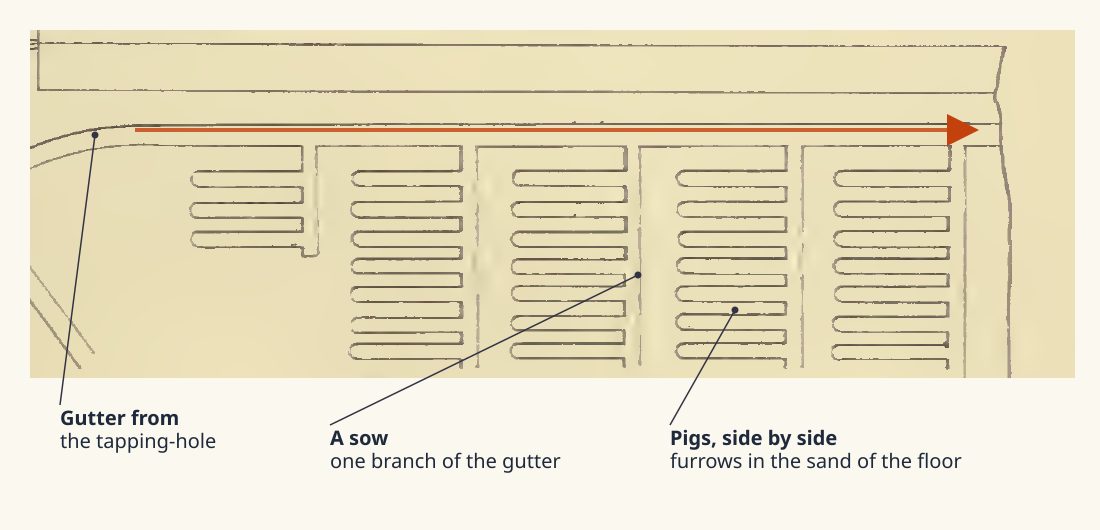
"The transverse feeding channels form the sows. The names of pig and sow are fancifully suggested by a sow feeding her litter" (Percy p. 493). Johnson, in American practice more than fifty years later, uses the same picture, "a sow with a litter of suckling pigs", and calls a branch runner with the pigs that go with it a "bed" (Johnson Construction p. 328). Truran calls the sand of the blast furnace the "dust-bed" (Truran p. 194).
How a bed was made
Before each cast the floor had to be made again. The preparation of the pig bed and the moulding of the pigs was the keeper's work, or at large furnaces the helper's, and the founder generally tapped the iron (Overman p. 201). The bed ran from below the cinder-fall to a considerable distance in front of the furnace, sometimes under a roof and sometimes open to the weather (Percy p. 493). It sloped gradually away from the furnace, so that the iron would run (Percy p. 493).
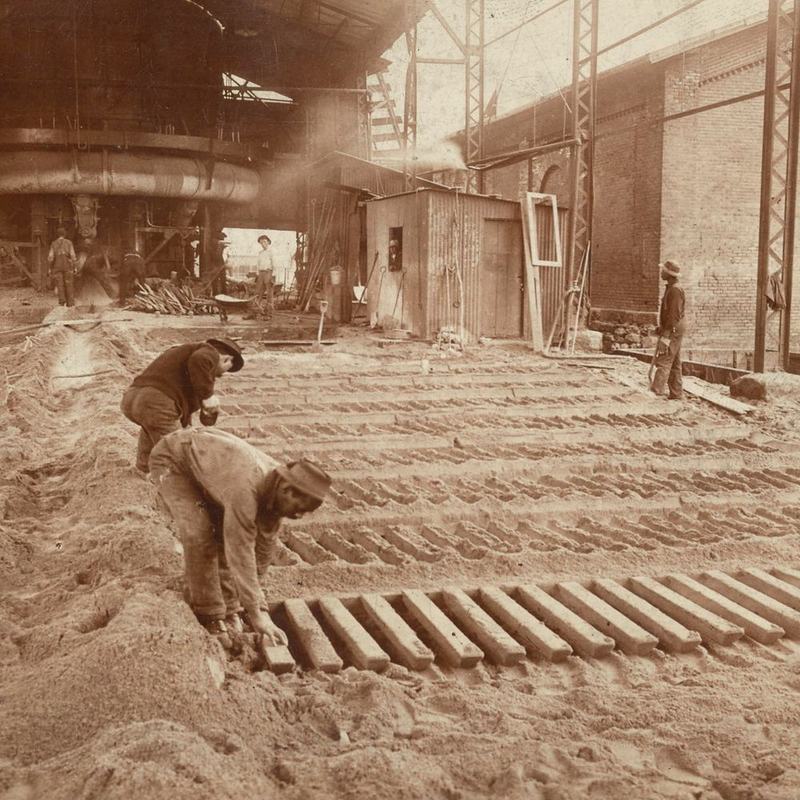
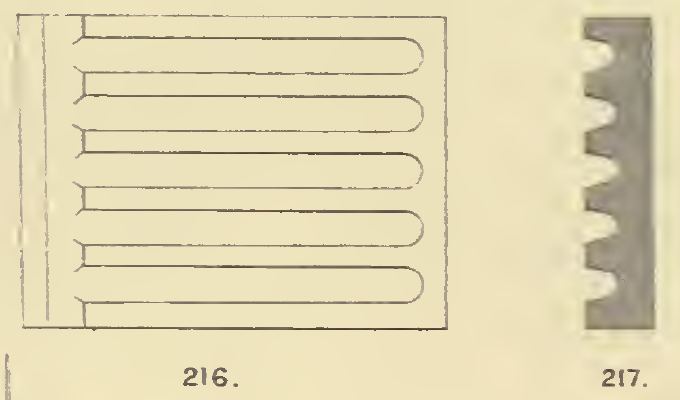
The moulds were furrows in the sand of the casting floor, made with wooden cores of a D-shaped section, curved side down, and the core usually carried the name or brand of the works, so that each pig was cast with its maker's mark (Bauerman p. 193). Walls of sand were left between the furrows, strong enough to hold back the pressure of the metal (Percy p. 493). The sand of the American bed had to be coarse and open-grained, nearly free of clay, lime and iron oxide, to keep the metal from boiling on it (Johnson Construction pp. 328-329).
The cast
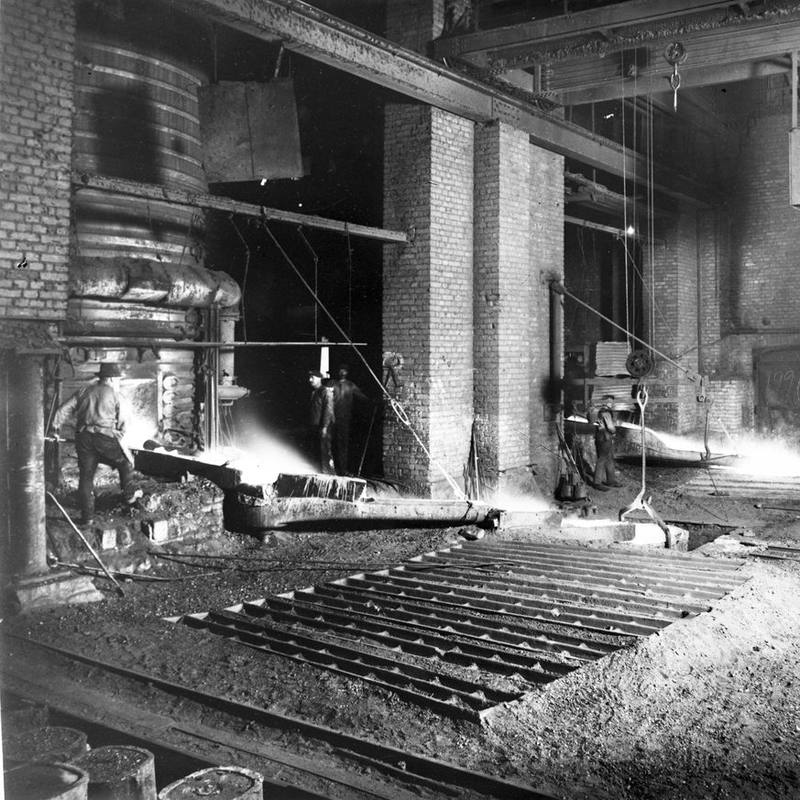
Casting came at fixed hours: "Six in the morning, and six in the evening is the time usually set apart for casting" (Overman p. 201). In South Staffordshire tapping came every twelve hours, at Ebbw Vale every four (Percy p. 494). A cast-iron trough about 6 ft long carried the metal from the tapping-hole to the bed (Truran p. 29).
The order was the point of the arrangement. The lowest row was the only one open at first. The iron ran down the main channel past the closed rows, filled that row, and was then stopped from it with the spade and sand, while a barrier higher up was dug away and the next row took the flow, "the metal flowing last into those nearest the furnace" (Percy p. 493). Bauerman describes the same succession with the moulds in parallel series either side of a central feeder (Bauerman p. 193).
After the cast, sand was thrown lightly over the pigs from a shovel to cut down the radiant heat (Percy pp. 493-494). The bed was also a first assay of the furnace. Good grey iron stayed liquid for a long time in the pig bed, and white iron chilled very soon in the moulds with a rough, concave surface (Overman p. 205). A smell of sulphur from the iron in the bed pointed to the coke or to too little limestone (Overman pp. 130, 240). Percy saw three varieties of pig from the same furnace in the same cast, because the metal differs at different levels in the hearth and tapping does not mix it (Percy p. 493).
Breaking and clearing
The pigs were broken off the sow while still red hot, by forcing the point of a long bar between two of them and levering, since iron at a red heat is comparatively weak (Encyclopaedia of Chemistry p. 257). Johnson's men did the same with a crowbar under the junction of pig and sow while it had "still very little strength", or waited and went on the beds cold with sledges and bars (Johnson Construction p. 331). When cold, a pig could be dropped across an A-shaped anvil to break it, and its fracture judged its quality (Encyclopaedia of Chemistry p. 257).
When the iron had cooled it was removed, weighed and stored, and the sand "dug up, wetted, and prepared for another cast" (Overman p. 206). The next bed began there. Cinder went elsewhere: to carts at small furnaces, or to basins dug beside the stack (Overman p. 206), or along its own gutter to tubs, as on Truran's plan (Truran Plate 36).
Sand was not the only way. Dowlais and Ebbw Vale used iron moulds (Percy p. 494), and Sweden generally did (Bauerman p. 193). The books describe the two and do not argue the choice. The method lasted a long time all the same: beds of sand were used in American practice until about 1897 and persisted at merchant furnaces after the casting machine had replaced them elsewhere (Johnson Construction pp. 328-329, 332).
What the game keeps of it
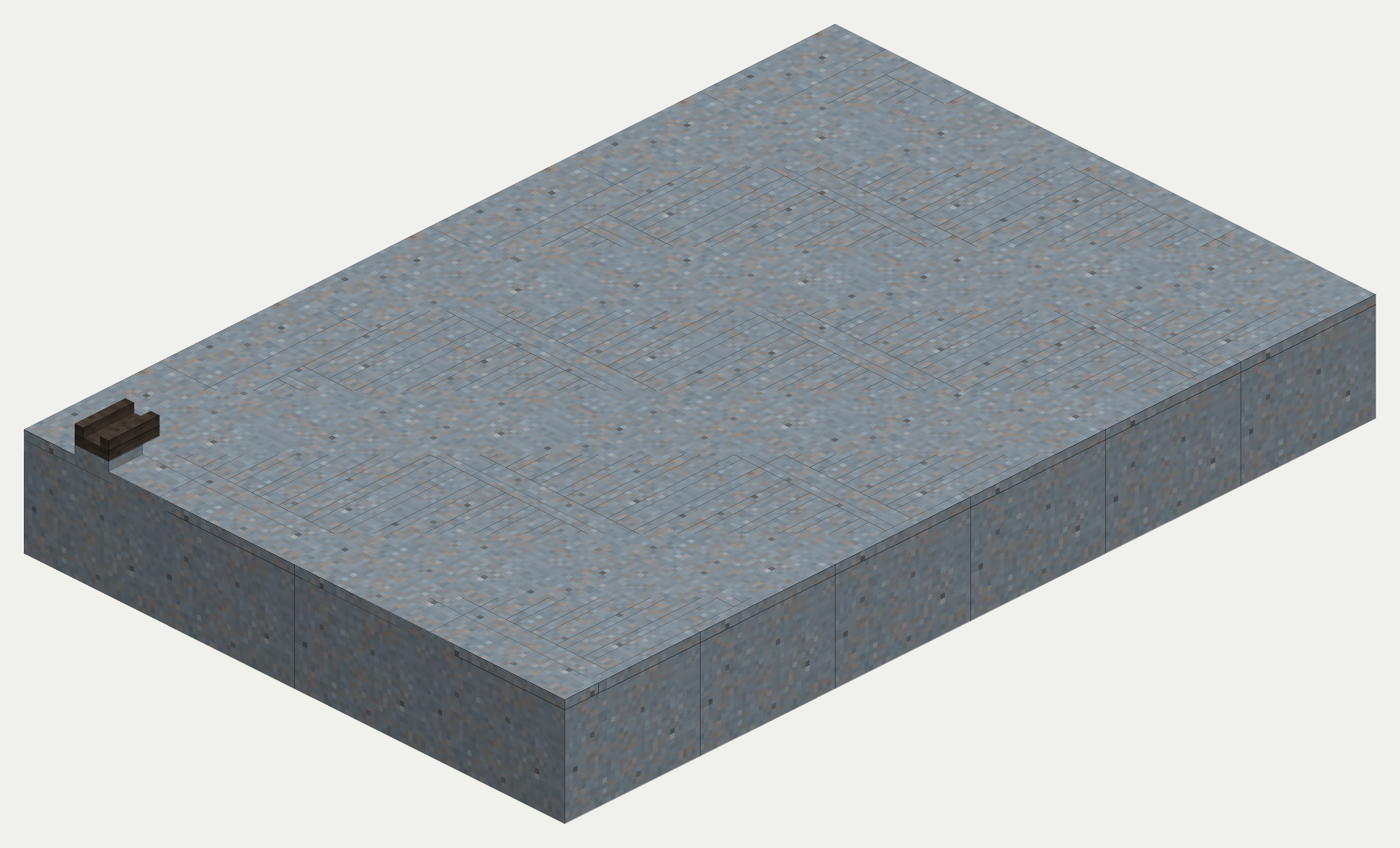
A bed in the game is a pit dug in the floor, filled with sand a course at a time, and carved by hand. The main channel and the five sows are the period layout, and the fill order is Percy's: when the main channel is full the iron goes to the farthest carved row, and each row fills before the next one nearer. A row left as plain sand is shut off, as a sand barrier shut it, and takes nothing. After a cast each row is shaken out by hand, and the sand is plain again until the row is carved anew. See running a blast furnace for the furnace that feeds it, and the metal ladder for what the pig becomes.
Period basis, and what is the game's own
- Period: a main channel down one side, transverse sows, parallel furrows in the sand, filled from the farthest row back (Percy p. 493). The game keeps this: the channels, the rows and the fill order are the book's.
- Period: a row was shut with an iron spade and sand, and each next row opened by taking a sand barrier away (Percy p. 493). The game leaves out the spade. The order follows by itself, and an uncarved row is shut.
- Period: the moulds were remade before each cast (Overman p. 206), and the same floor served for the next. The game keeps it: the shake-out leaves plain sand, to be carved again. The sand needs no wetting.
- Period: pigs were broken from the sow (Encyclopaedia of Chemistry p. 257, Johnson Construction p. 331). In the game the sow's iron comes back as chunks and shot. Breaking a pig further is a hammer's work, on the belly helve.
- The game's own: the bit, called shot in the game, has no period counterpart. It is there so that a pour's remainder is never lost.
- The game's own: a slag cast on the same bed comes out as slag brick. Real cinder never went into the pig bed: it left by its own gutter to tubs or basins (Overman p. 206, Truran Plate 36).
- The game's own: the iron runs through level channels and needs no slope. The bed needs no roof, the metal no brand, and no wet sand boils under it. See vanilla against reality.
- The game's own: nothing is cast at fixed hours. The player taps when ready.
The numbers
Values are what the game has now. A voxel is 6.25 cm and a unit of iron 0.70 kg (scale and units). The figures are period where the books give one and the game's own where they do not (how the numbers are scaled).
| In the game | Period figure | How it was scaled | Game value |
|---|---|---|---|
| Pig length | About 4 ft (Encyclopaedia of Chemistry p. 257); 3 ft (Scientific Industries p. 94) | Whole voxels at true size | 15 voxels, 0.94 m |
| Pig section | 4 in thick (Scientific Industries p. 94); a D-shaped furrow (Bauerman p. 193) | Whole voxels, drawn square, the game's own | 2 x 1 voxels, 12.5 x 6.25 cm |
| Pig weight | About 1 cwt or a little more (Encyclopaedia of Chemistry p. 257); about 100 lb (McElrath p. 389); 60 to 100 lb (Swank p. 140); 2 1/2 cwt (Scientific Industries p. 94) | 2.5 u per voxel at the drawn size; a cwt is about 73 u | 75 u, about 52 kg worked out |
| Furrows a row | 28 at Cwm Celyn (Percy p. 493) | Fitted to the pit, the game's own | 18 |
| Rows | 6 at Cwm Celyn (Percy p. 493) | Fitted to the pit, the game's own | 5 |
| Pigs in a full bed | 168 at Cwm Celyn, worked out from Percy p. 493 | Rows x furrows | 90 |
| What a tap fills | About 5 tons a cast, in a new furnace's fourth week (Truran p. 41) | One shaft's tap of 7500 u, about 5.2 t worked out | The main channel, rows 5 to 2 and part of row 1 |
| Iron in a row | No figure | Sow 270 u + 18 furrows at 75 u | 1620 u: 18 pigs, 10 chunks and 4 shot |
| Main channel | No figure | The game's own | 555 u, kept in the channel |
| Whole bed | No figure | Channel + 5 rows, to the metal level | 8655 u |
| Pour basin | No figure | The game's own | 200 u |
Open, and what you can tell us
No book at hand of 1841 to 1869 states the weight of a blast-furnace pig: the figures above are from McElrath in 1871 and later. Nor do the books say why a pig was the size it was, beyond what a man could break and carry, which is an inference. They differ on the layout as well: Percy has the main channel down one side, and Bauerman a central feeder with moulds to either side. If you know a source from a works' own records for the weight of a British pig before 1870, or one that explains the size, we would like to read it.
Picture credits
- Making the sand moulds for pig iron: Underwood & Underwood stereograph, after 1895, Science History Institute, public domain, cropped.
- Forsbacka jernverk utslag: Carl J. Larsson, CC BY 4.0, Lansmuseet Gavleborg, cropped.
- Fig. 84: Percy, Metallurgy: Iron and Steel, p. 493, Library page, labels and path added.
- Fig. 213: Truran, The Iron Manufacture of Great Britain, Plate 36, Library page, cropped, labels and path added.
- Figs. 216 and 217: Truran, Plate 36, Library page, cropped.
- The game's bed: the mod's drawing.
Comment or suggest something in the Expanded thread on the Vintage Story Discord