
Moulding in sand
Iron that comes out of a furnace can only be poured, so almost everything made of cast iron began as a hole in packed sand. How to run the casting stations in the game is in the molten metal guide, and the pig bed, the simplest sand mould of all, has its own page. This page follows the moulder through one mould, then says what the game keeps of it.
Every period claim below comes from one working moulder's book, Bolland's The Iron-Founder of 1892, American in its examples. The work he describes is older than his book, but this page cannot say by how much.
The work in order
The pattern. A mould starts as a wooden copy of the casting.
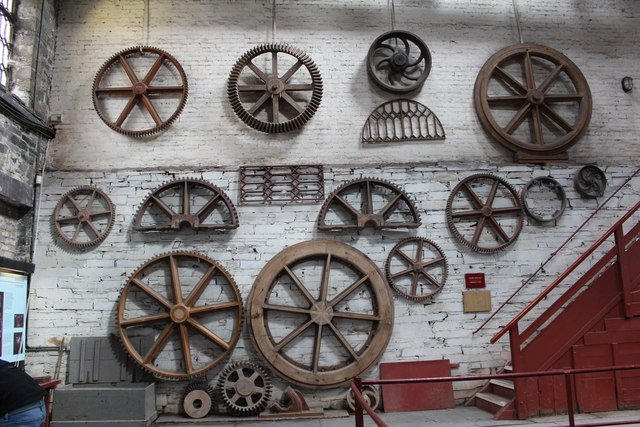
It has to come out of the sand again without tearing it. Bolland's complaint about wheel patterns is the whole difficulty in one job: a pattern with loose arms makes "extra labor in the machine-shop", and one lifted with a jar breaks the teeth of the mould, which then get pushed back and patched (Bolland p. 314). His remedy is to bed core plates against the teeth and lift them clear of the pattern, so that the mould comes away "exact" (Bolland p. 315). For a long run of one article a wooden pattern was not enough, and halves of a finished casting were "finished up and pinned together and used for the pattern" (Bolland p. 326); an iron pattern could be cast from a wooden model (Bolland pp. 344-349).
The flask. The box that holds the sand costs labour with every shovel, so it was made no larger than it had to be: just big enough for the rammer to work 2 to 3 inches off the pattern (Bolland p. 37).
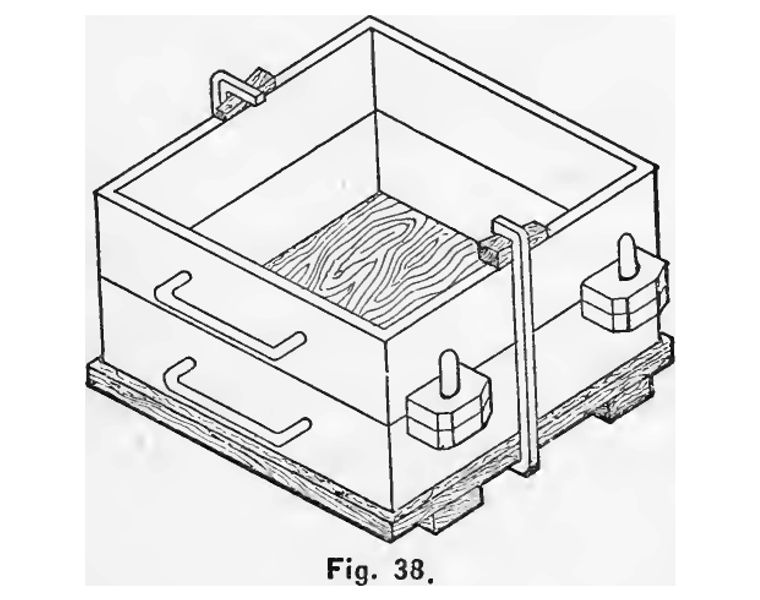
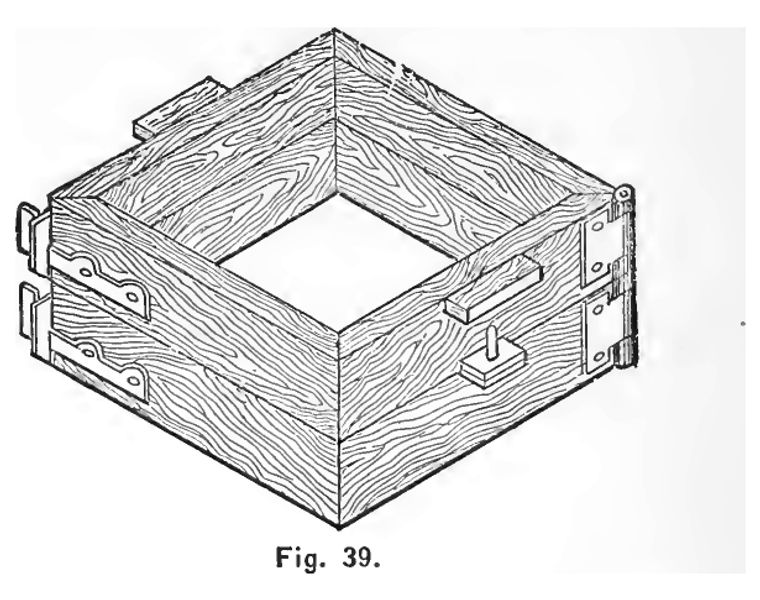
Large flasks were built up of loose sides and bars cast in open sand (Bolland p. 42). The lower part is the drag and the upper the cope, with cheeks between where a job needed more depth (Bolland p. 38).
Facing and backing. Sand came in two grades. A fresh facing mixture went against the pattern, with sea-coal in it for green work (Bolland p. 310). Old floor sand made up the bulk behind it and was used over again (Bolland pp. 133, 302).
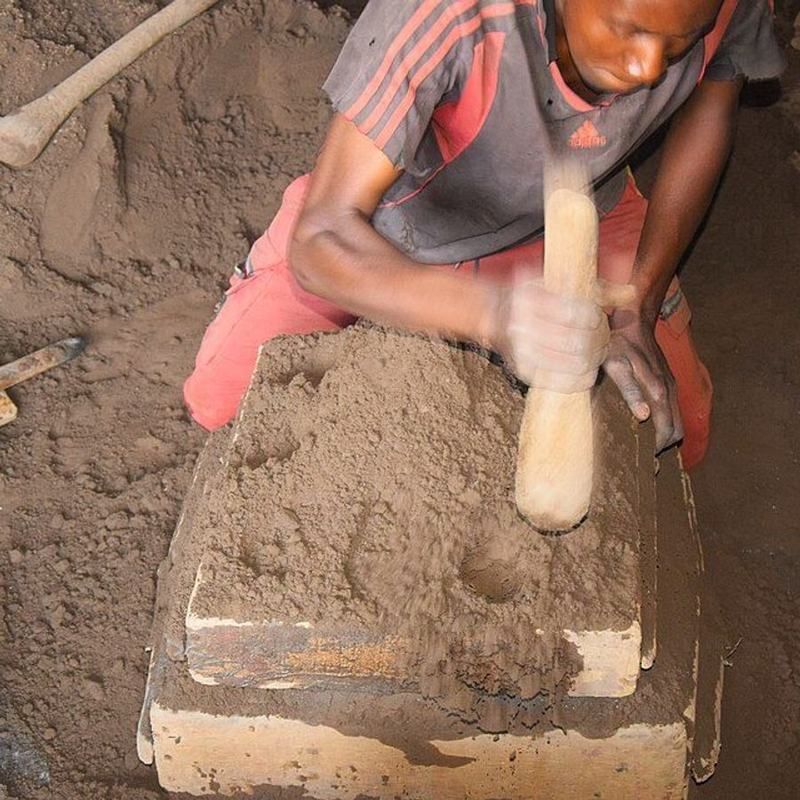
Ramming. "No amount of finishing will rectify faulty ramming" (Bolland p. 29).
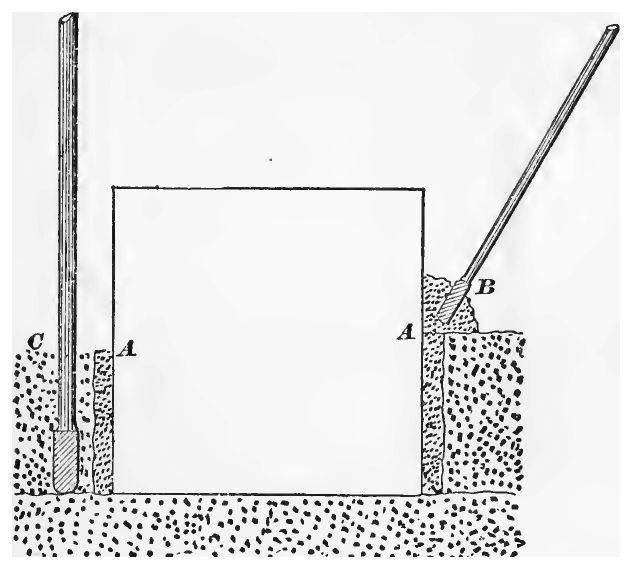
Bench moulders used short wooden rammers, often one in each hand, and floor moulders worked standing with long iron ones (Bolland pp. 27-28). Sand hanging under the bars of a cope was carried on iron hooks called gaggers (Bolland p. 27).
Venting. Damp sand makes steam the moment iron reaches it. Too much water leaves holes in the upper faces of the casting from steam that "no ordinary amount of venting will carry away" (Bolland p. 26). The vent was a hole pushed through the rammed sand with a wire (Bolland p. 26).
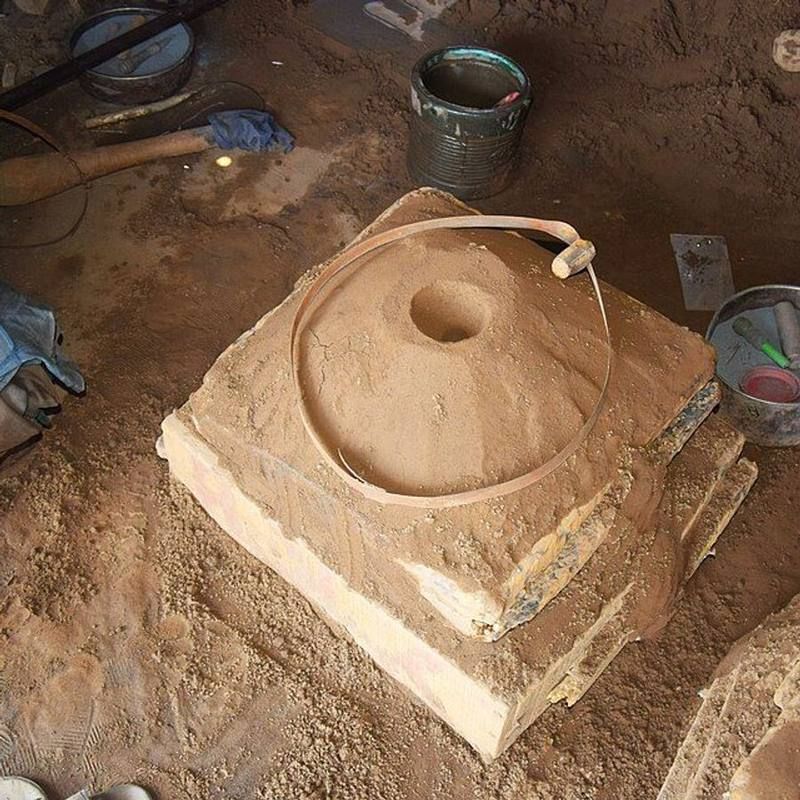
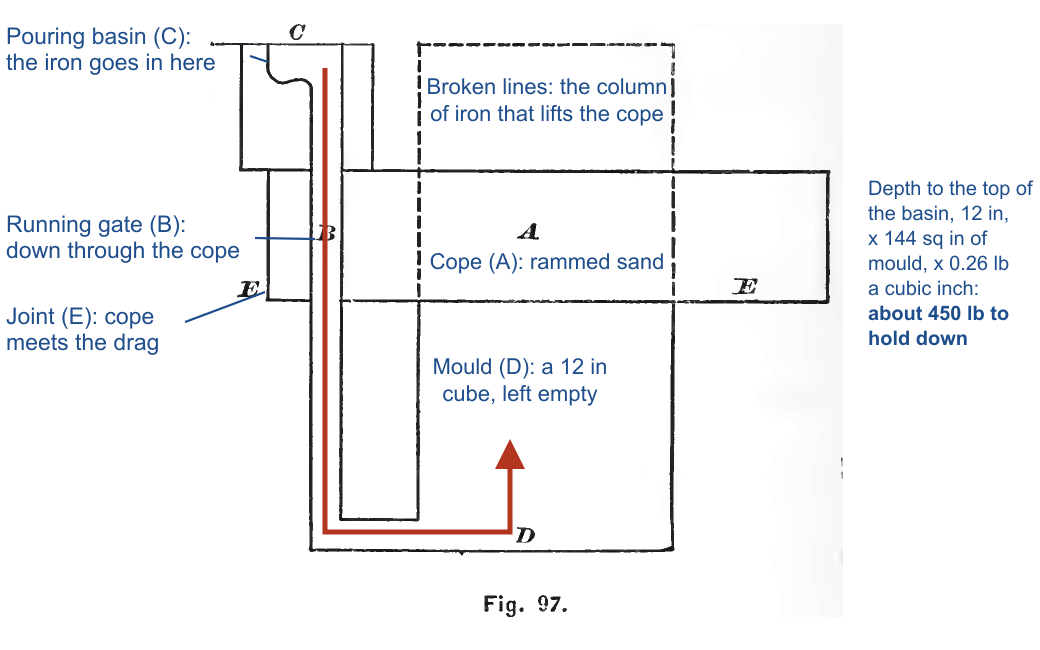
The joint and the lift. On a kettle mould parting sand is thrown on before the cope ring goes on (Bolland p. 181), so that the two will come apart. The cope was lifted, the pattern drawn, the mould mended, and the cope closed down again on an empty space (Bolland pp. 314-315).
The joint also decides how good each face will be. In a floor mould Bolland finds "smooth upper surfaces, and equally rough and unsightly lower surfaces" (Bolland p. 46). Work that mattered went into dry sand or loam, where every face could be reached and finished (Bolland pp. 46-52).
Cores. A hollow in a casting is a separate piece of sand set into the mould.
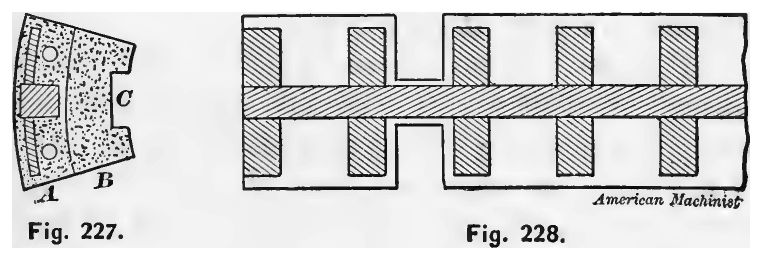
Bolland's best mixture for cylinders is 8 parts fire-sand, 2 of moulding sand and 1 of flour, in clay-water (Bolland p. 124), dried in an oven (Bolland pp. 52-62). Each core needs its own vent (Bolland p. 262).
Pouring and feeding. The iron went in hot and quickly, because metal crossing a mould loses heat to the sand (Bolland pp. 79-80). Green-sand work was poured as cool as would still fill it (Bolland pp. 69-70).
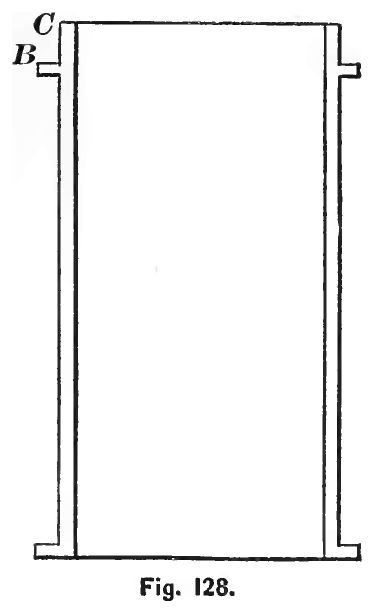
Iron shrinks as it freezes, and freezes from the outside, so the middle of a thick section is the last to set and the first to go hollow. A "riser or feeding head" keeps hot iron against that place, and counteracts the shrinkage "in some measure at least" (Bolland p. 75). A cylinder has a head on its top end (Bolland p. 243), and a 16-foot gun carries a 3-foot sinking head (Bolland p. 264).
Shaking out. The casting was broken out, and the sand went back on the heap, though not for ever. A heap "very rotten on account of a preponderance of burnt sand" needs new sand mixed in (Bolland p. 303).
Period basis, and what is the game's own
- Period: three classes of mould: green sand, cast damp; dry sand, baked first; and loam, built and struck to shape (Bolland pp. 147-148, 233). The game's flasks work in green sand; loam and dry-sand moulds are not modelled, and a dry-sand core is planned.
- Period: a wooden pattern, drawn from the sand and used again. The game's pattern is a tool cut from planks that wears a little with each impression and is cut again from its diagram when it is spent.
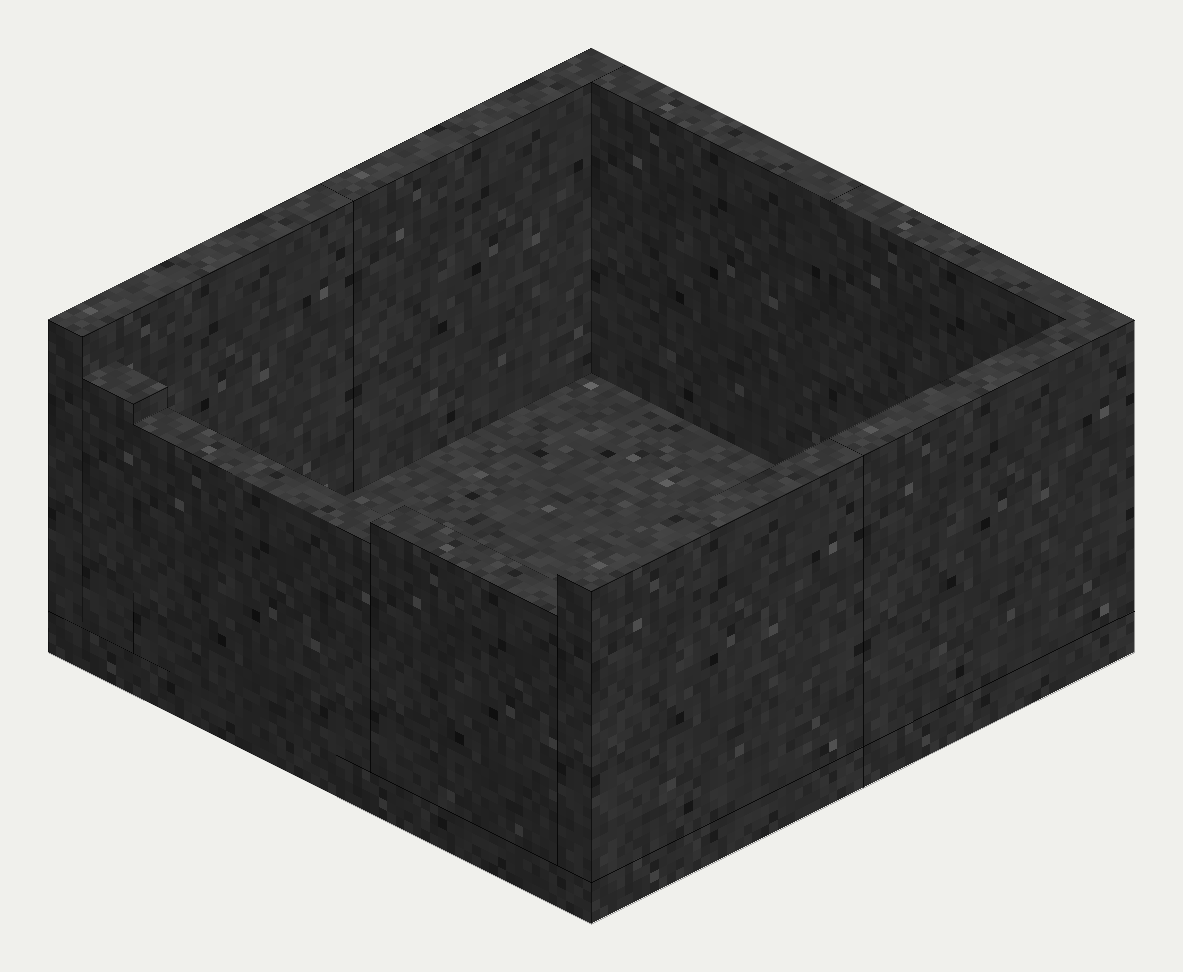
- Period: a flask is the smallest box that lets the rammer work (Bolland p. 37). The game's small flask has a brick-walled box today; a plank box with iron straps is planned, so that it can be built before any iron has been cast.
- Period: ram, turn, ram the cope, lift, draw, close. The game's ordinary flask keeps this as one rammed body and a single press of the pattern. The long flask has a real hinged cope, to be closed and wedged for work that needs it; ramming that cope stands for ram, lift, draw and close together. The long flask's cramps must be wedged first: poured unwedged, the cope lifts and the iron runs out at the joint, by Bolland's rule (Bolland pp. 97-99).
- Period: a mould is poured hot and filled fast (Bolland pp. 79-80). The game keeps one check, a misrun: iron that arrives below the pattern's minimum pour temperature gives scrap for the whole cavity. A short pour keeps its full pieces and scraps the rest.
- Period: a head is added to take the shrinkage and the dirt (Bolland pp. 75, 148). The game plans a head for bored work only, its metal coming back as scrap. Today no pattern carries one.
- Period: the core is a separate article, made in a box and dried (Bolland pp. 124, 262-263). The game plans a core rammed in a wooden box, drying by itself for a day as a bow stave does, and spent at shake-out.
- Period: facing mixed fresh and old sand reconditioned (Bolland pp. 303, 310). The game's own: sand is never used up. A flask takes sand once and shake-out leaves it full, so a casting costs labour and pattern life and no sand.
- The game's own: gates, vents, gaggers and the joint's rough face are left out, and a gate is carved only in the sand bed. See vanilla against reality: the base game has no sand casting at all, only clay moulds.
The numbers
Casting amounts follow the density rule; the rest are the game's own, as the scaling page explains.
| In the game | Period figure | How it was scaled | Game value |
|---|---|---|---|
| Sand to commission a flask | None given | The game's own, sand reused for ever | 1 green sand, once |
| Impressions from a wooden pattern | None given | The game's own | 240, then re-cut from its diagram |
| Feeding head on bored work | 6 in on a cylinder of 6 ft (Bolland p. 148), about 8% of the length | Share of the impression | Planned about 8%, returned as scrap |
| Pour gate for every pattern | No temperatures given | The game's own: 100 C over the iron's melt, under the coolest cupola tap of 1339.6 C | 1300 C, against a melt of 1200 C |
| Hold-down on a cope | 450 lb on a 12 in cube under a 12 in head (Bolland p. 99) | Bolland's rule, as a pass or fail | The long flask's two wedged cramps hold it; unwedged, the pour runs out |
| Core drying | Oven dried, no time read (Bolland pp. 52-62) | The game's own, as bow staves | Planned 24 in-game hours |
Open, and what you can tell us
Bolland writes in 1892, for American shops, and this page draws only on him. If you know a source for how an English or Scottish moulder vented, weighted and mended a mould in the first half of the nineteenth century, and how it differed, we would like to read it. Bolland gives no temperature for a pour; if you know of one measured before pyrometers were common, the misrun gate could use it.
Picture credits
- Ramming sand mold in a foundry shop, Kaduna: Kambai Akau, CC BY-SA 4.0, cropped.
- Making sand mold in a foundry shop, Kaduna: Kambai Akau, CC BY-SA 4.0, cropped.
- Wooden patterns in the foundry: Richard Hoare, CC BY-SA 2.0.
- Figs. 38, 39, 15, 97 (labelled for this page), 227-228 and 128: Bolland, The Iron-Founder, pp. 37, 38, 29, 98, 263 and 148, Library page.
- The game's floor flask: the mod's planned drawing.
Comment or suggest something in the Expanded thread on the Vintage Story Discord