
Beehive coke oven
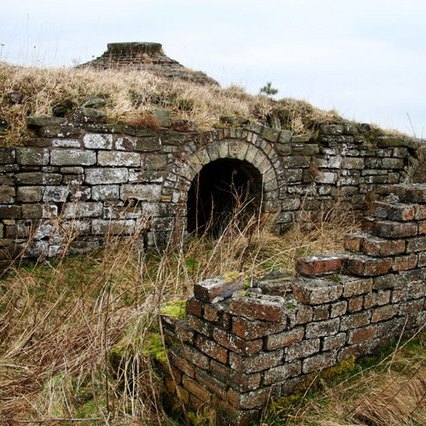
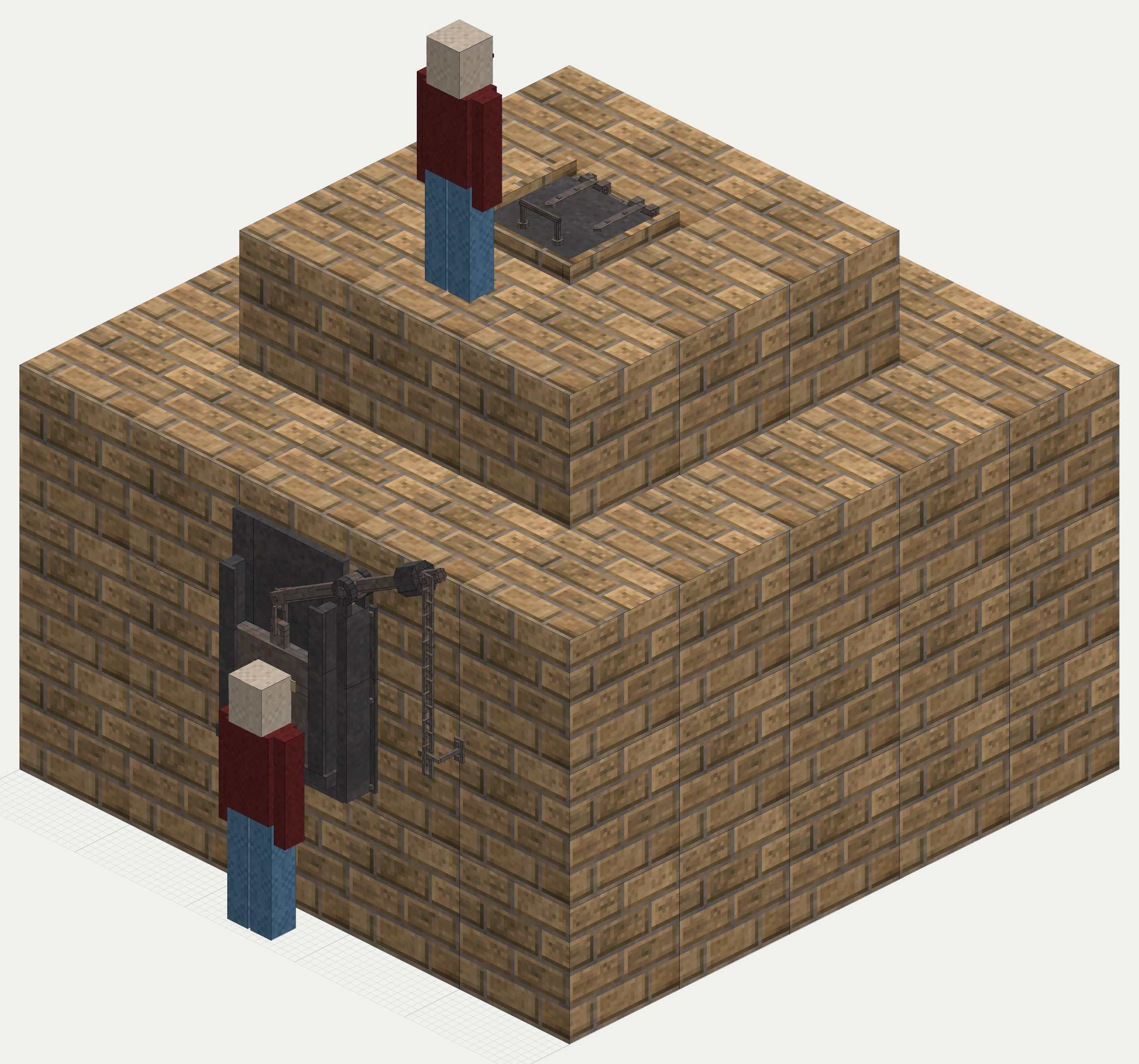
A beehive oven is a brick dome with a door at the front and a hole in the crown. Coal goes in through the hole, is lit, and burns off everything but its carbon. How to build and run one in the game is in the coke and fuel guide, and the door is in the catalogue. This page is about the real oven and how the game's follows it.
How the real one worked, and why it was built so
Coal straight from the ground is a poor fuel for a tall furnace: it softens and swells as it heats (Fulton p. 196) and gives off gas and tar (Fulton pp. 158, 200-202). Coking drives that off first and leaves a hard, porous fuel, about 87% fixed carbon at Connellsville (Fulton p. 158). The trade names three ways of doing it: heaps in the open, the partly closed beehive, and the retort with air almost entirely excluded (Fulton p. 145).
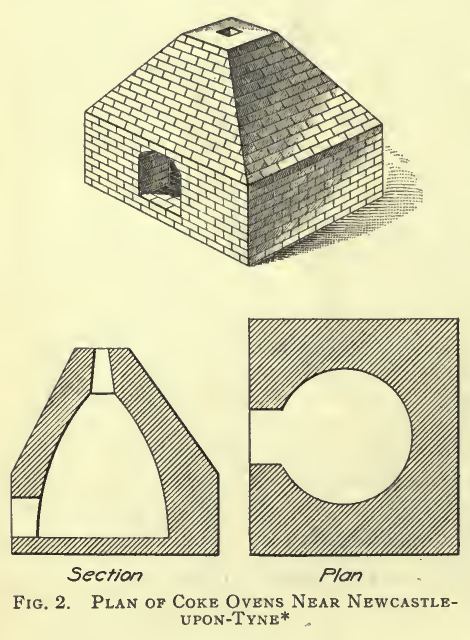
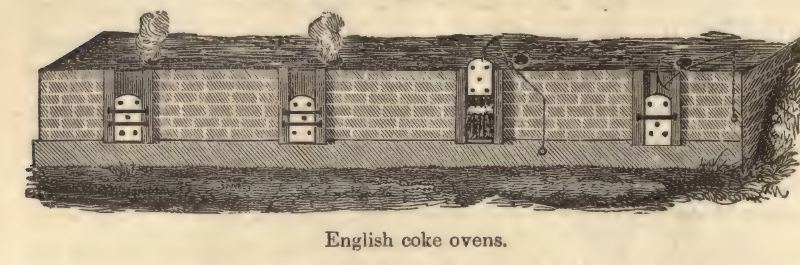
The oldest way was a long heap fired through flues and covered with dust once "the white flames" stopped (Overman p. 122, Fulton p. 146). The dome keeps the same idea and adds a roof that holds heat. Overman's ovens gave 12% more coke than his heaps (Overman pp. 130-132). Fulton could not say whether the plan came from the coking mound or the charcoal kiln (Fulton p. 148). It then grew for a century and a half, to 12 to 13 ft across with a dome 7 to 8 ft over the floor (Fulton p. 148).
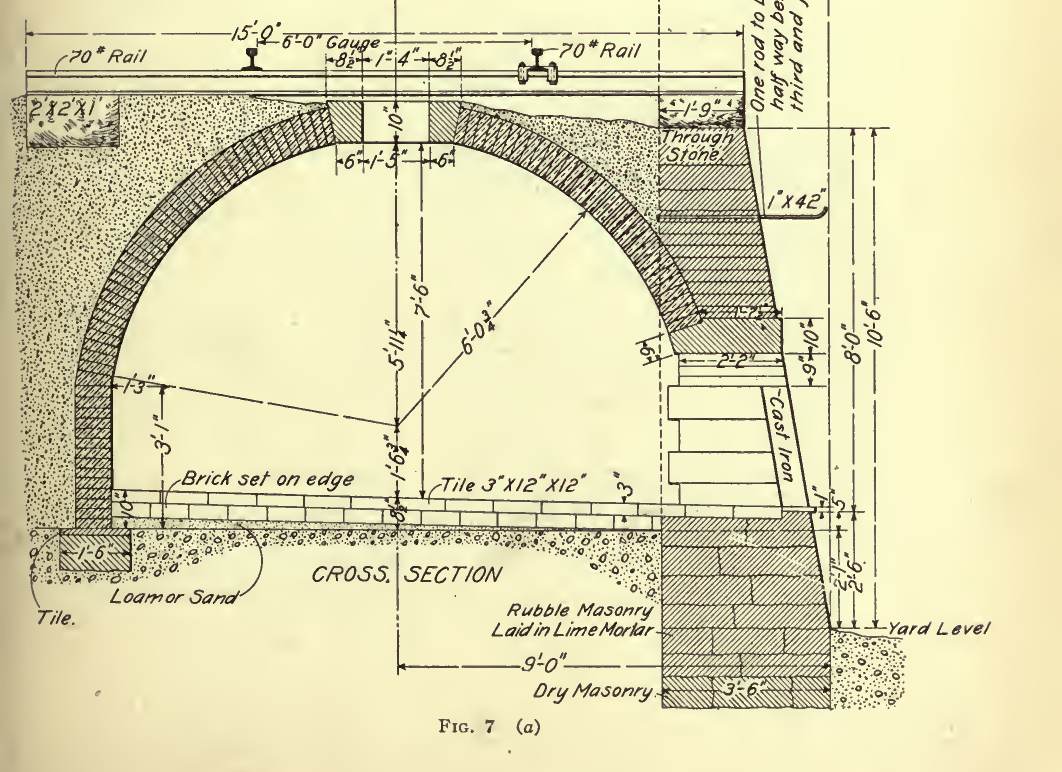
Everything in the shape serves the heat. The crown is the part that lasts or fails: clay brick stood from two months to three or four years, and silica brick twelve to fifteen (Fulton p. 192). The floor stood on a subfloor of red brick laid "to store heat" against black ends (Fulton p. 155). Ovens stood in banks along rising ground, where the neighbours and the hill kept each other warm and only the front ran cool (Fulton pp. 150, 182, 373-375).
How it was really worked
The next charge went in as soon as the last was drawn, while the oven was still hot. Overman's oven "needs no kindling" after its first and second heats, and he gives the rule: "the hotter the oven, the better the coke" (Overman p. 125). Fulton measured it. An oven sealed at door and port right after drawing lit its new charge in 8 minutes against 32, and finished 8 hours sooner (Fulton pp. 193-194).
Coal was tipped through the crown from a larry on rails over the ovens (Fulton pp. 157, 362-363). The door was then bricked up with the air let in above the charge (Fulton pp. 148, 159).
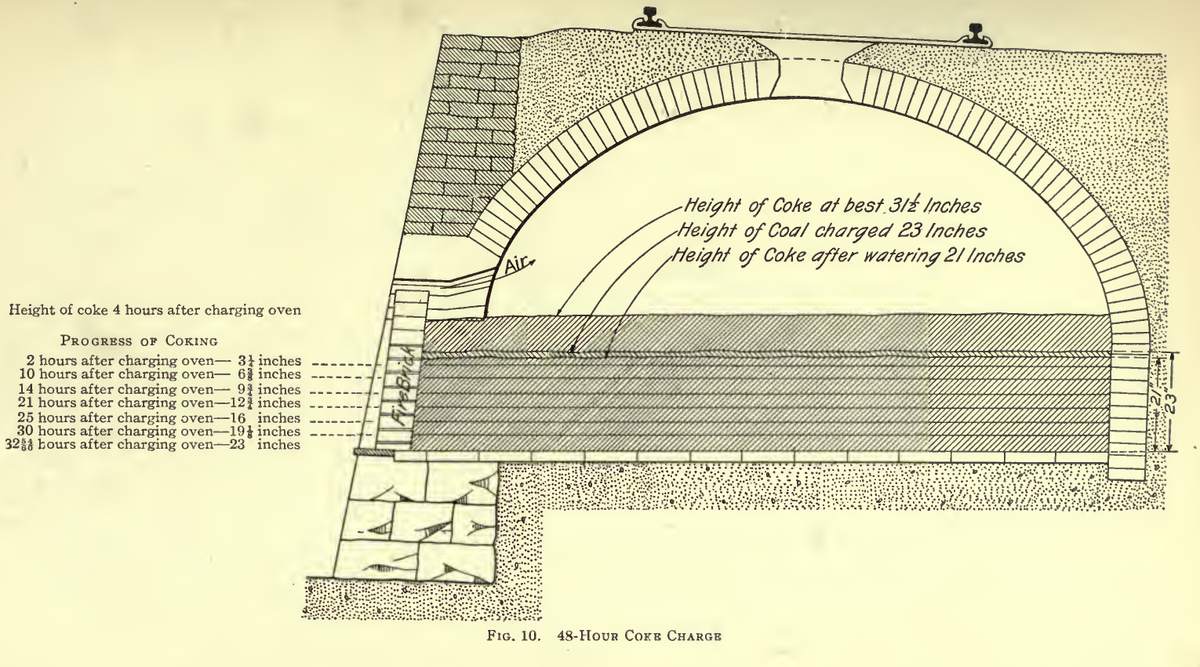
The coking starts at the top and goes down: "The process of fusing and coking begins on the top surface of the charge of coal, and goes down through the mass" (Fulton p. 158). That is why the door was set above the charge. The air burns the gas off the top and the heat works down. The gas rising through the hot coke leaves the silvery glaze prized on the best coke (Fulton p. 158).
The air had to be judged. Most gas comes off early, "requiring the most ample supply of air, say up to the twenty-fourth hour; after this the supply of air should be gradually diminished until the flaming ceases, when the oven should be entirely closed until drawn" (Fulton p. 193). Too much air cools the oven and burns coke, and too little heat leaves black ends (Fulton p. 193).
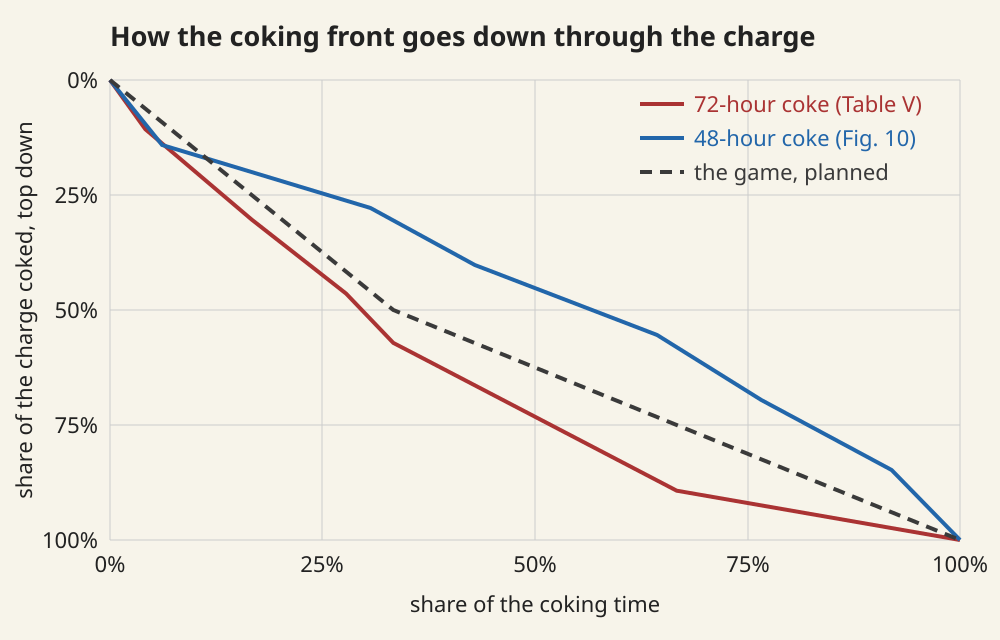
The time was what the depth allowed. Fulton's ovens took 5 net tons at 23 in. for 48-hour coke and 6 net tons at 26.5 in. for 72-hour coke (Fulton p. 158). Overman's Pittsburgh oven took 75 to 80 bushels about twelve inches deep and was done in 10 to 12 hours, then stood closed 8 to 10 hours to cool (Overman p. 125). A charge cut short burned off "10 to 12 hours before the time of drawing" and made spongy coke (Fulton p. 196). Drawn "just as soon as the top is well coked", the oven gave "large black ends", and left until the bottom was done the top "is ashed over" (Fulton pp. 180-182).
Drawing was by hand: "When the oven is burned off the coke is watered in the oven and then drawn by hand" (Fulton p. 175), the costliest labour of the plant at 18 of 36.2 cents a ton (Fulton p. 346). Watering in the oven left 1 to 3% water in the coke (Fulton p. 147). Overman had called quenching "a bad habit; it injures the coke, makes it rotten" and drew his coke hot with bars and scrapers (Overman pp. 125, 130).
What the beehive threw away was the gas. "More than 50 per cent. of the combustible gases escape from the tunnel head of the oven unconsumed", accounting for "the immense volume of black smoke always arising from coke ovens" (Fulton p. 307). It made no tar, ammonia or benzol to sell, and at most its waste heat raised steam at the pit, as at Browney and Pratt (Fulton pp. 167-172). The retort ovens that saved those by-products yielded 70 to 73% to the beehive's 63 to 66% (Fulton pp. 348-349), and still the beehive's coke smelted better: 0.956 lb a pound of Bessemer pig against 1.028 for Semet-Solvay retort coke (Fulton p. 343).
Why furnaces wanted coke
A blast furnace is a tall column of charge with the fuel holding up the ore above it. The fuel has to stay whole under that weight while the blast passes through it. Charcoal "from its softness of body ... could only be used in the old-time forges and low furnaces with feeble blast" (Fulton p. 328), while anthracite and coke bear the highest furnace (Fulton p. 328). A furnace coke was judged by hardness of body, full cell structure, purity, uniform quality and coherence in handling (Fulton p. 330), with black ends and breeze as the faults a furnace pays for (Fulton p. 334). Connellsville beehive coke was 44% body and 56% cells (Fulton p. 332).
Why the game's furnaces take coke and not coal is in fuels.
Period basis, and what is the game's own
- Period: the brick chamber baking coal shut away from most of the air, charged from above through the crown and drawn through a door (Fulton pp. 148, 157, 175). The game keeps both openings and the order of the work: coal in through the crown, draw at the door.
- Period: the oven kept no by-products (Fulton p. 307). The game's oven makes coke only, no tar, gas or ammonia.
- Period: a hot oven lights its next charge (Overman p. 125, Fulton pp. 193-194). In the game a charge laid in a chamber over 600 C catches from the heat, and a cold oven is lit by hand with a torch or firestarter at the door. The oven never lights itself from cold.
- Period: coking runs from the top down, and drawing early leaves raw coal under the coke (Fulton pp. 158, 180-182). The game plans the same: a chamber opened early gives coke over raw coal, and the raw coal goes back into the next bake. Today the whole chamber turns at once when the clock runs out.
- The game's own: the oven runs the base game's coal-pile process, scaled up, with its own rate and bake, and takes the base game's coke. The base game's chamber takes one pile and this one takes 18 piles' worth. See vanilla against reality.
- The game's own: "lid shut = coking". The chamber bakes only while its crown lid and drawing door are shut, the base game's rule for its own door. A real oven burned with air let in over the door and gas leaving at the crown, and was fully shut only when the flames ended (Fulton p. 193). The game has no air to regulate.
- The game's own: the chamber is a square room one block deep, not a dome, with no watering and no black ends beyond the planned raw coal.
- The game's own: only bituminous coal is accepted. The base game would also coke lignite.
The numbers
The bake and the yield keep the base game's values as they stand (how we scale), and the chamber is at true size in blocks (scale and units). "Planned" is the design; values without that word are what the game has now.
| In the game | Period figure | How it was scaled | Game value |
|---|---|---|---|
| Chamber across | 12 to 13 ft, about 3.7 to 4 m (Fulton p. 148) | Whole blocks, the game's own square | 3 blocks |
| Charge depth | 23 to 26.5 in. (Fulton p. 158), 12 in. (Overman p. 125) | One block of cells, the game's own | 1 block |
| Charge | 5 to 6 net tons (Fulton p. 158), 2 to 3 tons (Overman p. 126) | The base game's pile multiplied by the chamber | 288 coal, 18 base-game piles |
| Bake | 48 to 72 hours (Fulton p. 158), 10 to 12 hours (Overman p. 125) | The base game's value kept | 12 game hours, 14.5 from lighting with the 2.5-hour soak |
| Coke yield | 63 to 66% (Fulton p. 348), 75% (Overman pp. 130-132) | The base game's rate kept | 0.75, so 216 coke from 288 coal |
| Output of one oven | About 2 tons a day (Fulton p. 371) | Follows from the bake and the charge, the game's own | About 18 coke a game hour |
| Coking curve | Half the depth in about a third of the time, 72-hour coke (Fulton p. 192) | Curve taken from Table V | Planned, about half the depth in the first third |
| Lighting heat | None given | The game's own | 400 C to bake, 600 C to catch by itself |
| Heat kept after burning out | Hot ovens light faster (Fulton pp. 193-194) | The game's own cooling rate | Planned, falls 120 C a game hour, so 5 game hours over the 400 C line from 1000 C |
Open, and what you can tell us
The books at hand do not date the first beehive or settle its origin: Fulton calls it unclear whether the dome came from the coking mound or the charcoal kiln (Fulton p. 148). They also disagree on quenching, watered in the oven (Fulton p. 175) against "a bad habit" (Overman p. 130). If you know a source on either, we would like to read it.
Picture credits
- Beehive coke oven: Helen Wilkinson, CC BY-SA 2.0, cropped.
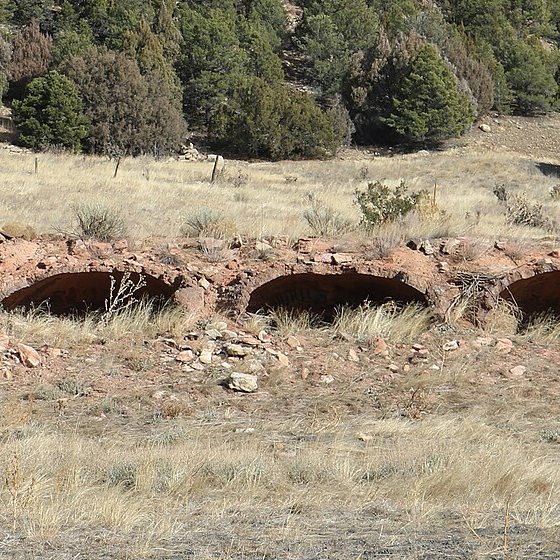
- Beehive coke ovens in Hastings, Colorado: Jeffrey Beall, CC BY 4.0, cropped.
- Fig. 2 (Fulton p. 148), Fig. 7 (a) (a plate facing Fulton p. 152) and Fig. 10 (Fulton p. 159): Fulton, Coke, Library page.
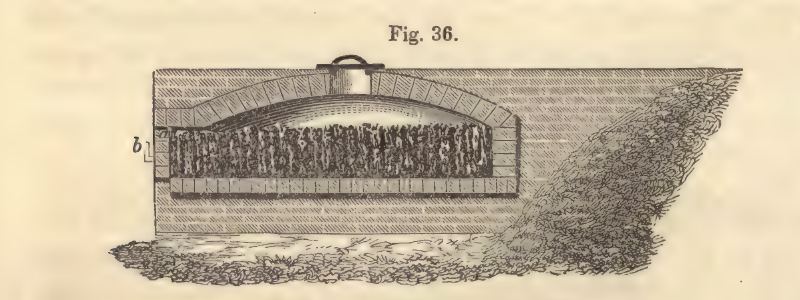
- Figs. 36 and 37: Overman, The Manufacture of Iron, pp. 124 and 126, Library page.
- The coking front: drawn for this page from Fulton p. 192 (Table V) and p. 159 (Fig. 10).
- The game's oven: the mod's planned drawing.
Comment or suggest something in the Expanded thread on the Vintage Story Discord