
Blowing machines
A blast furnace burns on the air forced into it, and it needs far more air, at far more pressure, than a person can pump. A blowing machine is a pump for that air, and the history of the machine is the history of making that pump bigger and stiffer: leather and wood first, wooden tubs, then cast iron, then steam. How the air is run in the game is in the furnaces and heat guide, and the tubs are in the catalogue. This page is about the real machines and how the game's follow them.
Why a furnace needs a machine at all
A hearth fire is blown by hand. A blast furnace is a column of ore, fuel and flux many feet tall, and the air has to be pushed in at the bottom and up through all of it. Overman asks 400 to 500 cubic feet a minute for a charcoal forge, 1000 to 2000 for a charcoal blast furnace and 3000 to 5000 for a coke or anthracite furnace (Overman p. 401). Pressure rises with the fuel: a charcoal furnace works on half a pound to a pound on the square inch, and hard charcoal, anthracite and coke want more than any wooden machine gives (Overman pp. 411, 426).
Leather or wooden bellows return only 30 to 40% of the power put into them, wooden cylinders 50 to 55%, and iron cylinders 60 to 65% (Overman p. 426). Each step of the ladder wasted less of the power put into it.
The wooden tubs
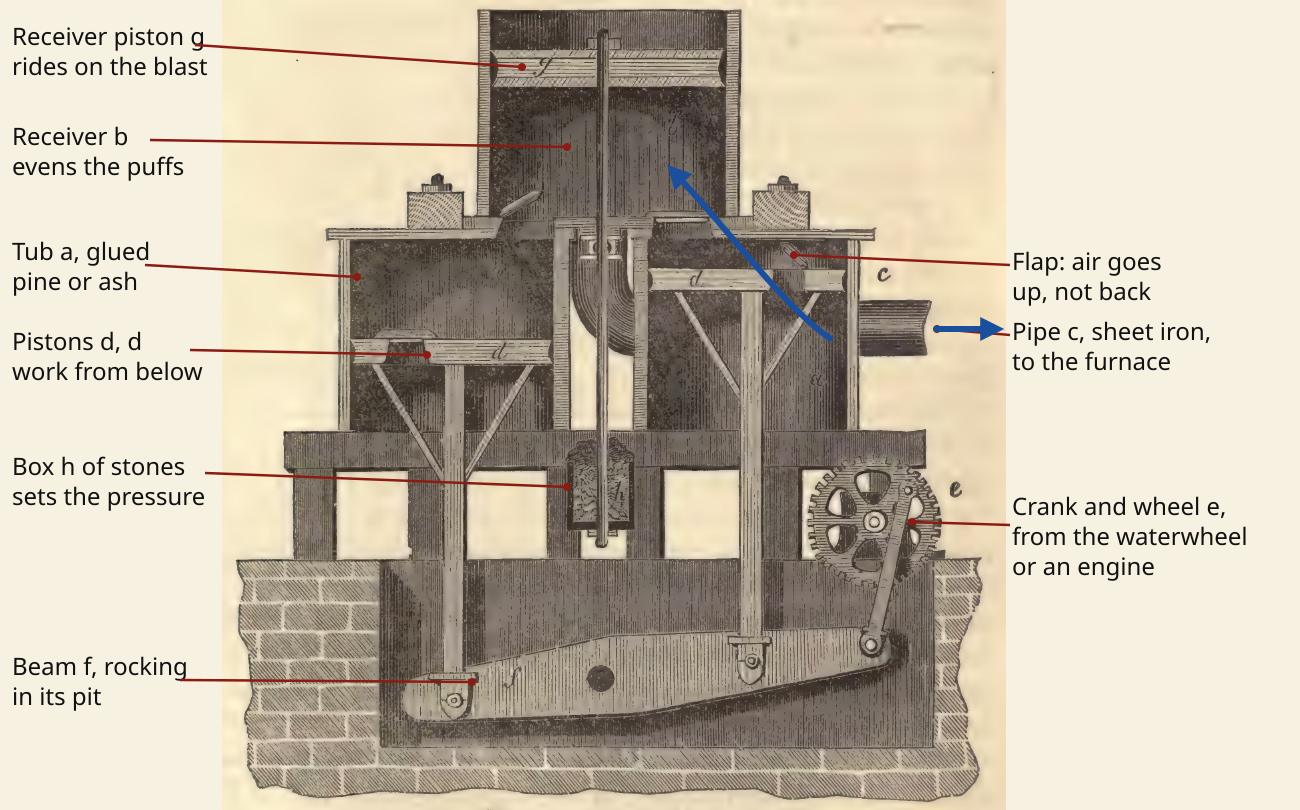
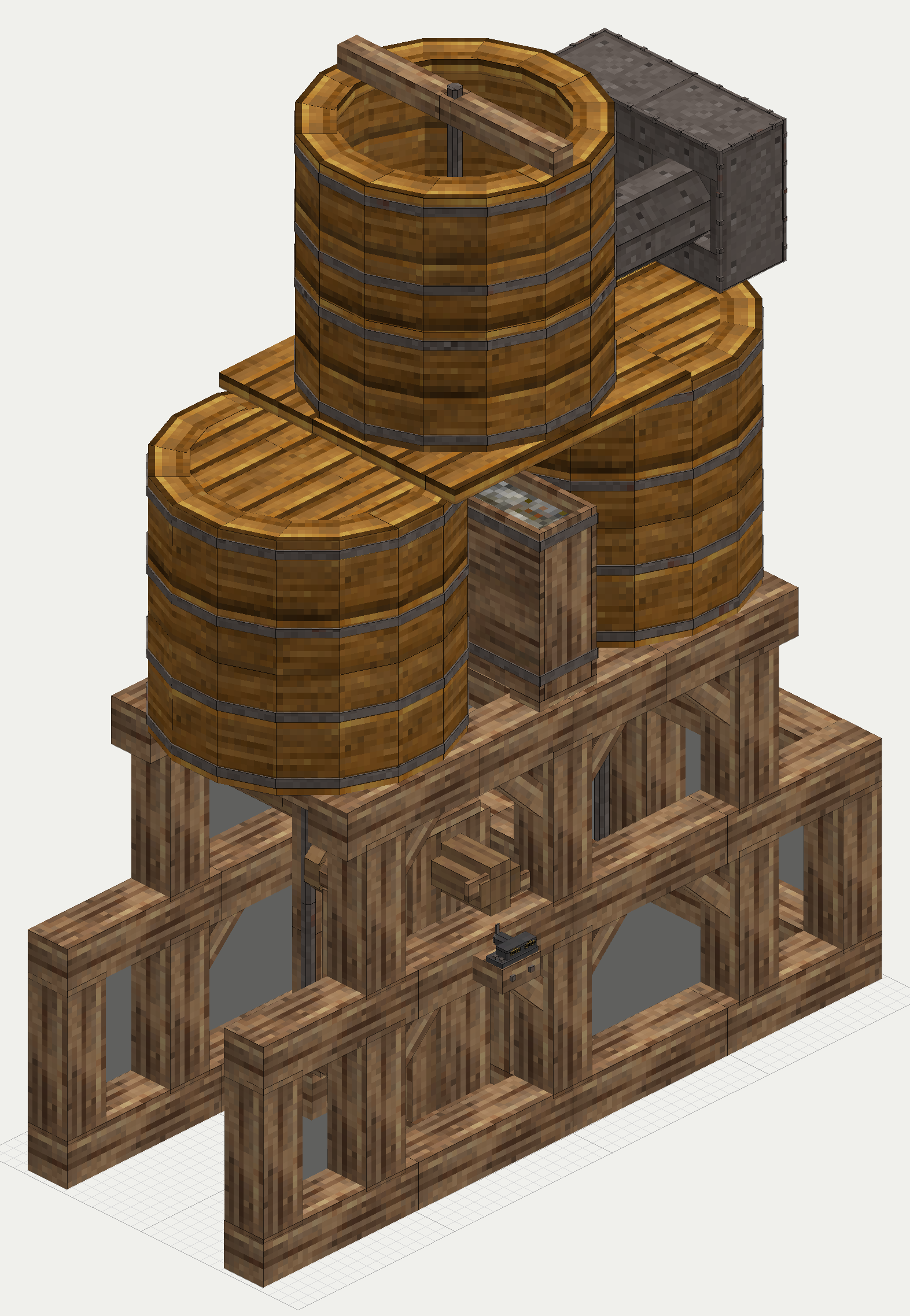
By 1851 the American charcoal furnace had settled on one form: two round tubs, the pistons working from below, and a dry receiver on top (Overman p. 395). The tubs and receiver were four to four and a half feet wide and four feet high, with a three-foot stroke, made eight to ten strokes a minute, and were built of glued segments of dry pine or ash with the grain running round the tub, because a tub made that way keeps its shape better (Overman p. 396). Tops and heads were three inches thick (Overman p. 397). The valves were wood lined with leather (Overman p. 396), and fat or oil was forbidden on the wood; the inside took a coat of glue and plumbago instead (Overman pp. 396-397).
Such a machine cost $250 to $350 and could blow one charcoal furnace or four to five forge fires, on 12 to 16 horse power from a wheel or an engine (Overman p. 396). Its limit was the wood. Five-eighths to three-quarters of a pound was as much as a wooden cylinder could hold, and coke "cannot be carried on to advantage without iron bellows" (Overman p. 426). Tubs were also "a temporary arrangement, to gain time and means after the works are just started" (Overman p. 396).
The iron cylinder
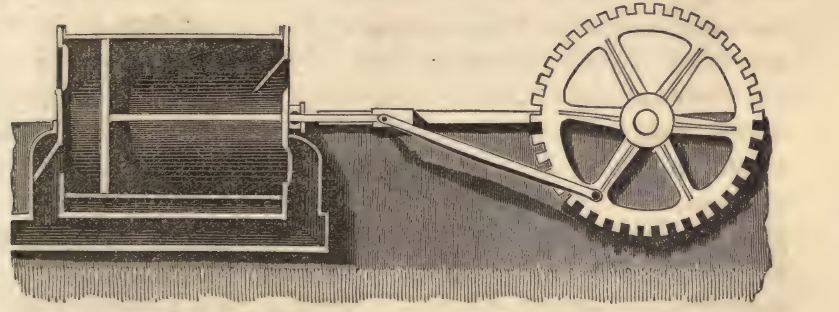
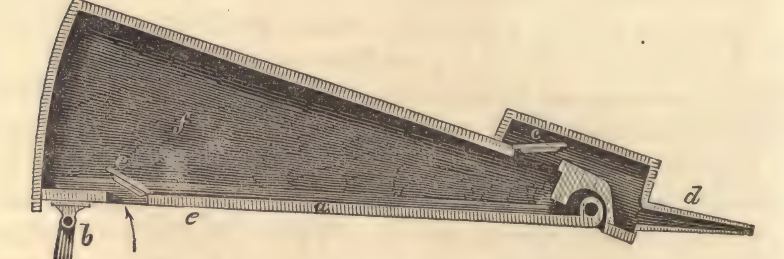
An iron cylinder is the same pump with stiffer walls. It holds more pressure and returns more of the power (Overman p. 426). The piston was packed with a steel or wrought-iron hoop and hemp behind it (Overman p. 403), and the dead space at the ends still cost at least 10% of the air, up to 25% in poor machines (Overman p. 402). Valves are light flaps of sheet iron lined with leather, hung vertically so they shut by their own weight, and one-twelfth of the piston's area is enough for them (Overman pp. 399, 402).
The blowing engine
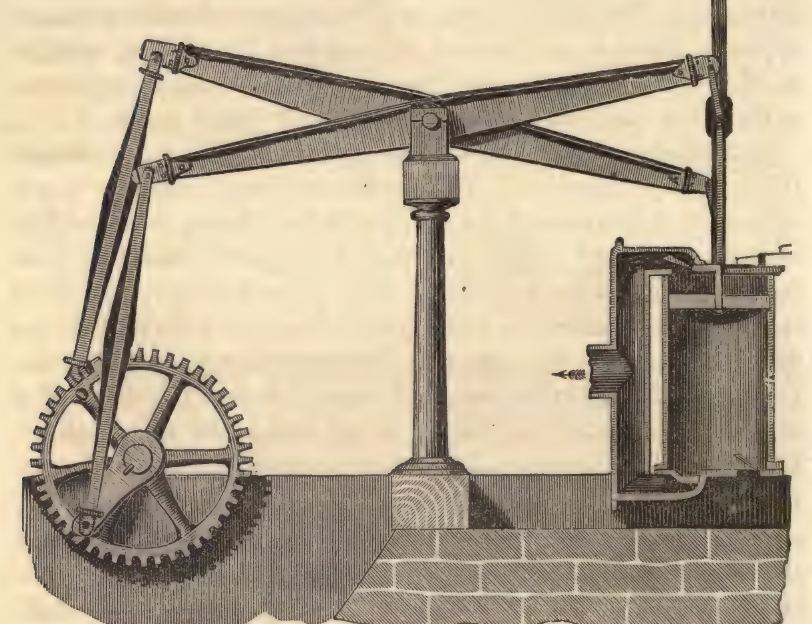
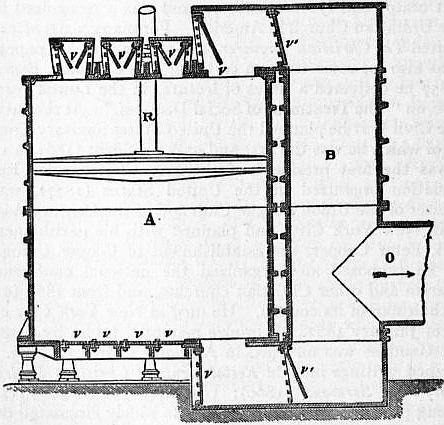
Early engines were put to raising water onto the furnace's wheel (Farey p. 280), then to blowing directly. In 1777 an engine was built with a steam cylinder of about 30 inches on one end of the great beam and a blowing cylinder of about 36 inches on the other, closed at both ends so that it blew in both directions; Farey calls it the first double-acting air pump (Farey p. 328). Overman, on the iron side, sees no reason left for water at all: "There is no reason whatever for employing water power in the propelling of blast machines at blast furnaces" (Overman pp. 399-400), since the furnace's own waste heat can raise the steam.
The size climbed fast. The Boulton and Watt engine Farey draws, about 1807, has a 48-inch steam cylinder and an 84-inch blowing cylinder on an 8 foot stroke, runs 12 strokes a minute, and blows two furnaces at 3 lb, discharging about 6864 cubic feet a minute (Farey pp. 724, 727-728). The largest engine in Truran's table, built in 1850, has a blowing cylinder of 144 inches on a 12-foot stroke and gives 51,528 cubic feet a minute at 3 lb (Truran pp. 188-189). Truran wants every part of a blowing engine twice as strong as in any other engine, and expects one to run a month and then stop an hour, about 30 hours a year all told (Truran pp. 183, 188).
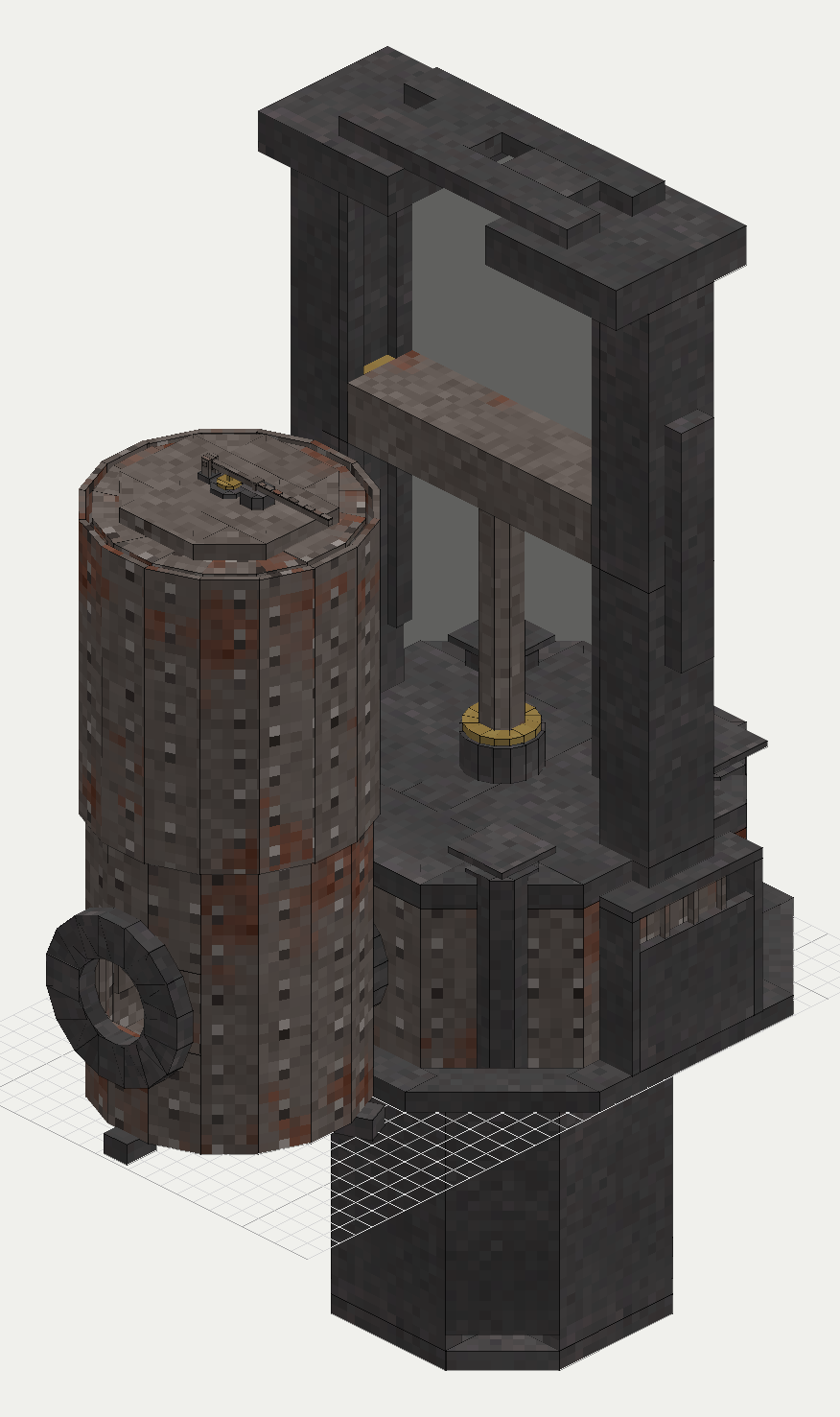
The receiver: why a blast has to be smoothed
A pump delivers in pulses, and a furnace burns better on a steady wind. Overman's dry receiver, a loaded piston in a cylinder of a tub's size (Overman pp. 396, 411), is good enough for forges but "far from producing a uniform pressure" (Overman p. 411). For a furnace he prefers an air chamber: a riveted sheet-iron drum like a boiler, four to eight feet across, 10 times one cylinder's volume with two double-stroke cylinders and 20 to 30 times with one (Overman pp. 412-413). Three double-stroke cylinders blow steady enough to need none (Overman p. 412). Farey's Boulton and Watt engine keeps its blast steady with an inverted iron chest holding about 3780 cubic feet of air in a cistern of water (Farey pp. 726-727). The bigger the air store against the stroke, the steadier the wind at the tuyere.
How the game uses the ladder
The game keeps the ladder and the reason for it. A pair of wooden tubs on a vanilla axle is the first blower, enough to run a charcoal furnace at the small volume wood gave, and it reaches the coke furnace only at the small slow make its air and pressure allow. No furnace refuses the tubs' wind; a weak blast costs heat. The iron cylinder on the shafting and the steam blowing engine are the steps that lift that make, on charcoal and then on coke.
Period basis, and what is the game's own
- Period: two tubs, pistons from below by beam and crank, dry receiver with a loaded piston, wood valves lined with leather (Overman pp. 395-396). The game draws this, and the tubs' size is Overman's.
- Period: a charcoal furnace on tubs at 8 to 10 strokes a minute, 5/8 to 3/4 lb, wooden limit (Overman pp. 396, 426). The game plans those strokes as a band of axle speed, and the wooden ceiling as the tubs' limit.
- Period: cast cylinder, horizontal on a waterwheel, rod through both heads, flaps of sheet iron lined with leather (Overman pp. 399-400, 402). The game plans it on its iron shafting, sharing the Watt engine's 44-inch barrel and its receiver.
- Period: the steam blowing engine with a vertical cylinder and a receiver (Overman pp. 400-401). The game plans one cylinder on the Watt's beam, single-acting, into a riveted drum.
- The game's own: vanilla's bellows are pumped by hand and blow a small puff into whatever they face, with no pipe and no pressure. See vanilla against reality.
- The game's own: the tubs turn from a vanilla axle, which has no measured horse-power, and the blast is one network of air at one pressure. There is no leather to replace, no glue to renew and no dead-space loss beyond the rated figures.
- The game's own: the iron cylinder's 3 lb safety valve is a limit no book gives for that machine. Coke furnaces took 2 to 3 lb (Truran pp. 113-115), and the wheel's power is the real limit.
The numbers
Air is at true size in litres; pressures are real. Overman gives no delivered volume for his machines, so delivery is bore times stroke times strokes, less his dead-space loss. Scaling is covered on the scaling page and scale and units. "Planned" is the rating in design; values without that word are what the game has now.
| In the game | Period figure | How it was scaled | Game value |
|---|---|---|---|
| Tub size | 4 to 4.5 ft wide, 4 ft high, 3 ft stroke (Overman p. 396) | Whole voxels at true size | Planned 1.375 m across, 1.25 m high, 0.94 m stroke |
| Tub strokes | 8 to 10 a minute (Overman p. 396) | Axle speed to strokes | Planned 8 to 10 |
| Tub delivery | Not stated; furnace needs 1000 to 2000 cu ft a minute (Overman p. 401) | Two tubs swept, less 10% (Overman p. 402) | Planned 334 to 418 L/s; today 45 L/s |
| Tub pressure | 5/8 to 3/4 lb a sq in (Overman p. 426) | The figure as written | Planned 5.2 kPa over ambient; today 2.2 atm, a game number |
| Tub power | 12 to 16 hp (Overman p. 396) | Vanilla axle, no kW | A load of the game's own |
| Iron cylinder bore and stroke | About 4 ft by 6 ft (Overman p. 403) | The Watt's blowing barrel | Planned 1.125 m by 1.26 m |
| Iron cylinder speed | 3 ft a unit of time at 4 ft bore (Overman p. 401) | Read as per second | Planned 0.90 m/s |
| Iron cylinder delivery | Not stated; bore x stroke, less 10 to 25% (Overman p. 402) | Swept volume less dead space | Planned 806 L/s |
| Iron cylinder pressure | 1/2 to 1 lb charcoal (Overman p. 411); coke 2 to 3 lb (Truran pp. 113-115) | A 3 lb valve of the game's own | Planned 20.7 kPa |
| Receiver | 20 to 30 times the cylinder (Overman p. 413) | The shared receiver | Planned 22.8 times a stroke |
| Charcoal furnace air | 1000 to 2000 cu ft a minute (Overman p. 401) | Bottom of the range, in litres | Planned 472 L/s |
| Coke furnace air | 3000 to 5000 cu ft a minute (Overman p. 401) | The game's own, below the period range | Planned 620 L/s |
| Steam blowing engine | 12 strokes, 3 lb, two furnaces (Farey p. 727) | Watt's blowing barrel, Farey's 96% delivery (Farey p. 727) | Planned 703 L/s |
Open, and what you can tell us
Overman's "stroke" for the tubs is not defined: read as one delivery a tub, the machine meets his own furnace demand, and read as one delivery for both tubs it does not, so the game takes the first reading (Overman pp. 396, 401). His "three feet" of piston speed prints no unit of time (Overman p. 401). And he says of the horizontal cylinder both that experience rather bears against it and that it presents many advantages with a waterwheel (Overman pp. 399-400). If you know a source that settles what a tub-machine maker meant by a stroke, or that times a horizontal blowing piston, we would like to read it.
Picture credits
- Figs. 131, 132, 133 and 134: Overman, The Manufacture of Iron, pp. 394, 395, 398 and 399, Library page. Fig. 132 labelled for this site from pp. 395-396.
- Early blowing engine, section: Encyclopaedia Britannica, 1911, public domain.
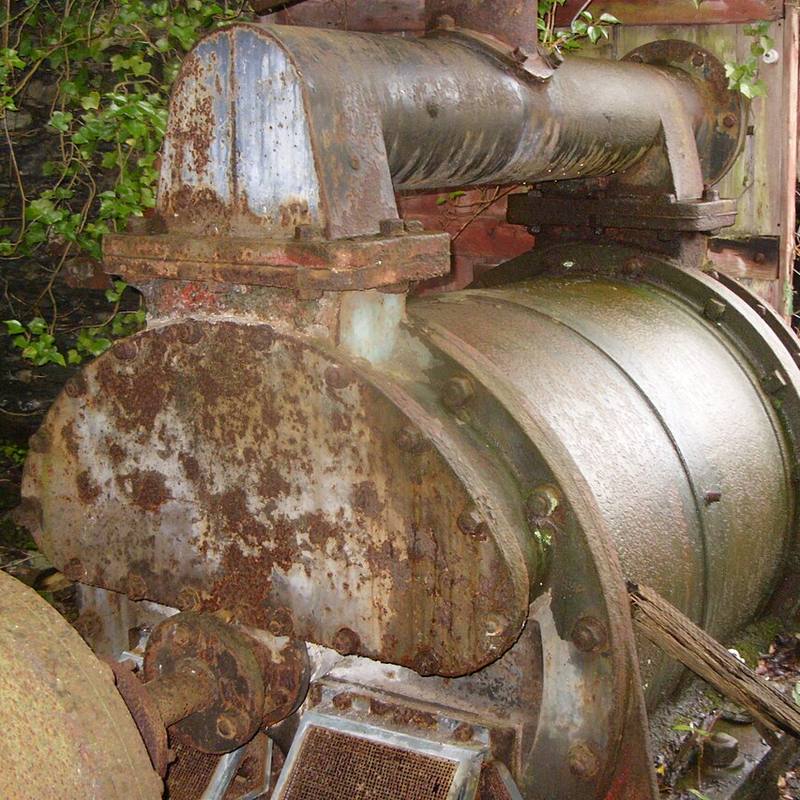
- Backbarrow blowing engine: Peterrivington, CC BY-SA 3.0, cropped.
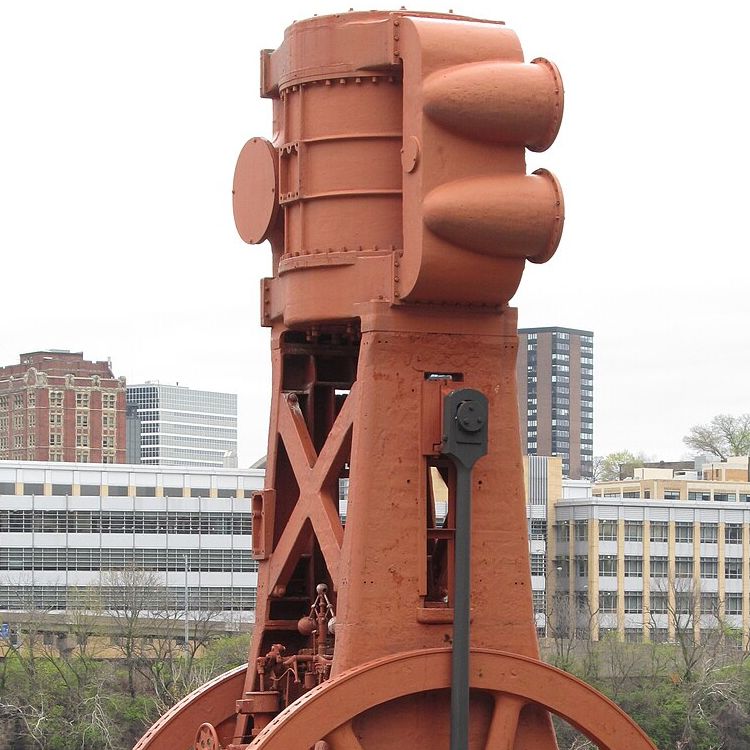
- Blowing engine, Station Square: Cbaile19, CC0, cropped.
- The game's tubs and engine blower: the mod's planned drawings.
Comment or suggest something in the Expanded thread on the Vintage Story Discord