
Cold-blast furnace
A blast furnace is a tall hollow stack kept full from the top, with air blown in near the bottom and liquid iron and cinder taken off underneath. Cold blast means the air goes in unheated; hot blast came later. How to build and run one in the game is in the furnaces and heat guide and the burden guide, and the structure is in the catalogue. This page is about the real one and how the game's follows it. The day's work of running it is in running a blast furnace.
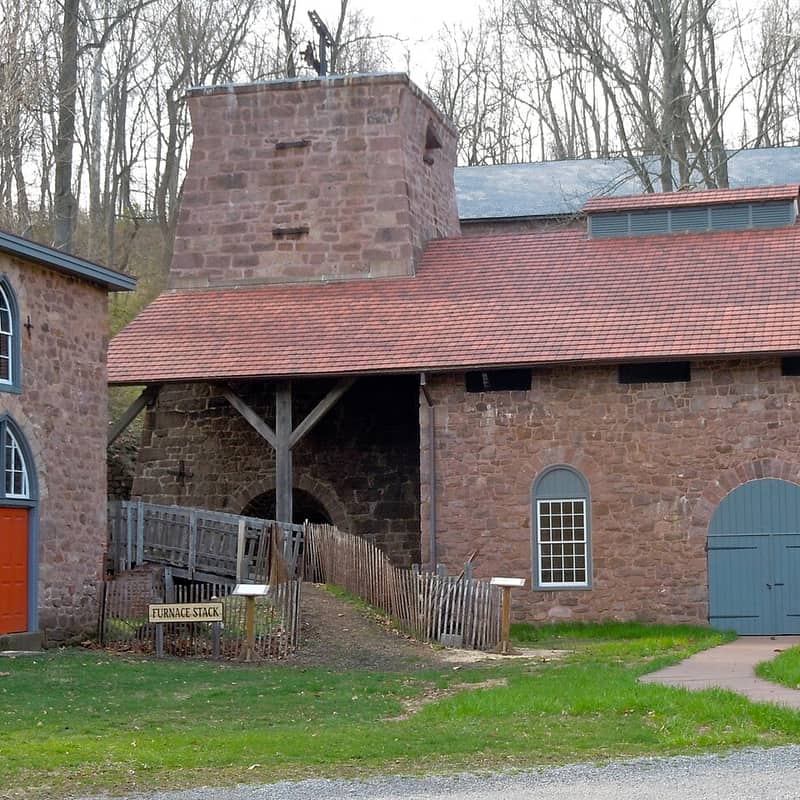
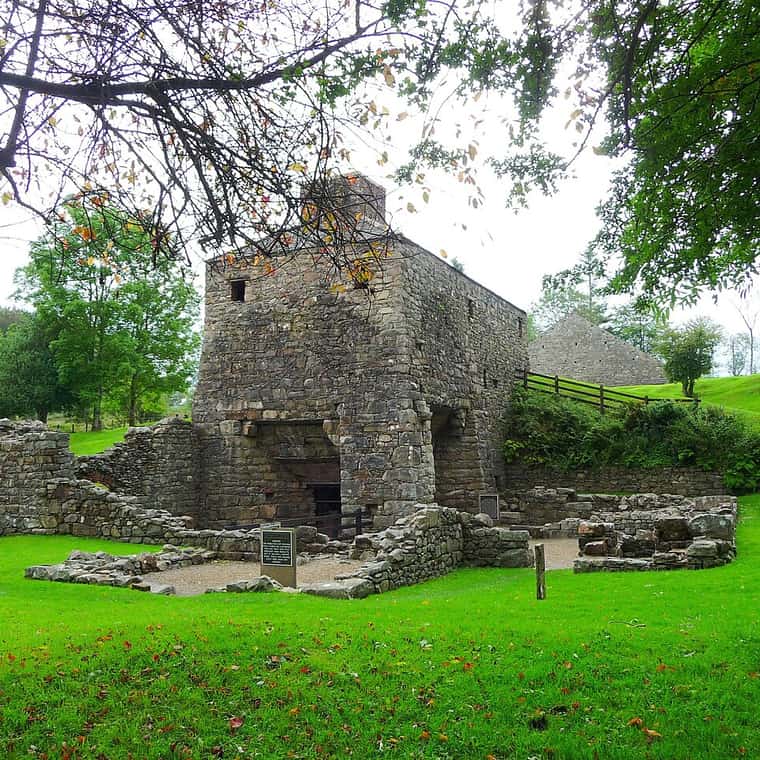
How the real one worked, and why it was built so
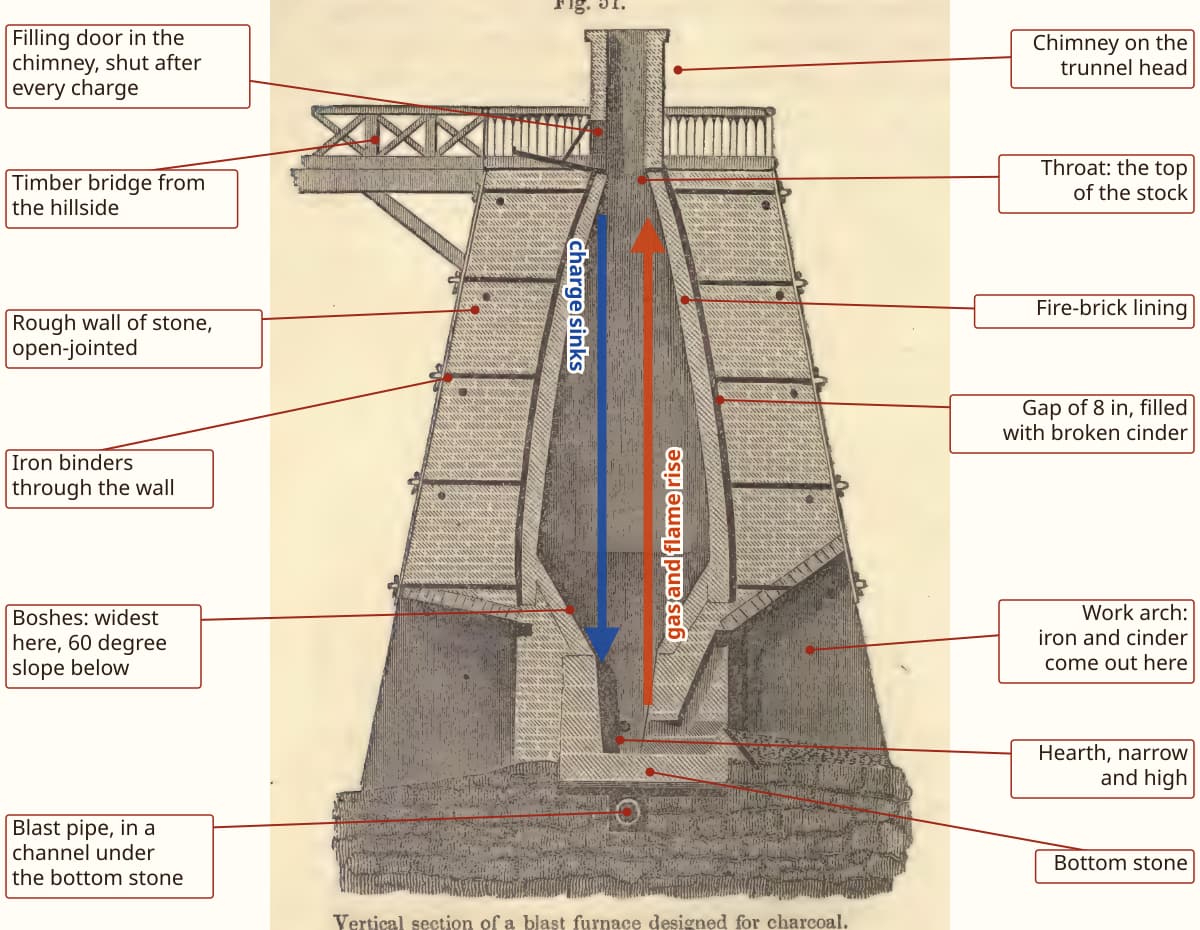
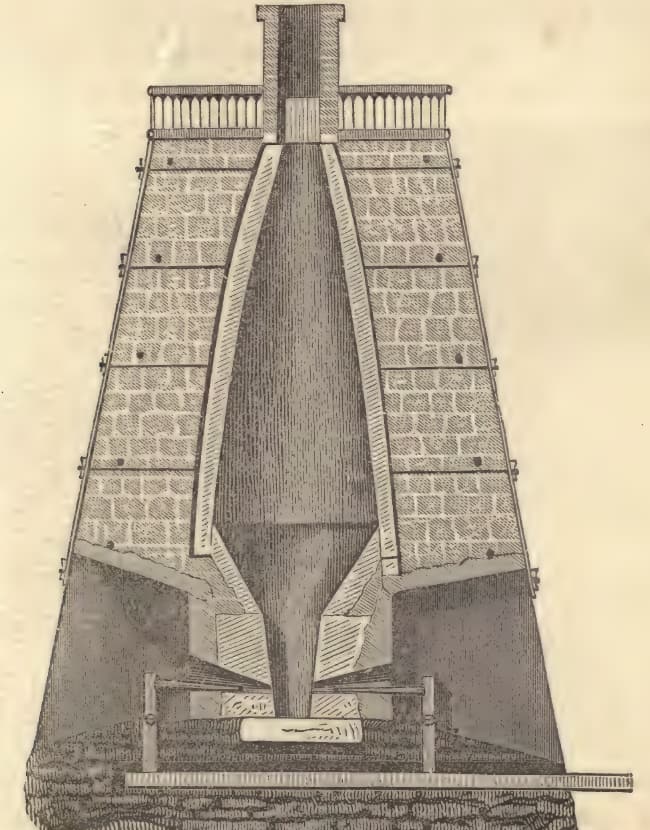
A furnace does two jobs at once in the same space. Coal burns at the bottom, in front of the tuyeres, and that is the only place it burns: the combustion is hottest right around the tuyeres (Johnson Principles pp. 2-4). The gas from that fire, hot and full of carbon monoxide, then has to climb the whole height of the stack through the charge coming down. On the way it strips the oxygen from the ore and hands its heat to the cold stock. The furnace is tall because that exchange takes distance: gas that left the top still very hot would be fuel thrown away.
So the top is narrow and the middle wide. Overman's stack has a throat of 20 in to 4 ft and boshes of 9 ft 6 in (Overman pp. 151-152): the charge needs room to expand on its way down and the gas room on its way up (Johnson Principles p. 134). Below the boshes the walls come in steeply, at about 60 degrees (Overman p. 153), and the stock narrows into the crucible.
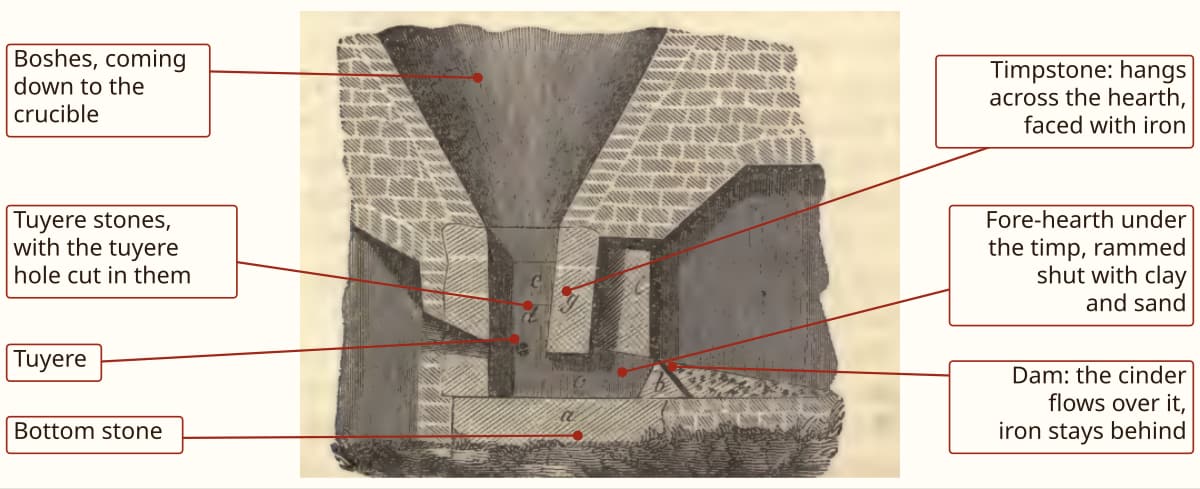
The hearth is narrow and high (Overman p. 151), 24 in wide at the bottom and 36 in at the top of its 5 ft 6 in on the model furnace (Overman p. 152), with the tuyeres 20 in above the bottom stone (Overman pp. 152-153). A hearth too wide makes dust, half-smelted ore that forms infusible lumps (Overman p. 190). Its stone is chosen for what the furnace does to it: "It is not the heat which destroys the hearth, but the chemical action of the materials in the furnace" (Overman p. 158).
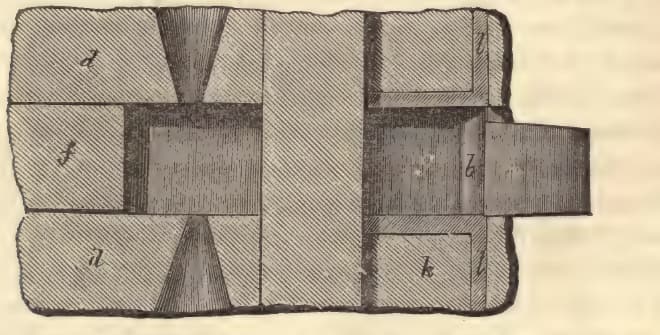
Below the tuyeres the melted metal and cinder gather, the cinder floating on the iron because it is lighter (Overman p. 145). The cinder rises until it reaches the height of the dam, and then "a regular current of the cinder will flow off by itself" (Overman p. 189). The iron is held back and let out through a tapping hole at intervals (Overman p. 190). In a charcoal furnace the cinders were drawn and the hearth cleaned every twelve hours, in a coke furnace every six (Overman p. 186).
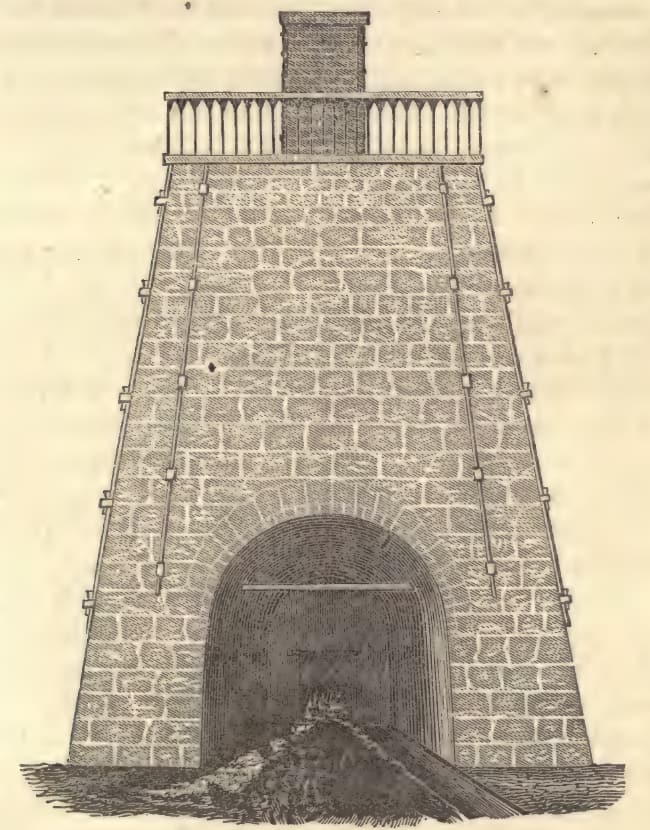
The walls are built in two layers because the inside gets hotter than the outside and moves more. A fire-brick lining up to 16 in thick stands inside the rough wall with a space of 8 in between, filled with stone fragments or broken cinder (Overman p. 157). The rough wall above the arches is left very open and full of channels that drain the watery vapours from the masonry (Overman p. 156). Twenty iron binders in five courses hold it (Overman p. 157).
Charging: the bedding floor and the top
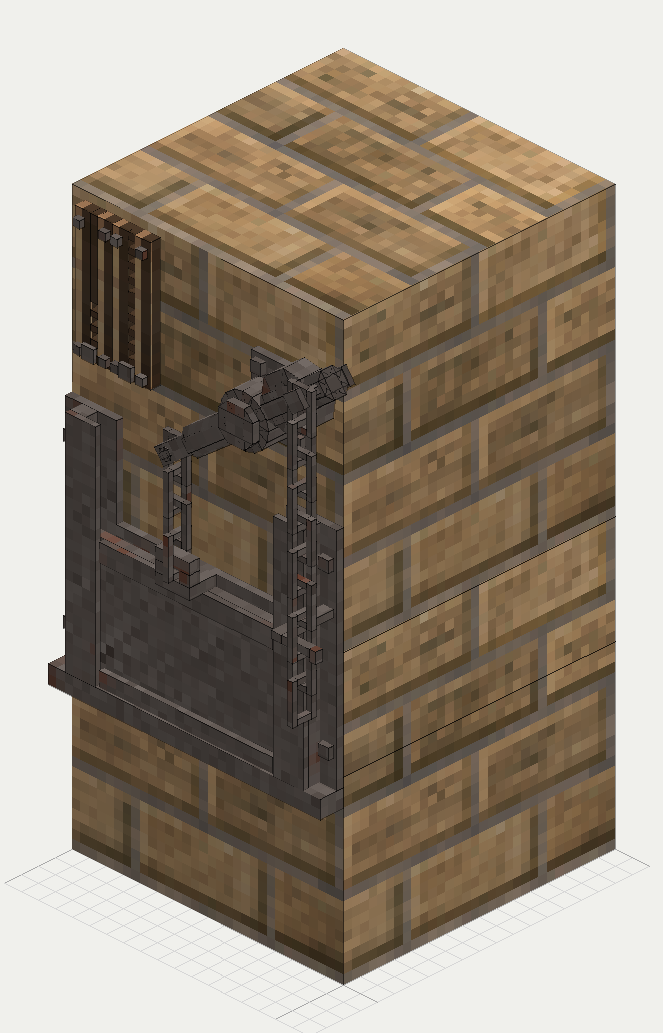
The stack could only be fed from above, so a furnace stood against a hillside with a bridge to its top, or had its stock hoisted (Overman pp. 149, 191, 193-194). Ores were mixed first on the yard: a hundred barrowfuls of one ore, half as much of a second, a fifth or sixth of a third, the flux over all, in beds one to two feet high, "from which an amount sufficient for a charge is taken" (Overman pp. 199-200). Bedding let the mixing be watched rather than left to the barrow men (Overman p. 200).
At the top, the coal and ore went in as alternate charges, the coal first (Overman p. 195). Coal charges stayed the same and any change was made in the ore (Overman p. 195), and the ore was weighed, never measured (Overman pp. 195-196). The filler kept the stock up to the top and the furnace full, every new charge just filling it (Overman p. 191), and a chimney and a door on the trunnel head let the manager hold the temperature of the top by opening and shutting it (Overman p. 158).
Period basis, and what is the game's own
- Period: Overman's model charcoal furnace (Overman pp. 152-158), a battered square stack with work and tuyere arches, a fire-brick lining inside a rough wall, a chimney on the trunnel head with a door for filling, and two tuyeres facing each other. The game takes the bore's proportions and the two opposed tuyeres from it, and lays the same lining inside a stack of plainer brick.
- Period: fuel and burden went in as alternate rounds (Overman p. 195, Truran p. 64). The game charges them as alternate courses of fuel and burden through the door; the ratio of the two is the player's dial, as the ore charge was the founder's.
- Period: ores were bedded on the yard, and a charge was taken from the bed (Overman pp. 199-200). The bedding floor is that, one shovel dig cutting through every layer. Proposed: a burden item standing for six laid items.
- Period: a new furnace was dried for a week or ten days, then heated for three or four days, and came up to its full make over three or four weeks on a light burden (Overman pp. 165, 184-186). The game has no drying, and a furnace is blown in by a player holding a flame to an open tap-hole with the air on.
- Period: too little fuel chills the hearth, the tuyeres go dark, and cold stuff has to be taken out through the open hearth (Overman p. 190). Dead charges with no ore in them were the remedy for a cold hearth (Overman p. 187). The game's column chills the same way, and the bottom piles are broken out by hand.
- Period: iron let out through a tapping hole at intervals, cinder over the dam (Overman pp. 189-190). The game gives each its own tap, plugged with fire clay, and the slag notch stands higher in the wall than the iron notch, as the dam stood above the iron.
- The game's own: the base game's bloomery holds ore and fuel in two slots at a fixed ratio, with no shaft and no blast. See vanilla against reality.
- The game's own: the charge is kept as a list of courses in each column of the shaft, and the combustion is at the tuyeres only. Coke burns from the moment the furnace is lit, whether it is melting or not, with no fuel clock.
- The game's own: the hearth pool is one column of iron and slag, with its own temperature, poured from at that temperature.
- The game's own: the door refuses charcoal today, though the stack is drawn from a charcoal furnace; charcoal is planned, with the burden's flux following the fuel.
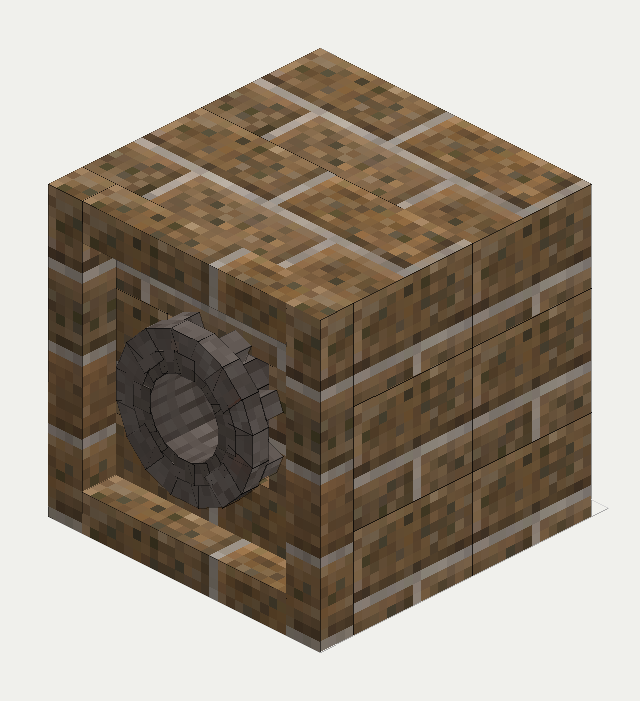
- The game's own: the planned tuyere has a nose of about 5 in bore, twice Overman's upper size.
The numbers
The furnace is drawn at about true size (scale and units). Its fuel and make follow the factor set for every ironworking furnace (how we scale). "Planned" is the rating in design; values without that word are what the game has now.
| In the game | Period figure | How it was scaled | Game value |
|---|---|---|---|
| Height to the top of the stack | 27 ft at Malapane (Overman p. 145), 35 ft on the model (Overman p. 152) | True size, whole blocks | 10 m (33 ft) |
| Chimney on top | 10 to 12 ft, as wide inside as the throat (Overman pp. 157-158) | True size, whole blocks | 3 m |
| Boshes | 9 ft 6 in, 60 degree slope over 4 ft (Overman pp. 152-153) | True size, whole blocks | 3 m |
| Hearth height | 5 ft 6 in (Overman p. 152) | Whole blocks, the tuyere one course above the pool | 2 m |
| Throat | 3 ft 4 in to 4 ft (Overman pp. 146, 152) | True size, whole blocks | 1 m |
| Tuyeres | Two, opposed (Overman pp. 152, 160) | As given | Two, opposed |
| Air the furnace needs, charcoal | 1000 to 2000 cu ft a minute at 1/2 to 1 lb (Overman pp. 396, 401, 411) | The period pair, see how we scale | Planned 472 L/s at 2.3 kPa |
| Air the furnace needs, coke | 24 to 36 cu ft a minute a cubic yard, 610 to 910 L/s at the drawn size (Truran pp. 113-115) | The period pair | Planned 620 L/s at 10.3 kPa |
| Make, well-run charcoal stack | 16 to 18 tons a week (Overman p. 165) | The period pair, read at the blower's air | Planned 262 to 329 u an hour on the tubs, 371 u at the furnace's need |
| Fuel a ton of iron, charcoal | 180 bushels (Overman p. 151) | The fire's fuel, by the factor | Planned 0.60 of the bloomery's fuel a unit of iron |
| Iron to slag | About 500 lb of slag a ton of iron on charcoal, 1200 lb on coke (Johnson Principles p. 48) | Ratio at face value | 1.8 : 1 on coke; planned about 4.5 : 1 on charcoal |
| Iron tap, flowing | None given | The game's own | Up to 30 u/s; planned 50 u/s |
| Slag tap, flowing | None given | The game's own | Up to 40 u/s |
| Charge in the shaft | None given | Capacity is the shaft's geometry | 1312 u, 41 charge cells |
Open, and what you can tell us
Overman's model and Truran's coke furnaces differ in almost everything except the shape: a charcoal stack of 32 to 35 ft against coke stacks of 40 to 45 ft with hearths of 6 to 8 ft (Truran pp. 113, 126). The game draws the small one and today runs it on coke. The books at hand do not say what a coke furnace of Overman's size would have made, so the coke figures in the table are read from the larger furnaces and scaled to the drawn volume. If you know of figures for a small coke furnace, we would like to read them.
Picture credits
- Joanna Furnace: Smallbones, CC0, cropped.
- Bonawe Iron Furnace: ronnie leask, CC BY-SA 2.0, cropped.
- Figs. 51, 52, 54, 57 and 58: Overman, The Manufacture of Iron, pp. 152, 153, 155, 159 and 161, Library page. Figs. 51 and 57 are labelled for this site, from Overman's text.
- The game's drawings: the mod's charging door and planned tuyere.
Comment or suggest something in the Expanded thread on the Vintage Story Discord