
Running a blast furnace
A blast furnace was never finished with. Once lit it was filled at the top and tapped at the bottom, day and night, for as long as the lining held. How to build and run the game's furnace is in the burden guide and the furnaces and heat guide. This page follows the real work in the order the workers did it, then says what the game keeps of it.
Preparing the burden
The word has a precise meaning. Burden is "the weight of calcined ironstone which is charged into the furnace for a definite measure of the fuel used" (Truran pp. 64-65), and a charge is one measure of ore with its assigned fuel and flux. The usual South Wales burden was 10 cwt of calcined mine to 9 cwt of coal, with about 3.5 cwt of limestone (Truran p. 65).
The fuel charge was held steady and the ore moved. Overman says it plainly: when something must change, "this is effected in the charges of the ore" (Overman p. 195), and Johnson repeats the rule in 1918 (Johnson Principles pp. 265-266). A change as small as 1% of the burden could be ordered by 1917 (Johnson Construction p. 44).
Weighing was the weak point. Coal was usually measured and ore weighed (Overman pp. 194-196), and Truran complains that weighing "is too generally omitted" when the managers were not by (Truran pp. 66-67). Where ores were mixed, on the Continent, they were spread in beds one or two feet high on a level yard, flux over all, and each charge cut from the bed (Overman pp. 199-200). Limestone was 14 to 24% of the ore and stone in a coke furnace (Johnson Principles pp. 268-271) and about 8% in a charcoal one (Johnson Principles p. 51).
Filling, round after round
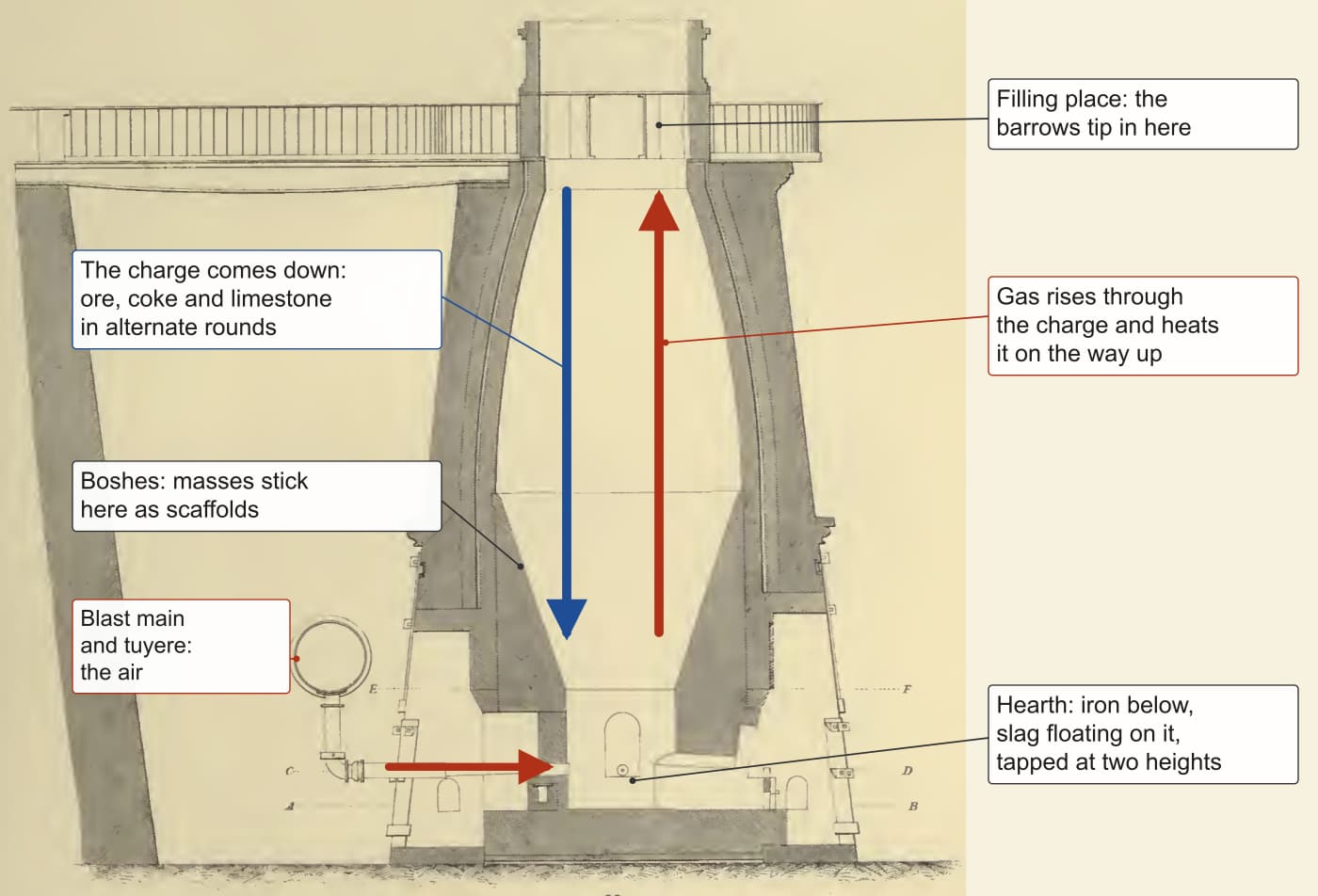
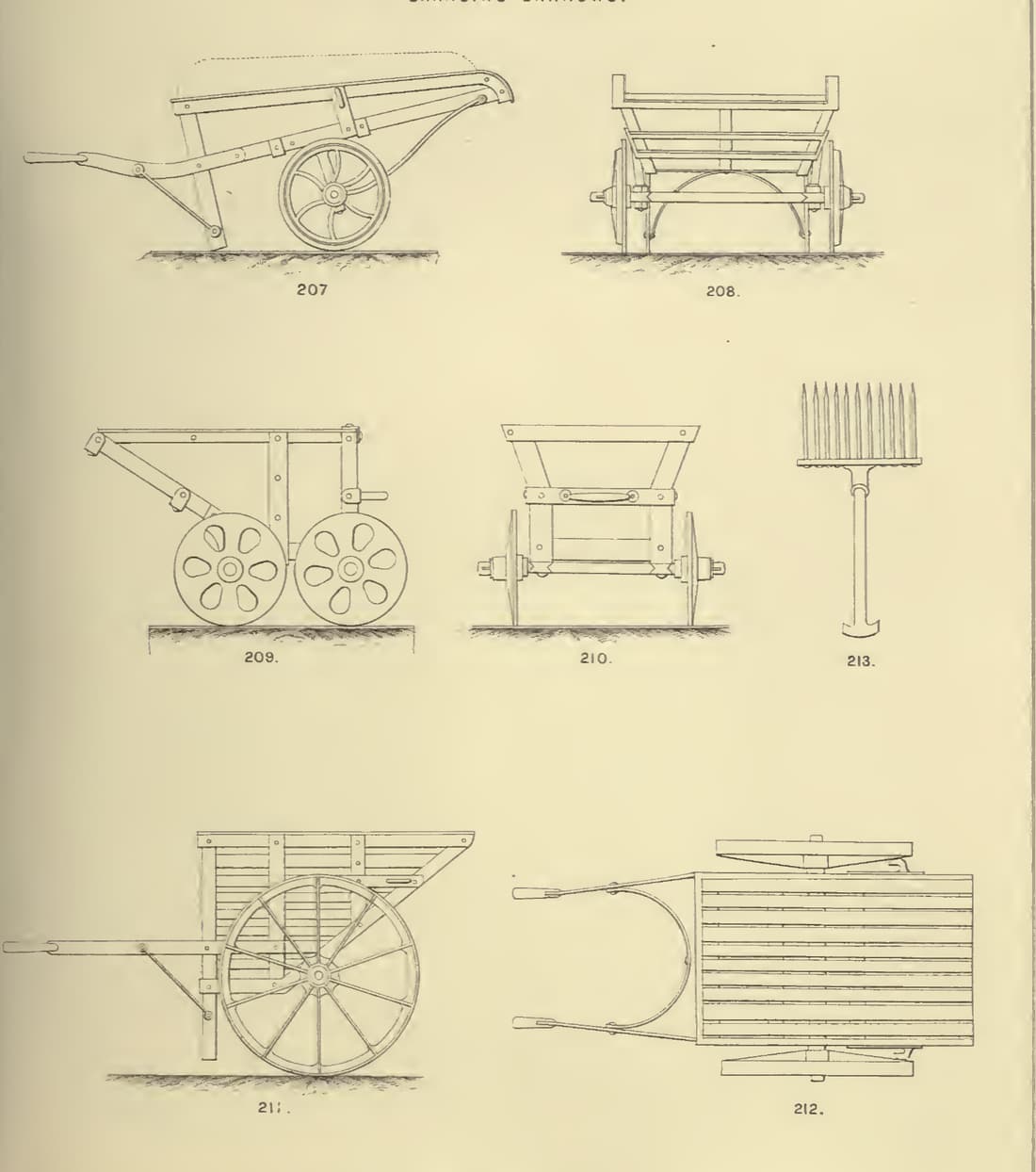
Fillers took the barrows from the weighing machines at the bridge and tipped them at the top in turn. "Immediately after a coal charge is filled, a charge of ore is thrown into the furnace" (Overman p. 195); "Between each barrowful of calcined ore the proper quantities of fuel and flux are filled in" (Truran p. 64). The furnace was kept full to the stock line (Johnson Principles p. 2), so the shaft held a tall stack of alternating coke and ore layers, each sinking as the one below burned away.
Evenness mattered as much as weight. The ore was spread uniformly over the coal, and a furnace with one filling place that was thrown to one side went badly, "scaffolding in and above the boshes" (Overman p. 200). Truran, who watched fillers do it, blames the habit for "much irregularity in the working of the furnace" (Truran p. 66).
Blowing in
A new furnace was dried first: two months and 70 tons of coal for a large one (Truran p. 28), or seven weeks of firing in Overman's America (Overman p. 164). Then timber was laid five or six feet deep in the hearth, coke put on it from the top to fill the hearth and boshes, and fire set to the timber. Regular charges followed to the throat, on a light burden: at Merthyr 5.5 cwt of calcined ironstone to 4 cwt of coke (Truran p. 40). Only then was the blast let on, through small pipes.
Johnson's practice in 1918 had the same shape. A coke blank a quarter to a third of the furnace's height went in first, then a light burden on two or three times the normal coke (Johnson Principles p. 326). It was lit at the tuyeres, with oily waste, because lighting at the top was "absurd" (Johnson Principles pp. 328-329). The tap hole stayed open with a pipe in it so that the gas "burns fiercely out the end", warming the bottom, until cinder came (Johnson Principles p. 331). Cinder appeared in about twelve hours and metal ten hours after that (Truran p. 41), and the furnace reached its full burden over weeks.
Blowing and watching
Once on, the furnace was read by eye, because nothing else could be read. A sound tuyere was "bright and star-like" (Overman pp. 187-188). A dark one, with a cold nose of cinder forming around it, meant a cooling hearth (Overman pp. 187-190). The flame at the top said the rest: heavy and dark for a cold furnace with too much burden, white-fumed for too much lime, "almost invisible" and lively for health, and wavering, sometimes large and sometimes small, for scaffolding (Overman pp. 204-205). The cinder was the third witness: glassy and greenish was sound (Overman pp. 203-204), and black held far more iron than white (Johnson Principles pp. 219-220). The furnace held three or four hours of heat in reserve (Johnson Principles pp. 261-262), so it did not go wrong the moment something did.
"Obstructions to the descent of the materials are called 'scaffolds'" (Truran p. 68), masses stuck above and around the boshes. The remedy for one low in the furnace was to work it hotter: much less ore and flux to the coal, and more blast (Truran p. 68). A local obstruction dams the gas, and the stock below keeps settling until a cavity forms under it. Then it falls: a slip, and slackening the blast lets it down (Johnson Principles pp. 122-123). Too much heat did the same thing another way, and a furnace too hot "won't take the wind" (Johnson Principles pp. 311-312).
Tapping and casting
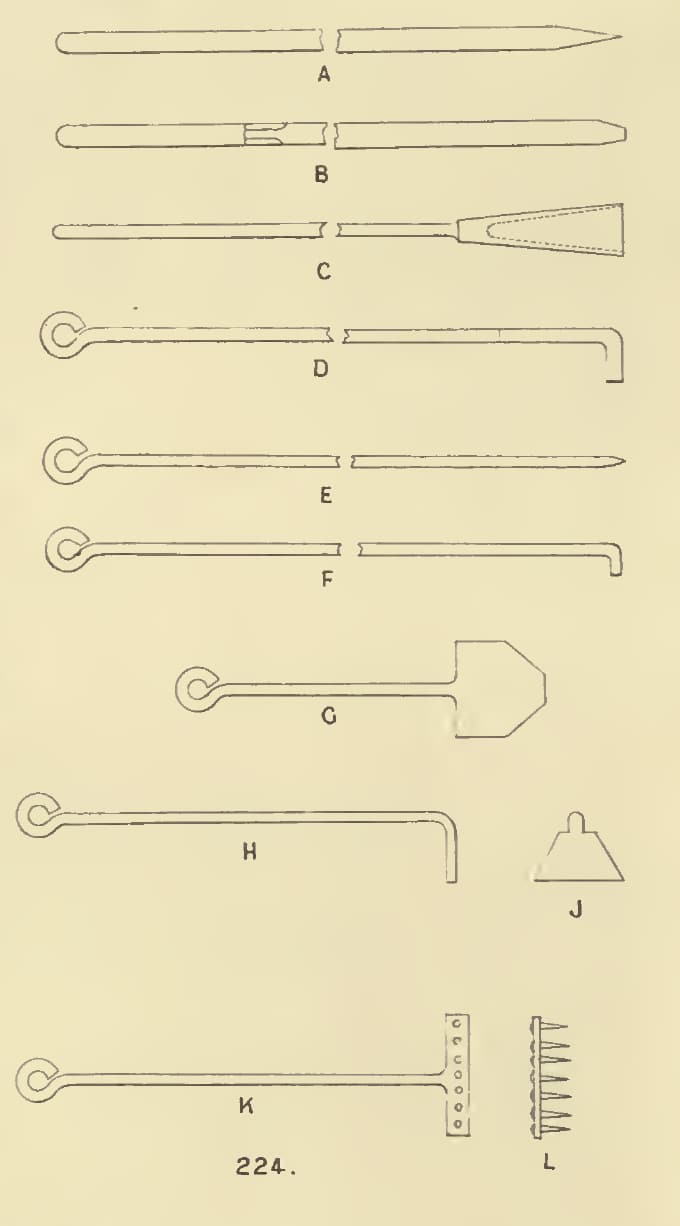
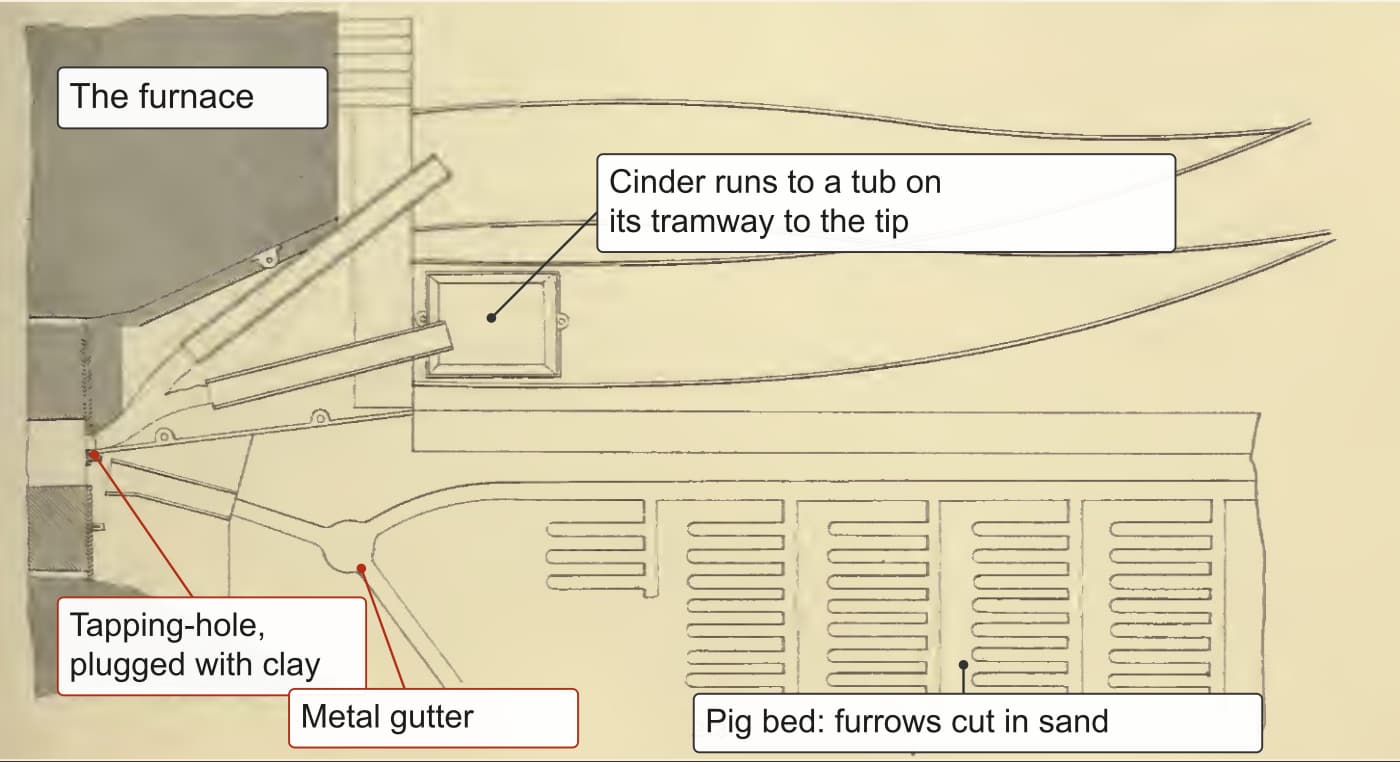
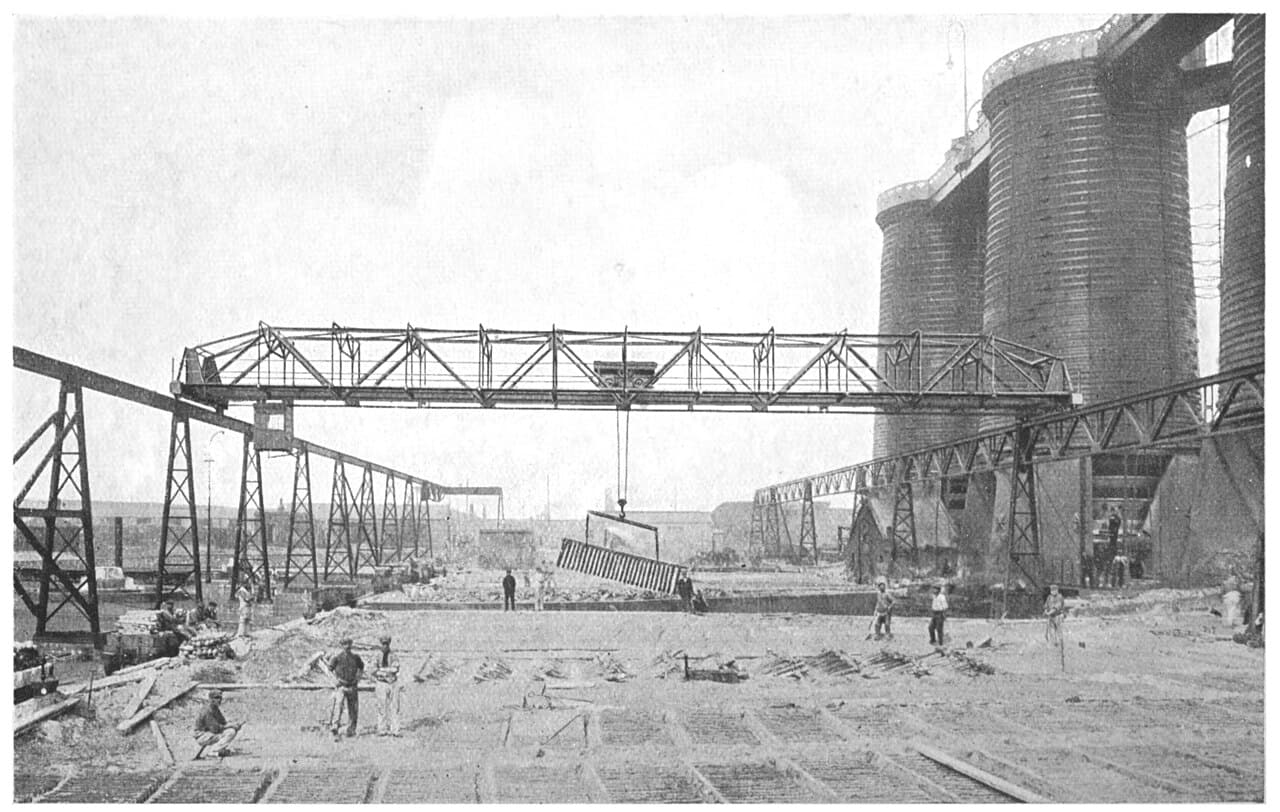
Metal and cinder lay in two layers in the hearth, the lighter cinder on top (Truran p. 45). So there were two openings at two heights: a cinder notch well above the iron, flushed two to five times a cast, and the tap hole at the bottom, stopped with fireclay and opened at the cast (Johnson Principles pp. 314-318). Cinder was drawn every twelve hours on charcoal, every six on coke (Overman p. 186). Slag left to rise reached the tuyeres, raised the blast's resistance and slowed the furnace (Johnson Principles pp. 314, 317). Casting four times a day was "the almost universal custom" until recent years (Johnson Principles p. 317), and in Overman's day each twelve-hour shift had its cast (Overman p. 201). Iron left long in the hearth turned white (Overman p. 201).
What the game keeps of it
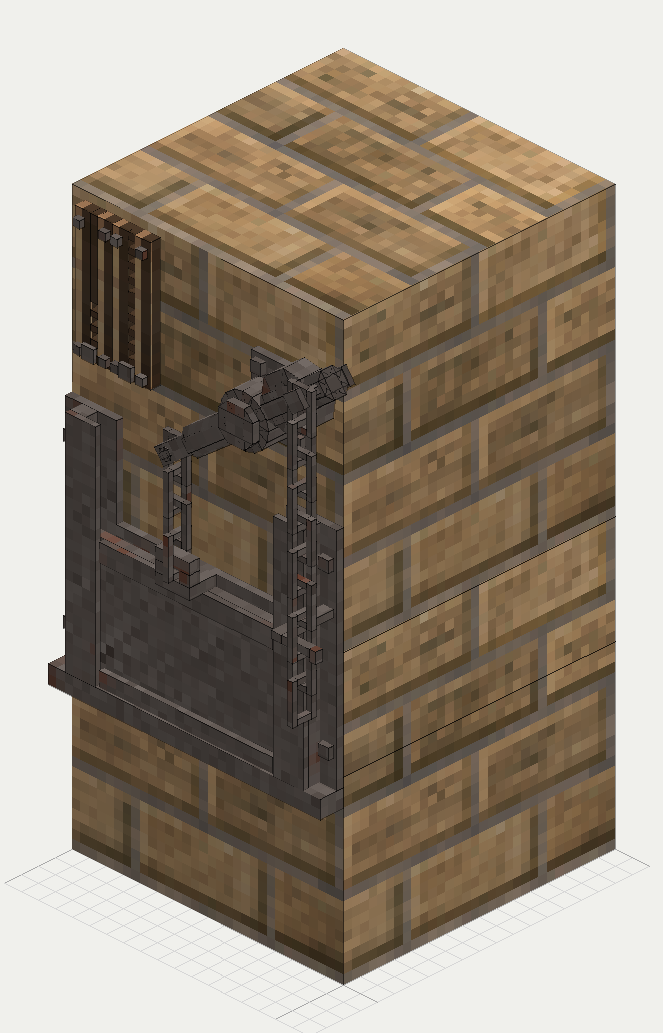
The same work, in the same order. The player prepares burden and fuel apart; a round is a load of coke and a load of burden put through the door at the top, the next on top of the last, and the ratio between the two loads is the decision that matters. Air comes from a blowing machine on an axle. Lighting is a flame held to an open tap, as Johnson lit his at the tuyeres, and it costs one clay plug. The first iron comes only after the column has warmed, and the molten metal runs from two taps at two heights into a canal and a sand bed. There is no start button. The decisions are the flux in the burden and the coke in the round, which is what the furnace manager decided too. See fuels for coke against charcoal and hot blast for what the later furnace changes.
Period basis, and what is the game's own
- Period: alternate rounds of fuel and ore-bearing charge, the fuel held steady and the ore changed (Overman p. 195, Truran pp. 64-65). The game keeps both: each load is laid in its own course, and the coke dial is the ratio between the two loads.
- Period: charges weighed or measured at the bridge, by barrow (Truran p. 66, Overman pp. 194-196). The game loads the door by hand; it plans boxes of 12 items at counts set on the door's board, which is the barrow in another form.
- Period: ores mixed in yard beds with the flux spread over them (Overman pp. 199-200). The game today mixes them in a burdenmaker with two hoppers; it plans a bedding floor, laid and dug in the same way.
- Period: lit in the hearth or at the tuyeres, on a light burden and with a coke blank (Truran p. 40, Johnson Principles pp. 326-329). The game lights through the open tap and blows in on coke-rich rounds. Days of drying and blowing in become minutes of firing.
- Period: scaffolds and slips, with a hang held up over a cavity (Truran p. 68, Johnson Principles pp. 122-123). The game's own: a cold band stops its column and everything above rests on it, but a real hang is not modelled. A planned rule has a round past break-even hang and burn nothing while the furnace cools, until the blast is raised or the piles are broken (Overman p. 173 for the scraping out).
- Period: a banked furnace is cast out, its tuyeres sealed and coke charged to them (Johnson Principles pp. 333-335). The game banks with its blast stopped and its taps plugged, smouldering at the damper-shut draught. Planned: with no blast a lit shaft burns its carbon at that rate whatever its taps, making heat and no iron.
- The game's own: a campaign ends when the carbon in the shaft does, not when the lining fails. A real one ran "literally for years at a time" (Johnson Principles p. 323).
- The game's own: gas chemistry, silicon and sulphur, and grades of pig are left out. One pig iron comes out and yield follows the ore in the charge. The base game has no shaft furnace at all; its bloomery holds ore and fuel in two slots of one chamber. See vanilla against reality.
The numbers
The period figures are weights of real materials; the game's are items and units on the scale in scale and units, with the fuel rules on the scaling page. "Planned" is the rating in design; a game hour is two real minutes.
| In the game | Period figure | How it was scaled | Game value |
|---|---|---|---|
| Round: burden to coke | 10 cwt mine to 9 cwt coal, South Wales (Truran p. 65); 6 cwt to 4 cwt coke after blow-in (Truran p. 41); 2.2 ore to 1 coke by weight (Johnson Principles pp. 268-271) | The game's own heat balance, by item | Today chills below about 24% carbon on cold blast, works near 30%. Planned about 5 burden items to 1 coke |
| Flux in the burden | 14 to 24% stone, coke; about 8%, charcoal (Johnson Principles pp. 51, 268-271) | A share by item; today's standard band is a charcoal-type share | Standard band 3 to 8%. Planned about two to three times that on coke |
| Iron to slag | About 1.8 to 1, coke, worked burden (Johnson Principles pp. 268-271); 400 to 500 lb of slag a ton of iron, charcoal, so about 5 to 1 (Johnson Principles p. 219) | Period ratio by fuel, planned; today a single figure | 6 to 1 today. Planned 1.8 to 1 on coke, 4.5 to 1 on charcoal |
| Blowing in | First cast 24 to 48 hours; normal burden after one to two weeks (Johnson Principles pp. 326-327) | Compressed to the game's scale | Minutes of firing before first iron |
| Casts | Four a day (Johnson Principles p. 317) | None today: the player taps when ready | Planned hearth holding 12 game hours of make, and 34 hours to the slag notch on a Watt engine's coke |
| A full shaft of charge | A furnace ran for years (Johnson Principles p. 323) | The game's own: the charge in the shaft is the campaign | 922 burden and 230 coke items, about 100 pigs. Blown through in about 11 real minutes today, planned 16.7 game hours |
Picture credits
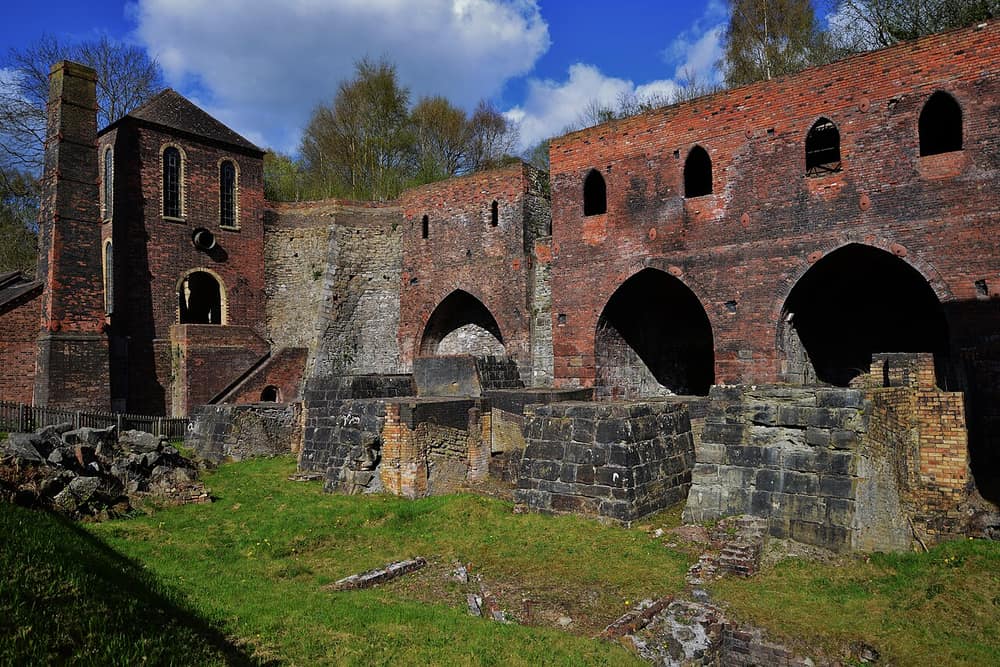
- Blists Hill blast furnace: Photo by Michael Garlick, HARTLEPOOLMARINA2014, CC BY-SA 4.0.
- Blast furnace pig iron bed, Middlesborough: Walter MacFarlane, The Principles and Practice of Iron and Steel Manufacture, 1917, public domain; printed caption names Ayresome Ironworks, Commons names Port Clarence; cropped of its caption.
- Fig. 88, Plate 15: Truran, The Iron Manufacture of Great Britain, Library page, labelled for this site.
- Figs. 207-213, Plate 35; Fig. 213, Plate 36, labelled for this site; Fig. 224, Plate 37: Truran, The Iron Manufacture of Great Britain, Library page.
- The game's charging door: the mod's drawing.
Comment or suggest something in the Expanded thread on the Vintage Story Discord