
Engine lathe
A lathe spins the work and holds a cutting tool still against it. Everything else follows from wanting that tool held steadily, moved truly and driven slowly enough to cut iron. The machine and its parts are in the catalogue, and the shafts that drive it in the shaft power guide. This page is about the real one and how the game's follows it.
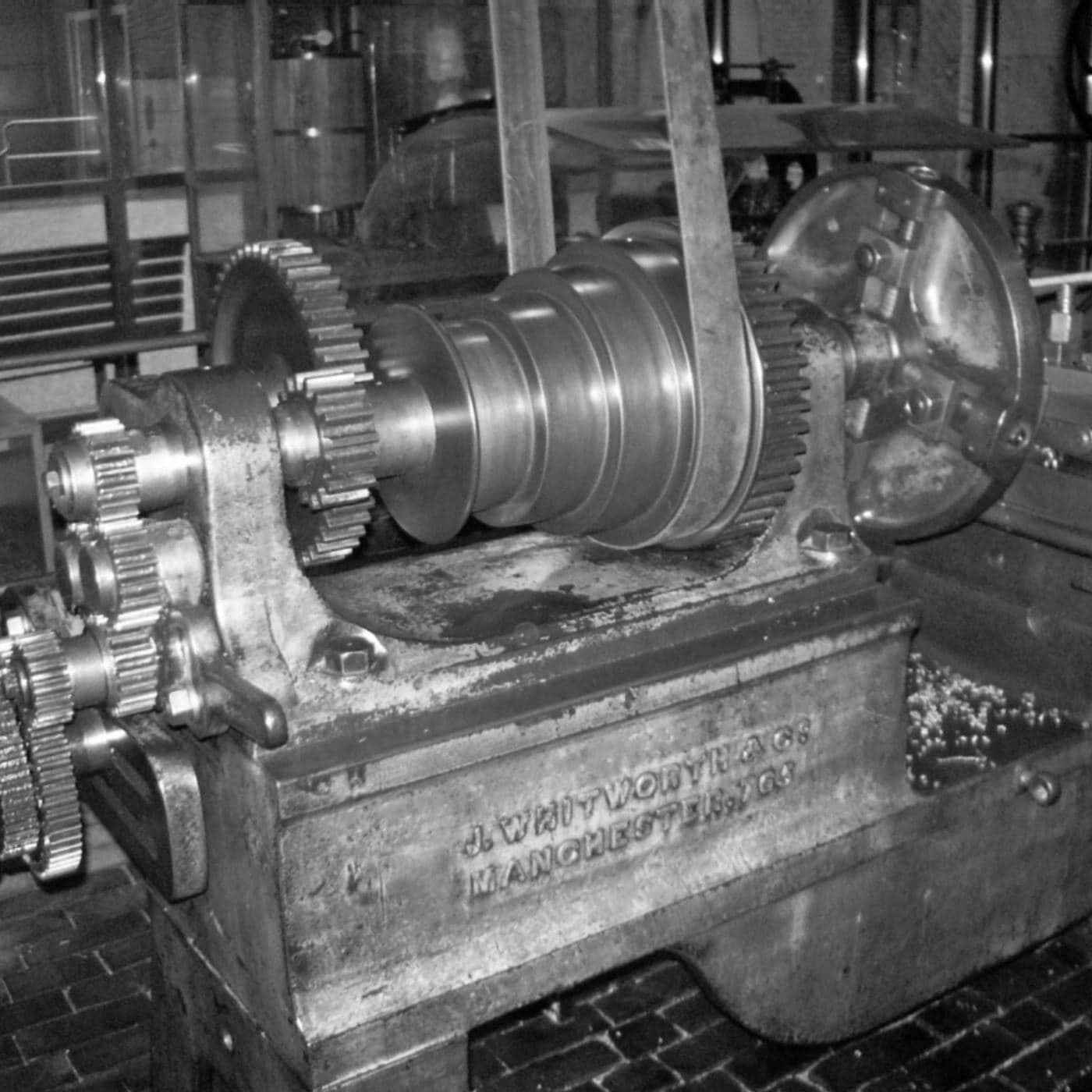
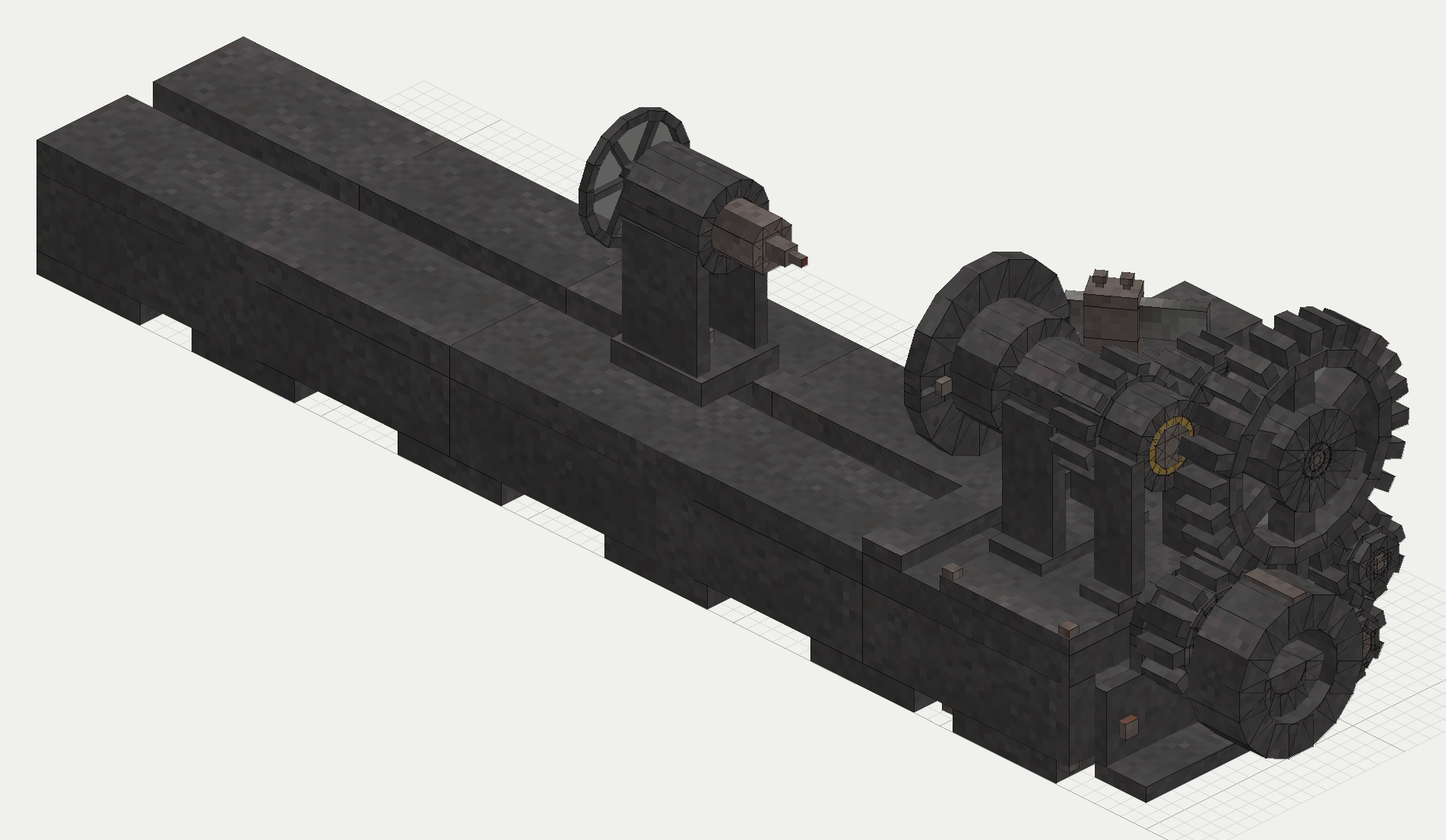
What a lathe has to do
Sellers states the job in a sentence: a good lathe "must turn a true circle, it must turn a true cylinder, and it must, when facing off, produce a true plane surface" (Sellers 1877 p. 113). A screw-cutting lathe must add a true thread to those. Each of the machine's main parts answers one of those demands.
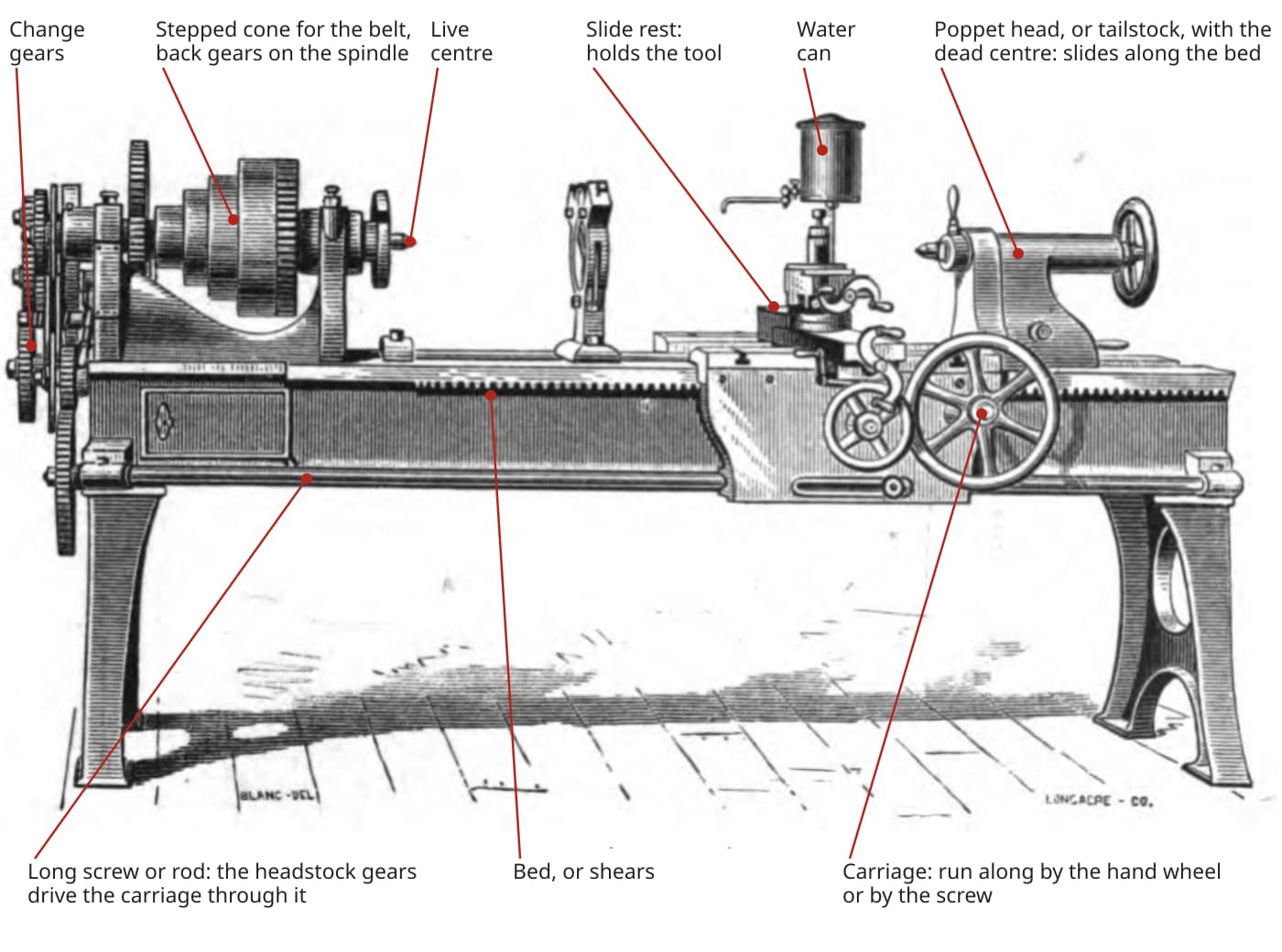
The bed, or shears, keeps the two centres in line wherever the tailstock is clamped (Rose p. 119). The live spindle, carried in the headstock, is the part that sets the circle, and it carries the drive. Sellers made his flat on top, and remarks that the V form had long been the favourite in America while the flat top was the rule in England (Sellers 1877 p. 114).
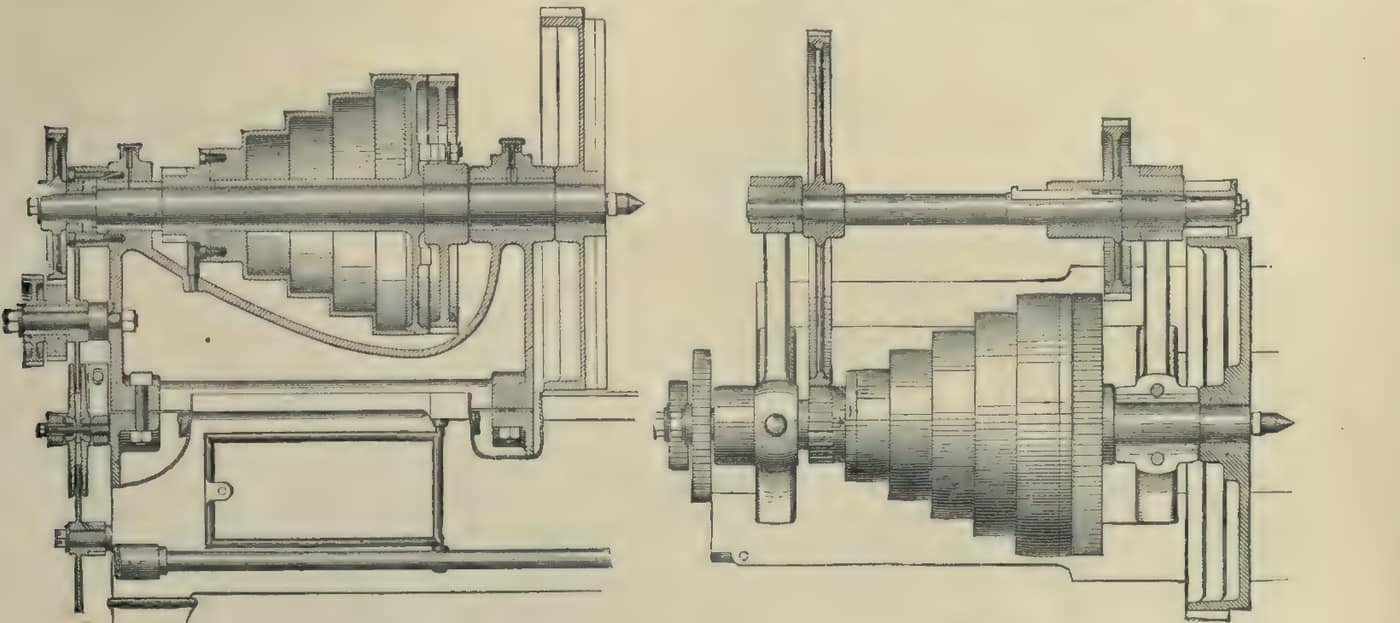
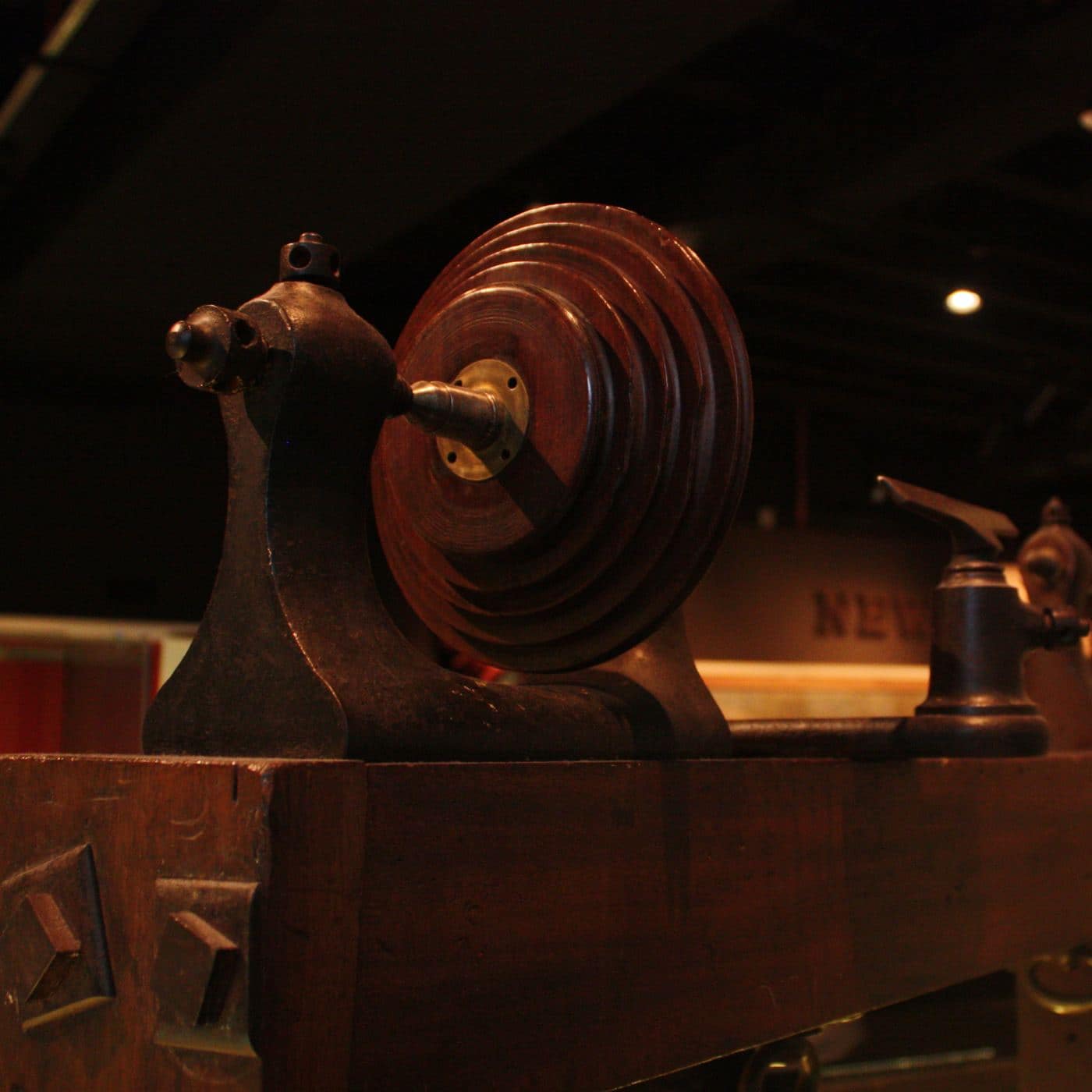
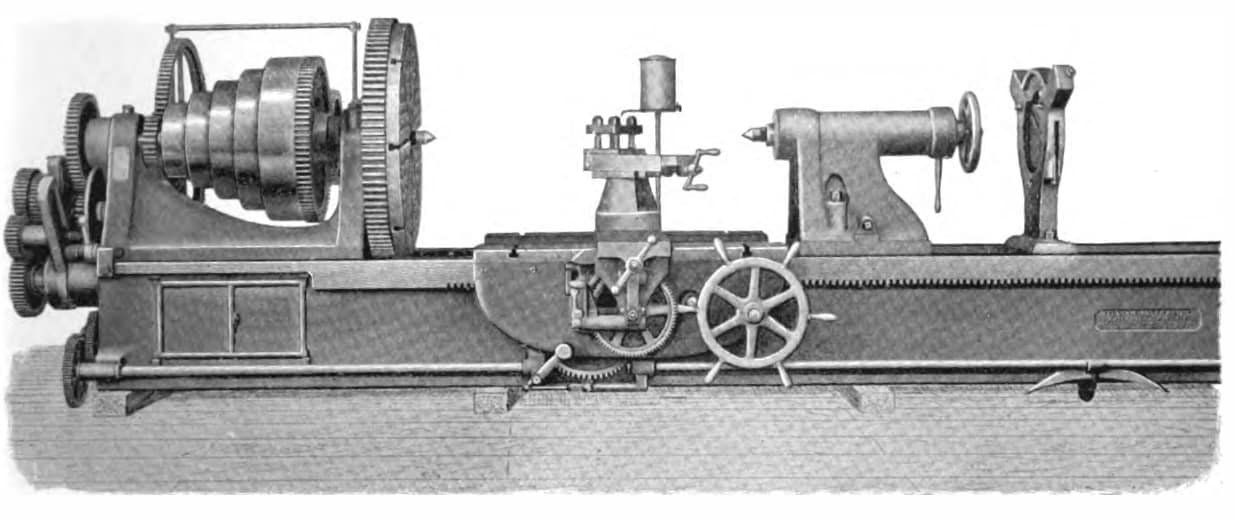
A wide piece wants a slower spindle than a narrow one to keep the same speed at the tool. So the stepped cone gives a set of speeds from one belt, and the back gear gives a second, slower set (Rose pp. 119, 144). On the 48-inch lathe of Sellers's 1895 catalogue the back gear reduces 7 1/2 to 1 and the triple gear 45 1/2 to 1 (Sellers 1895 p. 113).
What it took to get the tool out of the hand
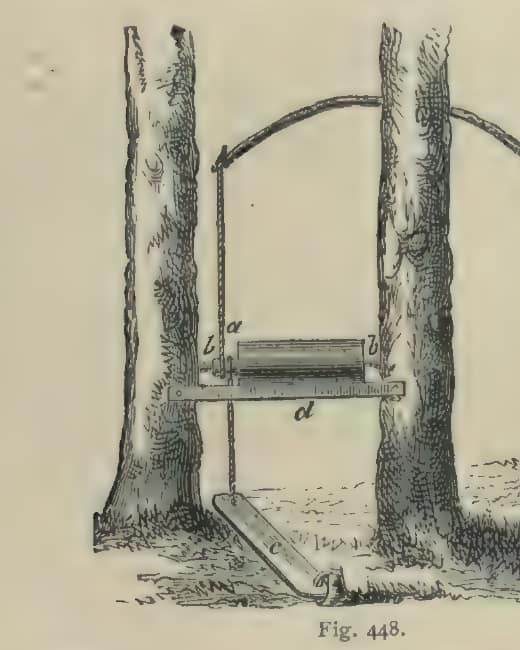
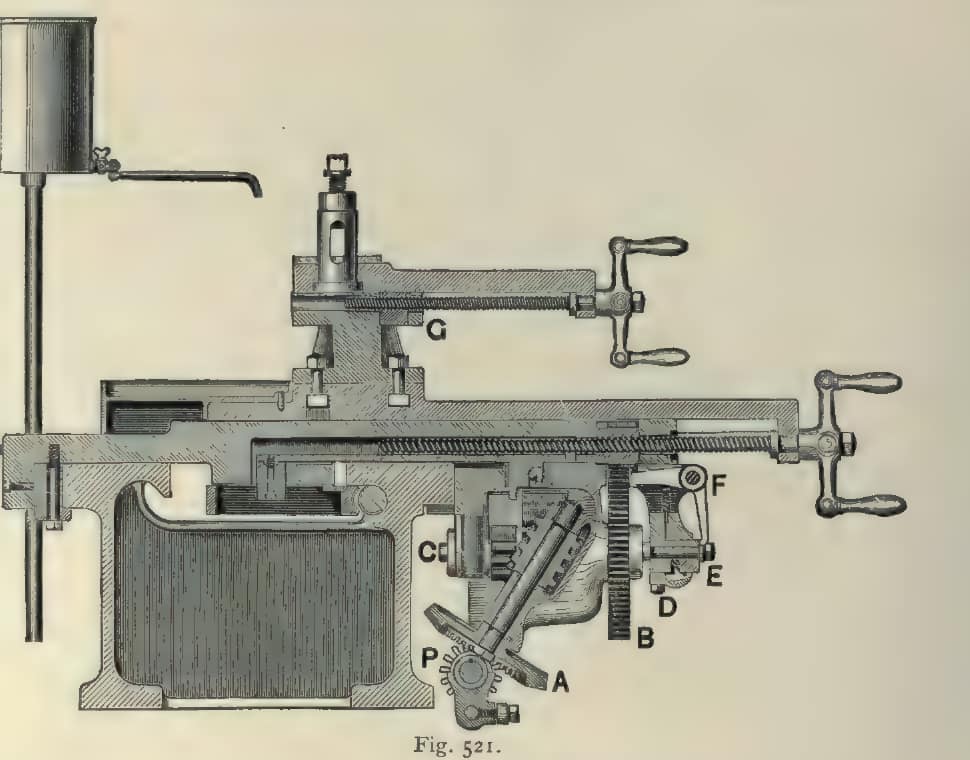
On a hand lathe the turner holds the tool on a rest and his skill sets the cut (Rose p. 119). Moving the tool on slides is what let a machine make something truer than the man using it. Rose's classification of the trade's lathes runs along that line: the hand lathe, the back-geared lathe, the self-acting or engine lathe whose rest is driven along the cut, and the screw-cutting lathe with a lead screw (Rose p. 119).
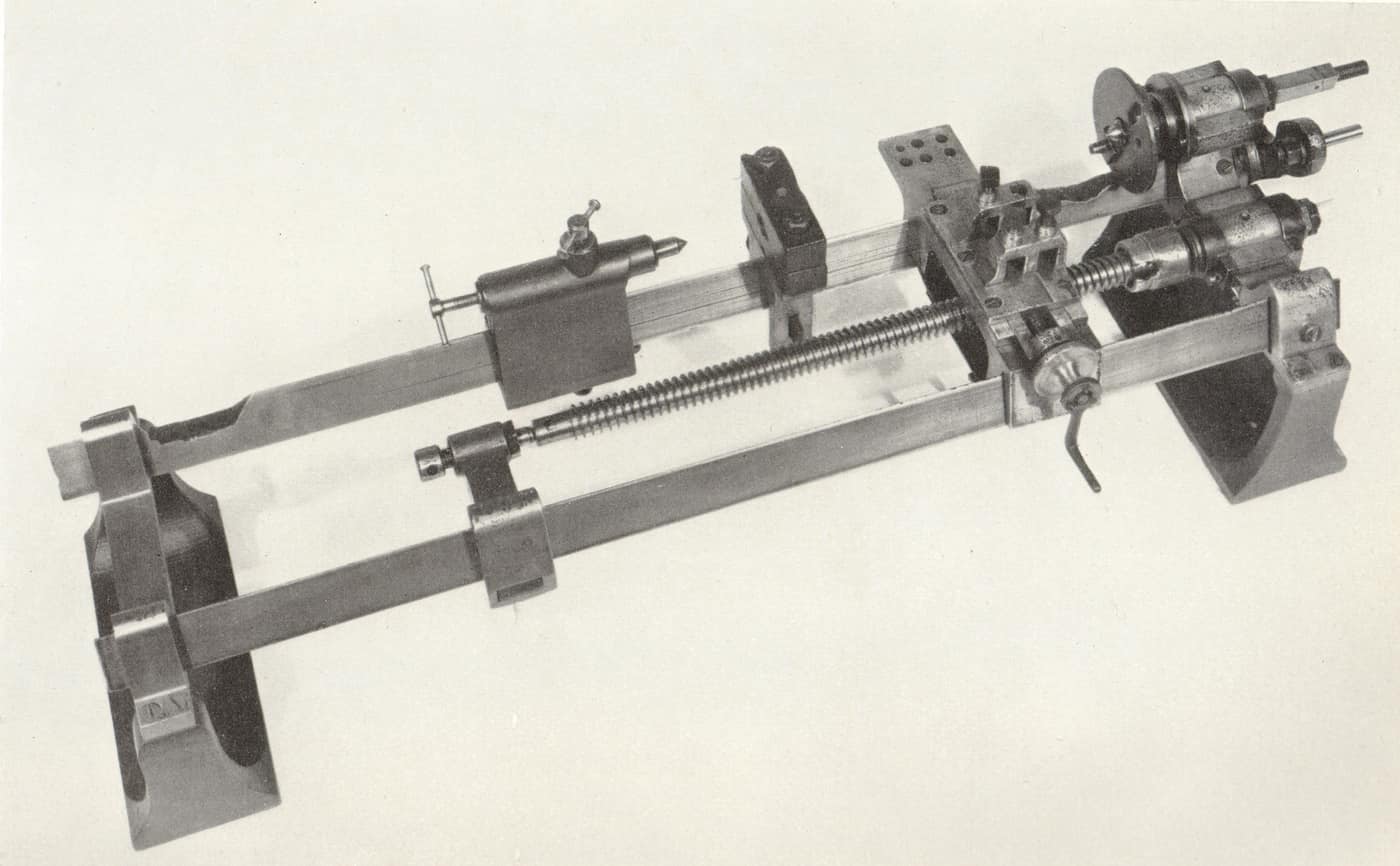
The lead screw needed a true screw to begin with, and that is the part of the story Nasmyth watched. In 1829 he went to work as Maudslay's private assistant and his first job was on a machine for "generating" original screws: a knife-edged steel instrument, set at an angle against a revolving bar of soft steel or brass, wound a spiral groove into it, and a pointed tool in a slide deepened the groove (Nasmyth pp. 138-140). From that came the guide screw, and from one guide screw and a set of change wheels, screws of every pitch. Nasmyth gives a five-foot screw of two inches diameter with fifty threads to the inch, and a nut twelve inches long holding six hundred threads (Nasmyth p. 140).
Why it came first
Both Rose and Sellers call the lathe the oldest machine tool (Rose p. 119, Sellers 1877 p. 113). Rose gives the reasons it stayed the most important: it cuts continuously where a planer or shaper cuts on one stroke of two, and it can bore, drill and ream as well as turn, and some planing work too (Rose p. 119). He says a turner was held able to run any other machine in the shop, while a man who had learned only those would be "altogether inefficient if put to operate a lathe" (Rose p. 119). Cylinders too were bored on lathes built for the job (Rose p. 219).
A lathe also makes the parts of other machines. Sellers made every steel spindle for his other lathes on his own 20-inch lathe (Sellers 1877 p. 127), and a shop with one lathe could turn the shafts and screws of the next machine. The books at hand do not trace which tool followed which in any given shop.
How a lathe is sized
A lathe's size is the diameter it can swing clear of the bed. The height of the centres above the bed is half of that, so Rose's 28-inch lathe is the same size as a 14-inch-centres lathe (Rose p. 120). The work between centres must clear the rest, so the swing over the rest is less: 38 1/4 inches over the rest on the 48-inch (Sellers 1895 p. 113). Beds came in lengths, and the length between centres is the bed less the two heads (Rose p. 120).
What the game does with it
The lathe is the second machine tool the game opens, after the shaper, and it turns what the player cannot make well by hand: journals on shafts, roll sets for the mill, pistons, brass bushes, rods, feed screws, and the bores of keyed eyes on pulleys and couplings. Today the block can be placed but has no process. The plan is that a blank goes in the chuck window and is shown mounted, the player holds the turret and the machine feeds along the work, and the turned piece replaces it. The cutter wears and is changed by hand; it is the shared cutter of four machine tools. See machine-tool sizes and why the numbers are what they are.
The bootstrap is the period problem in small: the first lathe needs a turned shaft, turned rods and brass bushes before any lathe exists. In the game those come from hand routes at the bench, slower and costlier, so the line can start at all. See line shafting for the drive.
Period basis, and what is the game's own
- Period: the lathe is the oldest machine tool, and it could bore, drill and ream as well as turn (Rose p. 119, Sellers 1877 p. 113). The game keeps that breadth: its planned lathe does a long list of jobs across turning, boring eyes on the faceplate, and cutting screws.
- Period: a large engine lathe was sized by swing, with its centres at half the swing, its bed by a table (Rose p. 120, Sellers 1895 p. 128). The game plans to build the 48-inch at true size on a long bed.
- Period: the tool was clamped, and the machine fed it along (Rose pp. 119, 146). The game's player holds the feed, and the machine does the cutting: a single held control stands for the hand wheels and the self-acting feed.
- Period: rolls had lathes of their own and screws were cut on the lathe (Sellers 1895 p. 131, Sellers 1877 p. 127), and cylinders were bored on lathes built for them (Rose pp. 219-220). The game's cylinders are planned bored and faced at the boring machine alone, their outsides left as cast.
- The game's own: the shaper opens before the lathe. Gears are the bottleneck of the bootstrap, and a spur gear needs the shaper and the drill press, so the order follows the game's chain and does not follow the history of the tools.
- The game's own: no change wheels and no thread pitch. A feed screw is one job, the screw plate and file its early route.
- The game's own: the job's time is the energy of the metal removed over the machine's cut power, a single figure for the machine, with no cutting speeds, feeds or back gear to choose. The base game has no lathe; see vanilla against reality.
The numbers
The lathe takes a period machine at its true size, and period figures for the work (see the scaling page and scale and units). "Planned" is in design; nothing here runs yet.
| In the game | Period figure | How it was scaled | Game value |
|---|---|---|---|
| Swing over the bed | 48 in, 38 1/4 in over the rest (Sellers 1895 p. 113) | True size | Planned 48 in (1.22 m) |
| Bed, centres | Bed 17 ft 0 3/4 in, 8 ft 10 in between centres (Sellers 1895 p. 128) | Bed rounded to five standard sections | Planned about 80 voxels (5.0 m) |
| Height of centres | Half the swing, 24 in over the bed (Rose p. 120) | True size | Planned about 1.1 m above the floor; drawn today at 1.6 m |
| Spindle | 6 1/4 in on a 48-in lathe (Niles p. 74) | Whole voxels at true size | Planned 2.5 voxels across; 4 voxels today |
| Turning energy, cast iron | Hartig's rate for the lathe, .0314 hp per lb of cuttings an hour (Rose p. 273) | Converted at 5.918 MJ/kg per hp/(lb/h) | Planned 185,800 J/kg |
| Turning energy, wrought iron | Hartig's rate, .0327 hp per lb an hour (Rose p. 273) | The same | Planned 193,500 J/kg |
| Power at the cut | A cast iron cut at 45 ft/min, feed 30 to the inch (Rose p. 294), the 1/8 in depth inferred | Energy per second of that cut | Planned 822 W |
Open, and what you can tell us
The size is taken from Sellers's 1895 catalogue, and that is later than the iron stage the machine belongs to. British catalogues of the 1850s and 1860s (Whitworth, Nasmyth) were looked for and not found as scans. The books at hand give a 12-inch English lathe (Rose p. 147) and American and English tools of the 1870s to 1890s, and they say nothing of how large an ordinary shop's main lathe was around 1850. If you know a source with sizes for that period, we would like to read it.
Picture credits
- Fig. 448: Rose, Modern Machine-Shop Practice, p. 119, Library page.
- Figs. 516 and 517, and Fig. 521: Rose, Modern Machine-Shop Practice, pp. 145 and 146, Library page.
- Fig. 64: Sellers, A Treatise on Machine Tools, p. 127, Library page, labelled for this site.
- Plate 61: Sellers, Machine Tools for Working Metal (1895), p. 113, Library page.
- Maudslay's screw-cutting lathe, Plate 10: Gilbert, The Machine Tool Collection (1966), public domain, cropped.
- Treadle lathe, c1814: RichardAsh1981, CC BY-SA 2.0, cropped.
- Drehbank 1860: Huhu Uet, CC BY 3.0, cropped.
- The game's lathe: the mod's planned drawing.
Comment or suggest something in the Expanded thread on the Vintage Story Discord