
Belly helve
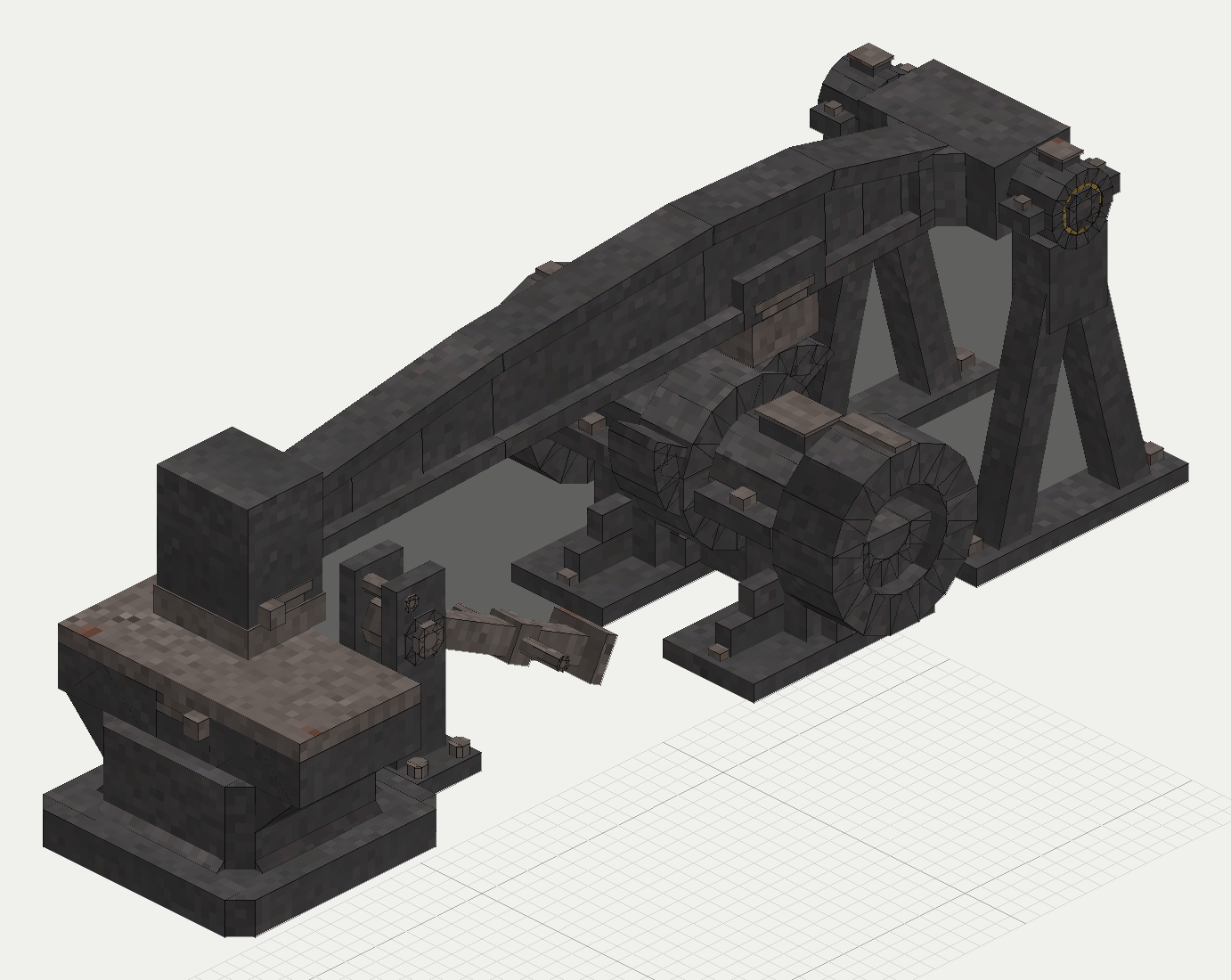
A helve is a heavy cast-iron beam, pivoted at one end, that a turning ring of cams lifts and lets fall on a ball of hot iron. The belly helve is the form that takes its lift partway along the beam. The ball comes from the puddling furnace; what the game does with it is in the iron grades guide. The game's own belly helve is planned: its castings exist, the machine does not yet, and today the vanilla helve still works the bar. This page is about the real machine and how the game's will follow it.
How the real one worked, and why it was built so
A puddled ball leaves the furnace as a spongy mass of iron full of liquid cinder. Hammering it while it is still hot consolidates the iron and drives the cinder out, and shapes it to go to the rolls (Truran p. 218, 231). Each ball took 15 to 25 blows in 18 to 30 seconds to become a bloom (Truran p. 219).
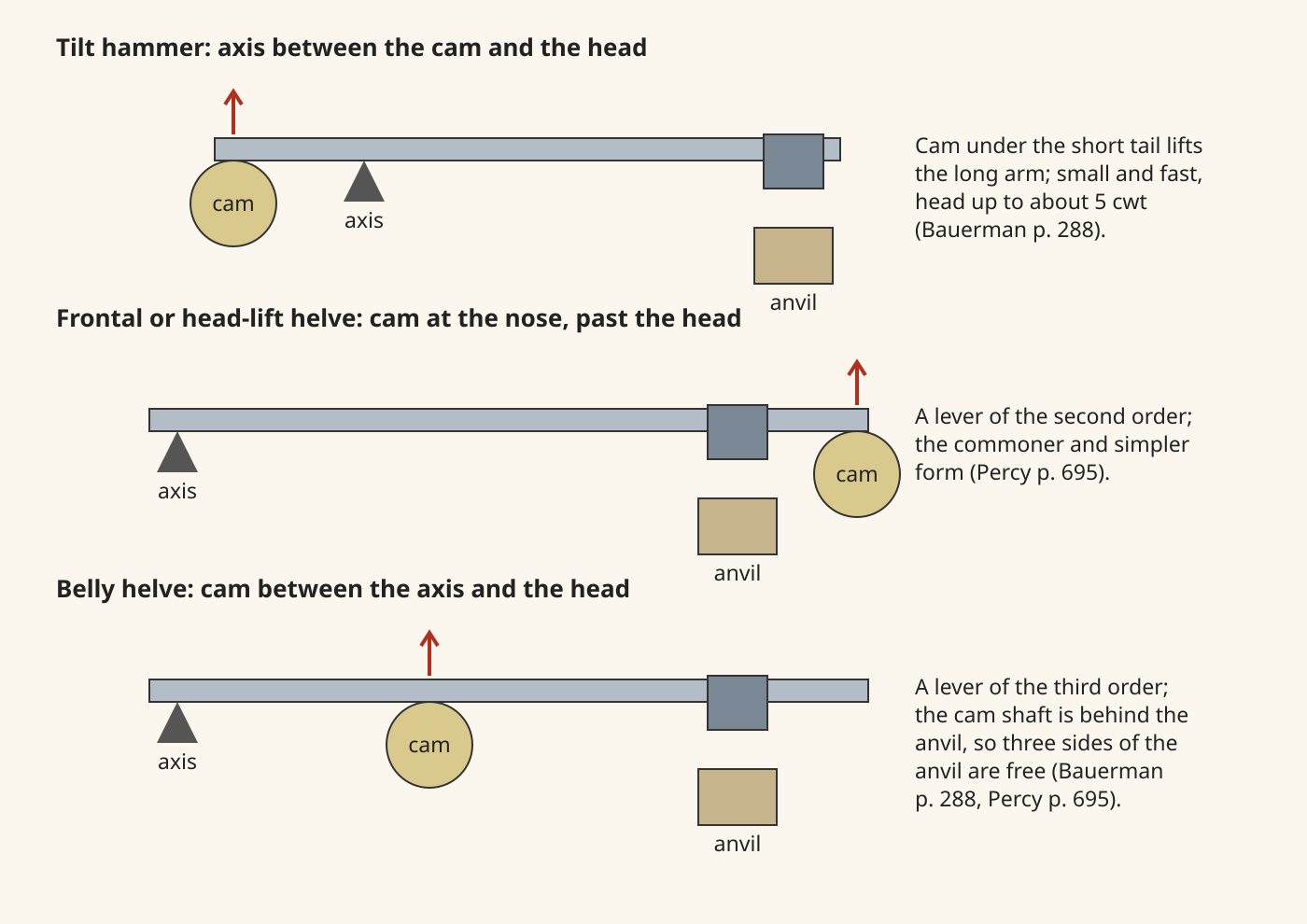
The cam and the head on the same side of the axis make a helve; the cam on the opposite side makes a tilt hammer. Tilt hammers were kept small and fast, for drawing bars and finishing work, with heads of about 5 cwt at most (Bauerman p. 288). Their helve was usually of wood, hooped with iron (Bauerman p. 288, Overman p. 336).
Lifting the full weight of a helve at its nose is the simplest arrangement, and so the commonest (Percy p. 695). The belly helve moves the lift back along the beam, near the middle (Bauerman p. 288). The cam shaft, the heaviest part of the machine, then lies behind the anvil instead of beside it, and the workers get three sides of the anvil to stand at (Percy p. 695, Bauerman p. 288). That is the whole reason for the form; everything else is the same as on a head-lift helve.
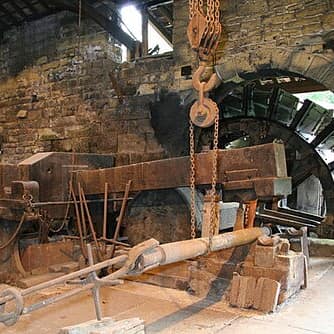
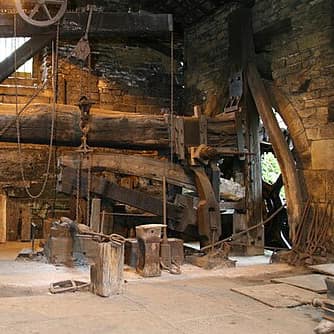
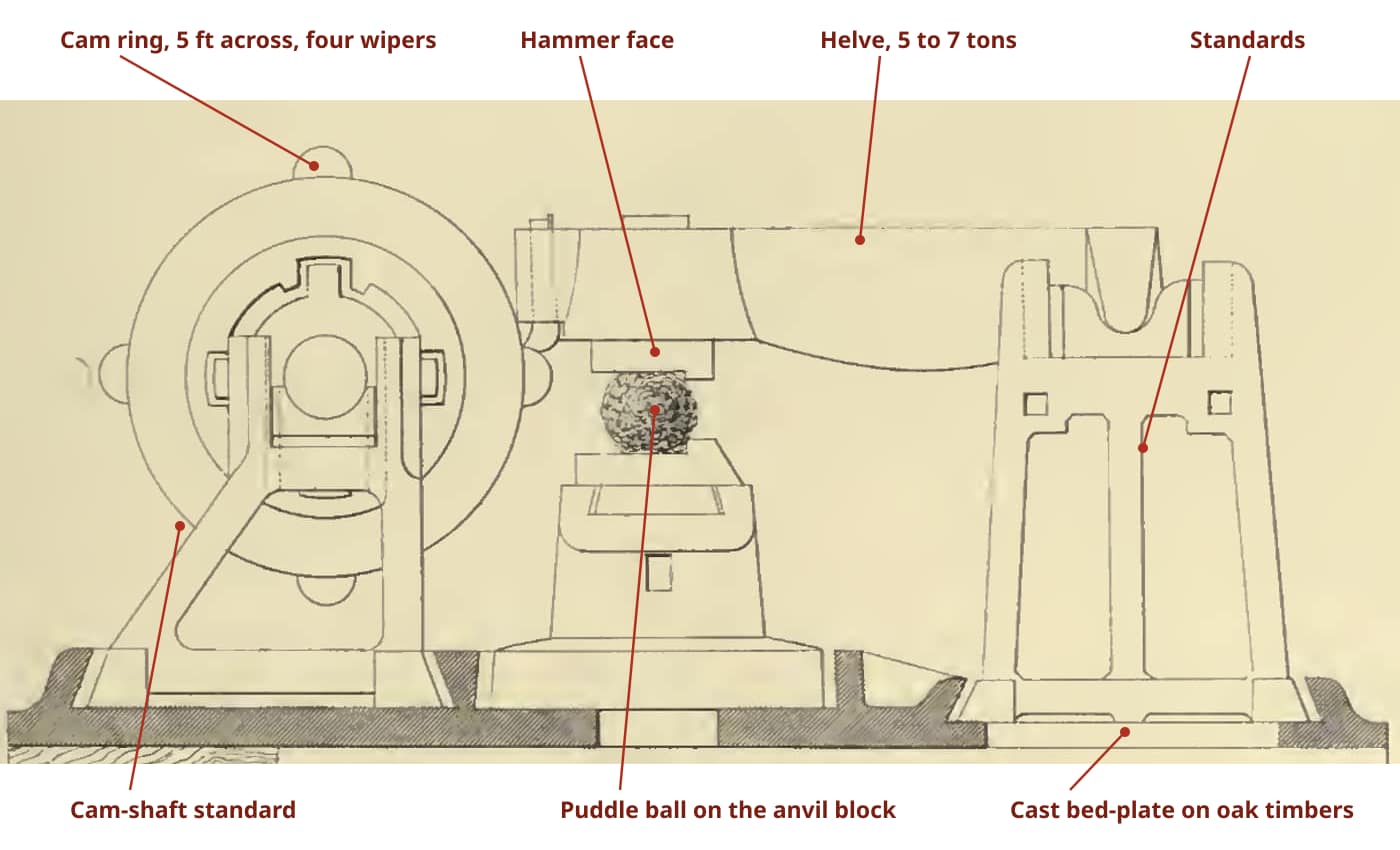
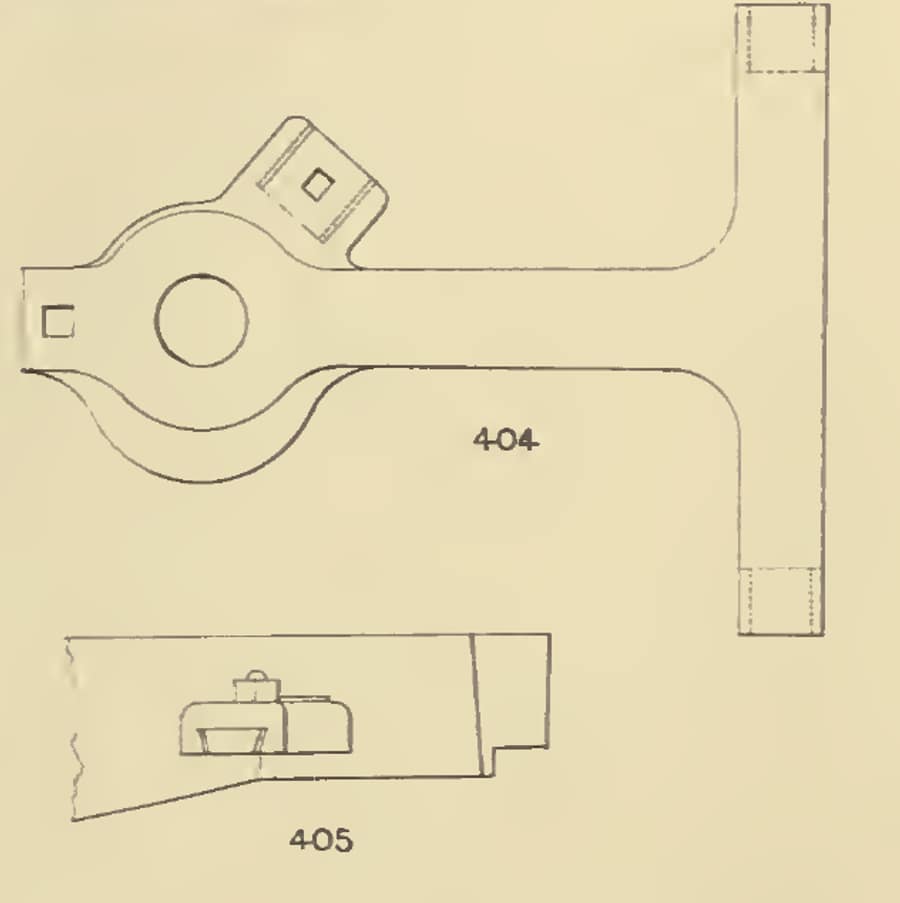
A helve was cast in one piece and is T-shaped in plan, the cross arm making the pivot (Truran p. 218, Bauerman p. 289, Percy p. 694). The long cross arm is there to keep the mass from shifting in its bearings, which are open (Bauerman p. 289), and to resist the sideways push of the cams (Percy p. 694). The face is wrought iron, keyed or dovetailed into a seat so it can be changed (Bauerman p. 289, Percy p. 694), and it needed changing: a face in constant work lasted from three to seven days (Percy p. 695). The anvil is a separate block of cast iron, several times the weight of the hammer, standing alone so that its shaking does not reach the bearings (Bauerman pp. 289-290).
How it was really worked
When not at work, the helve was propped up clear of the turning ring on an iron bar under a projection cast for the purpose (Truran p. 218). Bauerman's stop or gag does the same job, between head and anvil, for a reason that matters: the hammer must never fall directly on the anvil (Bauerman p. 289).
The start is a small piece of drill. With the ball on the anvil, a boy held a small iron block under the point, which raised the helve into reach of the wipers; the prop came out, and the helve fell on the ball (Truran pp. 218-219). During the hammering the bloom was set on end for a couple of blows to upset it (Truran p. 218). A helve cannot be coaxed: a ball had to be of tolerably good iron to stand its dead, heavy blow, and a ball that would crumble under it could be worked sound under Nasmyth's hammer, whose blows could be regulated (Percy p. 695).
The helve lost its place from two sides. In the majority of English forges the steam hammer had to a considerable extent replaced it by Percy's day (Percy p. 695), and in Truran's forges the squeezer had almost entirely supplanted the hammer, at under half the first cost (Truran p. 219). Bar iron still wanted the same force at every blow, and for that the mill hammer of the same pattern held on over the steam hammer (Truran p. 231).
Period basis, and what is the game's own
- Period: the belly helve itself, a T-shaped casting with its cross arm in the standards, lifted between the axis and the head, its wrought lifter and face seated by dovetails (Percy p. 694). The game draws this, and makes its lifter and faces separate smithed parts as the Mersey helve had them.
- Period: the anvil is apart from the hammer and much heavier (Bauerman pp. 289-290). The game's helve has its own cast anvil on a stock, about 4.4 t together under a moving 1.7 t, the stock sunk in the floor on an oak bed.
- Period: the helve was propped clear of the turning ring and let down by hand (Truran p. 218). The game keeps the prop, a post with a handle, and it holds the helve clear of the cams with the ring still turning.
- Period: open bearings on the cross arm (Bauerman p. 289, Percy p. 694). The game's caps are its own: see the open question below.
- Period: the cam shaft was placed below the floor on a belly helve (Bauerman p. 288). The game's ring stands in a cell at floor level, on the main that runs through it.
- The game's own: nobody stands at the work. A shingler, a boy with the iron block, and a helper bringing the ball are all replaced by placing the work on the pad and knocking the prop out. Vanilla's helve also works by itself.
- The game's own: the ball is worked only at 750 degrees C or hotter, and a colder ball takes the blows and does not change. Real iron welds and consolidates hot; a single threshold is the game's.
- The game's own: no ball crumbles under this helve.
- The game's own: the faces do not wear yet. A period face was changed within the week (Percy p. 695).
- The game's own: there is no squeezer (Truran p. 219 has it taking most of the work); the game shingles under the helve, and the steam hammer takes the pile forgings.
The numbers
The helve follows period practice with the sizes rounded to whole blocks and voxels at true scale; see the scaling page and scale and units. Every game value here is planned.
| In the game | Period figure | How it was scaled | Game value |
|---|---|---|---|
| Moving mass | 10 tons at Mersey (Percy p. 694); usual 30 cwt to 5 tons (Bauerman p. 289) | Drawn casting at true density; the low end of the usual range | Planned 1.74 t |
| Fall of the head | 16 in average (Truran p. 219); 16 to 20 in (Bauerman p. 289); 18 to 24 in on the 10 ton helve (Percy p. 694) | Whole voxels at the head, cam travel by the lever | Planned 15 in (0.375 m) |
| Where the lift acts | "about midway" (Bauerman p. 288) | One third along, the lever 3 to 1 | Planned, 1.0 m of 3.0 m |
| Cam ring speed | 18 to 19 turns a minute (Truran p. 219) | Set by the main; 2 rad/s is 19 rpm | Planned 19 rpm at the main's usual speed |
| Cams | Four (Truran p. 219); five (Bauerman p. 290) | The game's own count | Planned 3 |
| Cam ring size | 5 ft across (Truran p. 218) | Whole voxels in the ring's cell | Planned 2.8 ft (0.84 m) at the tips |
| Blows a minute | 72 to 76 (Truran p. 219); 70 to 100 (Bauerman p. 289); up to 60 at Mersey (Percy p. 694) | 3 cams times the main's speed | Planned 57 at 19 rpm, 105 at the Watt engine's 35 rpm |
| Energy a blow | None given | The game's own: the helve's weight through its lift | Planned 3.21 kJ; the game's own, against 1.4 kJ for the vanilla helve |
| Power | 25 hp water wheel, 70 cwt helve (Bauerman p. 290) | The game's own load from the energy of a blow | Planned 3.07 kW (4.1 hp) at 2 rad/s |
| Anvil and stock | 5 to 6 tons under 5 to 7 tons of helve (Truran p. 218); "several times" the hammer (Bauerman p. 289) | Drawn castings | Planned about 4.4 t, 2.5 times the moving mass |
| Time on a ball | 15 to 25 blows, 18 to 30 s (Truran p. 219) | The game's own count, two steps a blow | Planned 40 blows, 42 s for a one-ball plate; 80 blows, 84 s for a two-ball bar; the counts will follow the planned redraw of the ball |
Open, and what you can tell us
The books say a belly helve's bearings were open (Percy p. 694, Bauerman p. 289), and they say the lifter acted about midway. If the beam's centre of weight lies outside the lifter, and in the game's drawing it does, then while the cam lifts the head the journals should rise out of open bearings. The game therefore keeps the caps. The books do not explain how an open bearing held on a belly helve: whether the real lifter stood past the centre of weight, whether the cross arm was simply heavy enough, or something else. The scan of Percy's drawing of the Mersey helve is too damaged in our copy to measure. If you know a measured drawing or a surviving helve, we would like to hear.
Picture credits
- Belly helve hammer, Wortley Top Forge: Chris Allen, CC BY-SA 2.0, cropped.
- Wortley Top Forge - belly helve hammer: Chris Allen, CC BY-SA 2.0, cropped.
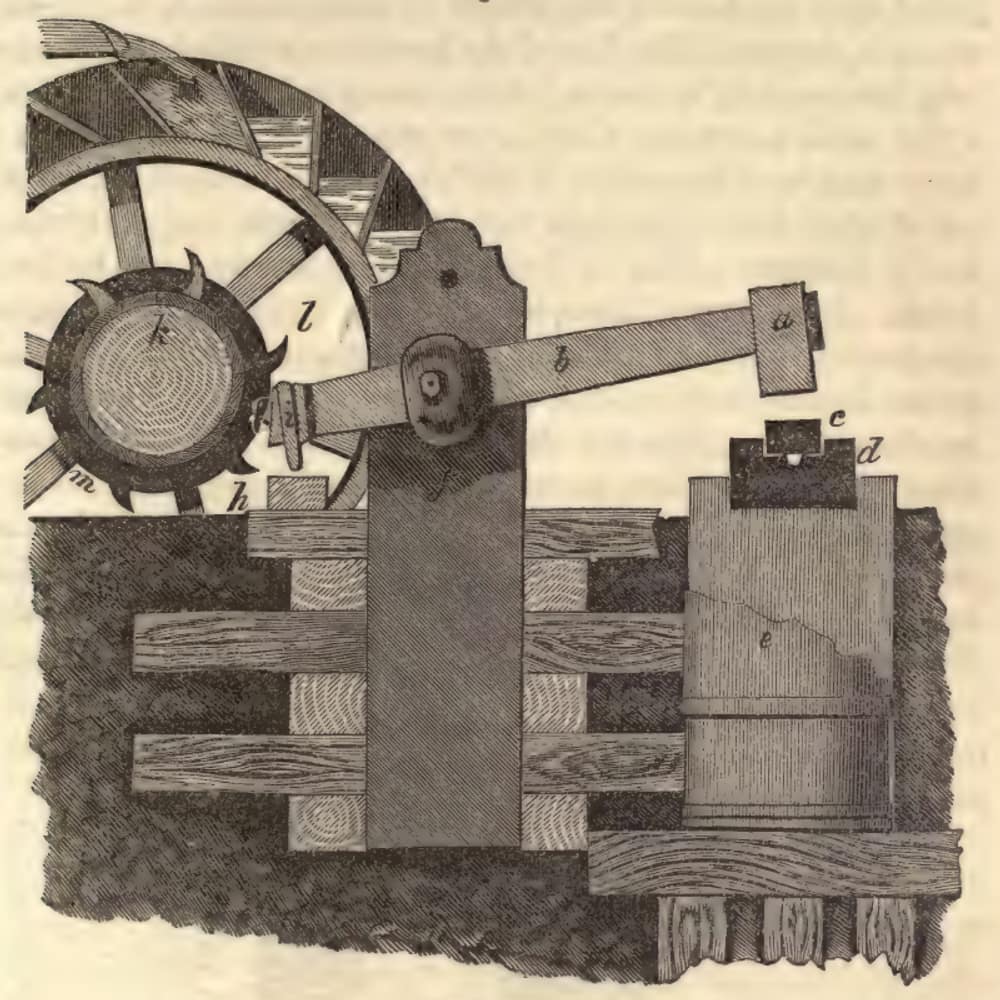
- Plate 62, Fig. 392, labelled for this site, and Plate 63, Figs. 404 and 405: Truran, The Iron Manufacture of Great Britain, Library page.
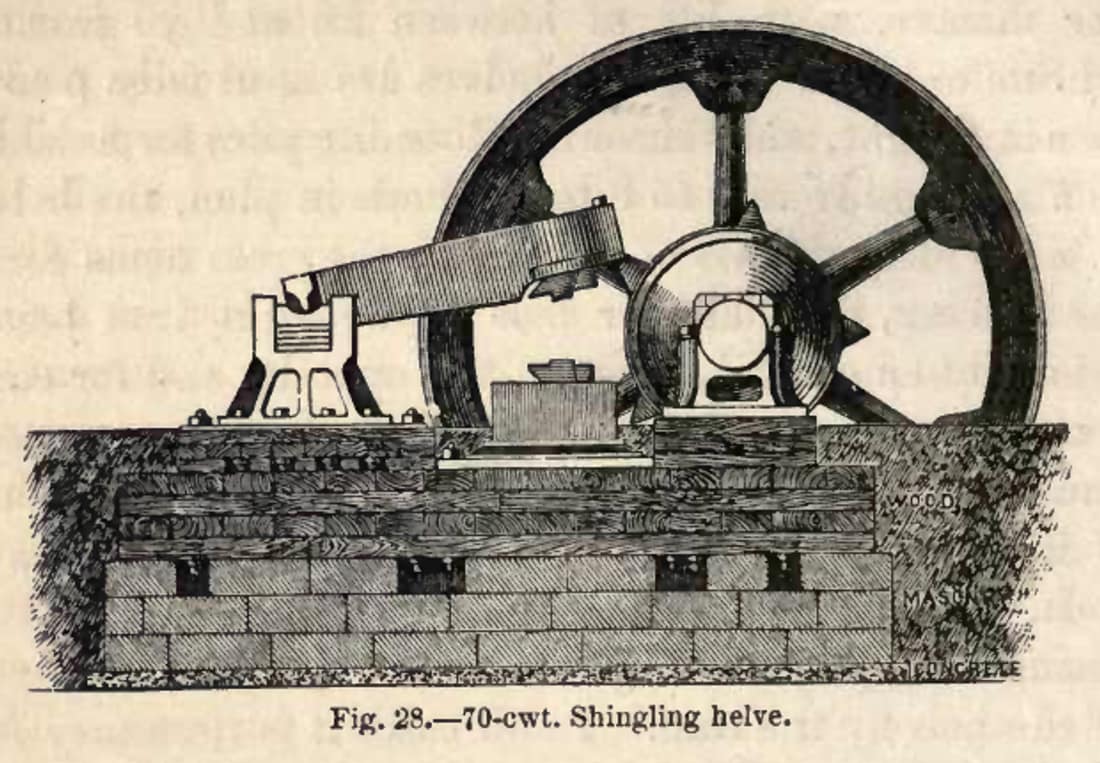
- Fig. 28: Bauerman, A Treatise on the Metallurgy of Iron, p. 290, Library page.
- Fig. 95: Overman, The Manufacture of Iron, p. 335, Library page.
- The three lever arrangements: drawn for this site from Bauerman p. 288 and Percy pp. 693-695.
- The game's helve: the mod's planned drawing.
Comment or suggest something in the Expanded thread on the Vintage Story Discord