
Chimneys and draught
A boiler or furnace of this period had no fan. Its air came through the fire because a tall column of hot gas stood at the end of the flues. The chimney was the engine that moved the air. How the game asks for one is in the steam and boilers guide and the boiler it serves is on its own page. This page is about the real chimney and how the game's follows it.
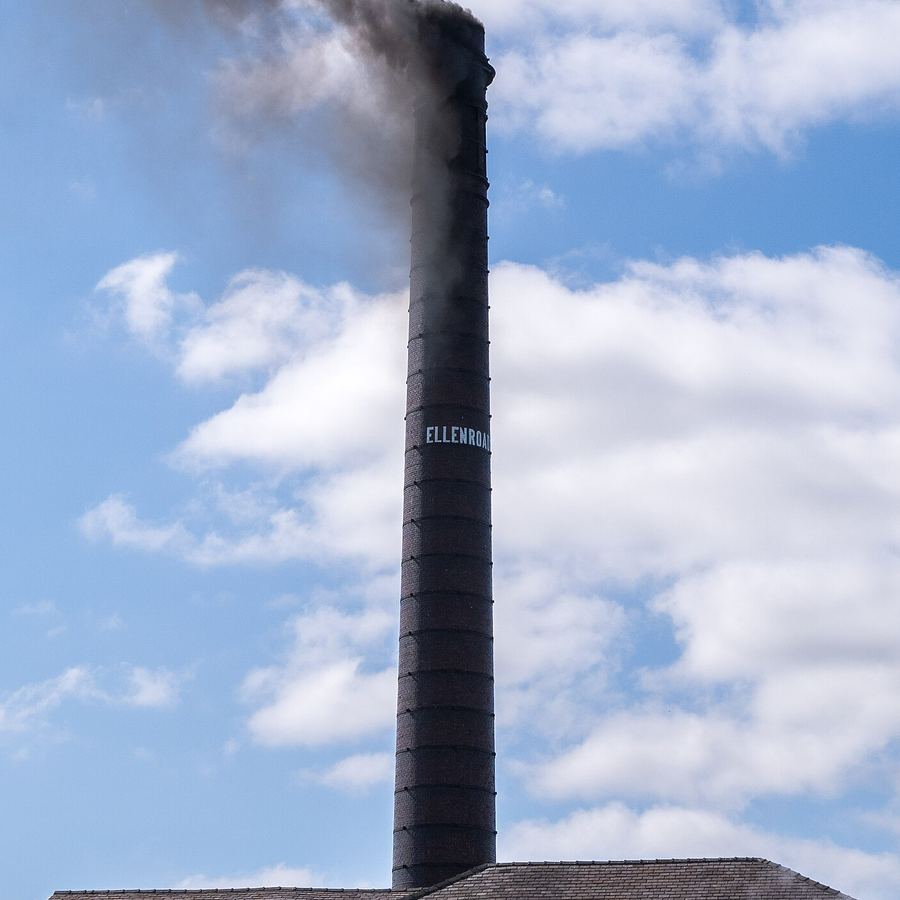
The game has no drawing of this block of its own: the stack is built from the game's own bricks around a pipe intake, so there is no render to show here.
Why a tall stack pulls the fire
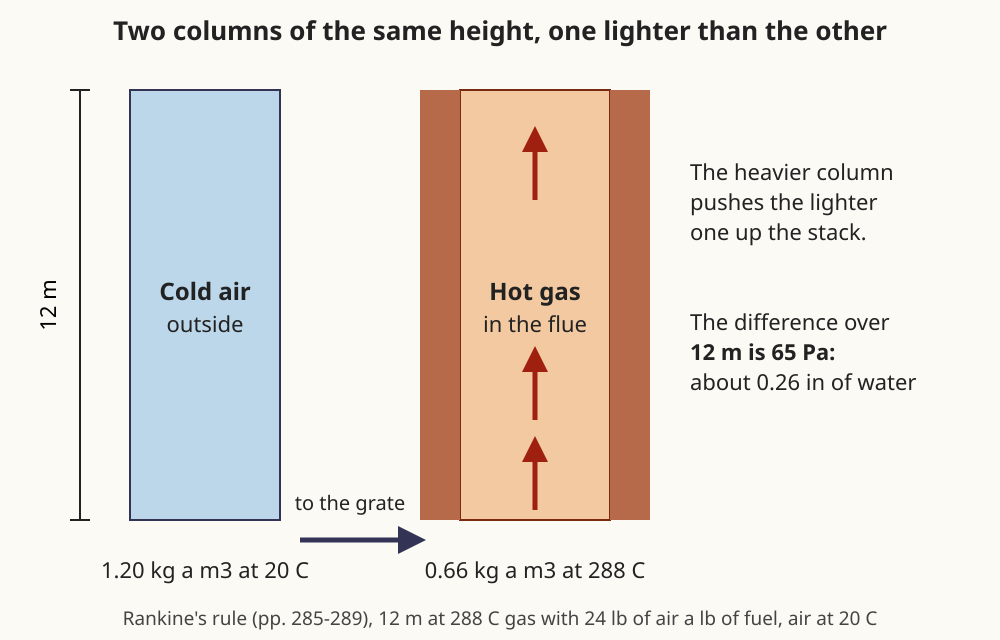
Hawkins puts it in a paragraph: draught "is caused by the difference between the weight of the air outside and that inside the chimney". As the hot gas rises "the cooler air eagerly hastens to fill" its place, and comes in through the bars of the grate (Hawkins p. 296). Rankine gives the same thing as a rule. The height of the shaft and the temperature of its gas fix a head, the head fixes the speed against the resistance of grate and flue, and the speed and the area of the top fix the coal burned (Rankine pp. 285-289). A conical shaft counts by the area at its top (Rankine p. 287).
Two consequences follow, and both shaped real chimneys. Height buys draught only slowly: "the draught power of chimneys is proportional to the square root of the height" (Hawkins p. 297), so doubling a stack does not double what it pulls. And height can be traded for area: "by making the chimney of large enough dimensions as compared with the grate", less heat need be spent on draught (Rankine p. 293).
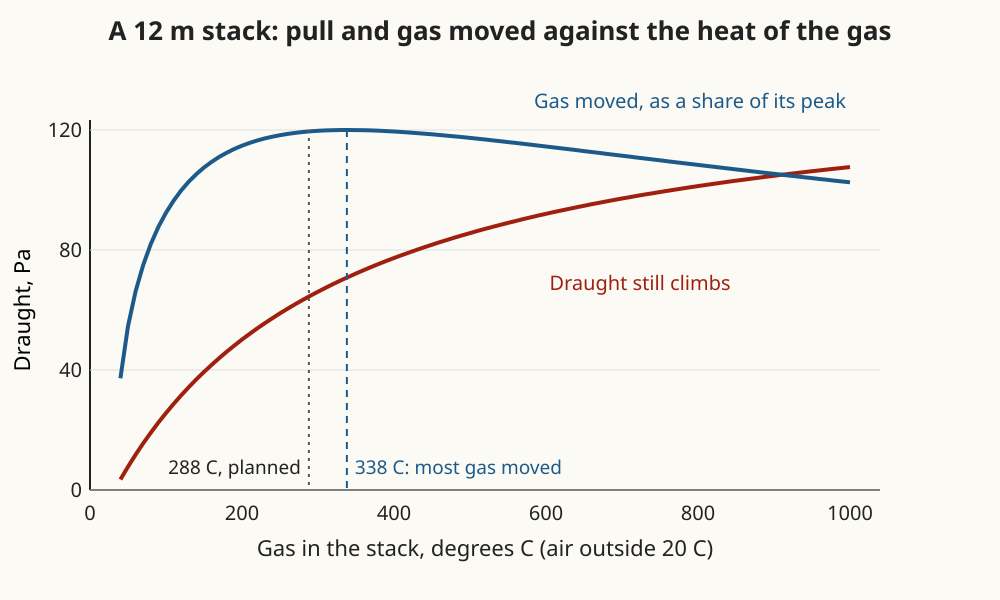
Past that temperature more heat in the stack buys nothing, and "it is never advantageous to raise the temperature in the chimney above that limit" (Rankine p. 289). A chimney's draught is paid for in heat. Rankine puts the worst case at a quarter of the heat of combustion (Rankine pp. 292-293), and Wilson finds the gas really entering the chimney at 400 to 700 degrees F, carrying off seldom less than 25% (Wilson p. 258).
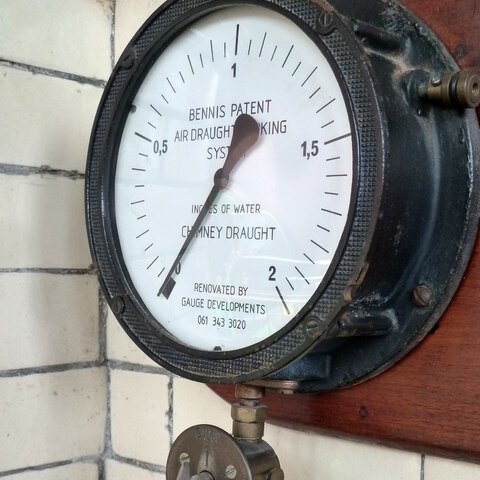
A draught was also a fragile thing. Hawkins lists what starves one: too little area, too low a chimney, obstructions, and a chimney overtopped by buildings, hills or trees, and says the draught of a new chimney "is very often an uncertain thing until every-day trial demonstrates its action" (Hawkins p. 296). It was measured in inches of water, by the difference of level in the two legs of a U-shaped glass tube joined to the chimney (Hawkins p. 297). The dial above reads the same quantity. A cold chimney was a nuisance of its own, and on a new or idle plant Hawkins advises a small fire in the base of the chimney before the boiler fires, to heat it and drive out the moisture (Hawkins p. 37).
How tall, and what for
No book here gives a table of height against grate. Rankine gives the rule and leaves the sum to the engineer (Rankine pp. 285-289), Wilson gives no chimney height at all, and the figures that survive are examples. They run from a puddler's stack to a works' great shaft:
- one puddling furnace: 30 ft above the ironwork, 36 ft in all, the flue 24 in square inside (Truran p. 207); or "from 30 to 50 feet high, and about 20 inches square" (Bauerman p. 267);
- a crucible furnace: "about 40 feet high, in order to command a strong draught" (Bauerman p. 356);
- several flues led past boilers to one stack: 100 ft or more "in order to overcome the additional resistance" (Bauerman pp. 267-268);
- boilers with 180 to 200 sq ft of grate at 15 lb of coal a sq ft an hour: 110 to 120 ft (Truran p. 117);
- the puddling and reheating furnaces at Dowlais led under boilers: 150 ft and 12 ft square (Percy p. 692).
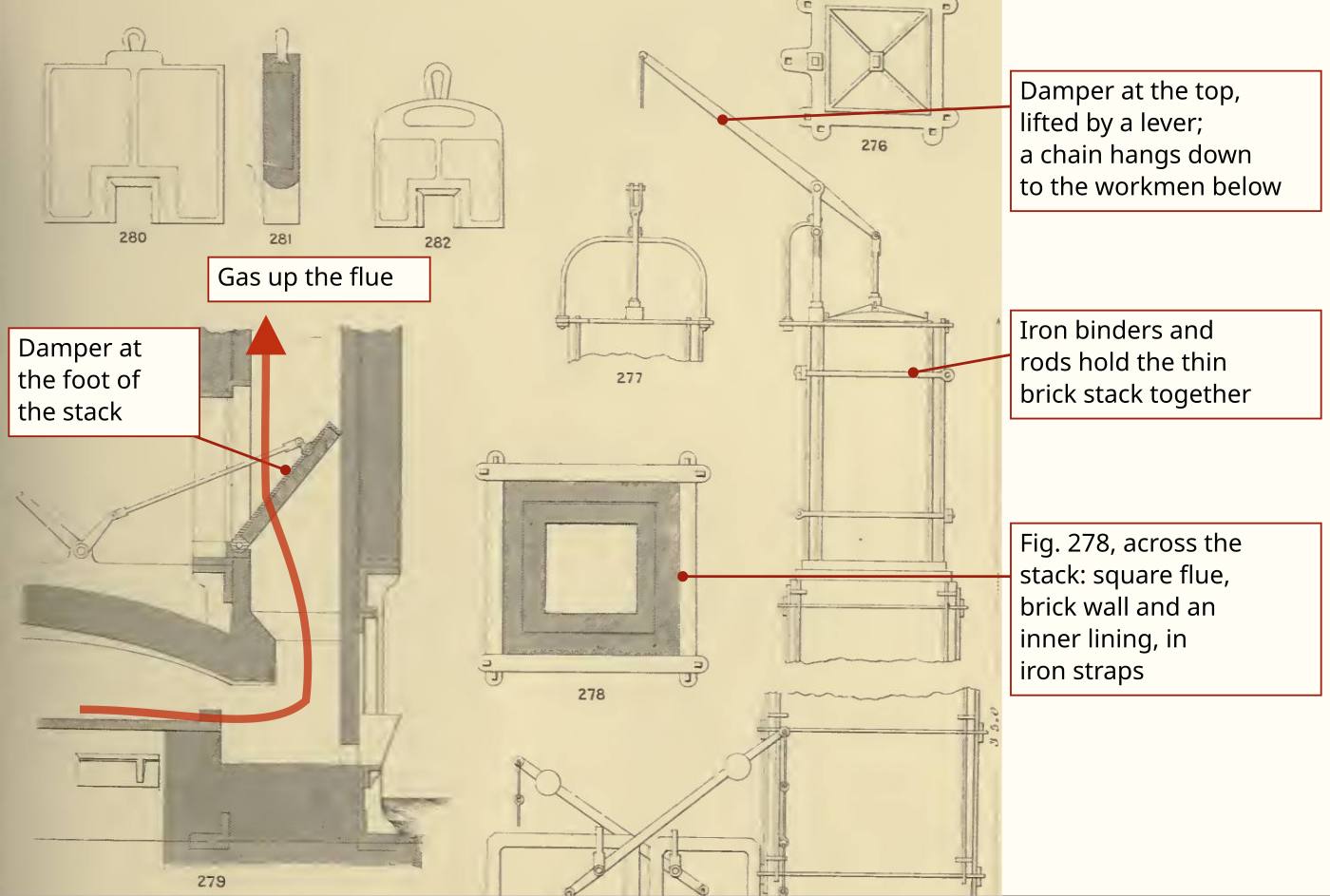
Because "the intense heat in the chimney destroys the lower courses in a comparatively short period", a stack of this kind carried a loose half-brick lining for its first 20 ft, which was pulled down and rebuilt without disturbing the stack (Truran p. 207). Where the draught was controlled mattered too. Hawkins wants it regulated below the grate, and the chimney damper kept wide open except when it must be shut (Hawkins p. 296). Truran warns that a damper at the foot, when shut, lets a column of cold air into the stack, which is then slow to recover (Truran p. 239), and that a stack gone cold has its drawing power "reduced to a minimum" (Truran p. 240).
Period basis, and what is the game's own
- Period: the chimney is the fire's engine, its draught the weight of two columns (Rankine pp. 285-289, Hawkins p. 296). In the game a fire with no chimney or smoke stack on its exhaust pipe has no draught, and is put out after 10 seconds.
- Period: a stack's height and bore are worked out from the fire it serves (Rankine pp. 285-289). The plan is that the stack's height, bore and gas temperature set what it can draw, by Rankine's rule, when it becomes the Cornish boiler's chimney.
- Period: flues led past boilers needed a taller stack to overcome the added resistance (Bauerman pp. 267-268). The game plans the boiler's grate capped at what the stack will carry.
- The game's own: today the stack draws a fixed 48 L/s whatever its height, its gas or the weather. That figure is set to swallow the exhaust of one hot blast furnace, and is not a period one.
- The game's own: a vanilla chimney set on a pipe fitting does the job for small exhausts, at 16 L/s. See vanilla against reality.
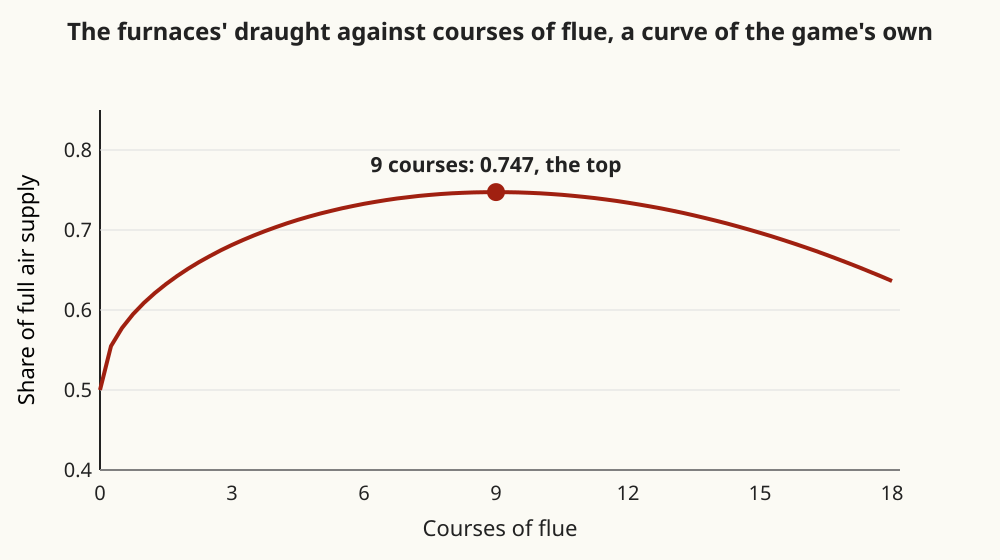
- The game's own: the furnaces' natural draught follows a curve of flue courses that rises and then falls, shown below. Real draught does not fall with height until friction overtakes it (Rankine p. 287 counts that friction), and no book here puts a peak at any height.
- The game's own: nothing here wears. A real stack lost its lower courses to heat and leaned if badly bound; the game's stands until a block of it is broken.
The numbers
"Planned" is the design for the stack as the Cornish boiler's chimney. Other values are what the game has now. Period measures are converted at true size (scale and units); the draught rule is used as it stands, not scaled (the scaling page).
| In the game | Period figure | How it was scaled | Game value |
|---|---|---|---|
| Stack height | 30 to 50 ft for one furnace (Bauerman p. 267); 36 ft (Truran p. 207) | True size; the game's own choice of 12 blocks | 12 m |
| Gas temperature | 400 to 700 F entering the chimney (Wilson p. 258) | The middle of that range | Planned 288 C |
| Draught | Rankine's rule (Rankine pp. 285-289) | The rule at face value, air at 20 C | Planned 65 Pa; 108 Pa at 1000 C gas |
| Stack's draw | Rankine's rule (Rankine pp. 285-289) | The rule at face value, with the stack's bore | Planned 3.8 m3/s of hot gas, 343 kg/h of coal on the Cornish grate |
| Boiler's firing against that draw | 4 to 18 lb a sq ft of grate an hour (Wilson p. 272) | Grate area x period rate | Planned 134 kg/h open, 90 kg/h usual |
| Stack's vent today | None | The game's own, set to one hot blast furnace's exhaust | 48 L/s |
| Vanilla chimney on a pipe | None | The game's own | 16 L/s |
| Furnace draught at 9 flue courses | None | The game's own curve, peaking at 9 | 0.747 of full air |
| Backed-up exhaust | None | The game's own | Fire snuffed at 0.8 atm after 10 s |
Open, and what you can tell us
The books here give the rule and a handful of examples, and no table of height against grate; Wilson's chapters on combustion, from Wilson p. 254, carry no draught figure at all. If you know a period source that sets out chimney height for a given boiler or grate, or measures the draught of a working mill chimney, we would like to read it.
Picture credits
- The chimney and engine house at Ellenroad Mill: Tom Axford, CC BY-SA 4.0, cropped.
- Ellenroad Engine House, chimney draught gauge: Chris Allen, CC BY-SA 2.0, cropped.
- Puddling furnace, Dowlais: Truran, The Iron Manufacture of Great Britain, Plate XLVIII, Library page, cropped, with labels and the gas path added.
- The two columns and the temperature chart: drawn for this page from Rankine pp. 285-289.
- The course curve: drawn for this page from the game's own figures.
Comment or suggest something in the Expanded thread on the Vintage Story Discord