
Shaping and planing machines
Both machines make a flat surface the same way: a single-point tool is drawn along the metal in a straight line, moved over a little, and drawn along again. They differ in what moves. In the shaper the tool travels and the work waits. In the planer the work travels and the tool waits. How to run them belongs to the shaft power guide, and they are listed in the catalogue as the shaper and the planer. This page is about the real machines and why a shop kept one of each. Their place among the other tools is on the machine shop.
What moves, and why
A straight, true surface needs a straight, true motion, and the part that makes the motion has to be guided along its whole travel. That is the reason there are two machines.
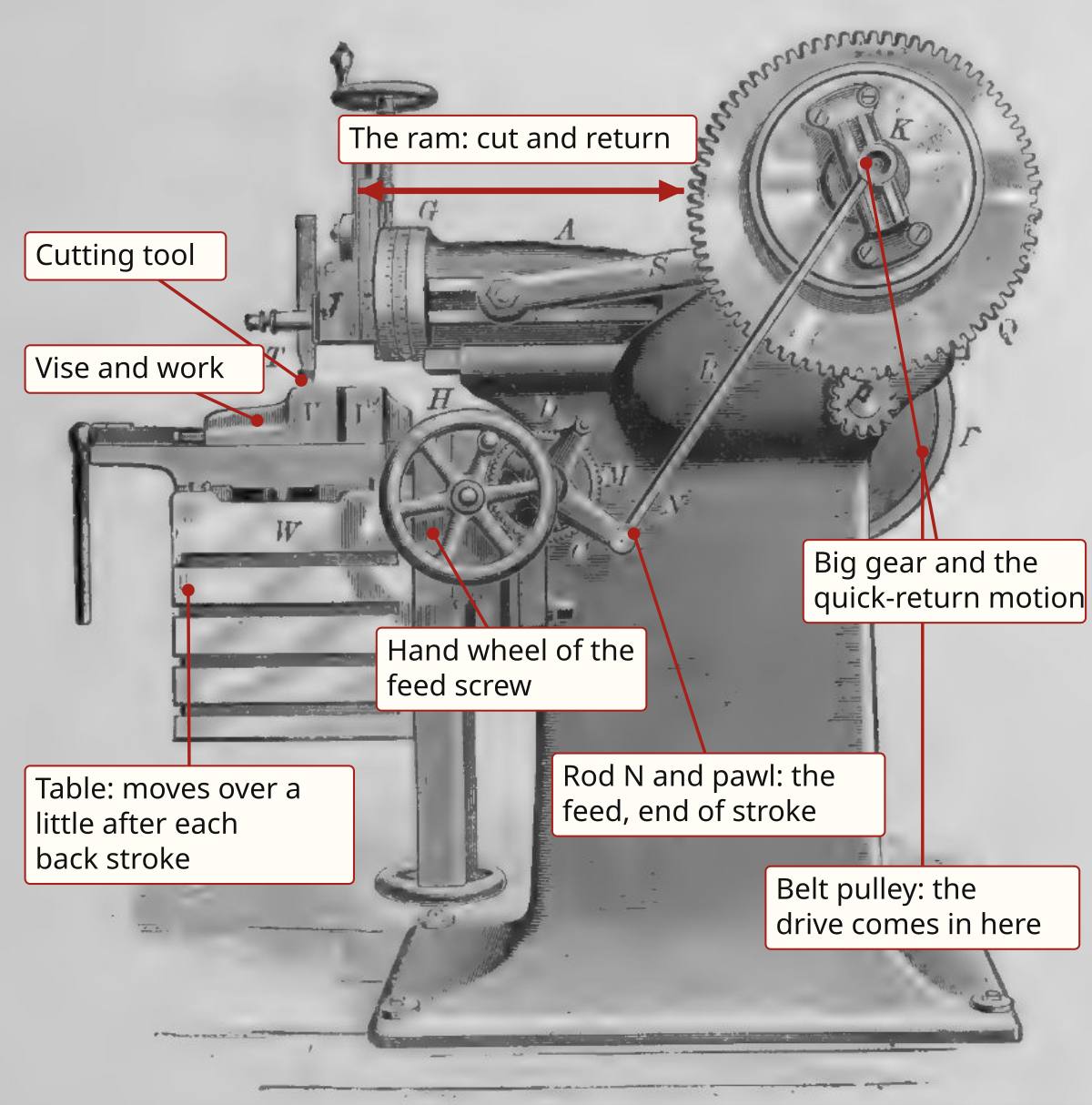
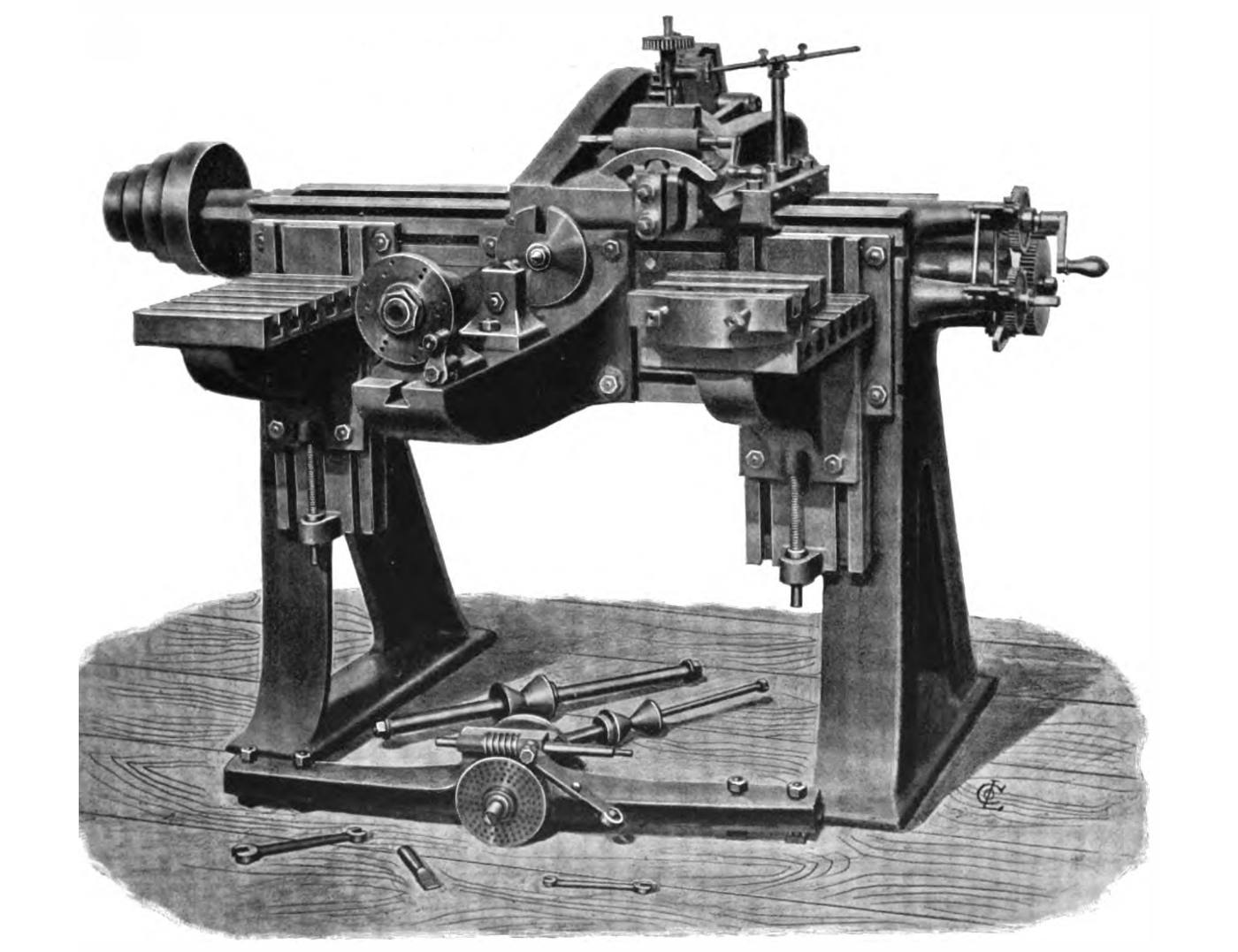
Rose gives the shaper's office as dressing "such surfaces as can be most conveniently cut by a tool moving across the work in a straight line" (Rose p. 389). Its limit is in its own construction. The slide leaves its guides on each stroke, so the longer the stroke, the less the tool is held, and its use stops at "about 18 inches, and in small machines not to exceed 12 inches" (Rose p. 397). Sellers's shapers of 1895 have strokes of 9, 12 and 16 in (Sellers 1895 pp. 175-177). Niles sold one with 24 in and called it the heaviest and most powerful built in the country (Niles p. 113).
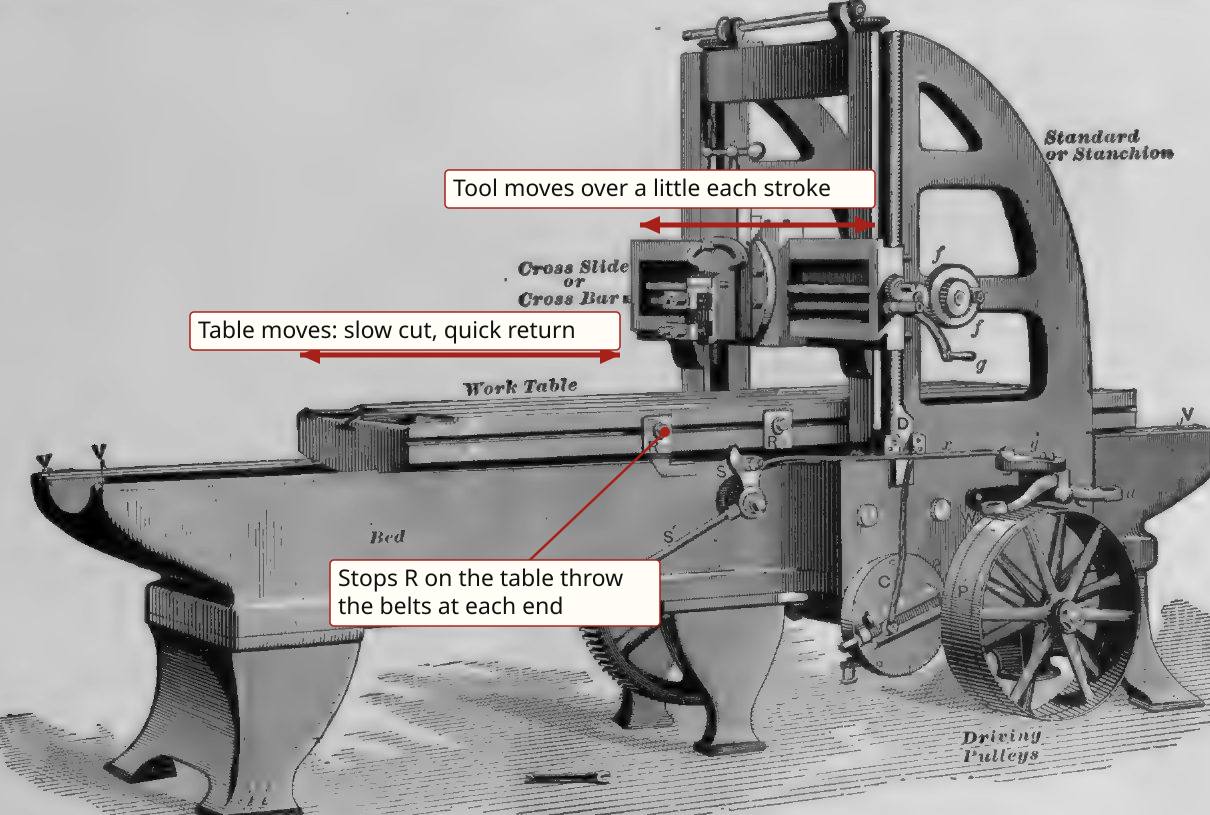
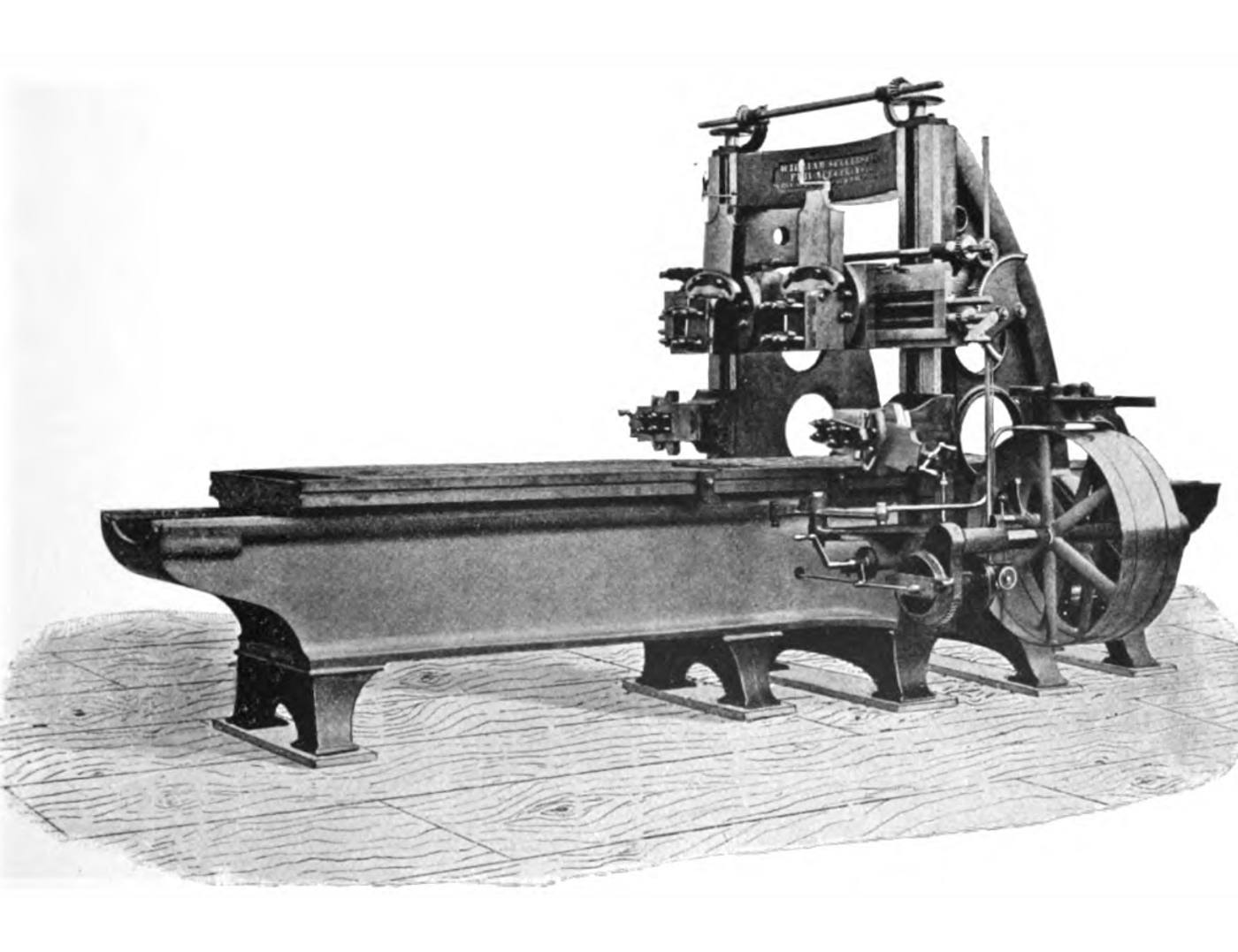
A planer's table is guided along the whole of its bed, so length costs only more casting. Nothing hangs out. Sellers listed machines to plane 36 in by 36 in with a table of 5 ft at the shortest (Sellers 1895 p. 188), and sizes went on up to 120 in. The price is the setting up, and the time: a heavy table has to be started and stopped at each end, and all of it has to go back again before the next cut.
For a short piece the shaper is the better machine. Sellers calls it "more economical than the planing machine on pieces for which it is adapted", for the ease of setting the work and the quickness of the machine (Sellers 1895 p. 174). Rose adds that it can be faster on the same piece, because a stepped pulley lets its speed suit the work, "whereas in a planing machine the cutting speed of the tool is the same for all sizes of work, and all kinds of metal" (Rose p. 398). For a long piece nothing replaces the planer. And for work too heavy even for its table the idea was turned around: Sellers built planers for stationary work, "to move the planing machine instead of the work" (Sellers 1895 p. 200).
The stroke that does nothing
A single-point tool cuts one way only. Half the machine's travel is spent coming back, and much of the design of both machines goes into shortening that half.
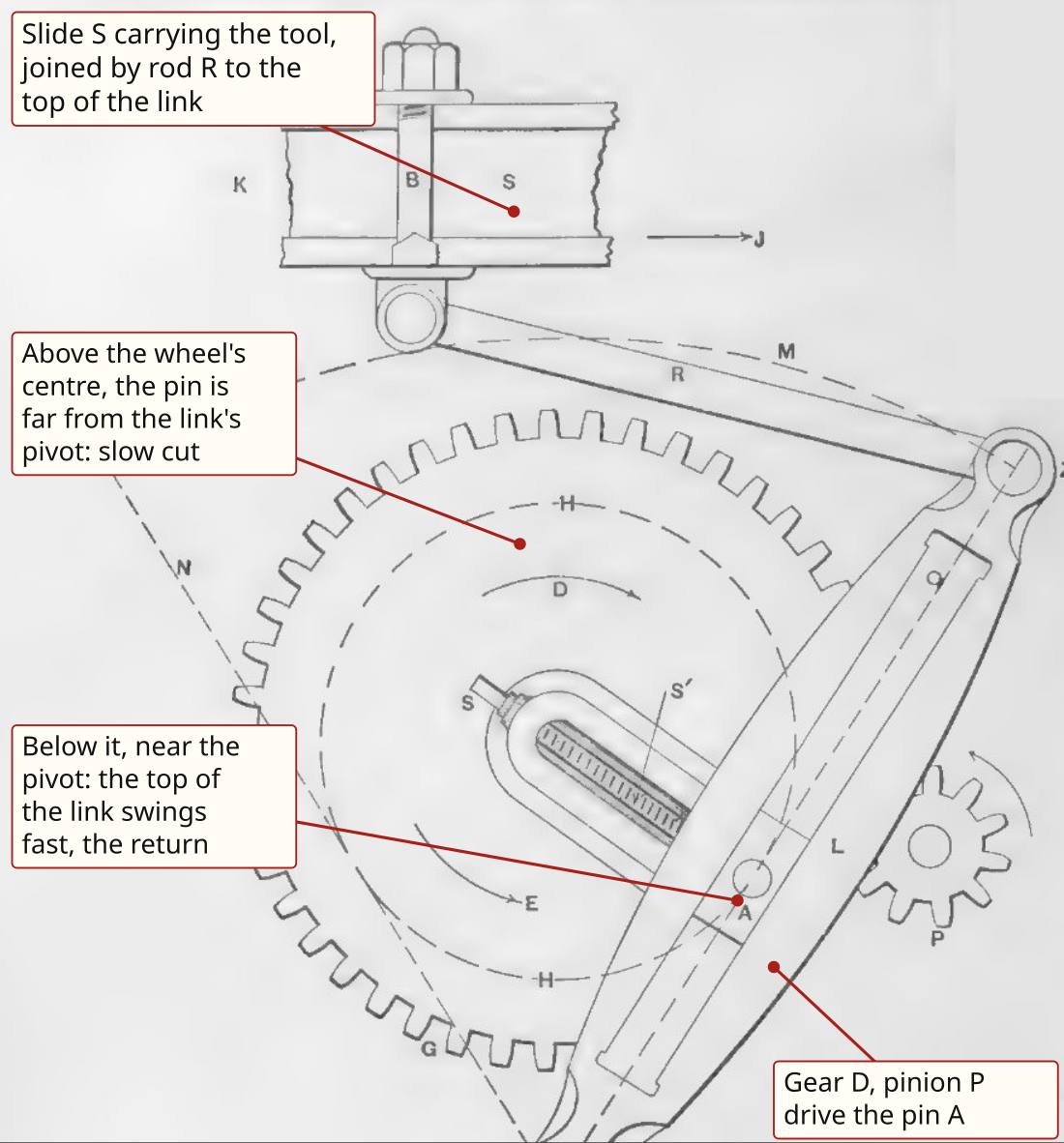
On a shaper the quick return usually came from linkage, and Whitworth's quick-return motion was "the most general" form (Rose p. 399). A belt could return it faster still (Rose p. 389): one rack-driven shaper Rose describes came back 40% quicker than it cut (Rose p. 398). On a planer the return came from the belts: an open belt and a crossed belt from the overhead shaft, and the countershaft pulley for the back traverse made larger than the one for the cutting stroke (Rose p. 403). Sellers rated one machine at 18 ft a minute cutting and 72 ft a minute returning (Sellers 1895 p. 187). The makers would not go much past that. Sellers limited their reverse to three or four times the cutting speed, on belt-shifted machines (Sellers 1895 p. 188), since time is needed at each end to shift the belt and start the table.
The tool has to be kept off the work on the way back. On one shaper Rose moves the feed to the end of the return stroke, "so as to preserve the edge of the tool" (Rose p. 398), and on the planer the feed waits for the reversal so that the tool does not rub the side of the cut (Rose p. 403). The judges' report that Sellers reprints praises "the arrangement which raises the cutting instrument from the work during the return of the planing table" (Sellers 1895 p. 186).
Where the shaper came from
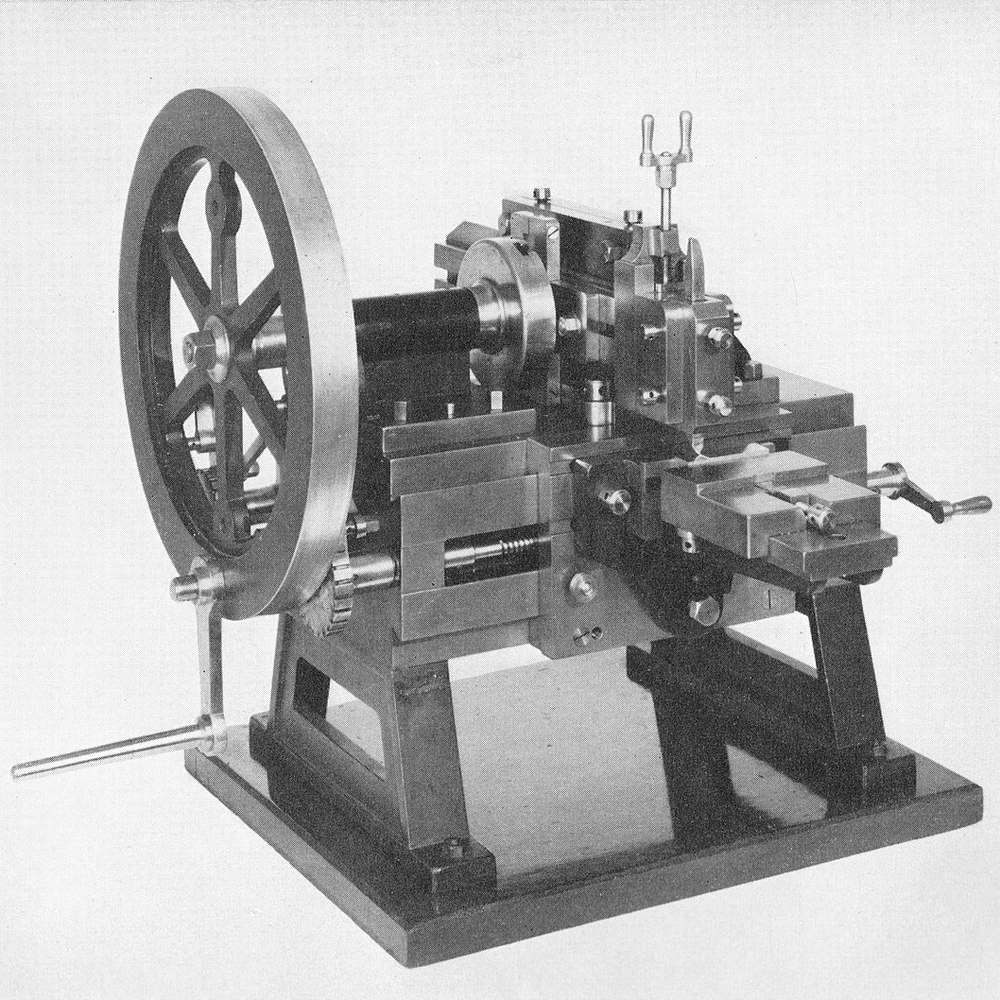
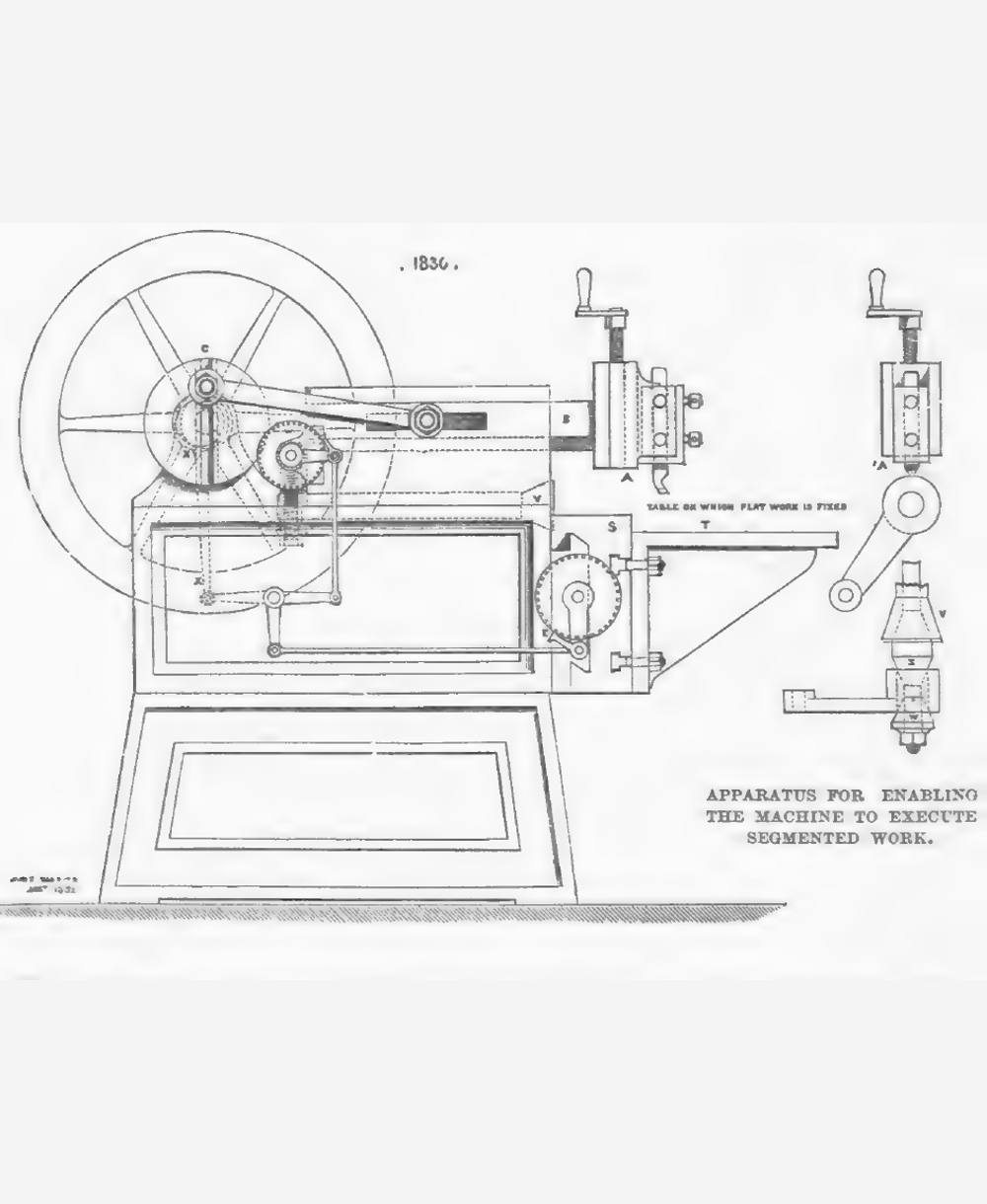
In Nasmyth's account the planer came first. He writes that the "first child" of his great lathe was a planing machine 3 ft long by 1 ft 8 in wide (Nasmyth p. 179), and that the planer was chiefly for the larger parts: a great many of the small ones "still continued to be executed by hand labour, in which the chisel and the file were the chief instruments employed" (Nasmyth p. 415). He put the time lost to the workman stopping, checking and starting again at not less than one-sixth of the working hours (Nasmyth pp. 415-416). His answer in 1836 was the machine he called the Steam Arm, a small "modification" of the planer for detail parts, which would "rival the hand work of the most skilful mechanic" and could be left to "any attentive lad" (Nasmyth p. 415).
So the shaper grew out of the planer, for work the planer was too clumsy to set up for, and it took over the small flats, the keyways in shafts, and work indexed round by a worm and division plate (Rose p. 397; Sellers 1895 p. 174). Sellers warns that it was "a difficult machine to build correctly", since the tool's path must be a perfect plane made out of two separate motions (Sellers 1895 p. 174). And Rose, writing later, says it had lost ground: its position was "not as important as was the case a few years ago, because of the advent of the milling machine" (Rose p. 389).
Period basis, and what is the game's own
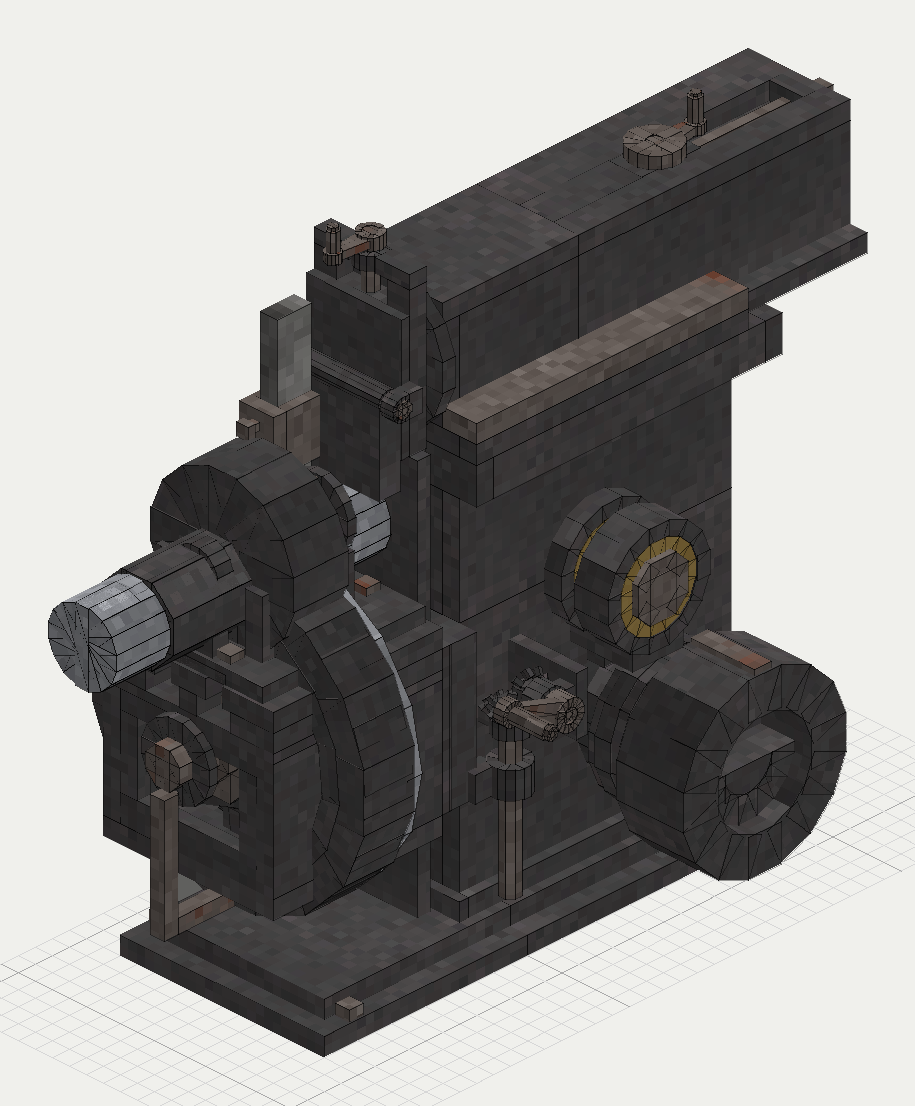
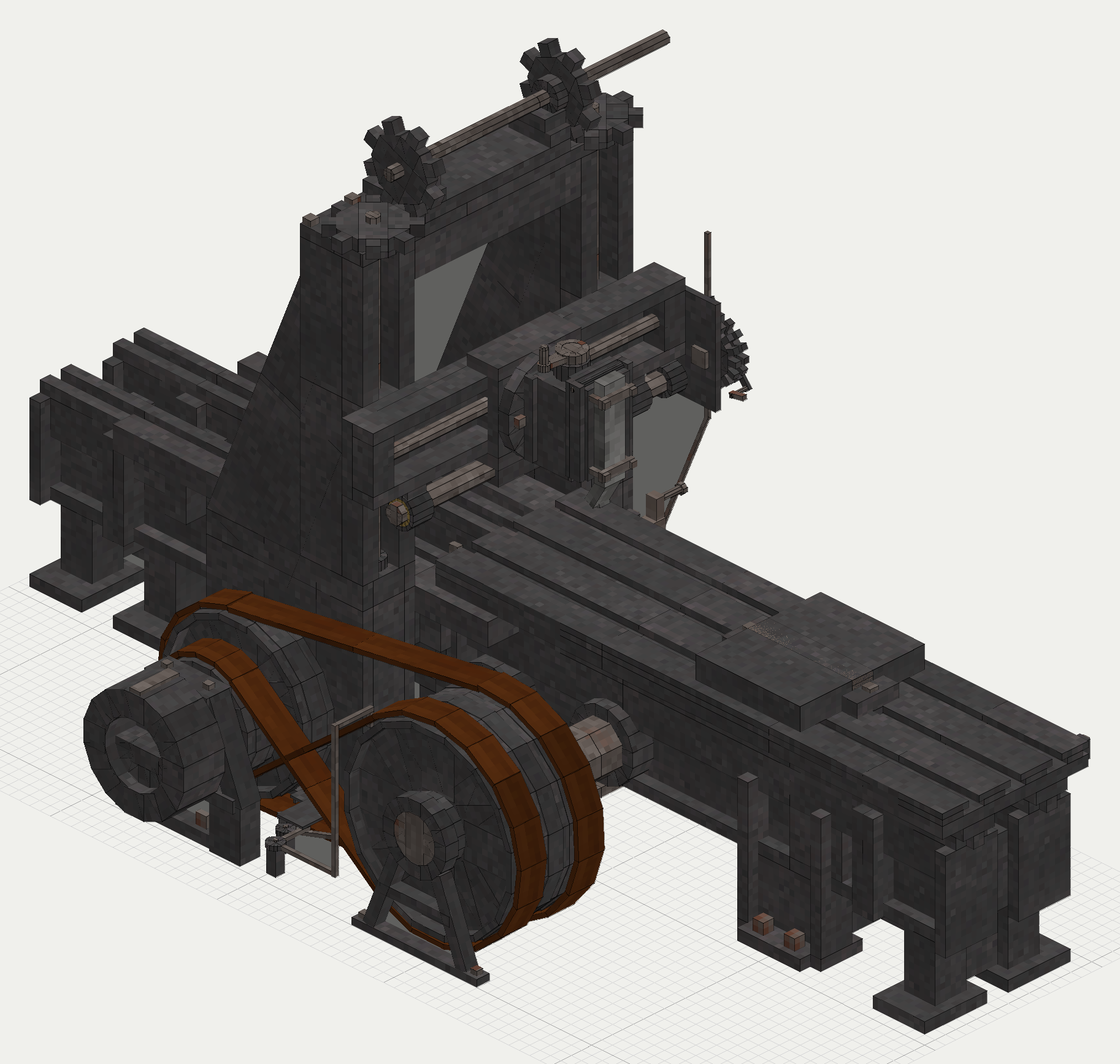
- Period: the shaper took short flats and keyways, the planer the long and heavy faces (Rose pp. 389, 397; Sellers 1895 p. 174). The game plans the same split: small flats, keyways and teeth at the shaper, and the sliding and seating faces of large castings at the planer.
- Period: both machines cut on one stroke and returned faster (Rose pp. 398, 403; Sellers 1895 p. 187). The game drives its planned shaper through a bull wheel, a crank pin and a rocker, and its planer through an open and a crossed belt with two loose pulleys and one fast. Today's animations run out and back in equal halves.
- Period: the hand route was the chisel and the file (Nasmyth p. 415). The game keeps it. Each part has a route at the bench that stays open as the early route, and the machine is planned to be quicker and cheaper in cutter wear. The first machine tools have to be built by hand, since a gear needs the shaper and the shaper needs gears.
- Period: teeth were cut on gear-cutting engines with revolving or rack-form cutters (Rose pp. 34, 36). The game's own: the shaper cuts every gear's teeth, one machine instead of another, with the worm index Rose gives it for dividing work (Rose p. 397).
- Period: a separate slotting machine, planing vertically (Sellers 1895 p. 200), was sold beside the shaper (Niles p. 115). The game's own: the shaper stands in for it and cuts the keyway in an eye.
- The game's own: what a planer takes off comes away as cuttings for remelting. The books at hand give the machines' speeds but not what became of the swarf.
- The game's own: no planned job models the tool lifting on the return (Sellers 1895 p. 186) or the wear of the bed's ways (Rose p. 415). Both machines are placed blocks today, with no process; their jobs are planned.
The numbers
Drawn at true size at a metre to the block (scale and units). Their speeds and power do not use the furnaces' fuel factor (the scaling page). "Planned" is the rating in design; everything else is as the machine is drawn today. All of a machine's job times are planned.
| In the game | Period figure | How it was scaled | Game value |
|---|---|---|---|
| Shaper stroke | 9, 12, 16 in (Sellers 1895 pp. 175-177); 18 in limit (Rose p. 397); 24 in, the heaviest (Niles p. 113) | Whole voxels at true size, the largest of the catalogues | Planned 10 voxels, 0.62 m (24.6 in) |
| Shaper table rise | 21 in (Niles p. 113) | Whole voxels at true size | Planned about 8.5 voxels, 0.53 m (21 in) |
| Shaper table | None printed by Rose; 11 in table to bar on the Sellers 9 in (Sellers 1895 p. 175) | The game's own | Planned 10 x 10 x 10 voxels, 0.62 m a side |
| Shaper return | 40% quicker than the cut (Rose p. 398) | Read as 1.4 x the cutting speed, 0.583 of the time cutting | Planned; the animation today runs equal halves |
| Shaper power | Derived from the planer's cut and the return above | Energy to cut over time cutting | Planned 570 W |
| Planer height under the tool | 36 in (Sellers 1895 p. 188) | Whole voxels at true size | Planned 14.6 voxels, 0.91 m (36 in); drawn today 5.7 |
| Planer table length | 5 ft shortest for a 36 in machine (Sellers 1895 p. 188); 6 to 16 ft in the 26 to 38 in class (Niles p. 91) | The game's own choice of 10 ft | Planned 48.7 voxels, 3.04 m; drawn today 41.1 |
| Planer stroke | 10 ft of work on the 36 in (Sellers 1895 p. 189) | Whole voxels, short of the table | Planned 41 voxels, 2.56 m; drawn today 34.4 |
| Planer width | 36 in (Sellers 1895 p. 188) | The machine's frame at true size | 16 voxels between the housings, 1.0 m |
| Planer return | 18 ft a minute cut, 72 return (Sellers 1895 p. 187) | 0.8 of the time cutting | Planned; the animation today runs equal halves |
| Planer power | Feed and depth of cut not printed | Energy to cut over time cutting, feed and depth the game's own | Planned 780 W |
| Energy to cut wrought iron, reciprocating | .0520 hp (Rose p. 273) | Converted to joules a kilogram | Planned 307,800 J/kg |
Open, and what you can tell us
The books at hand name no inventor of the planer, and they give no date for the first one: Nasmyth's account is one workshop's. It is also open how far the shaper's history is one line from Nasmyth, since Rose describes the machine only as he found it. And the game's shaper cuts gear teeth, where the books have a separate machine for it. If you know a source on who first planed iron by machine, or on any shop that really did cut its teeth at a shaper before gear engines were common, we would like to read it.
Picture credits
- 9 in shaping machine, Plate 100: Sellers 1895 p. 175, Library page, cropped, its plate number masked.
- 36 in by 36 in planing machine, Plate 110: Sellers 1895 p. 189, Library page, cropped.
- Fig. 1496, Plate LXIX, labelled for this page: Rose, Modern Machine-Shop Practice, Library page.
- Fig. 1558 and Fig. 1550, labelled for this page: Rose p. 403 and Rose p. 400, Library page.
- Nasmyth's shaping machine, Plate 24: K. R. Gilbert, The Machine Tool Collection (1966), public domain, cropped.
- Nasmyth's drawing, 1836: James Nasmyth, Engineer: An Autobiography, Nasmyth p. 416, Library page.
- The game's shaper and planer: the mod's planned drawings.
Comment or suggest something in the Expanded thread on the Vintage Story Discord