
Stock and plate sizes
A rolling mill made a short list of forms: bars, flats, rods, plates. Their sizes were set by the rolls, and by what a price list would sell without charging extra. The game takes most of its planned sizes from those lists and rounds them to the voxel. How the forms are rolled is on the rolling guide and how the mill itself works is on the rolling mill page. The pieces are in the catalogue under stock. This page is about where the numbers come from. Most of it is planned: the game today still rolls its first, much bulkier set of pieces, and the sizes below arrive with the forming stage.
Why a bar has the section it has
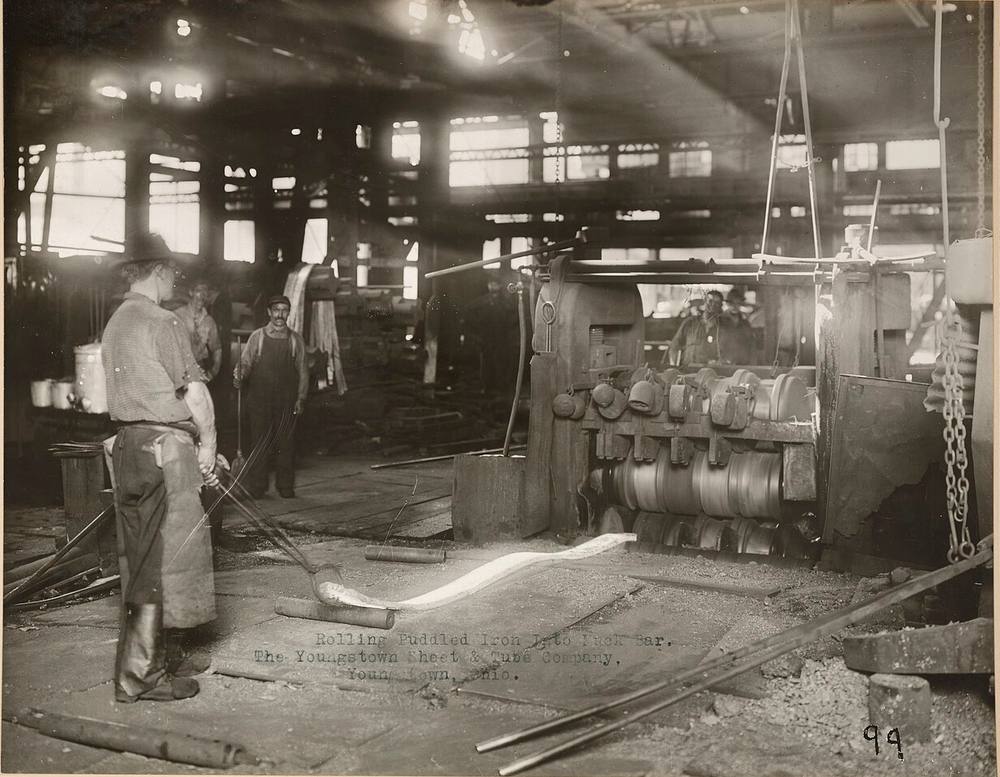
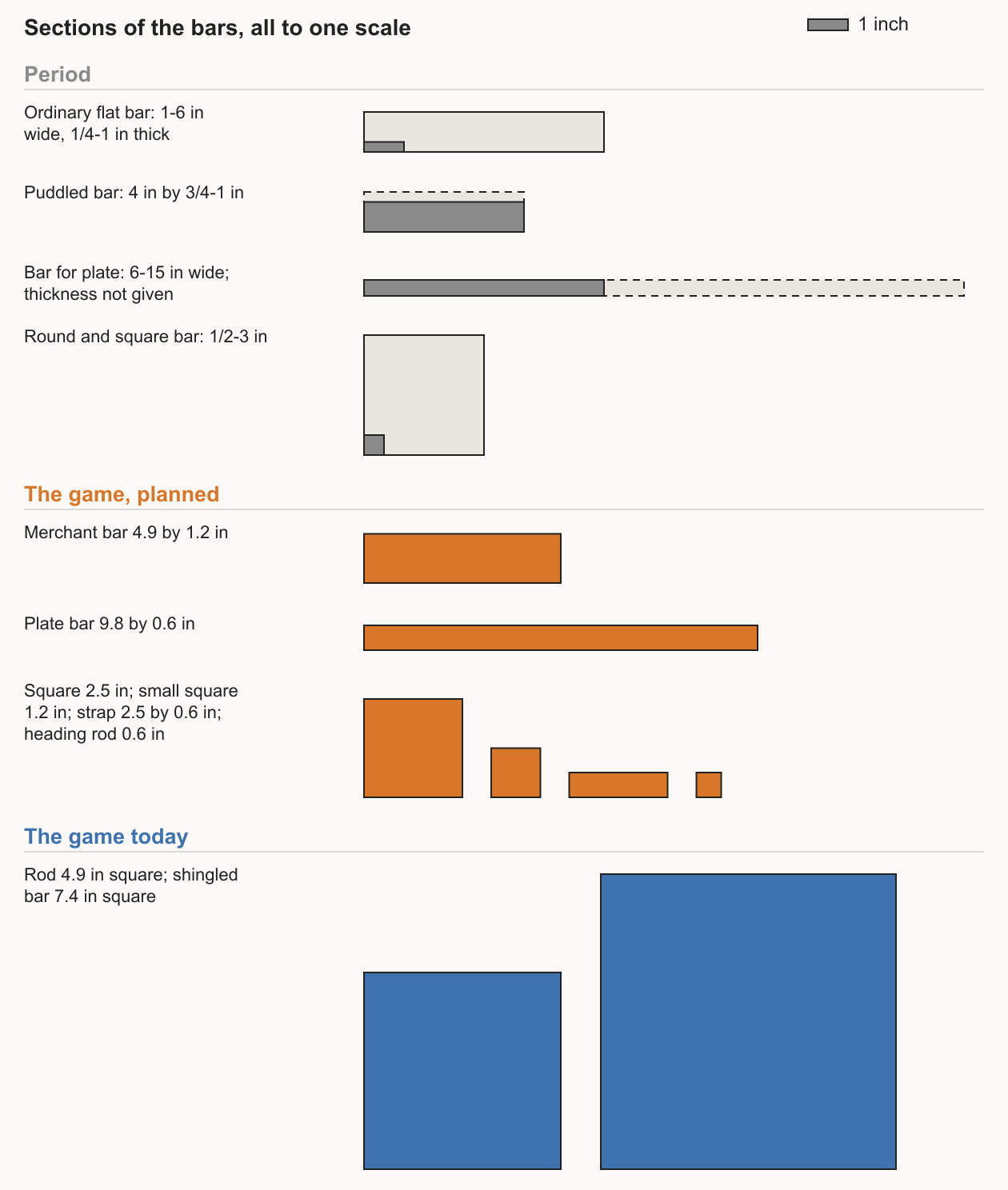
A puddled ball of about 80 lb (Percy p. 656) was squeezed into a bloom about 5 in across and 18 in long (Truran p. 219), and the bloom went straight to the rolls. Those finishing grooves were "turned with grooves to produce flat bars from 3 to 7 inches wide by 1/2 inch to 1 1/2 inches thick" (Truran p. 223). Fairbairn's bar is the middle of that: about 4 in wide and 3/4 to 1 in thick (Fairbairn Mills II p. 257). A bar in this state was only the first form. Everything finer was made by cutting it up, piling it and rolling it again.
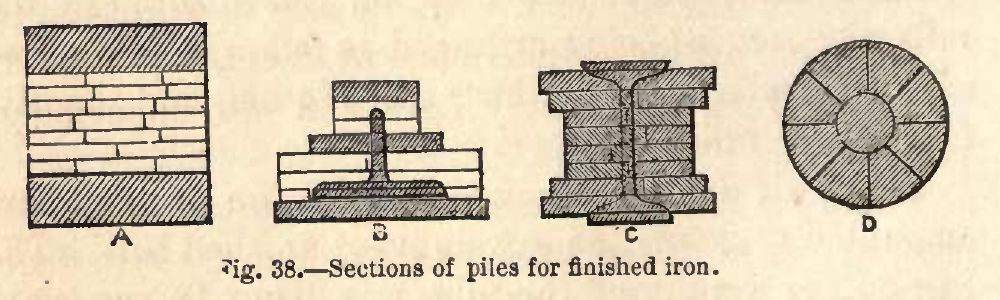
The pile is the reason the sizes form a ladder. Puddled bars were cut to "generally from 3 to 4 feet" and laid together (Truran p. 226), in a section from 3 to 10 in square according to the iron ordered (Truran p. 226). Bauerman gives one in full, from a South Staffordshire forge in 1861: for bars of 1 in square, six bars 3/4 in thick and 4 in wide, 18 in long, 100 lb in all, passed eleven times through the rolls (Bauerman p. 315). The rolled iron lost about 15% in the furnace, crop ends and waste (Bauerman p. 315).
The game's plan follows that ladder at the voxel. A planned puddled ball is 50 u, which is 38 kg of wrought iron, worked out, and the ball of the books is 32 to 36 kg (Overman p. 268, Percy p. 656). One ball makes one bloom, 2 x 2 x 5 voxels, and the bloom rolls only into a merchant bar or a plate bar. Every other form comes from a pile of sheared merchant bar, cut to 5, 10 or 20 voxels and stacked four high, 2 x 2 voxels in section (4.9 in square, inside Truran's range). That is the rule in Truran and Bauerman, kept as a rule of the game: nothing fine is rolled from a bloom.
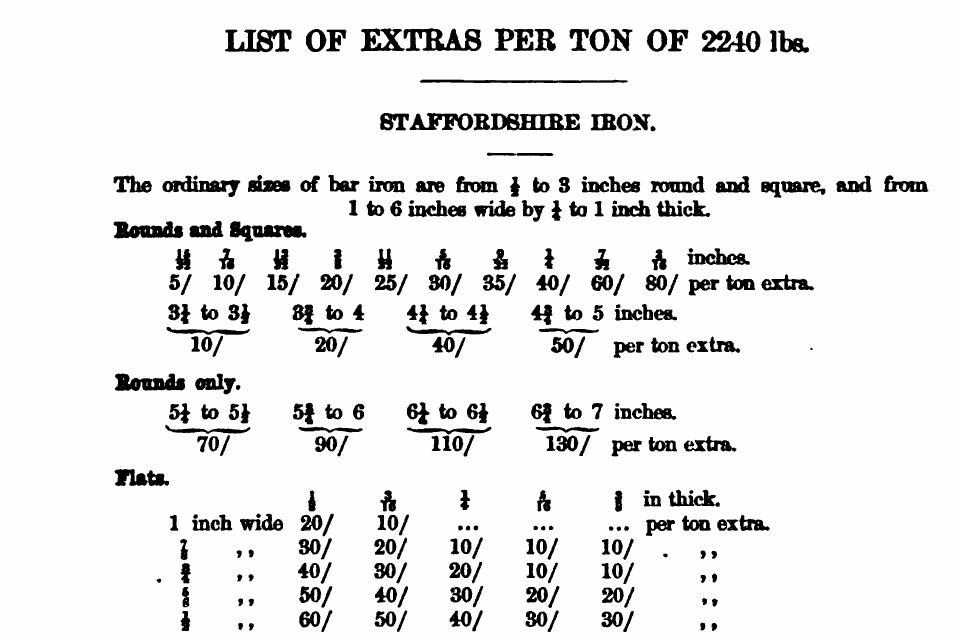
Square and flat stock has a size because the rolls cannot make everything. The small sizes come in bundles because the game counts metal in whole units, and a single small square of 12.5 u cannot exist, so a small square or a strap is a bundle of four and a heading rod a bundle of sixteen, each bundle 50 u. Percy's list has the same idea in reverse: the smallest sizes carry the greatest extras (Percy p. 754).
Why a bar is the length it is
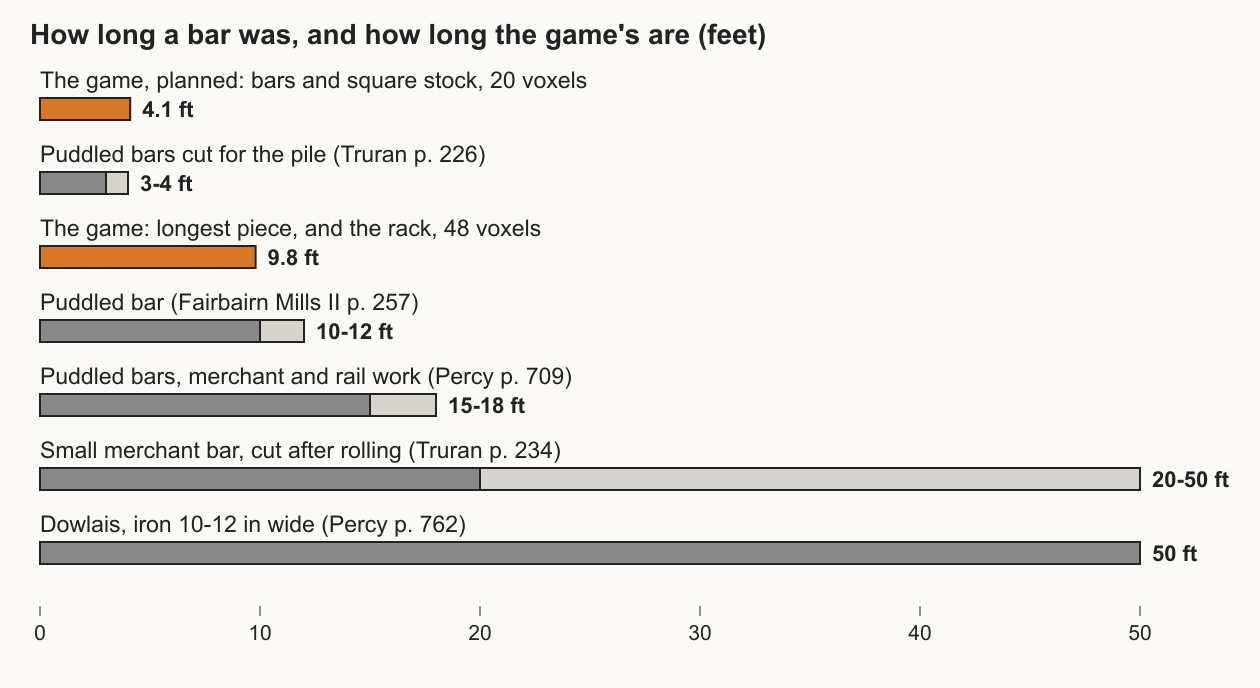
A mill rolled long and cut afterwards. Small merchant bar, "formerly" 20 ft, had come to run to 50 ft, cut into two or three (Truran p. 234). The game cannot carry 15 m of bar across a world built in metres. A bar in the game is 20 voxels, 1.25 m, about 4 ft, which is Truran's length for a piece cut for piling and not the length of bar a mill rolled. The longest piece that may exist is 48 voxels, 3 m, set by what the reheating furnace can take, and the piles are the short end of the same scale: 5, 10 and 20 voxels, 1 to 4 ft.
Why a plate is the size it is
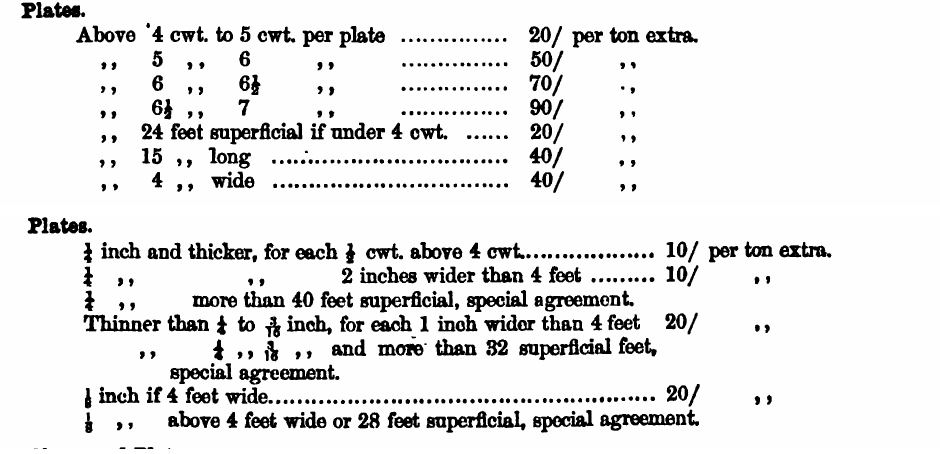
The rolls set the width. Boiler-plate rollers were "four and even five feet long" (Overman p. 366), and some for large plates were upwards of 6 ft (Fairbairn Iron p. 125). The manufacturer's limit was what mattered to a boiler maker: "The greatest width, without extra charge, is usually about 4 feet, and the length is arranged to keep the weight of the plate within 4 cwt." (Wilson p. 91).
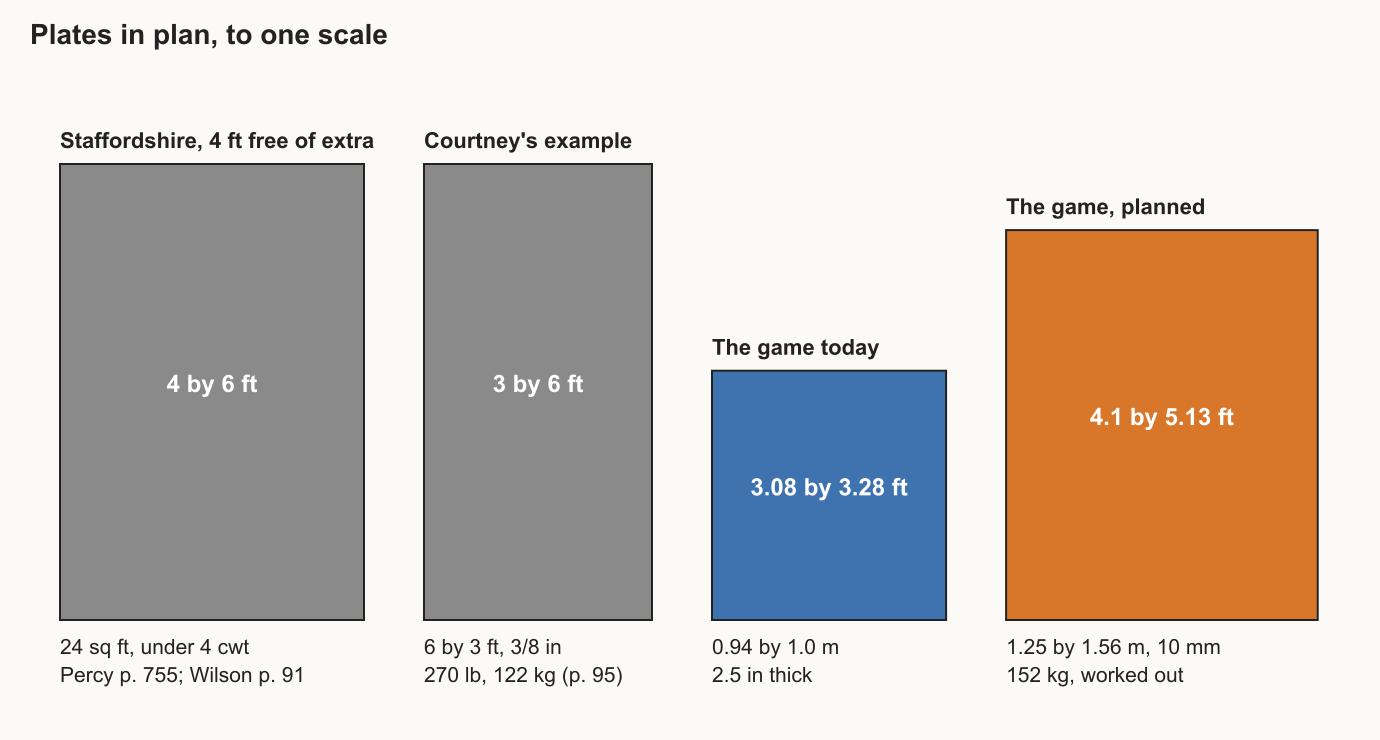
Thickness is the part the game has most to fix. A plate one voxel thick is 62.5 mm, far beyond anything rolled for a boiler, and it exists today because the wide rolls and the slab rolling were worked out a voxel at a time. The planned plate goes to its period thickness, 0.16 voxel or 10 mm, and is priced by the area it covers rather than its count. It is rolled, as Truran's boiler plate was, from layers laid crosswise (Truran p. 230), so that it is equally strong each way.
How much a rack holds
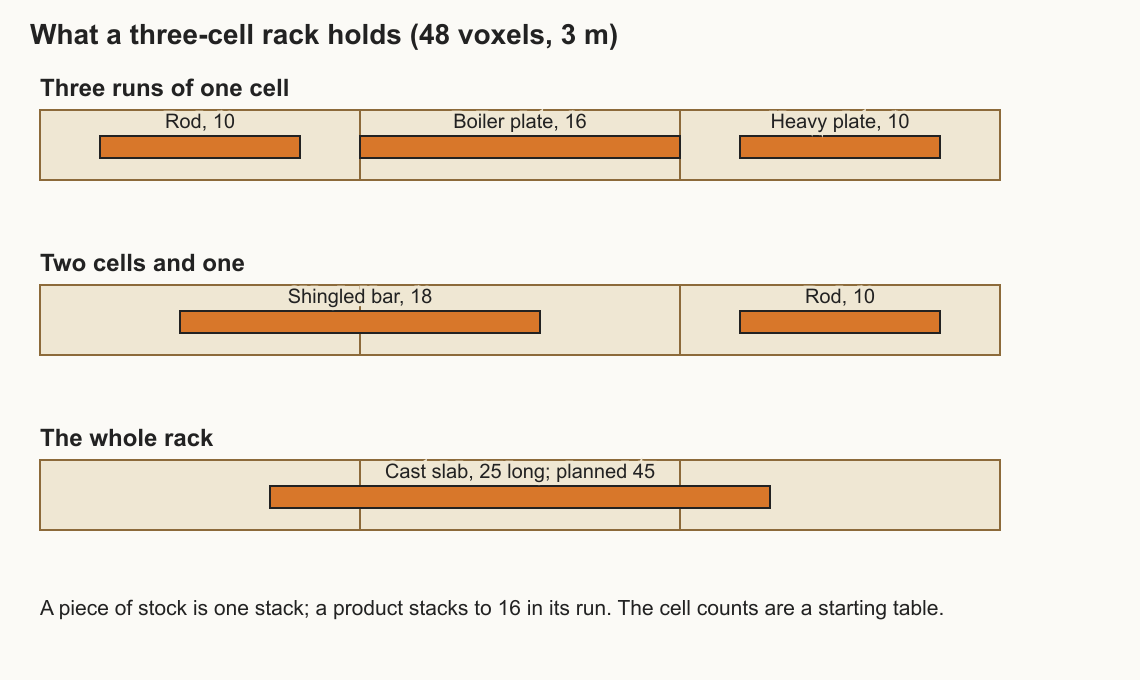
A rack is three cells long, 48 voxels or 3 m. That is the longest piece that may legally exist, so no piece is ever without a place to lie. Capacity is length, not layers: nothing stacks upward on a rack. The rack is the cheap block of the line on purpose, and it stores iron without heating it, so a piece gone cold on a rack is no closer to the mill than one on the floor. The cell counts per item are a starting table, set by hand.
Period basis, and what is the game's own
- Period: bars by section with extras past the ordinary sizes (Percy p. 754), and the rolled bar's section from its grooves (Truran p. 223). The game's forms are sections of the same kind, in voxels.
- Period: finer forms rolled from cut and stacked bars, in piles square in section (Truran p. 226, Bauerman p. 314). The game plans the same rule, and rolls every form except the two first bars from a pile.
- Period: plate limited by weight and width (Percy p. 755, Wilson p. 91), and cross-layered (Truran p. 230). The game's planned plate is under the same limits by size.
- The game's own: bars stop at 20 voxels because the game has no room for the lengths the books give, and the longest piece stops at 48 voxels because of the reheating furnace. See scale and units.
- The game's own: the bundles of 4 and 16, because the game's metal counts in whole units.
- The game's own: vanilla's rod, 2 x 2 x 10 voxels, and vanilla's plate, 9 x 1 x 9, stay in the game as they are. They are the early pieces, thicker than the ordinary sizes on the list. See vanilla against reality.
- The game's own: the rack. The books read for this page do not describe how merchant bar was stored.
The numbers
Sizes are drawn at the game's 2.46 in a voxel (scale and units); masses of wrought iron at 7.8 g/cm^3 are worked out. "Planned" is the size in design; values without that word are what the game has now. How period figures are carried over is on how we scale.
| In the game | Period figure | How it was scaled | Game value |
|---|---|---|---|
| Puddled ball | 70 to 80 lb (Overman p. 268); about 80 lb (Percy p. 656) | The game's unit, near the period mass | 200 u today; planned 50 u, 38 kg |
| Bloom | 5 in diameter x 18 in (Truran p. 219) | Whole voxels, length shortened | Planned 2 x 2 x 5 voxels, 4.9 x 4.9 x 12.3 in |
| Bar from the rolls | 3 to 7 in x 1/2 to 1 1/2 in (Truran p. 223); 4 in x 3/4 to 1 in x 10 to 12 ft (Fairbairn Mills II p. 257) | Whole voxels, length to the pile piece | Planned merchant bar 2 x 0.5 x 20 voxels, 4.9 x 1.2 in x 4.1 ft |
| Bar for plate | 6 to 15 in wide (Percy p. 709) | A quarter voxel thick, width in whole voxels | Planned plate bar 4 x 0.25 x 20 voxels, 9.8 x 0.6 in x 4.1 ft |
| Square bar | 1/2 to 3 in (Percy p. 754) | A whole voxel | Planned 1 x 1 x 20 voxels, 2.46 in square |
| Small square | 1/2 to 3 in (Percy p. 754) | Half a voxel | Planned 0.5 x 0.5 x 20 voxels, 1.23 in, in a bundle of 4 |
| Strap | 1 to 6 in x 1/4 to 1 in (Percy p. 754) | Whole units in the bundle | Planned 1 x 0.25 x 20 voxels, 2.46 x 0.6 in, in a bundle of 4 |
| Rivet stock | 3/16 to 9/16 in (Percy p. 757) | Just above the list, a quarter voxel | Planned heading rod 0.25 x 0.25 x 20 voxels, 0.62 in, in a bundle of 16 |
| Pile | 3 to 10 in square (Truran p. 226); 18 in, 100 lb for 1 in bars (Bauerman p. 315) | Four bars high, cut to whole lengths | Planned 2 x 2 x 5, 10 or 20 voxels, 50, 100 or 200 u |
| Widest rolls | 4 to 5 ft (Overman p. 366), upwards of 6 ft (Fairbairn Iron p. 125) | Barrel at true size | 16 voxels, 1 m today; planned 24, 1.5 m, 4.9 ft |
| Boiler plate, width | About 4 ft without extra (Wilson p. 91) | Round voxels | 15 voxels, 3.1 ft today; planned 20 voxels, 4.1 ft |
| Boiler plate, length | Length to keep within 4 cwt (Wilson p. 91), 24 sq ft (Percy p. 755) | Round voxels | 16 voxels, 3.3 ft today; planned 25 voxels, 5.1 ft, 21 sq ft |
| Boiler plate, thickness | 3/8 in (Fairbairn Useful p. 301) | At true thickness | 1 voxel, 2.46 in today; planned 10 mm |
| Boiler plate, mass | Under 4 cwt, 203 kg (Wilson p. 91, Percy p. 755) | From the drawn size | Planned 200 u, 152 kg, worked out |
| Weight by size | 5 lb a sq ft per 1/8 in of plate; 3.33 lb a foot per sq in of flat; 2.64 lb a foot per sq in of round (Courtney p. 95) | The density of the game's iron | Used as a check of the sizes above |
| Bar and rack length | 20 to 50 ft rolled, 3 to 4 ft for the pile (Truran pp. 226, 234) | Length to the reheating furnace | Longest piece 48 voxels, 3 m; rack 3 cells, 48 voxels |
| Rack contents | Not found in the books read | The game's own | One stack a cell run: 3 cells, stock one piece a run, products 16 to a stack |
Open, and what you can tell us
The books at hand name no standard length for merchant bar or flats; Percy only says that iron of unusual lengths costs more (Percy p. 760). Percy's own figures for the thickness of puddled bar for merchant and rail work are unreadable in the scan (Percy p. 709). And Truran's large pile, 3 ft 6 in by 7 in by 8 in, is 663 lb if solid but "about 4 cwts." in his words, 448 lb (Truran pp. 226-227), so either the pile was far from solid or the weight is for a lighter mix. None of the books read for this page describes how bar was stored at a mill or a merchant's yard. If you know a source for a stock length, a surviving merchant's list with thicknesses, or how racks of bar were kept, we would like to read it.
Picture credits
- Rolling puddled iron into muck bar, Youngstown Sheet and Tube Company, 1918: unknown author, U.S. National Archives, public domain, cropped.
- Fig. 38, sections of piles: Bauerman, Treatise on the Metallurgy of Iron, p. 314, Library page.
- Lists of extras, bars and plates: Percy, Metallurgy: Iron and Steel, pp. 754 and 755, Library page. The plate figure joins the upper and lower parts of p. 755.
- Sections, lengths, plates in plan and the rack: drawn for this page from the sources in their captions and from the game's sizes.
Comment or suggest something in the Expanded thread on the Vintage Story Discord