
Rolling a bar
A rolling mill does not hammer iron thinner. It squeezes a hot piece between two turning iron cylinders, and the piece comes out longer. How to run the mill in the game is in the rolling guide; the machine itself is on the rolling mill page. This page follows the bar through the rolls, as the men at the train worked it, and then says what the game keeps.
The rolls, and how a groove works
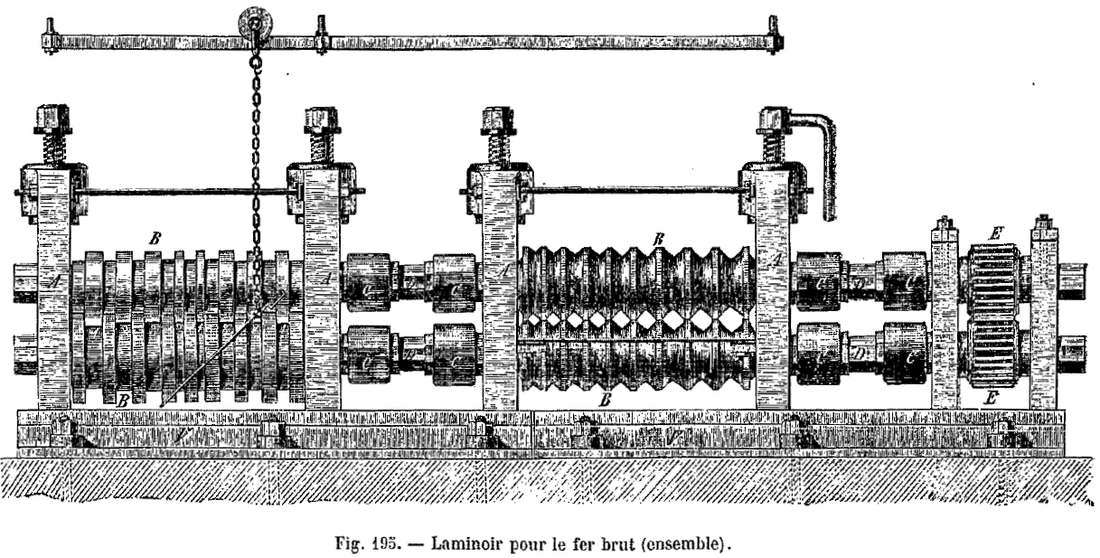
A pair of rolls does two jobs, and every mill of the period was arranged around them. Bauerman gives the two ways of making the piece smaller: set the rolls closer together, or pass the piece through grooves that diminish in size, or both (Bauerman pp. 299-300).
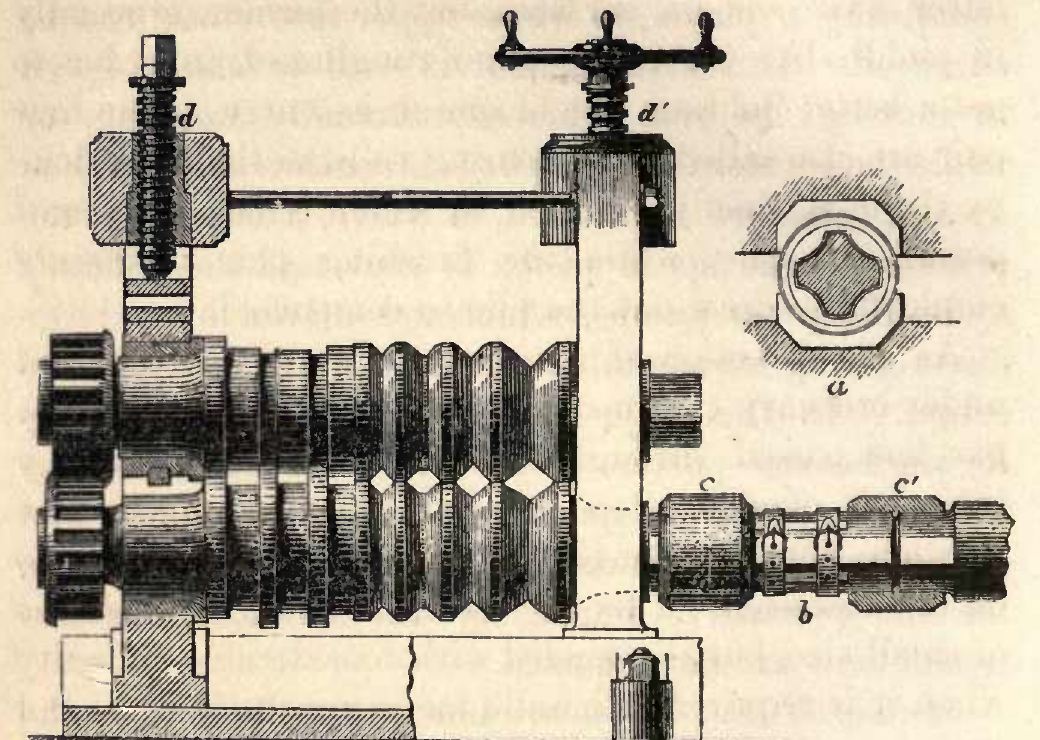
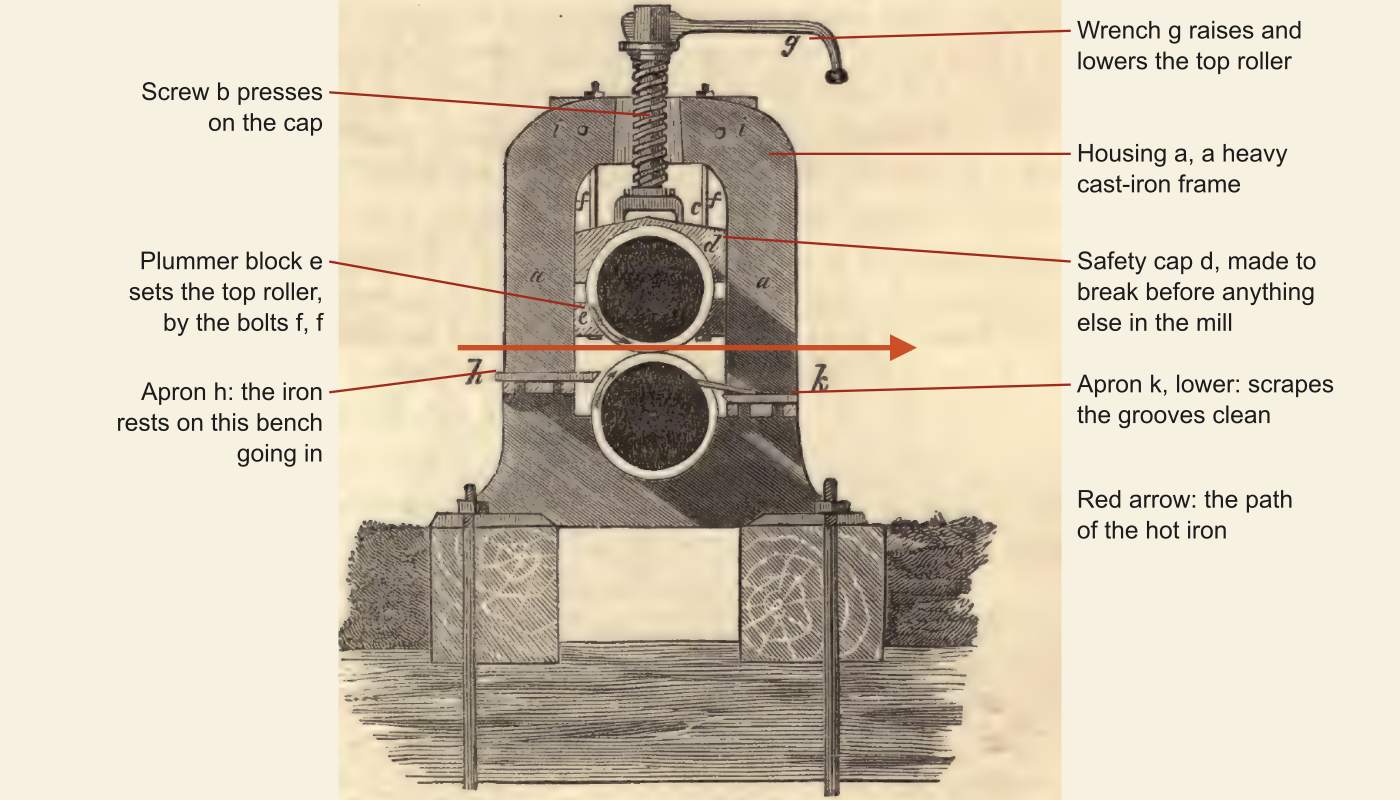
The surface of the rolls differed by job. Plate rolls were smooth, and bar rolls were grooved (Bauerman p. 299). Roughing rolls in puddle-bar trains were often roughened to get a better hold on the bloom as it entered (Bauerman p. 301), and a first groove too narrow to "catch" a pile was, for Overman, one of the worst of false economies (Overman p. 360). The whole trade rested on that grip: the rolls can only pull in what friction can take hold of. A pass that asks for too much reduction skids.
Roughing: the bloom to a billet
The bloom came straight from the hammer or squeezer to the roughing rollers (Overman p. 344), which did most of the condensing and drawing of the iron (Overman p. 346). Their grooves were neither square nor round but between the two.
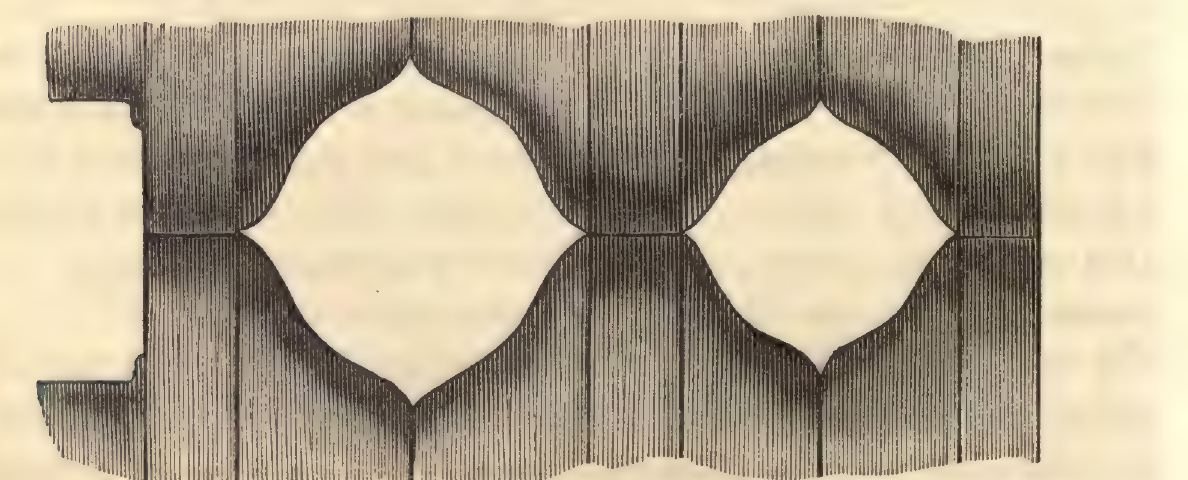
Truran says why the turn was needed. The rolls compress only vertically and have no power laterally, so the pile is turned at each succeeding groove and the side that was horizontal becomes the one under pressure (Truran p. 233). The difference in section from one groove to the next was called the draught (Truran p. 233).
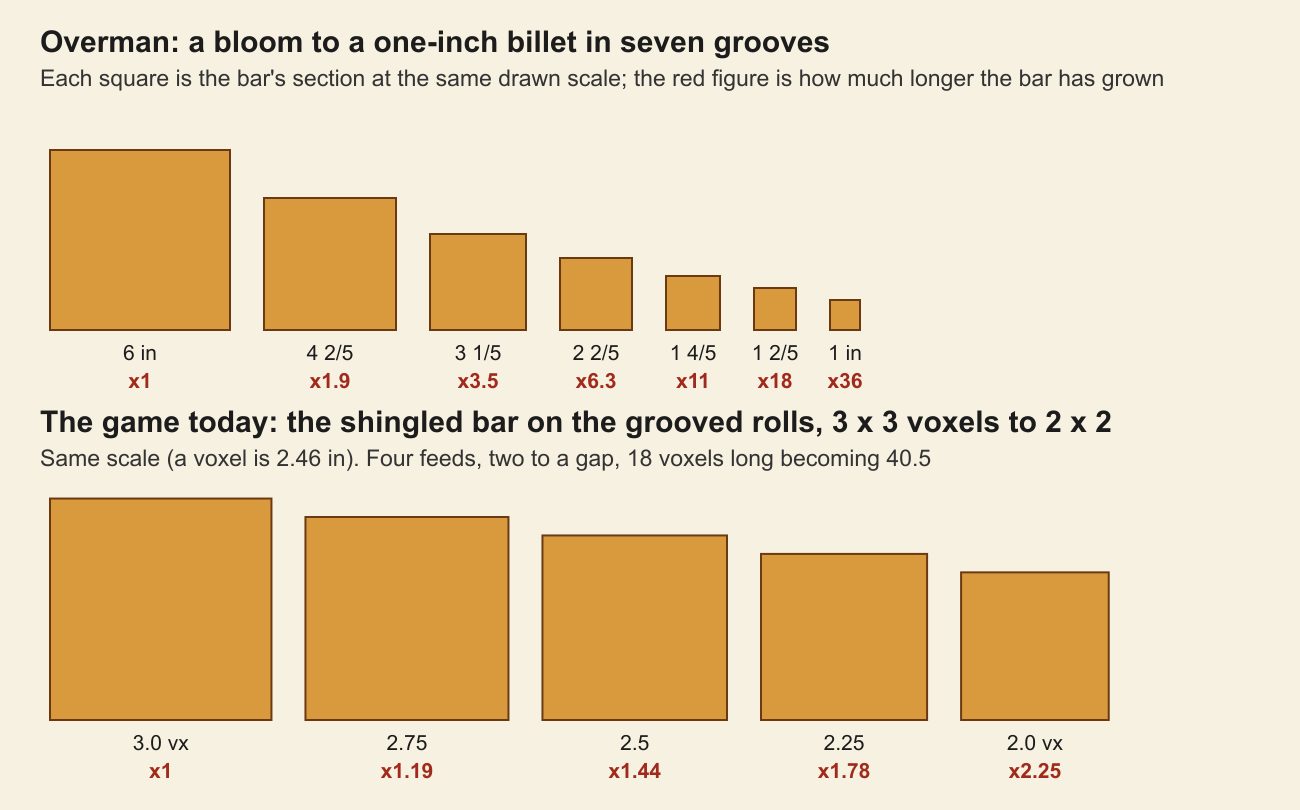
Overman gives the draught as a rule of proportion. From one groove to the next the sides stand as 15 to 11, so the area falls to nearly one-half and "the original length of the bar is nearly doubled in each groove" (Overman p. 347). Soft puddled iron and good strong rollers would stand that. Hard iron would not, and charcoal iron worked with difficulty, so the rule became 15 to 12 with more grooves (Overman p. 347).
Flat bars, rods and finishing
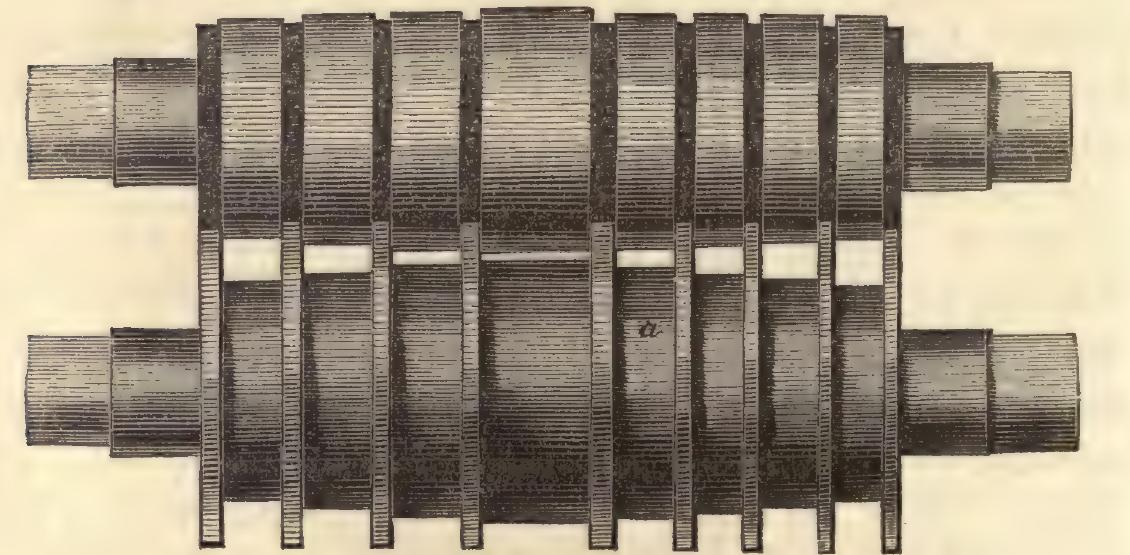
From the billet, flat bars came from a second set of rollers with flat grooves, fourteen inches across in Overman's example (Overman p. 348). Collars stand between the grooves, an inch and a half thick in his example (Overman p. 348). His first flat groove takes the square bloom and is the narrowest and highest. As the grooves diminish in height they increase in width (Overman p. 348).
A square bar was finished by going two or three times through the last groove, turned a quarter each time (Truran p. 233). A round bolt passed five or six times through its last groove, a man holding the end in heavy tongs to stop it rolling over on its side (Truran p. 233). The finished bar went to the cropping shears, or for the larger sections to a saw (Truran p. 235).
Between passes the bar had to come back. Rolls turned one way, so after each groove the bar was lifted over the top roll and fed into the next one smaller (Bauerman p. 301, Truran p. 235). Reversing the rolls was tried and Truran doubted it paid (Truran p. 235). Three rolls stacked one above another solved it for small iron, the bar passing forward between one pair and back between the other (Overman p. 354, Bauerman pp. 301-302). The lifting cost time, and time cost heat and scale (Bauerman p. 301). A rail pile that went cold half-rolled was the worst loss at the roughing rolls: too long to go back in the furnace and too thick to cut (Overman p. 360).
Plate went another way. It was rolled on smooth chilled rolls, passed sideways and then endways so the grain did not all lie one way, and the roller chose his directions to bring out the size ordered (Truran p. 238). See making boiler plate.
What the game keeps of it
The game keeps the shape of the job: hot iron, narrowing gaps, and a piece that gets longer each time and has to be walked back. It keeps the friction limit as the one real rule. It leaves out the hands.
A pass in the game is a feed. The piece goes in on the deck and through the rolls, the player carries it back around the stand, and the next feed goes in. A gap is reached in two rounds, so the piece comes through at a half-step first. Roll families are items the stand takes in turn: flat, grooved and wide flat, as the period mills had separate sets for squares, flats and plates (Overman pp. 347-348, 354). Only the wide set has a screw; on the others the groove fixes the gap, and the stand offers a gap by where you feed it.
The bite is the game's friction rule, a plain piece of physics: the deepest a pair of rolls can take is the square of the friction times the roll radius. Hot iron grips and cold iron does not, thirty times less by that sum, so a cold piece will not enter at all. That is the catching Overman worried about, turned into a number: it is what stops a player skipping a gap, and why a schedule needs a reheat furnace beside the mill. A piece cools whether or not it is moving, so a mistake gets worse while it is being fixed.
Under all of it the game measures iron by volume, so what the rolls take from thickness they give to length or width. A rolled product is the piece's own volume cut to the right geometry at the shear, and this is why one bar makes four rods.
Period basis, and what is the game's own
- Period: rolls grooved for bar, smooth for plate, gap and groove together setting the size (Bauerman pp. 299-300). The game has flat, grooved and wide flat sets.
- Period: the bar was lifted over the top roll after each groove, and the time cost heat and scale (Bauerman p. 301, Truran p. 235). The player carries the piece back round the stand, and it cools on the way. Designed but not built: the wide hall stands mills in a row on one shaft, so a piece moves forward from stand to stand.
- Period: a quarter turn between grooves to work every side (Overman p. 346, Truran p. 233). The game's grooved pass keeps the bar square, and the turn is left out: the two rounds of a gap stand in for it.
- Period: the mill built with a part made to break first (Overman p. 350, Bauerman pp. 302-303). The game's stand has no breaking spindle or safety cap.
- Period: a two-high train for heavy work and three-high for small iron (Overman pp. 354, 358). The game's stand is two-high.
- The game's own: on the flat rolls, length holds and the iron goes into width, up to the width of the barrel. The rolls of the period compressed vertically only, exercising no power laterally (Truran p. 233), and the bar lengthened. The flat rule keeps a plate's length and width on a whole grid.
- The game's own: every gap is exactly half a voxel less than the last, so a gap costs the same two rounds everywhere.
- The game's own: the skill is the schedule and the walking. There is no roller's eye, no tongs work, no holding a bar upright. Nothing is spoiled by a bad pass; it only refuses, and iron goes in and comes out to the unit. A planned mill scale, a small loss per pass that goes back to the fettling stock, is the one exception.
- The game's own: a mill today can only be reached in creative, as no roll set has a recipe yet.
The numbers
Reductions are read off the books and the design pages at true size, and game sizes convert at 62.5 mm a voxel (scale and units, how we scale). "Planned" is what the design holds and the game has not built.
| In the game | Period figure | How it was scaled | Game value |
|---|---|---|---|
| Area per groove, roughing | Sides 15 to 11, area nearly one-half; hard iron 15 to 12 (Overman p. 347) | The game's own ladder of half-voxel gaps | 3.0 to 2.5 voxels, area to 0.69; 2.5 to 2.0 voxels, area to 0.64, the same 15 to 12 |
| Groove series | 6 in to 1 in square in seven grooves; bar length 36 times (Overman p. 347) | The game's own | Shingled bar 3 x 3 x 18 to 2 x 2 x 40.5 voxels, four feeds, length 2.25 times |
| Draught taken in one feed | Not given | Half of one gap | 0.25 voxel (15.6 mm), a half-step |
| Deepest bite | Not given; a groove must "catch" (Overman p. 347) | Friction squared by roll radius, the game's own | Hot 0.36 voxel, cold 0.0121 voxel |
| Rolling heat | None given, "too cold" (Overman p. 360) | The game's own | 900 C and above |
| Bar stock entering | Bloom about 6 in square (Overman p. 347) | Whole voxels | 3 x 3 voxels (7.4 in) today |
| Roll across | 14 in flat rollers (Overman p. 348); 15 to 18 in, roughing (Overman p. 350) | True size to the voxel | 8 voxels, 19.7 in |
| Barrel | Merchant seldom over 3 ft (Overman p. 354); roughing to 7 ft (Overman p. 347); plate 4 and even 5 ft (Overman p. 366) | True size to the voxel | 16 voxels, 3.3 ft; planned wide barrel 24 voxels, 4.9 ft |
| Speed | 30 to 40 rev a minute, roughing (Overman p. 349); 45 to 50 average on best iron (Truran p. 235) | Not modelled as a period figure | Set by the drive |
| Planned bar | Rough bars from 2 to 6 in wide, 1/2 to 3/4 in thick (Overman p. 347) | Whole voxels | Planned 2 x 0.5 x 20 voxels (merchant) and 4 x 0.25 x 20 voxels (plate bar), one bloom to one bar |
Open, and what you can tell us
The books here give no rolling temperature as a number, only iron going too cold, and none gives a bite in figures; the game's 900 C and its friction values are its own. Overman's 15 to 11 is one American's rule from the 1850s. If you know a source with the draught British mills actually took per groove, a measured rolling temperature for wrought iron, or how many grooves a Welsh or Staffordshire billet really went through, we would like to read it.
Picture credits
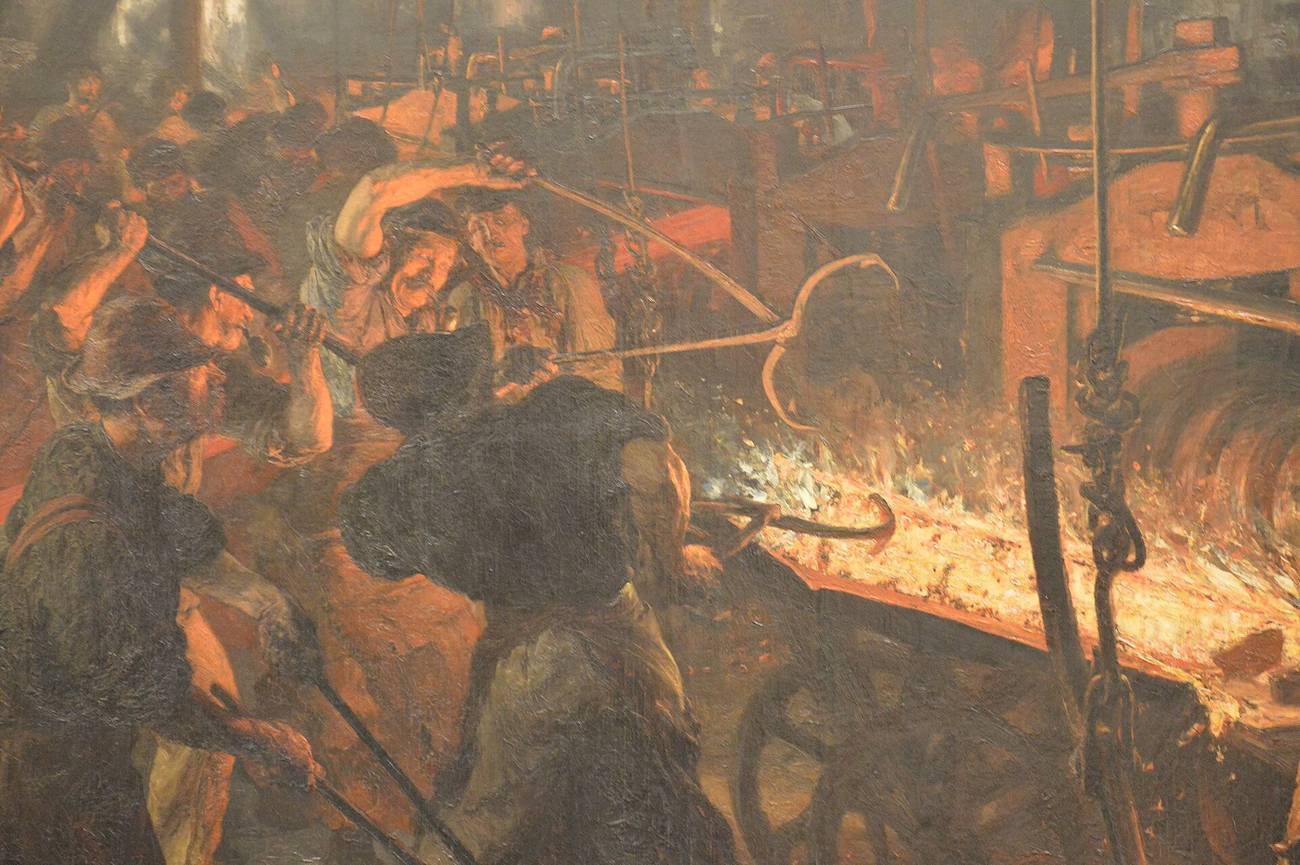
- Adolph Menzel, The Iron-Rolling Mill, 1872-1875 (detail): Adolph von Menzel, public domain.
- Rolling mill for puddling, Fig. 195: Adolf Ledebur, Manuel de la metallurgie du fer, tome 2, page 282, public domain.
- Fig. 32: Bauerman, A Treatise on the Metallurgy of Iron, p. 300, Library page.
- Figs. 105, 106 and 107: Overman, The Manufacture of Iron, pp. 346, 348 and 349, Library page. Fig. 107 labelled for this site from his pp. 349-351.
- Seven grooves: drawn for this site from Overman p. 347 and the game's roll schedule.
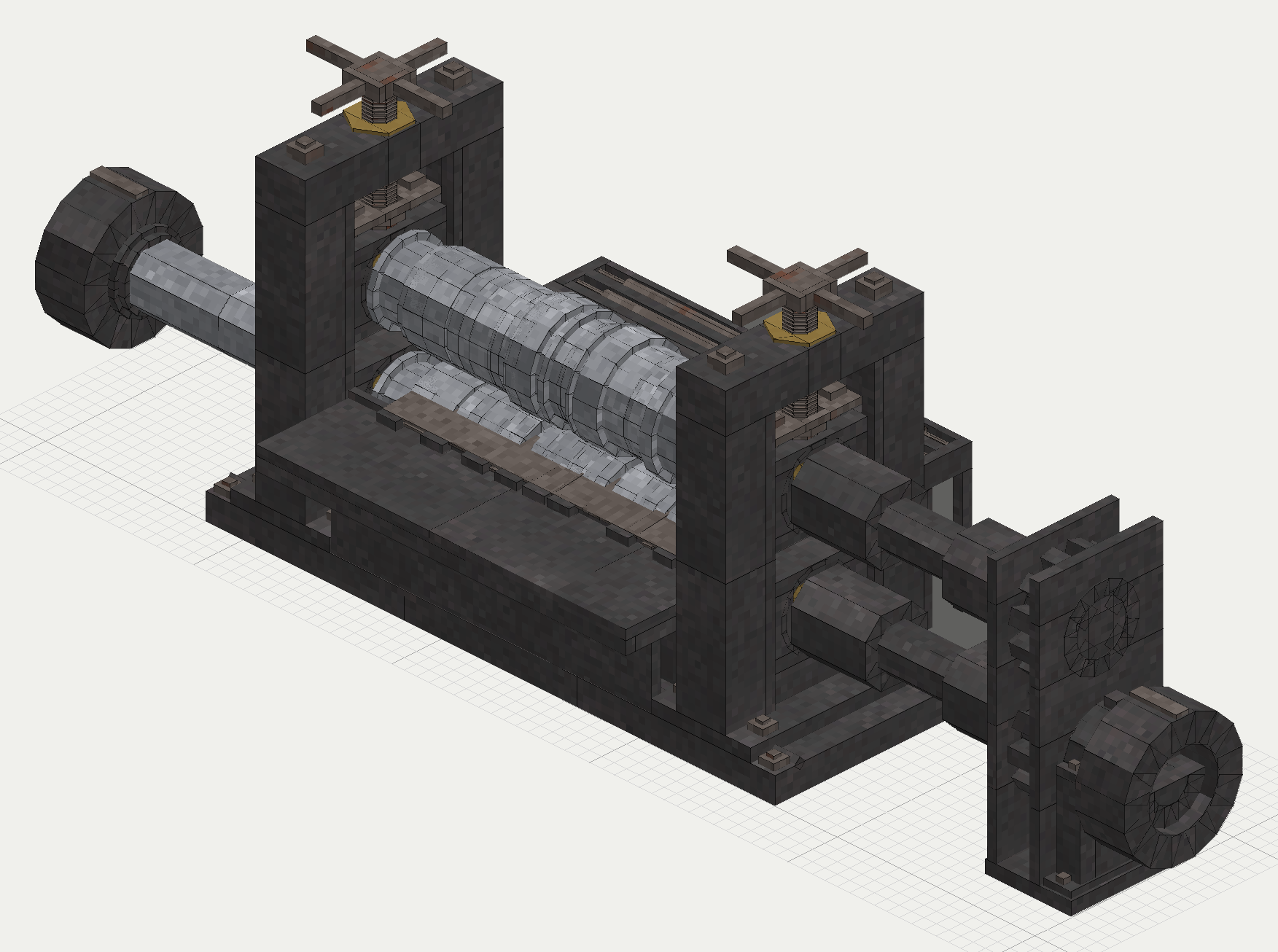
- The game's rolling mill: the mod's planned drawing.
Comment or suggest something in the Expanded thread on the Vintage Story Discord