
Ore crusher
A jaw crusher is a pair of iron jaws set in a V, one of them rocked a fraction of an inch by a very stiff linkage. Stone goes in at the wide end and comes out at the narrow end in pieces no bigger than the gap. The game plans one as a powered machine for the ore yard; it is not built yet. What crushed ore does in the furnace is in the burden guide. This page is about the real machine and how the game's follows it.
Why ore was broken at all
Ore comes out of the ground in every size from dust to boulders, and a furnace wants one size. Bauerman's reason is regularity: all charges of ores and fluxes should be "reduced to fragments of nearly uniform dimensions", the size proportioned to the height of the furnace and how readily the ore reduces (Bauerman p. 103). Large furnaces took blocks of 4 or 6 inches on a side; big pieces suit tall furnaces, where the slow descent gives the heat time to reach the middle, and small pieces pack close and resist the blast (Bauerman p. 103). For roasting, Overman asks for "two or three inches", since large pieces do not take heat and oxygen through their whole body so soon (Overman p. 40). See iron ore and the calcining kiln.
Dust is the enemy on the other side. Bauerman finds stamps objectionable for iron ore except on very hard ores, because they pulverise and make a larger share of dust (Bauerman p. 104). So a good breaker is one that makes the piece small enough, once, and lets it fall away.
Before the machine
By hand the work went in two steps. Rock was ragged with a sledge of about 12 lb, and where there was no breaker it was spalled with 3 lb hammers to the size of road metal (Hunt p. 716). Machines existed for the next stage down: roller crushers, tilt hammers and stamps (Bauerman p. 104). At Finspong in Sweden a tilt-hammer of 60 blows a minute broke 15 to 16 cwt an hour of ore already roasted (Bauerman p. 104). At Eisenerz a single pair of 18 in rolls broke roasted spathic ore (Bauerman p. 104). Rollers wanted a soft ore, and roasted ore suited them better than raw (Bauerman p. 104).
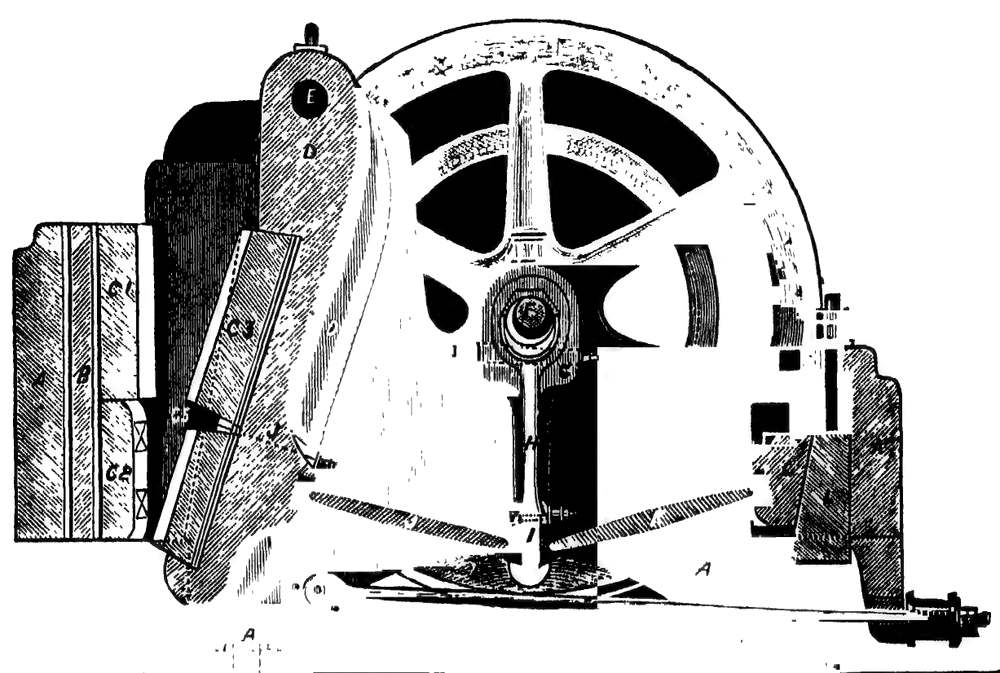
The jaw machine is Blake's, patented in America in 1858 (Hunt p. 694, US patent 20,542). Hunt, writing for British mines, says later makers changed its parts but all "failed in devising a machine capable of superseding the main part of Blake's invention" (Hunt p. 694). In California it had almost universally replaced roller crushing since 1861 (Encyclopaedia of Chemistry p. 75). Bauerman's treatise has it at an iron works by 1870: at Kirkless Hall near Wigan a machine with a 20 in face, taking stone up to 7 in thick and turning 200 to 250 times a minute, broke red hematite and limestone for the furnaces at 10 to 12 tons an hour, to pieces of about 1 1/2 in (Bauerman p. 105). The furnace at Greenwood near Marquette put all its materials through one before charging (Bauerman p. 207).
What it did better than a hammer
Hunt compares the two. A spalling hammer breaks stone mostly along its joints and leaves its texture alone. The machine "crushes up the rock irrespective of joints or faces" and so spoils its toughness, and the rolls or stamps after it do more work and wear less; it also makes three tons of fine sand where the hammer makes one (Hunt p. 716). That last is wanted before dressing and is a loss before a furnace, which is why the setting of the gap mattered. At Peden-andrea a tin mine reckoned 6 1/10d a ton by hand against 3 3/4d by a 20 x 9 in breaker (Hunt pp. 716-717).
The jaws are the part that wore. They were double-chilled iron; a bad pair would not break 300 tons of stone and a good pair broke 2,000 to 3,000 tons of siliceous veinstone (Hunt p. 718). Bauerman has the lower corners of the swing jaw often broken off on the hard slaty hematite of the Marquette district (Bauerman p. 106).
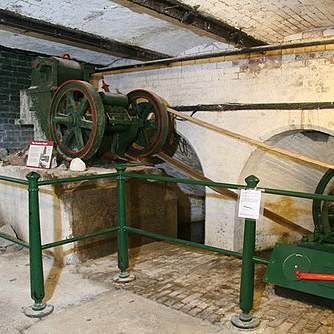
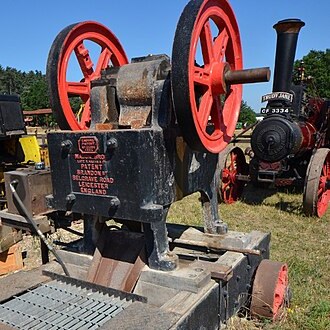
The strain is why the flywheel is there. The jaw only works for half of each turn, and all of it comes at the bite. Blake's own machine carried one wheel of four feet and 750 lb (US patent 20,542); the two surviving machines above have two.
How it was run
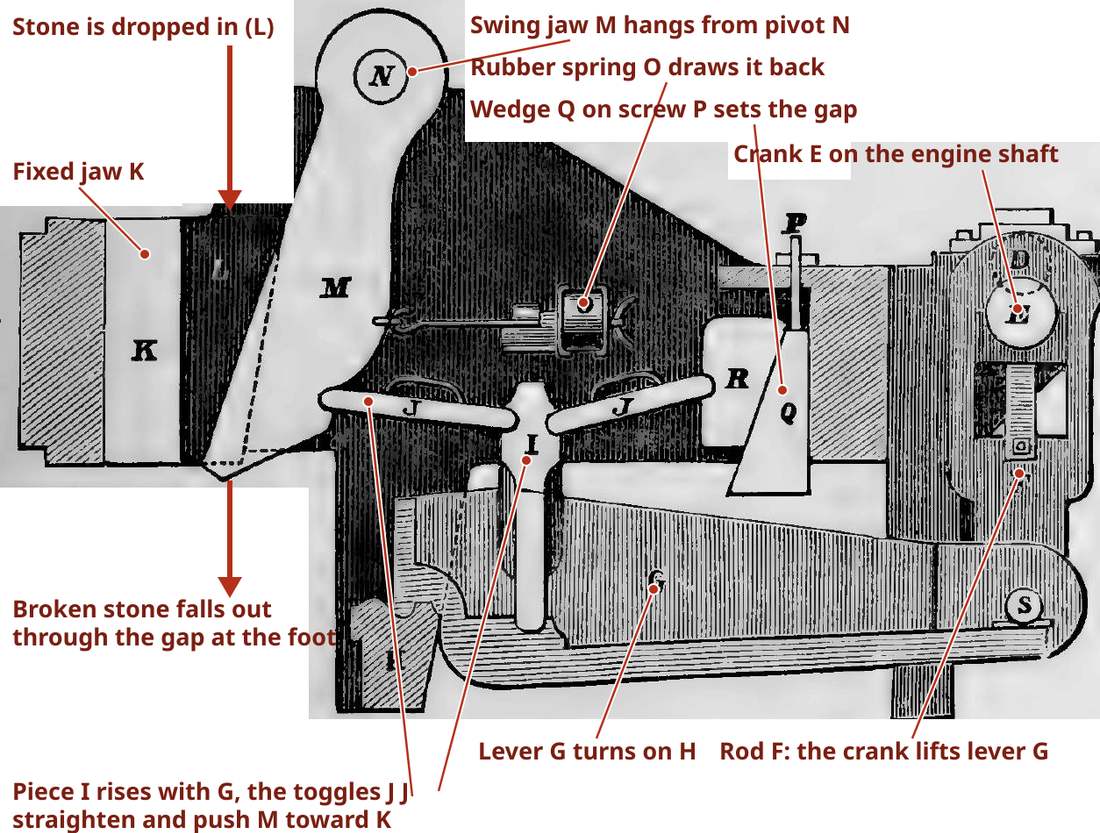
The size of the mouth names the machine and fixes the largest stone it can take (Hunt p. 717). The gap at the foot sets the product: the wedge L on Marsden's machine goes up or down at the will of the user and thereby "reducing or increasing the opening of the jaw at the bottom" (Hunt p. 719), and longer or shorter toggles change it further. Set at 2 to 2 1/2 in it delivers pieces three to four times smaller than hand-spalling (Hunt p. 717). The eccentric shaft runs best at 200 to 250 turns a minute (Hunt p. 717).
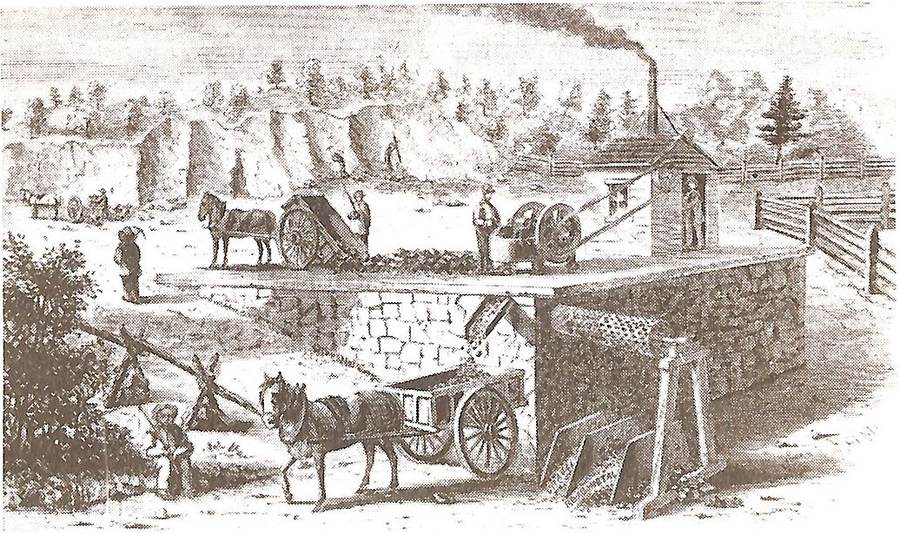
At Peden-andrea the stuff came on a raised tramroad, was shot over a grating to take out the small pieces, and was shovelled into the hopper; the broken stone fell to the floor beneath (Hunt p. 717). Elsewhere it was tipped straight on a slide and went through without a shovel (Hunt p. 717). The aim was to make dressing automatic (Hunt p. 717), and the staging in the engraving at the top of this page is that same aim at a quarry.
Period basis, and what is the game's own
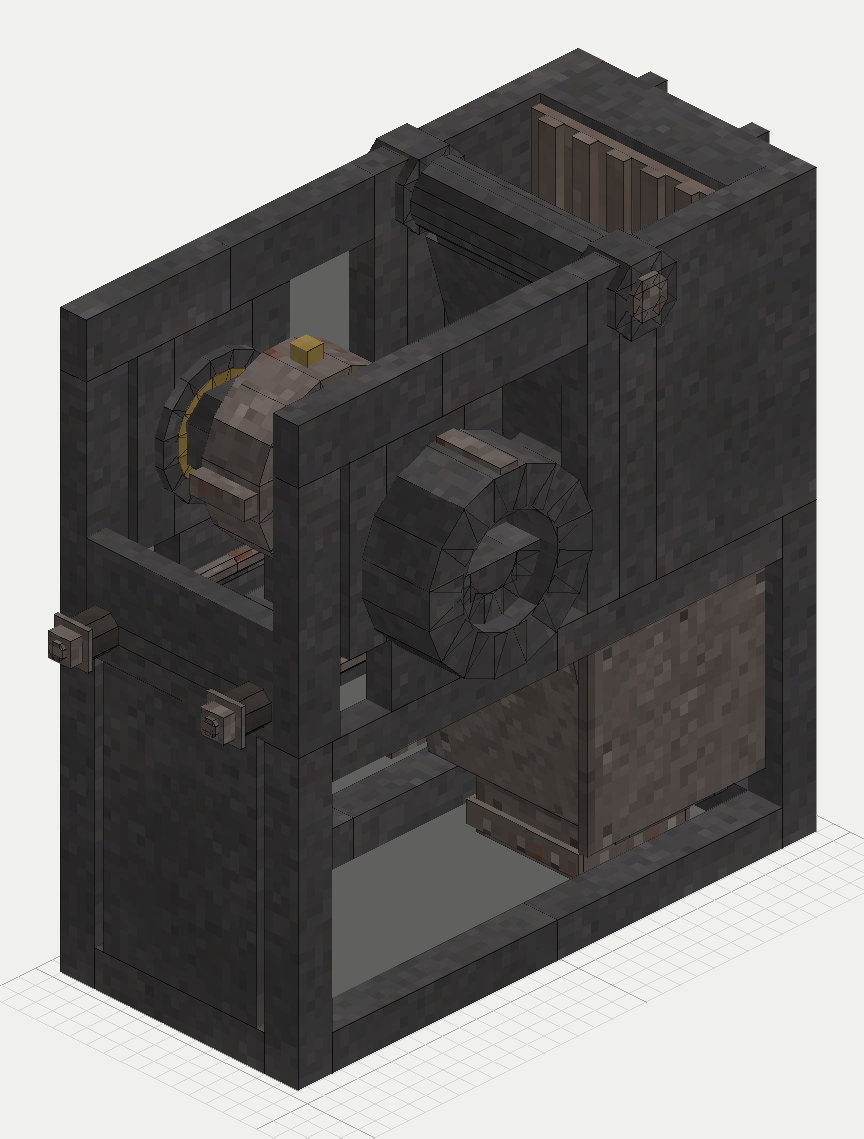
- Period: a fixed jaw and a swing jaw in a V, worked by an eccentric through a toggle joint (Hunt pp. 718-719, Encyclopaedia of Chemistry p. 75). The game's drawing keeps this linkage, the ribbed jaws and the rear toggle seat, and it moves in its animation.
- Period: the machine was belt-driven from the works' engine (Hunt p. 718). The game takes that form: the crusher is a load on the line shaft, with the line shafting and engines the player already has.
- Period: a flywheel on the shaft carried the bite (US patent 20,542). The game keeps this as the machine's lesson: the load comes in pulses, the wheel carries it, and a crusher with no flywheel on a weak wheel stalls on every rock. The flywheel is the separate block on the shaft.
- Period: broken stone falling away to a lower floor (Hunt p. 717). The game's line is bin, chute, crusher, chute, bin, with the crusher standing in a pit of its own lower storey, so the mouth is near the floor to feed from a chute or by hand.
- The game's own: hard ore is an energy threshold. An ore too hard for the speed the shaft is turning does not break. No book gives such a threshold; the books only record that hard ore broke the corners of the jaw (Bauerman p. 106).
- The game's own: the crusher is never the only route. The base game's pulverizer goes on working and also breaks limestone, chalk and marble for flux; the crusher does the same work faster. See vanilla against reality.
- The game's own: jaws do not wear, the gap cannot be set, and the machine does not screen or sort what it breaks.
The numbers
The crusher's throughput is not settled: the energy per unit of each ore waits for the game's power figures. These are the drawn sizes, at true scale (scale and units), and the planned yields; see also how the numbers are scaled. All of it is planned.
| In the game | Period figure | How it was scaled | Game value |
|---|---|---|---|
| Mouth | 24 x 13 in machine, 10 nominal hp (Hunt p. 718) | Whole voxels at true size | Planned 11 x 5 voxels, about 69 x 31 cm (27 x 12 in) |
| Gap at the foot | 2 to 2 1/2 in (Hunt p. 717); pieces of about 1 1/2 in at Kirkless Hall (Bauerman p. 105) | Drawn | Planned 0.75 voxel, about 4.7 cm (1.8 in) |
| Angle of the jaws | Not above 18 degrees (US patent 20,542) | Drawn inside the patent's limit | Planned 15.9 degrees |
| Movement at the foot of the jaw | 1/2 in (Hunt p. 719) | Exaggerated so it can be seen | Planned 1.2 voxels, about 7.5 cm |
| Eccentric speed | 200 to 250 turns a minute (Hunt p. 717) | Not used; speed follows the load on the line | Planned, load-driven |
| Output | 200 cwt on a 20 x 10 in machine at 200 turns (Hunt p. 718; his table names no time, and Kirkless Hall's 10 to 12 tons an hour fits it read as hourly) | Waits for the power figures | Open |
| Crushed ore per lump | None | The game's own | Planned 6 for oolitic ironstone and clay ironstone nodules, 12 for massive hematite |
Open, and what you can tell us
The books at hand give a machine at Kirkless Hall by 1870 and say nothing of when iron works in general gave up hand breaking; the date that matters to an ironmaster is not in them. Blake's patent of 1858 holds the jaw at its lower end and swings the top, and the later books pivot it at the top and swing the foot. No book here says when that changed. If you know a works' records or a catalogue that dates either, we would like to read it.
Picture credits
- Demonstration of Blake Stone Crusher, about 1875: Department of Commerce, Bureau of Public Roads, copied from the November 1938 issue of Civil Engineering, page 786, public domain, cropped.
- Etruria Industrial Museum, jaw crusher: Chris Allen, CC BY-SA 2.0, cropped.
- Weeting Steam Fair, Blake stone crusher: Ashley Dace, CC BY-SA 2.0, cropped.
- Blake's Rock Breaker, Fig. 13: Encyclopaedia of Chemistry, p. 75, Library page, labelled for this page.
- Marsden's stone-breaker, Fig. 193: Hunt, British Mining, p. 719, Library page.
- The game's crusher: the mod's planned sketch drawing.
Comment or suggest something in the Expanded thread on the Vintage Story Discord