
Cast and wrought iron
Cast iron and wrought iron are the two irons a nineteenth-century engineer built with, and each did the work the other could not. One was poured to any shape and snapped under a pull. The other could not be poured at all, and it held a pull, bent before it broke, and could be welded to itself. How each is made in the game is in the iron grades guide. Where they sit among the other metals is on the metal ladder. This page is about what makes them different and what each was used for.
One element, two materials
Iron "is employed in the arts under three several states", and the differences are "mainly due to differences in the quantity of carbon present" (Bauerman p. 3). Cast iron holds between 2% and 6% of it, and is "a hard and comparatively brittle substance" that melts and can be moulded (Bauerman pp. 3-4). Wrought iron holds never more than 0.25%, and is soft and tenacious, "infusible" in an ordinary furnace, and joined by welding at a white heat (Bauerman p. 4).
The carbon does two separate things to a cast iron. Where it stays combined with the iron, as cementite, it makes the metal hard. Where it comes out as graphite, it lies in the metal as a soft separate substance. Campbell gives both effects in one passage: more graphite leaves more soft ferrite, "with a toughening of the mass", yet "in reality the graphite weakens the iron by destroying its continuity" (Campbell p. 84). A cast iron is a hard body full of breaks that were there before any load came. Under a push those breaks close, and under a pull they open. That is why the same metal can be strong in one direction and weak in the other.
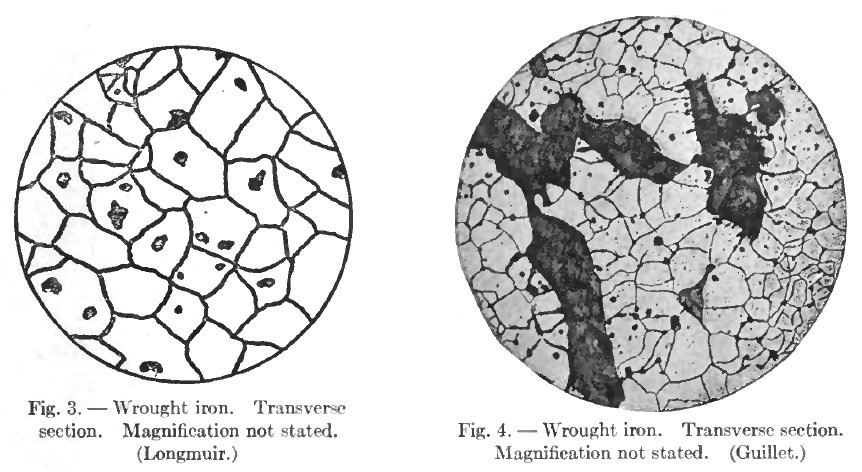
Wrought iron is a different thing, and it comes by a different route. In a puddling furnace the carbon and the other elements burn away, the metal "becomes viscous, then pasty, and finally is worked into balls", and these are hammered or squeezed into a bloom (Campbell p. 85). It never melts. The ball is "an innumerable number of globules of nearly pure iron, while the interstices between the particles are filled with slag", and rolling never gets all of it out. The slag "forms a skeleton which permeates the finished bar" (Campbell p. 85). The 1876 committee that tried to fix the names called such metal "weld iron", because it was "aggregated from pasty masses" and never from a fluid state (Campbell p. 92). See puddling.
Fibre, and what a broken bar shows
Fairbairn describes both the metal and the way a smith read it. Every iron "is crystalline in the first instance", and "these crystals, by every succeeding process of hammering, rolling, etc., become elongated, and resolve themselves into fibres" (Fairbairn Iron p. 269). Broken slowly by bending, the fibre draws out "in the shape of threads as fine as silk" (Fairbairn Iron p. 268). Snapped by a sharp blow, the same bar breaks short and looks crystalline (Fairbairn Iron pp. 268-269).
So a bright grainy break in wrought iron was a bad sign, and an argument. Fairbairn records the claim that fibrous iron turned crystalline in service, from percussion, heat and magnetism, and reports the broken axle in the Versailles railway accident as an example. He doubts that all those causes are needed, and blames the blows and the vibration (Fairbairn Iron pp. 236-238). The cause was disputed in his day, and the books here leave it open.
The quality of a bar was not decided by carbon alone. Fairbairn names two kinds off the forge and rolling mill: "red short", the ductile, "tough fibrous material", and "cold short", brittle, with a crystalline fracture "almost like cast-iron" (Fairbairn Iron p. 236). Phosphorus was the impurity known to make iron cold short (Fairbairn Iron p. 268). Some carbon does the same: Fairbairn reports a plate with 0.23% of it, equal to the best plates in tension and compression, as far worse under impact (Fairbairn Iron p. 268).
Why cast iron was still everywhere
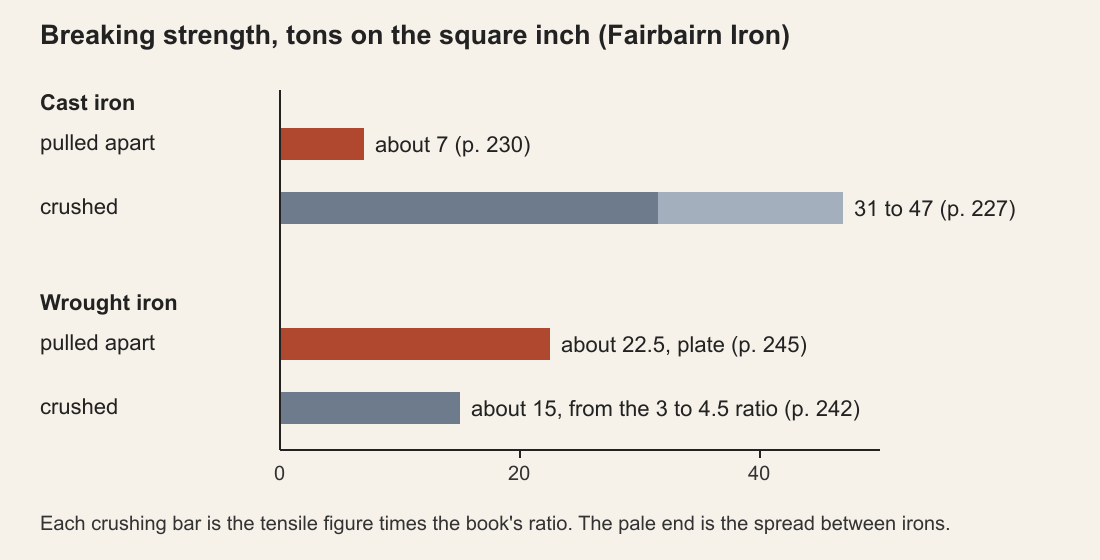
Breaking under a pull did not make cast iron a poor material. It melts readily and takes the shape of its mould (Bauerman pp. 3-4), so it needs no hammer. Fairbairn's tables put its tensile strength at about 7 tons on the square inch (Fairbairn Iron p. 230), and, in Hodgkinson's series, its crushing strength at 4.5 to 6.7 times that, depending on the iron (Fairbairn Iron p. 227). A column, a base, a bed or a wall plate all load it in the direction it likes. A beam is harder: its underside is pulled. By plain mechanics a cast beam wants its most metal on the lower side, the opposite of the wrought girder above, and the game's has its deep flange there. Fairbairn's tables test bars, and proportions for a period cast beam were not found in the books searched.
It also breaks by repeated knocks. In the Commission on Railway Structures' trials, no cast bar struck hard enough to bend it through half of its breaking deflection stood 4000 blows (Fairbairn Iron p. 238). Cast shot broke against a thick wrought plate and lost much of its energy doing so (Fairbairn Iron p. 230).
Pouring has troubles of its own. A casting shrinks as it cools, the thin parts first. Bolland warns that designers often ignore it (Bolland p. 76), and his pages on shrinkage are a catalogue of warped lintels and crooked columns, each with the thickness that keeps it straight (Bolland pp. 83-85). Columns "are often made with heavy mouldings, and bases cast on them", and he calls that dangerous, because such castings "have separated at places where abrupt changes have occurred in the outline" (Bolland p. 85). A casting holds strains from its own cooling before any load is put on it.
Why wrought iron went where it went
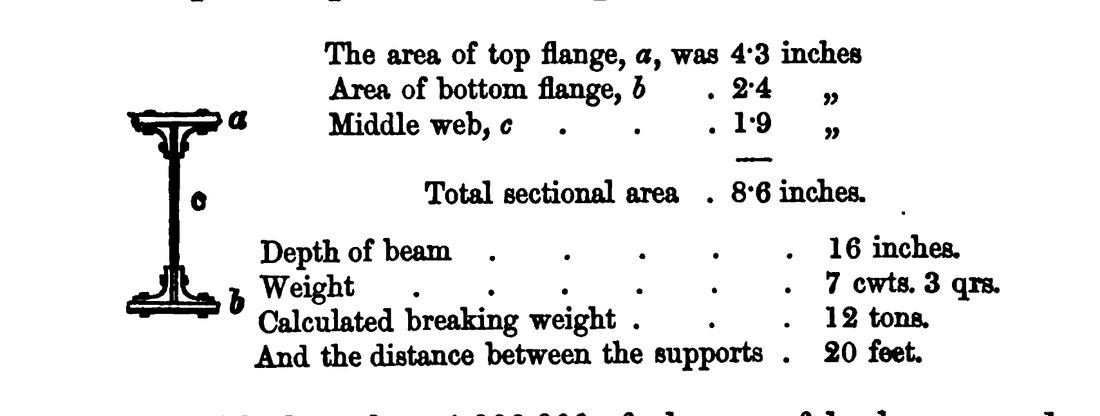
Wrought plate tears at about 22.5 tons on the square inch along the fibre, and 23 across it (Fairbairn Iron p. 245), so a plate has about the same strength either way. In a girder it is the top that needs help: wrought iron in compression stands to tension "as about 3 to 4.5", and Fairbairn's own beam carried nearly twice the metal in the top flange (Fairbairn Iron pp. 240-242). Under the working limit the Lords Commissioners for Trade set, 5 tons on the square inch, which Fairbairn calls "an ample standard", a girder of his went through more than 3,000,000 changes of load (Fairbairn Iron pp. 240-242). Boiler plate is among the wrought irons in his tables (Fairbairn Iron p. 245).
What it costs is the work. A puddler's heat, a hammer and a mill sit between the pig and the plate, and each piece has to be welded or riveted to the next, because the metal cannot be poured.
Period basis, and what is the game's own
- Period: cast iron carries compression and fails in tension (Fairbairn Iron pp. 227, 230). The game keeps it as a rule of design: machine parts are cast only where loaded in compression. The period also cast parts that carried tension, and the game's rule is stricter than its practice. The planned Watt connecting rod is the one machine part cast against it, because the period cast it (Farey p. 498).
- Period: cast iron was poured and never forged (Bauerman pp. 3-4). In the game it cannot be forged, and a pig on a hammer only breaks. Every cast part comes from a mould.
- Period: wrought iron was never molten and was welded, not cast (Bauerman p. 4, Campbell pp. 85, 92). In the game it comes off the puddling furnace as a ball, and it can only be hammered and rolled. Rolled wrought stock is the base game's iron.
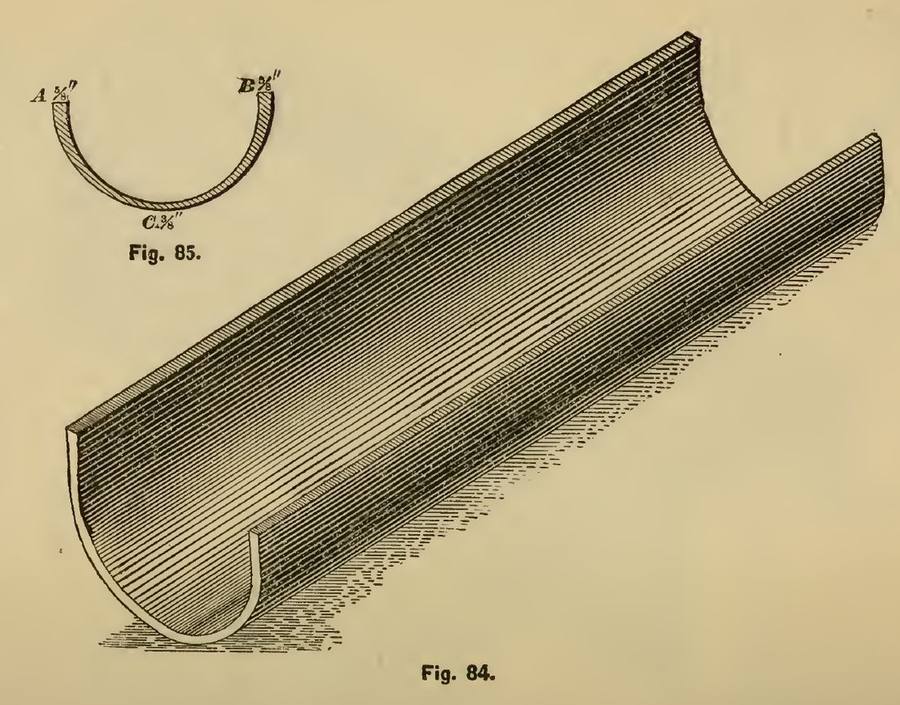
- The game's own: the cast beam, with its deep flange below, poured on its side and used as a building block. Its proportions follow from mechanics; Bolland's lintel (Bolland p. 84) has a deep web, and no book searched gives a period cast beam's section.
- Period: wrought iron went into boilers, ties and girders (Fairbairn Iron pp. 240-245). The game passes it for pressure work and boilers. Planned: a cast part and a riveted fabricated part as a pair for one job, a player's choice rather than a replacement. The shank ladle already has both routes.
- The game's own: neither iron has a strength number. A metal is accepted or refused by the machine that uses it, so the difference between the irons is a rule, not a stress calculation.
- The game's own: there is no red-short or cold-short iron and no fibre direction. Wrought plate behaves the same either way, which is close to Fairbairn's result for plate (Fairbairn Iron p. 245).
- The game's own: a cast part does not warp on cooling. A pattern for bored work carries a feeding head for its shrinkage, and that is the only trace of it.
The numbers
Strength is not simulated in the game: these are the figures behind the rule. "Planned" is in design and not built. See how we scale and scale and units.
| In the game | Period figure | How it was scaled | Game value |
|---|---|---|---|
| Cast iron, carbon | 2% to 6% (Bauerman p. 3) | Inside the period range | About 3.0% |
| Wrought iron, carbon | Never more than 0.25% (Bauerman p. 4) | Inside the period range | Under 0.1% |
| Cast iron in tension | About 7 tons a sq in (Fairbairn Iron p. 230) | Not a stat | Machine parts in compression only; the beam is a building block |
| Cast iron in crushing | 4.5 to 6.7 times its tension, by iron (Fairbairn Iron p. 227) | Not a stat | Machine beds and frames |
| Wrought plate in tension | Mean 22.5 tons a sq in with the fibre, 23.0 across (Fairbairn Iron p. 245) | Not a stat | Passes for pressure work and boilers |
| Wrought iron, compression against tension | About 3 to 4.5 (Fairbairn Iron p. 242) | Not a stat | None |
| Cast iron melts | About 1240 C at 3.0% carbon, read from the diagram (Campbell p. 312) | The game's own value, a little under the diagram | 1200 C |
| Puddled ball | No book weight used here | The game's own | 200 u |
Open, and what you can tell us
The books here give the strength of each iron and describe the fracture, but the explanation of why graphite weakens the metal comes only from the later ones, Campbell in 1907 among them. Fairbairn's tables test bars and plate, and no section of a period cast beam was found. If you know of a period test of cast beams in British practice, or a surviving broken bar with a dated origin, we would like to read it.
Picture credits
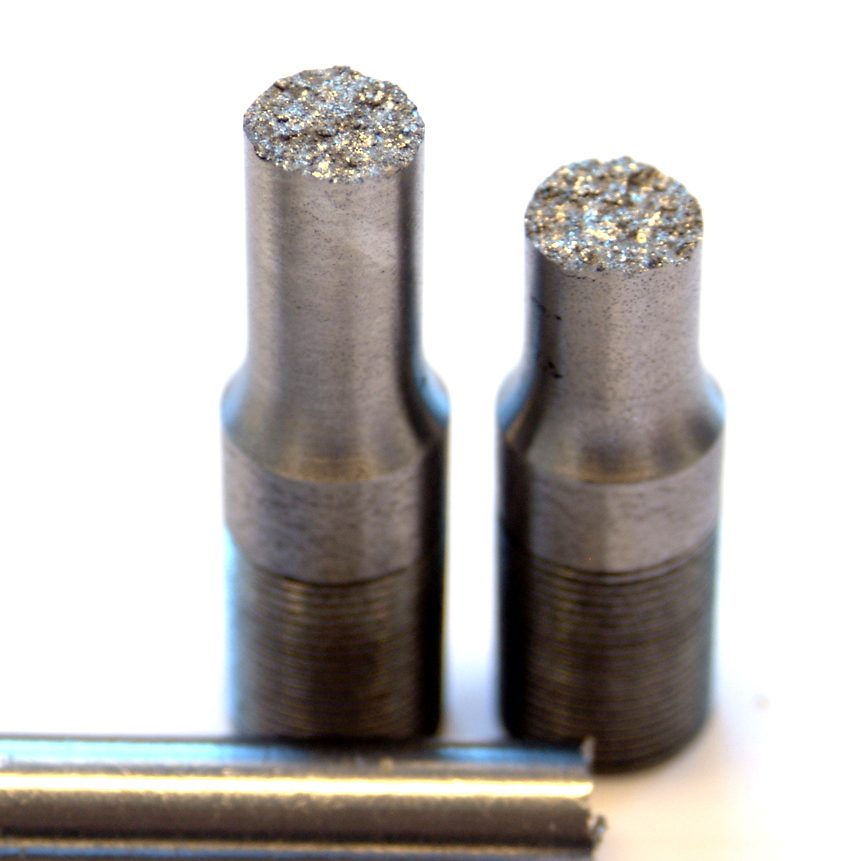
- Cast iron tensile test: Sigmund, CC BY-SA 3.0, cropped.
- Puddled iron, transverse section: Albert Sauveur, public domain.
- The strength of the two irons: drawn for this page from Fairbairn Iron pp. 227, 230, 242 and 245.
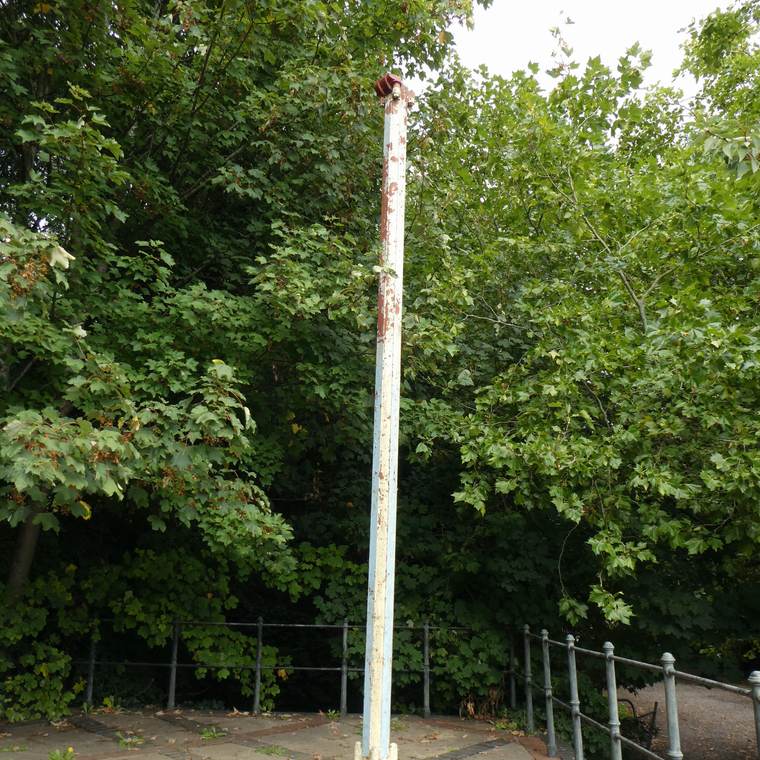
- Cast-iron column from the Crystal Palace, Bromley: Lrjlo, CC BY-SA 4.0, cropped.
- Beam section: Fairbairn, Iron, its History, Properties and Processes of Manufacture, p. 240, cropped, Library page.
- Figs. 84 and 85: Bolland, The Iron-Founder, p. 84, cropped and turned, Library page.
Comment or suggest something in the Expanded thread on the Vintage Story Discord