
Ironstone and roasting
Most of Britain's iron in the period did not come from bright ore veins. It came from dull grey stone lying in beds among shale and coal, at about a third iron, that had to be burnt before it was worth carrying to a furnace. How to prepare ore for the furnace in the game is in the burden guide. This page is about what the ores were, how they lay, and what roasting did to them.
What the ores were
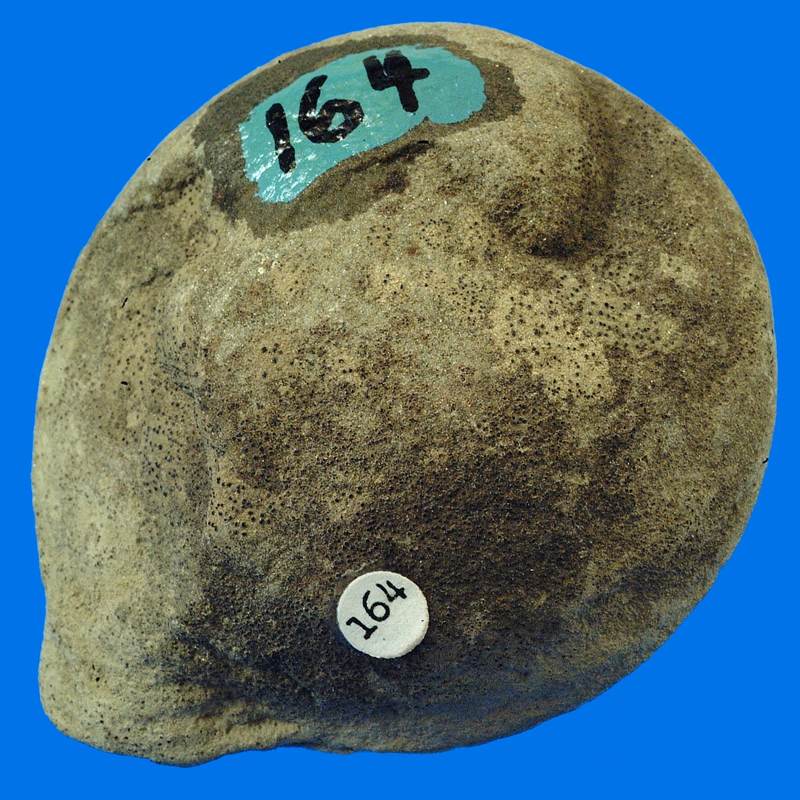
Truran sorts the ores of Britain by what comes with the iron: clay in the argillaceous ores of the coal measures, carbon in the carbonaceous ores of the same ground, lime in the calcareous ores, and silica in the red and brown hematites, the ores of the oolitic formation and the rest (Truran p. 1). The first two supplied the great works.
Pure iron carbonate is 48.22% iron, the rest being protoxide's oxygen and 37.93% carbonic acid (Bauerman p. 52). As raised it was far from pure. A rich Dudley stone was 37.7% iron and a stone nearer the Staffordshire average 29.3% (Truran p. 3); the South Wales seams averaged over 32% (Truran p. 2); Overman's figure is 30 to 33% (Overman p. 29). The name clay band or clay ironstone is the smelter's for this carbonate when it is shapeless and clayey, and black band for the kind carrying enough coaly matter to burn by itself (Bauerman p. 52).
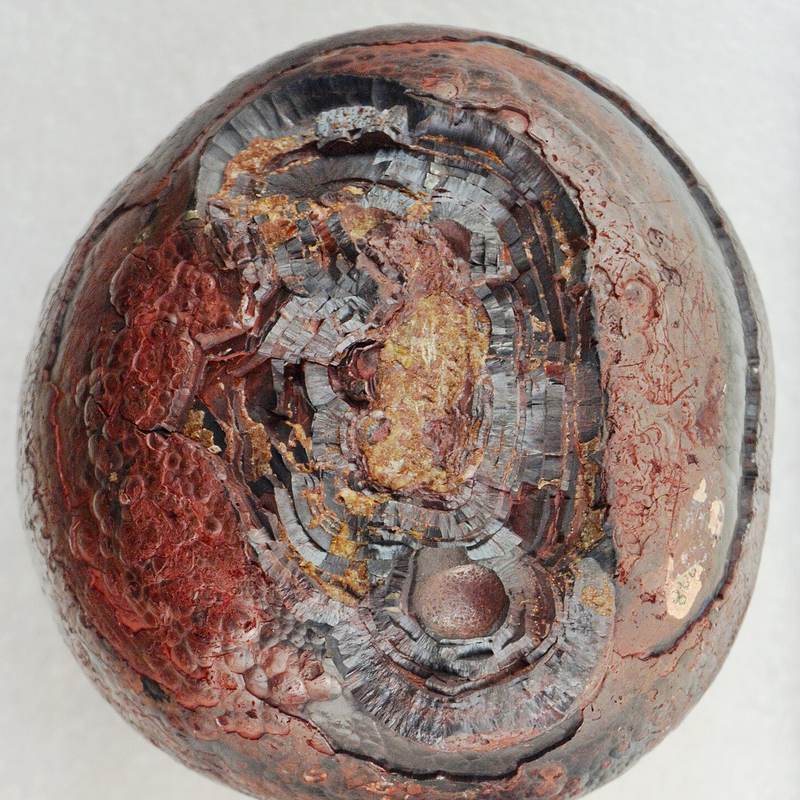
Hematite is another matter. A selected specimen was 81.6% peroxide of iron (Truran p. 8), about 57% iron worked out, though "taking the average of a cargo as it comes from the mines the yield will not reach 50 per cent" (Truran p. 8). The Cumberland and Lancashire ore lay in "very irregular deposits" in the carboniferous limestone; near Cleator it formed a bed of 15 to 60 feet between a shale floor and a limestone roof (Bauerman p. 62).
How it lay
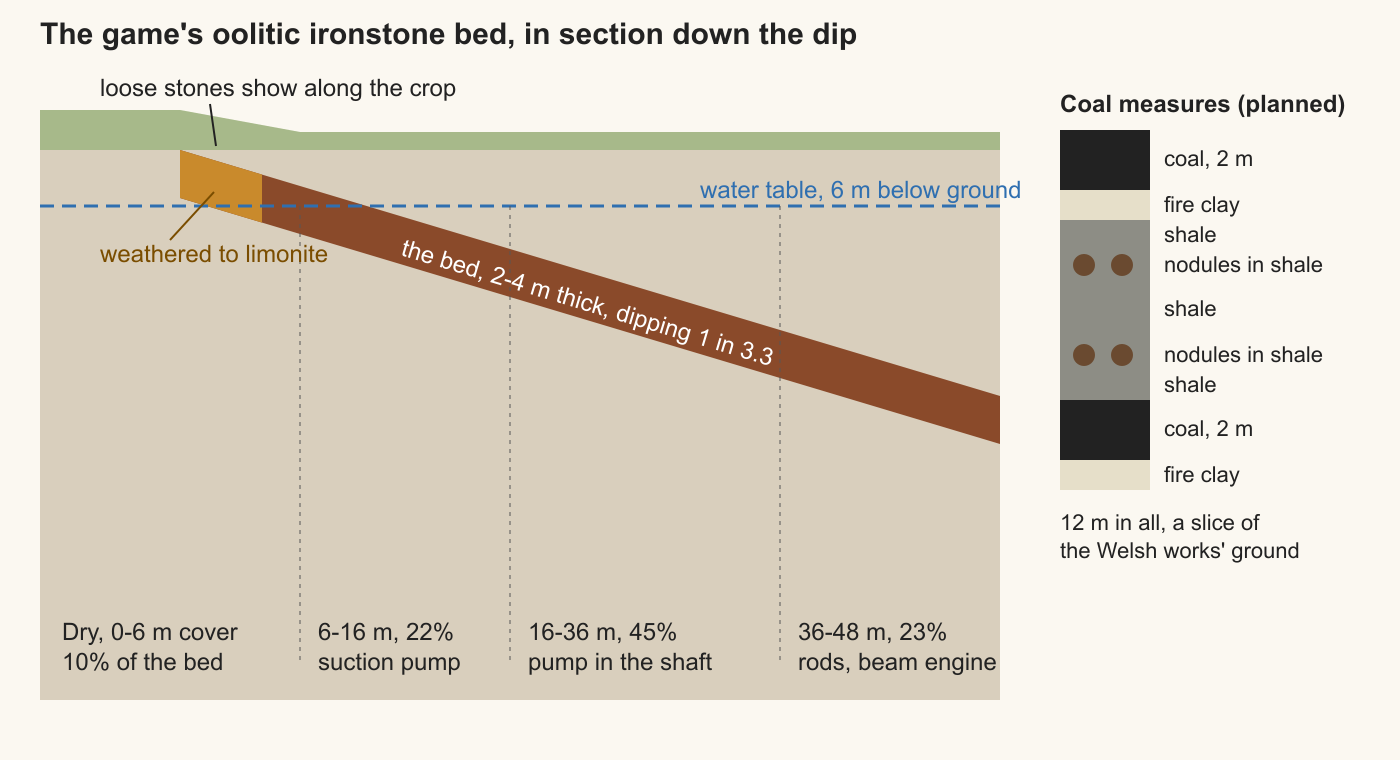
Clay ironstone comes in the coal measures, in seams of a quarter of an inch to three feet and in nodules of one inch to two feet, "lying parallel with and not unfrequently in close proximity to the coal seams" and mined in the same way as the coal (Truran p. 1). South Wales had seams adding up to twenty-one feet (Truran p. 2). Some was got by open working, known in Wales as "patching", but most came from pits, from a few yards down to a hundred and fifty fathoms (Truran p. 1). The ground that gave the iron gave the coal to smelt it.
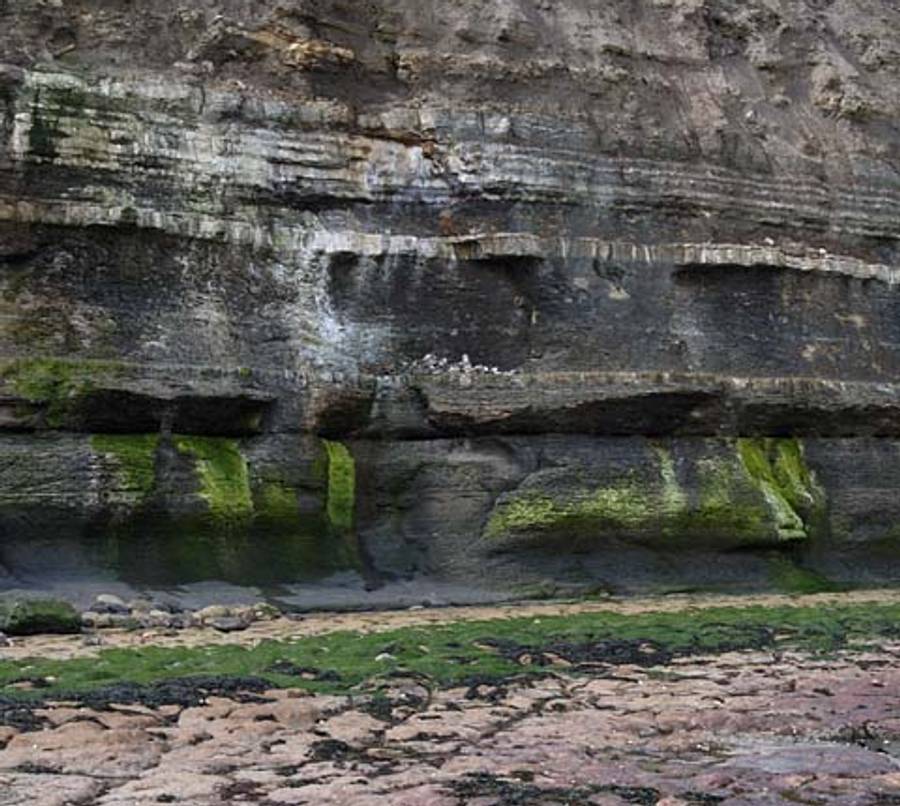
Cleveland was different: a single thick bed of oolitic stone, usually "a dull bluish green" (Bauerman p. 78), and lean, at 29 to 32% iron raw (Bauerman pp. 212-213). Its furnaces burned hard coke from the south of Durham (Bauerman p. 212), so the coal came to the stone.
The game keeps the two shapes. The oolitic ironstone bed follows Cleveland and is a single thick sheet with no coal in it. The planned coal measures follow Wales, with coal and iron from one drift and much more waste rock for each ton. The hematite flat follows Cumberland: rich, small, in limestone, always below the water table.
Where a bed meets the ground it rusts. The first blocks of an ironstone layer below the surface are vanilla's limonite ore, an oxide already, more of it in hot, dry ground and little or none in cold, wet ground.
Why it was roasted, and how
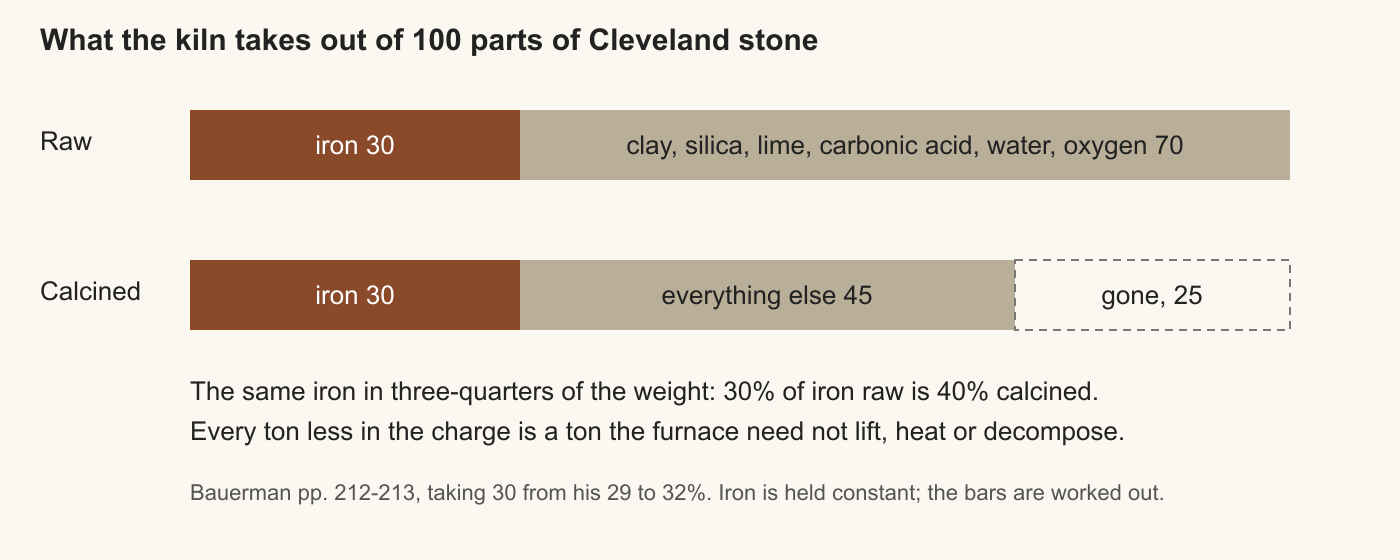
"Whether an iron ore should be roasted, is a question which very seldom arises" (Overman p. 39). Only massive red hematite and certain magnetites were commonly exempt (Bauerman p. 106). Roasting does three things. It drives off water and carbonic acid, so the iron is concentrated into less weight. It leaves the pieces in their shape but porous, so the furnace gases can reach inside them (Bauerman p. 106). And it decomposes sulphides, sending the sulphur off (Bauerman p. 106). Carbonate is the ore it does most for.
The first way was the clamp, on open ground. A bed of coal a few inches thick, ten or twelve inches of stone, then more coal and stone to four or five feet, lit from the bottom and left for eight to twelve days (Truran pp. 15-16, Bauerman p. 107). It cost almost nothing to set up and worked poorly: the outside stones came out half burnt, a change of wind or a shower threw the heat about, and "adjacent stones are not unfrequently melted into a hard refractory mass" (Truran p. 16). It also cost more coal, 2 cwt of small and half a cwt of large to each ton, against 1 cwt of small in a kiln (Truran p. 17). Black band was calcined on its own coaly matter, with slack only at the base to start the fire (Bauerman p. 108).
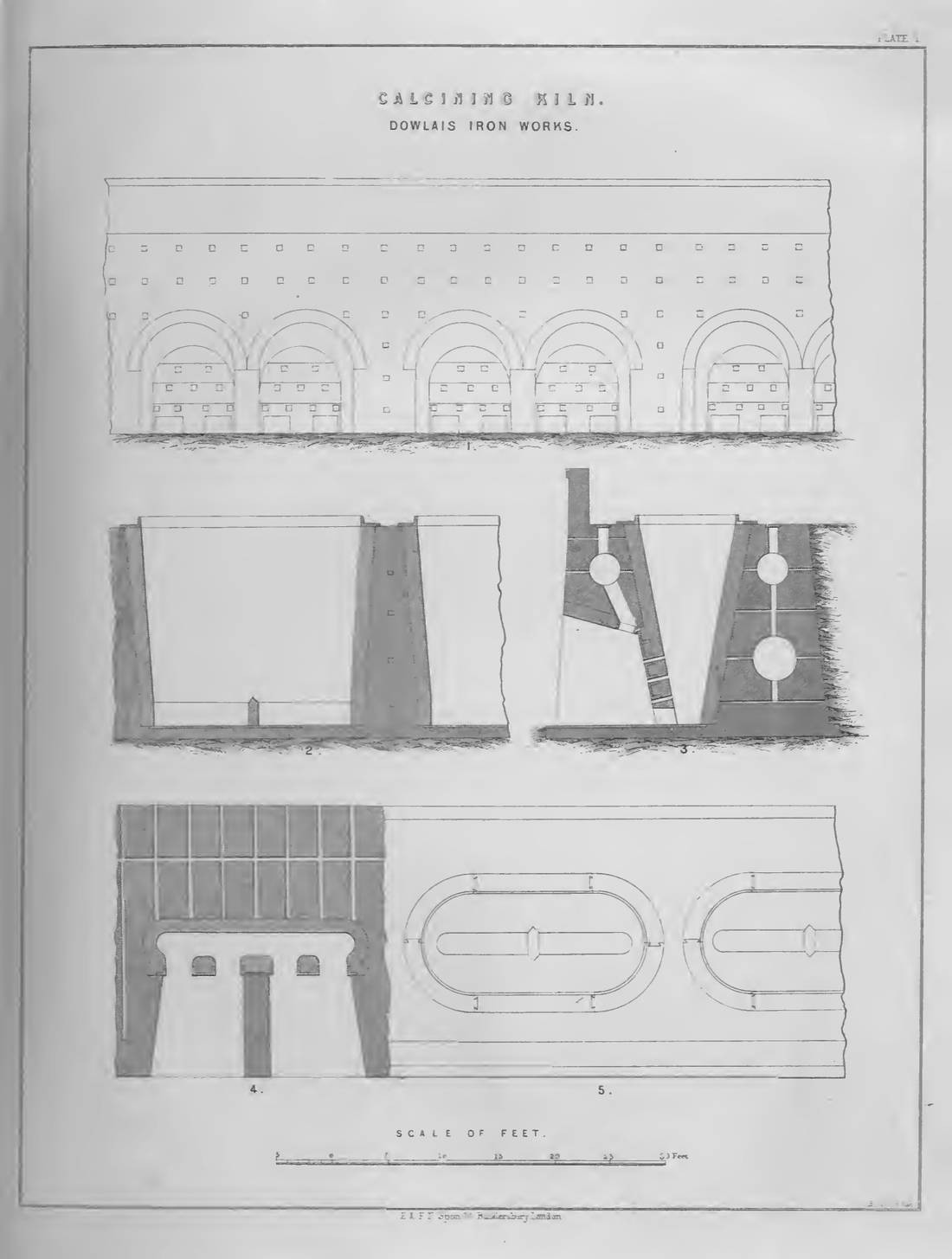
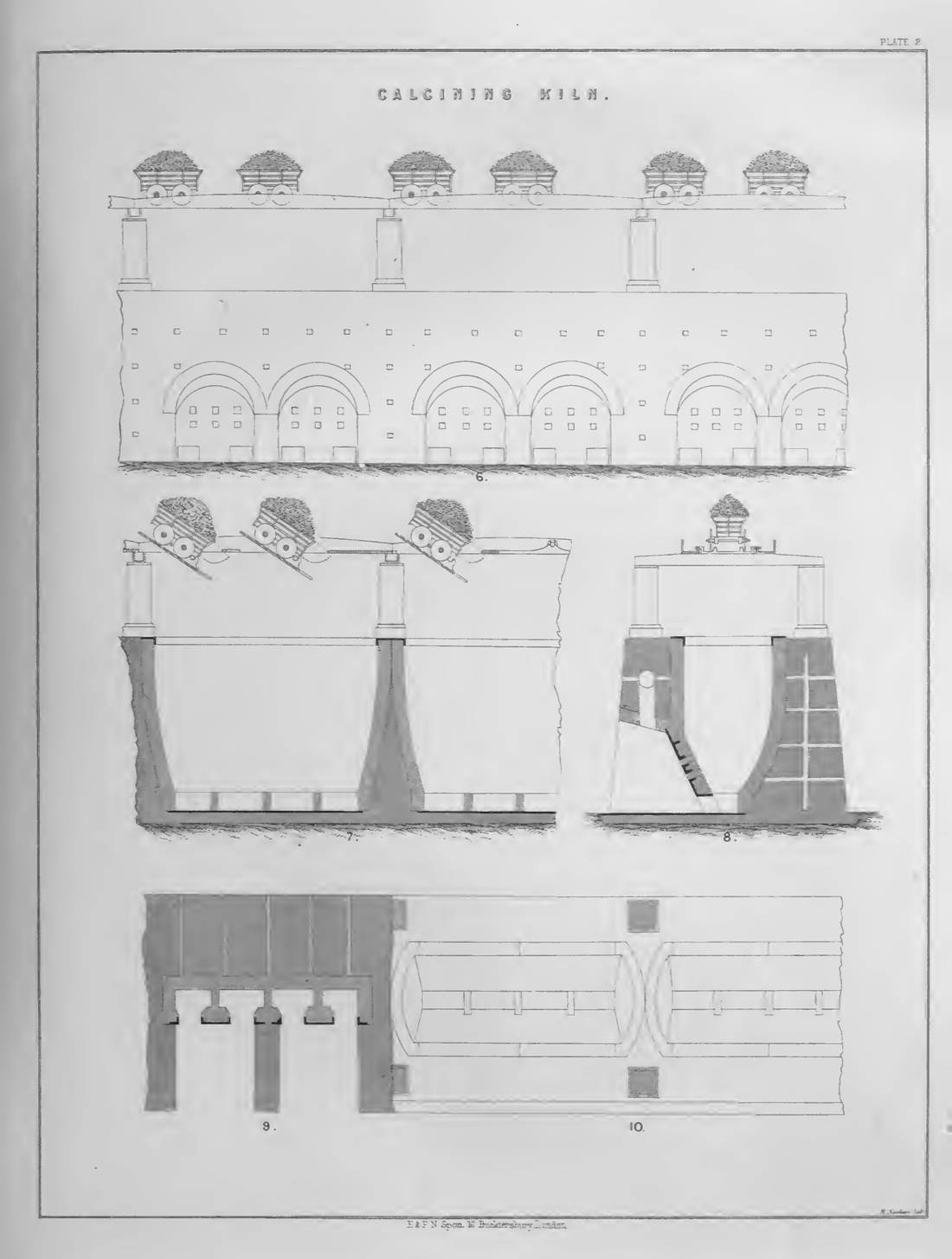
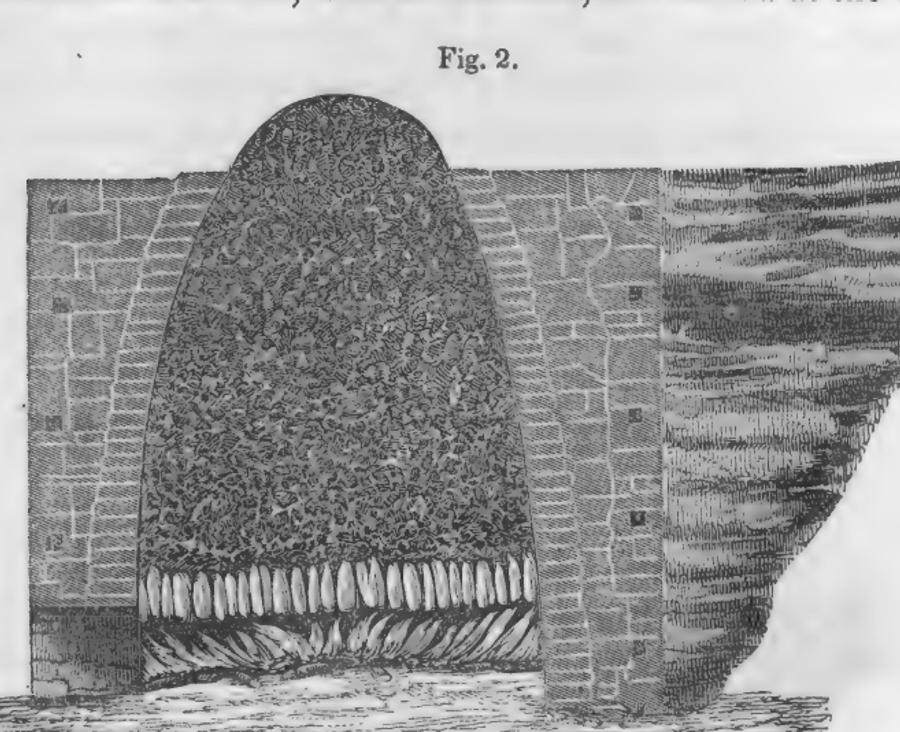
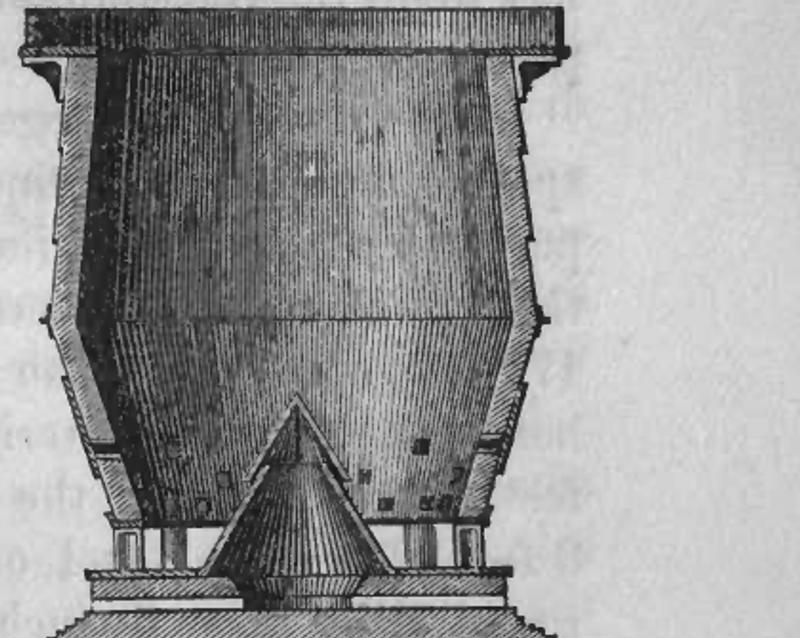
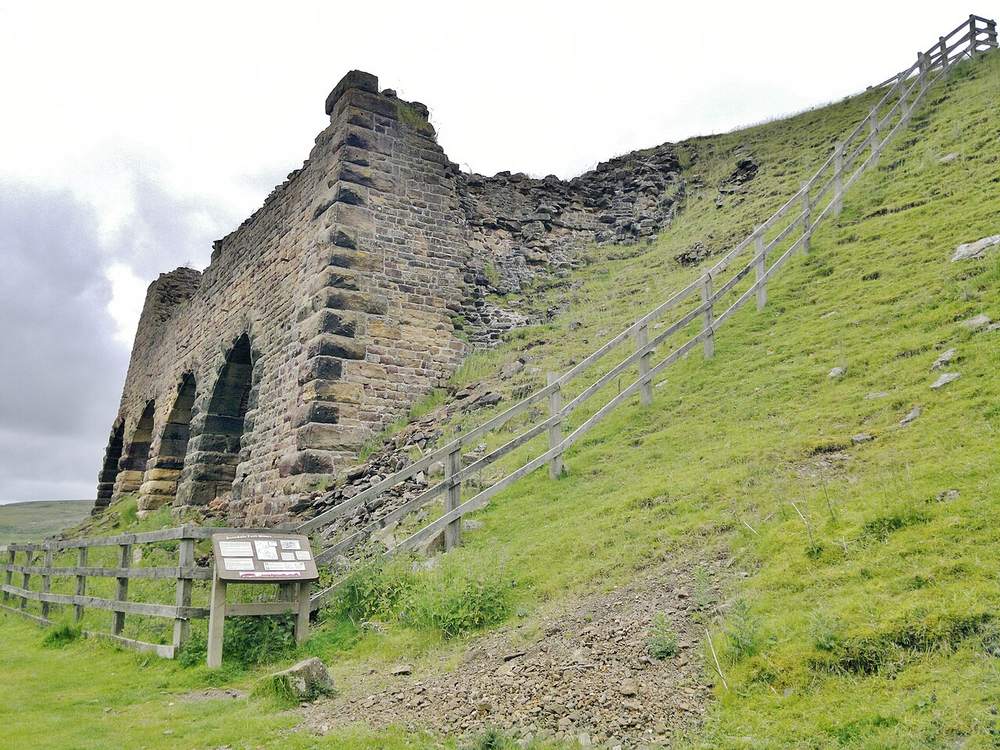
A kiln was worked as a slow column. Two or three small coal fires went on the floor, then raw stone over them; a layer eight or nine inches thick with about 5% of small coal was added when the last layer reached a red heat. By the time the kiln was full the bottom was cold enough to draw (Truran p. 15). A Dowlais kiln held 70 tons of argillaceous ironstone and calcined 146 tons a week (Truran p. 16), about three and a half days in the kiln (Bauerman p. 112).
The danger was too much fire. A carbonate heated too hard "melts together with the oxide, and forms a black cinder" (Overman p. 40), and in a clamp a place burning too fast was smothered with small ore or ashes before the stones clotted together (Bauerman p. 108). Pieces had to be near one size: Truran found the time to heat a stone nearly proportional to its smallest diameter, a 12 inch piece taking 24 hours and a 2 inch piece 4 (Truran pp. 19-20). Fuel enough for the big lumps overburnt the small ones.
What the game keeps of it
Raw ironstone blooms and charges the blast furnace as it comes. The roast is optional, and the kiln is planned to come after the casting plant; see the calcining kiln. Crushing is in the ore crusher. Where the numbers go after the kiln is in ore and fuel per ton.
Period basis, and what is the game's own
- Period: ironstone beds and nodules in shales, and hematite in limestone, each lying as the books describe them (Truran pp. 1-2, Bauerman pp. 62, 78). The game's oolitic seam, hematite flat and planned coal measures follow those three.
- Period: iron carbonate loses its carbonic acid in the fire and becomes a richer, more porous oxide (Bauerman p. 106). The game plans the roasted item to give more metal per ore unit, 9.2 u against 8.5 u raw.
- Period: a shaft kiln worked as a column, charged at the top with stone and small coal and drawn at the foot (Truran p. 15, Bauerman p. 112). The game plans the same kiln, and over-fired ore turns to clinker as Overman warns (Overman p. 40).
- Period: most ore was roasted as a matter of course (Overman p. 39). The game's own: roasting is optional for every ore, because a player without a kiln must not be locked out of iron.
- The game's own: one roasted ore unit is one raw ore unit. The real stone lost a quarter or more of its weight in the kiln; the game keeps the count and raises the yield instead.
- The game's own: the bed dips 1 in 3.3, steeper than the real beds, whose fall the books read for this page do not give, so that a body of 160 m fits four depth bands and the pumps have something to climb. See the Cornish pumping engine and mine drainage.
- The game's own: the base game's iron ore is an oxide in small discs deep in rock, with no seams and no carbonate. See vanilla against reality.
- The game's own: the coal measures with their nodules and the kiln itself are planned, and the water that closes the deep bands is planned too. The oolitic ironstone and hematite flat are what the mod's data has now.
The numbers
Ore figures here are period ratios set on vanilla's scale (how we scale); a block is a metre (scale and units). An ore unit is one crushed-iron's worth of ore.
| In the game | Period figure | How it was scaled | Game value |
|---|---|---|---|
| Iron in ironstone | 30 to 33% (Overman p. 29), over 32% in South Wales (Truran p. 2), Cleveland 29 to 32% (Bauerman p. 212) | Half of hematite's ore units, the ratio below | 6 ore units a lump, 7.5 a block |
| Iron in hematite | Specimen about 57% worked out, cargo under 50% (Truran p. 8) | Twice ironstone, from the richer specimen | 12 ore units a lump, 15 a block |
| Bed thickness, Cleveland | About 20 ft, 12 to 17 ft workable (Bauerman p. 78) | True size, thinner | 2 to 4 m, average 3 |
| Seams and nodules, coal measures | Seams 1/4 in to 3 ft, nodules 1 in to 2 ft (Truran p. 1) | A one-block course | Planned 1 m courses, 6 ore units a block |
| Hematite body | Bed 15 to 60 ft at Cleator (Bauerman p. 62) | The game's own size | 3 m thick, lens 64 by 48 m |
| Depth | Pits to 150 fathoms (Truran p. 1) | The game's own | 48 m below the crop |
| Dip | None given | The game's own | 1 in 3.3 |
| Yield of iron, raw and roasted | Cleveland 29 to 32% raw, 40% calcined (Bauerman pp. 212-213) | The game's own recovery ladder | 8.5 u raw, planned 9.2 u roasted, per ore unit |
| Weight lost roasting | Argillaceous 20 to 33% (Truran p. 21), clamped ironstone 28 to 33% (Bauerman p. 108) | Not modelled | None, one ore unit for one |
| Kiln fuel | About 5% small coal, 1 cwt a ton (Truran pp. 15, 17) | By heat value | Planned 1:20 |
| Time in the kiln | About 3.5 days (Bauerman p. 112) | Shortened by the make factor 3.608 | Planned about 22 game hours |
| Kiln throughput | 70 t held, 146 t a week (Truran p. 16) | The same factor on the planned shaft | Planned about 58 ore units a game hour |
Open, and what you can tell us
The books read for this page give the thickness of the beds but not their dip, so the game's slope is its own. If you know a source that gives the dip of the Cleveland or South Wales ironstone beds, we would like to read it.
Picture credits
- Clay ironstone nodule: Nessa Euler, CC0, cropped.
- Hematite (Kidney Ore): Pacific Museum of Earth, CC BY-SA 2.0, cropped.
- Cleveland Ironstone: Stephen McCulloch, CC BY-SA 2.0, cropped.
- Iron Calcining Kilns, Rosedale: Chris Morgan, CC BY-SA 2.0.
- Plates I and II, cited at Truran pp. 15 and 20: The Iron Manufacture of Great Britain, Library page.
- Fig. 2, section of an ore roasting oven: Overman, The Manufacture of Iron, p. 42, Library page.
- Fig. 1, Gjers' calcining kiln: Bauerman, Treatise on the Metallurgy of Iron, p. 113, Library page.
- The two beds in section: drawn for this page from the game's design.
- What the kiln takes out: drawn for this page from Bauerman pp. 212-213.
Comment or suggest something in the Expanded thread on the Vintage Story Discord