
Ore and fuel per ton
A ton of pig iron took several tons of other things to make, and most of what went into a furnace left it as gas and slag. The plain version of how the game sets its numbers is in why the numbers are what they are. This page is about what the books measured, why so much went in, and what the game keeps of it.
Why so much went in
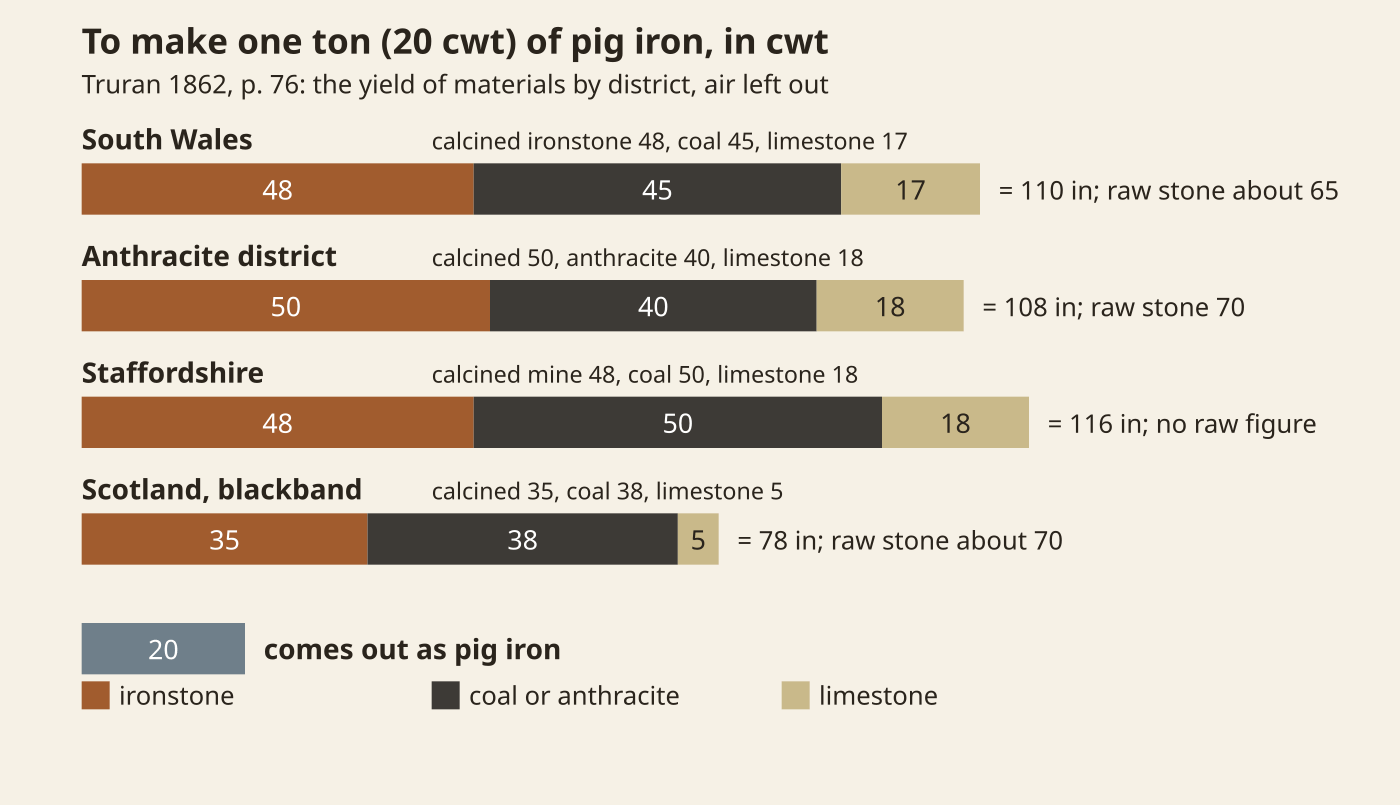
Iron ore is not iron. Ironstone of the coal measures lost a large part of its weight before it reached the furnace, and the rest was still mostly earth. Truran counts about 65 cwt of raw stone for 48 of calcined in South Wales, and about 70 raw for 35 calcined in Scotland (Truran p. 76). The blackband of Scotland was calcined with little fuel beyond what lit the heap, because it carried its own coal (Truran p. 17).
Calculated on the raw stone, then, a ton of pig took about three and a quarter to three and a half tons of rock. A richer ore cut that down. Overman reckons a ton and a half of ore at best and two tons on average to a ton of metal (Overman p. 235). Everything in the rock that was not iron had to go somewhere, and so limestone went in to turn it into a slag that would run.
The fuel did two jobs at once: it melted the charge and it took the oxygen off the iron. Charcoal furnaces of Overman's day ran at about 180 bushels of charcoal to the ton of pig (Overman p. 151), and coke furnaces at 45.3 cwt a ton (Truran p. 120). Johnson, writing in 1918 of far larger furnaces, puts the best practice at 1700 lb of coke to the ton and common practice at 2100-2200 (Johnson Principles p. 275).
What came out, and what stayed in the slag
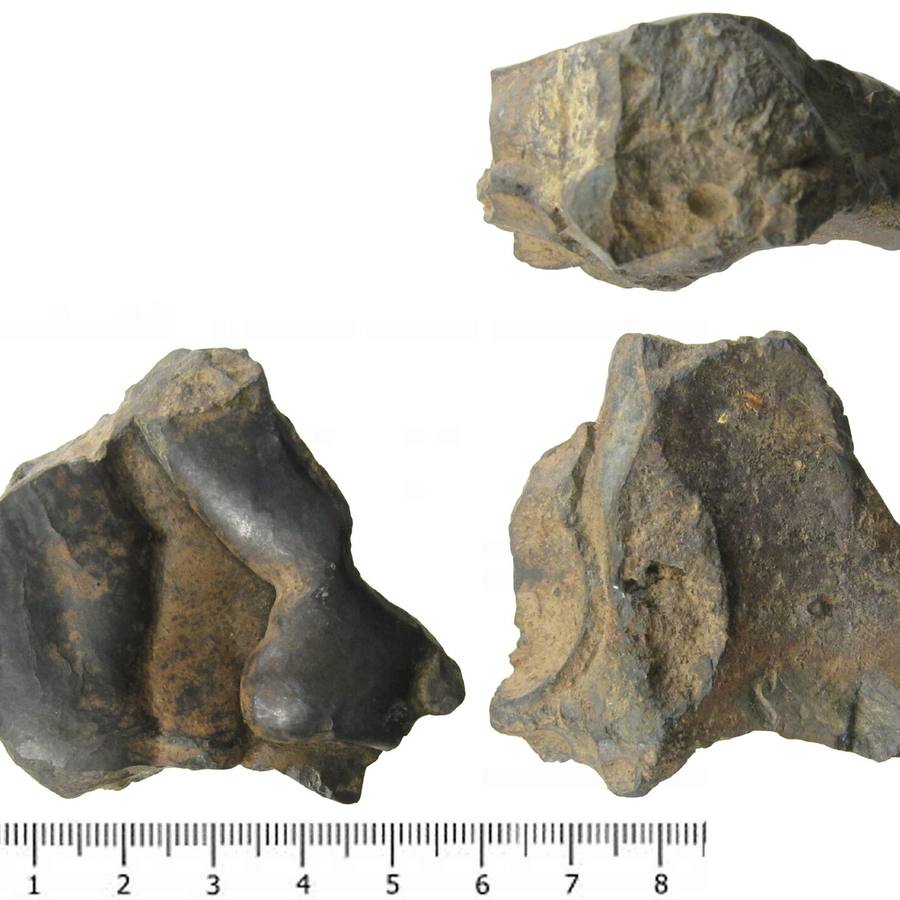
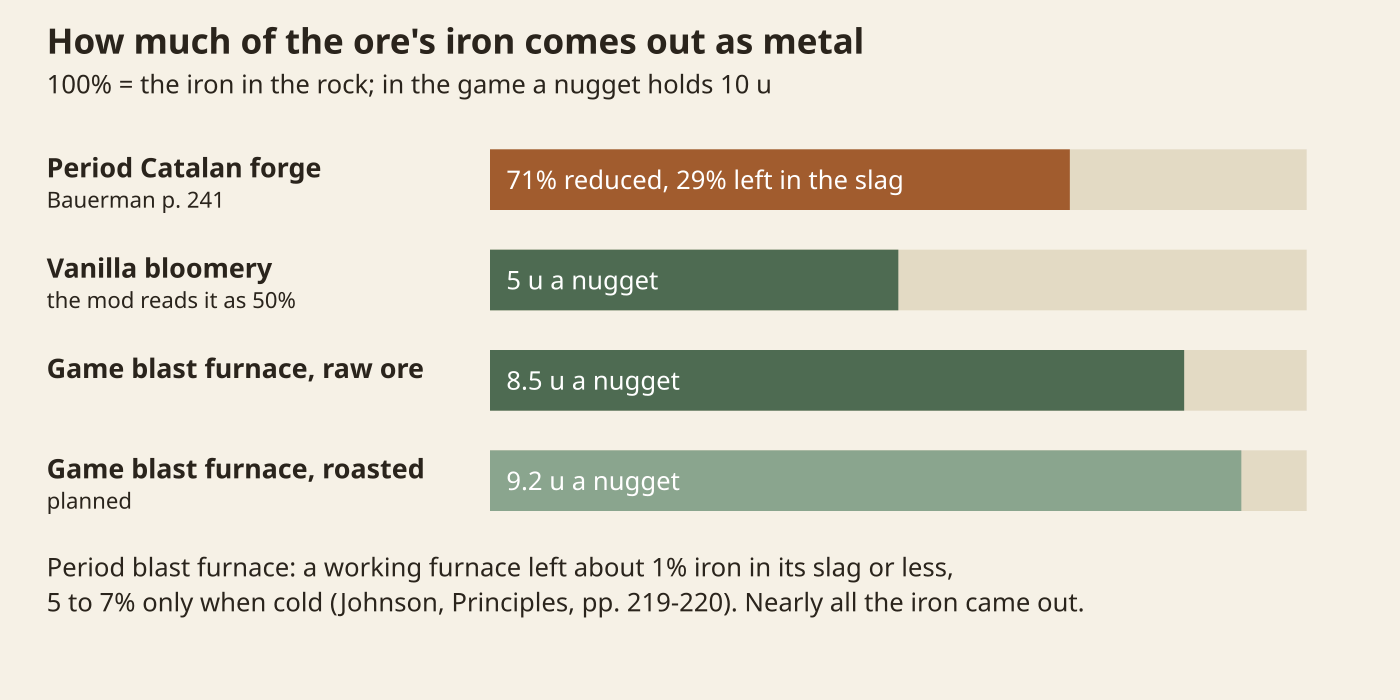
The old direct process threw away much of its iron. In the Pyrenean Catalan forge, 100 lb of ore holding 45 to 48% of iron gave 31 lb of bar iron and 41 lb of slag still at 30% iron, so 71% of the iron was reduced and 29% was spent in the slag (Bauerman p. 241). The fire took 312 lb of ore and 340 lb of charcoal for 100 lb of bar there; in Vermont four tons of ore and 300 bushels of charcoal went into a ton of blooms (Overman p. 248).
The blast furnace changed that. A white slag carried under 0.1% of iron and a dark brown or black one about 1%; a cold furnace ran to 5 to 7%, and a furnace in serious trouble about 25% (Johnson Principles pp. 219-220). At the 1200 lb of slag a ton of iron that Johnson gives for coke (Johnson Principles p. 48), a slag of 1% holds 12 lb of iron a ton of pig, worked out. The furnace's whole gain over the bloomery is in that line.
What the shop lost, and what it kept
Each later step lost a little more. Puddling took 21.5 to 22 cwt of pig to 20 cwt of bar (Percy p. 657), and a forge charged hammer slag and mill scale back into its furnaces: a Bromford heat of 1859 went in with about 1 cwt of them (Percy pp. 655-656), and an Abersychan blast-furnace burden carried 5 cwt of forge cinder among its ironstone (Truran p. 99).
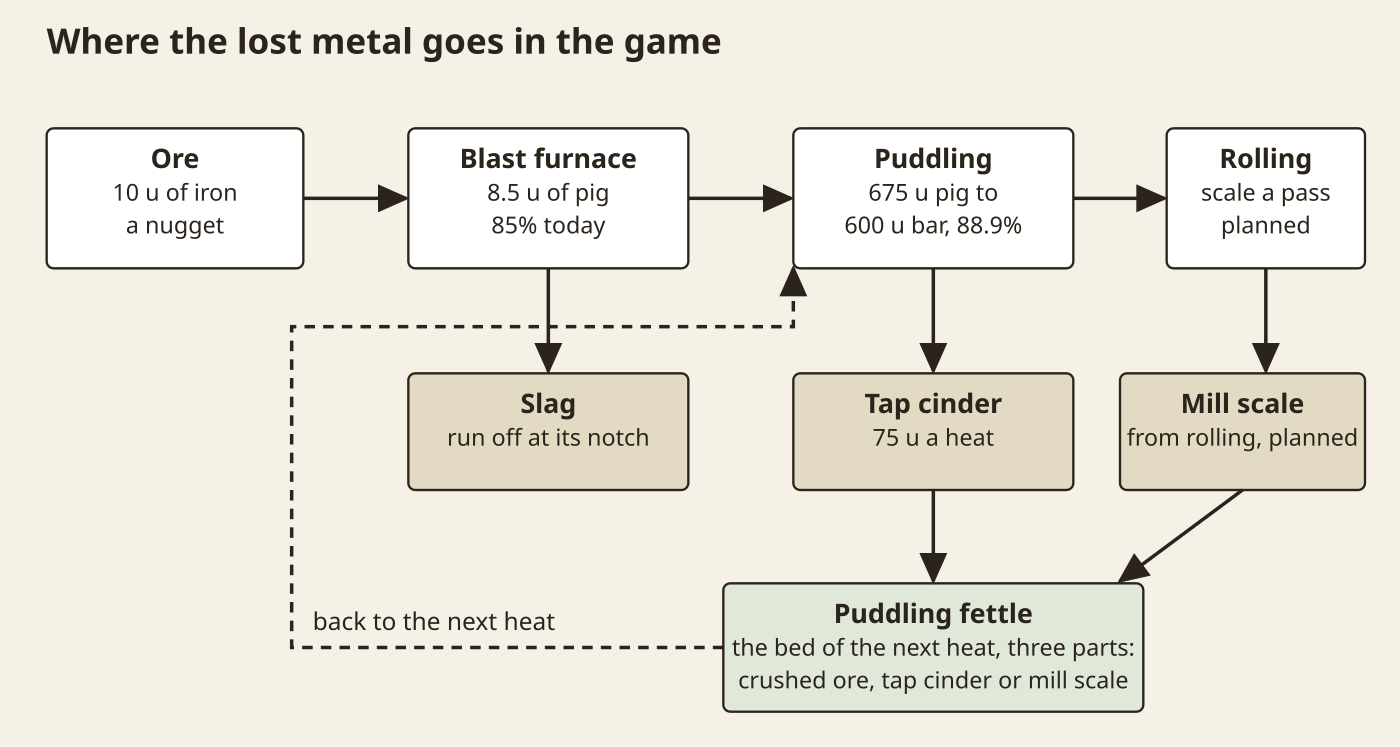
The game keeps this rule whole: a step that loses metal states how much, as a fixed number, and the loss turns up as something the player can see. Transport, casting and forming lose nothing; reduction and refining declare what they keep. There is no loss by chance. A blast-furnace burn-out leaves its ore and flux in the column to be dug out, and costs only part of its fuel. The stock forms are also planned so that every stage a piece can be left in fits a heater, so that a piece of rolled iron cannot be stranded too long and too cold to work.
The loss is not the only thing a player pays. The ore a burden carries comes to about what real ironstone holds: an item of it takes 1/16 of a cubic metre, holds 48.5 u of iron at 5% flux and weighs about 110 kg, planned, so 34 kg of iron comes out of it, about 3.1 weights of ore for each of iron, worked out, close to Truran's raw-stone figures.
Why the fuel is so light
The ore comes at period weight, and the fuel does not. A vanilla bloomery burns 6 fuel items for 600 u, 0.14 kg of charcoal a kg of iron, where a period blomary fire burned 2.08 kg (Overman p. 248). That gap is the base game's, and the mod does not widen it. A furnace's fuel is its period ratio to the fire, multiplied onto the bloomery's 0.01 items a unit, and the scaling page works it through. The result is the period's order and the game's weight: coke burns less than charcoal for the same iron, and both far less than a real furnace did by weight.
Period basis, and what is the game's own
- Period: a blast furnace burden in cwt of calcined ironstone, coal and limestone to the ton of pig (Truran p. 76). The game keeps the proportion of ore and flux in one burden item, and charges its coke as separate bands.
- Period: about 400 lb of limestone a ton of iron on a charcoal furnace at 50% ore yield, about 8% of ore and stone (Johnson Principles p. 51). The game's flux band of 3 to 8% is set at charcoal practice; a coke furnace is planned to want two to three times the flux.
- Period: slag was the great bulk of a coke furnace's output, about 1.8 tons of cinder a ton of iron at Dowlais (Truran p. 84), against 5665 lb of slag to about 10,100 lb of iron in Johnson's coke burden (Johnson Principles pp. 268-271), about half a ton a ton, worked out. The game's slag runs at 1.8 of iron to 1 of slag.
- Period: forges and furnaces reused cinder and scale (Percy pp. 655-656, Truran p. 99). The game keeps that as the fettle loop.
- The game's own: the 85% recovery of the raw-ore blast furnace, and the 50% it reads into the bloomery, are round figures between the bloomery and the roast, not book figures.
- The game's own: losses are fixed and stated, never rolled.
- The game's own: the blast furnace's slag is run off and is not fettle. The fettle recipe takes crushed ore, tap cinder or mill scale.
- The game's own: nothing checks yet that a rolled piece stays short enough to reheat; the rule above is a design rule at present.
The numbers
Ore, fuel and air are kept in their period proportions where the numbers say so; the bloomery sets the game's scale (how we scale, scale and units). "Planned" is the value in design, the game's value otherwise. A unit of iron is 0.70 kg.
| In the game | Period figure | How it was scaled | Game value |
|---|---|---|---|
| Iron in a nugget of ore | None: the books give ore by percent of iron | The game's own; vanilla's 5 u read as half the content | 10 u |
| Bloomery recovery | 71% reduced, the Catalan forge (Bauerman p. 241) | The game's own, below the period | 50%, 5 u a nugget |
| Blast furnace, raw ore | Nearly all, with 1% of iron in the slag or under (Johnson Principles pp. 219-220) | The game's own step | 85%, 8.5 u a nugget |
| Blast furnace, roasted ore | None: no book at hand gives a recovery for roasted ore; see the calcining kiln | The game's own step | Planned 92%, 9.2 u a nugget |
| Ore a ton of pig | 65 to 70 cwt raw, 35 to 50 calcined (Truran p. 76); two tons on average, richer ore (Overman p. 235) | Burden at real bulk: 110 kg of charge for 34 kg of iron | Planned about 3.1 weights of ore a weight of iron, worked out |
| Iron in a burden item | None quoted; the design takes ironstone at about 30% iron | 6 ore items at 8.5 u, 5% flux | Planned 48.5 u; today 8.5 u x its ore share |
| Flux | 17 cwt to 48 calcined, on coal (Truran p. 76); about 8% of ore and stone, charcoal (Johnson Principles p. 51) | Charcoal band for every fuel | Standard band 3 to 8%; coke band planned at 2 to 3 times charcoal's |
| Coke | 45.3 cwt a ton, 2.265 kg a kg (Truran p. 120) | 0.39 of the fire's fuel, on the bloomery's 0.01 items a unit | Planned 0.00388 items a unit, 0.156 kg a kg |
| Charcoal | 180 bushels a ton of pig (Overman p. 151) | 0.60 of the fire's fuel | Planned 0.00600 items a unit |
| Bloomery fuel | 300 bushels a ton of blooms, 2.08 kg a kg (Overman p. 248) | Vanilla's own | 0.0100 items a unit, 0.14 kg a kg |
| Working round | Burden and coke charged in about equal weights (Truran p. 76) | Burden items to one coke item | Planned about 5 burden items a coke item, 5.32 on the fuel anchor, 3.44 a charcoal item |
| Slag, coke | 5665 lb of slag to 10,100 lb of iron (Johnson Principles pp. 268-271) | Iron to slag kept at the coke ratio | 1.8 iron to 1 slag; charcoal planned at about 4.5 to 1 |
| Puddling | 21.5 to 22 cwt of pig to 20 cwt of bar (Percy p. 657) | Round figures of the stock ladder | 675 u pig to 600 u bar, 88.9%, and 75 u of tap cinder |
| Spent metal tool | None given | The game's own | Planned 80% back in metal, 20% as mill scale |
Open, and what you can tell us
The books disagree on how much cinder a ton of pig made: Truran's Dowlais forge-iron furnace made nearly two tons of cinder for each of iron, and Johnson's American burdens of half a century later about half a ton. Ore grades and blast differ, and none of these sources sets them side by side. If you know a period source that follows one furnace's ore, slag and iron through a whole campaign, we would like to read it.
The game's 85% is a step for play. A figure for how much iron an early coke furnace of about the game's size really lost, measured rather than estimated from the colour of the slag, would be better evidence.
Picture credits
- What a ton of pig cost: drawn for this site from Truran p. 76.
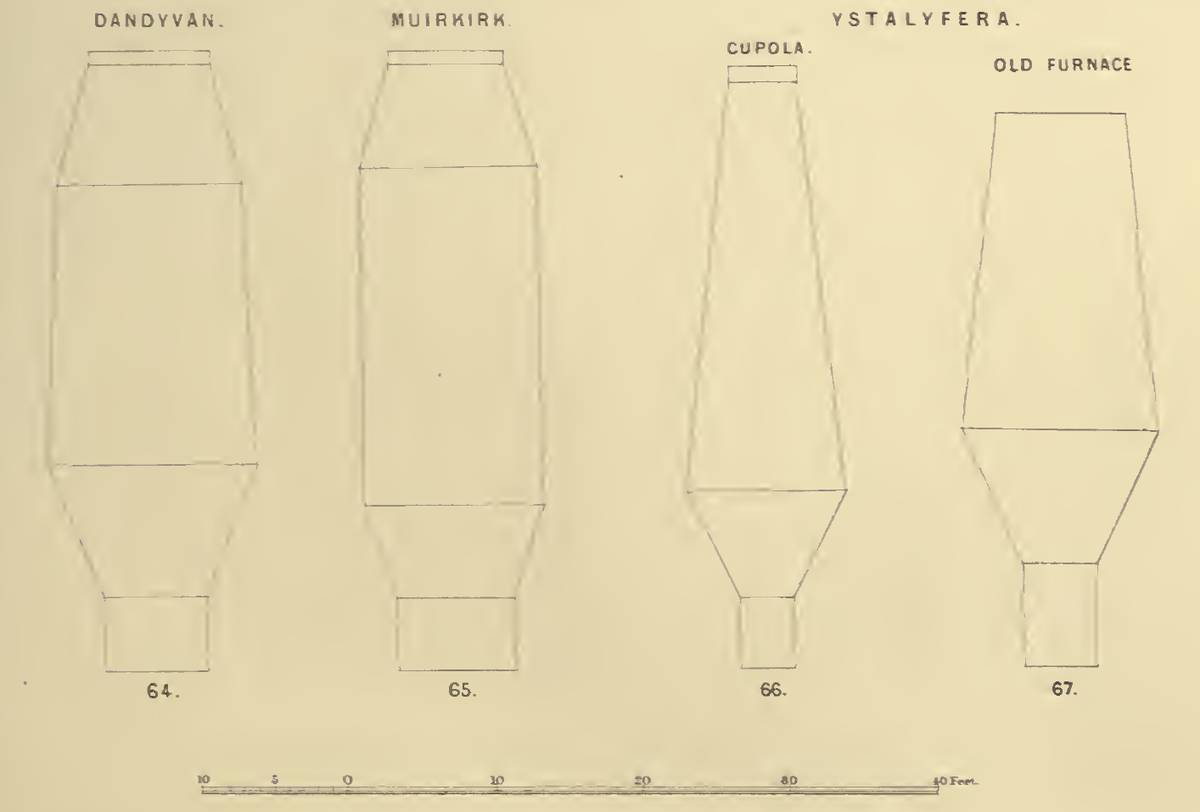
- Figs. 64 to 67: Truran, The Iron Manufacture of Great Britain, Plate X, Library page.
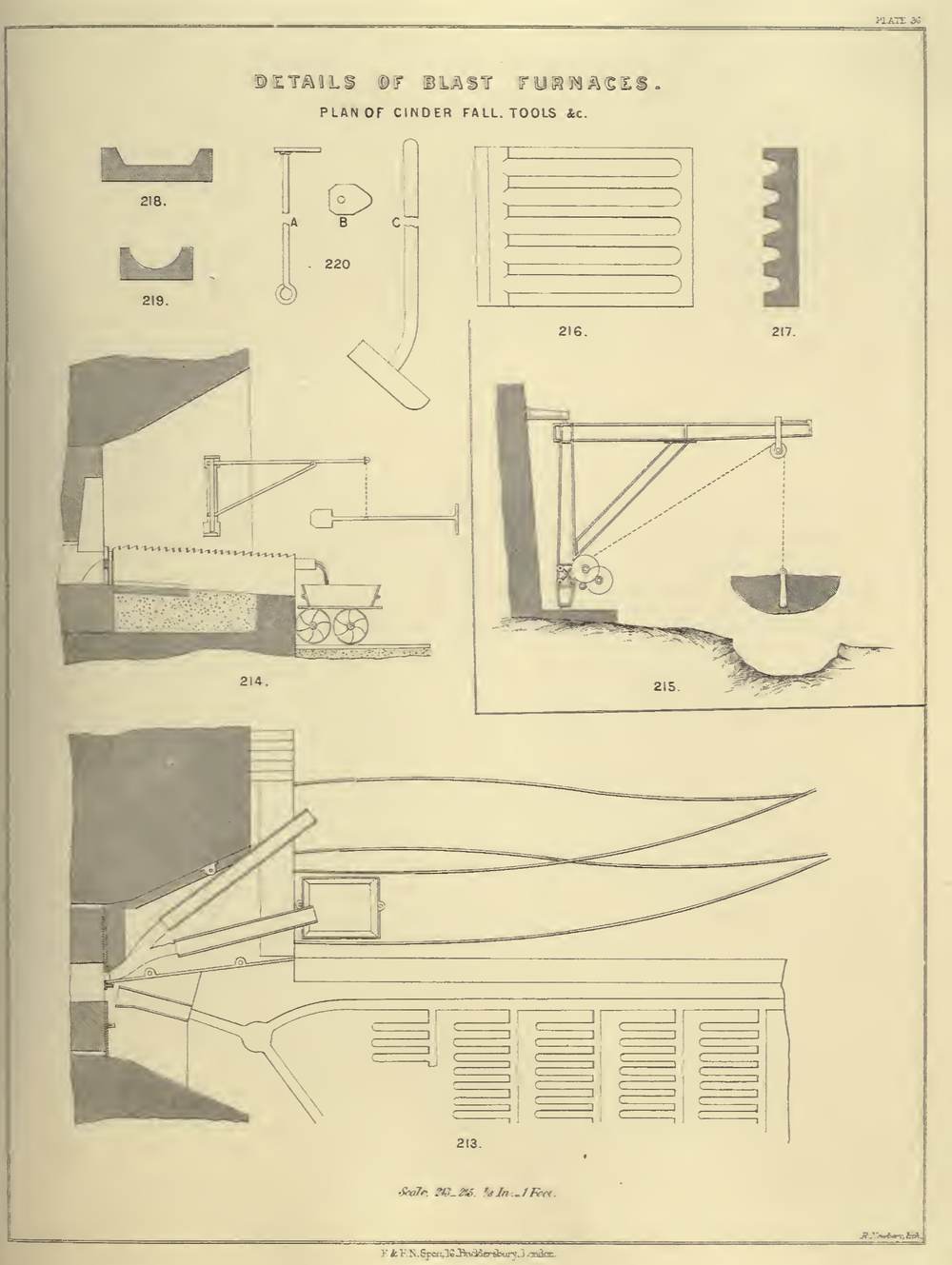
- Plate 36, details of the blast furnace: Truran, The Iron Manufacture of Great Britain, Library page.
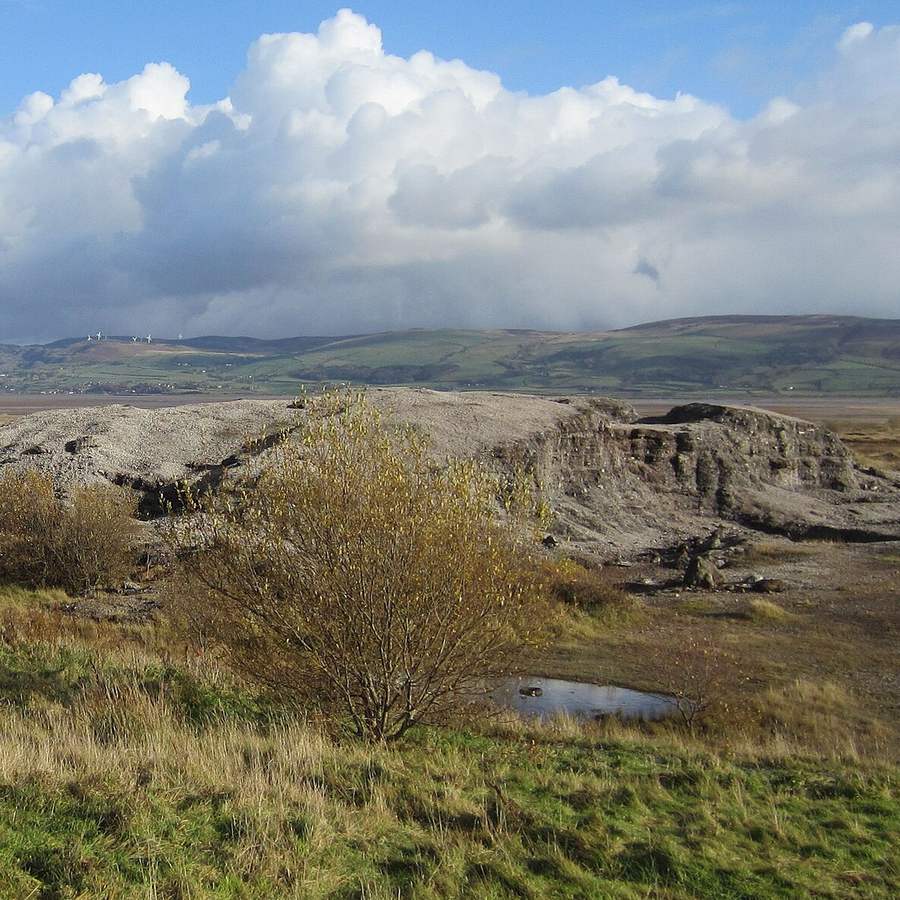
- Slag Heap on Millom Ironworks Local Nature Reserve: Perry Dark, CC BY-SA 2.0, cropped.
- Tap Slag (FindID 489595): West Yorkshire Archaeology Advisory Service, Amy Downes, CC BY-SA 4.0, cropped.
- The share of the ore reaching the metal: drawn for this site from Bauerman p. 241, Johnson Principles pp. 219-220 and the game's design values.
- Where the lost metal goes: drawn for this site from the game's design values.
Comment or suggest something in the Expanded thread on the Vintage Story Discord