
Shingling and piling
A puddled ball is not yet iron anyone can use. It is a sponge of iron with liquid cinder through it, and two separate jobs turn it into stock: shingling closes it into a solid lump, and piling welds finished bars into better ones. How to do it in the game is in the rolling guide and the iron grades guide, and how the ball is made is on the puddling page. This page follows the real work in the order the workers did it, then says what the game keeps of it.
The forge: from ball to puddle bar
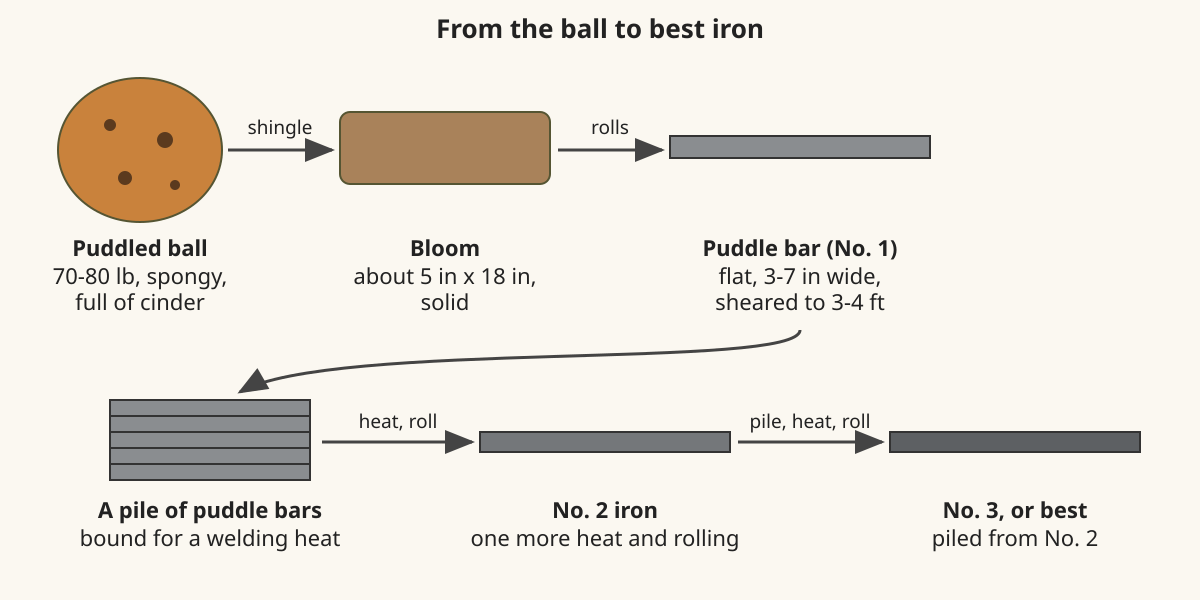
The ball came out of the furnace to the shingler. Percy gives the reason in a sentence: the ball is "a spongy mass, consisting of particles of malleable iron feebly cohering, and infiltrated throughout with liquid cinder" (Percy p. 693). Hammering welds the particles into an oblong slab and squeezes the cinder out, more or less completely, and the books call the man who did it the shingler (Percy p. 693). No ball, from a finery or a puddling furnace, went to the rolls without this first (Percy p. 693). Ironworks kept the words apart: the forge took the ball as far as the puddled bar, and the mill made the finished iron (Percy p. 693, Bauerman p. 287).
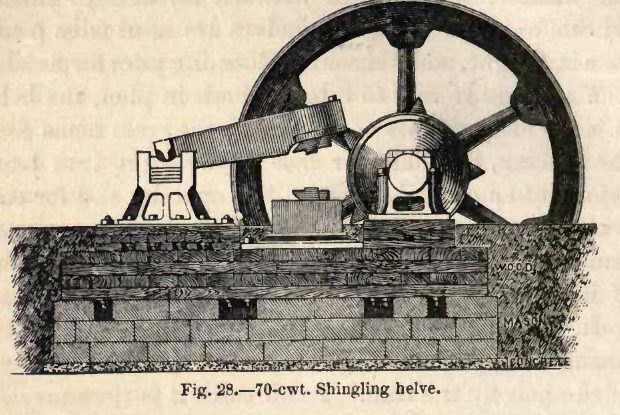
The work was short. Truran's helve lifted about 16 in at 72 to 76 blows a minute and gave a ball 15 to 25 blows in 18 to 30 seconds (Truran p. 219). A ball weighed about 80 lb (Percy p. 656), or 70 to 80 lb at 12 to 15 in across (Overman p. 268), and left as a bloom about 5 in across and 18 in long (Truran p. 219). The man kept turning it, and the ends were closed by setting the bloom on end and pressing it, called upsetting (Truran p. 219, Bauerman p. 297).
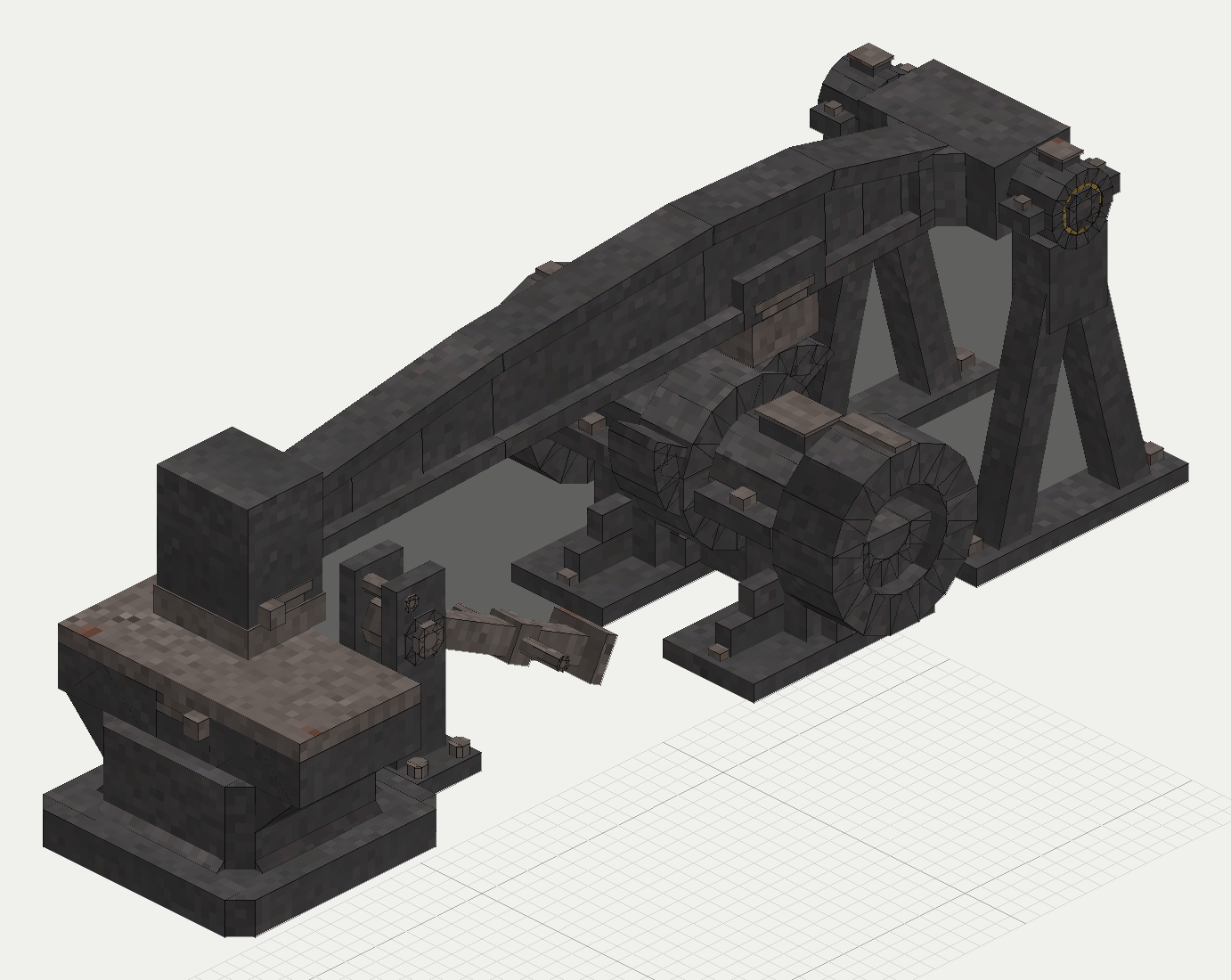
The hammer did not stay alone. Helves ran to 10 tons, usually 30 cwt to 5 tons, at 70 to 100 strokes a minute (Bauerman p. 289). A tilt hammer, with its pivot between cam and head, was small and fast, used for drawing out rather than for a first shingling (Bauerman p. 288). A belly helve had its cam midway between pivot and head, under the floor, which leaves the anvil free on three sides (Bauerman p. 288, Percy pp. 694-695).
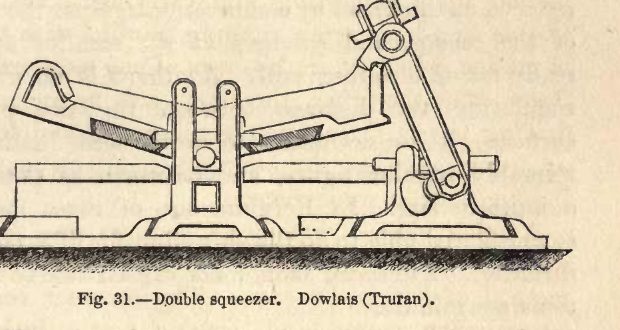
Squeezers pressed instead of striking. The common lever squeezer cost less than half of a hammer and, in Truran's day, had "almost entirely supplanted the hammer in the forge" (Truran p. 219). The ball reached its bloom in 15 to 20 strokes, about 25 seconds (Truran pp. 219-220). Truran also says that no squeezer "can improve the quality of the iron", which depends on the iron and the puddler (Truran p. 222). Rotary squeezers that took everything alike tore apart a badly worked ball, which gave the master a check on his men (Truran p. 222).
The steam hammer, first made practical by Nasmyth in 1842 (Percy p. 695), was the one tool that could be gentle. Its blow could be stopped anywhere in the stroke, so a ball could be consolidated with short, light strokes and then struck harder as it firmed up (Bauerman p. 292). "Balls, which would crumble to pieces under the helve" could be wrought sound under it (Percy p. 695). In new forges Bauerman found it generally preferred to the helve (Bauerman p. 291).
From the hammer the bloom went straight on through the grooved rolls, at the same heat (Bauerman p. 287), to a flat puddle bar 3 to 7 in wide (Truran p. 223). The bars were generally sheared hot (Truran p. 224).
The mill: piling and welding
The mill took the puddle bar from there. Bars cut to lengths, generally 3 to 4 ft, were placed together to form a pile, its section chosen by the iron ordered, from 3 to 10 in square (Truran p. 226). Piles for railway bars and larger merchant iron were commonly 3 ft 6 in by 7 in by 8 in, about 4 cwt, charged four at a time on a flat bar called a peeler (Truran pp. 226-227). All the bars had their ends cut square, and every surface in contact was kept clean of scale and rust (Bauerman p. 314).
The pile went into the balling furnace until it reached a welding heat, turned so it heated evenly. A cinder flowed over its surface and briefly protected the iron; held too long, the flow stopped and the iron began to lose its tenacity and its power to weld (Truran pp. 226-227). The pile then went to the rolls and became one bar, and the bars of which it was made were gone as separate pieces.
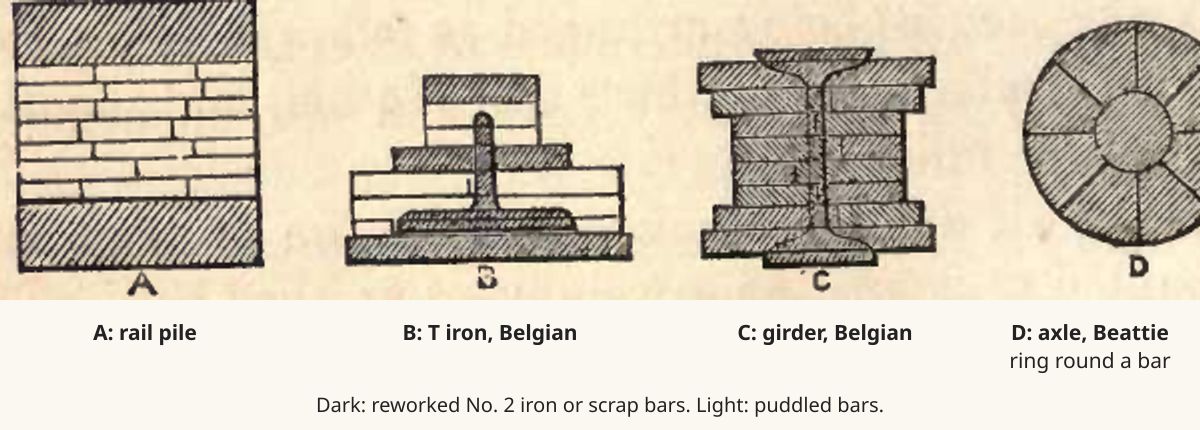
What a pile was built from depended on what it was for. Common merchant iron was made of puddle bars laid one on the other (Truran p. 228). A rail pile had a bottom and a top of No. 2 iron with 18 or 20 pieces of puddle iron between (Truran p. 228), because butt joints do not weld properly unless they are covered and the outsides must come out clean (Bauerman p. 314). Numbered iron counted rollings: puddle bar No. 1, a pile of those No. 2, a pile of No. 2 bars No. 3, called best, and then best best and treble best (Bauerman p. 314, Truran p. 228). Truran warns that the number describes how often a bar was rolled and only modifies its quality, the No. 2 of one maker being able to beat the No. 3 of another (Truran p. 227, footnote).
Thickness governed the fire. A pile 6 in thick, in two widths of puddle iron, took about 52 minutes to reach a welding heat where a single width took 27 (Truran pp. 229-230), so the bars of a pile had to be of a single thickness or the thin ones overheated while the thick did not weld. Truran thought unequal bars were behind more than half the lamination in railway iron (Truran p. 229). A short, thick pile made a dense fibrous bar, but its outside burned before its centre reached heat (Truran p. 228).
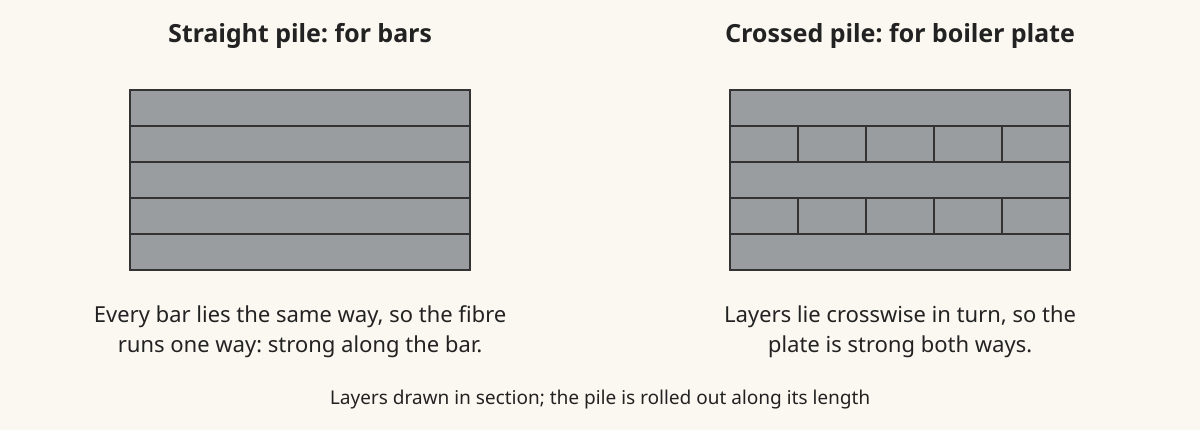
Faggots were a rougher relation. A box of iron plates was filled with clippings, old chains and other scrap, heated and rolled, or better hammered first (Truran p. 230), and Fairbairn uses the word for reheated, piled bars generally (Fairbairn Iron p. 131).
Every heat was paid for. In a South Staffordshire forge in 1861, a 100 lb pile for 1 in square bar lost about 15% in all, 5 to 6% in the furnace and the rest in crop ends and waste in the rolls (Bauerman p. 315). A pile for 4 in round bars lost 30 to 32%, two thirds of it in the crops (Bauerman p. 316). Truran weighed bars before and after and got less, 80 lb a ton on large piles (Truran p. 227).
What the game keeps of it
Today a ball works only under the helve, on a two-ball pile, and comes off as one shingled bar, a thing that stands in for a bloom. The plan is closer to the books: the ball drops to a period-sized lump shingled to a bloom one for one, and the bloom rolls to bar. Piling arrives with the rolling mill: bars cut and laid up as a pile, rolled, with the piled forms coming from piles and with grades counted as the iron was. The helve keeps what it can do early, drawing a bloom into a bar slowly before any roll set exists. The belly helve page and the steam hammer page cover the two machines.
Period basis, and what is the game's own
- Period: the ball is a cinder-filled sponge closed by hammering (Percy p. 693). The game's ball must be struck hot and will not work below half its melting point.
- Period: a helve was struck by the cam and could not vary its blow (Bauerman p. 292, Percy p. 695). The game's planned helve runs by itself on its pile, with no blows chosen.
- Period: piles of cut bars welded in the balling furnace and rolled (Truran pp. 226-227). Planned: the pile is laid on the mill's seat and rolled.
- Period: numbered iron by the count of pilings (Bauerman p. 314). Planned: a pile is one grade above its lowest piece, to No. 3, tools from No. 2 and No. 3 lasting longer (the iron grades guide).
- Period: boiler plate from crossed piles (Truran p. 230). Planned: the boiler plate's pile is laid from plate bars in crosswise layers.
- Period: faggots of scrap reworked under a hammer (Truran p. 230). Planned, on paper only: a part heavier than a 4-bar pile is forged from a faggot the helve welds, a heat a pile, and no part drawn so far needs one.
- The game's own: nothing is lost. Iron in equals iron out, where the books lost 15% or more (scaling); the cinder is accounted for at the puddling hearth, and planned hammer slag comes back as fettle stock.
- The game's own: a fixed count of blows stands in for the shingler's judgement, and there is no risk in the job.
- The game's own: a planned pile is whole bars cut to 5, 10 or 20 voxels, and four bars at most at the anvil, chosen to divide cleanly.
- The game's own: the steam hammer takes no ball pile. Period practice went the other way, the steam hammer replacing the helve for shingling; in the game the helve keeps this job and the hammer takes the pile forgings.
The numbers
Lengths follow scale and units, a unit being 0.70 kg of iron. "Planned" is the design; other values are what the game has now.
| In the game | Period figure | How it was scaled | Game value |
|---|---|---|---|
| Ball | 80 lb (Percy p. 656); 70-80 lb, 12-15 in across (Overman p. 268) | Taken as a period weight, 0.70 kg a unit | 200 u; planned 50 u, 6 voxels across, about 35 kg |
| Bloom | About 5 in by 18 in (Truran p. 219); 60 to 100 lb forged (Overman p. 334) | Whole voxels at true size | Shingled bar 3 x 3 x 18, 400 u from two balls; planned bloom 2 x 2 x 5, 50 u from one ball |
| Blows on a ball | 15 to 25 at 72 to 76 a minute, 18 to 30 s (Truran p. 219) | The game's own, not scaled | Planned 80 blows on a two-ball bar, about 84 s, for the helve at 57 a minute; the planned one-ball bloom has no blow count yet |
| Hammer rate | Up to 60 a minute, Mersey belly helve (Percy p. 694); 70 to 100 for helves (Bauerman p. 289) | Three cams on a turning shaft | Planned 57 a minute at 2 rad/s |
| Puddle bar | 3 to 7 in wide (Truran p. 223), 3-4 ft for piling (Truran p. 226) | Whole voxels at true size | Planned merchant bar 2 x 0.5 x 20, plate bar 4 x 0.25 x 20, 50 u each |
| Pile | 3 to 10 in square, about 4 cwt at 3 ft 6 by 7 by 8 in (Truran p. 226) | The game's own, whole bars | Planned 1, 2 or 4 bars cut to 5, 10 or 20 voxels |
| Pile loss | 15% and 30 to 32%, two thirds in the crops at the top end (Bauerman pp. 315-316); less with care (Truran p. 227) | The game's own: not modelled | None |
| Grades | No. 1, 2, 3 by rolling (Truran p. 227, footnote) | The game's own factors | Planned No. 1 x1.00, No. 2 x1.15, No. 3 x1.30 on a tool's durability |
Open, and what you can tell us
Truran has the squeezer almost displacing the hammer; Bauerman, later, finds the steam hammer generally preferred in new forges, and neither gives figures for how the works divided. Truran's large pile is 3 ft 6 in by 7 by 8 in at about 4 cwt, but that section solid works out nearer 6 cwt, and he does not say whether the difference is the gaps between bars or a lighter mix. If you know a works' records or a source that settles either, we would like to read it.
Picture credits
- Fig. 28, Fig. 31 and Fig. 38 (labelled for this site): Bauerman, A Treatise on the Metallurgy of Iron, pp. 290, 297 and 314, Library page.
- The road from ball to best iron: drawn for this site from Truran pp. 219, 223, 224 and 226 to 228, Overman p. 268 and Bauerman p. 314.
- Straight and crossed piles: drawn for this site from Truran p. 230.
- The game's belly helve: the mod's planned drawing.
Comment or suggest something in the Expanded thread on the Vintage Story Discord