
Blast and furnace heat
A blast furnace is a fire with a very large appetite for air, and whether it makes iron is settled by a sum: the heat its fuel and its wind bring in, less the heat it loses. The working guide is furnaces and heat. This page is about how much air the period furnaces took, what the books understood of their heat, and where each of the game's numbers came from.
How much air
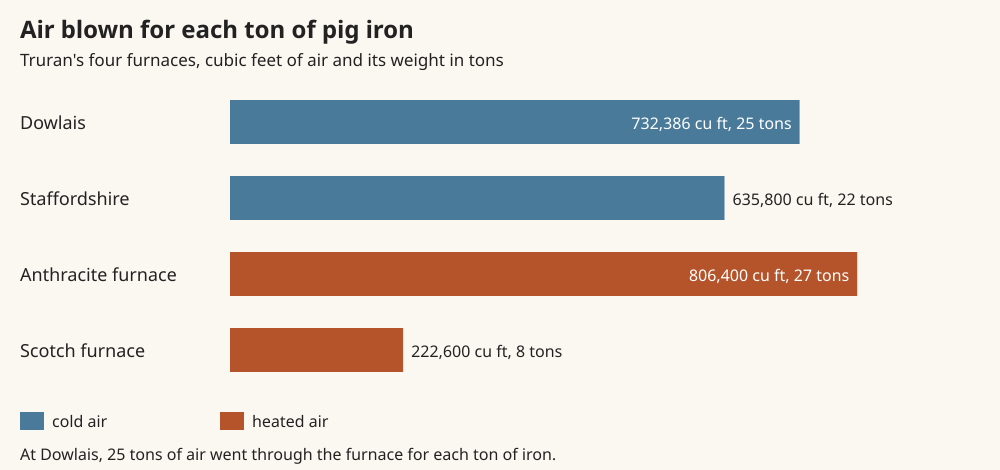
The period measured the wind two ways, by the minute and by the ton of iron. Overman gives a charcoal furnace 1000 to 2000 cubic feet a minute, and an anthracite or coke furnace more (Overman p. 401). Truran works it out by the size of the stack: Dowlais took 24 cubic feet a minute for each cubic yard of furnace, Staffordshire 25, the anthracite furnace nearly 36, the Scotch furnace 19 (Truran p. 78).
Pressure is a separate matter, and it belongs to the opening the air leaves by: "it is the opening of the nozzle which determines the pressure of the blast" (Overman p. 416). Overman's charcoal furnace ran on 1/2 to 1 lb to the square inch (Overman pp. 411, 426). Coke needed more, because the wind had to reach the middle of a wider hearth: Truran asks 1 1/2 lb to penetrate 3 feet and 3 lb for 6 feet (Truran p. 116). Two pounds was his minimum for a working coke furnace (Truran p. 113).
The chemistry sets a floor under all of this. To burn one kilogram of carbon to carbon monoxide takes about 4.8 cubic metres of air at room temperature, plain chemistry. Truran's Clyde furnace on cold blast took 85 cubic feet to the pound of carbon, which is 5.3 cubic metres to the kilogram, and 67 cubic feet on hot blast (Truran p. 161). The whole-furnace figures run well above that floor.
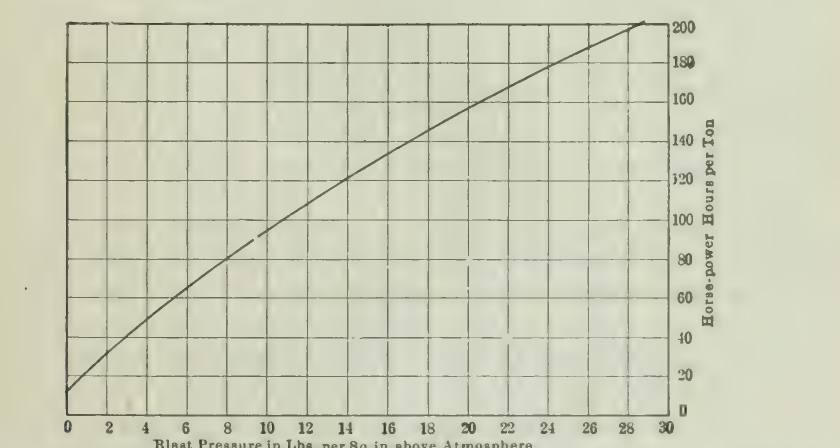
Air was also a cost in engine power: the blast had to be bought at the shaft of a wheel or the piston of an engine for as long as the furnace stayed in blast. The machines that did it are on the blowing machines page.
What the blast does for the heat
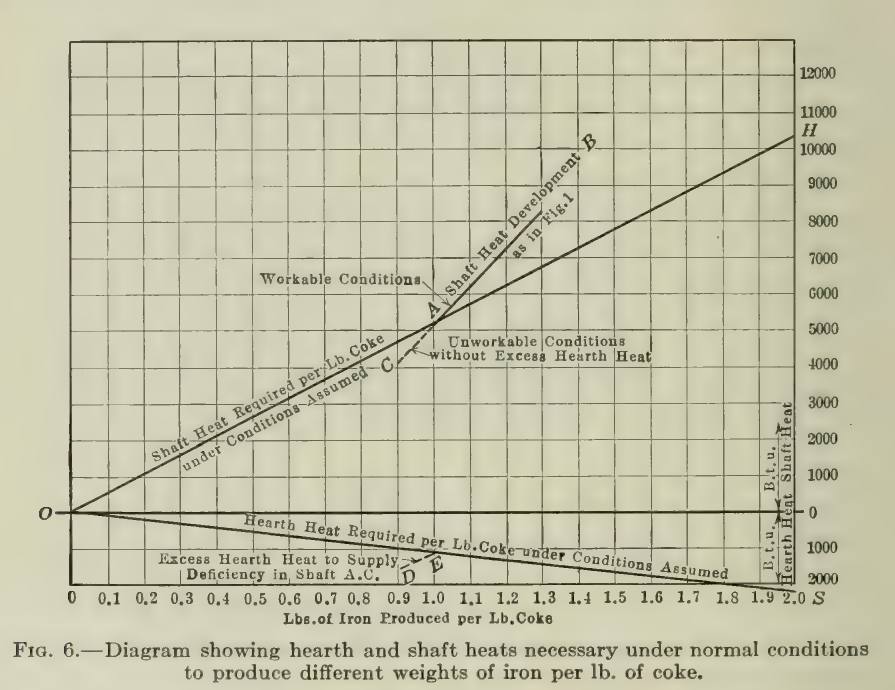
For most of the period nobody could put a number on the inside of a furnace. Sir Lothian Bell made the first heat balance, an account of "the quantity of heat developed and the amounts utilized and lost in various ways" (Johnson Principles p. 30). Johnson's complaint about the balances that followed is the idea this page turns on: they counted the quantity of heat and "ignored the quality factor, that is, temperature-head or intensity" (Johnson Principles p. 30). A furnace has plenty of heat in total and still fails if the heat at the tuyeres is not hot enough to run the slag. Johnson calls that the critical temperature: 2750 F in general (Johnson Principles p. 32), 2700 F for a good Bessemer slag and 2300 F for charcoal practice (Johnson Principles p. 50).
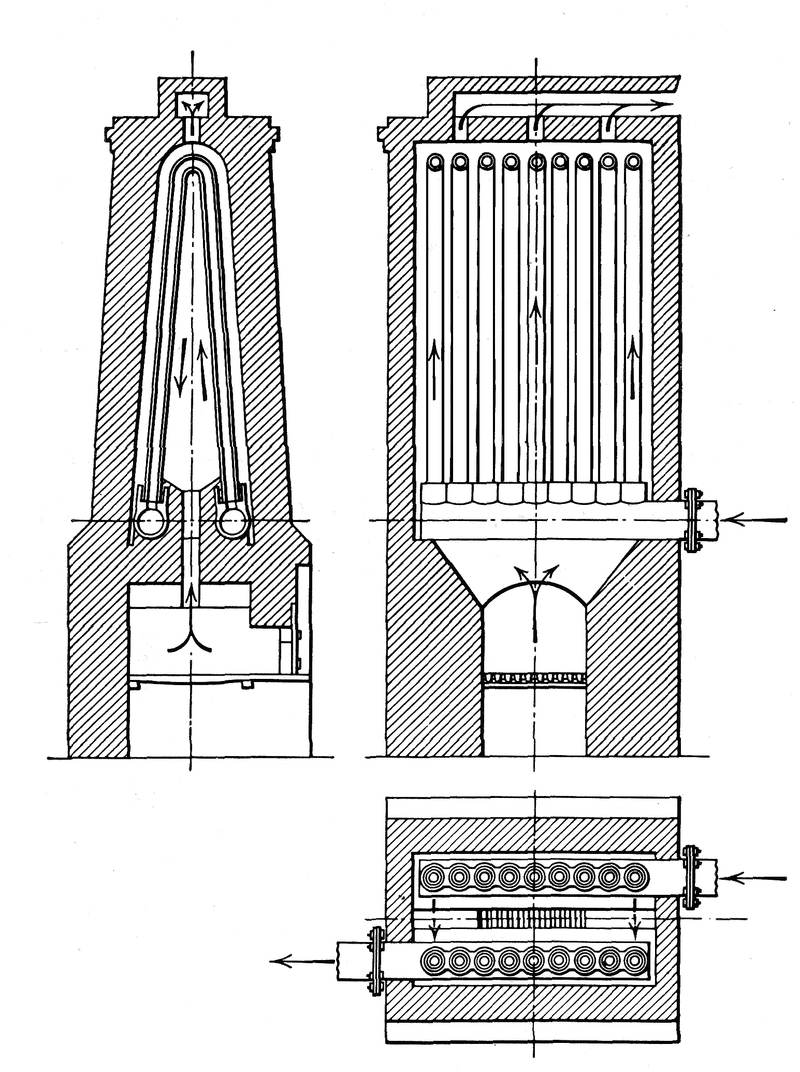
Heating the wind attacks exactly that. Every degree in the blast arrives at the tuyere without any fuel being burned for it there. Clyde Iron Works recorded the result over the same months of three years: 8 tons 1 cwt of fuel on cold blast, 5 tons 3 cwt on air at 300 F, and 2 tons 5 cwt at 600 F, a ratio of 3.42 to 1 (Johnson Principles p. 39). Overman puts the saving at 30 to 60% on anthracite and coke, with "nearly twice the quantity of iron" in the same time (Overman p. 442). Charcoal gained far less: one furnace's fuel went as 1.7 to 1 (Johnson Principles p. 39), and blast heat did little there because charcoal needed more fuel down in the hearth (Johnson Principles p. 47). Overman also records the other way of paying: "pressure is an equivalent for hot blast" (Overman p. 427).
How the game keeps the sum
Each furnace in the game settles at the temperature its own heat budget gives. There is no maximum anywhere in it. Heat in is a base figure, a gain that follows the carbon in the charge at the tuyeres and the air supplied, and a credit for a heated blast. Heat out is the walls, the charge being warmed, and a cold day. The temperature falls where the two meet. In the plan a full shaft holds its heat better than one let down, reversing the charge term in the chart below. Johnson's point survives as the melt line: the fire has to reach it, and any amount of fuel below it makes nothing.
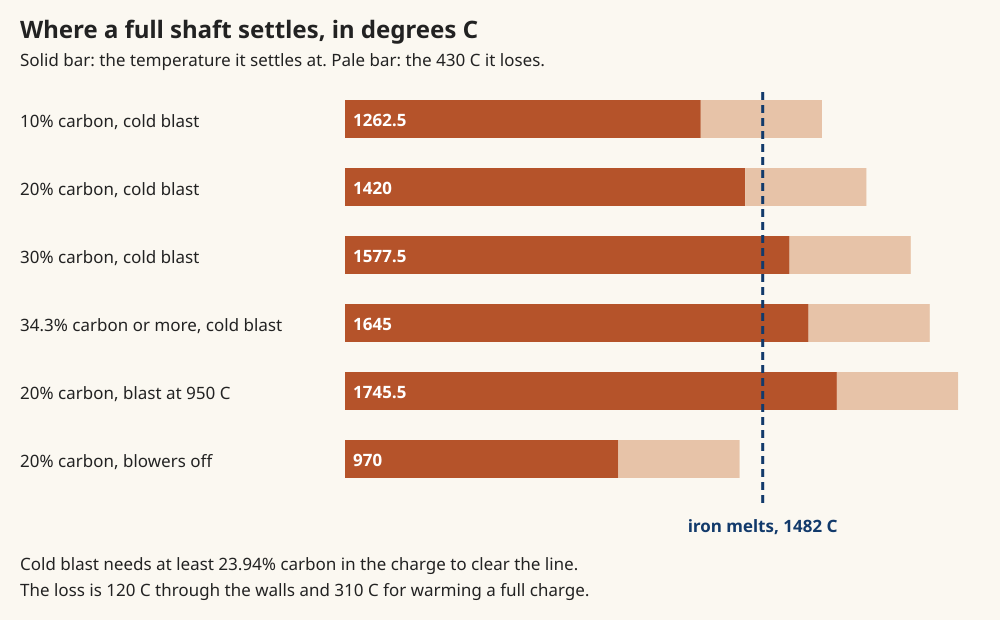
The charge's carbon is read where it burns, at the bottom of the columns, which is why the ratio of the two loads in each course is the coke dial. A shaft keeps half its fire on natural draught, and the rest of the coke's heat comes only with the wind: lose the blowers and it loses 450 C at the reference charge, and it makes no iron at all, because only blast air counts toward the burn at the tuyeres.
One change is planned. The demand is to be set by the volume of air actually blown. A furnace will take whatever its blower can drive through its nozzles, the gauge will rise with the square of the flow as at any orifice, and iron will follow the air. A weak blast then costs only heat, never a refusal, so a poor blower gives a slow cold furnace. Too much heat will tighten the furnace, as a hanging furnace did: Johnson describes the pressure running up as the charge stops moving (Johnson Principles pp. 122-123).
Scale follows the general rules. Air is kept in real litres a second and kilopascals, and the iron and fuel a cubic metre of air gives are scaled together against the vanilla bloomery. A period check is kept beside it: at its need, the planned furnace makes 17.3 tons a period week on charcoal, inside Overman's 16 to 18 (Overman p. 165), and 18.4 tons on coke, inside the 16.3 to 24.5 that Truran's roughly 6 to 9 cwt a cubic yard a week (Truran p. 77) gives on a furnace of this size. Air per kilogram of fuel is each fuel's period pair, taken as it stands, so the two fuels are not equal: on the same air charcoal is the faster fuel, and coke wins on its fuel supply.
Period basis, and what is the game's own
- Period: air by the minute and by the ton (Overman p. 401; Truran p. 78), and pressure set at the nozzle (Overman p. 416).
- Period: heat as both quantity and intensity, with a critical temperature (Johnson Principles pp. 30, 32, 50).
- Period: the fuel saved by heating the blast, large on coke and anthracite and small on charcoal (Johnson Principles p. 39; Overman p. 442).
- Period: a hot furnace going tight, pressure up as the charge stops (Johnson Principles pp. 122-123).
- The game's own: one temperature for the whole furnace, where Johnson's Fig. 6 asks for two heats, hearth and shaft.
- The game's own: the terms of the heat budget are tuning figures, not measurements. No book gives a loss in degrees.
- The game's own: the melt line is the single figure 1482 C. Johnson's 2700 F for a good Bessemer slag is the same temperature, but his is a slag's free-running point and the game's is iron's melting point.
- The game's own: a blast heated only at the steel tier. The period heated it at Clyde by 1830 (Johnson Principles p. 39), on ironmaking furnaces.
The numbers
"Planned" is the design as ruled and not yet in the game; the rest is the game today. Heat figures are the game's own and marked so. Conversions are in scale and units.
| In the game | Period figure | How it was scaled | Game value |
|---|---|---|---|
| Air the furnace needs, charcoal | 1000 to 2000 cu ft a minute at 1/2 to 1 lb (Overman pp. 401, 411, 426) | The period pair, resistance from the middle pair, 1500 cu ft at 3/4 lb; need at 1000 cu ft | Planned 472 L/s at 2.3 kPa |
| Air the furnace needs, coke | 24 to 25 cu ft a minute a cubic yard (Truran p. 78); 1 1/2 lb for a 3 ft hearth (Truran p. 116) | Those rates on the game furnace's 53.6 cubic yards | Planned 620 L/s at 10.3 kPa |
| Air a kilogram of charcoal | Overman's stack, 17 tons a week on 1000 cu ft, 180 bushels a ton (Overman pp. 151, 165, 401) | Period pair, air to fuel | Planned 13.3 m3 |
| Air a kilogram of coke | Dowlais, 732,386 cu ft a ton (Truran p. 78); coal 45.3 cwt a ton (Truran p. 120) | Period pair, air to fuel | Planned 9.0 m3 |
| A furnace's make | 16 to 18 tons a week (Overman p. 165); About 6 to 9 cwt a cubic yard a week (Truran p. 77) | Scaled to the vanilla bloomery; the period week kept as a check | Planned 17.3 tons a period week on charcoal, 18.4 on coke, at need |
| Melt line | 2700 F, a good Bessemer slag (Johnson Principles p. 50) | The game's own, iron's melting point | 1482 C |
| Heat from a lit charge | None given | The game's own | 950 C, plus 900 C at the reference charge and full air, 1125 C at the richest |
| Carbon at the reference | None given | The game's own | 20%, and 34.3% is the most that counts |
| Natural draught | None given | The game's own | Half of full blast, on a shaft |
| Heat lost, full shaft on a 20 C day | None given | The game's own | 430 C: 120 walls, 310 charge |
| Hot blast credit | Fuel 3.42 to 1 at 600 F (Johnson Principles p. 39); 30 to 60% saved (Overman p. 442) | The game's own coefficient | 0.35 C per degree of blast above the air; 325.5 C at a 950 C blast |
| Furnace tightens when too hot | Hanging, no temperature given (Johnson Principles pp. 122-123) | The game's own, 267 C over the melt line | Planned from 1749 C, resistance doubling per 100 C over |
Open, and what you can tell us
The books we hold describe a furnace going tight when too hot but give no temperature for it and no rate, so both of those figures are ours. If you know a measured account of a furnace's pressure against its heat, we would like to read it.
Picture credits
- Air for each ton of pig iron: drawn for this site from Truran, The Iron Manufacture of Great Britain, pp. 76, 78, Library page.
- Fig. 86: Johnson, Principles, Operation and Products of the Blast Furnace, p. 307, cropped, Library page.
- Fig. 6: Johnson, Principles, Operation and Products of the Blast Furnace, p. 94, cropped, Library page.
- Calder hot-blast stove: James Beaumont Neilson, after von Herder 1840, public domain; cropped.
- Where a full shaft settles: drawn for this site from the game's calculation.
- Blast furnaces at Blaenavon Ironworks: Philip Halling, CC BY-SA 2.0.
Comment or suggest something in the Expanded thread on the Vintage Story Discord