
Drilling and boring machines
A drill makes a hole where there was none. A boring machine takes a hole that already exists, cast into the work, and cuts it true. The two tools look alike from across a shop and do different jobs. The lathe can do some of both, and the machine shop page shows where they stood. This page is about the real machines and how the game's follow them. Their parts are in the catalogue, the drilling machine and the boring machine.
What each one does
A drill cuts into solid metal with a point. The metal comes out as chips up the flutes or the sides of the hole. It is a quick way of making many holes and it does not need the hole to be very exact: bolts and rivets have clearance. A drill finds its own way, so a poor grinding or a hard spot sends it off line.
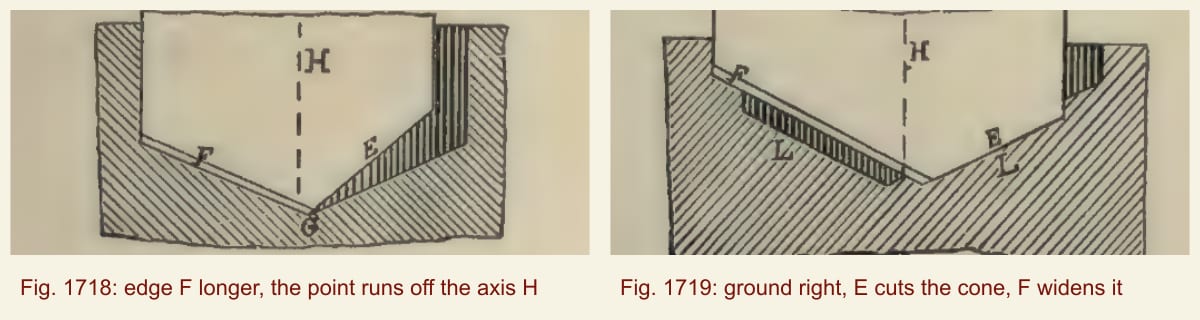
The twist drill, Rose says, "is the best tool" for the drilling machine (Rose p. 442), against the flat drill the smith forged, which rarely ran true and put excessive wear on the spindle (Rose p. 442). A sharp one went a long way. Rose quotes a 1/2 in twist drill going through 2 3/4 in of hammered scrap iron in 1 minute 20 seconds, 120 to 130 holes between grindings, and another drilling more than 3000 small holes in steel without regrinding (Rose p. 278). He has the drill run dry in brass and cast iron, and lubricated in wrought iron (Rose p. 444).
A boring tool works differently. The cutter travels round the inside of a hole that already exists, so it only has to remove a thin skin, and the bar that carries it sets the line of the hole. A bore is cut when something has to fit it: a piston, a journal, a bush.
Why boring is built round a bar
The history is mostly of learning this one thing. Before about 1775 a cylinder was bored much as a tree trunk was bored for a wooden water pipe. "Most of the large foundries had their boring mill" for cannon, pump barrels and cylinders, some turned by horses and the better sort by a water wheel (Farey p. 291). The cylinder was chained to a sledge and hauled against a disk of six or eight steel cutters on the end of an iron axis, the sledge drawn slowly forward by chains and a windlass (Farey p. 291).
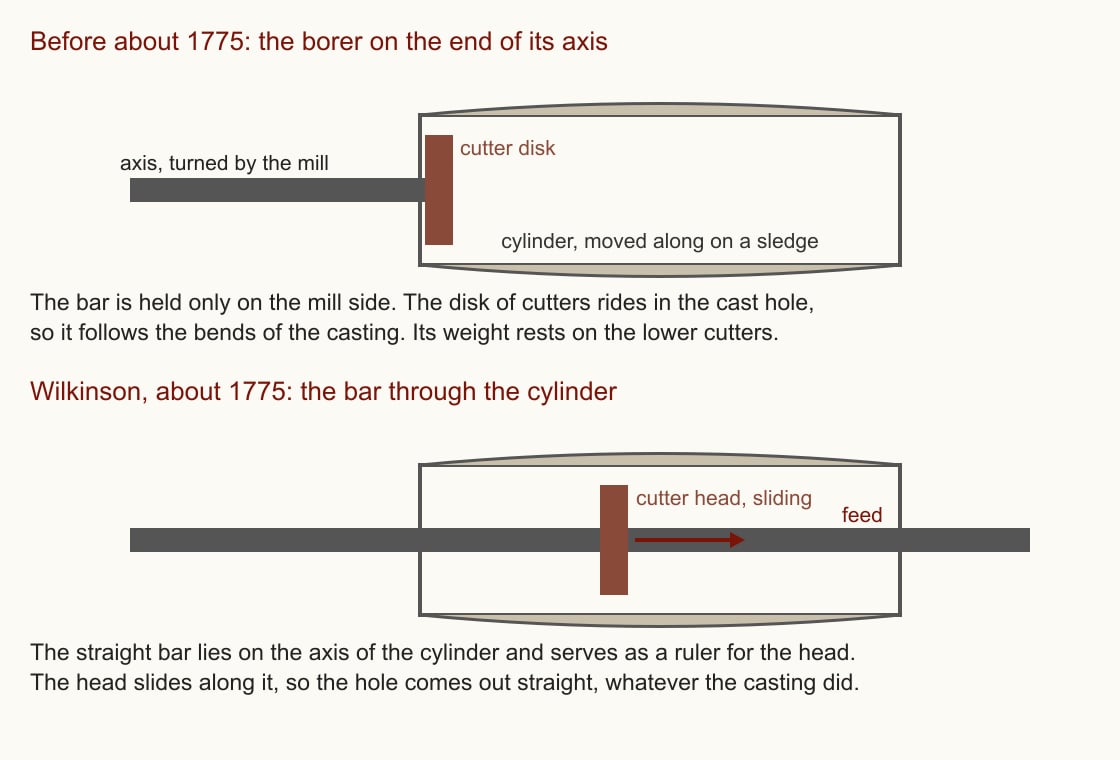
The fault was that nothing guided the borer. Its weight rested on the lower cutters, so a large cylinder came out smooth at the bottom and barely touched at the top, and for the largest cylinders the work was turned and bored again four times to reach all four quarters (Farey p. 294). Smeaton's remedy, at Carron, was a counterweight to carry the borer.
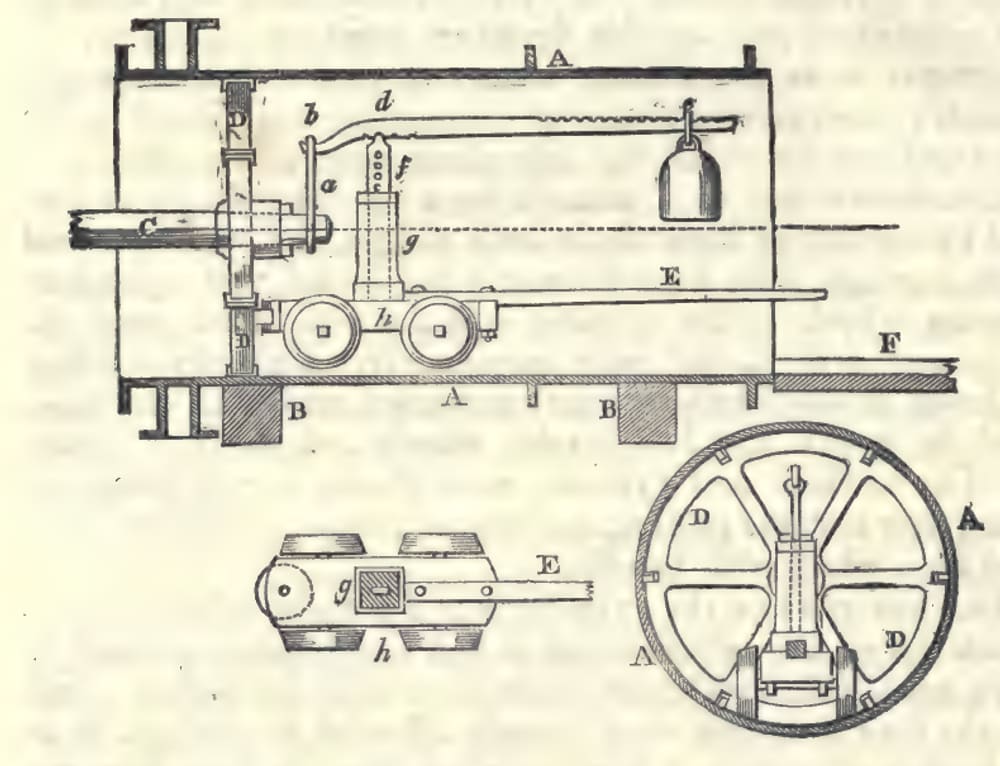
John Wilkinson's machine, introduced at Bersham about 1775, gave the borer a guide. A straight central bar of great strength ran down the axis of the cylinder, and the borer was "accurately fitted to slide along this bar", which served "as a sort of ruler, to give a rectilinear direction to the borer in its progress" (Farey p. 326). Farey calls it the common boring machine of his own day (Farey p. 326). The makers at Soho, in a letter Farey prints, wrote of a 50 in cylinder of Wilkinson's boring at Tipton that it "does not err the thickness of an old shilling in any part" (Farey p. 328). The old method was thought sufficient for the old engines, but "Mr. Watt's engines required greater precision" (Farey p. 326).
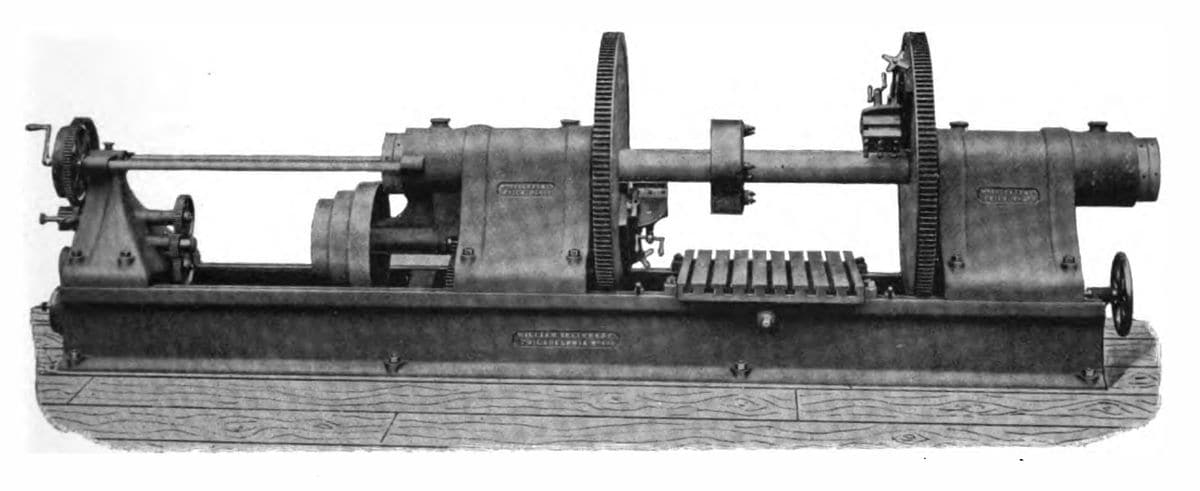
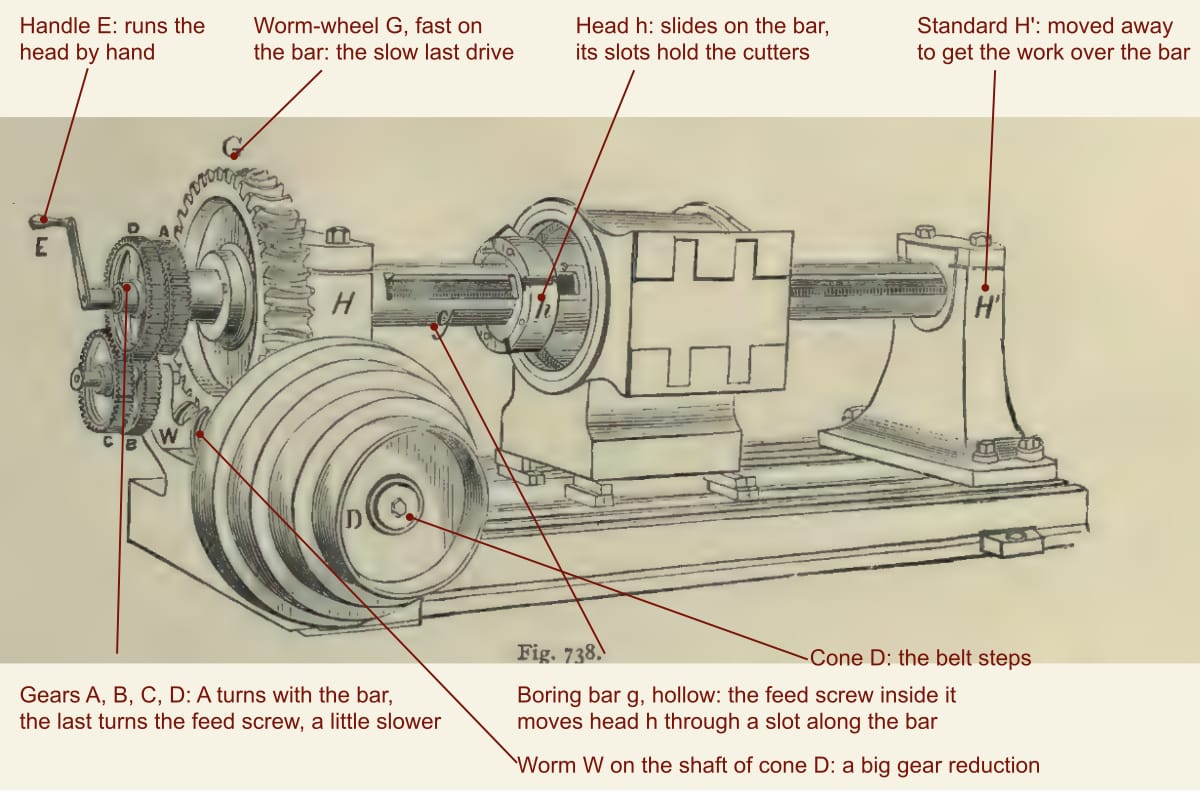
Rose gives why the design ended there. Driving the bar from each end divides the twisting strain between the two halves, which lets it carry a longer cutting edge without chatter and a heavier cut (Rose p. 219). A bar with its cutters in a fixed slot must be twice the length of the work, since the work has to pass all the way along it; a head traversed along the bar by a screw avoids that, at the cost of cutting the bar for the screw (Rose p. 289). Heavy work is left still and the tools go round it (Rose p. 218): a few tons of casting are easier to bolt down than to spin.
How the game divides the work
The two machines are a division of labour that the shop floor had. The drilling machine makes many small holes, and the boring machine cuts the one large hole that has to fit. Hand drilling comes first, at the bench, with the hand drill, up to a hole 3 in across. The shafts that drive both machines are in the shaft power guide.
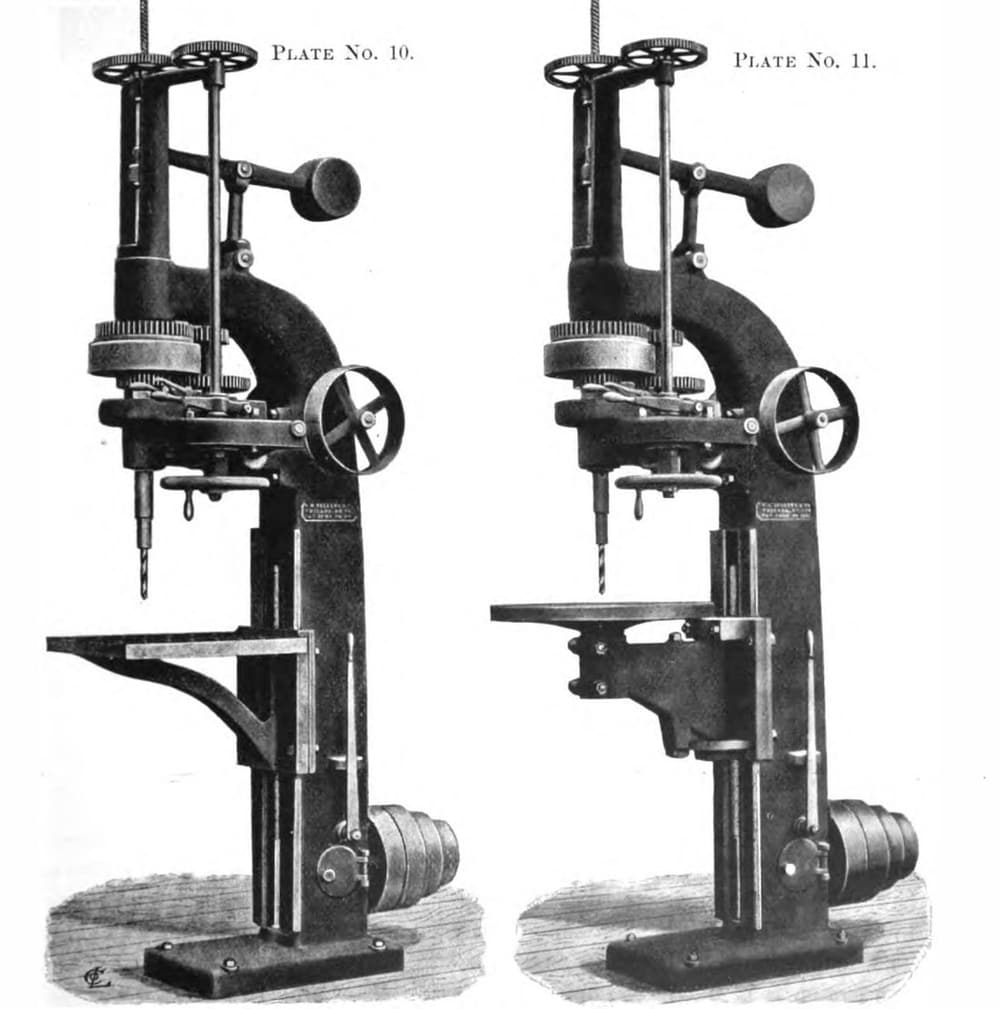
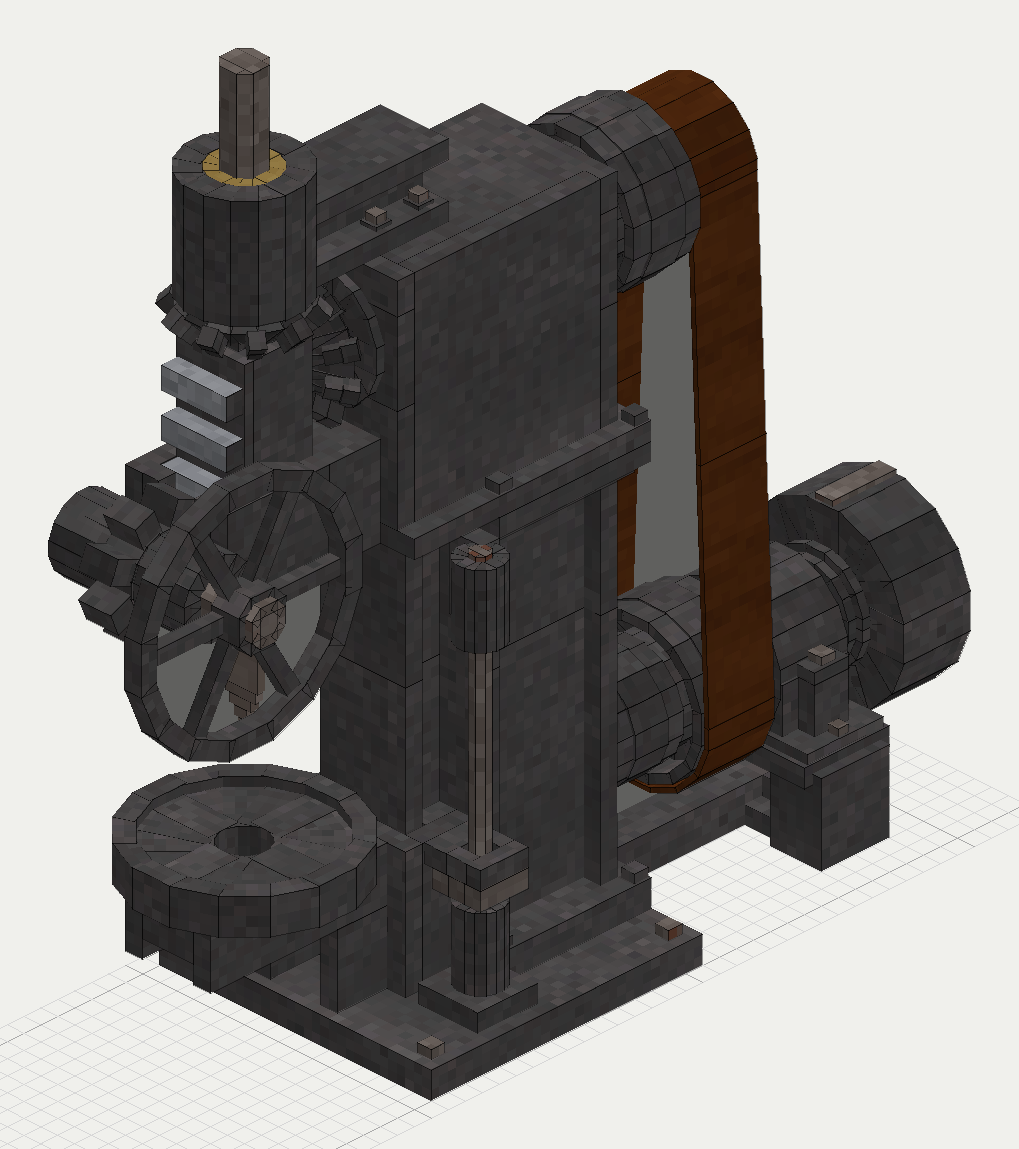
The drilling machine stands where the bench gives out: it drills solid to the same 3 in, faster and with less wear on the bit, and it reaches eyes up to about 10 in across with a bar in its spindle, where the work is the size that sits under it. The planned machine is the Sellers 36 in class. A gear's eye, a helve's holes, a pipe's flange holes and the holes round a cylinder's flange are its work.
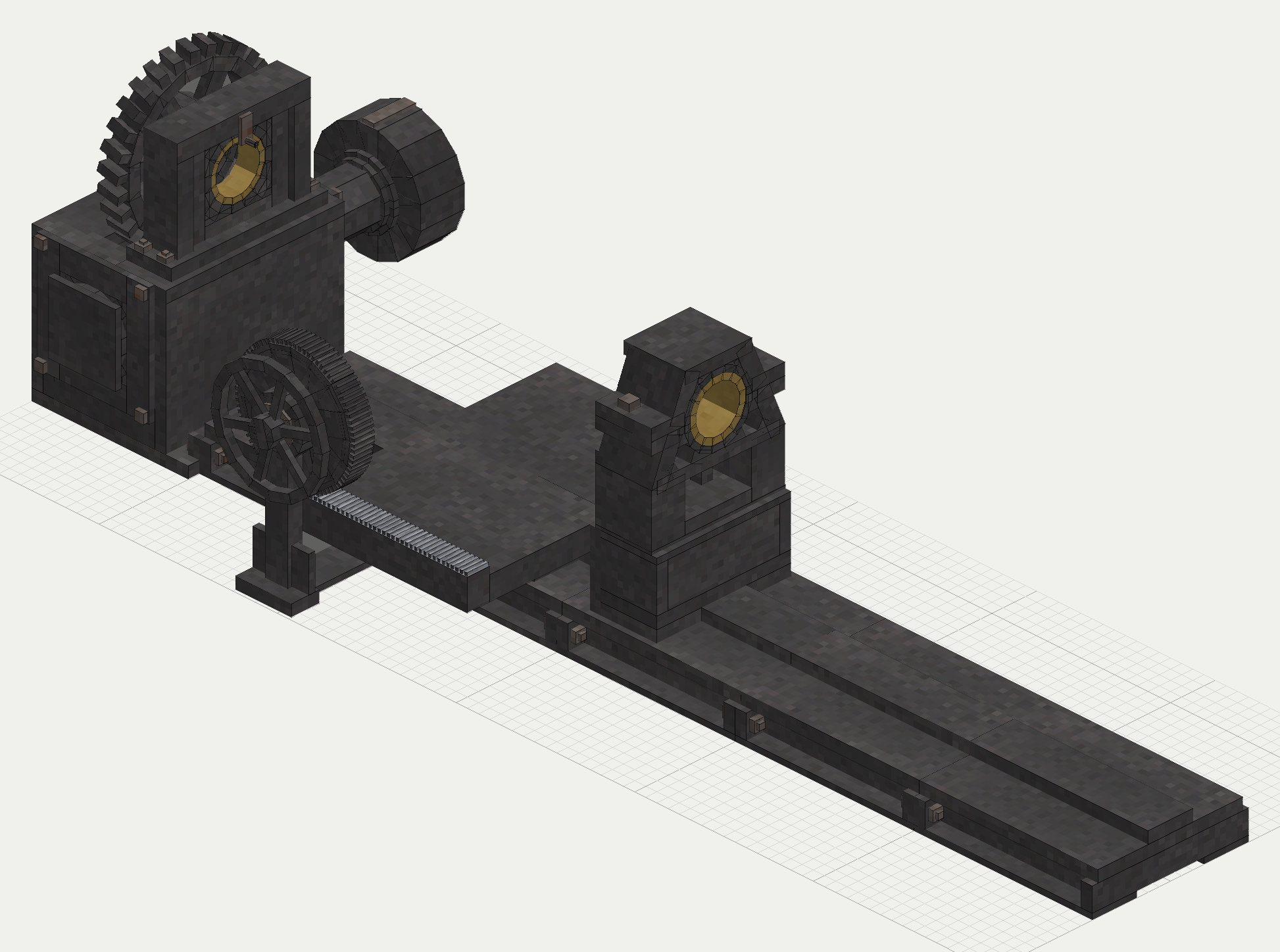
The boring machine is the machine the steam engine waits for. Every cylinder the engine line uses is bored and its ends faced here, because no hand tool can make that hole true. Beyond cylinders it bores the big bearing seats on parts bolted to its platen, and it uses Rose's arrangement: the work bolted still, a cutter head on the bar, and a screw that moves the head. Each bore size has its own cast head. That choice makes each size a thing to prepare for.
Time and torque are worked out from the energy of cutting the metal. The rule comes from how the game scales: the same job on a machine or by hand costs the same work in joules and differs only in how fast that work can be delivered, so a man at a crank takes six times longer than the belt.
Period basis, and what is the game's own
- Period: a drilling machine with a column, a table that rises and falls and a counterweighted spindle fed from the head (Sellers 1895 p. 23). The game's planned drawing is of the Sellers 36 in class.
- Period: Wilkinson's bar through the cylinder with the head sliding along it, and the later form with a feed screw inside the bar (Farey p. 326, Rose p. 219). The game's planned boring machine uses that form: the work bolted down, the head moved along the bar by a screw with a star feed, and the outboard standard moved away to load the work.
- Period: holes in cast iron drilled dry and bits ground carefully and often (Rose pp. 443-444). The game's bit is fitted and wears, and a spent one has to be replaced.
- The game's own: the base game has neither machine and no boring operation at all. See vanilla against reality.
- The game's own: bit and cutter wear are counted by holes and jobs, with no regrinding. Temper gates what will cut at all.
- The game's own: no hole is tapped. Parts are held by bolts through their flanges with nuts.
- The game's own: rivet holes in plate are not drilled at this machine, as drilling those would only tax the build.
- The game's own: a real shop's drilling machine and boring mill overlapped in size far more than the game's do: a drilling head could be fitted for boring (Rose p. 431). The split between 3 in holes and larger bores is the game's own line.
- Planned: nothing here runs yet. The machines can be placed; their processes, bits and cutters are designed, not built.
The numbers
"Planned" is in design and not yet in play. How a real figure becomes a game figure is on the scaling page and scale and units.
| Quantity | Period figure | How it was scaled | Game value |
|---|---|---|---|
| Drill size class | Sellers 36 in vertical: table 26 in by 18 in, stroke 12 in, spindle bearing 5 ft up (Sellers 1895 pp. 23-24) | 16 voxels to the metre, about 0.406 voxels an inch | planned: table 10.6 by 7.3 voxels, stroke 4.9, bearing 24 voxels |
| Largest hole by drill | no direct figure | set on 1.2 voxels, about 3 in | planned: 1.2 voxels, machine and hand alike; the game's own |
| Largest bored eye at the drill | no direct figure | set on 4 voxels, about 10 in | planned: 4 voxels; the game's own |
| Machine drilling power | a 1/2 in twist drill through 2 3/4 in of hammered iron in 1 min 20 s (Rose p. 278), about 170 W as the energy of the metal removed | the same cut scaled to a 3/4 in hole | planned: 360 W; the game's own |
| Man at the drill | a man at a crank, sustained (Rankine 1876 p. 626) | game-to-real time 30 | planned: 61 W |
| The worked example, four holes in a 1.5 kg plate | no direct figure | energy, over power, over 30 | planned: 27 s at the machine, 159 s by hand |
| Bit life | 120 to 130 holes of a 1/2 in twist drill between grindings (Rose p. 278) | not scaled; a bit does not regrind in the game | planned: 120 holes iron, 300 steel; the game's own |
| Boring machine power | a locomotive cylinder bored, faced and counterbored in 3 1/2 hours (Sellers 1895 p. 74) | energy of the skin removed, the skin thickness assumed | planned: 1620 W |
| Largest cylinder bored | Sellers bar 10 in to 22 in (Sellers 1895 p. 75); Wilkinson's 50 in (Farey p. 328) | set to the Watt engines' cylinders | planned: 10 in to 44 in; the game's own |
Open, and what you can tell us
- The books here do not tie a bar's size to the bore it can take, or give a largest cylinder for a boring machine. The game's bar and its 44 in limit come from the Watt engines it has to bore. A maker's table relating bar to bore would be welcome.
Picture credits
- Figs. 738, 1718 and 1719, and Plate CIV.-A, Figs. 1681 and 1682: Rose, Modern Machine-Shop Practice, pp. 219 and 443 and the plate, Library page. Fig. 738 labelled and Figs. 1718 and 1719 set side by side for this page, the plate cropped.
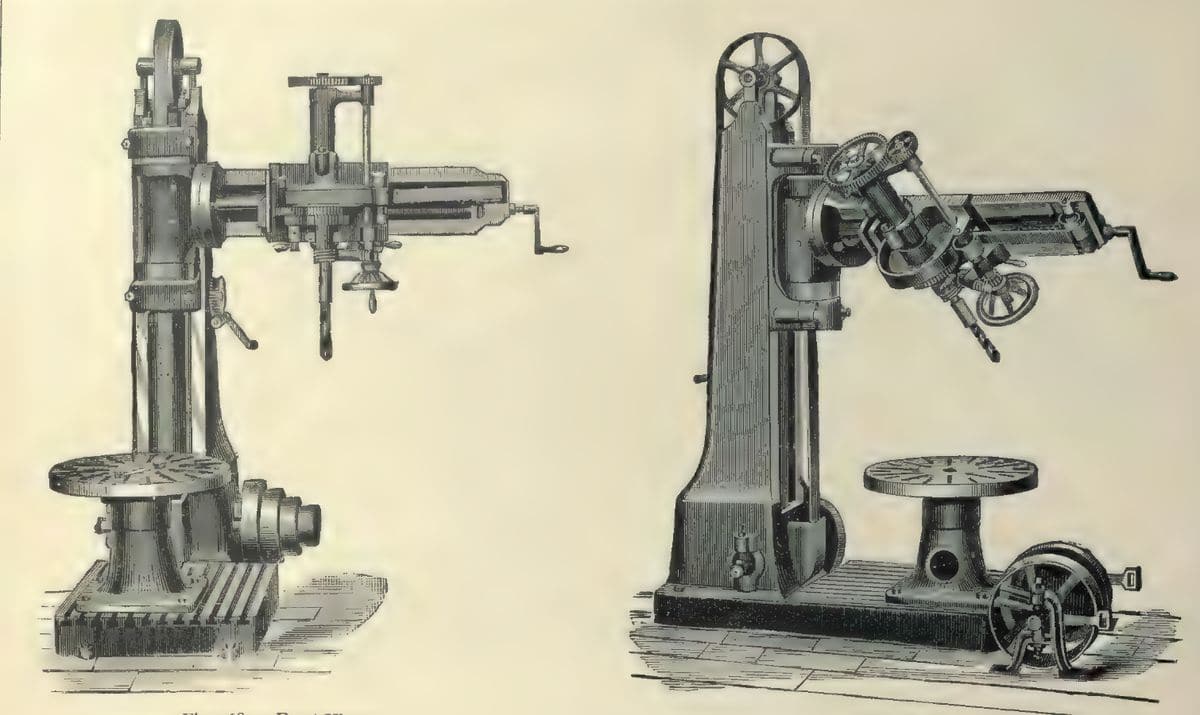
- Plates 10 and 11 and Plate 41: William Sellers and Co., Machine Tools for Working Metal (1895), pp. 23 and 75, Library page.
- Smeaton's steelyard carriage: Farey, A Treatise on the Steam Engine, p. 294, Library page, cropped.
- The two ways of boring: drawn for this page from Farey pp. 291 and 326.
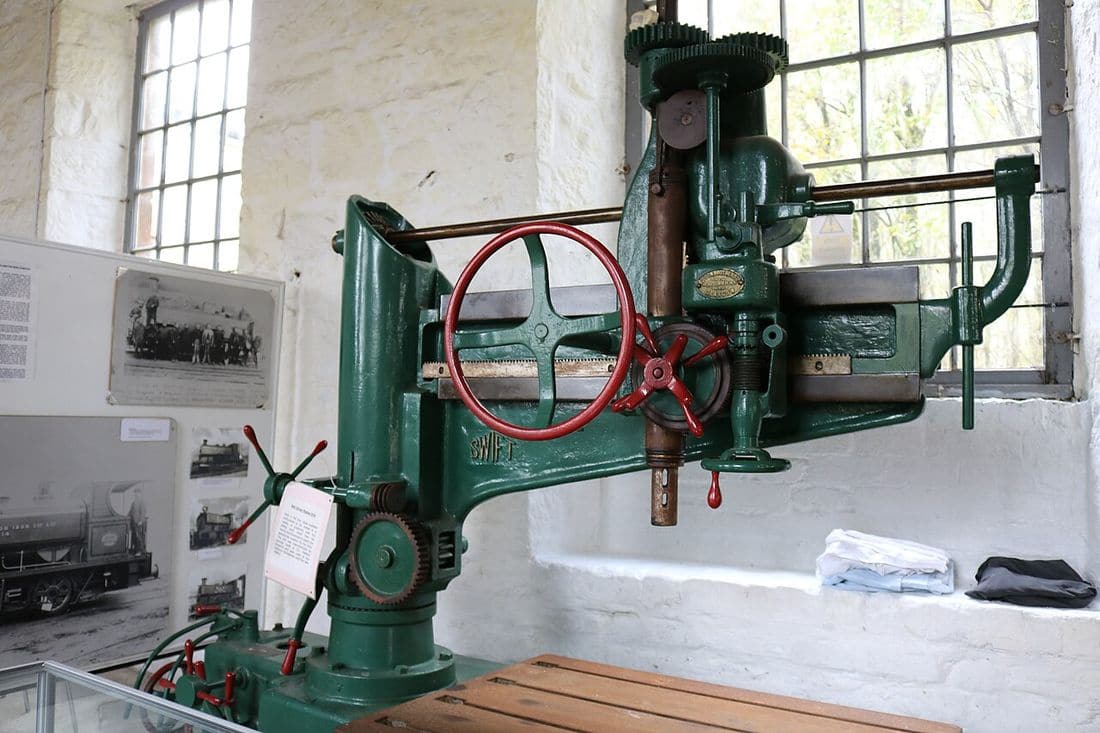
- Belt Driven Radial Drill, Dunaskin Museum: Billy McCrorie, CC BY-SA 2.0, resized.
Comment or suggest something in the Expanded thread on the Vintage Story Discord