
Making boiler plate
A boiler is made of plate, and the plate had to be right before the boiler shop saw it: strong both ways, sound through its thickness, and big enough to cut square with its defects left outside the line. This page follows a plate from the pile of bars at the ironworks to a riveted ring of a shell, then says what the game keeps. Rolling in the game is in the rolling guide, the boiler it goes into is on the Cornish boiler page, and the iron itself comes from shingling and piling. Bending and the shells it makes are planned, not yet in the game.
At the ironworks: the pile, the slab and the plate
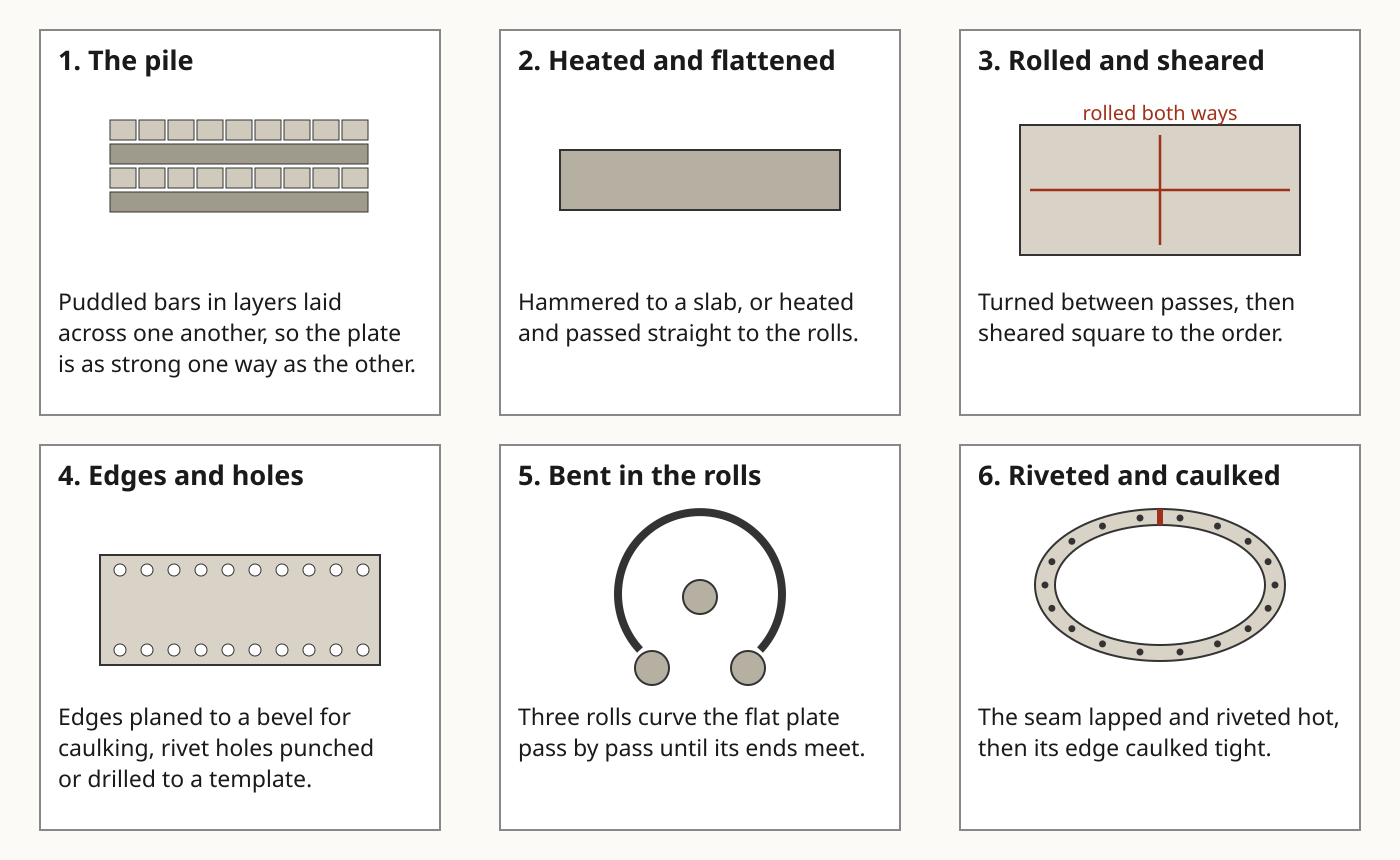
Plate began as a stack. "Boiler plates, if manufactured of best iron, are invariably rolled from piles having alternate layers laid crosswise" (Truran p. 230). Iron has the least strength at right angles to the way it was rolled out (Truran p. 238), and a boiler shell is pulled every way at once, so the fibre was laid across itself before the first heat. A cheaper road hammered two blooms together and rolled them direct, giving a plate of about the same strength each way, but "no higher than No. 2 iron" (Truran p. 230).
Works differed in the next step. Overman's American practice took a slab from the hammer, 12 to 18 in long, 7 to 10 wide and 2 to 3 thick, and rolled it in one heat (Overman pp. 368-369). At Farnley a lump 12 in square and 4 or 5 thick was piled and hammered to a slab 2 to 4 ft long (Percy p. 734). Truran's mills heated the pile and took it to the rolls, the pile being "wider, shorter, and generally thinner than the piles for bars" (Truran p. 238).
The rolling went by turning the piece. It was "passed sideways between the rolls, then endways, changing the direction at each rolling" until nearly to size, and the roller then chose each pass by which way the plate still had to grow, so that it would come out big enough to cut to the order (Truran p. 238). Careless work left its mark: "Boiler plates too commonly are stronger in one direction than another" (Truran p. 238). The rolls were large and slow, upwards of 6 ft long and 18 to 21 in across, running at 28 or 30 revolutions where merchant rolls ran at 60 or 70 (Fairbairn Iron p. 125). Thin wide plates could defeat engine and flywheel together, and then "the plates cool and stick fast in the middle" (Fairbairn Iron p. 125). The surface was swept with a wet broom as it was rolled, which loosened the scale (Overman p. 369).
The finished plate was sheared square. Its size was set by what it cost: 4 ft was the usual widest without extra charge, and the length was arranged to keep the plate within 4 cwt (Wilson p. 91). A specification might require 2 to 4 in between the cut edge and the nearest defect, and some plates were ordered oversize so a strip could be cut off and broken (Wilson p. 37). To find a lamination hidden in the thickness, the plate was propped on its corners, strewn with fine sand and lightly tapped from below: the sand danced off sound plate and lay still over a split (Wilson p. 37). Good boiler plate was also expected to bend cold without fracture, to angles Wilson tabulates by thickness, and the best quality to bend double when red hot (Wilson p. 37).
In the boiler shop: edges, holes, bending and the seam
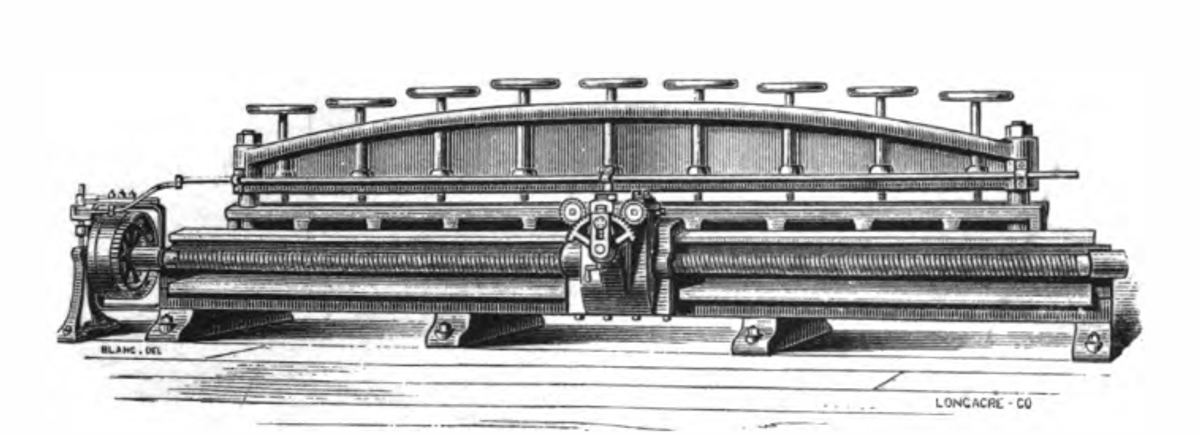
Hawkins's list of what a shop needed is short: the rolls, a wide planer, heavy shears, a power punch, a tool for the big tube holes, and rivet furnaces and riveters, with chisels, hammers and drift pins for the hand work (Hawkins p. 281).
Rivet holes were punched or drilled: soft iron and mild steel could be punched safely, but brittle metal had to be drilled (Hawkins p. 92). Maynard's experiments put drilled work 15% ahead of punched taken all round (Wilson p. 69). The trouble lay in getting two plates' holes to agree. "A place where skill is shown in boiler construction is in laying out the rivet holes, with a templet," so that "the dreaded drift pin does not have to be used" (Hawkins p. 92). Wilson records a new boiler whose holes had been repunched larger to get the rivets through the adjoining plate, and plates cracked by the drift (Wilson p. 217).
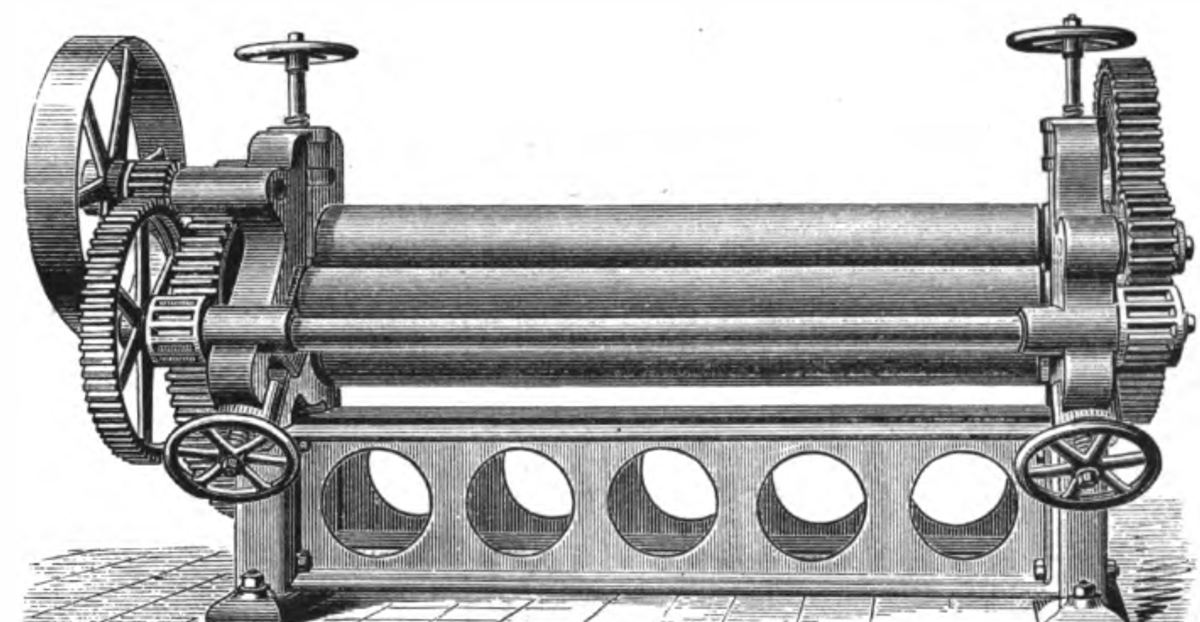
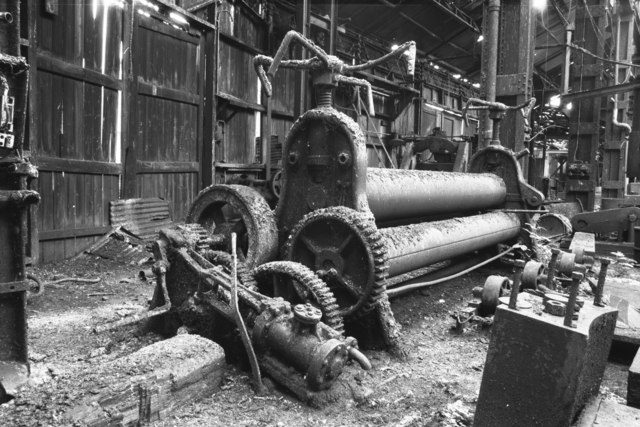
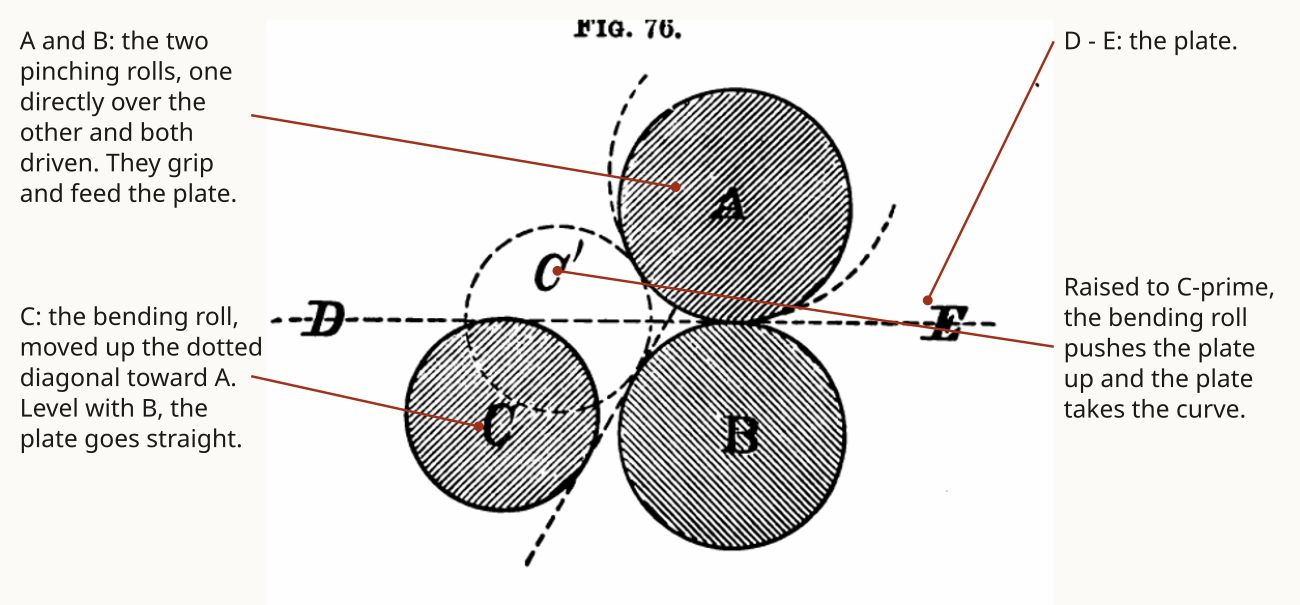
The rolls were worked by hand levers or by power (Hawkins p. 281), and the hand sets used the three-high pyramid; Sellers would not gear a pyramid to power, because the pinions carried too much strain (Sellers 1877 p. 161). A pyramid leaves more of the plate's end flat, which is the reason for the two-pinching-roll setting (Sellers 1877 p. 163). Wilson lists plates "cracked in bending" and "burnt in flanging" among the defects a shop could put into a new boiler (Wilson p. 217), and fracture in flanging, dishing, bending and punching again in his later list (Wilson p. 230).
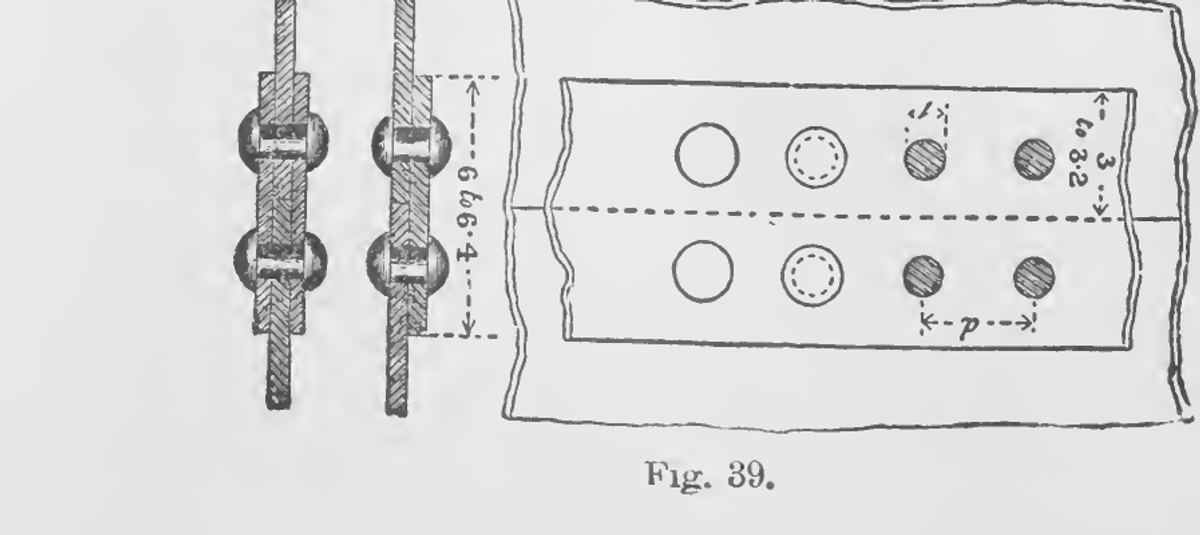
Rivets went in hot and were headed by hand, by steam riveting machine, or by a pneumatic one that held the plates together while it struck (Hawkins p. 92). Then the seam was made tight: the edges, planed true beforehand, were closed with a blunt chisel and a 3 or 4 lb hammer, and fullering did the same with a round-nosed tool (Hawkins p. 94). Below 1/4 in a plate was too thin to caulk properly, and 1/4 in was the thinnest a boiler should use (Hawkins p. 94).
And stamping?
Period boiler plate was not stamped out in dies: Hawkins's list of boiler-shop tools has no die or stamp (Hawkins p. 281). In the game's design a die under the steam hammer turned one hot boiler plate into three vanilla plates, a job designed but not built. It is planned to go, because the planned plate is too large and too thin for it, and vanilla plate is planned as a rolled product of its own. Die work on the steam hammer stays for forgings.
Period basis, and what is the game's own
- Period: boiler plate was piled in crosswise layers so as to be equally strong each way (Truran pp. 230, 238). The game plans a pile of plate bars in 4 crosswise layers, laid cold beside the reheat furnace and charged whole. The direction of the fibre is not modelled.
- Period: the plate was turned between passes and worked both ways (Truran p. 238). The game plans it rolled lengthwise on the wide flat rolls to the thin gauge, cropped by the shear into five pieces, each rolled on to the finished gauge.
- Period: plate rolls were a mill of their own, plain and chilled (Truran p. 238). The game uses the mill's one wide flat roll set for plate and for bending alike, and that set does not wear.
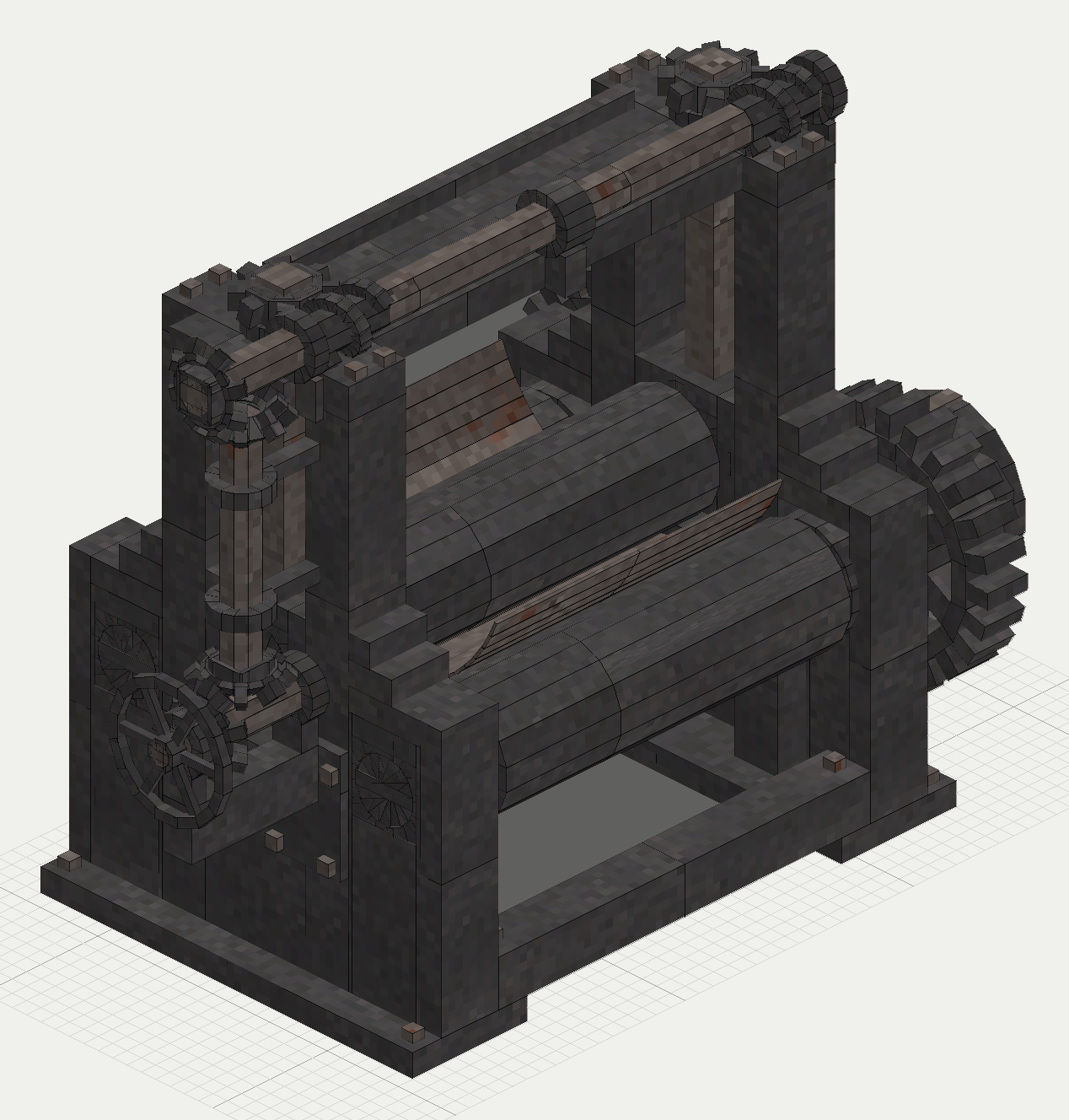
- Period: plate bending rolls stood beside the shear and the punch in the boiler shop (Hawkins p. 281). The game plans one pyramid machine, the top roller's height choosing the bend, built where the player wants it.
- Period: a shell was marked out, its edges planed, its holes punched or drilled, the rivets driven hot and the seam caulked (Hawkins pp. 92, 94; Sellers 1877 p. 101). The game's own: rivets are an ingredient of the recipe and the joint is a line in the bill, with no punch, no driving and no caulking.
- The game's own: springback, the plate relaxing slightly after a pass, is left out, because a hidden number with no readout goes against the rest of the game.
- The game's own, planned: an unfinished shell can be put down and picked up later. Every other forming job in the game races a cooling piece, and cold bending is the one schedule with no clock.
- The game's own: stamping boiler plate into vanilla plate, designed but not built, and planned to go. See above.
- The game's own: the base game's plate has no gauge and no grain, and is smithed rather than rolled. See vanilla against reality.
The numbers
Voxels are the game's drawn units (scale and units); a block is a metre and 16 voxels make one. Plate and pile sizes follow period figures through the rule of the scaling page. "Planned" is the value in design; without that word it is what the game has now.
| In the game | Period figure | How it was scaled | Game value |
|---|---|---|---|
| Plate, width | 4 ft usual, more at extra charge (Wilson p. 91, Percy p. 755) | True size, whole voxels | 15 voxels, 0.94 m; planned 20 voxels, 1.25 m |
| Plate, length | Length to keep within 4 cwt (Wilson p. 91), lengths to 15 ft and beyond at extras (Percy pp. 755, 759) | True size, whole voxels | 16 voxels, 1.0 m; planned 25 voxels, 1.56 m |
| Plate, thickness | 3/8 in mill boiler shells (Fairbairn Useful p. 301), 1/4 in the thinnest (Hawkins p. 94) | True thickness | 1 voxel, 62.5 mm; planned 0.16 voxels, 10 mm |
| Plate, weight | 15 lb a sq ft at 3/8 in (Courtney p. 95): 360 lb, 163 kg for 4 ft x 6 ft (Wilson p. 91) | By volume at the drawn size | Planned about 150 kg by the same weight rule (5 lb a sq ft per 1/8 in, Courtney p. 95) |
| Metal in a plate | None given | The game's own, 2.5 u a cubic voxel | 600 u; planned 200 u |
| Roll length | "upwards of 6 feet" for large plates (Fairbairn Iron p. 125), 4 and even 5 ft (Overman p. 366) | Whole voxels, barrel to take the plate | Planned 24 voxels, 1.5 m |
| Pile | Laid crosswise to the plate's shape (Truran pp. 230, 238) | The game's own: 4 layers of 5 plate bars | Planned 20 x 20 x 1 voxels, charged whole |
| Roll speed | 28 or 30 revolutions a minute (Fairbairn Iron p. 125) | Not modelled | None |
| Passes in the bending machine | Not given | The game's own, open | Not chosen; the bending itself is planned |
| Seam strength | Double-riveted 70, single 56, plate 100 (Wilson p. 73, Courtney p. 92) | The rule at face value in the boiler rating | See the Cornish boiler's numbers |
Open, and what you can tell us
The books consulted say how a good plate should bend cold as a test (Wilson p. 37), and show plate rolls with no furnace beside them (Sellers 1877 pp. 161-163, Hawkins p. 281), but none of them says in so many words that a shell plate was rolled cold or heated. The game plans it cold. If you know a shop book that states it, or the thickness at which a plate was heated for the rolls, we would like to read it.
Picture credits
- The road from pile to ring: drawn for this page from Truran pp. 230 and 238, Overman p. 369, Percy p. 734, Hawkins pp. 92 and 94, and Sellers 1877 pp. 101 and 161.
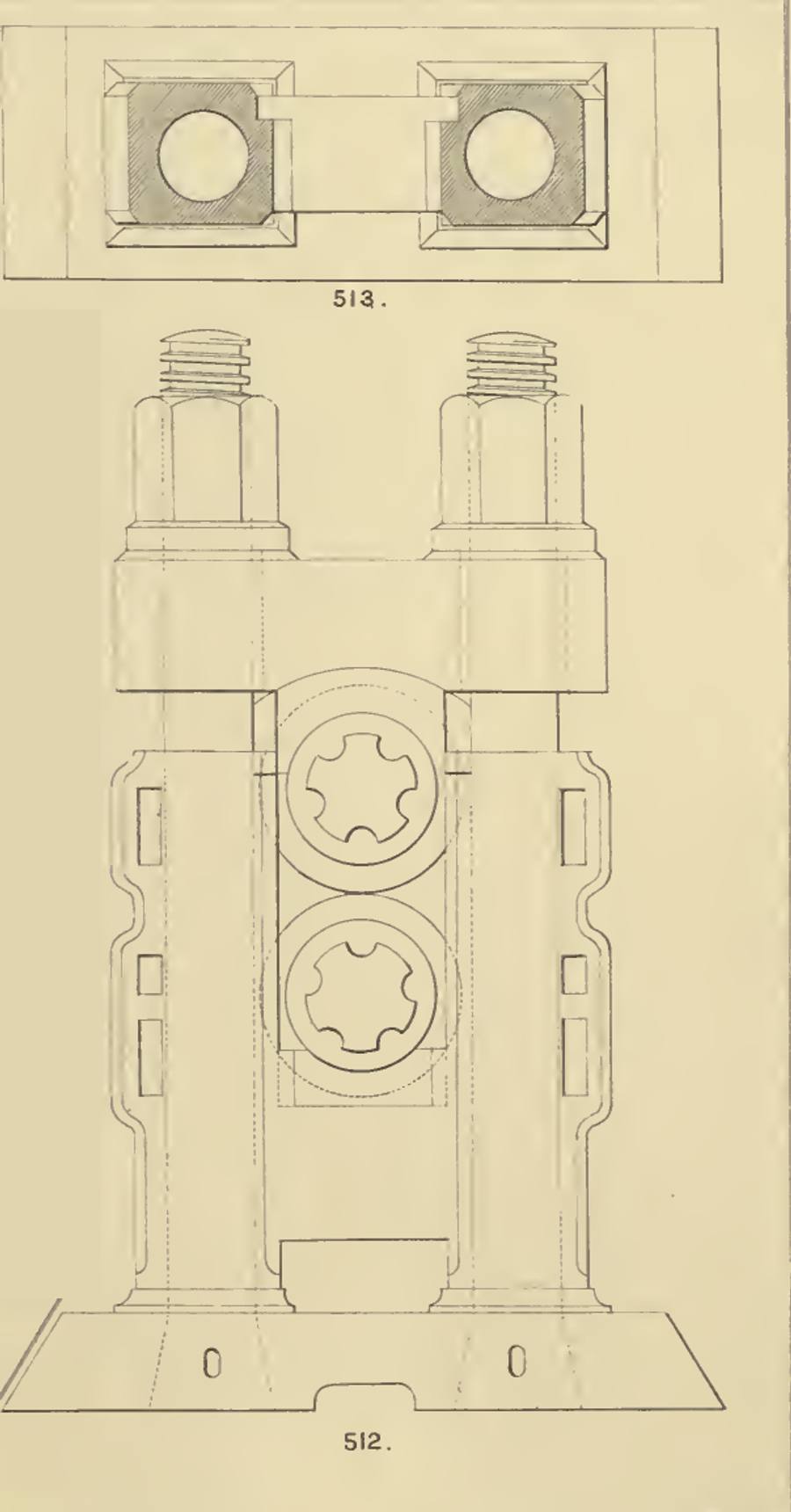
- Plate-mill housing, Figs. 512 and 513: Truran, The Iron Manufacture of Great Britain, Pl. 76, cropped and the neighbouring figures painted out, Library page.
- Bending rolls, Fig. 76, labelled for this page; power bending rolls, Fig. 77; plate-planing machine, Fig. 51: William Sellers and Co., A Treatise on Machine Tools (1877), pp. 162, 163 and 101, Library page.
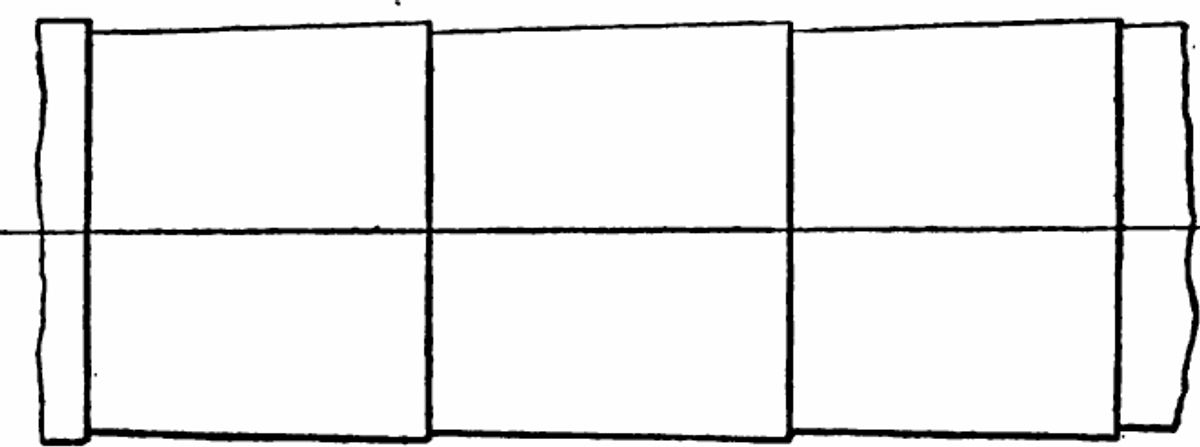
- A seam, Fig. 39: Hawkins, Maxims and Instructions for the Boiler Room, p. 92, Library page.
- Conical lapped plates, Fig. 96: Courtney, The Boilermaker's Assistant, p. 78, Library page.
- Plate bending rolls, Sheepford Boiler Works: Chris Allen, CC BY-SA 2.0.
- The game's plate-bending machine: the mod's planned drawing.
Comment or suggest something in the Expanded thread on the Vintage Story Discord