
Running a boiler house
A boiler was tended all day by a fireman with a shovel and a small set of habits, and the coal bill depended on those habits. How to build and fire the game's boiler is in the steam and boilers guide, and the machine itself is on the Cornish boiler page. This page follows the fireman's day in order, then says what the game keeps of it. Most of it comes from one book, Hawkins's handbook for the boiler room, which is written for the person doing the work.
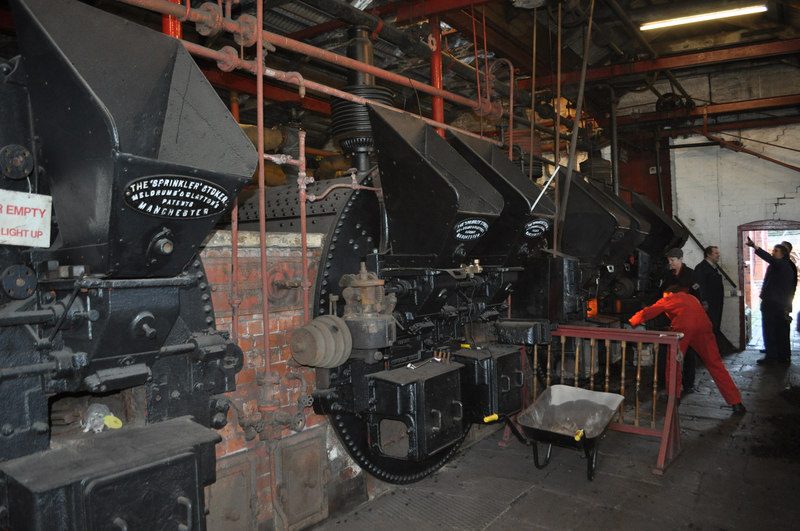
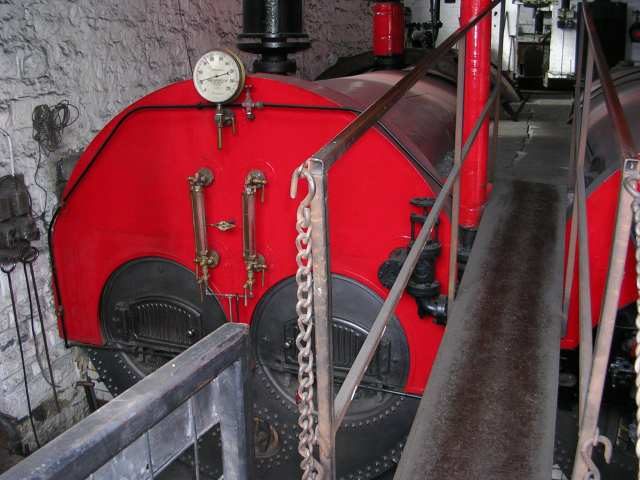
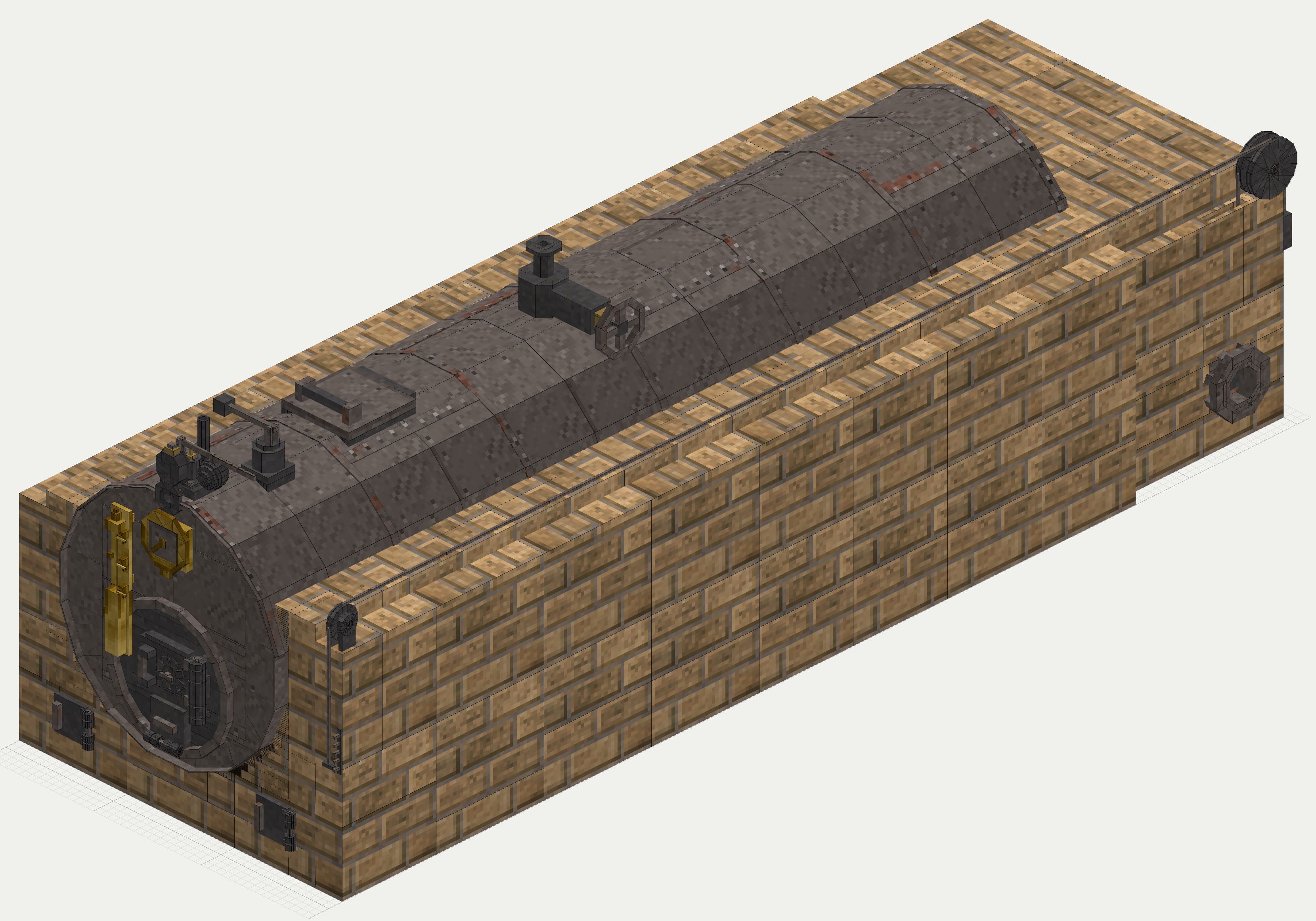
Before the fire
Hawkins divides the job into three: preparing the boiler, running it, and cleaning it afterwards (Hawkins p. 24). He also says it cannot be got from a book, "the art of firing cannot be self taught" (Hawkins p. 24), and gives the reason in figures: in German trials trained firemen evaporated 11 lb of water to the pound of coal, and the best of the untrained 6.89 lb (Hawkins p. 24).
Each morning came a round of checks, in order, before any match (Hawkins p. 25): that the boiler held the right water and had not run out or been tampered with in the night, that the safety valve lifted freely, that the top gauge cock stood open to let the air out, that the bars were clear of clinker. Then shavings, wood and a little of the regular fuel, the draughts wide open (Hawkins pp. 25-26). When steam showed at the open cock the air was out, and the cock was shut (Hawkins p. 26). Steam was raised slowly, for the plates' sake (Hawkins pp. 26, 44).
Firing
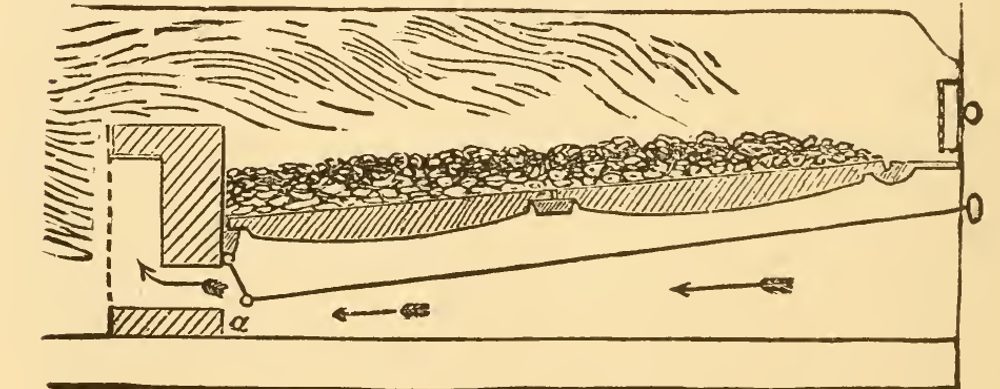
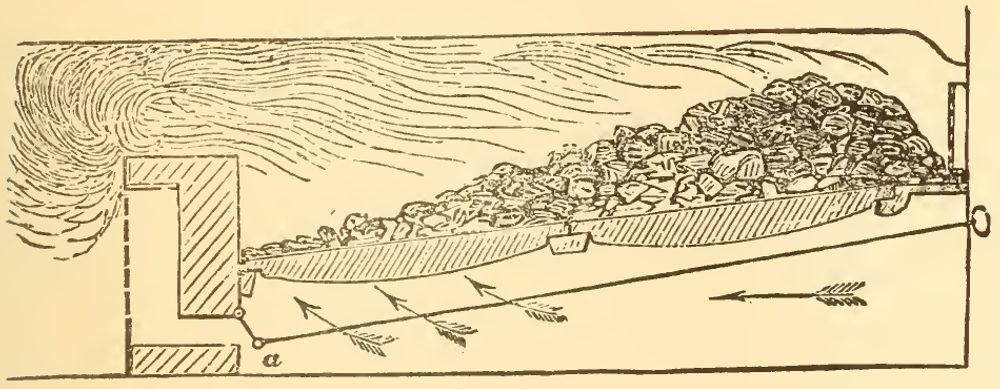
Hawkins sums up the day in seven rules (Hawkins p. 27). Charge from the bridge end to within a few inches of the dead plate. Never let the fire fall below three to five inches of clean burning fuel, spread evenly. Keep the bars covered at the sides and the bridge, where it burns fastest. Level the holes. Break large coals to the size of a man's fist. Clear a shallow ash pit before hot cinders burn the bars. Do not hurry the fire. Stirring was to be avoided, and firing done "a little at a time" (Hawkins p. 40). English trials gave a figure for all this care: "Difference in mode of firing only may produce a difference of 13 per cent" (Hawkins p. 40).
In a big house the rhythm was set for the fireman. In a Massachusetts mill with sixteen boilers each boiler was fired every five minutes, and a gong on a clock told the man when: he went down the row with half of each door open and charged half of each grate, and at the next gong the other half (Hawkins pp. 29-30). The book names batteries of five, eight and three, then two firemen "for the battery of twelve and one for each of the others" (Hawkins pp. 29-30), which does not add up as printed. The same page shows the small plant's way: an old engineer on a boiler of twenty horse power kept one heavy fire, disturbed it once in a ten-hour run, cleaned it, dressed it light, banked it as deep as the bridge wall allowed and shut his dampers; "in the morning I open and govern by the dampers" (Hawkins p. 30).
Feeding and watching the water
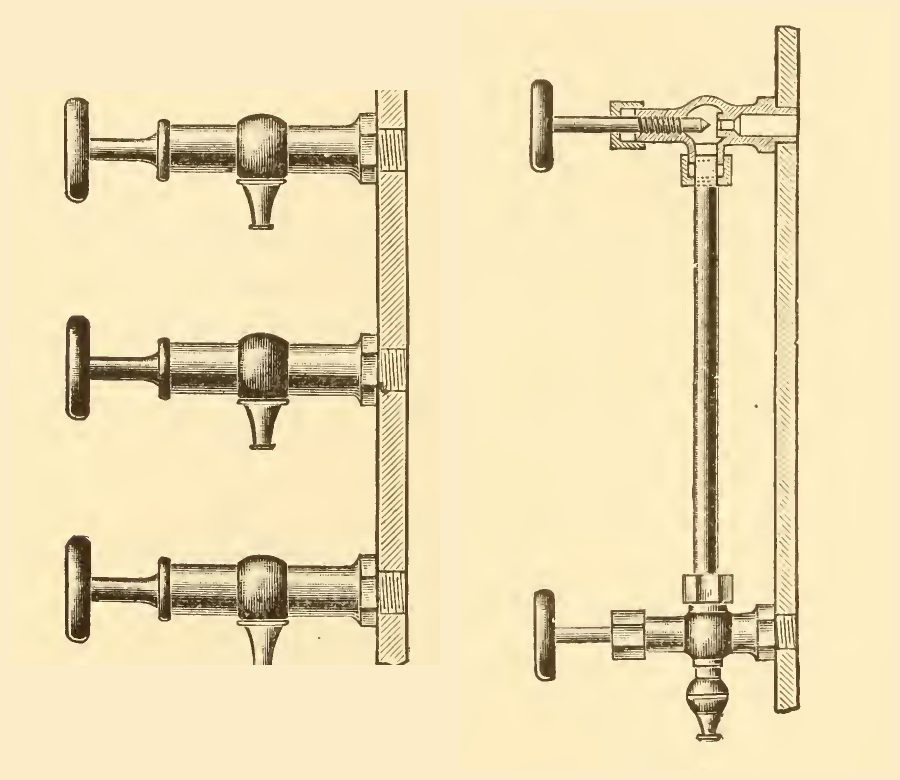
"It is of the first importance", Hawkins begins, that those in charge know the water level with certainty (Hawkins p. 176). The cocks were tried many times each day, and the top one should give steam and the bottom one water; a beginner soon told them apart by the sound (Hawkins p. 176). The water stayed at one height all day (Hawkins p. 44), which meant feeding as steadily as the steam went away. Every boiler had a feed pump or injector with its own feed valve and check valve (Hawkins p. 164), and ought to have two feeds, one of them an injector, in case one failed (Hawkins p. 206). The pumps are on their own page.
Low water was the danger the whole routine guards against. A fusible plug melted through and let steam on to the fire (Hawkins p. 172). If the water had fallen too low the fire was drawn, and if too hot to draw it was smothered with fresh coal, damp ashes or soil, the fire doors opened and the ash-pit doors closed. Hawkins then adds a run of don'ts, each for a man who wants to act: do not feed water in, do not blow off steam, do not touch the safety valve, do not change the feed or the throttle in a hurry (Hawkins p. 45).
Scale, mud and blowing down
Steam leaves the salts behind. Whatever came in with the feed stays in the boiler, and in a battery burning 20 tons of coal a day that is the residue of 200 tons of water daily (Hawkins p. 143). It settled as mud or baked on as scale, and scale cost fuel: 1/16 inch of it about 13% of the fuel, 1/2 inch about 60% (Hawkins p. 143).
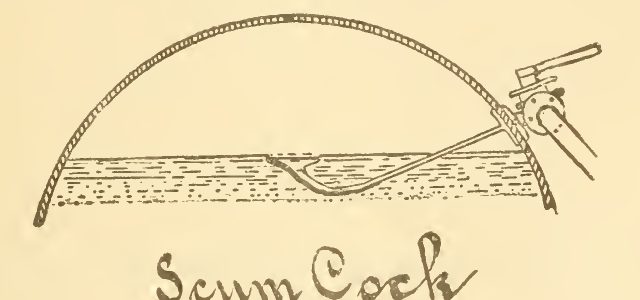
The custom was to "blow off" one or two gauges of water once or twice a day and refill with fresher water (Hawkins pp. 44, 159). Hawkins calls it "a very imperfect method", since it throws away all the heat in the water blown off (Hawkins p. 159), and the blow-off cock had to be closed in time (Hawkins p. 44). Full cleaning came after that: emptying the boiler every week or two and filling with fresh water (Hawkins p. 45), never while the brick was hot (Hawkins p. 44), never starting to clean before it had cooled (Hawkins p. 45). He gives two reasons not to blow out under pressure: the scum on the falling surface is left on the shell, and the hot walls bake the mud on, which could otherwise be washed out (Hawkins p. 151). Mud drums, once fitted to catch sediment, he calls "becoming antiquated" (Hawkins p. 180).
A battery on one main
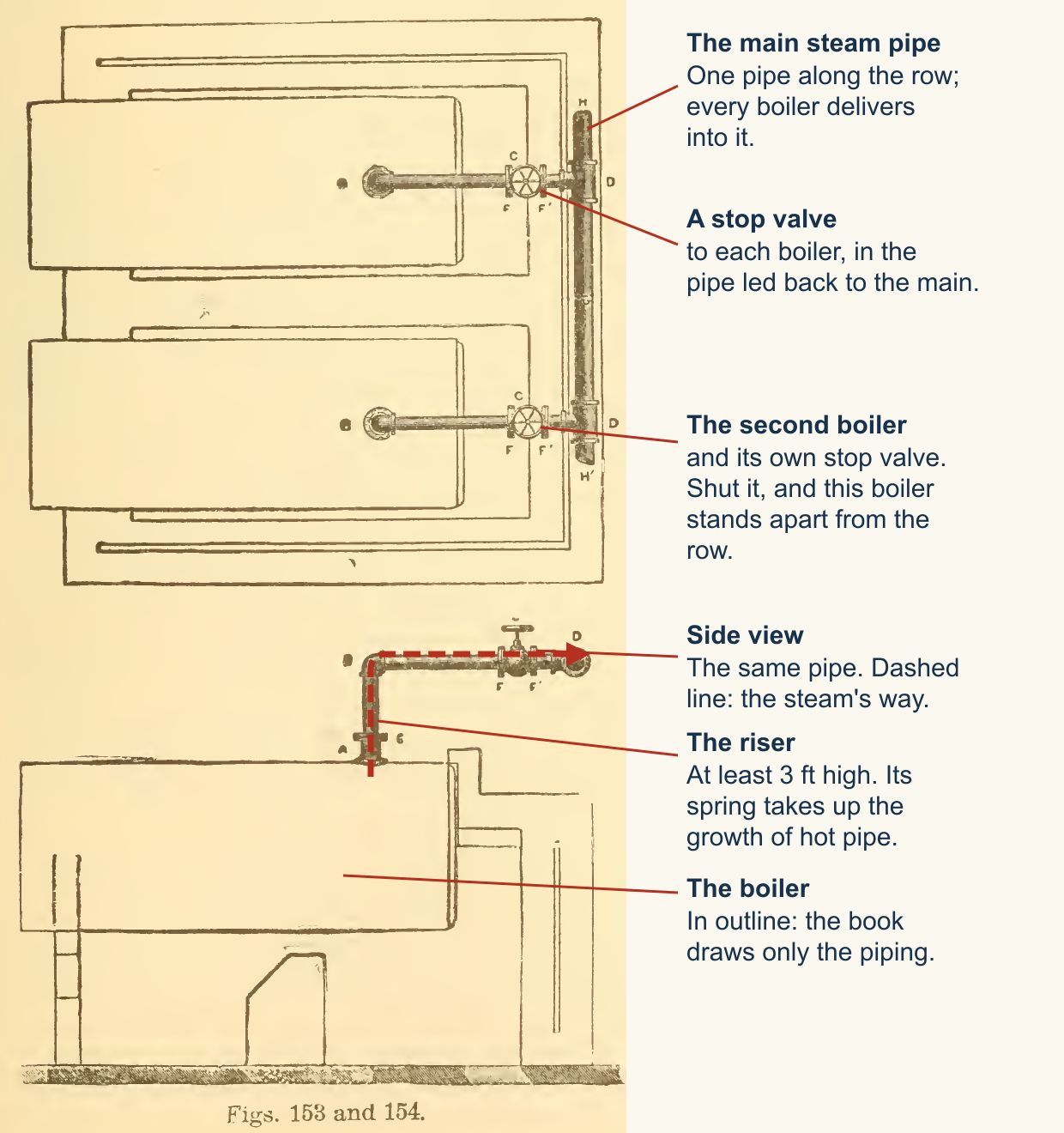
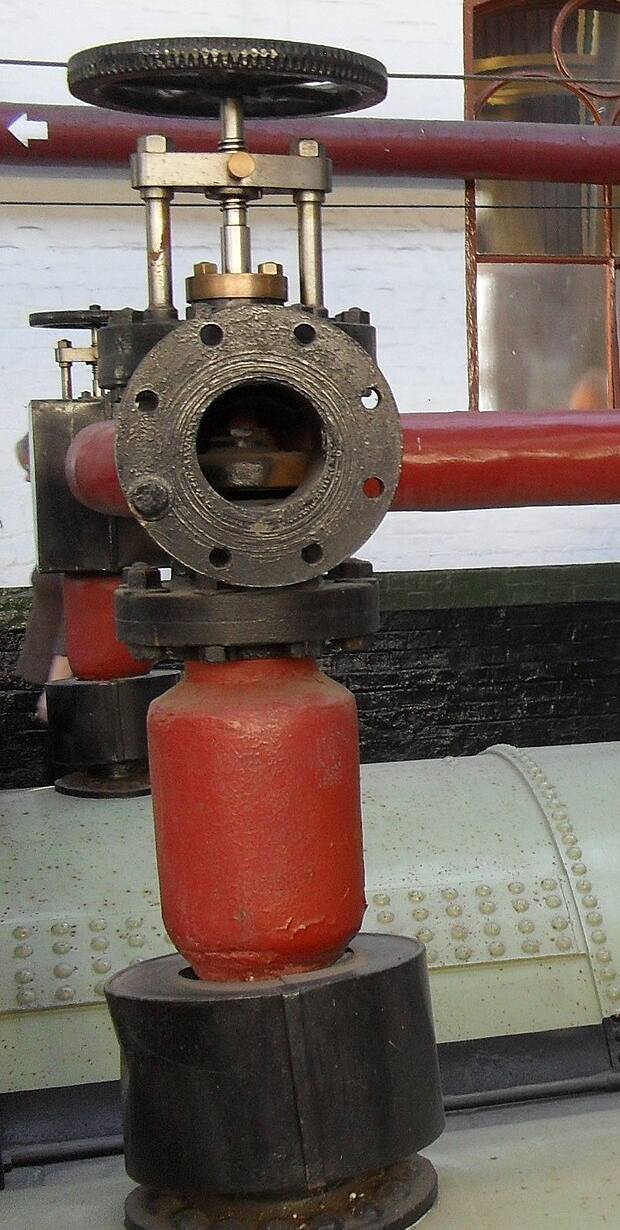
Hawkins gives the pipes and not the reasons. Each boiler in the row keeps its own safety valve, with no stop valve between it and the shell (Hawkins p. 191), and its own feed and check valve (Hawkins p. 164). Risers were at least three feet high, and six to eight in a battery of eight or ten boilers (Hawkins p. 272). The routine above suggests one reason a plant wanted more than one: a boiler that must be emptied every week or two, and cannot be touched until it is cool, stands idle for a time. That is inference from his routine and not his statement. A few firemen served a whole row (Hawkins pp. 29-30).
Bringing a cold boiler on to a live main is a rule of plain physics more than of any book: below the main's pressure a boiler with its valve open takes steam instead of giving it, and the steam condenses on its cold water. Steam is raised with the valve shut, and opened once the gauge reaches the main's pressure. The water side stayed separate too, since water connected between boilers "seeks a uniform level" (Hawkins p. 225), which is why each has a check valve on its feed.
Period basis, and what is the game's own
- Period: an even fire, charged by hand, kept deep on the bars and left alone (Hawkins pp. 27, 40). The game plans the fire door, a slit shutter in it and the ash-pit door as the fireman's controls: a fresh charge smokes for a minute with the slits shut, and the open slits let in cold air afterwards.
- Period: banking under shut dampers overnight (Hawkins p. 30). The game plans the damper, down to 0.35 of the burn, and the ash-pit door shut, which holds the bed in at 0.1 of its burn, alight and making no steam.
- Period: try cocks and a glass read by hand, many times a day (Hawkins pp. 176-177), and a feed set by the man to match the steam. Today the game's boiler draws its own water up to half full, the man hatch taking a bucket. The game plans the level as the player's: a feed valve set by hand, the glass and the three try cocks worked to read it, and a check valve of its own.
- Period: a low-water safety valve (Hawkins p. 59) and a fusible plug (Hawkins p. 172). The game has a low-water shutdown today, after 10 s of grace; it plans the valve, lifted by its float and sounding a whistle, and the plug, and without a plug low water ruins the boiler and feed on the hot plate bursts it.
- Period: soot in the flues, cleared by hand with the fire out (Hawkins p. 59, Wilson p. 156). The game plans fouling and a shovel through the flue doors.
- Period: a battery on one main, a stop valve to each boiler (Hawkins p. 271). The game plans it as the player's pipework, with the boiler brought on by the stop valve as above. A main never gives more steam per unit of coal; it gives standby and one pressure to read.
- The game's own: there is no scale, no mud, no blowing down and no weekly washing out. The water stays clean, and the boiler needs no cleaning inside.
- The game's own: no fireman's clock and no shift. The player is the fireman, and the bed burns on its fuel's own time.
- The game's own: nothing here exists in the base game, whose boiler is a heated container with no steam or pressure. See vanilla against reality.
The numbers
Boilers keep period figures rather than the fuel factor of the iron furnaces (see the scaling page). "Planned" is the design's rating; other values are in the game now. The boiler's own sizes are on its page.
| In the game | Period figure | How it was scaled | Game value |
|---|---|---|---|
| Usual firing | 12 lb of coal a sq ft of grate an hour (Wilson p. 300) | Grate area x period rate | Planned 89 kg/h |
| Damper shut to open | 4 to 18 lb a sq ft an hour (Wilson p. 272) | Grate area x period rate | Planned 30 to 134 kg/h |
| Steam at the usual firing | 1 cu ft of water from 16 sq ft an hour, Galloway Cornish (Wilson p. 300) | Coal rate x steam per kg | Planned 691 kg/h; the boiler today makes 64 L/s |
| Banked fire | Dampers shut overnight, no figure (Hawkins p. 30) | The game's own | Planned 0.1 of the burn |
| Fresh coal, slits shut | Radial slits in the fire door to admit air over the fuel (Hawkins p. 170), no figure for the loss | The game's own | Planned 60 s at 0.75 of the steam rate |
| Soot | No figure in the books at hand | The game's own | Planned, 0.85 of the steam rate after 20 beds uncleaned |
| Lowest water | Try cock 3 in over the fire line (Hawkins p. 176) | The drawn shell | Planned low water 9,081 L of 11,284 L |
| Scale | 1/16 in about 13% of fuel, 1/8 in 33%, 1/2 in 60% (Hawkins p. 143) | Not modelled | None |
Open, and what you can tell us
Hawkins lists the pipes of a battery and the routine of a fireman, and none of the works at hand say why a plant chose a row of boilers over one larger one. The reason above is inference from the routine. Nor do they settle how often a Cornish boiler was blown down in hard water and soft, beyond his "once or twice per day according as the water is more or less pure" (Hawkins p. 44). If you know a source on either, or a plant's own daily log, we would like to read it.
Picture credits
- Boilers at Claymills: Ashley Dace, CC BY-SA 2.0.
- Queen Street Mill - Boiler House: Betty Longbottom, CC BY-SA 2.0.
- Lancashire Boilers at British Engineerium, Hove: The Voice of Hassocks, public domain, cropped.
- Figs. 1 and 2, 70, 85 and 86: Hawkins, Maxims and Instructions for the Boiler Room, pp. 26, 27, 161, 176 and 177, Library page.
- Figs. 153 and 154, with labels added for this site: Hawkins, Maxims and Instructions for the Boiler Room, p. 271, Library page.
- The game's boiler: the mod's planned drawing.
Comment or suggest something in the Expanded thread on the Vintage Story Discord