
Nails, rivets and bolts
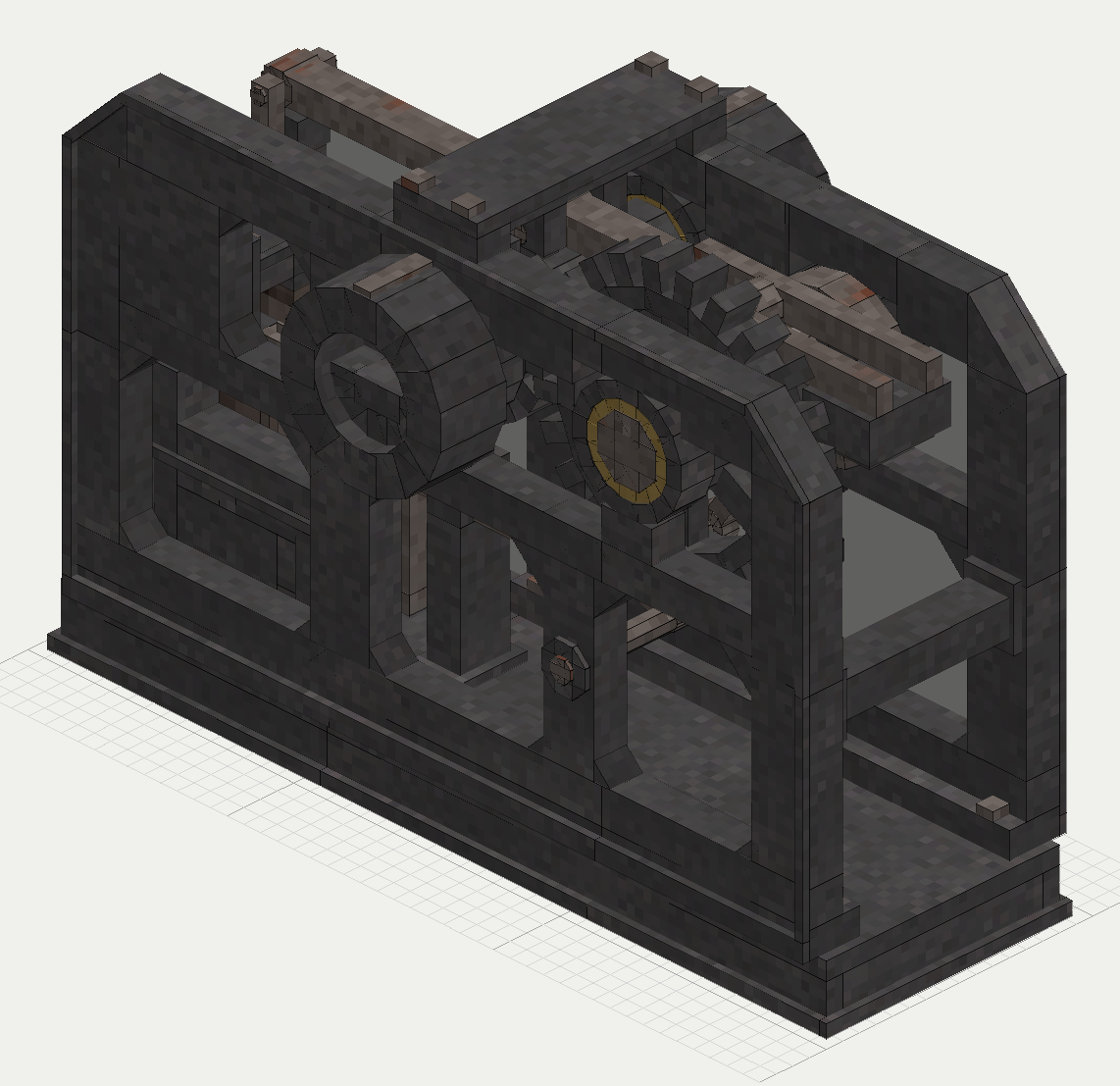
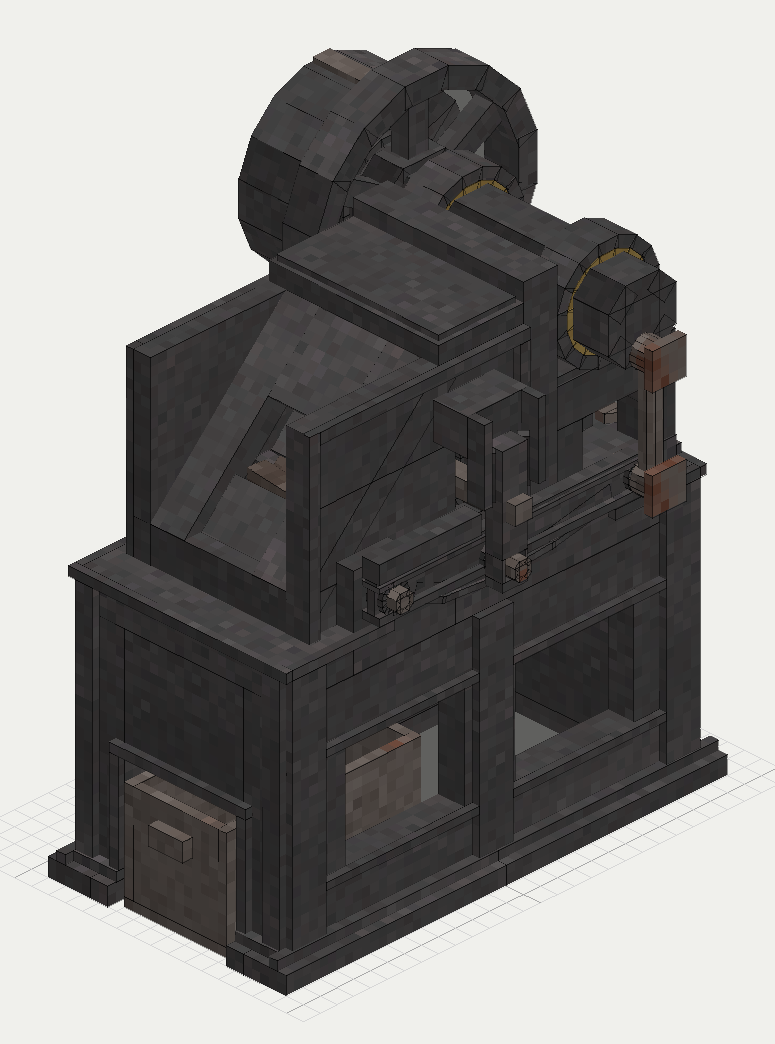
A nail holds wood, a rivet holds plate tight, and a bolt holds cast iron and comes apart again. Each was headed in its own way and by its own machine. The machines are in the catalogue as the rivet heading machine and the nail machine. This page is about the real practice and what the game keeps of it.
Nails: from the hammer to the machine
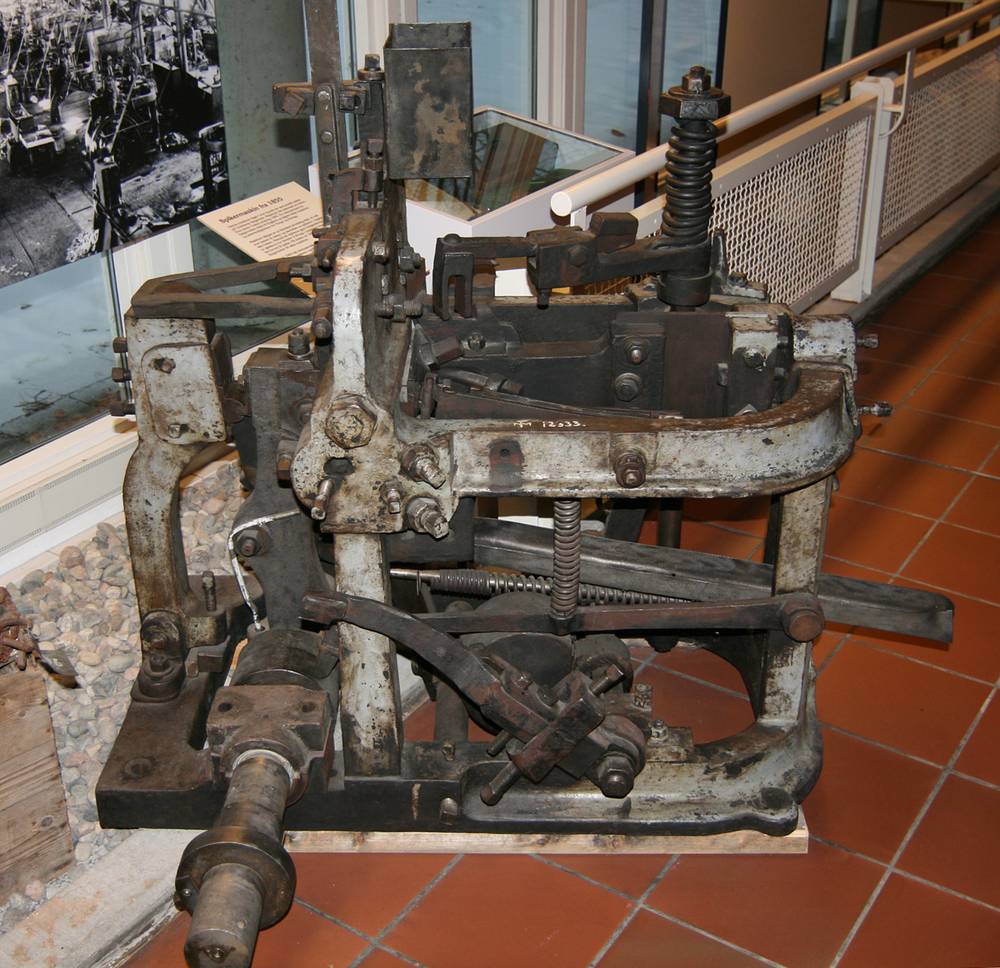
A wrought nail was made by hand from nail-rod, iron slit into narrow strips at a rolling mill (Swank p. 449). The American cut nail changed that. About 1775 Jeremiah Wilkinson of Rhode Island cut tacks from sheet and headed them in a vise; Ezekiel Reed invented a machine for cutting nails from the plate in 1786 and patented cutting and heading at one operation in 1798; by the close of the century there were twenty-three patents (Swank p. 448).
The early machines were small things. At Brownsville about 1795, wrought nails were made by hand in one shop and cut nails by machines in another, the machines worked by the foot of the workman while his hands guided the iron (Swank p. 216). A county smith of 1818 cut his nails at a red heat and carried them cold to a spring vice closed by his right foot, one nail at a time: one stroke of the hammer made a brad, two more a clapboard nail (Swank p. 449).
Nail iron was a class of its own. A nail needs neither strength nor the ability to weld, only to be malleable in one direction and cheap (Overman p. 391). Long, small nail plates were best, cut into strips crosswise so that each nail was cut along the fibre (Overman p. 392). The nail machine of the game takes a plate of that kind and cuts it whole.
Rivets: why a boiler is riveted
A rivet goes in hot, is headed in place and shortens as it cools, so it pulls the plates together, and the seam is then caulked. A boiler shell has to be both strong and tight, and a rivet gives both at one setting. Rivets were driven by hand, by steam riveting machines, or by pneumatic machines striking light blows while the rivet was hot (Hawkins p. 92). Holes were punched in soft iron and mild steel and drilled in anything brittle (Hawkins p. 92).
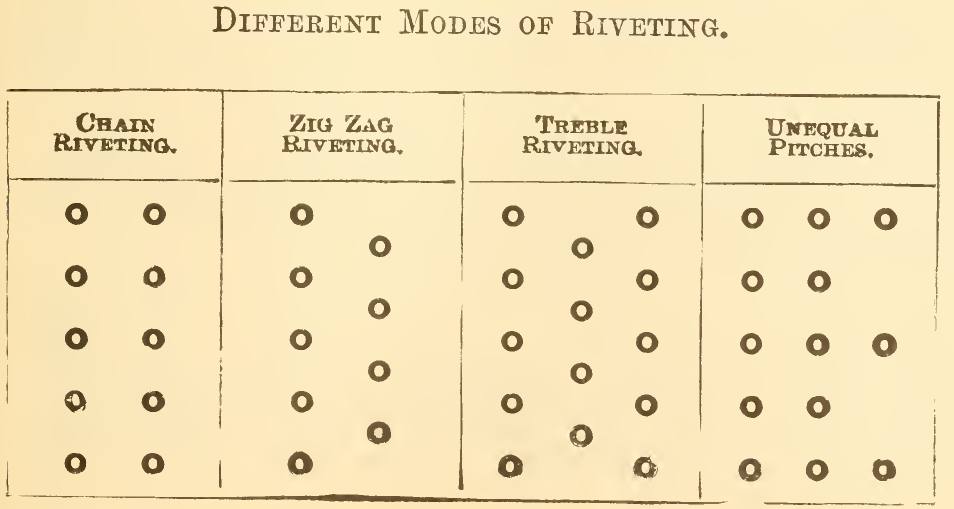
Wilson sets the rule. Taking the entire plate as 100, a double-riveted joint is 70 and a single-riveted joint 56, "originally deduced by Sir W. Fairbairn from his experiments" (Wilson p. 73), and Courtney gives the same two factors (Courtney p. 92). A circle seam carries half the strain of a longitudinal one under the same pressure, so round seams were single riveted and long seams double (Hawkins p. 93). The rivet was made nearly 2 1/2 times the thickness of the plate across (Wilson p. 76), and the plate between the rivets had to be as strong as the rivets themselves (Hawkins p. 93).
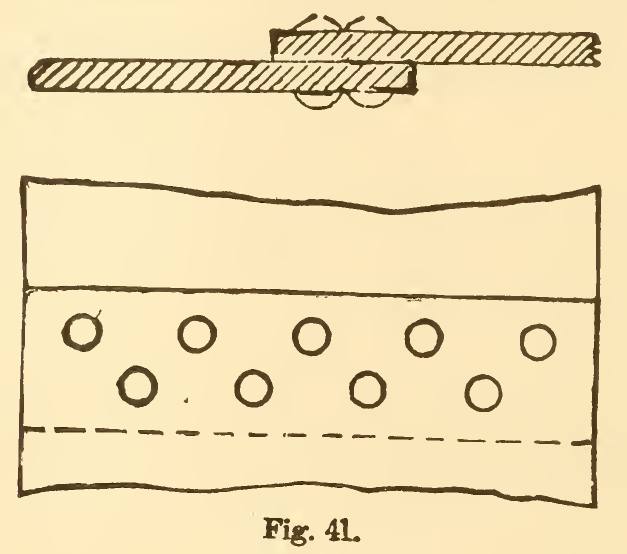
Rivets were of good charcoal iron or very soft mild steel (Hawkins p. 93). The US government's test for steel boiler rivets flattened them cold to half the diameter and hot to a third without cracks (Hawkins p. 95), and Lowmoor listed rivet iron from 3/16 to 9/16 inch (Percy p. 757). Long rivets gave trouble: the heads set and the middle cooled before the hole was filled, and the contraction could crack a head (Hawkins p. 93).
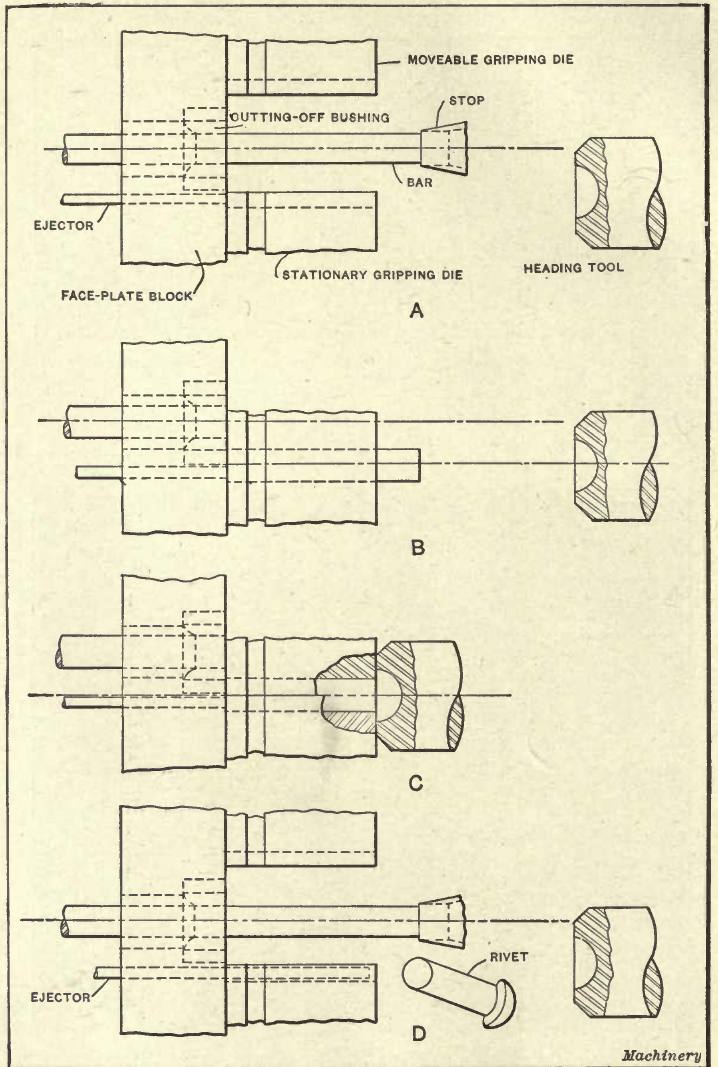
Rivets were made off the bar. A bar heated for four or five feet was pushed into the header and sheared, gripped, headed and ejected in one turn of the flywheel, over and over until the hot part of the bar ran out (Hamilton pp. 5, 20). The dies were kept cold under a constant stream of water (Hamilton pp. 9-10), and carried four grooves, so a worn one was replaced by turning the block (Hamilton p. 21).
Bolts and nuts
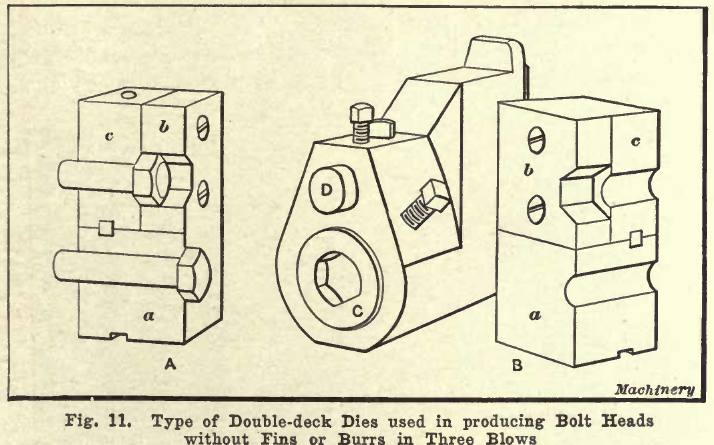
A bolt needs more than a rivet. Bars for a stop-motion header were sheared cold to length first, and then one end heated (Hamilton p. 5). In plain dies a square head took two or more blows in each of two positions, and a hexagon head "at least six blows", the operator turning the bar one-sixth of a turn between them (Hamilton pp. 6, 9). Double-deck dies brought that down to three (Hamilton p. 11), which is the figure the game takes.
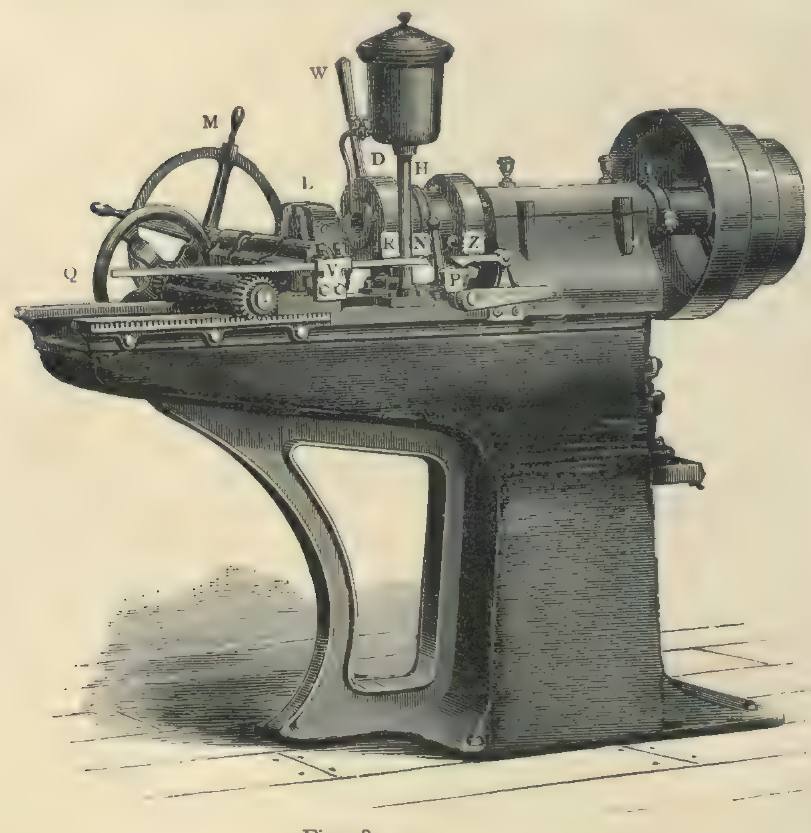
Threading was the second machine. Rose sets the two arrangements side by side: where the bolt turns, "the machine must be stopped to take out each finished bolt"; where it is held and the dies open at a set length, every bolt is threaded "to an equal distance or length without care on the part of the operator" (Rose p. 464). The chasers were plain pieces of rectangular steel, cheap to renew when worn short (Rose p. 467), and dies at work all day were ground once or twice a day. "The two important points in operating threading machines is to keep the dies sharp and to well lubricate them with oil" (Rose p. 464). Taps ran at the dies' speed (Rose p. 474), and the same class of machine held nuts in a recessed plate for tapping (Rose p. 465).
Bolts belong with cast iron for a plain reason. A rivet is closed with blows and pulled up by shrinking, which a brittle casting will not stand. Cast parts met at flanges: flange couplings were two bolted discs, turned and bored true (Fairbairn Mills II pp. 79-82).
Period basis, and what is the game's own
- Period: nails for timber, rivets for a tight plate joint, bolts for cast iron (Swank p. 449, Hawkins p. 92, Fairbairn Mills II pp. 79-82). The game makes this the rule: nails are the iron age's fastener, rivets the steam age's, and bolts belong to whatever is cast. Boilers take rivets and nothing else.
- Period: a bolt and rivet header is two gripping dies and a heading ram (Hamilton p. 5). The game's rivet heading machine is that machine, and one die in it makes the difference between a rivet and a bolt. A die fitted to the wrong machine is refused.
- Period: Hamilton's book is of 1914, later than the game's period. The books searched for this page give no earlier account of a header, so the game takes the principle and not the date.
- Period: a nail plate cut at the nail machine, as Swank and Overman describe (Swank p. 448, Overman p. 392). The game keeps the plate and cuts all four bundles at one stroke, and the machine is meant to stand in rows on one shaft.
- Period: a seam was closed by hand or by a riveting machine, then caulked (Hawkins pp. 92, 94). The game plans a riveting set as a tool step on each seam of a boiler's construction; the hot driving and the caulking are otherwise lines in the bill.
- The game's own: rivets have no forge route. The first boiler waits for a mill and a heading machine on purpose, so the machine rung comes before the steam.
- The game's own: fasteners are spent in bundles, a whole number at a time. The nut is inside the bolt bundle and there is no nut item.
- The game's own: one stroke of the bolt cutter threads one bolt and taps one nut. In the shop those were separate machines, and this one is built as a double head to carry both.
- The game's own: nails are the base game's item, from the anvil. See vanilla against reality.
- The game's own: a cast part held by bolts comes off whole with a wrench and hands its bolts back.
The numbers
Metal is counted in units, one ingot being 100 u (scale and units); the nail anchor is taken from the base game and not scaled (the scaling page). "Planned" is the rating in design; values without that word are what the game has now.
| In the game | Period figure | How it was scaled | Game value |
|---|---|---|---|
| Nails per ingot | None given | The base game's anvil plan and smelting ratio, kept as they stand | 4 bundles from 100 u, 25 u a bundle |
| Rivet bundle | None given | The game's own: half a nail bundle, whole and mass-neutral | 12.5 u; 8 bundles from 100 u. A thinner rod is planned, 3.125 u cut to 20 rivets |
| Bolts and nuts | None given | The game's own: half a nail bundle again | 12.5 u, four bolts with their nuts; a heavy bolt of 50 u is planned |
| Nail plate | Long small nail plates, cut crosswise (Overman p. 392) | The game's own: one plate, one stroke | 100 u to 4 bundles; planned 25 u to 1 bundle |
| Blows on a rivet | One, on a continuous header (Hamilton p. 20) | The period figure | 1, a 3 s stroke |
| Blows on a bolt head | At least six in plain dies (Hamilton p. 6), three in double-deck dies (Hamilton p. 11) | The double-deck figure | Planned 3 strokes of 3 s |
| Nail stroke | None given | The game's own | 2 s for one plate |
| Threading a bolt | The Adams double machine, one ton of track bolts in a 10-hour day (Rose p. 471); about 27 s a bolt a head if a bolt is taken at 0.75 lb, the book giving no weight | The game's own: about a tenth of the shop's time | Planned 2.25 s a bolt, 9 s a bundle |
| Thread die life | Dies ground once or twice a day at full work (Rose p. 464) | The game's own life in bundles | Thread die, planned: 100 iron, 120 meteoric iron, 250 steel |
| Seam strength | Entire plate 100, double riveted 70, single 56 (Wilson p. 73) | The rule at face value in the boiler's pressure | Planned 3.8 atm double riveted, 3.0 single; see the Cornish boiler |
Open, and what you can tell us
The books searched for this page describe the cut-nail machine by inventors and patents, not by its stroke. The game's plate is flipped between shears, alternating the cut so that the nail tapers, and none of them states how the taper was made. If you know a source that describes the feed of a cut-nail machine, we would like to read it.
Picture credits
- Coates cut nail machine: Mahlum, public domain.
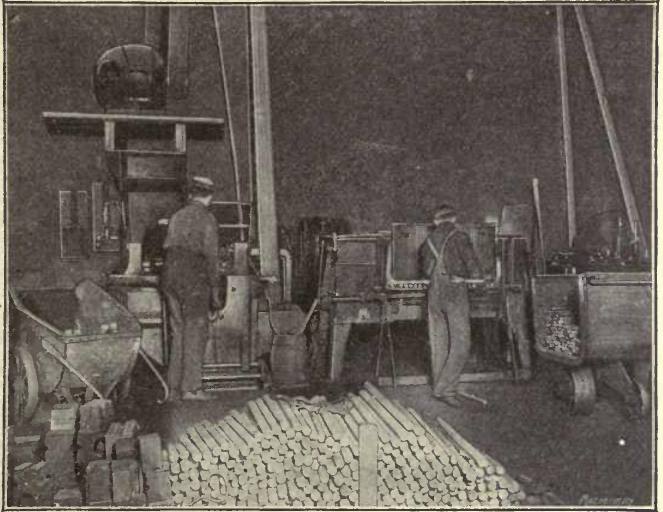
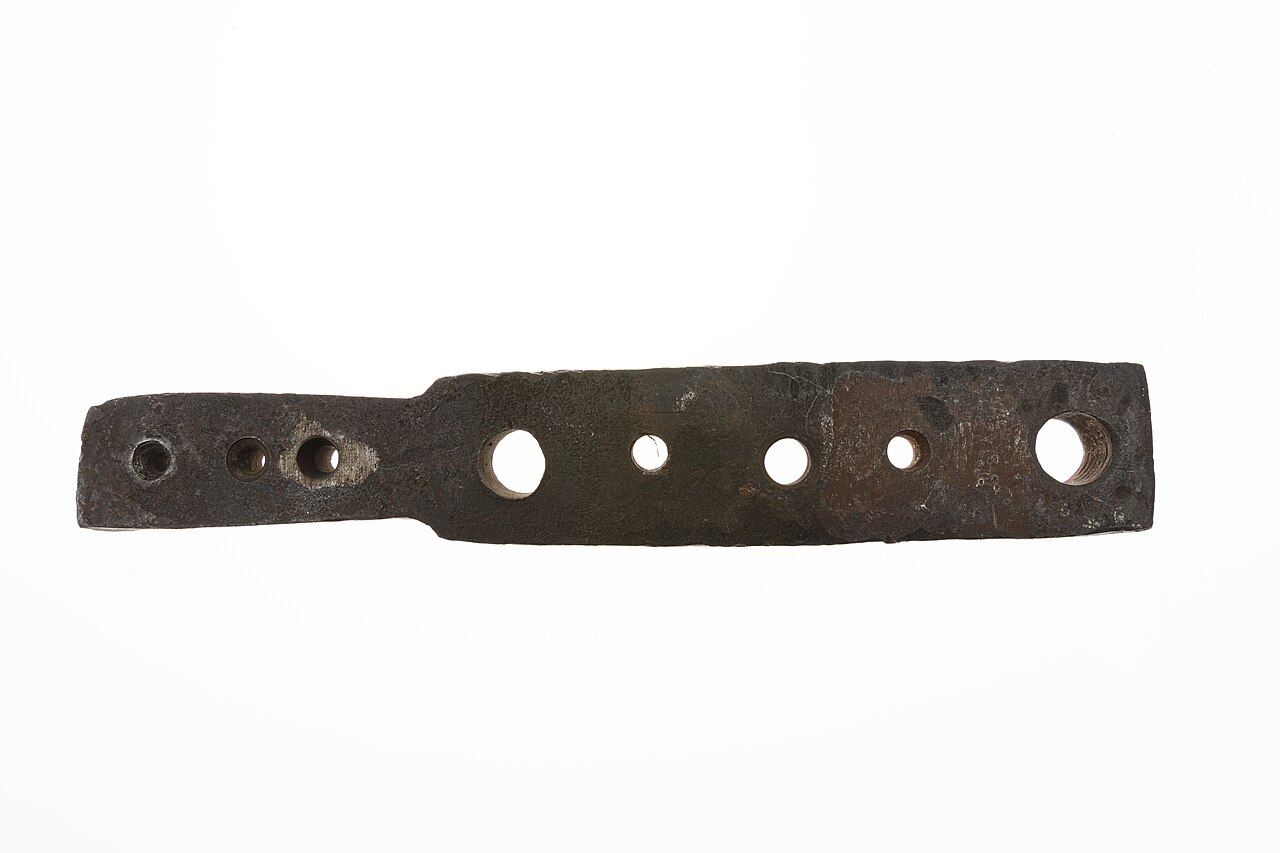
- Nail and Bolt Header Bar: Missouri Historical Society, public domain.
- Figs. 9, 11 and 29: Hamilton, Bolt, Nut and Rivet Forging, pp. 9, 11 and 24, Library page.
- Modes of riveting and Fig. 41: Hawkins, Maxims and Instructions for the Boiler Room, pp. 93 and 94, Library page.
- Fig. 1820: Rose, Modern Machine-Shop Practice, p. 466, Library page.
- The rivet heading machine and the nail machine: the mod's planned drawings.
Comment or suggest something in the Expanded thread on the Vintage Story Discord