
Cementation and crucible steel
Steel for edge tools was made in two long steps: bar iron was soaked in carbon in a sealed chest for more than a week, then broken up and melted in a clay pot. How to do this in the game is in the iron grades guide, and the pot is in the catalogue. This page follows the real work in order, then says what the game keeps of it.
Filling the chest
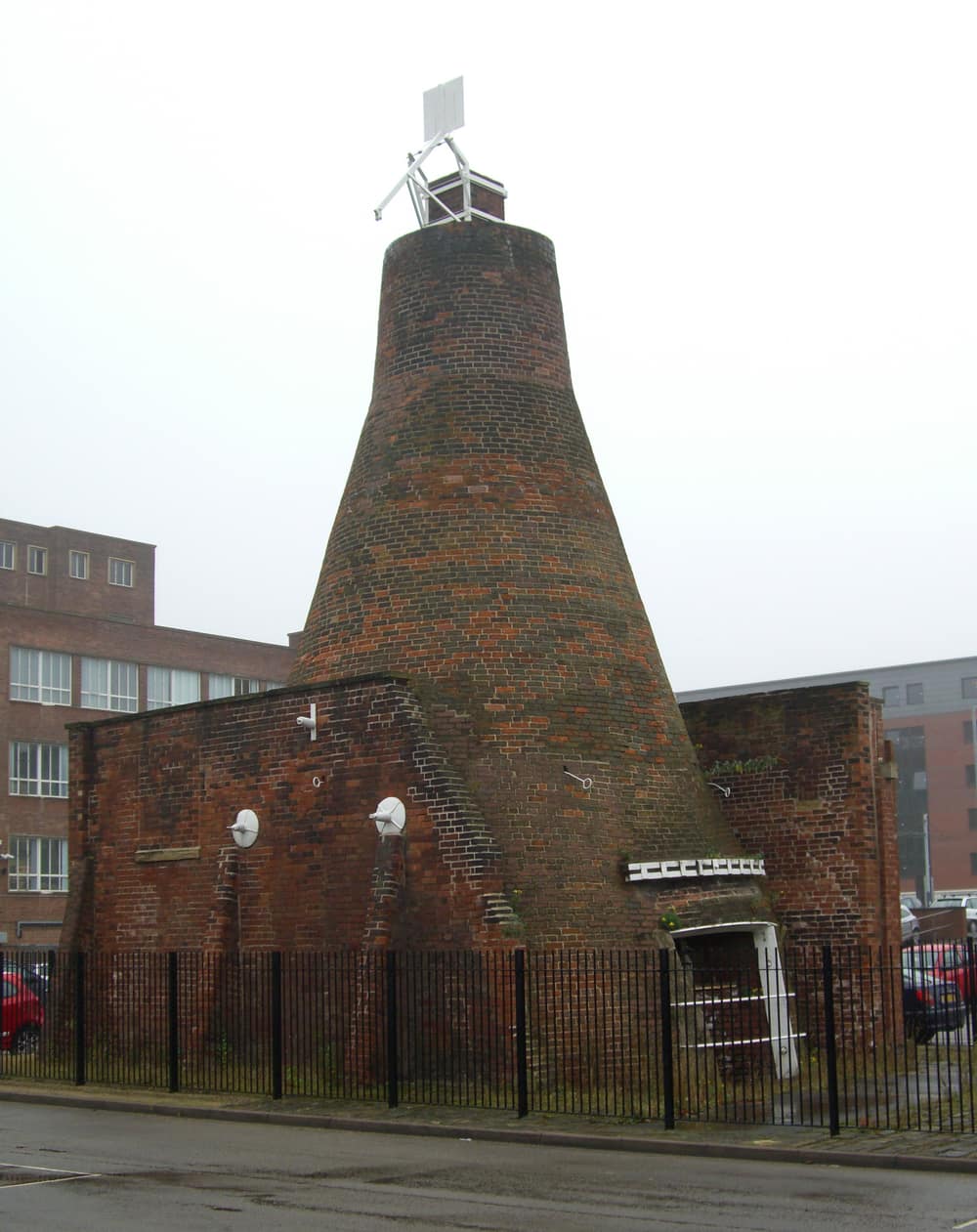
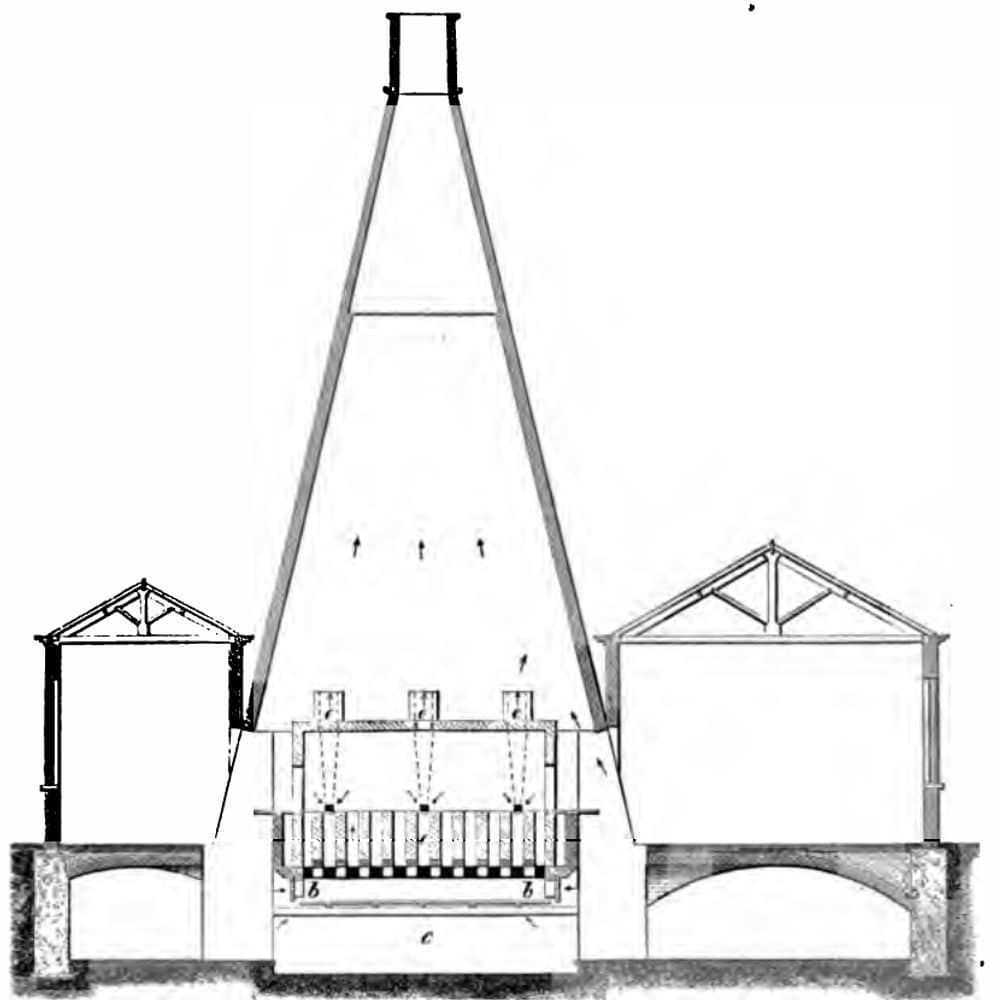
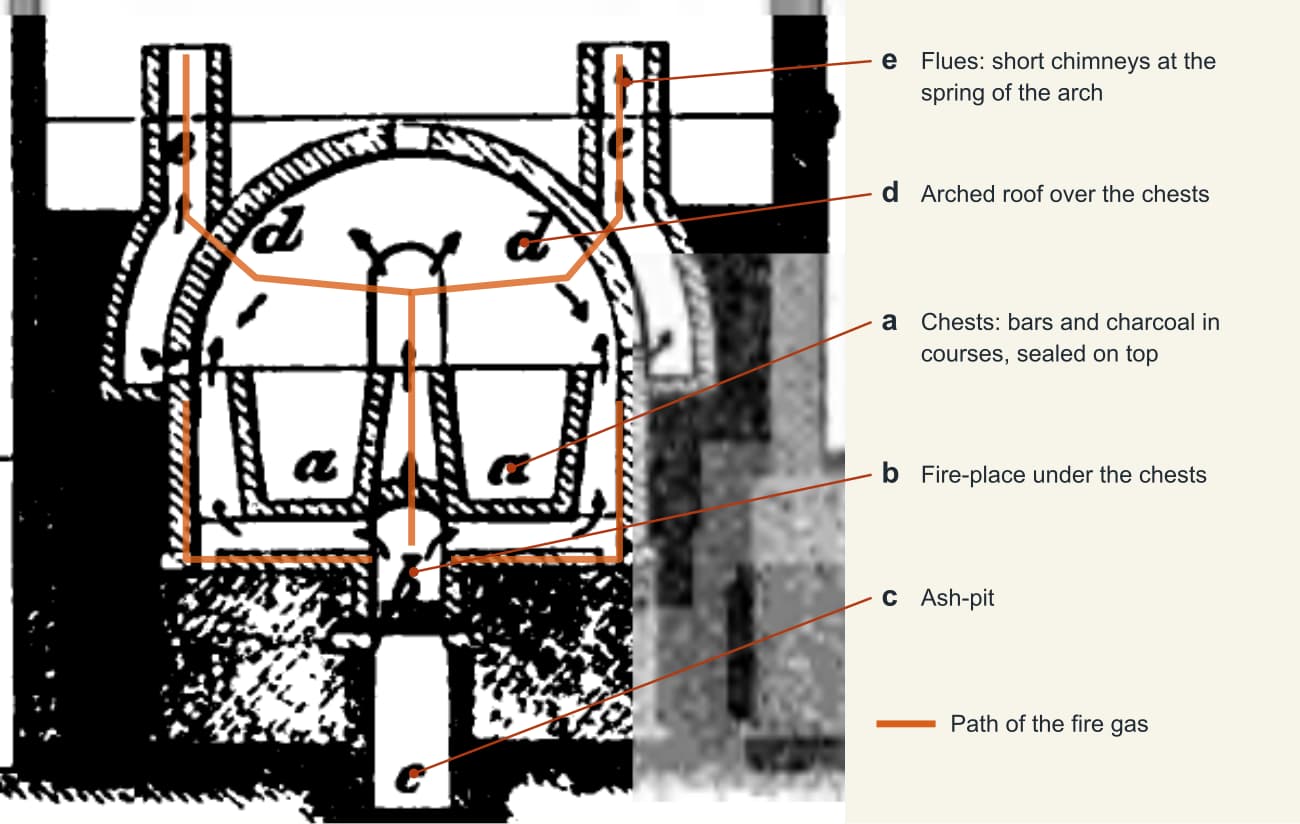
Cementation was already old: Reaumur described it well in 1722, and the converting furnaces in his engravings are "similar in all essential respects" to those at Sheffield (Percy p. 768). The furnace is a fire-brick chest open at the top, inside an arched chamber, with a fire-place below and flues rising round the chest into the arch (Percy p. 768).
The iron went in as flat bars about 3 in. broad, cut a little shorter than the chest to allow for expansion. A bed of ground charcoal went on the bottom, then a course of bars laid flat and nearly touching, then charcoal again, and so on to the top (Percy p. 769). The last and thicker layer of charcoal was plastered over with "wheelswarf", the silica and steel dust from grinding wheels, or with clay, to shut out the air (Percy pp. 769-770). Fresh charcoal was mixed measure for measure with old, because fresh alone "acts too finely" and the furnace had to run cooler (Percy p. 772).
Firing for a week and more
The fire was kept "at glowing redness", and the length of the firing set the grade: "Steel for melting purposes requires from 9 to 10 days, for shearing 8 days, and for spring temper 7 days" (Percy p. 771). Trial bars stuck out through plugged holes in the chest ends, and were drawn and broken to read the conversion by the fracture (Percy p. 771). The stoking had to be careful, on a white-ash coal that would not clinker (Percy p. 772).
Carbon crept into the bar at about 1/8 in. every 24 hours, saturating at about 1.5% and averaging about 1% (Campbell p. 94). After the fire was drawn the furnace cooled for several days, "during which a further degree of carburization occurs", and the man-holes were opened after three or four days (Percy p. 771). A heat therefore held the furnace for about a fortnight.
Breaking and sorting the bars
What came out was covered in hollow blisters and had changed character. A bar that had been tough was now "brittle, and may be easily broken across" (Percy p. 772). The men broke every bar and sorted them by the look of the fracture, because bars heated unevenly and those toward the middle of a large chest carburised less (Percy pp. 771-772).
The blisters left the old faults in place. Blister steel kept the slag seams of the wrought iron, and these were "of fatal moment in the manufacture of edged tools" (Campbell p. 94). There were two ways out. Shear steel took blister in 16 in. lengths, drawn out, piled and welded in a hollow coke fire, broken and rewelded for double shear (Percy p. 859). The other way was to melt it.
The pot
Huntsman, born in 1704 and dead in 1776, made his experiments at Handsworth (Percy p. 829); Bauerman puts the start at Sheffield about the year 1740 (Bauerman p. 356), and Percy says the later practice was substantially Huntsman's, except that two crucibles went into each furnace instead of one (Percy p. 830).
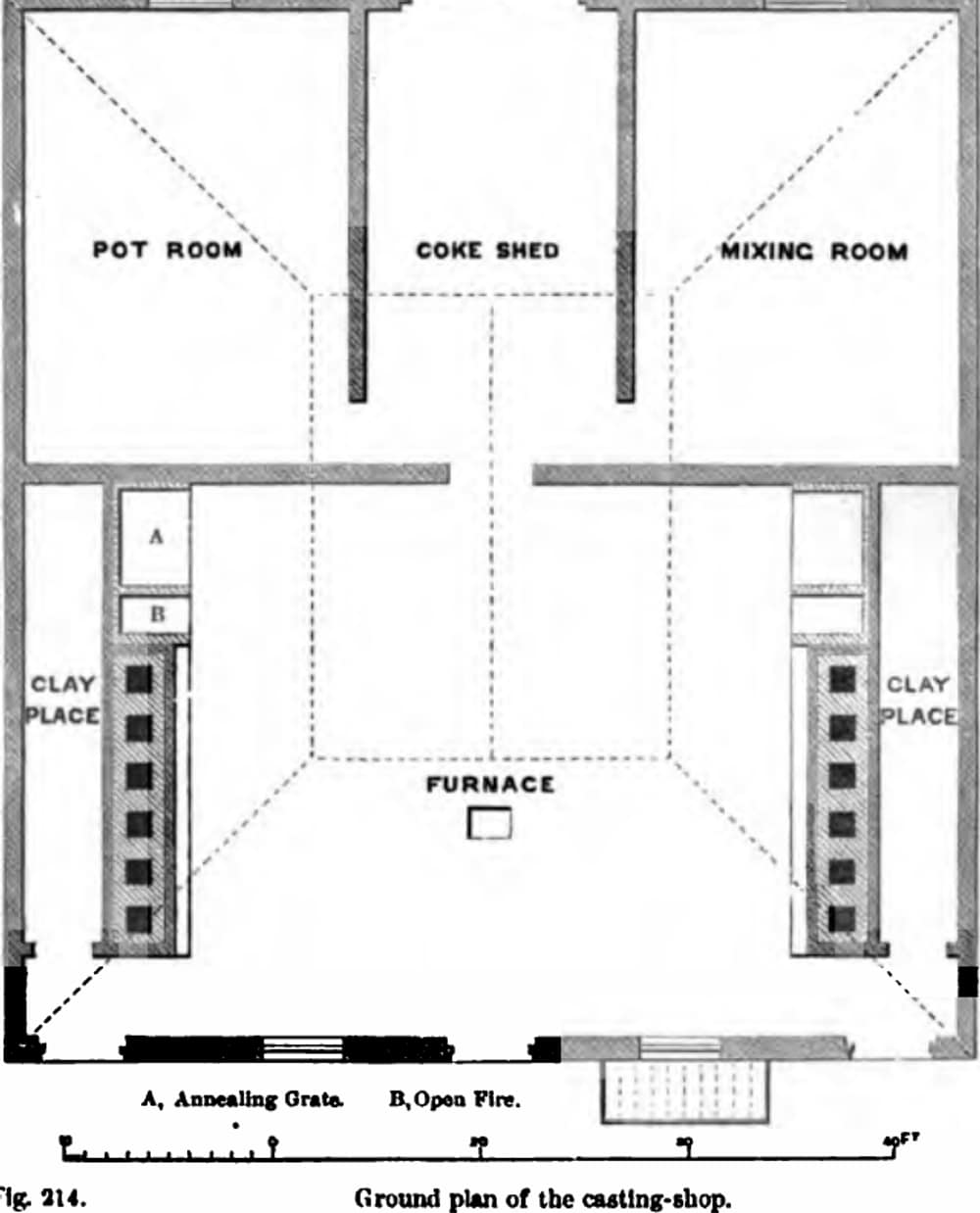
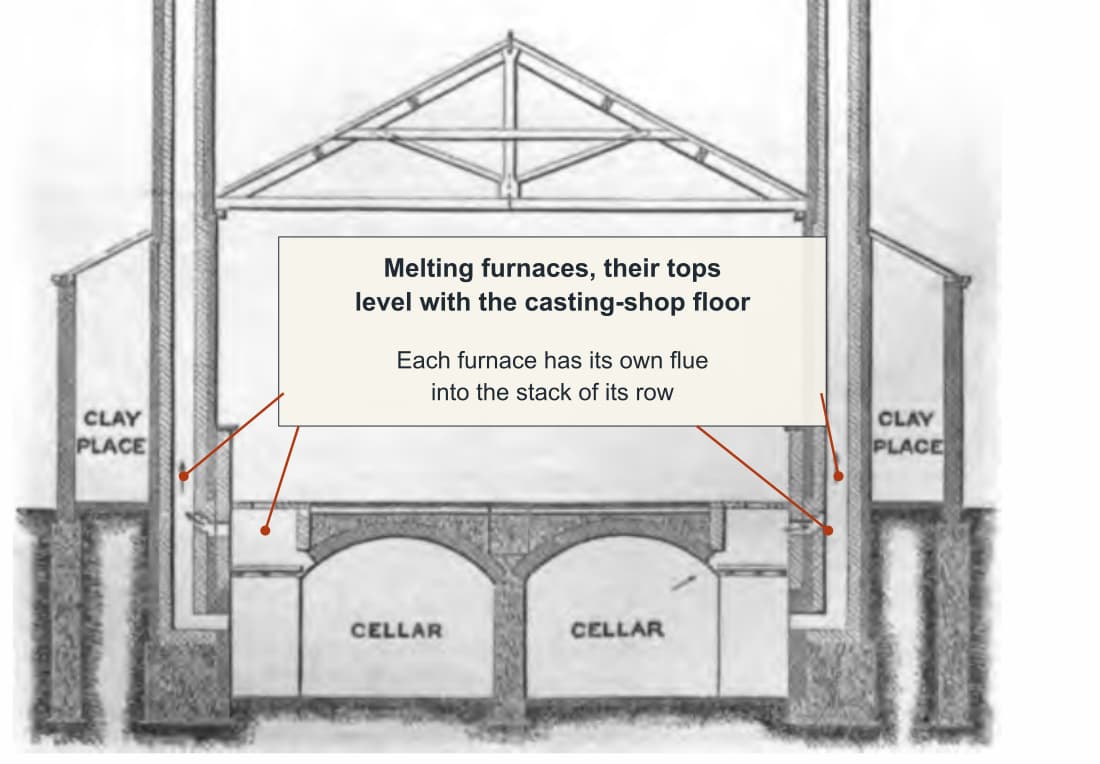
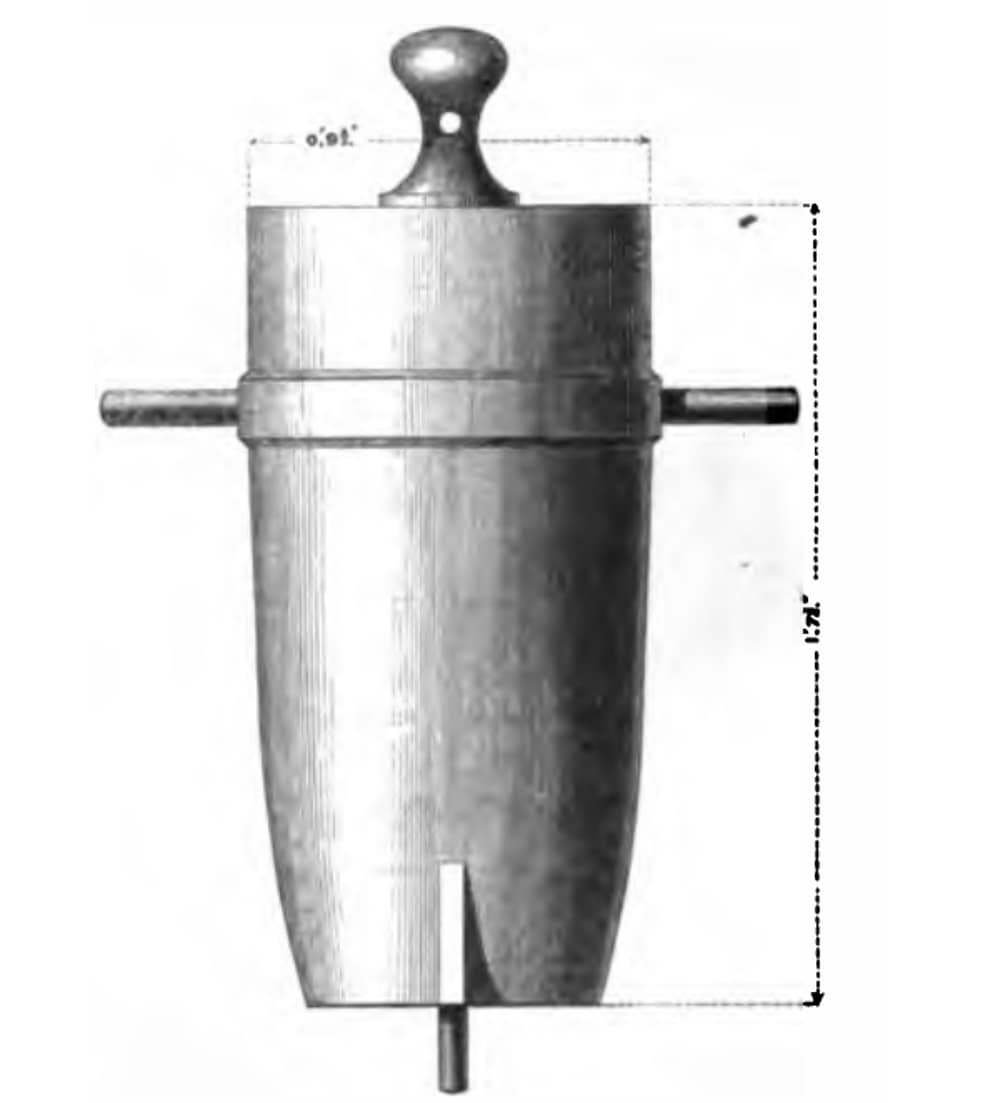
The furnace was a plain rectangular chamber, its top at floor level, its fuel coke (Percy pp. 830-832). The pots were what took the labour: Derbyshire and Stannington clays with ground old pot and coke dust, trodden barefoot for 8 to 10 hours, pressed in the mould of Fig. 219, and dried for 8 days (Percy pp. 834-835). Twenty-four pounds of clay made a pot for 28 lb of steel (Percy p. 835).
The heat
About twenty pots were "annealed, i.e. gradually heated to redness" mouth down on the grate overnight, then set upright on their stands in furnaces already burning (Percy p. 835). After about 20 minutes they took a charge of 30 to 40 lb of "broken up and assorted blister-steel", through a funnel of sheet iron, and a lid went on (Percy p. 835). The furnace was filled with coke, replenished after 3/4 hour, and after another 3/4 hour the foreman lifted a lid to judge the melt and added coke by eye (Percy p. 835). Manganese, where used, went in with the steel (Percy p. 835). A little glass gave a passive slag cover in later practice (Campbell p. 95).
The melt was held away from the fuel on purpose. "Cupola furnaces cannot be employed for the purpose", Percy wrote, because the metal "would be materially changed in composition by contact with solid carbonaceous matter" (Percy p. 838). Silicon and a little carbon came out of the pot walls instead, until the metal lay "quiet and 'dead'" and the pot was pulled (Campbell p. 95).
Teeming, and the pot going back
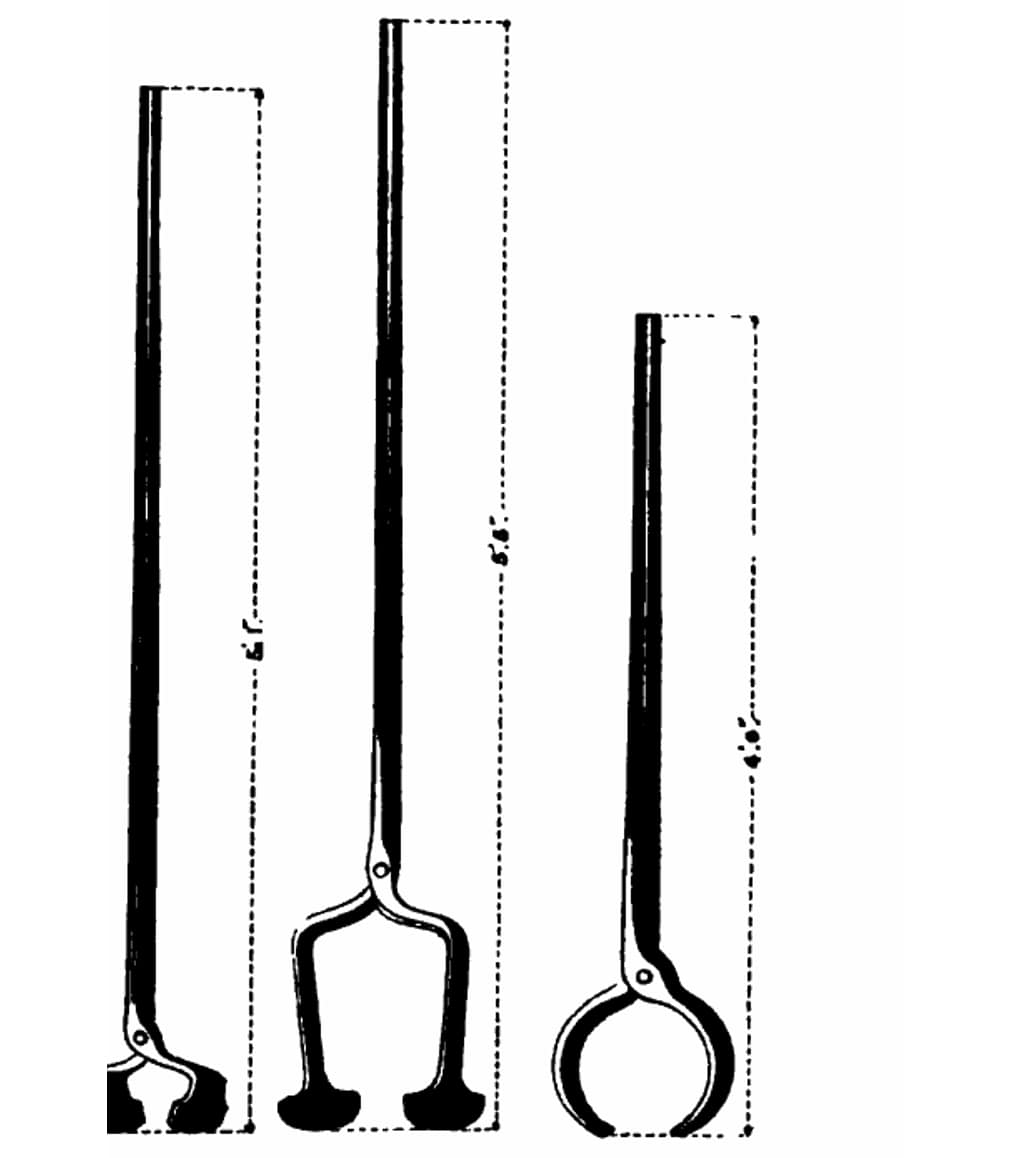
The "puller out" wrapped his legs in wet sacking, stood over the hole and hoisted the pot into an 18 in. cast-iron box floored with coke dust, so that the hot pot would not touch iron and crack (Percy p. 836). The lid went onto the pot just emptied, and that one went straight back into the fire (Percy p. 836). The chief melter poured with the teeming tongs, keeping the stream off the sides of the mould, while a boy held back slag with a "flux stick" (Percy p. 836).
"A pot will last three meltings, but each time with a diminished charge: thus, in the 1st charging, it may receive 45 lbs, in the 2nd 40 lbs, and in the 3rd only 36 lbs" (Percy p. 836).
Why it cost so much
Every pound of this steel had been through two furnaces, ten days of fire, days of cooling and sorting by hand. The double process was called "expensive" even in 1907 (Campbell p. 94). Bessemer remembered cast steel at 50 to 60 pounds a ton (Bessemer pp. 174, 180), melted in crucibles of at most 60 lb (Bessemer p. 138), and each pot was gone after three heats (Percy p. 836). Its use was the edge: what it bought was a steel with "perfectly uniform composition throughout" (Percy p. 828).
What the game keeps
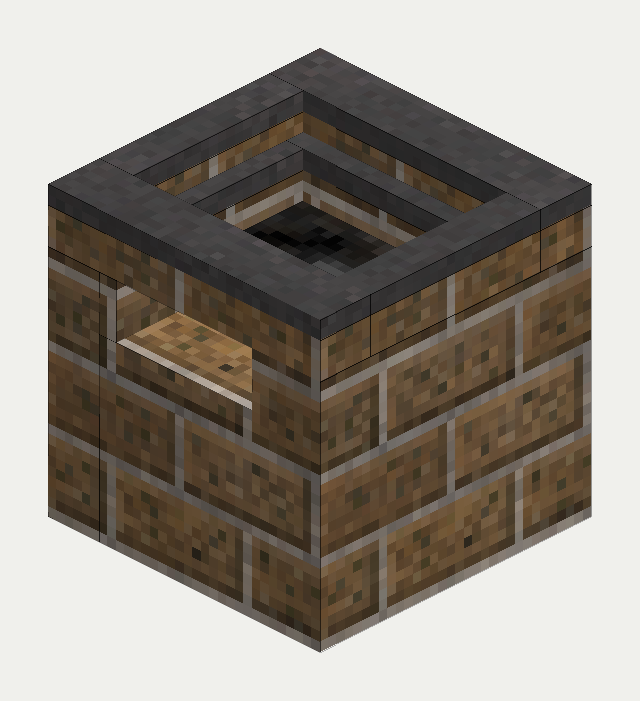
The game's route is the same shape. Blister steel comes from the base game's stone coffin, which takes layers of coke or charcoal round the iron; a hot ingot forges into shear steel as it always did, and a cold one is crushed into chunks and bits for the pot, under a helve hammer on the anvil. The pot is fireclay and is preheated, charged, melted and poured by hand, in a furnace that keeps the fuel away from the steel. See the crucible furnace page and vanilla against reality.
Period basis, and what is the game's own
- Period: the sealed chest, the charcoal and the grading by fracture (Percy pp. 768-772). The base game's stone coffin keeps the layering, and heats for 160 game hours.
- Period: blister broken cold (Percy p. 772) and shear steel forged hot (Percy p. 859). The game forks one ingot on its heat. That fork is the game's own rule; the books describe two trades, not one choice at an anvil.
- Period: a coke fire outside a sealed pot (Percy pp. 830-835, 838), a pot of three meltings on a shrinking charge (Percy p. 836), annealing before the full fire (Percy p. 835). The game keeps all of these; the shrinking charge is planned.
- Period: a glass cover (Campbell p. 95). Planned, and absent today.
- The game's own: a pot put through the full fire before it is preheated breaks every time. Percy anneals every pot and states no such penalty, and names no damper in the heat (Percy p. 835). The game uses its damper to mark the two phases.
- The game's own: four pots to a hearth, a cracked pot spilling its charge into the ash pit, and crucible steel's durability over vanilla steel.
- The game's own: 1600 C. Percy gives the cementation heat only as "glowing redness" (Percy p. 771) and no degrees for the melt in the pages used here.
The numbers
The steel line runs on game hours and 100 u ingots rather than the period's pounds (see the scaling page). "Planned" is the design value; values without that word are what the game has now.
| In the game | Period figure | How it was scaled | Game value |
|---|---|---|---|
| Time in the coffin | 9 to 10 days for melting steel, 8 for shearing, 7 for spring (Percy p. 771) | Base game's own | 160 game hours of heat |
| Pot life | Three meltings (Percy p. 836); four to six in America by 1907 (Campbell p. 95) | Percy at face value | 3 heats |
| Charge per heat | 45, 40, 36 lb (Percy p. 836) | Percy's proportion on a 100 u ingot | 110 u each heat; planned 110, 98, 88 u |
| Steel poured | Not given | Game's own loss, about 9% | 100 u each heat; planned 100, 89, 80 u |
| Pots to a furnace | Two to a hole (Percy p. 830) | Game's own, four to one hearth block | 4 |
| Preheat | Overnight on the grate, about 20 minutes in the furnace (Percy p. 835) | Game's own | 2 game hours |
| Melt | Two spells of 3/4 hour, then coke by judgment (Percy p. 835) | Game's own | 5 game hours a pot; planned 1.6 to 2.4 game hours for the first melt |
| Melt temperature | Not given | Game's own | 1600 C |
| Crucible steel tool durability | Not given | Game's own, set against the 2600 of the best preset | 3300 |
Open, and what you can tell us
The copy of Percy at hand is unreadable where it gives a furnace's charge in tons (Percy p. 771), so the page gives no tonnage for a heat. Percy gives no year for Huntsman's invention (Percy p. 829) and Bauerman only about 1740 (Bauerman p. 356). If you hold a clean copy, or a source that dates the first melt, we would like to read it.
Picture credits
- Converting furnace, Doncaster Street, Sheffield: Mick Knapton, Wikimedia Commons, CC BY-SA 3.0.
- Converting furnace, longitudinal section: J. Percy, Metallurgy: Iron and Steel (1864), Fig. 208, p. 769.
- Converting furnace, transverse section: Percy, Fig. 211, p. 771, labels added.
- Ground plan of the casting-shop: Percy, Fig. 214, p. 831.
- Casting-shop, longitudinal section: Percy, Fig. 215, p. 831, labels added.
- Crucible mould: Percy, Fig. 219, p. 833, cropped.
- Tongs: Percy, Fig. 222, p. 835, cropped.
Comment or suggest something in the Expanded thread on the Vintage Story Discord