
Crucible furnace
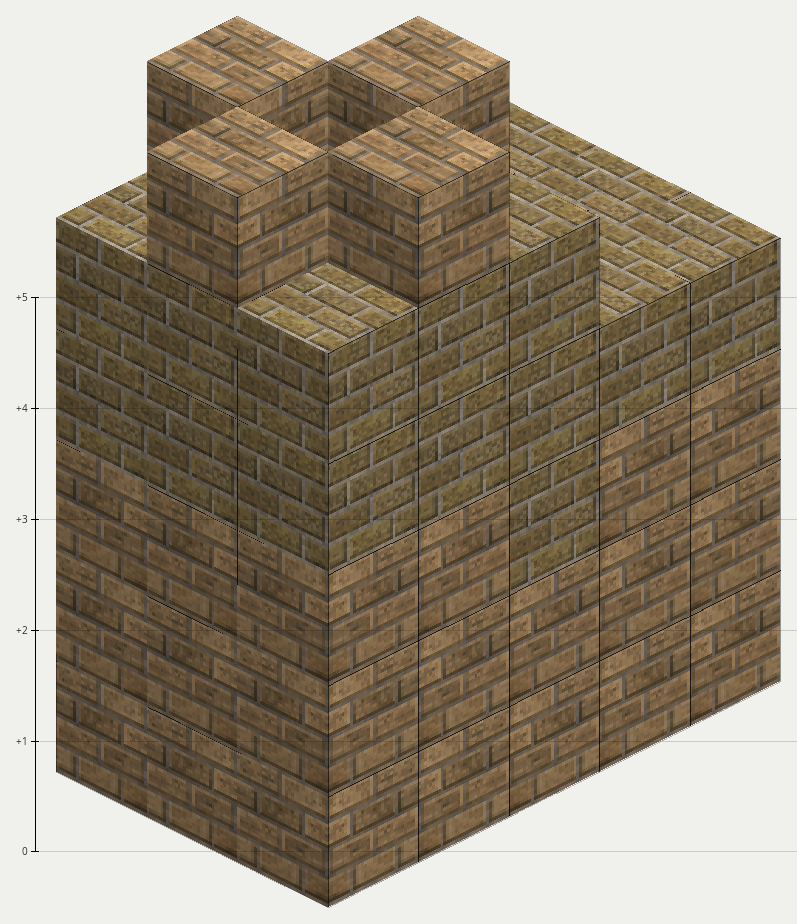
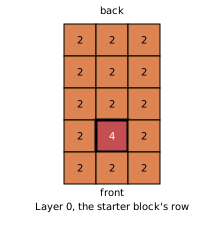
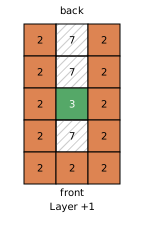
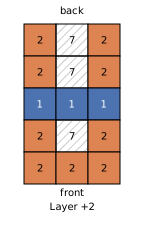
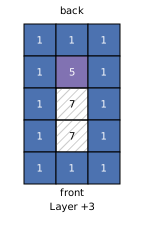
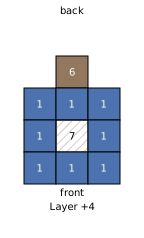
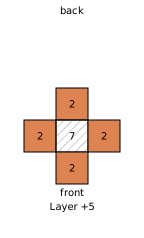
| # | Colour | Name | Matches |
|---|---|---|---|
| 1 | any Refractory bricks | game:refractorybricks-good-tier* | |
| 2 | any bricks | @(claybricks-(good-fire|clinkerrough)|refractorybricks-good-.*|brickcourse-.*) | |
| 3 | Iron hatch door | game:cokeovendoor-*-north | |
| 4 | Crucible Furnace Core | iiex:furnace-cruciblecore-*-* | |
| 5 | Crucible Hearth | iiex:furnace-cruciblehearth-*-* | |
| 6 | Charge Lid | iiex:furnace-chargelid-n | |
| 7 | Empty (air) | game:air |
Materials
| Block | Cells |
|---|---|
| any Refractory bricks | 23 |
| any bricks | 38 |
| Iron hatch door | 1 |
| Crucible Furnace Core | 1 |
| Crucible Hearth | 1 |
| Charge Lid | 1 |
Facings and connectors
- Iron hatch door turns with the structure; segment 3 of its code names the face.
- Charge Lid turns with the structure; segment 3 of its code names the face.
What it does
The crucible furnace melts blister steel whole in sealed pots, so the steel comes out with no slag streaks and no soft spots. It is a deep hole in the floor with fuel packed around four lidded pots, and everything about running it comes down to one lever: the damper.
It reaches 1600 C, the highest temperature in the mod, on natural draught alone. There is no blower and there never will be, so how tall the chimney is built is how hot the furnace gets.
Building it
- Place the core first, then ctrl plus shift plus right-click it for the build outline and the shopping list.
- Dig and line the ash pit under the hearth, and set its door in the front wall of the pit. Ash falls through the grate into it.
- Set the crucible hearth beside the core: four melting holes over a grate, each a stand for one pot.
- Set the charge door in front of the hearth.
- Set the chimney damper at the foot of the flue, directly over the hearth. It is at the bottom of the stack here rather than at the top, because everything above it is the player's own chimney.
- Lay the flue and the first course above it as the outline marks them.
- Then raise the chimney by hand: a ring of brick around an open middle, course after course. A course is one air cell ringed by brick on all four sides.
The core reads the chimney every tick and reports how many courses it counts, what they are pulling and how many it would take to reach the best a chimney can do. Six courses is where the furnace first clears its melting point and nine is the peak. Past nine a taller stack pulls less, because the flue loses more heat than the extra height gains, so the block says so rather than leaving it to guesswork.
The charge
The feedstock is vanilla blister steel out of the stone coffin, and it goes into the pot cold. A cold blister ingot on an anvil is crushed rather than forged: one ingot comes back as chunks and bits. Heat the same ingot first and it forges into shear steel exactly as before.
A pot takes 110 units, which is a little more than one crushed ingot, and pours 100 units of crucible steel. The difference is the melt loss. The pot itself is fire clay, clayformed and fired in a pit kiln; ordinary clay will not hold 1600 C. A pot gives three heats and then breaks after its last pour.
Right-click a melting hole with a charged pot to seat it. Which cell is clicked picks which hole.
The run
- Seat the pots and charge the hearth with fuel through the charge door.
- Shut the damper.
- Light the fire. The shut damper is what makes it gentle, and a cold pot taken straight into full draught cracks. Each hole reports how far through its warming it is. The preheat is 240 seconds.
- When every pot has come up, open the damper. That is the one deliberate act in a heat.
- Full draught takes the fire past 1600 C and the pots melt, each on its own clock, about 600 seconds apiece, advanced every 60 seconds. A pot seated late finishes late, and a furnace running well above its melt line finishes sooner.
- Pull a finished pot with an empty hand or with tongs.
- Pour it into a canal start, a Molten barrel or a Cast Iron Ingot Mold. One pot fills one mold exactly.
One full bed of fuel is one heat of four pots: 240 seconds of preheat, 300 to cross into melting and 600 melting, against a bed that burns for 1200.
What goes wrong
The pots were lost. The damper was opened before they had come up. The charge falls through into the ash pit and can be picked back out, but the pots are gone.
The furnace lights and never clears 1600 C. The chimney is too short. Read the course count off the core and keep laying.
A taller chimney made it colder. It is past the nine-course peak. That is the honest physics, not a bug.
The heat crawls with the damper shut. It is meant to. A shut damper keeps about a third of the stack's pull, which is the preheat.
A pot broke. Three heats is what a pot gives. Keep making pots.
The fire went out before the heat finished. The bed burns on a clock, not by consumption. Charge it full before lighting, and do not draw fuel back out of a lit bed.