
Boiler and pipe pressures
A boiler's pressure is not a matter of how hard it is fired. It is a sum done before the first plate is cut: the barrel's width, the plate's thickness, the seam and a chosen margin. How to raise and hold steam in the game is in the steam and boilers guide; the boiler itself is on the Cornish boiler page. This page is about where the pressures come from, and which of them are the game's own.
Why a shell bursts where it does
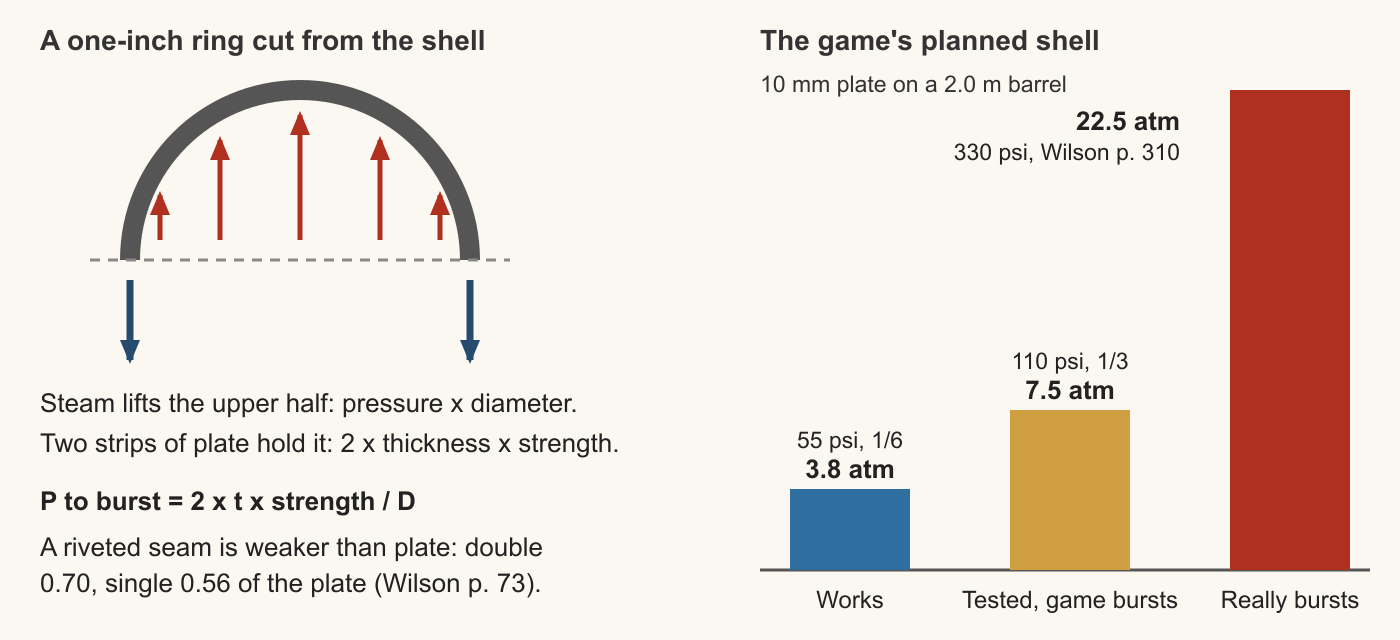
A thin shell is pulled apart along its length, so the long seams carry the load and the round ones half of it (Hawkins p. 93). A rivet line takes metal away: against the whole plate a double-riveted joint is worth 70 and a single-riveted 56 (Wilson p. 73, Courtney p. 92). Good iron plate broke at 20 to 25 tons a square inch (Courtney p. 92), and Wilson's standard was 21 (Wilson p. 73).
Wilson prints the sum ready to use: P = T x c / D, with T in sixteenths of an inch, D in quarter feet, and c 1372 for double riveting and 1097 for single on wrought iron (Wilson p. 310). The game's planned shell is 10 mm of plate, 0.394 in, on 2.0 m, which is 6.56 ft. That gives 330 psi. It would be 22.5 atm, far beyond anything a boiler of the time was meant to see.
The margin
The working pressure is that figure divided by a factor of safety, and here the books differ. The factor was meant to cover what the sum leaves out: wear and tear, flaws in the material and workmanship, the strain of uneven heating (Wilson p. 213).
- Fairbairn took a sixth of the bursting pressure, as Bourne reports him (Bourne p. 322). Bourne himself wanted a seventh or an eighth, and printed his rule to suit: thickness = diameter x pressure / 8,900 for single riveting, and / 11,140 for double (Bourne pp. 322-323).
- Wilson says "usually 6 and 3" for the working and testing pressures (Wilson p. 213). He allowed 5 or a little less on a new boiler examined every 6 to 12 months, and 6 or 8 on one whose condition was not well known (Wilson p. 216).
- Courtney allows the working strain a fifth of the strength of the joint (Courtney p. 92), and prints rules by the quality of the plate (Courtney p. 93).
- The American inspectors of Hawkins's day took a sixth of the lowest tensile strength stamped on any plate, with 20% added for double riveting (Hawkins p. 117).
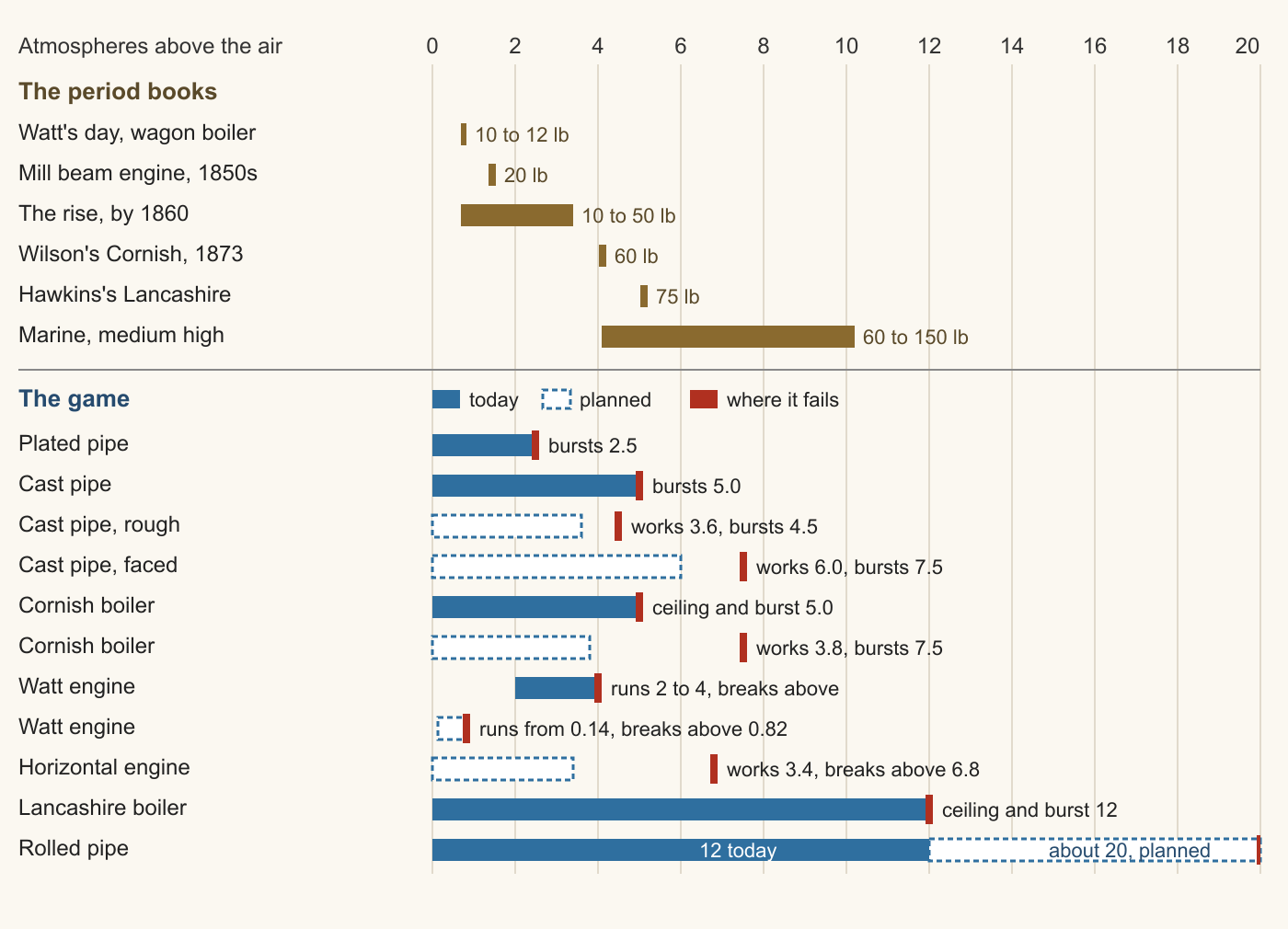
The whole of the game's rating for its Cornish boiler is this margin. Bourne's double-riveted rule on the planned 10 mm plate and 78.7 in barrel gives 55.7 psi, 3.8 atm, and Wilson's sixth gives 55 psi. Single riveting comes to 3.0 atm. Courtney's rules on the same shell (Courtney p. 93) would pay 5.3 atm for best Yorkshire plate, 4.2 for Staffordshire and 2.5 for ordinary iron, which shows how much the quality of the iron was worth.
Pressures rose through the century as plate and rivets were trusted more. In Watt's time the wagon boiler seldom passed 10 or 12 lb (Fairbairn Useful p. 299). A mill beam engine of the 1850s had 20 lb in the boiler (Fairbairn Useful p. 233), and Fairbairn in 1860 writes of a general increase "from 10 lbs. to 50 lbs., and even in some cases to 150 lbs." (Fairbairn Useful pp. 1-2). Wilson's worked Cornish of 1873 ran at 60 lb, 4.1 atm (Wilson p. 300). Hawkins thought 80 lb the most worth carrying in a single-cylinder cut-off engine (Hawkins p. 235). No book at hand gives a table by decade.
The furnace tube has its own, lower limit, because a tube under outside pressure collapses where a shell under inside pressure bursts. Fairbairn worked one out at about a third of the shell's bursting pressure unless stiffened with rings (Fairbairn Useful pp. 301, 305). The game's planned tube carries a stiffening ring at each joint and keeps the shell's figure; it does not fail on its own.
The test
The proof was hydrostatic, with water under pressure (Hawkins p. 117). Water stores almost nothing when compressed, so a split seam leaks and does not fly apart. Hawkins asks 150 lb of test for 100 lb of working pressure (Hawkins p. 117), and Wilson's "6 and 3" puts the test at a third of the bursting strength, twice the working pressure (Wilson p. 213). A test at a third stays under the elastic limit, which Wilson takes at about half the breaking weight (Wilson pp. 214-215), so a sound plate comes through unharmed.
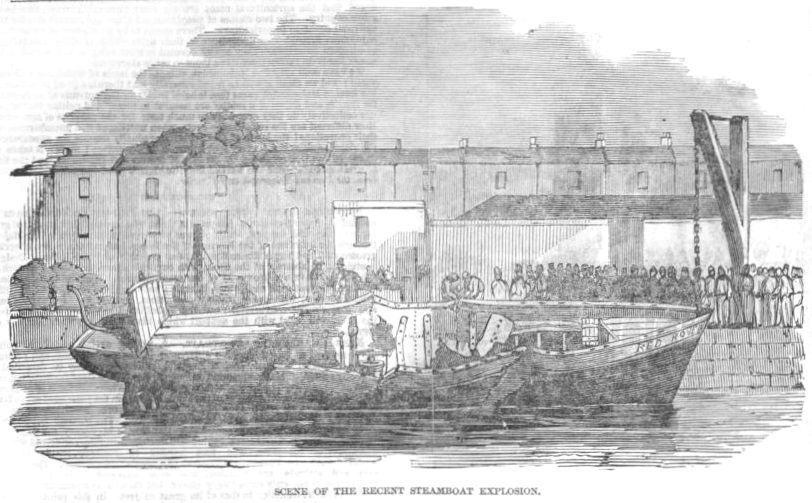
In the game the test pressure is the point of failure. It is a third of the true bursting strength, 7.5 atm on the planned shell. A boiler stays at that pressure, fire burning, for 30 s, and then goes: 40% of what it was built of comes back, and everything fragile within the blast is broken. Today's Cornish does this at its ceiling of 5.0 atm.
The safety valve
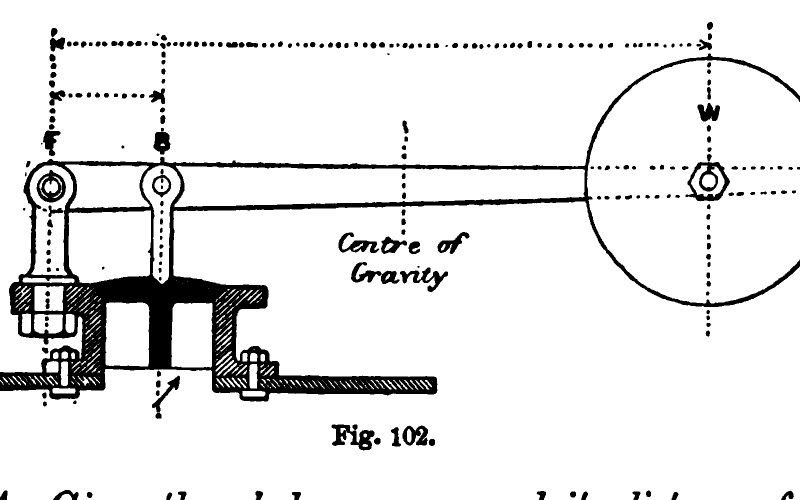
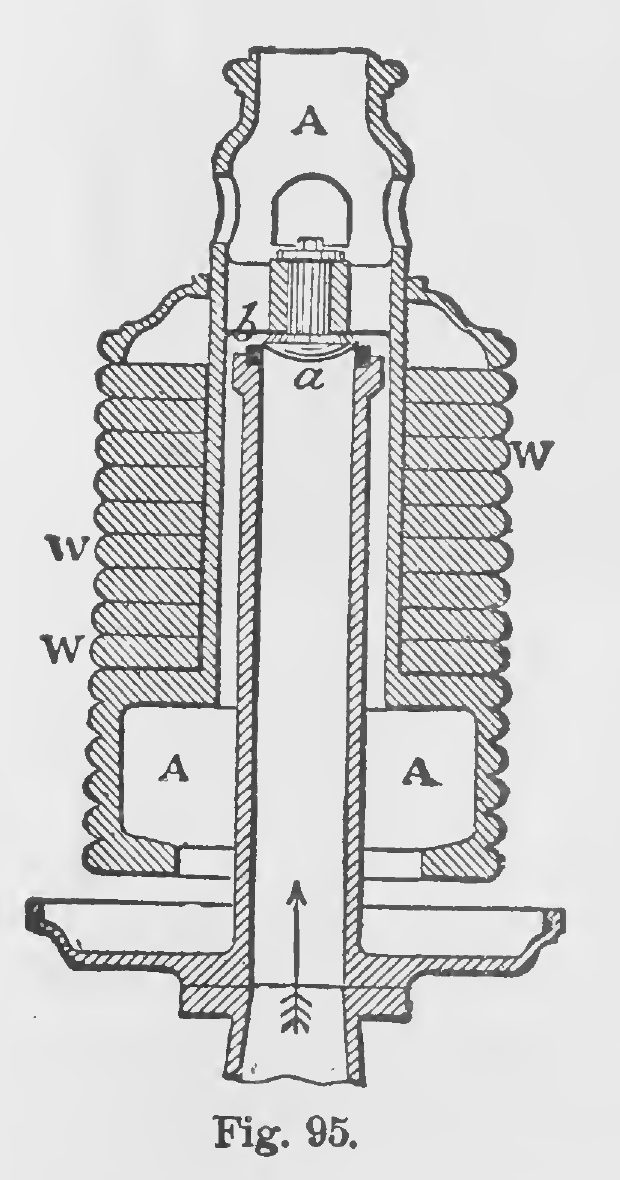
The valve was sized from the grate, or from the steam it had to pass. Hawkins prints American rules of one square inch of valve for every three square feet of grate on a spring valve with lift (Hawkins pp. 189-190), and Rankine's of 0.006 square inches for each pound of water evaporated an hour (Hawkins p. 190). He is plain on the one thing that defeats them: "There should not be any stop valve between the boiler and safety valve" (Hawkins p. 191). A disc valve did not hold the pressure level at all; Wilson gives 12 to 20 lb of rise above a setting of 60 or 70 lb (Wilson p. 122).
The game's valve sits on the shell with no stop valve in the way, and a lever with notches sets it. Its size follows the grate rule: 2.475 in, drawn. Today the lever sets 3.0 atm at its lowest notch and 0.5 more for each notch, up to the ceiling; the planned settings run from 2.01 to 3.80 atm. The planned valve can blow four times what the boiler makes with the damper open, so a working valve holds the boiler below its burst, and a fire that outruns it still bursts the vessel.
Pipes
The pipe is a smaller shell, and by the wall alone it should be safe at very high pressures. A 4 in bore with a 3/8 in wall, at cast iron's 6 tons a square inch (Wilson pp. 25-26), would not burst below about 2,500 lb. The wall is not what limits it. Wilson calls cast iron "almost invariably used" for steam pipes at full boiler pressure, except on marine boilers (Wilson p. 27), and worries about the hidden flaw that breaks it without warning (Wilson p. 26); flanges were faced and turned for a better joint (Hawkins pp. 248-249). Cast-pipe sectional boilers worked at 80 or 90 lb (Wilson p. 27).
The game's ladder of pipes, then, is the game's own, chosen against what each must carry: plated pipe at 2.5 atm for air and low work, cast at 5.0 to take a Cornish boiler's ceiling, rolled pipe for siex's high-pressure line. Planned, the cast main comes in two grades: rough, with flanges as cast, working at 3.6 atm and bursting at 4.5, the boiler's working pressure on 3/8 in plate; and faced, its flanges turned, working at 6.0 and bursting at 7.5, Wilson's 80 to 90 lb.
Period basis, and what is the game's own
- Period: a boiler's working pressure is set by a rule of plate, seam and diameter, with a factor of safety (Bourne pp. 322-323, Wilson pp. 213, 310). The game's planned Cornish uses the rule directly.
- Period: a boiler was proved under water at about twice its working pressure (Wilson p. 213, Hawkins p. 117). The game's own: that test pressure is where its boiler bursts, and there is no proof test to perform.
- Period: the safety valve on the shell with nothing between it and the steam (Hawkins p. 191), sized from the grate (Hawkins pp. 189-190). The game keeps both.
- Period: the valve loaded by a ball on a lever (Courtney p. 90). The game's own: the ball's settings are notches, none of which passes the shell's ceiling, so the lever cannot be overloaded as a real one was.
- Period: the furnace tube had to be stiffened against collapse (Fairbairn Useful pp. 301, 305). The game's own: it draws the rings and has no separate collapse.
- The game's own: a boiler bursts only after 30 s at its ceiling with the fire burning, and opening the man hatch resets that count. The valve reseats 0.05 atm under its setting; no book at hand gives that.
- The game's own: the books at hand give no working pressure for a cast steam pipe. The pipe ratings are chosen against the machines they serve.
- The game's own: the Lancashire's 12 atm has no source in the books at hand, which put Hawkins's at 75 lb (Hawkins p. 60). It is the high-pressure band of the later mod, kept as a game value.
- The game's own: the base game's boiler has no pressure at all. See vanilla against reality.
The numbers
Boilers keep period figures rather than the fuel factor of the iron furnaces (see the scaling page), drawn at true size (scale and units). Every pressure is gauge, above the air, as the books count it. 1 atm is 14.7 psi. "Planned" is the rating in design; values without that word are what the game has now.
| In the game | Period figure | How it was scaled | Game value |
|---|---|---|---|
| Cornish, working | P = t x 11,140 / D, double (Bourne p. 323); a sixth of bursting (Wilson pp. 213, 310) | The rule at face value, 10 mm on 2.0 m | Planned 3.8 atm double-riveted, 3.0 single |
| Cornish, burst | "6 and 3" (Wilson p. 213): a third of 330 psi (Wilson p. 310) | The test pressure taken as the failure | Planned 7.5 atm; 5.0 atm today, and 4.0 on the normal-plate build |
| Cornish, true bursting | 330 psi by Wilson's constants (Wilson p. 310) | Not used; shown for comparison | About 22.5 atm, no game value |
| Safety valve setting | Ball and lever (Courtney p. 90) | Notches on the lever, the game's own step | 3.0 atm plus 0.5 a notch, to the ceiling; planned 2.01 to 3.80 atm |
| Safety valve size | 1 sq in to 3 sq ft of grate (Hawkins pp. 189-190) | Drawn; the rule gives 4.4 to 5.5 sq in | 2.475 in, 4.81 sq in |
| Valve blow-off | None given | The game's own, against the steam made | 128 L/s today; planned 4 times the open-damper steam |
| Reseat | None given | The game's own | 0.05 atm below the setting |
| Time at the ceiling before a burst | None given | The game's own | 30 s |
| Plated pipe, burst | None given | The game's own | 2.5 atm |
| Cast pipe, burst | No working pressure in the books at hand; steam mains at full boiler pressure (Wilson p. 27) | Chosen to clear the boiler | 5.0 atm; planned rough 3.6 working, 4.5 burst |
| Cast pipe, faced | 80 or 90 lb, cast-pipe boilers (Wilson p. 27) | The game's own rating on Wilson's figure | Planned 6.0 working, 7.5 burst |
| Rolled pipe, burst | None given | The game's own | 12 atm today; planned about 20 atm |
| Lancashire ceiling | 75 lb, 5.1 atm (Hawkins p. 60) | The game's own, for the later mod | 12 atm |
| Watt engine | Boilers of Watt's time, 10 or 12 lb (Fairbairn Useful p. 299) | Period pressure for the planned figure | Runs 2 to 4 atm, breaks above 4; planned 0.14 atm working, breaks above 0.82 (12 psi) |
| Horizontal engine | 49 lb, Allen's engine (Bourne p. 356) | Taken as 50 psi | Planned 3.4 atm, breaks above 6.8 |
Open, and what you can tell us
The books at hand do not give a working pressure for a cast-iron steam pipe, only the strength of the metal and the fact that the pipes carried full boiler pressure (Wilson pp. 25-27). If you know of a period rating, an inspector's rule or a failed main with its pressure recorded, the game's rough and faced grades would change to meet it. Bourne's own factor of a seventh or eighth and Fairbairn's sixth also leave a real spread, and the books do not say what a Lancashire mill owner of the 1860s was commonly allowed to carry.
Picture credits
- The pressures in the books and the game, and the shell and its rating: drawn for this page from the books and pages named in their captions.
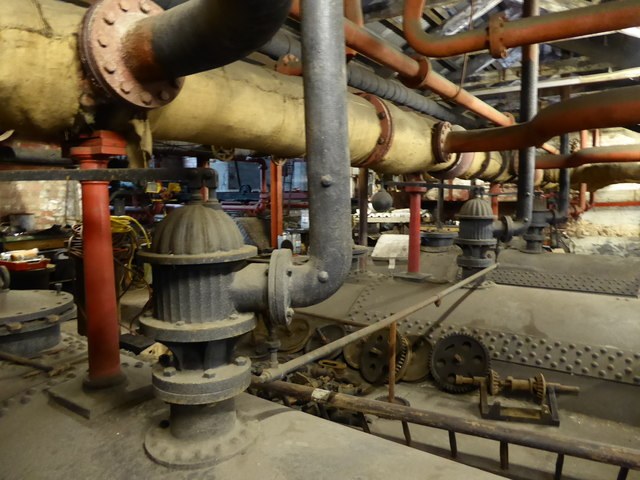
- Boilers, Claymills Victoria Pumping Station: Chris Allen, CC BY-SA 2.0.
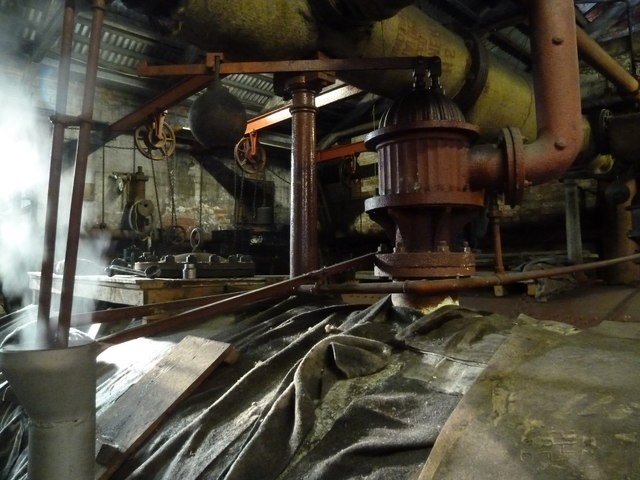
- Claymills Victorian Pumping Station, under pressure: Chris Allen, CC BY-SA 2.0.
- Scene of the Recent Steamboat Explosion, Bristol: Illustrated London News, 27 July 1850, public domain.
- Fig. 102: Courtney, The Boilermaker's Assistant, p. 90, Library page.
- Fig. 95: Hawkins, Maxims and Instructions for the Boiler Room, p. 188, Library page.
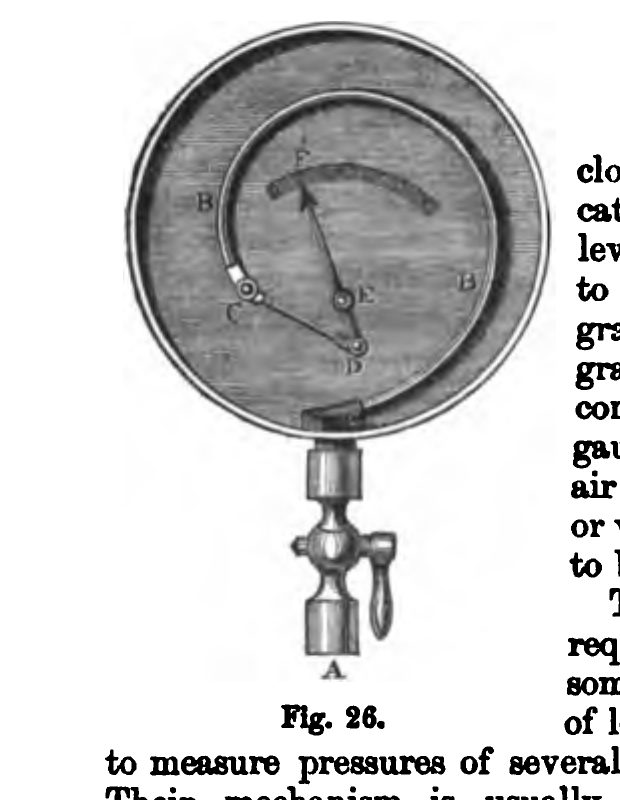
- Fig. 26: Rankine, A Manual of the Steam Engine, p. 112, Library page.
Comment or suggest something in the Expanded thread on the Vintage Story Discord