
Rolling mill
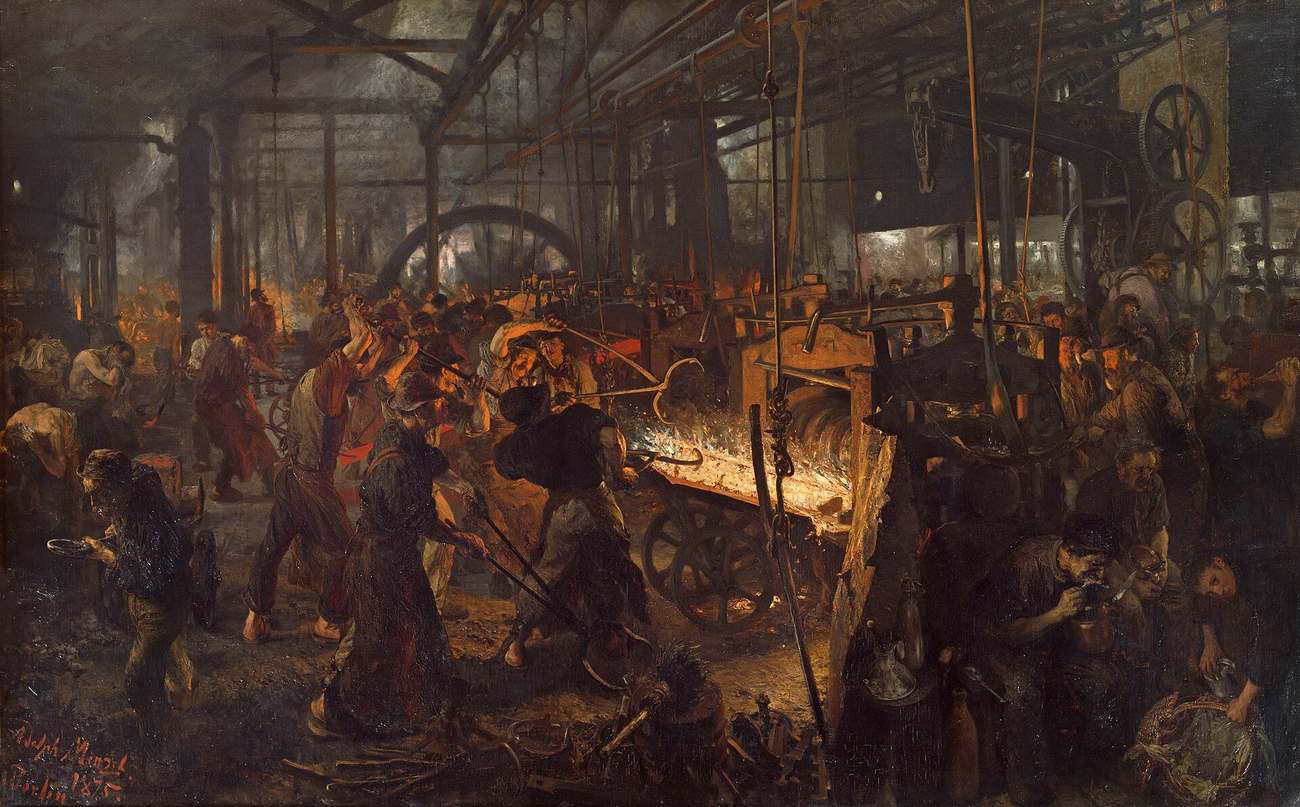
A rolling mill squeezes hot iron between two turning cast-iron rolls, so that it comes out thinner and longer. How to run the game's mill is in the rolling guide, and its parts are in the catalogue. This page is about the real one, and about what the game keeps of it.
How the real one worked, and why it was built so
Before the rolling mill, wrought iron was drawn out under a hammer, one blow at a time. Henry Cort took out his patent for grooved rolls in 1783 and paired them with puddling in 1784 (Percy pp. 627-629). A pair of rolls does continuously what a hammer does in strokes. By Bauerman's time rolls were generally used for finished iron "in preference to the hammer", which kept to the old open forges (Bauerman p. 299).
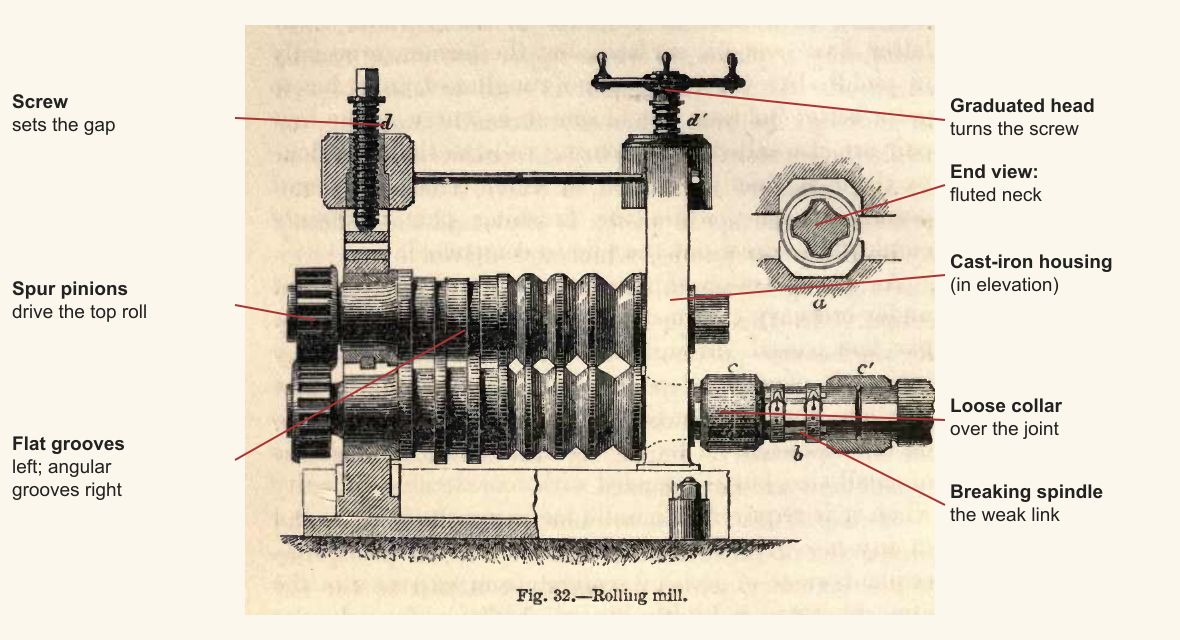
The two rolls are cast iron, with their axes one above the other, geared to turn at one speed (Bauerman p. 299). Plate rolls are smooth. Bar rolls are grooved, each roll carrying half the section, so that the pair forms "an aperture or rotating die" (Bauerman p. 299). The piece gets smaller by closing the rolls, by moving to a smaller groove, or by both (Bauerman pp. 299-300).
The rolls ran one way only. After a pass the bar had to be lifted back over the top roll to the entry side, which wasted time and iron, because the piece lost metal to scale all the while it lay out in the air (Bauerman p. 301). Three-high stands and reversing mills were the later answers (Bauerman pp. 301-302).
A stand was built to survive its own accidents. Each screw of wrought iron, four and a half inches thick, turned in a brass box in the top of the housing, and it pressed down on a cast "safety-cap" that was "calculated to break before any other part of the machinery" (Overman p. 350). Aprons of cast iron filled the space between the housings and carried the iron to the roll, and wrought-iron scrapers lay in the grooves to stop the bar from wrapping round a roll (Overman pp. 350-351).
Why a roll will only take so much
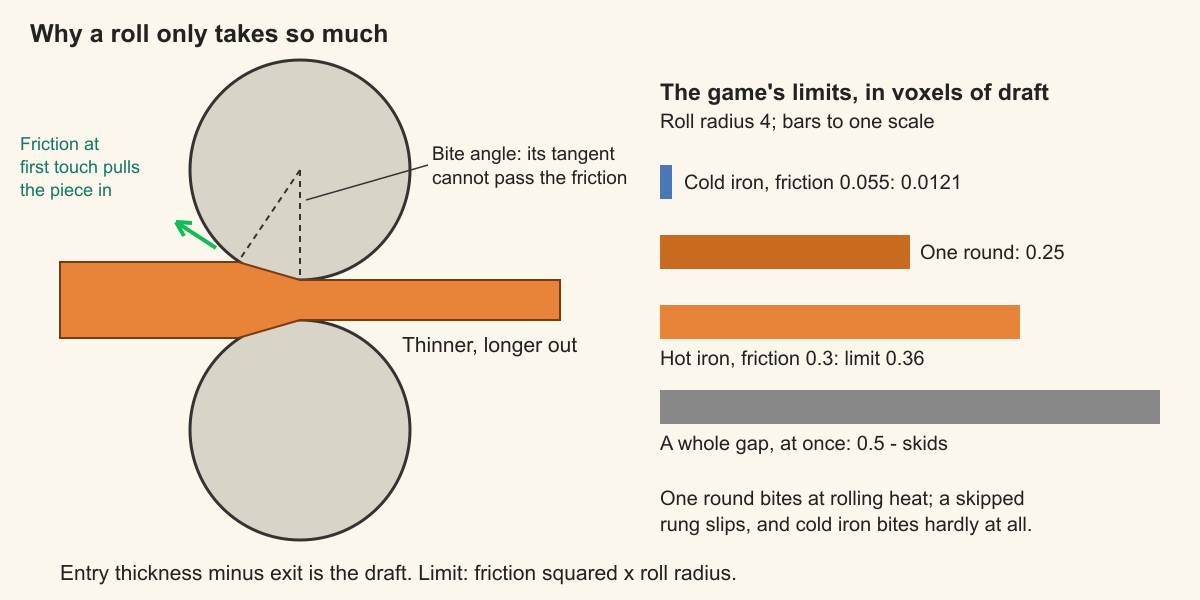
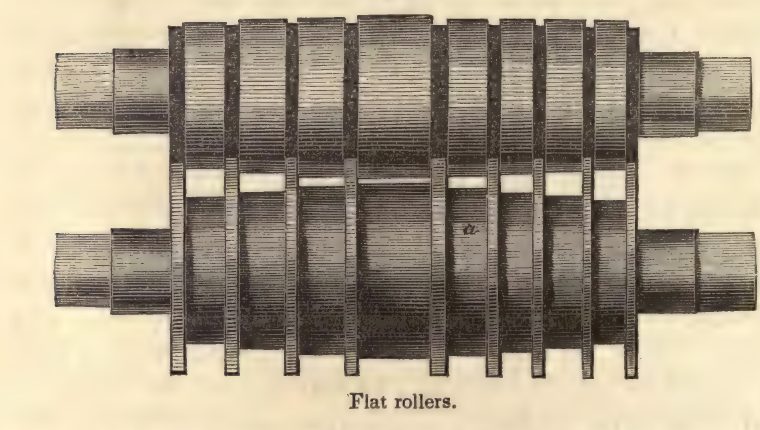
The period books feel for this limit without stating it. Overman's first groove had to be "sufficiently large to catch" (Overman p. 347), and in parts of Europe the first grooves had projecting ribs "for catching" (Overman p. 344). Roughing rolls were often roughened to get a better hold on the bloom (Bauerman p. 301). A flat groove sequence had one more groove than the shapes needed, which "would not be actually needed, were it not for the catching of the bar" (Overman p. 348).
Heat was the working margin. The rollers wanted the iron fast and hot, and if it cooled in the rough rolls the piece was in trouble: "the loss at the roughing rollers, caused by the iron getting too cold, is, of all others, the most disagreeable, because the iron is generally too long to be re-heated, and too thick to be cut" (Overman p. 360). Plate was the hardest case. Plate rolls wanted "the momentum of a large fly-wheel", and even then "the plates cool and stick fast in the middle" (Fairbairn Mills II p. 259).
The screw, the plate stand and the shear
On a bar groove the screw is hardly touched. For rails it is set to bring the product to its proper weight and then left alone, because the section gets smaller by moving along the grooves (Bauerman p. 304). Plate has no grooves, so there the gap is the whole job. The foreman "regulates the thickness of the sheet by these screws", and the wrenches on them form a cross so that a handle always faces the men (Overman p. 367). The heads were graduated so that both ends of the roll came down alike (Bauerman p. 304).
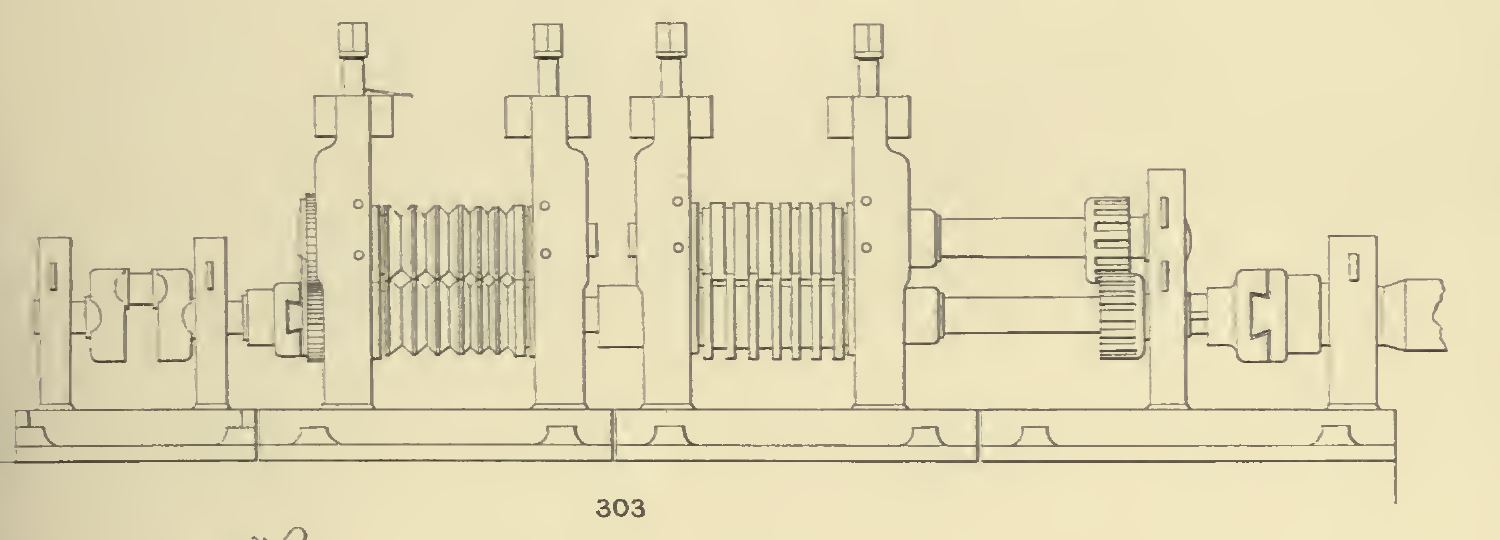
Plate mills usually had three pairs of rolls: a grooved pair to bloom the pile, a roughing pair, and a chilled, polished finishing pair, 5 to 6 ft long and 20 to 24 in across (Bauerman p. 309). Boiler-plate rollers of four and five feet were in use (Overman p. 366). This is where the game's wide hall comes from.
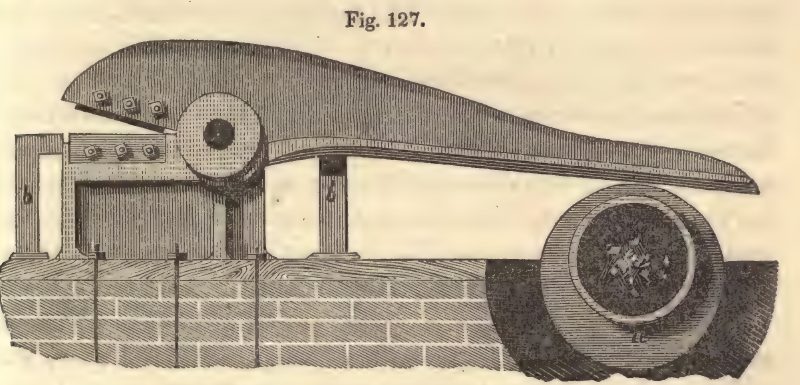
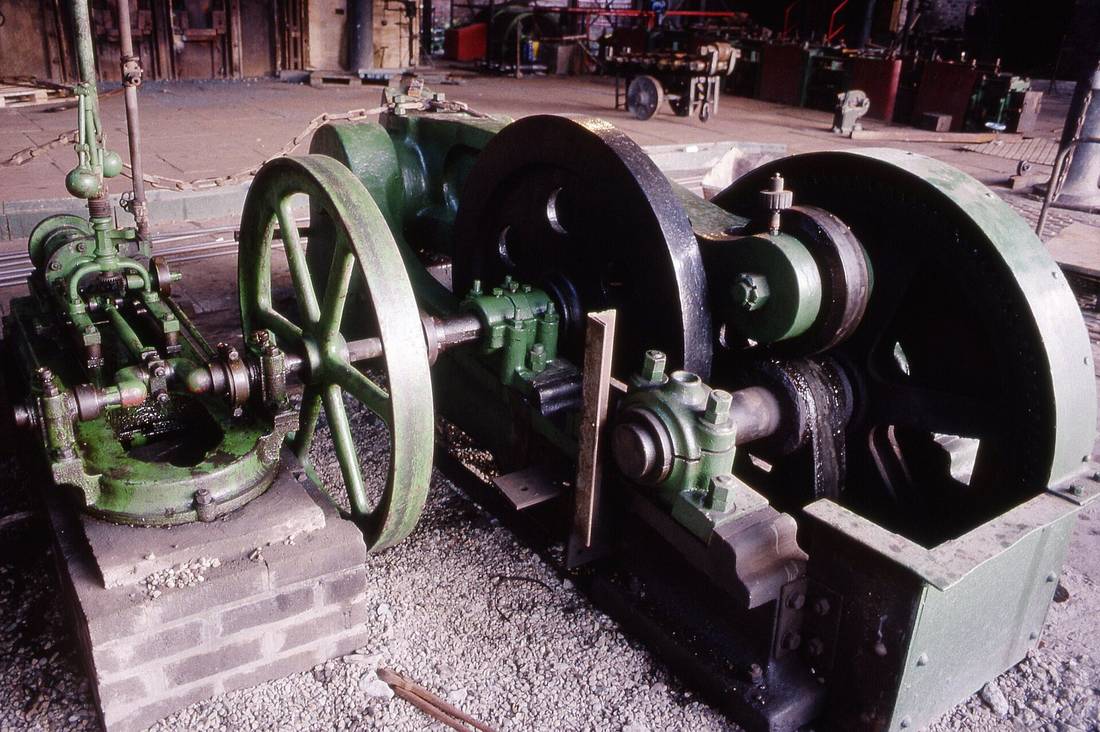
Smaller work had hand shears as well: two-foot lever shears on a plank at the end of each pile, where the boys cut the bad ends off small rod and hoop (Overman p. 378).
Period basis, and what is the game's own
- Period: rolling is a hot job. A cooled piece stalls, and iron must go back to the fire (Overman pp. 360, 373). The game follows this strictly: below rolling heat a piece will not bite and it loads the stand ten times harder, so the reheat furnace sits by the mill.
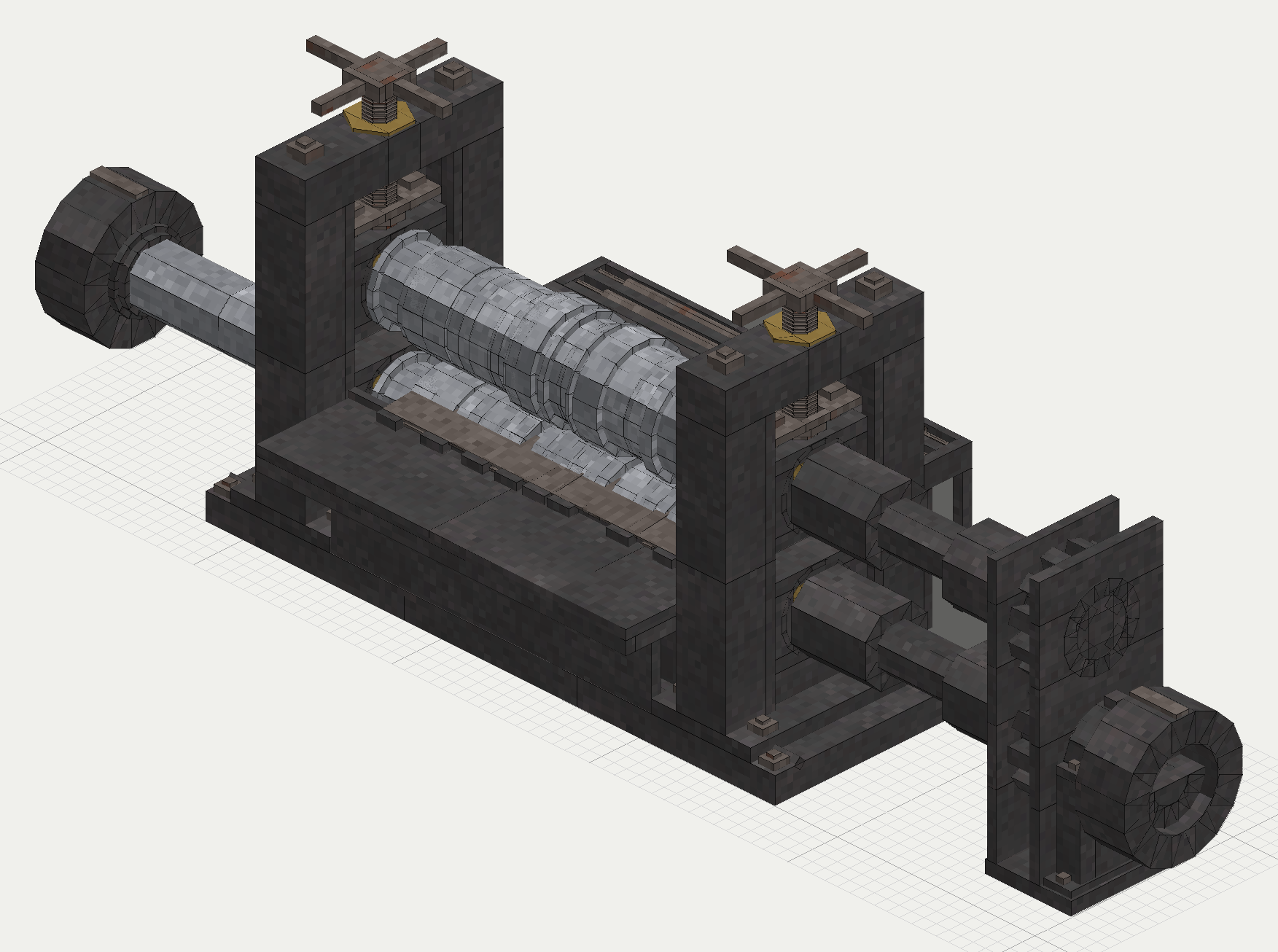
- Period: bar passes go through grooves of falling size, and plate is set by the screw (Bauerman p. 304, Overman p. 367). The game keeps both. The flat and grooved roll sets have fixed gaps and the piece walks along them; only the wide set has a screw.
- Period: a piece turned a quarter at each roughing groove to keep its edges sound (Overman p. 346). The game keeps the turn as a rule: a gap takes two rounds, the half-step and then the gap itself.
- Period: a mill gave off roll scale, and roll scale went into the puddling charge (Overman p. 298). Planned: each pass sheds mill scale, which goes back to the fettling of the puddling furnace.
- Period: plate mills had a line of stands (Bauerman p. 309). Planned: the wide hall is four ordinary mills on one drive shaft, each screwed to its own gap, and the steel line adds two more at its front. Setting one mill over and over stays allowed, and costs handling instead of iron.
- The game's own: friction decides the order of the rolling. A jump deeper than the bite limit skids, and nothing else enforces the schedule. The real rule, that the roller knew his grooves, is not modelled.
- The game's own: every gap is 0.5 voxel below the last, where real grooves took a share of the section (Overman p. 347).
- The game's own: a piece is a section and a length. Camber, guides, side guards, roll wear and roll changes are left out.
- The game's own: the rolls turn one way, and the player walks the piece round the stand. No three-high stands or reversing mill.
- The game's own: no hand shears. Every crop goes through the one shearing machine, and a crop keeps the heat of its piece. A hot cut is easy, and a cold one needs the drive to have the torque for it.
- The game's own: steel roll sets differ from iron ones by the torque they need, not by what they are made of. Planned: the steel line's torque gate is not read yet. See cast and wrought iron for what the iron itself does.
- Today: no roll set can be crafted, so the mill runs in creative mode only.
The numbers
Rolls are drawn at true size (scale and units). Friction, load and the ladder of gaps are the game's own. "Planned" is the design value; values without that word are what the game has now.
| In the game | Period figure | How it was scaled | Game value |
|---|---|---|---|
| Roll diameter | Merchant rolls 18 in (Fairbairn Mills II p. 259); 12 to 16 in (Bauerman p. 309) | Whole voxels at true size | 8 voxels, 19.7 in |
| Barrel length | Merchant 2.5 to 3 ft (Fairbairn Mills II p. 259) | Whole voxels at true size | 16 voxels, 3.3 ft |
| Wide barrel | Plate rolls over 6 ft (Fairbairn Mills II p. 259); 5 to 6 ft (Bauerman p. 309) | Limited by the block size; the game's own | 16 voxels, 15 usable; planned 24 |
| Roll speed | Rough 30 to 40 rpm (Overman p. 349), merchant 60 to 75 (Bauerman p. 309), heavy plate 25 to 30 (Bauerman p. 309) | Not scaled; the speed is whatever the drive gives | Set by the drive |
| Reduction per pass | Section x about 0.54, 11 squared to 15 squared (Overman p. 347) | Replaced by a fixed ladder; the game's own | 0.5 voxel a gap, 0.25 a round |
| Bite limit, hot | None given | The game's own: friction 0.3, radius 4, friction squared x radius | 0.36 voxel draft |
| Bite limit, cold | None given | The game's own: friction 0.055 | 0.0121 voxel draft, about 30 times less |
| Rolling heat | None given | The game's own | 900 C; ten times the load fully cold, reached 400 C below that |
| Stand load | None given | The game's own | 340 Nm hot, 3.4 kNm cold |
| Wide screw | The foreman's own setting (Overman p. 367) | The game's own steps | 2.5 to 1.0 in steps of 0.5; planned 2.0 to 0.16, with rungs at 0.75, 0.5, 0.25 |
| Plate stands | Usually three pairs (Bauerman p. 309) | The game's own count | Planned 4, the steel line 6 |
| One mill or a hall | None given | The game's own | Planned 12 feeds for 2 plates on narrow rolls, 28 feeds and 5 stamps for 15 on wide ones |
| Shear lever | 7 to 12 ft (Overman pp. 378-379) | True size | Planned 2.9 m |
Open, and what you can tell us
None of the books read here gives a working limit for how much a roll could take at one pass, or a figure for hot friction. They give ratios of grooves, and they say only that a groove must be large enough to catch. If you know a period table of draft against roll diameter for wrought iron, we would like to read it. We also found no freely licensed photograph of a surviving two-high wrought-iron stand with its rolls in place.
Picture credits
- Eisenwalzwerk (The Iron-Rolling Mill): Adolph Menzel, 1875, public domain.
- Steam driven shears, G R Morton Ironworks, Blists Hill: Gillett's Crossing from Bristol, United Kingdom, CC BY 2.0.
- Fig. 32, labelled for this site: Bauerman, A Treatise on the Metallurgy of Iron, p. 300, Library page.
- Plate 53, Fig. 303: Truran, The Iron Manufacture of Great Britain, Library page.
- Figs. 106 and 127: Overman, The Manufacture of Iron, pp. 348 and 379, Library page.
- The bite diagram: drawn for this site; the game's values from its design.
- The game's mill: the mod's planned drawing.
Comment or suggest something in the Expanded thread on the Vintage Story Discord