
Pig, bar and casting weights
A piece of iron in the game has a weight in units, and every one of those weights comes out of the same rule. The plain version of why is in why the numbers are what they are. This page is about what the books say the pieces weighed, how metal is counted in the game, and where the two meet or part.
What a pig weighed
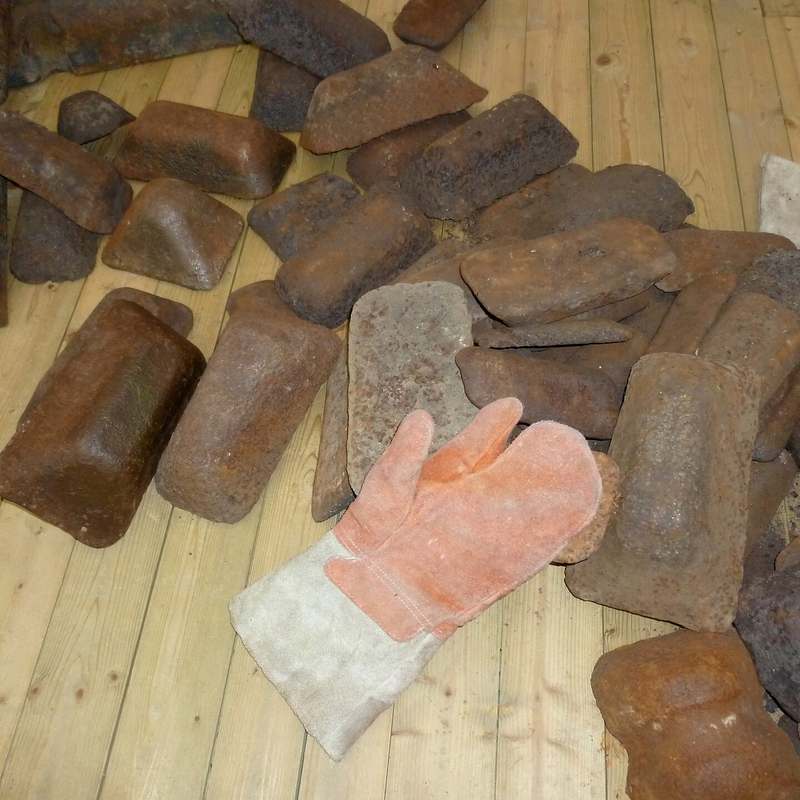
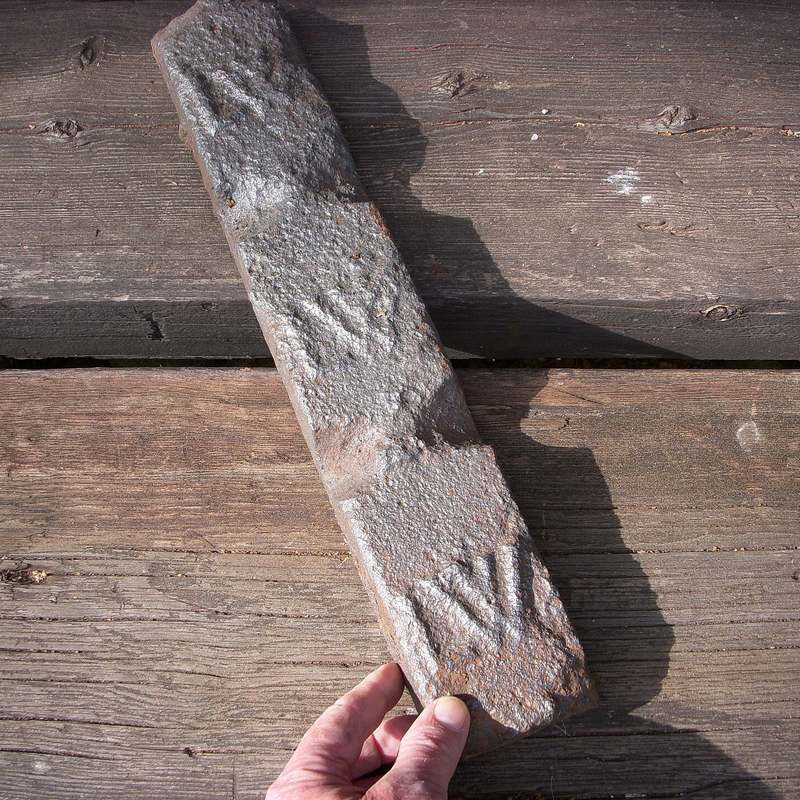
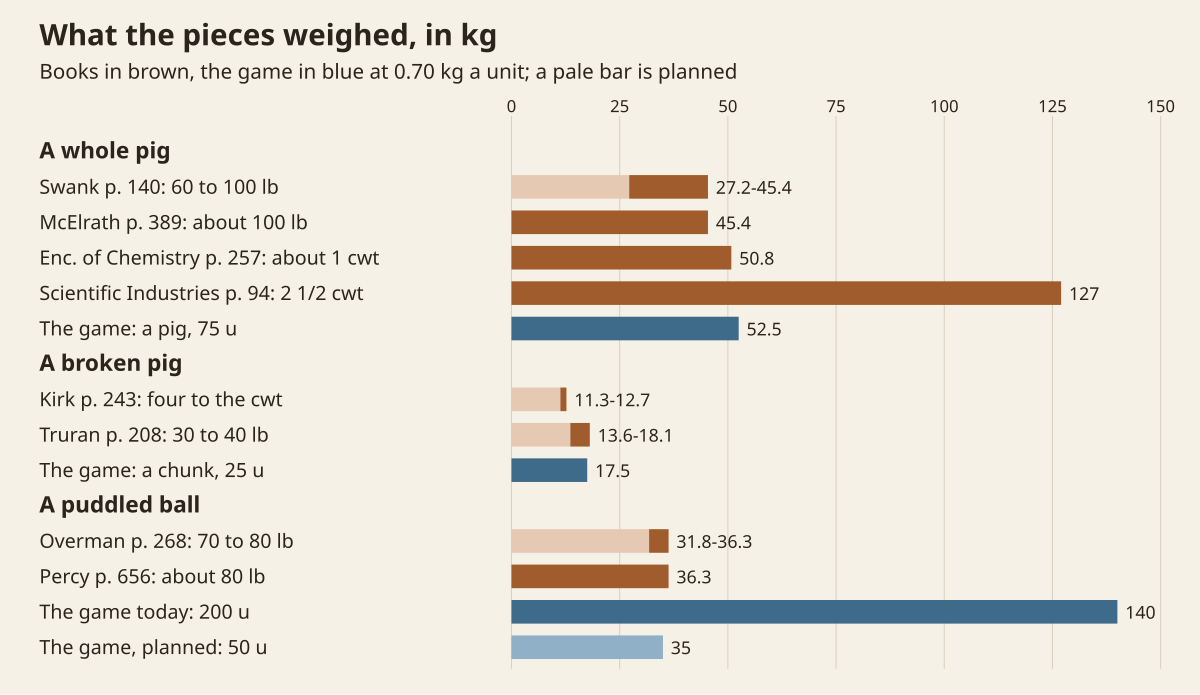
No book held here from 1841 to 1869 says what a blast-furnace pig weighed; the figures come later and do not agree. "Each pig weighs about 100 lbs., varying somewhat, however, at different furnaces" (McElrath p. 389). British practice is "about 1 cwt. or a little more" (Encyclopaedia of Chemistry p. 257). Scientific Industries makes them "about 3 feet long and 4 inches in thickness, weighing about 2 1/2 cwt. each" (Scientific Industries p. 94). An early American works ran "pigs of 60 to 100 pounds' weight" (Swank p. 140).
A pig was as big as its furrow in the sand and no bigger. The moulds were "about 4 feet long" and branched off the runner called the sow (Encyclopaedia of Chemistry p. 257).
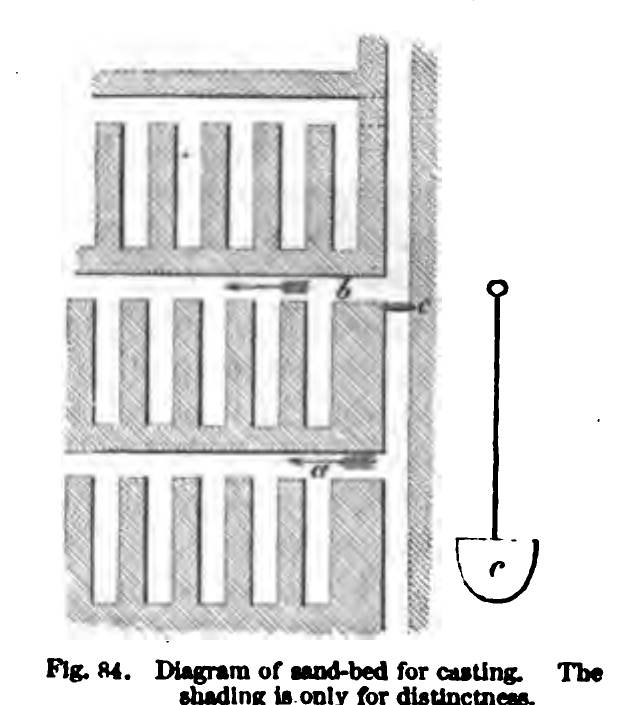
Once cold, the pig was broken. In American practice of 1917 men went onto the beds with sledges and crowbars and broke the iron from the sow and each pig in two (Johnson Construction p. 331). For the puddling furnace, pieces of "30 to 40 lbs. is best, and the more uniform the better" (Truran p. 208). The foundry reckoned "four pieces to the hundred weight" (Kirk p. 243).
Why a hundredweight? The books do not say. A cwt pig makes a ton of 20 cwt come to 20 pigs, worked out, and it is a weight a man can shift, but neither reason is stated. More on the bed is in the pig bed and pig iron.
How the game counts metal
Vanilla counts metal in units, 100 u to an ingot, without saying what a unit is. The mod reads a unit off the drawn shape.
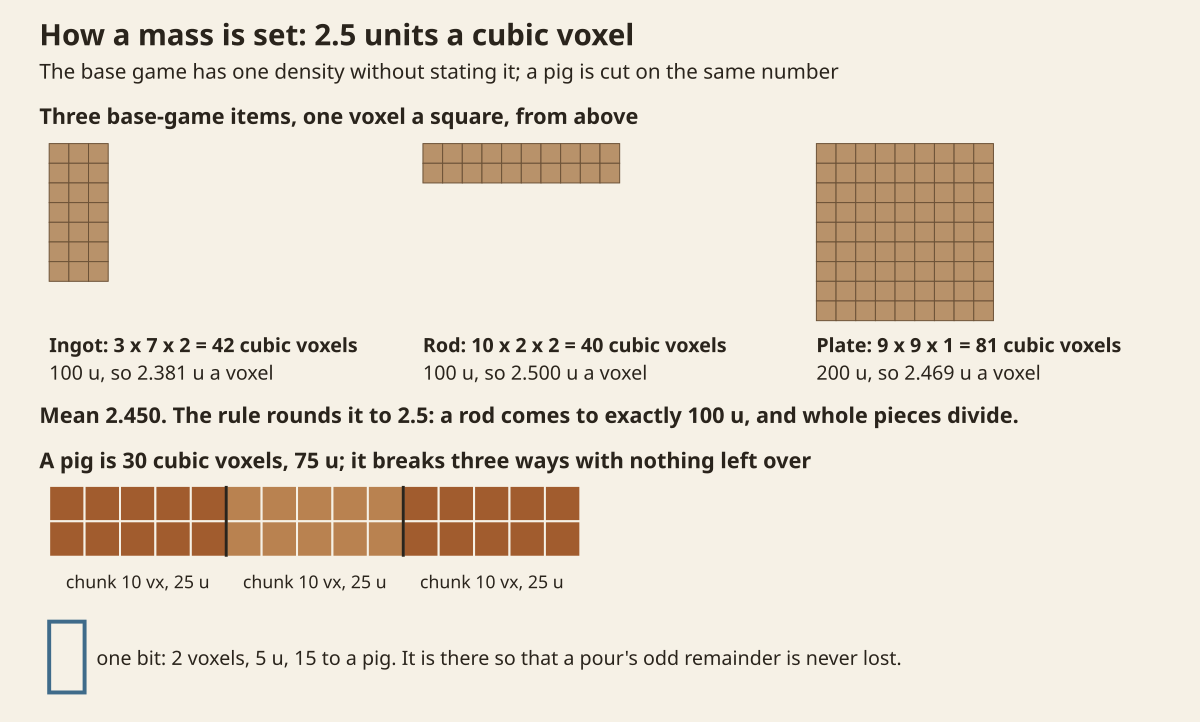
A voxel is 6.25 cm a side, so a cubic voxel is 244 cm^3, a unit is 0.4 of one, 98 cm^3, and at the density of iron that is 0.70 kg (scale and units). An ingot of 100 u is 70 kg of iron. That is vanilla's figure, not a period one: drawn at this scale the base game's ingot is a bar 44 cm long.
The pig is where the rule and the books meet. 1 cwt at 0.70 kg a unit is 73 u. 73 is a prime and nothing divides it, so the game makes the pig the nearest figure that goes into whole thirds and fifteenths, 75 u, or 52.5 kg. Its drawn length of about 15 voxels, 95 cm, sits between the 3 ft and 4 ft of the books above.
The small pieces are there so that nothing is lost. The bed freezes whatever reached a mould, and a pour never lands on a whole number of pigs. Three chunks or 15 bits keep the arithmetic whole: every odd remainder of a pour is paid out as pieces. A chunk at 17.5 kg sits inside Truran's size, 19 to 26 u (Truran p. 208). The bit has no period counterpart; it exists because the arithmetic needs a smallest piece.
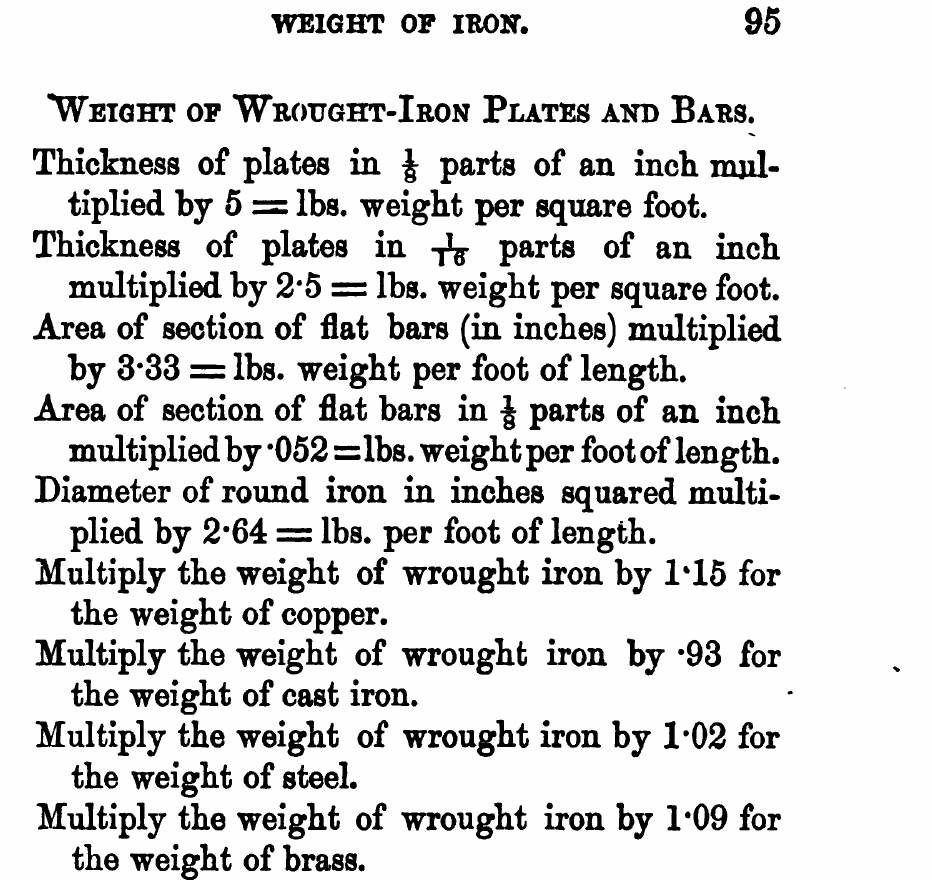
The rule takes no notice of the metal. The period's handbooks did:
What came after the pig
A puddler drew his iron as balls. "A ball weighs about 80 lbs." (Percy p. 656), and Overman has them "twelve or fifteen inches in diameter, or seventy or eighty pounds in weight" (Overman p. 268). The general charge was 4 1/4 or 4 1/2 cwt of pig to a heat (Truran p. 208), and six balls came out of it (Percy p. 656). A solid iron ball of 12 inches would be over 100 kg, worked out, so the ball was a lump of iron and slag, about a third as dense as it looks.
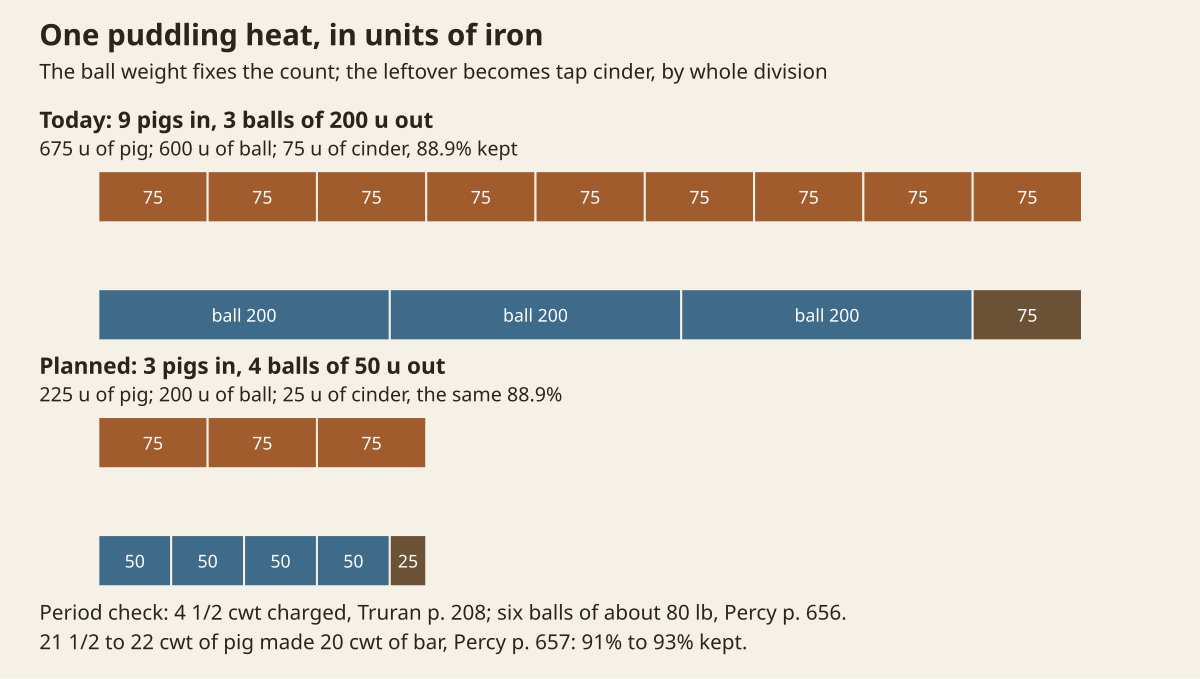
The game's ball today is 200 u, 140 kg. The planned ball is 50 u, 35 kg, drawn as a rough sponge 6 voxels across, which is 37.5 cm against Overman's 30 to 38. It is the one piece exempt from the voxel rule, because a slag-laden sponge has no solid section to measure.
The next forms follow. A planned shingled bloom, 2 x 2 x 5 voxels, is 50 u: one ball pressed square. Truran's squeezed bloom ran about 5 inches across by 18 long (Truran p. 219), 45 kg solid, worked out, and Overman forged them from 60 to 100 lb (Overman p. 334). A planned merchant bar of 2 x 0.5 x 20 voxels is 12.5 cm x 3.1 cm x 1.25 m, and 50 u or 35 kg. Truran's finishing rolls made flat bars of "3 to 7 inches wide by 1/2 inch to 1 1/2 inches thick" (Truran p. 223) and his cut lengths were 3 to 4 ft (Truran p. 226). Run through Courtney's rule, that planned bar is about 37 kg, worked out, within a few kilos of the 35 the unit gives.
Today the bar is the older 400 u shingled piece, 280 kg, and the slab 1200 u. The sizes are in stock and plate sizes, and the work is in puddling.
Castings
A casting's weight is the volume of its pattern and nothing else. The game measures each one from its drawn shape at the same 2.5 u a voxel. A hollow casting counts only its metal, so a cored cylinder is measured from its actual walls, and the heavy plate is half a slab, 600 u, cast or rolled.
The books at hand give no such weights for the pieces the game casts, so no period figure stands behind the numbers below. A figure of Courtney's shows how they compared: his worked plate of 6 ft x 3 ft x 3/8 in comes to 270 lb, 122 kg (Courtney p. 95). The game's heavy plate at 420 kg is far the thicker piece, the size that divides from a slab.
The anvil is the one place that counts differently. Its grid is vanilla's, and on it an ingot lays 42 voxels for 100 u, 2.38 u a voxel. A planned bar is 20 cubic voxels by the rule and lays 21 voxels on the anvil: 50 u both ways, so a bar is exactly half an ingot however it is measured.
Period basis, and what is the game's own
- Period: pig weights from 60 lb to 2 1/2 cwt, the most cited figures about 100 lb and 1 cwt (McElrath p. 389, Encyclopaedia of Chemistry p. 257, Scientific Industries p. 94, Swank p. 140). The game's pig is 75 u, 52.5 kg.
- Period: pig broken up for the next furnace, in pieces of 30 to 40 lb for puddling (Truran p. 208) or four to the cwt for the foundry (Kirk p. 243). The game's chunk is 25 u, 17.5 kg.
- Period: balls of about 80 lb (Percy p. 656), 70 to 80 lb and 12 to 15 in across (Overman p. 268). The game plans 50 u, a sponge 37.5 cm across.
- Period: cast iron weighs 0.93 of wrought (Courtney p. 95). The unit does not follow it.
- The game's own: 100 u to an ingot and 2.5 u a cubic voxel, read from vanilla's own items, and 0.70 kg a unit worked out from them.
- The game's own: a pig divides into exactly 3 chunks or 15 bits, because the units have to divide. A real pig broke where it broke.
- The game's own: no metal is lost in moving or casting it; a piece that loses metal states how much. See ore and fuel per ton.
- The game's own: units count volume, not weight, so cast iron, wrought iron and steel of one size are the same number of units.
The numbers
A unit is 0.70 kg of iron and a voxel 6.25 cm (scale and units); the metal is counted at the mod's rule rather than scaled the way furnace rates are (how we scale). "Planned" is the value in design, the game's value otherwise.
| In the game | Period figure | How it was scaled | Game value |
|---|---|---|---|
| Density | Cast iron 0.93 of wrought (Courtney p. 95) | Vanilla's ingot, rod and plate measured, mean 2.450, rounded | 2.5 u a cubic voxel, whatever the metal |
| Ingot | None: the base game's | Vanilla's own | 100 u, 70 kg |
| Rod | None: the base game's | Vanilla's own, on the rule exactly | 100 u, 70 kg |
| Pig | About 100 lb (McElrath p. 389), about 1 cwt (Encyclopaedia of Chemistry p. 257), 2 1/2 cwt (Scientific Industries p. 94); 39 to 181 u, worked out | Nearest whole figure above 1 cwt's 73 u that divides by 3 and 5 | 75 u, 52.5 kg |
| Chunk | 30 to 40 lb (Truran p. 208), 19 to 26 u; four to the cwt (Kirk p. 243) | A third of a pig | 25 u, 17.5 kg |
| Bit | None: the game's own | A fifteenth of a pig | 5 u, 3.5 kg |
| Slag brick | None: the game's own | Shares the pig's mould, so it is the pig's size | 75 u |
| Puddled ball | About 80 lb (Percy p. 656), 70 to 80 lb (Overman p. 268); 45 to 52 u, worked out | Whole balls from whole pigs; the planned ball exempt from the rule | 200 u, 140 kg; planned 50 u, 35 kg |
| Puddling heat | 4 1/2 cwt charge, the larger of Truran's two (Truran p. 208), 229 kg | Whole pigs, today nine, planned three | 675 u, 472 kg; planned 225 u, 158 kg |
| Heat kept | 21 1/2 to 22 cwt of pig to 20 of bar (Percy p. 657), 91% to 93% | Forced by whole balls | 88.9% |
| Shingled bloom | 5 x 18 in, 45 kg solid, worked out (Truran p. 219); 60 to 100 lb (Overman p. 334) | Whole voxels on the rule | Planned 2 x 2 x 5 voxels, 50 u, 35 kg |
| Merchant bar | 3 to 7 in x 1/2 to 1 1/2 in (Truran p. 223), cut 3 to 4 ft (Truran p. 226); 37 kg at the planned size by Courtney's rule | Whole voxels on the rule | Planned 2 x 0.5 x 20 voxels, 50 u, 35 kg; today a 400 u bar, 280 kg |
| Slab | Large pile, about 4 cwt, 203 kg (Truran pp. 226-227) | Whole voxels on the rule | Today 1200 u, 840 kg |
| Heavy plate | 6 ft x 3 ft x 3/8 in, 270 lb (Courtney p. 95), a thin plate | Half a slab | 600 u, 420 kg, cast or rolled |
| Light cylinder blank | None at hand | Measured from the drawn shape | 980 u, 686 kg |
| Heavy cylinder blank | None at hand | Measured from the drawn shape | Planned 3780 u, 2646 kg |
Open, and what you can tell us
No book held here says why a pig was the weight it was, or gives a pig's weight from 1841 to 1869. The figures that exist disagree by more than two to one. If you know a period source that gives the section of a pig or a weighed run of pigs from a named furnace, we would like to read it. A source that gives the finished weight of an ordinary cast part of a mill or engine, a plate, a cylinder or a bed, would give the castings on this page a period figure they do not have.
Picture credits
- Gueuses de fonte, Usine d'Uckange: Borvan53, CC0, cropped.
- Tackjarn Dalarna 1800: Holger.Ellgaard, CC BY-SA 3.0, cropped.
- Fig. 84, diagram of sand-bed for casting: Percy, Metallurgy: Iron and Steel, p. 493, Library page.
- Weight of wrought-iron plates and bars: Courtney, The Boilermaker's Assistant, p. 95, Library page.
- What the pieces weighed: drawn for this site from McElrath p. 389, Encyclopaedia of Chemistry p. 257, Scientific Industries p. 94, Swank p. 140, Kirk p. 243, Truran p. 208, Overman p. 268, Percy p. 656 and the game's design values.
- How a mass is set: drawn for this site from the game's design values and the base game's shapes.
- One puddling heat: drawn for this site from Truran p. 208, Percy pp. 656-657 and the game's design values.
Comment or suggest something in the Expanded thread on the Vintage Story Discord