
Puddling furnace
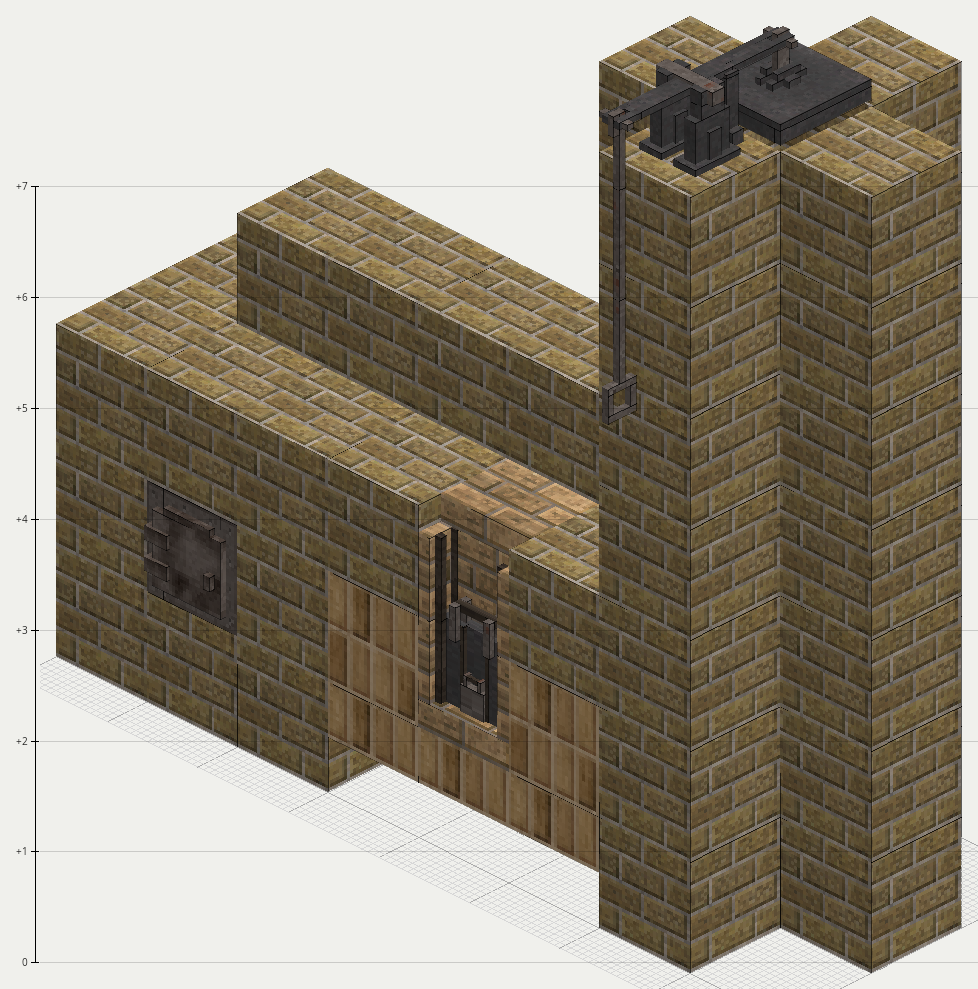
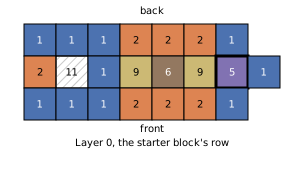
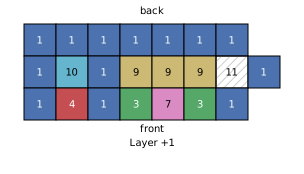
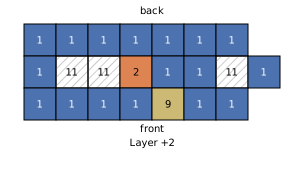
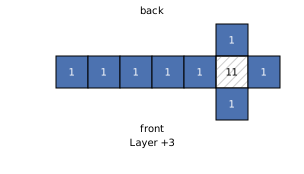
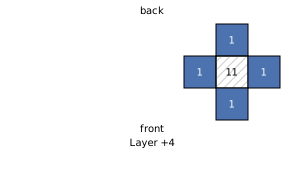 Layers +4 to +6 (the same course)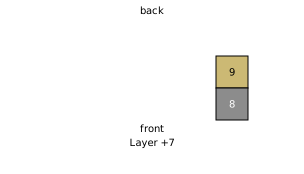
| # | Colour | Name | Matches |
|---|---|---|---|
| 1 | any Refractory bricks | game:refractorybricks-good-tier* | |
| 2 | Fireclay brick slab | game:brickslabs-fire-up-free | |
| 3 | Fireclay brick slab | game:brickslabs-fire-south-free | |
| 4 | Iron hatch door | game:cokeovendoor-*-north | |
| 5 | Puddling Furnace Core | iiex:furnace-puddlingcore-*-* | |
| 6 | Puddling Hearth | iiex:furnace-puddlinghearth-n | |
| 7 | Puddling Door | iiex:furnace-puddlingchargedoor-n | |
| 8 | Chimney Damper | iiex:furnace-puddlingchimneycap-s | |
| 9 | Reserved space (kept clear) | exlib:structurefiller | |
| 10 | Firebox | iiex:furnace-firebox-*-* | |
| 11 | Empty (air) | game:air |
Materials
| Block | Cells |
|---|---|
| any Refractory bricks | 60 |
| Fireclay brick slab | 10 |
| Iron hatch door | 1 |
| Puddling Furnace Core | 1 |
| Puddling Hearth | 1 |
| Puddling Door | 1 |
| Chimney Damper | 1 |
| Firebox | 1 |
Facings and connectors
- Fireclay brick slab turns with the structure; segment 3 of its code names the face.
- Iron hatch door turns with the structure; segment 3 of its code names the face.
- Puddling Hearth turns with the structure; segment 3 of its code names the face.
- Puddling Door turns with the structure; segment 3 of its code names the face.
- Chimney Damper turns with the structure; segment 3 of its code names the face.
What it does
The puddling furnace decarburises pig iron into wrought iron, which is vanilla iron. It is a reverberatory furnace: the fire burns in a firebox at one end and the flame is drawn across a bridge and over the metal, so the fuel never touches the charge.
It never melts iron. It holds the bath at 1400 C, between pig iron's melting point and wrought iron's, so the pig melts down and then, as carbon leaves it, the metal's own melting point climbs past the bath temperature and it comes to nature: it balls up. That is why rabbling is a verb and not a wait.
Building it
- Place the core first, then ctrl plus shift plus right-click it for the build outline and the shopping list.
- Lay the ash pit and the firebox at the far end from the core, and set the fire door in front of the firebox.
- Set the puddling hearth in the middle: a fettled cast-iron bed, three rows wide.
- Set the puddling door in front of the hearth, one course up. It is a big charging door with a second, small working door beside it. The small one exists so the heat does not pour out of the big one on every stroke.
- Raise the stack in the core's own column and cap it with the chimney damper at the top.
- Keep laying until the outline reports complete.
The core's side variant fixes the facing and the whole furnace turns with it. The stack is fixed at the height the layout declares; unlike the crucible furnace, there is nothing for the player to add.
The charge
Charge order is the mechanic. Fettle first, then pig.
- Right-click a hearth row with Puddling Fettle to lay fettling in it. A row can hold only one fettling, and a row that already carries fettle or pig refuses more.
- Right-click that row with Pig Iron to lay a pig in it, up to three per row.
An unfettled row refuses pig outright, because pig laid on a bare bottom plate would weld itself to it. Fettling is a running cost, not a build cost.
A loaded centre row blocks both flanks, going in and coming out, so load the flanks first and draw them last. The centre is the fast lane for a single piece.
The run
- Fettle all three rows and charge nine pigs.
- Charge the firebox with fuel and shut the doors. An open door spills the stack's pull into the room and costs the furnace a large part of its draught.
- Light the firebox. The bath melts down at 8 per cent of a full charge per cycle, on a ten-second cadence, so a full bed goes down in about two minutes of held heat.
- Work the bath with a Rabbling Bar through the small door. Each stroke gathers one ball and leaves it standing on the bed.
- Draw each ball off with a Puddler's Paddle through the same door. Both gestures share one three-second cooldown, because they are the same motion at the same door.
- A ball cools fast. Carry it straight to the helve, where two balls shingle into a Shingled Bar.
- When the bath is gathered dry, clean the bed with an empty hand. Nine pigs give sixteen balls and three Tap Cinder, which grid-craft into exactly the three fettlings the next heat wants.
There is no tap of either kind. Puddled iron leaves as pasty balls through the door, and the hearth makes far too little slag to plumb, so the bed is cleaned rather than tapped.
What goes wrong
A row refuses pig. It is not fettled, or it is already full at three.
A flank row refuses everything. The centre row is loaded and blocking it. Draw the centre first, or load the flanks before the centre next time.
The clean-out is refused. Balls are still standing on the bed. Draw them all off first.
The strokes are being eaten. They share a three-second cooldown. Clicking faster does nothing.
The furnace will not reach its process temperature. A door is open, which costs the draught, or the firebox is not full. A firebox lights only when its bed is full.
Nothing is left in the bath but it will not clean. The remainder that does not make a whole ball is not recoverable as iron; it comes out as tap cinder on the clean-out.