
Machine-tool sizes
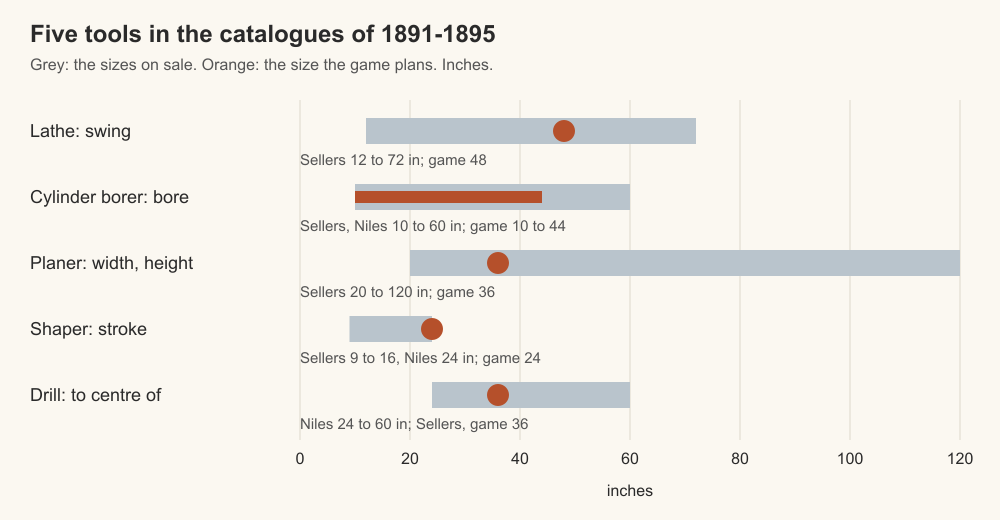
A machine tool was sold by a size in its name: a 48-inch lathe, a 36 by 36 planer, a 24-inch shaper. The game's five take their measures from those names, out of catalogues of the 1890s, and they are drawn at true size. The tools are in the catalogue from the lathe to the planer, and how a casting moves through them is on the machine shop. This page is about where the numbers come from. Nearly everything here is planned: the machines stand in the game at their first drawn sizes, and the catalogue sizes come in with their redraws.
What a size meant
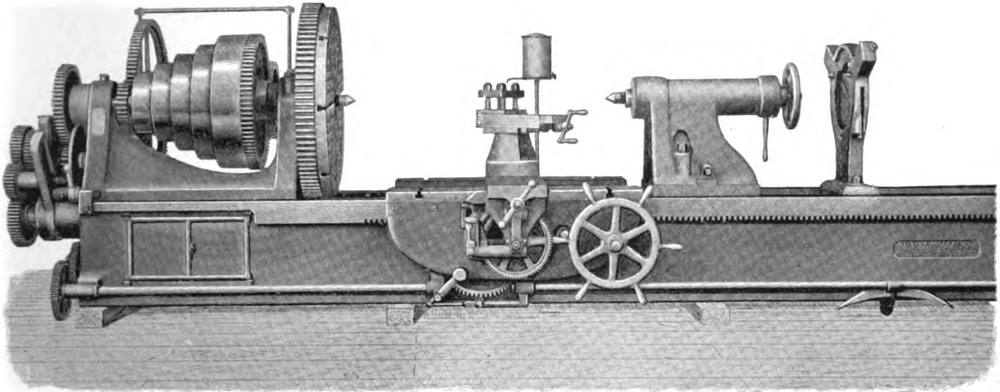
Rose gives the rule for naming a lathe: by the swing and the total length of the bed, or by the height of the centres and the length of the shears. "The height of the centres is obviously equal to half the swing of the lathe" (Rose p. 120), so a 28-inch swing and 14-inch centres are the same lathe. A longer bed did not make a bigger lathe in this sense: the swing was what it could hold, the length only how much.
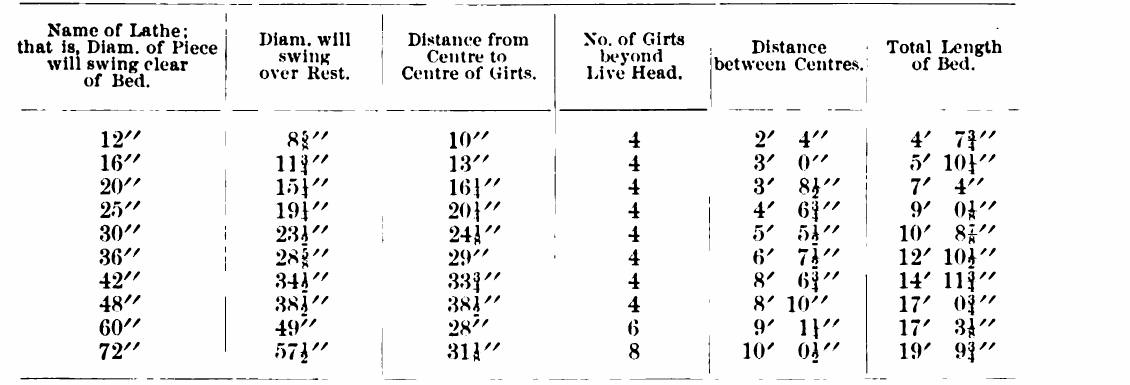
The game's lathe is drawn on the 48-inch row: 19.5 voxels of swing and a bed of about 80 voxels, five cast bed sections, against the 83 voxels the catalogue length would make. Rose's worked examples are lathes of 12 to 28 in (Rose pp. 133, 140), and he shows 44 and 90 in as well (Rose pp. 143, 150). No book at hand gives the height of the centres above the floor, and the game's 1.1 m is its own.
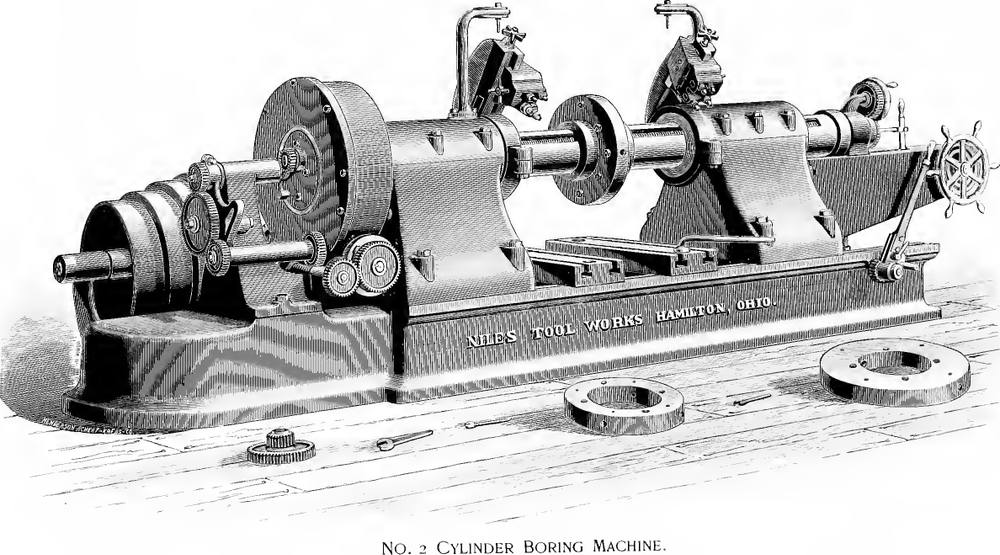
The cylinder borer is the one tool whose size comes from the job instead of a catalogue row. Niles's Nos. 3 to 5 reach 36, 60 and 42 in (Niles pp. 154-155), which is the bracket the game's machine is drawn in, and the top bore of 44 in is the Watt blower's own. The bars vary too much to read a rule from: 6 in for 10 to 22 in bores (Sellers 1895 p. 75), 8 in for 16 to 22 and 9 in for 28 (Niles p. 153), 7 in up to 18 and 12 above (Niles p. 155).
Why a stroke or a table is that long and no longer
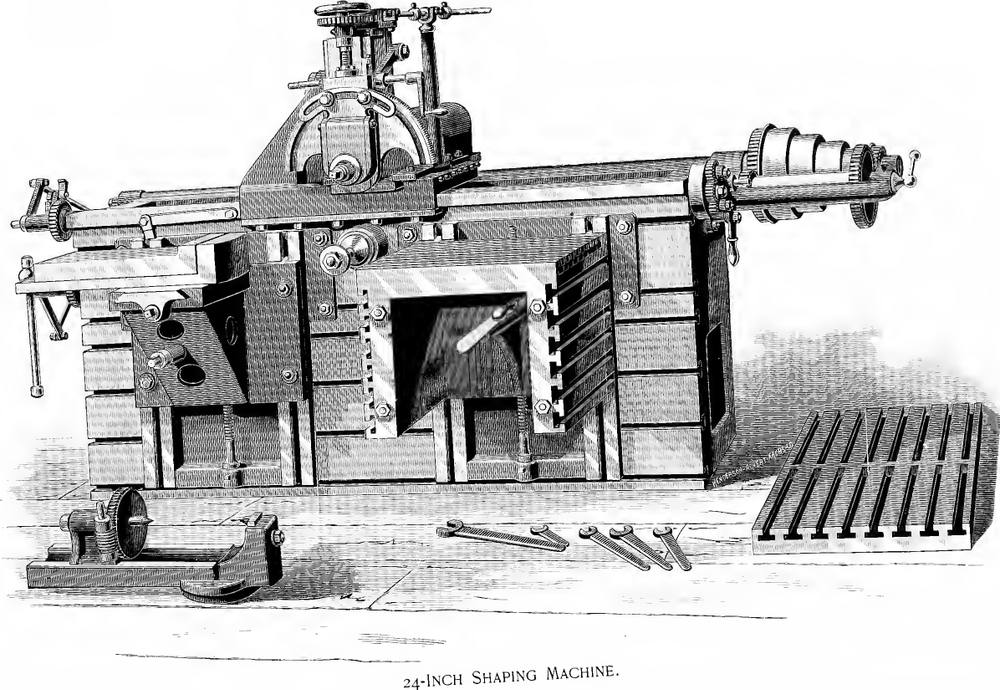
A shaper's tool slide leaves its guides on the stroke, so its use was "limited to work that does not require a greater tool stroke than about 18 inches", and 12 in on a small machine (Rose p. 397). Rose names one of 20 in (Rose p. 397), the Sellers machines stop at 16 (Sellers 1895 p. 177), and the Niles 24 in is the longest in the books at hand (Niles p. 113). The game's shaper takes that 24 in stroke, 10 voxels, so a face fits when one side is at most 10 under the stroke and the other at most 10 on the table.
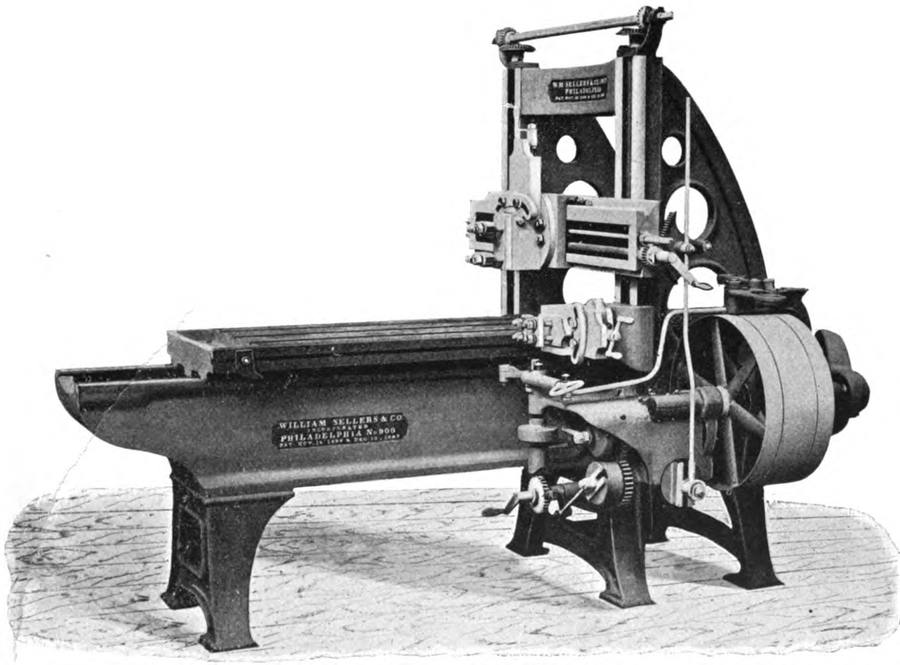
A planer has the opposite problem, and a table long enough to carry the work sets everything else. Sellers lists the 36 in with a 5 ft shortest table (Sellers 1895 p. 188), and Niles sells the nearest size, 38 by 38, from 8 to 16 ft (Niles p. 91). The game takes a 10 ft table, 48.7 voxels, with a 41-voxel stroke, 8.4 ft, and raises the rail to clear 36 in of work. Parts longer than that stay at the bench. No book at hand plans one face in two settings, shifting the work along the table partway through.
Why they cut at the speed they do
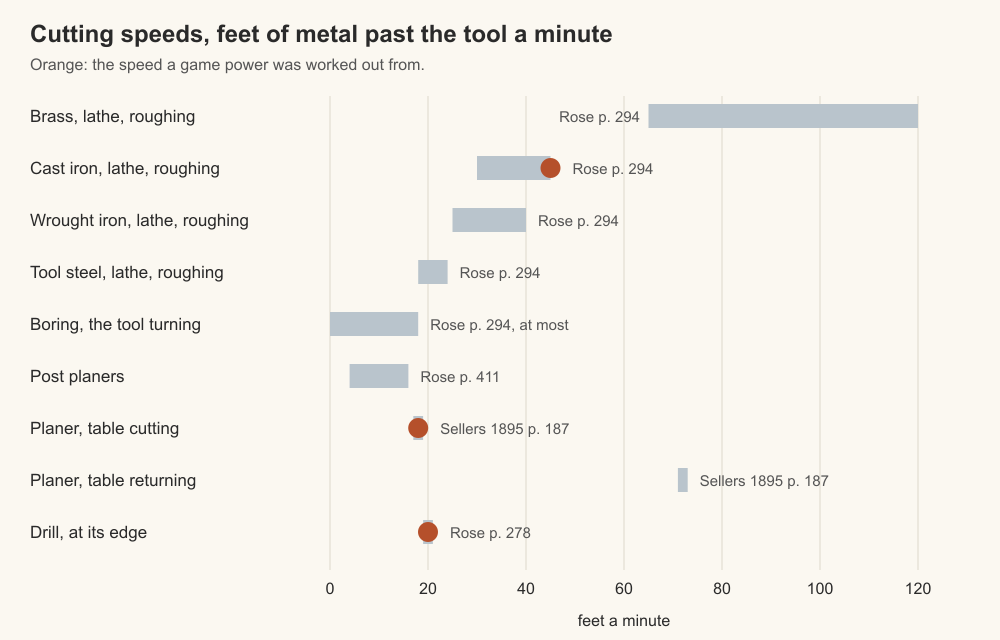
Period machines took their speed from a countershaft and made it what they needed with cones and gears: the 36 in drill's ran at 110 revolutions a minute (Sellers 1895 p. 23), a Niles cylinder borer's at 125 (Niles p. 153), the 24 in shaper's at 200 (Niles p. 113). A big Sellers lathe had fifteen speeds (Rose p. 143).
The game has no speed changes. Each machine has a power, and a job takes as long as its energy lasts at that power. The powers are worked back from the period rates. A lathe cutting cast iron at 45 ft a minute (Rose p. 294), 30 feed turns to the inch (Rose p. 294) and an 1/8 in cut removes 4.4 g of iron a second. Hartig's 185,800 J/kg (Rose p. 273, see work rates) makes that 822 W. The Sellers planer's 18 ft a minute gives 980 W while cutting, and with 72 ft back it spends 0.8 of its time cutting, 780 W. The shaper's return is 40% quicker than the cut (Rose p. 398), so 0.583 of its time, 570 W. The planer's feed and depth of cut and the lathe's depth are the game's own, as the books give no matching figure.
A slower shaft stretches a cut, and one that cannot carry the torque stalls it. The boring machine's 1620 W comes from Sellers's three and a half hours on a 22 in by 36 in cylinder (Sellers 1895 p. 74), on a skin of 3/8 in the game assumes. A running machine counts 30 period seconds in each second on the clock (how we scale).
Period basis, and what is the game's own
- Period: a machine named by the size of work it takes, in sizes running from 12 to 72 in for a lathe and 20 to 120 in for a planer (Sellers 1895 pp. 128, 188). The game takes one size of each.
- Period: the planned sizes are from the Niles catalogue of 1891 and the Sellers catalogue of 1895. Sellers's lathe table is from the same family as the 1877 treatise. No earlier British tool tables were found.
- Period: lathe centres at half the swing (Rose p. 120), a shaper's stroke limited by its slide (Rose p. 397). The game keeps both.
- Period: cones and back gears gave each tool many speeds (Rose p. 143). The game's own: one rated shaft speed and one power for each tool. All five are rated at 5 rad/s today, about 48 revolutions a minute, a value the game sets; the drill is planned at 10.7 rad/s, 102 revolutions, the speed of a 3/4 in drill at Rose's 20 ft a minute (Rose p. 278).
- The game's own: the height of the lathe's centres above the floor, the planer's feed and depth, the lathe's depth of cut, and the boring machine's bar of 4 voxels with its small bar of 3 for the 10 in bores.
- The game's own: the base game has no metal-cutting machine tools, so nothing here replaces a vanilla number. See vanilla against reality.
The numbers
The machines are drawn at 16 voxels to the metre, 1 in being 0.406 voxels (scale and units), and powers take the period rates without a fuel factor (how we scale). "Planned" is the value in design; today's drawn size follows where the design gives one.
| In the game | Period figure | How it was scaled | Game value |
|---|---|---|---|
| Lathe swing | 48 in over the bed (Sellers 1895 p. 128; Niles p. 74) | True size | Planned 19.5 voxels, 1.22 m |
| Lathe centres over the bed | Half the swing, 24 in (Rose p. 120) | True size | Planned about 10 voxels |
| Lathe, between centres | 8 ft 10 in (Sellers 1895 p. 128) | True size | Planned 43 voxels, 2.69 m |
| Lathe bed | 17 ft 0 3/4 in, the shortest (Sellers 1895 p. 128) | Five whole cast sections | Planned about 80 voxels, 5 m |
| Lathe spindle | 6 1/4 in on the 48 in (Niles p. 74) | True size | Planned 2.5 voxels; 4 today |
| Lathe centres above the floor | None given | The game's own | Planned about 1.1 m; 1.6 m today |
| Cylinder bores | 10 to 22 in (Sellers 1895 p. 75); to 36, 42 and 60 in (Niles pp. 154-155) | To the game's cylinders | 10 to 44 in, planned |
| Longest cylinder | 60 in, Niles No. 3 (Niles p. 154) | True size, near enough | Planned 24 voxels, 1.5 m |
| Boring bar | 6 in to 12 in by bore (Sellers 1895 p. 75; Niles pp. 153, 155) | The game's own | 4 voxels, 3 for the 10 in bores |
| Planer, under the rail | 36 in class (Sellers 1895 p. 188) | True size | Planned 14.6 voxels; 5.7 today |
| Planer table | 5 ft shortest (Sellers 1895 p. 188); 8 to 16 ft, 38 in class (Niles p. 91) | A 10 ft table | Planned 48.7 by 14.9 voxels; 41.1 by 14.9 today |
| Planer stroke | None stated | Fits the table | Planned 41 voxels; 34.4 today |
| Planer, between housings | 36 in class (Sellers 1895 p. 188) | The drawing's | 16 voxels |
| Shaper stroke | 24 in (Niles p. 113); 9 to 16 in (Sellers 1895 pp. 175-177) | True size | Planned 10 voxels |
| Shaper table rise | 21 in (Niles p. 113) | True size | Planned about 8.5 voxels |
| Shaper table | None for this machine | The drawing's | Planned 10 by 10 by 10 voxels |
| Drill reach, spindle to column | 18 in, the 36 in machine (Sellers 1895 p. 23) | True size | Planned 7.3 voxels; 5 today |
| Drill table | 26 in by 18 in (Sellers 1895 p. 23) | True size | Planned 10.6 by 7.3 voxels; 8 across today |
| Drill spindle stroke | 12 in (Sellers 1895 p. 23) | True size | Planned 4.9 voxels |
| Spindle bearing above the floor | 5 ft (Sellers 1895 p. 23) | True size | Planned 24 voxels |
| Largest drilled hole | 3 in; bored to 10 in, Niles No. 3 (Niles p. 179) | True size | Planned 1.2 voxels; eyes bored to 4 |
| Lathe power | Cast iron at 45 ft/min, 30 turns an inch (Rose p. 294) | With a 1/8 in cut, the depth the game's own | Planned 822 W |
| Boring power | Cylinder 22 in by 36 in in 3 1/2 h (Sellers 1895 p. 74) | With a 3/8 in skin, the game's own | Planned 1620 W |
| Planer power | 18 ft/min cut, 72 return (Sellers 1895 p. 187) | 0.8 of the time cutting; 1/16 in feed and 1/8 in cut the game's own | Planned 780 W |
| Shaper power | Return 40% quicker (Rose p. 398) | The planer's cut at 0.583 of the time | Planned 570 W |
| Drill power | 1/2 in through 2 3/4 in in 1 min 20 s (Rose p. 278), about 170 W | The same cut scaled to a 3/4 in hole, 28.7 kJ over 80 s | Planned 360 W; the game's own |
| Shaft speed | 20 ft/min (Rose p. 278), taken on a 3/4 in drill | Revolutions at the drill's edge | Drill planned 10.7 rad/s; all five 5 rad/s today, the game's own |
Open, and what you can tell us
Rose's "40 per cent. quicker" return is read here as a speed 1.4 times the cut, and the shaper's 570 W rests on that; read as 40% less time it would be 610 W, and the books do not settle which he meant. The size tables are all American and from the 1890s: no British tool list of the 1840s to 1870s has been found, and nothing here says how large a lathe or planer a provincial works of that time would have bought. A catalogue or a works inventory from those years would be welcome, as would any printed height of a lathe's centres above the floor.
Picture credits
- The five tools against the catalogues, and cutting speeds: drawn for this page from Sellers 1895, Niles and Rose, at the pages named in their captions.
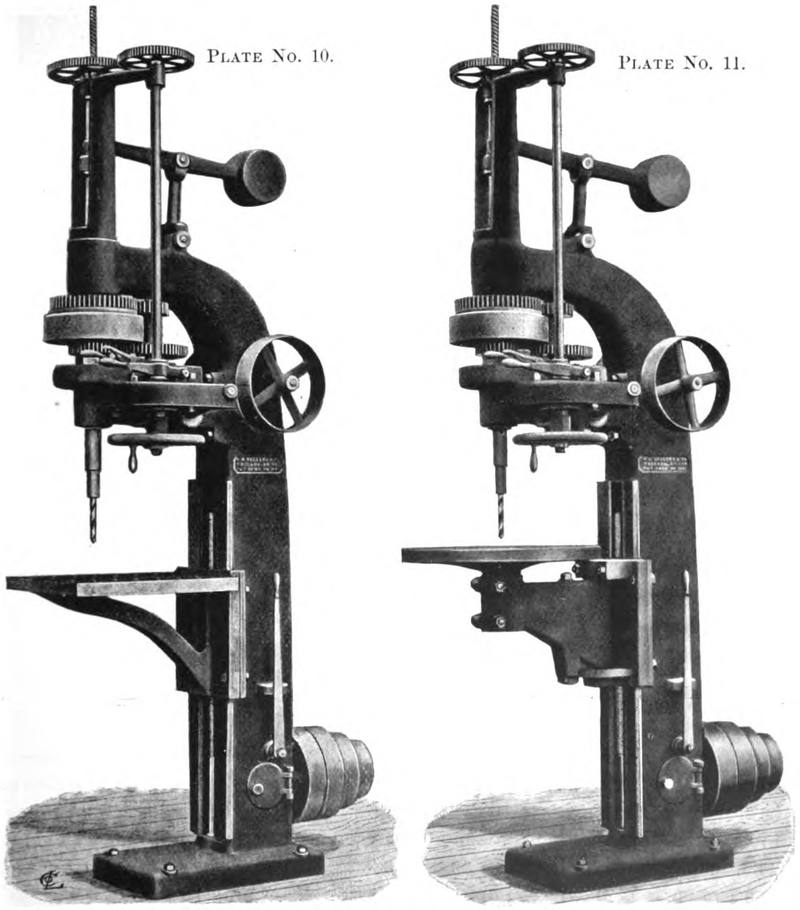
- 48 in lathe, the lathe table, the 25 by 25 planer and the 36 in drills: Sellers 1895 pp. 113, 128, 187 and 23, Library page.
- No. 2 Cylinder Boring Machine and 24-Inch Shaping Machine: Niles pp. 152 and 112, unnumbered plates, catalogue of 1891, Library page.
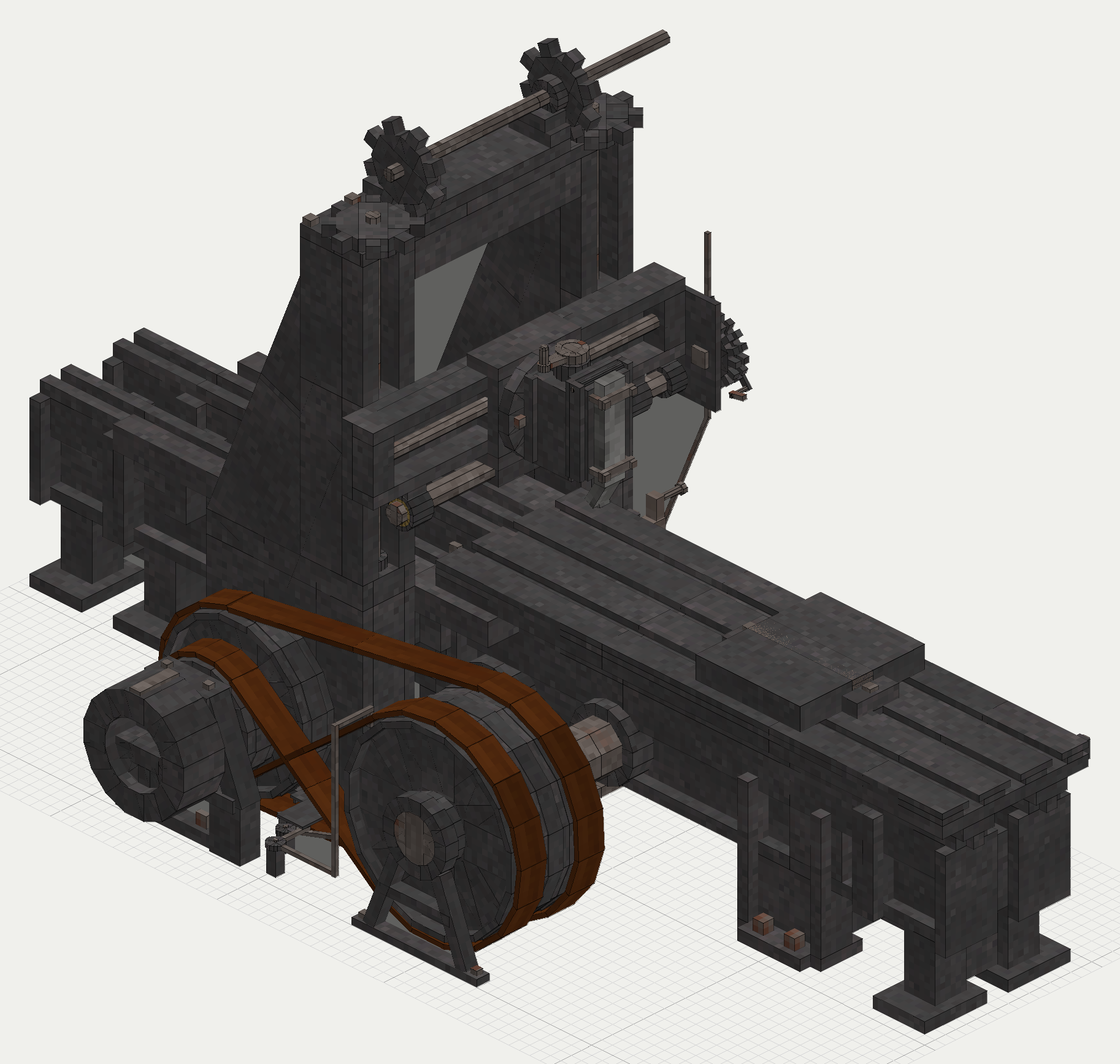
- The game's planer: the mod's planned drawing.
Comment or suggest something in the Expanded thread on the Vintage Story Discord