
Brass and zinc
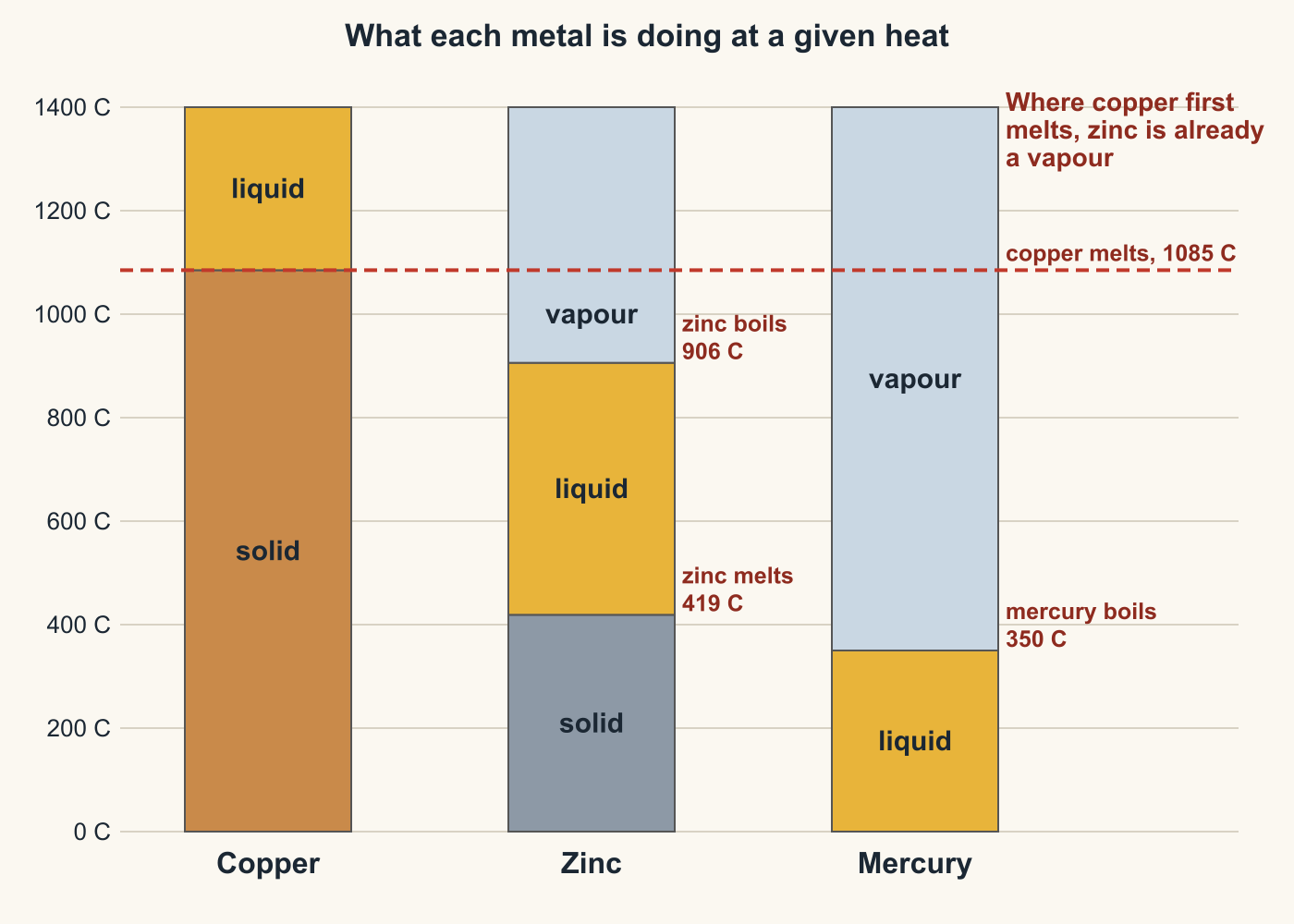
Brass bushes sit at every bearing and gland the game's machines turn, and brass is copper with zinc in it. Getting the zinc in is the hard part, because of one fact of physics: zinc boils before copper melts. Zinc and mercury also come out of their ores in the same way, as a vapour caught in a closed vessel. The retort furnace, its mercury and direct-fusion brass are planned and not yet in the game, and no guide teaches them yet. This page takes the furnace with its metals, and is about the real practice and how the game plans to follow it. Where the metals sit in the order of the game is on the metal ladder, and the crucible's other use on cementation and crucible steel.
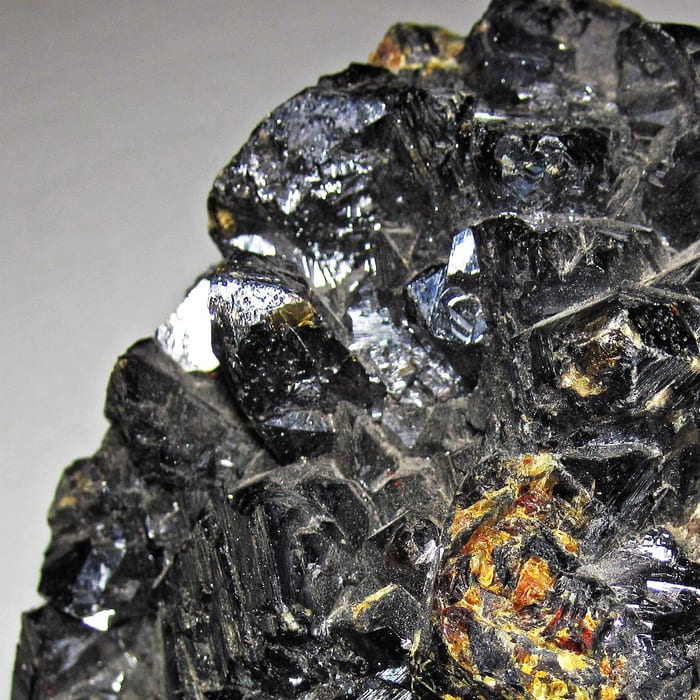
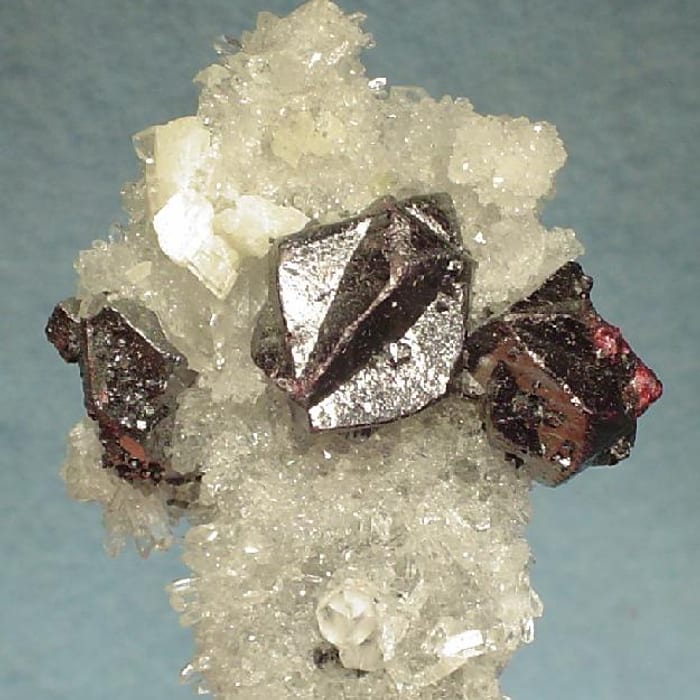
Why zinc had to be caught as a vapour
Zinc's oxide gives up its metal to carbon at a red heat (Overman p. 35), but the metal leaves as vapour: a zinc ore in a furnace goes off as white fumes of its oxide (Overman p. 31), or settles as oxide on the cold charge (Johnson Principles p. 288). In an open furnace it is simply lost up the flue. So zinc works shut the ore and the carbon in a closed clay vessel and led the vapour into something cooler, where it would condense as metal. No such vessel was needed for iron, copper or lead.
The ore needed a separate step first. Calamine, the older ore, is calcined; blende, the sulphide, has to be roasted to oxide, because few sulphides give up their metal to carbon alone (Overman p. 36). Roasting blende is "one of the most troublesome" operations of the kind (Percy 1861 p. 541). It was done on a flat reverberatory bed, at Silesian works stirred every ten minutes until the sulphurous vapours ceased (Percy 1861 pp. 550, 567-568), and "it is the custom in most zinc-works" to do it on the waste heat of the distilling furnace (Percy 1861 p. 569).
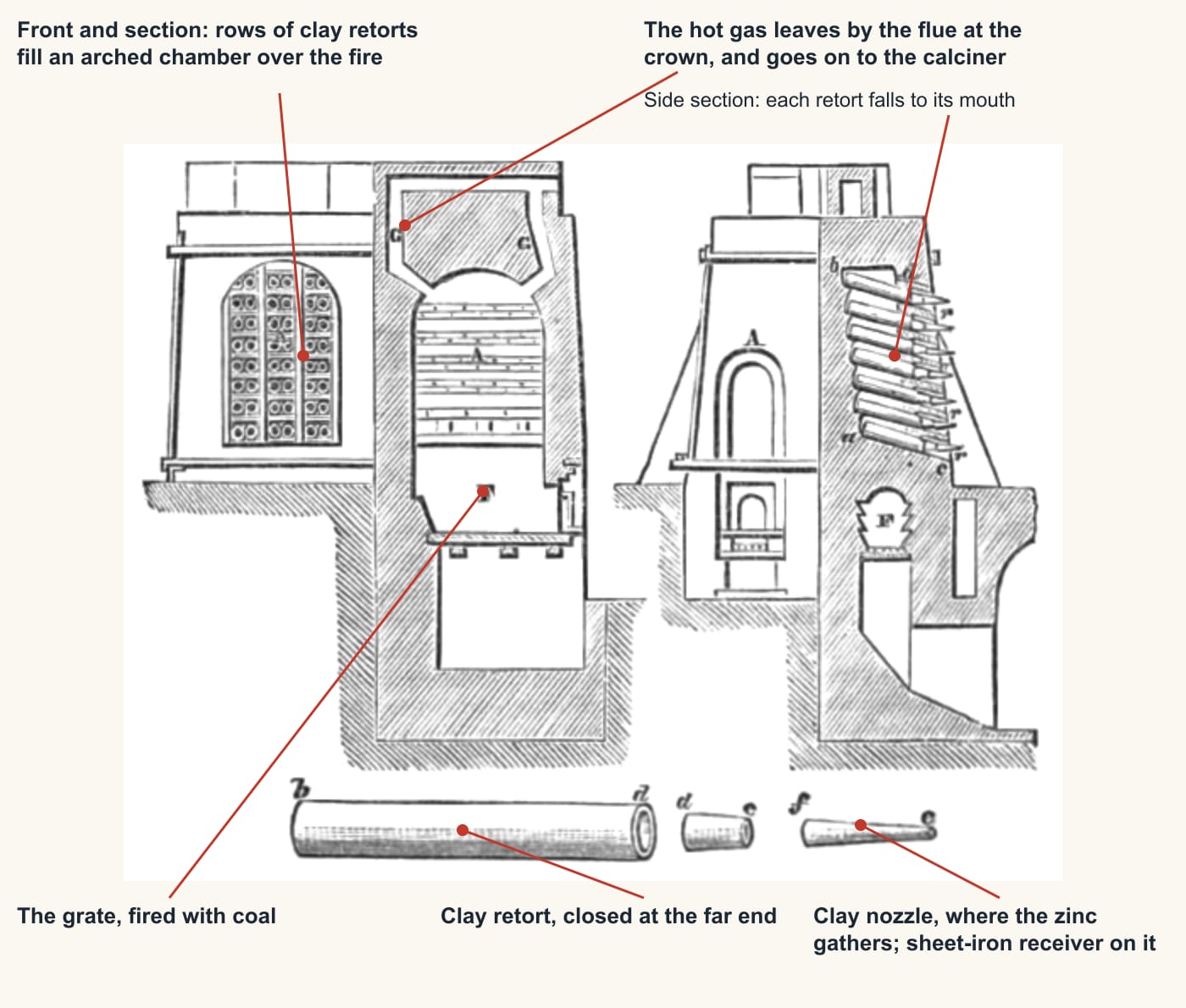
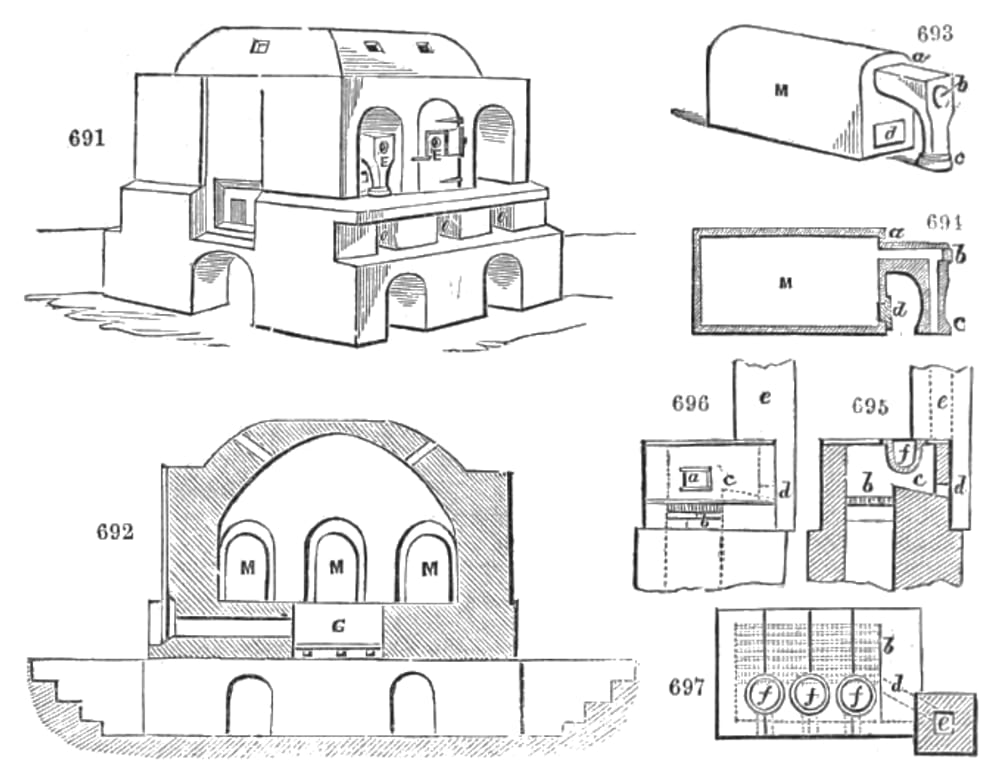
Three ways of distilling zinc were in use. The English pot furnace of Champion's Bristol works, from about 1740 (Ingalls pp. 1-2), led the vapour downward through a hole in the bottom of a big closed pot into a tube and a chamber below (Percy 1861 pp. 550-551). The Silesian furnace used larger clay muffles, begun at Wessola in 1799 or 1800 (Ingalls p. 2). The Belgian, or Liege, method that Dony found in 1805 (Ingalls p. 2) used many small clay tubes in rows, each one mended or replaced by itself, and its furnace "remained substantially the same" for the rest of the century (Percy 1861 p. 578). At one British works in 1861 Silesian and Belgian furnaces worked side by side, around 100 tons of zinc a week between them (Percy 1861 p. 584).
A Belgian retort was charged twice a day with ground, calcined ore mixed with half its weight of coal slack (Percy 1861 pp. 583-584), and after about six hours "most of the nozzles will be filled with melted zinc", which was drawn with a little scraper (Percy 1861 p. 583). Zinc wanted a heat close to white (Percy 1861 p. 569). Cracked or perforated retorts were replaced every morning, new ones having been "previously gradually heated to redness in an adjoining kiln" (Percy 1861 p. 583).
Why brass was melted the way it was
For centuries brass was made without any metallic zinc at all. Cementation packed copper with calamine and charcoal in closed pots (Ure p. 464), held "at a temperature below the melting-point of copper", so that the copper, "being thus exposed to the action of the vapour of zinc, becomes permeated with this metal" (Percy 1861 p. 617). If the copper did melt it ran to the bottom of the pot, "and much of the zinc would then escape" (Percy 1861 p. 617). The method works because of the chart above: the heat stays where the zinc is a vapour and the copper still solid. Champion took a patent for this old process in 1779 (Percy 1861 p. 612), and it was still being worked at Llanelly in 1859 (Percy 1861 p. 612).
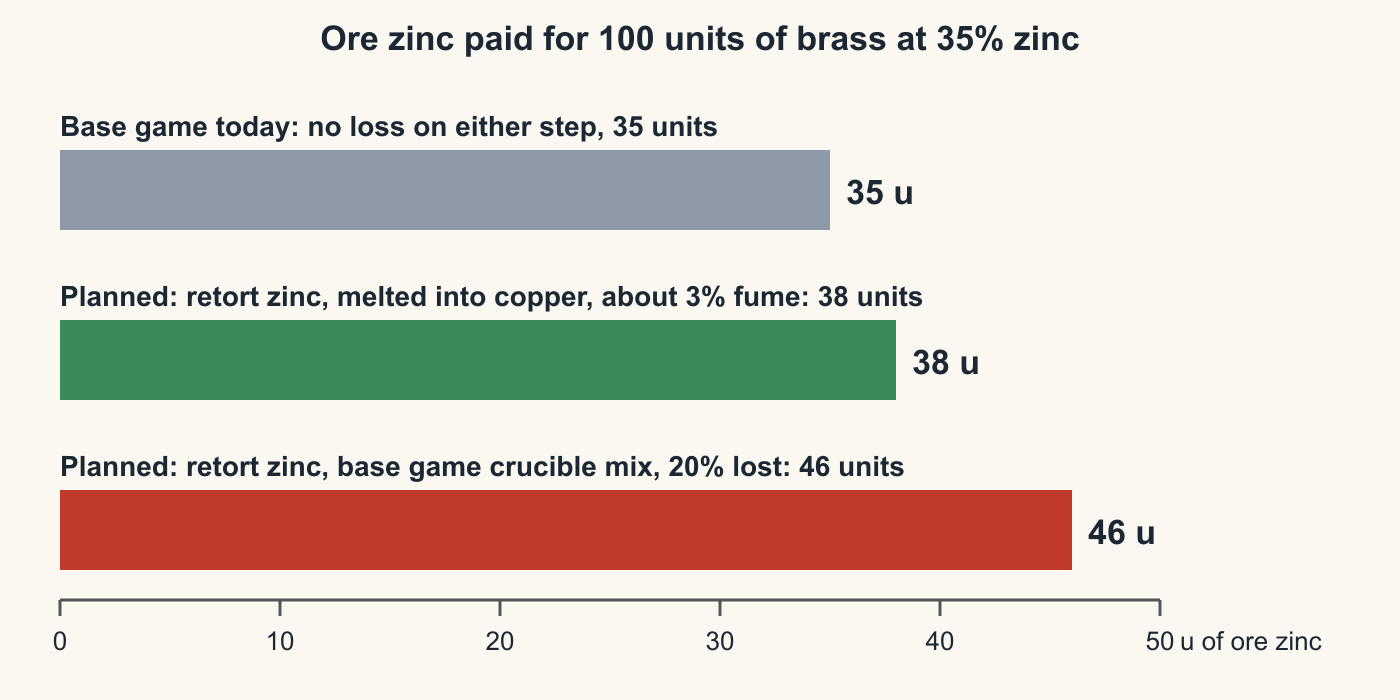
Once metallic zinc could be bought, the order could be turned around. James Emerson's patent of 1781 made brass "by the direct fusion of its two metallic elements" (Ure p. 464). Copper went into the crucible first and was melted, then "the zinc is gradually and cautiously added to the copper when the latter has just melted" (Percy 1861 p. 618). The copper is already as hot as it needs to be, and the zinc spends as little time as possible in it before the pot comes out; a due allowance for the unavoidable fume went to the founders (Percy 1861 p. 618), and 2.5 to 4 lb of waste on a 120 lb charge, about 2 to 3%, is one maker's figure (Ure p. 466). The furnace was a hole about 10 in square and 2 ft deep packed round the crucible with coke (Percy 1861 p. 618; Ure p. 465). A cupola would not do: brass melted in one oxidizes and is inferior to crucible brass (Kirk p. 223).
Mercury from the same kind of furnace
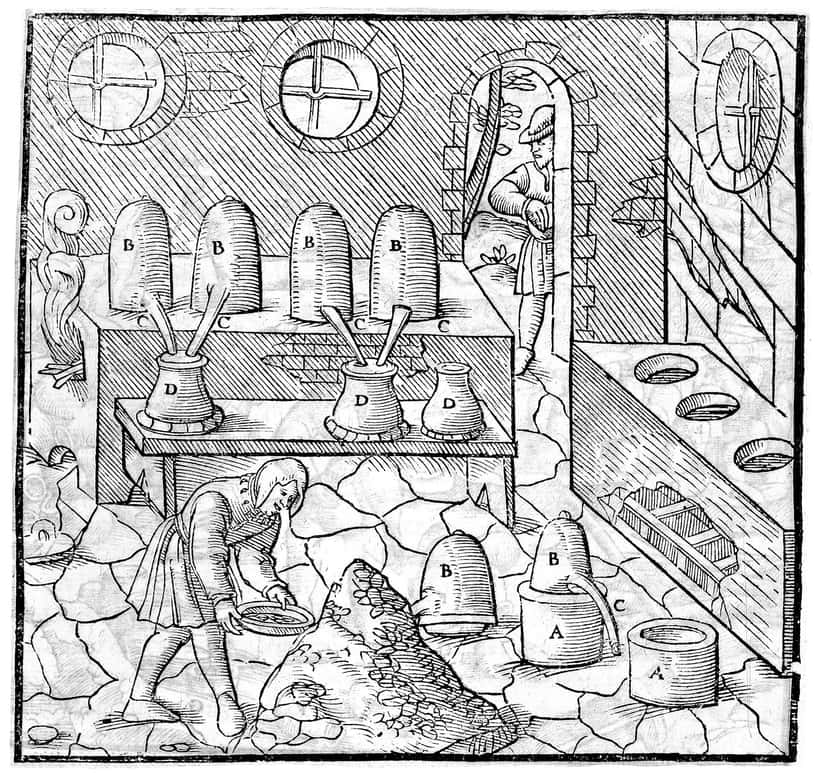
Mercury is easier still to drive out of its ore, since it boils at 660 F (Overman p. 433), and it was being distilled in stacked earthen pots before 1635 (Ure vol. 3, art. Mercury). Lime takes the sulphur from cinnabar, and the mercury goes off as vapour (Ure vol. 3, art. Mercury). In the Palatinate, retorts took 56 to 70 lb of cinnabar with 15 to 18 lb of quicklime, about four to one, with their receivers part filled with cold water (Phillips p. 461); by 1847 Landsberg had iron-lidded retorts with a cast-iron eduction tube into a water-filled condenser, the charge "almost totally expelled in the course of three hours" (Phillips pp. 462-463). Mercury ores fire only at a cherry red (Phillips p. 459), well under the white heat zinc wants.
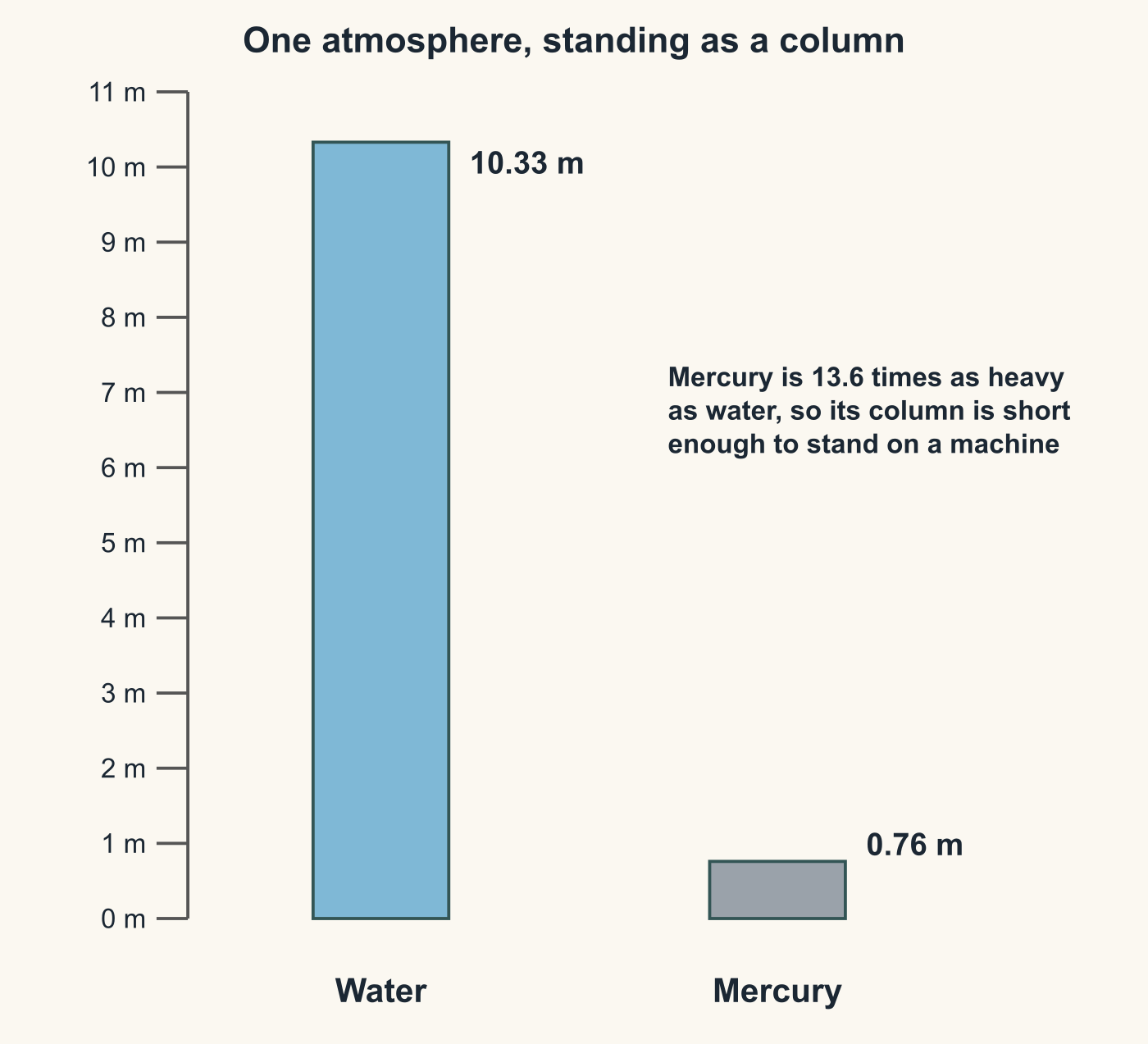
What mercury was for, on a steam plant, is the instruments. Its weight makes a column short enough to mount. Watt read his condenser's vacuum on a glass tube about 32 in long standing in a bason of mercury, the column around 28 in against a 30 in barometer (Farey pp. 377-378), and a mercury thermometer in a metal capsule reads the hot blast (Overman pp. 433-434). A boiler-room engineer was expected to know the gauges and the thermometer (Hawkins p. 9). None of the books at hand describes the closed-air mercury gauge that the game plans for the low-pressure boiler.
Period basis, and what is the game's own
- Period: zinc was distilled from roasted blende or calcined calamine in closed clay retorts, with carbon, and caught in cooled nozzles (Percy 1861 pp. 578-584). The game plans the Belgian furnace at small scale: four retorts over a firebox in place of sixty, with a bed that roasts the next charge on the furnace's own waste heat (Percy 1861 p. 569).
- Period: brass was made by adding zinc to molten copper in a crucible (Percy 1861 p. 618). The game plans the same in the pot of its crucible furnace, giving the base game's brass ingot, with about 3% of the zinc lost as fume (Ure p. 466).
- Period: the older cementation brass (Percy 1861 pp. 612-617) is left out here and belongs to a later early-game mod, as does the bronze air furnace.
- Period: cinnabar was distilled with quicklime, about four parts to one (Phillips p. 461), in iron or earthen retorts (Ure vol. 3, art. Mercury). The game plans an iron retort and the same charge.
- The game's own: the base game melts zinc from hammered nuggets in its crucible at 419 C, and mixes brass with no loss. The plan takes away the nugget smelt, where the zinc would really boil away, and loses 20% of the zinc in the crucible mix, both on one switch that is on by default. The 20% is the game's own, set against the period's 2 to 3%, to make the retort worth building. See vanilla against reality.
- The game's own: one furnace distils both metals, by two heats. With the door above it open the furnace runs at a red heat, for mercury and the roast; shut, it climbs to near white, for zinc. No book at hand sets zinc and mercury retorts in one furnace.
- The game's own: mercury's only uses are the three instruments. It is not alloyed or amalgamated. The vapour harms a player standing close to an open furnace, an estimate of the danger rather than a figure from a book.
The numbers
Everything here is planned, except the base game's copper range and the column's length, and the furnace's numbers are not yet tuned. The furnace is scaled down in count, not in size, as the scaling page describes for period ratios, and scale and units gives the unit values.
| In the game | Period figure | How it was scaled | Game value |
|---|---|---|---|
| Retorts in a furnace | 61 at Moresnet, 78 in a larger furnace (Percy 1861 p. 581) | Cut for a furnace built and mended by hand | Planned 4 |
| Zinc charge | Coal about half the ore by weight, Moresnet (Percy 1861 p. 584) | Whole items | Planned 7 roasted ore and 3 carbon |
| Zinc won | 11 to 12% of the zinc lost, half of it recovered (Percy 1861 pp. 584-585); 2% lost in the roast (Percy 1861 p. 568) | Period yield rounded | Planned 95%: 105 u of ore zinc gives 100 u |
| Retort life | 3 or 4 of 61 replaced a day (Percy 1861 p. 583), 15 to 20 days worked out | The game's own | Planned 6 distillations (zinc), 12 (mercury) |
| Heat for zinc | "near white" (Percy 1861 p. 569) | The game's own, degrees read from colours | Planned 1250 C |
| Heat for mercury | Cherry red (Phillips p. 459) | The game's own, degrees read from colours | Planned 700 C |
| Brass range | About 2 parts copper to 1 of zinc (Percy 1861 p. 608); Muntz metal 60 to 40 (Percy 1861 pp. 619-620) | The base game's range kept | 60 to 70% copper |
| Direct-fusion loss | 2.5 to 4 lb of 120 lb, about 2 to 3% (Ure p. 466) | Period value | Planned about 3% of the zinc |
| Crucible-mix loss | None given | The game's own | Planned 20% of the zinc |
| Ore zinc for 100 u of 35% brass | Worked out from the rows above | 35 divided by the zinc kept | Base game 35 u; planned 38 u direct fusion, 46 u crucible mix |
| Mercury charge | 56 to 70 lb cinnabar to 15 to 18 lb lime, about 4 to 1 (Phillips p. 461) | Whole items | Planned 4 cinnabar and 1 quicklime |
| Mercury yield | None used | The game's own, an untuned estimate | Planned 0.4 L a charge |
| Column to one atmosphere | 760 mm of mercury (Dichmann p. 7) | True length | 0.76 m, 12.2 voxels |
Open, and what you can tell us
The books at hand do not date the Liege process exactly: Percy could not say in which year it began (Percy 1861 p. 578), and Ingalls gives Dony and 1805 (Ingalls p. 2) in a later book. No book at hand names a furnace temperature in degrees, only colours. How long a direct-fusion crucible stayed in the fire is not stated. If you know a source for any of these, or a works where zinc and mercury really were distilled in one furnace, we would like to read it.
Picture credits
- Sphalerite, Tennessee: James St. John, CC BY 2.0, cropped.
- Cinnabar on quartz, Tongren Mine: Robert M. Lavinsky, CC BY-SA 3.0, cropped.
- Belgian furnace for zinc distillation: Figs. 689 and 690, Robert Hunt, A Supplement to Ure's Dictionary (1864), Ure Supplement p. 1093, public domain, labels added for this site.
- Silesian muffles furnace for zinc distillation: Figs. 691 to 697, Robert Hunt, A Supplement to Ure's Dictionary (1864), Ure Supplement p. 1095, public domain.
- The distillation of quicksilver: woodcut from Georgius Agricola, Wellcome Collection, CC BY 4.0.
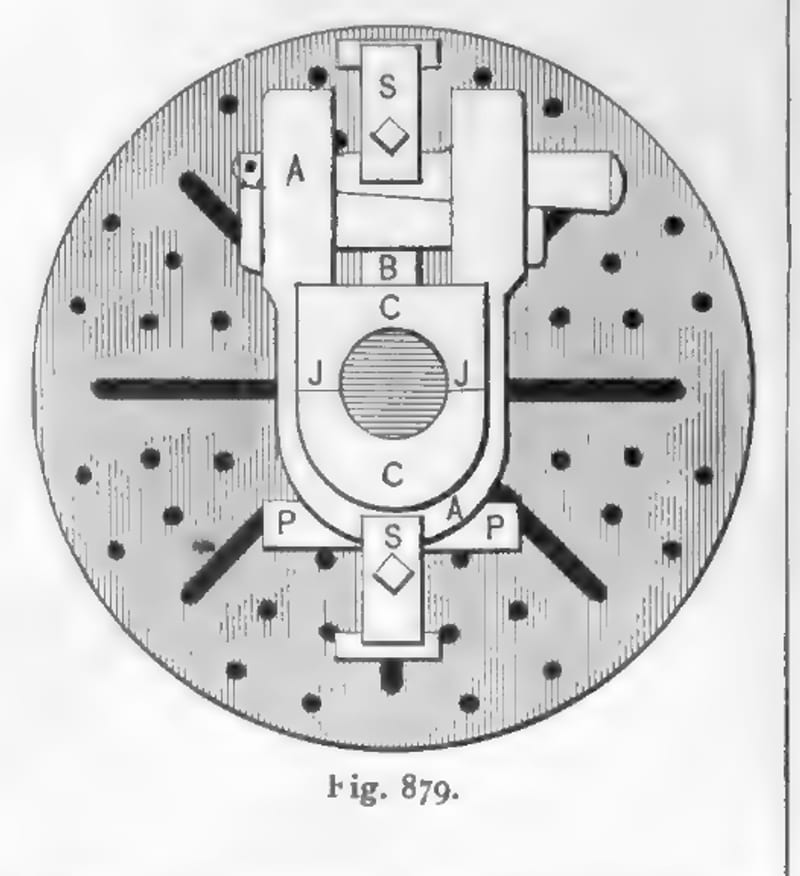
- Fig. 879, a connecting rod strap with its brasses: Rose, Modern Machine-Shop Practice, p. 246, Library page, cropped.
- The melting and boiling points, the ore zinc routes and the two columns: drawn for this page from the figures named in their captions.
Comment or suggest something in the Expanded thread on the Vintage Story Discord