
Dressing ore
Metal ore as it left the mine was mostly rock. Cardiganshire and Cornish lead veins held on average no more than 5% lead, and the smelter wanted ore of 70 to 75%, so it took 16 1/2 tons of vein stuff to make one ton of ore (Hunt p. 784). Dressing was the work that stood between the two: breaking the stuff down, then using water to part the heavy grains from the light. The game's dressing floor is planned, so this page follows the real work in the order the workers did it, then says what the game will keep of it. There is no guide yet; the machines come with the copper chain, after the ore crusher.
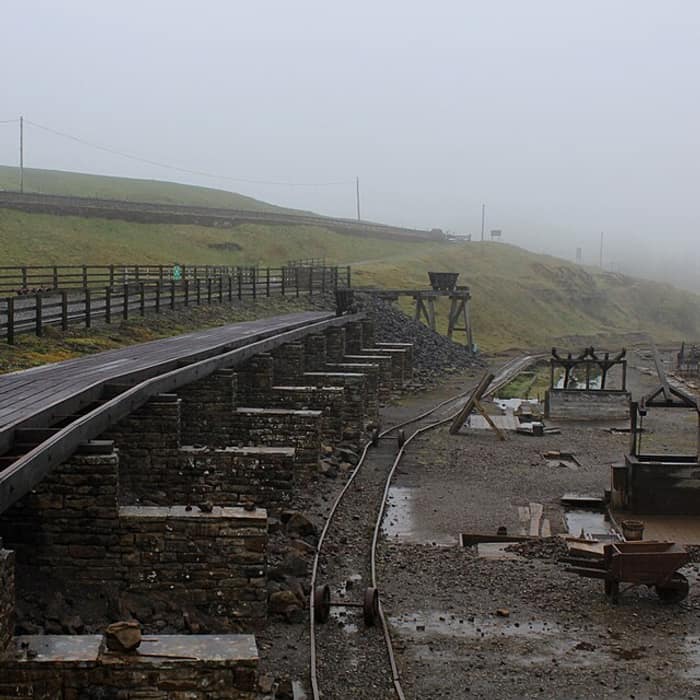
Breaking and picking
Vein stuff was tipped into stalls and the larger stones broken with a sledge, called ragging, then with spalling hammers to pass a ring of 3 or 4 inches. It was sieved and picked by children into three qualities: prill, nearly pure ore; dredge, ore still locked in rock; and halvans, waste (Hunt p. 785). Only dredge needed the machines. Blake's jaw breaker of 1858 replaced much of the hammering, running at 200 to 250 revolutions a minute (Hunt pp. 716-718).
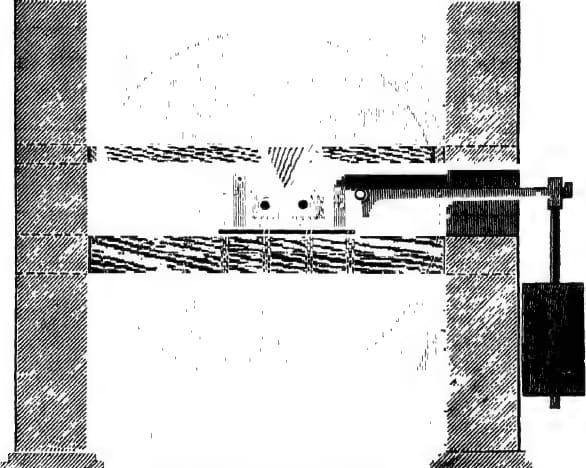
Rolls came first to copper, at Crowndale near Tavistock in 1806, when John Taylor used two lengths of cast-iron pipe (Hunt p. 693). A Cornish pair 21 inches across and 19 long, on lead ore, crushed 2 1/2 tons an hour to under 6 mm with five horse-power and three hands (Hunt pp. 722-723). Tin went a different way: it was stamped under falling iron heads to a much finer slime, and "in tin-dressing the jigger is not used" (Hunt pp. 724-733, 783).
From the crusher the stuff was sorted by size before it met any water machine. "From the crusher the sand is usually divided into slimes for buddles and sand for jiggers" (Hunt pp. 782-783). A separating cone made the cut: under 1.5 mm to the buddles, 1.5 to 6 or 7.5 mm to the jigs (Hunt pp. 756-757). Between 30 and 48% of the stuff through one pair of rolls went to the classifier (Hunt p. 724).
Jigging
Grains of equal size sort by weight when they fall through water, but the fall in a shallow tub is too short to do it, so the bed is lifted and dropped many times. In Borlase's words of 1758, sieving in water, "the waste will all rise to the top and settle in the middle like small sand, and what remains underneath will be clean ore" (Hunt p. 689). Boys did it at first, stooping over a tank with a sieve, and "many hands were required" (Hunt p. 694). The brake-sieve hung the sieve from a lever, still jerked by hand (Hunt pp. 758-759).
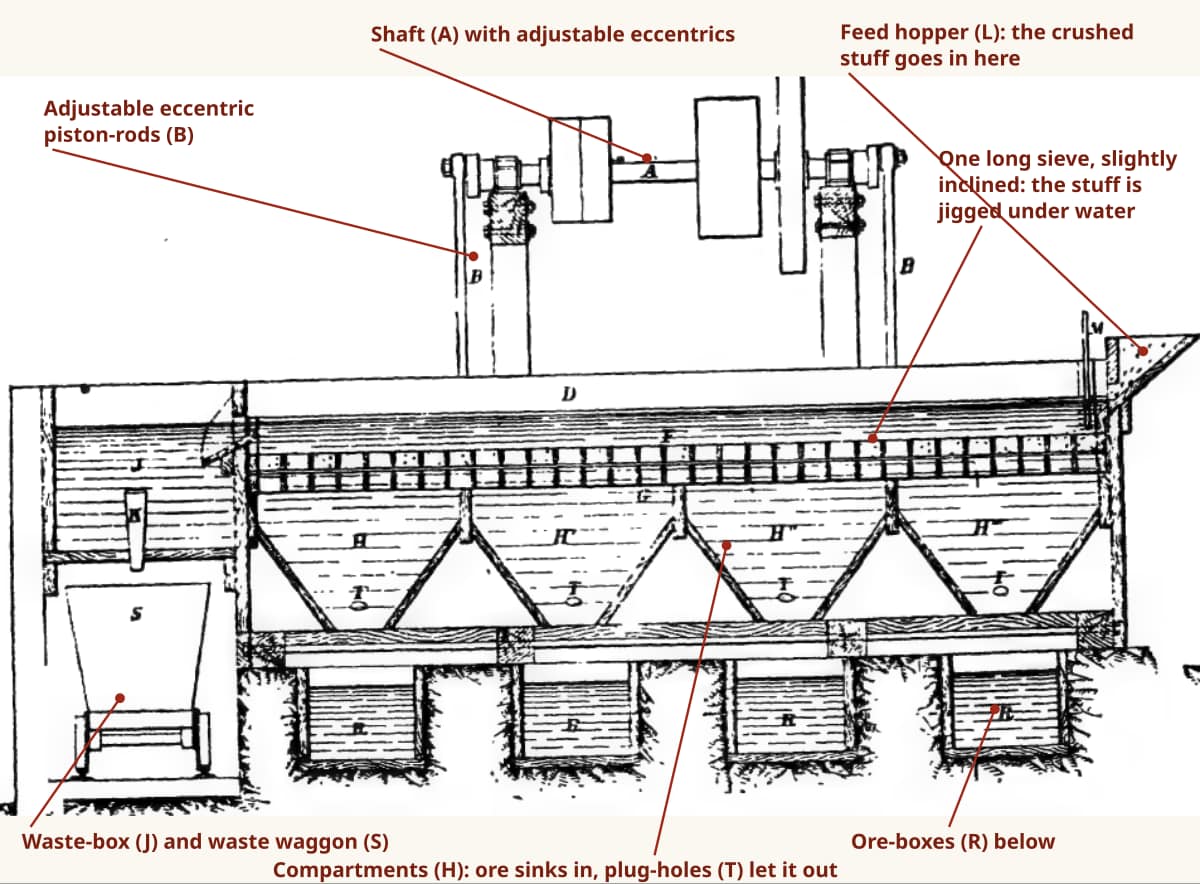
The first continuous jigger was Troughton's, patented on 23 June 1843, and the plunger form followed about 1850 (Hunt pp. 695-696). The change that mattered was that "in the mechanical jigger these products are continuously obtained by the flowing action of water" (Hunt p. 757): nothing had to be skimmed by hand. Coarse jiggers ran at 60 to 75 strokes a minute, finer ones 90 to 150, on 9 to 15 gallons a minute (Hunt p. 757). As the grains got smaller the speed went up and the stroke got shorter.
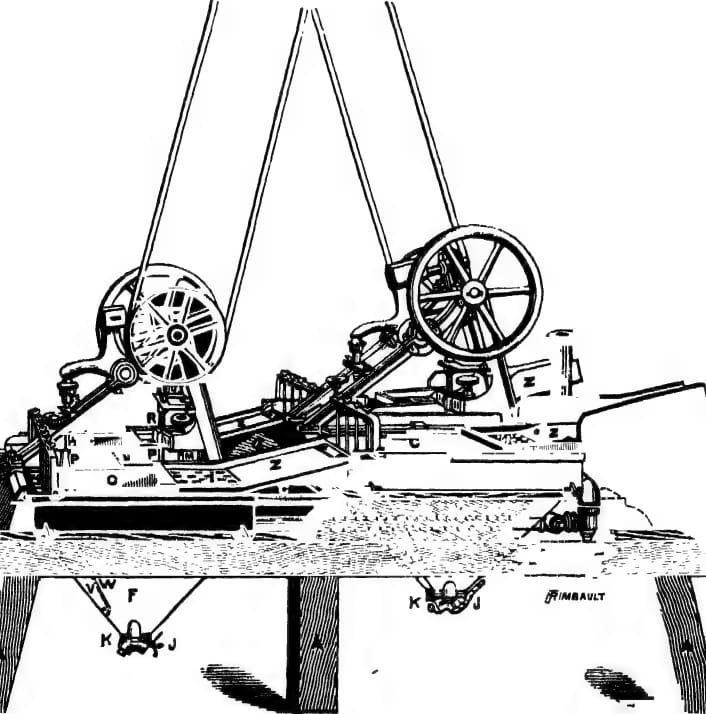
Where one ore went with its rock a 6-foot jigger was usually enough; with two or three ores "a greater length will be found advisable" (Hunt p. 758). That is the reason for the game's two sieves.
Buddling
Slimes are too fine to jig; the settling is done on a floor. The stuff was run in a thin film over a sloping surface, so the heavy grains stopped first and the light ones went further.
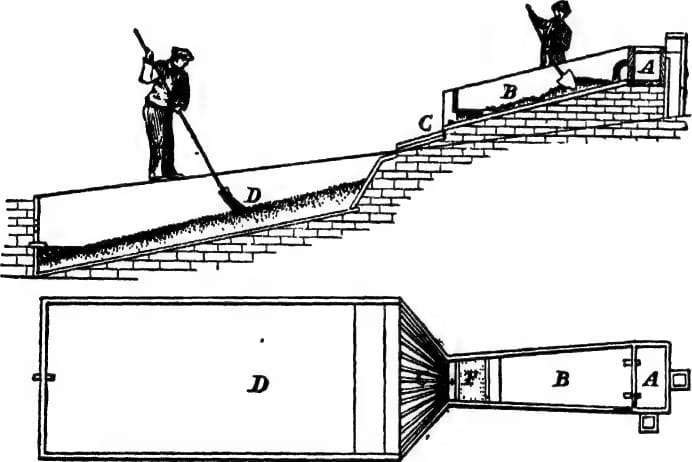
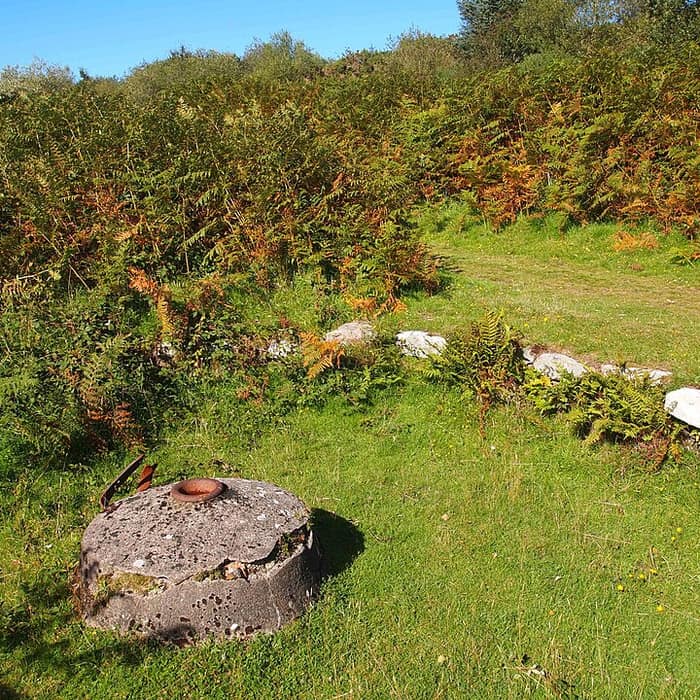
The round buddle first appears in Cardiganshire about 1848 (Hunt p. 696). It swept in a circle and needed no boy with a broom.
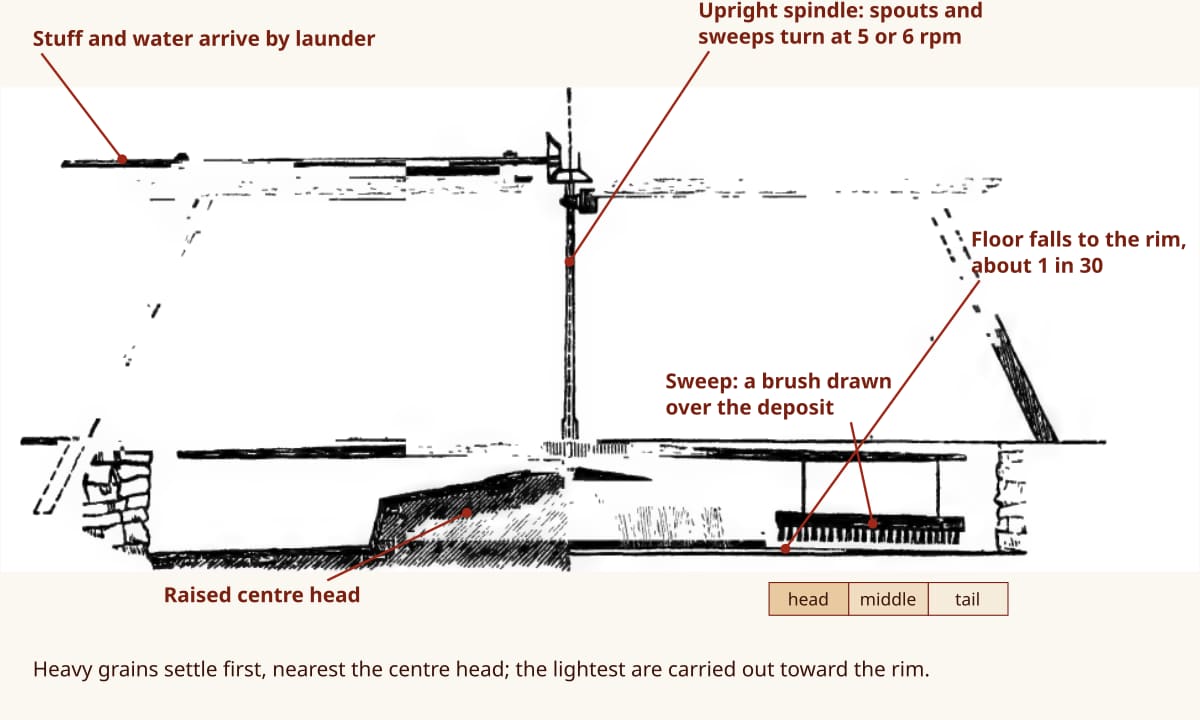
A buddle of 21 feet took "the stuff reduced by 12 or 16 stamp heads" (Hunt p. 788). Heads went over again on concave buddles, the last cleaning done by tossing in a tub (Hunt pp. 767-768, 778, 789). On lead and copper floors the buddle had only the slimes: the jigs did the main concentrating there (Hunt p. 785).
What water cannot do
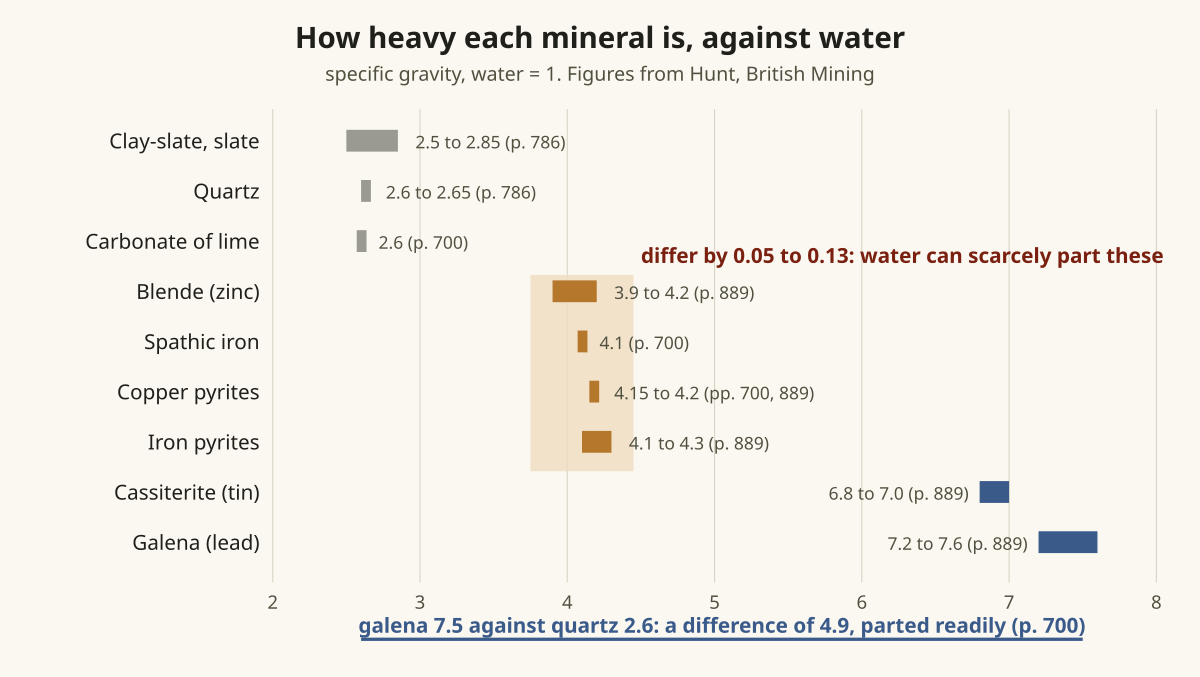
"Blende, carbonate of iron, and copper pyrites, when associated together, being nearly alike in density, are scarcely separable by hydraulic means" (Hunt p. 784; see also p. 700). Hunt gives other means for those: a roast at a dull red heat to make the iron carbonate magnetic, then magnetic wheels (Hunt p. 777), and later "dynamo-magneto apparatus" (Hunt p. 784).
What the game keeps of it
Planned, all of it, with the copper chain after the ore crusher; nothing here is built yet. Crushed ore of a deep zone goes by chute to a jig driven from the shafting, with water let on at its intake. Fines go by chute to a round buddle, and the concentrates go on to the copper reverberatory or the retort. What each ore gives follows the table above: galena comes out apart from blende, and copper pyrites comes out with its iron pyrites, as water leaves them. See iron ore for the seam ores, which are roasted and not washed.
The player plugs the tail board row by row as the deposit rises, and shovels out head, middle and tail by hand. The hand tiers stay, with the pan and the sieve, and the machines add throughput only. The planned edge runner mill grinds what the quern grinds, on the shafting; it is not part of this line, and Hunt's lists of floor machinery (Hunt pp. 783-784) do not include one.
Period basis, and what is the game's own
- Period: stuff crushed and sized, then sand to the jigs and slimes to the buddles, on a floor laid out so it all runs downhill (Hunt pp. 782-783). The game plans the same order, by chute.
- Period: a concentrate from each hutch, the waste over the tail (Hunt pp. 757, 761). The planned jig has two sieves and hutches, as Collom's, and drops its tailings as gravel.
- Period: head, middle and tail dug out of a filled buddle (Hunt p. 767), with plugs in the tail board as it rose (Hunt pp. 766-767). The planned buddle keeps the plugs and the shovel.
- Period: minerals close in density are not parted by water (Hunt pp. 700, 784). The game plans the same: one concentrate for each group of minerals water can part.
- The game's own: vanilla's pan and crucible are the whole of its ore work, with no dressing. See vanilla against reality.
- The game's own: a machine's rate is set by how much water it gets at its intake, and a still pond gives the jig a small trickle per block. No book gives such a rule.
- The game's own: iron seam ore goes through unchanged.
The numbers
Period figures are Hunt's; the game's follow the scaling page and scale and units. Everything in the Game column is planned. A game hour runs a period hour's work.
| In the game | Period figure | How it was scaled | Game value |
|---|---|---|---|
| Jig rate | 5 tons an hour of 3 to 5 mm stuff on 6.5 m2 of sieve, 0.77 t/h a square metre (Hunt p. 760) | By sieve area, 0.77 m2 | Planned 0.59 t/h, 12 crushed pieces a game hour |
| Share going to fines | 30 to 48% to the classifier (Hunt p. 724) | A third taken | Planned one piece in three |
| Jig strokes and stroke | Crank about 120 rpm, stroke 1/2 to 1 in (Hunt pp. 761-762) | At face value, top of the range | Planned 120 a minute, 25 mm |
| Jig water | 9 to 15 gal/min (Hunt p. 757) | 12 gal/min | Planned 0.91 L/s |
| Metal to the hutches | Half a unit of lead lost a ton of 5% stuff (Hunt p. 784), a tenth | The loss at the same share | Planned 90% to its hutch, 10% over the tail |
| Buddle bands | Head about 70%, middle some 20% (Hunt p. 767) | At face value | Planned 70%, 20%, 10% in the tail; 87.5% in all once middles are fed again |
| Buddle rate | Stuff of 12 or 16 stamp heads (Hunt p. 788), 15 to 20 cwt a head a day (Hunt p. 729) | 12 tons a day taken | Planned 0.5 t/h, 10 fines pieces a game hour |
| Buddle spindle | About 5 or 6 rpm (Hunt p. 767) | At face value | Planned 5.5 rpm |
| Buddle fill | About ten hours (Hunt p. 767) | The game's own rate, not Hunt's | Planned 250 pieces, about 25 game hours at full feed |
| Buddle water | 10 gal/min a stamp head (Hunt p. 731), so 9 to 12 L/s on 12 to 16 heads | A film 5 mm deep over the rim, the game's own estimate checked against that | Planned 10 L/s |
Open, and what you can tell us
Everything here rests on one book. Hunt names Ure's long article on dressing and Rittinger's textbook (Hunt p. 692) and neither was read for this page. Hunt names the strip, the trunk and the tye of a tin floor but gives no length, fall or rate for any of them. If you know a source that gives those, or a working account of how a floor was attended, we would like to read it.
Picture credits
- Round Buddle, Golden Dagger Mine: Chris Andrews, CC BY-SA 2.0, cropped.
- Washing Floor at the Killhope Lead Mining Museum: Chris Heaton, CC BY-SA 2.0, cropped.
- Fig. 196, Hunt p. 723; Fig. 215, Hunt p. 762; Fig. 217, Hunt p. 764: British Mining, Library page.
- Fig. 212, Hunt p. 759, turned and labelled for this site; Fig. 219, Hunt p. 766, labelled for this site: British Mining, Library page.
- The specific gravities: drawn for this site from Hunt pp. 700, 786 and 889.
Comment or suggest something in the Expanded thread on the Vintage Story Discord