
Cornish boiler
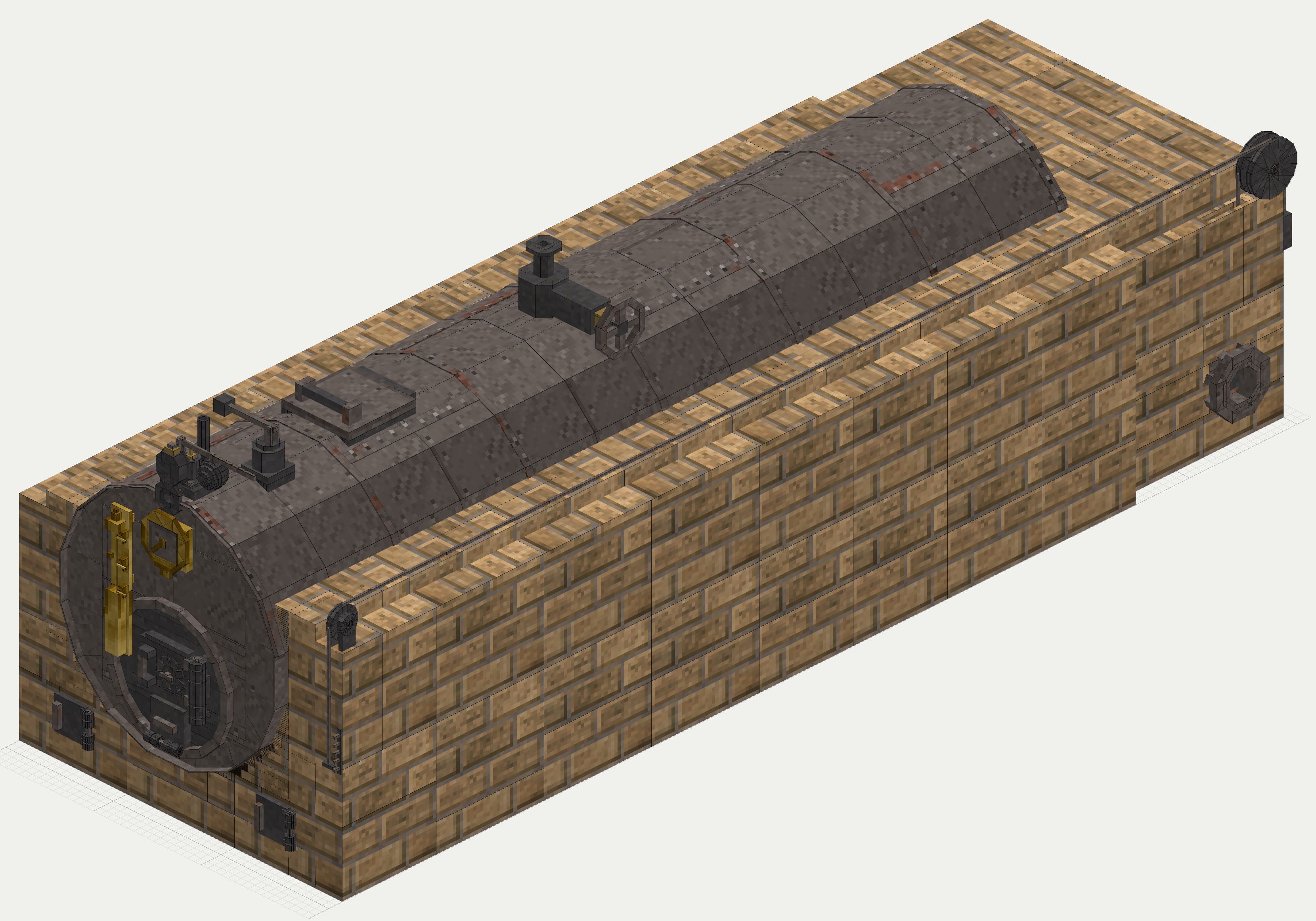
A Cornish boiler is a riveted iron barrel with a fire in a tube through its middle, set in brickwork that holds the flues. How to build and fire one in the game is in the steam and boilers guide, and its parts are in the catalogue. This page is about the real one and how the game's follows it.
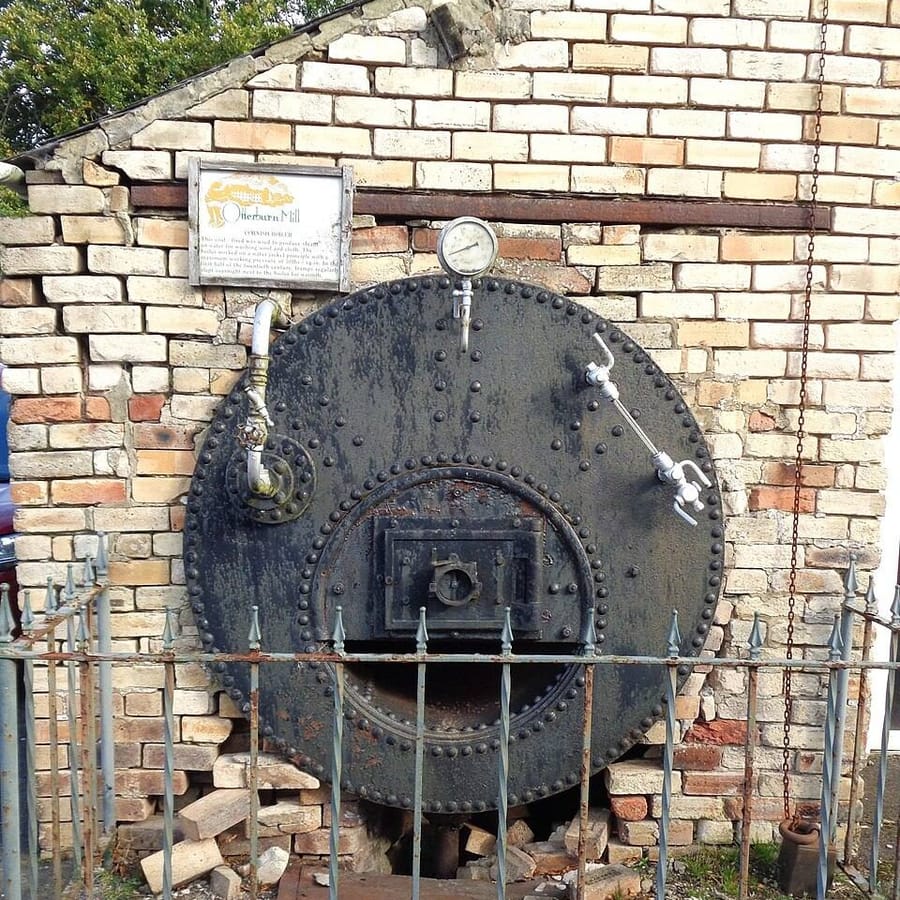
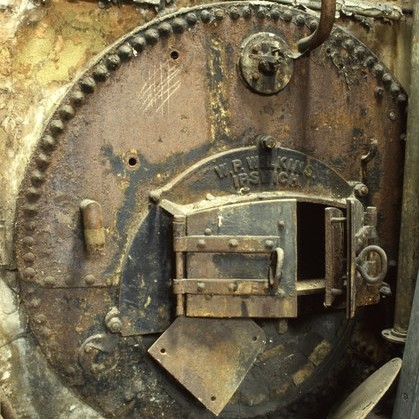
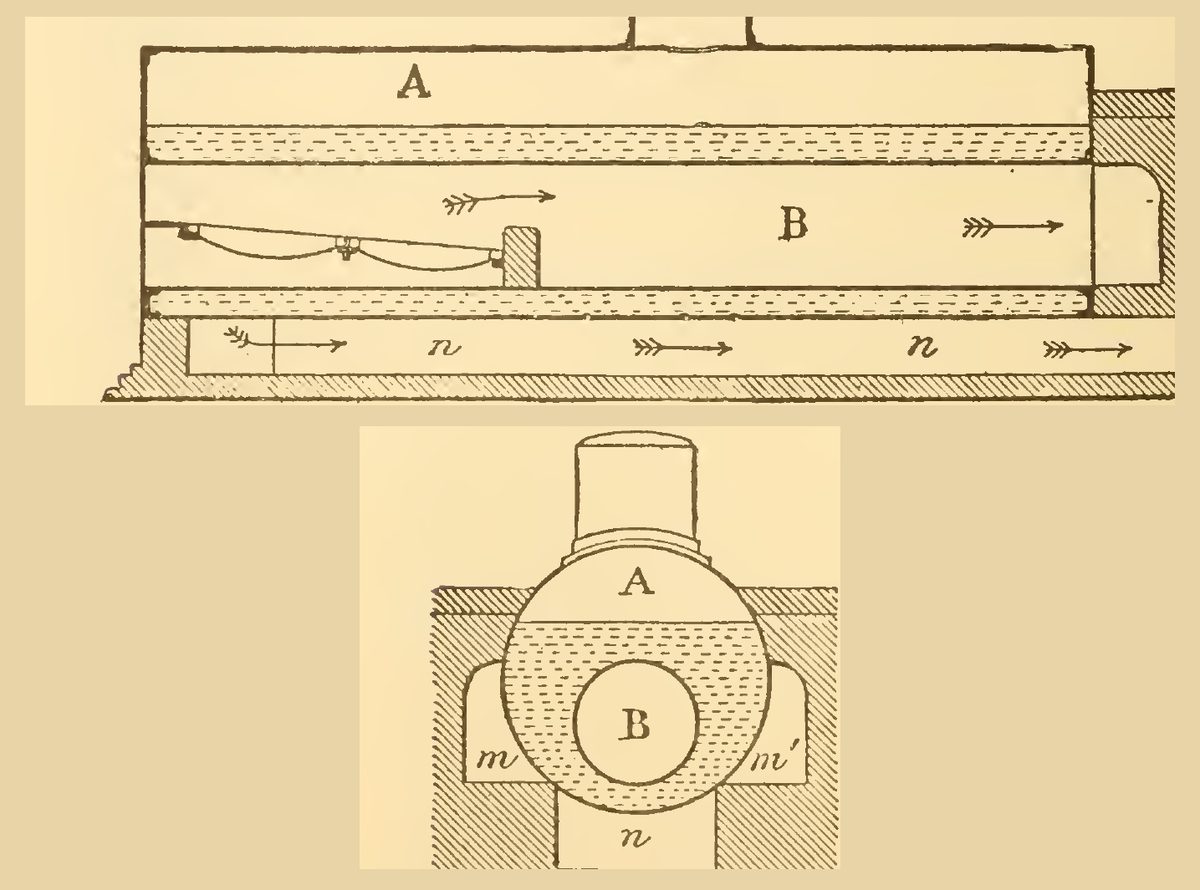
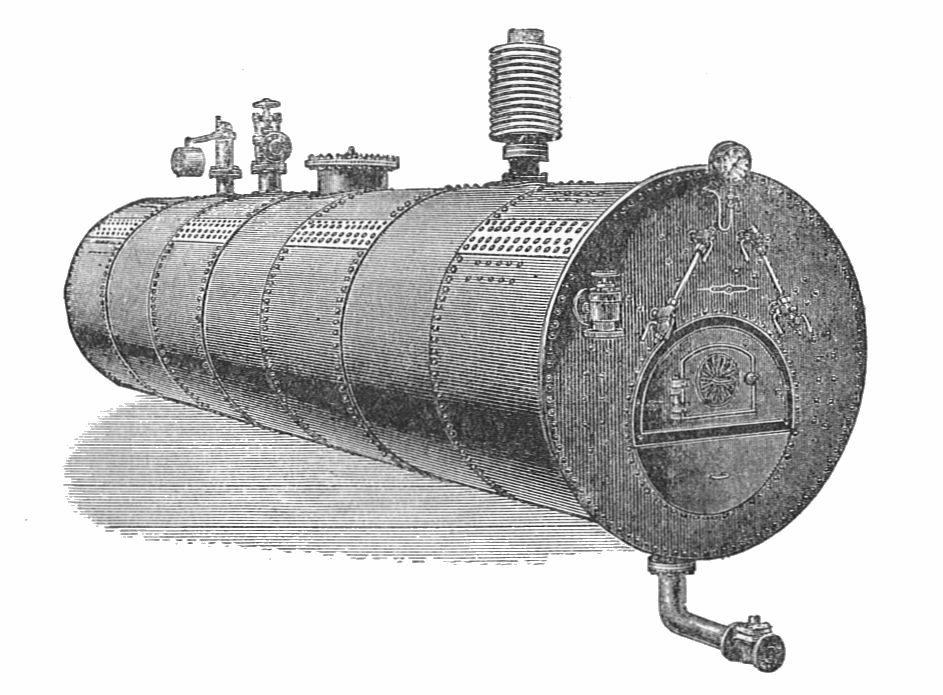
How the real one worked, and why it was built so
Burning coal is easy. Getting the heat out of the smoke and into the water, before the smoke reaches the chimney, is what the whole arrangement is for.
Gas only hands over heat where it touches something cooler, and hands it over slowly. In ordinary tubular and externally fired boilers the plate over the furnace evaporates up to 20 lb of water an hour on each square foot, and the plate where the gases leave a few ounces or nothing (Wilson p. 290). Even so, the gas entering the chimney is still at 400 to 700 degrees F and carries off seldom less than 25% of the heat of the coal (Wilson p. 258). Every yard of plate it can be led past takes back heat that was on its way out.
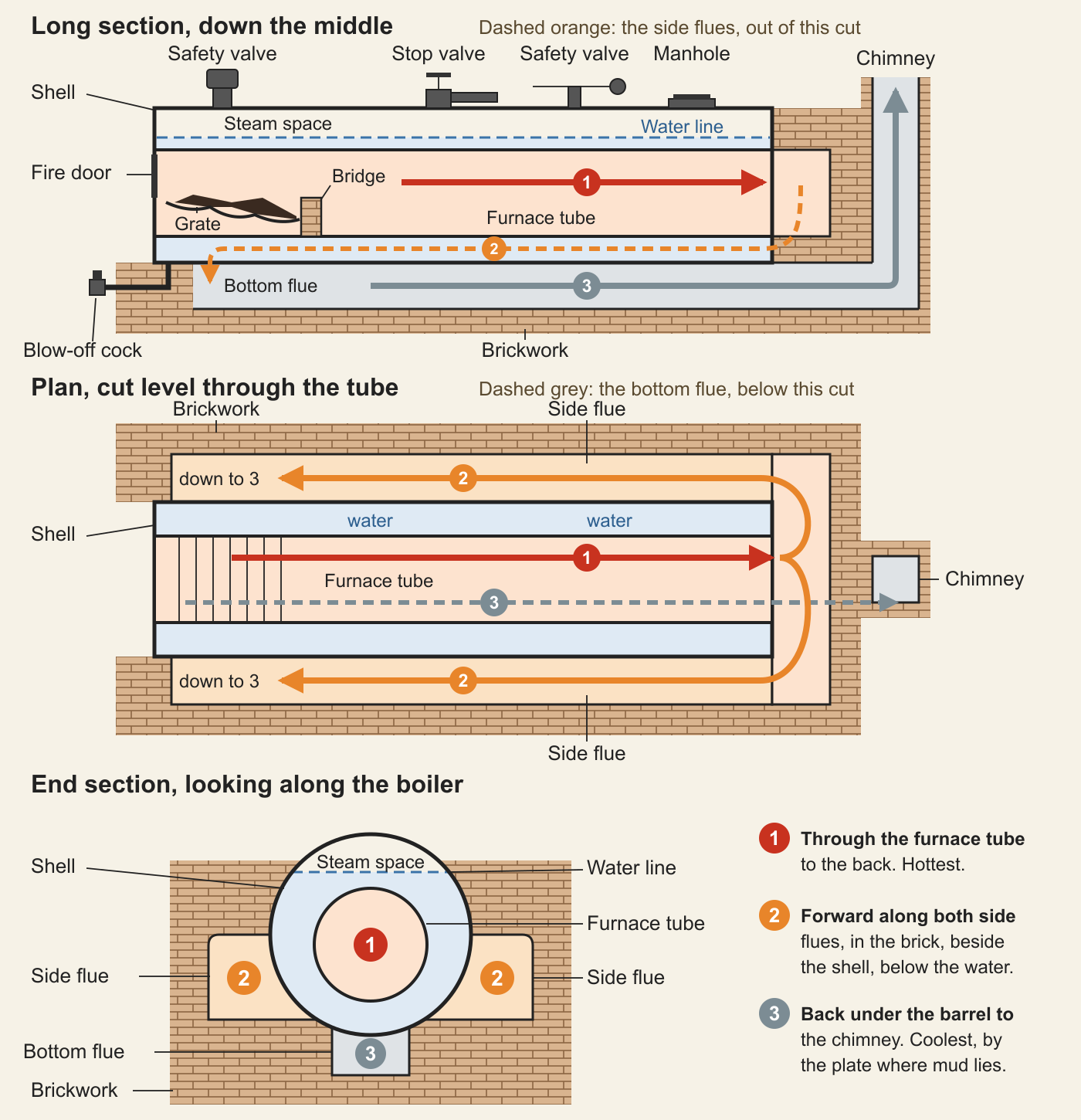
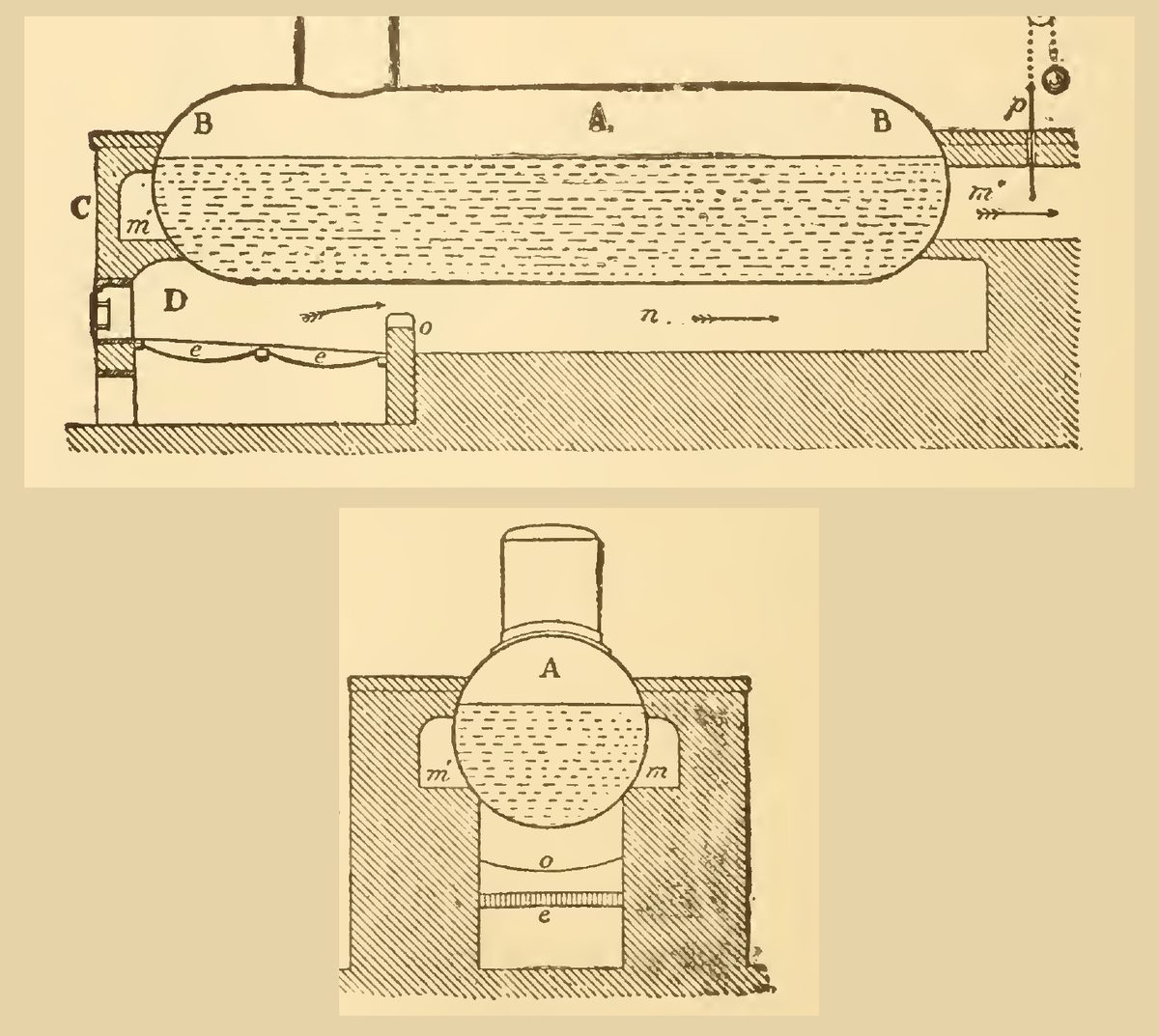
The bridge at the back of the grate narrows the way and forces the gases close to the boiler (Hawkins pp. 52-53). Baffles and sudden turns did the same job further along (Rankine p. 261, Wilson p. 290).
The tube has its own failing: it runs hotter than the shell, grows more than the shell, and can collapse (Hawkins p. 55, Fairbairn Useful p. 301). T-iron rings stiffen a long flue (Fairbairn Useful p. 305). The two-tube Lancashire boiler is the later answer, keeping the same outside flues (Hawkins pp. 55, 59). A setting in brick is the mark of a boiler that stays in one place; locomotives have no outside flues (Wilson p. 204).
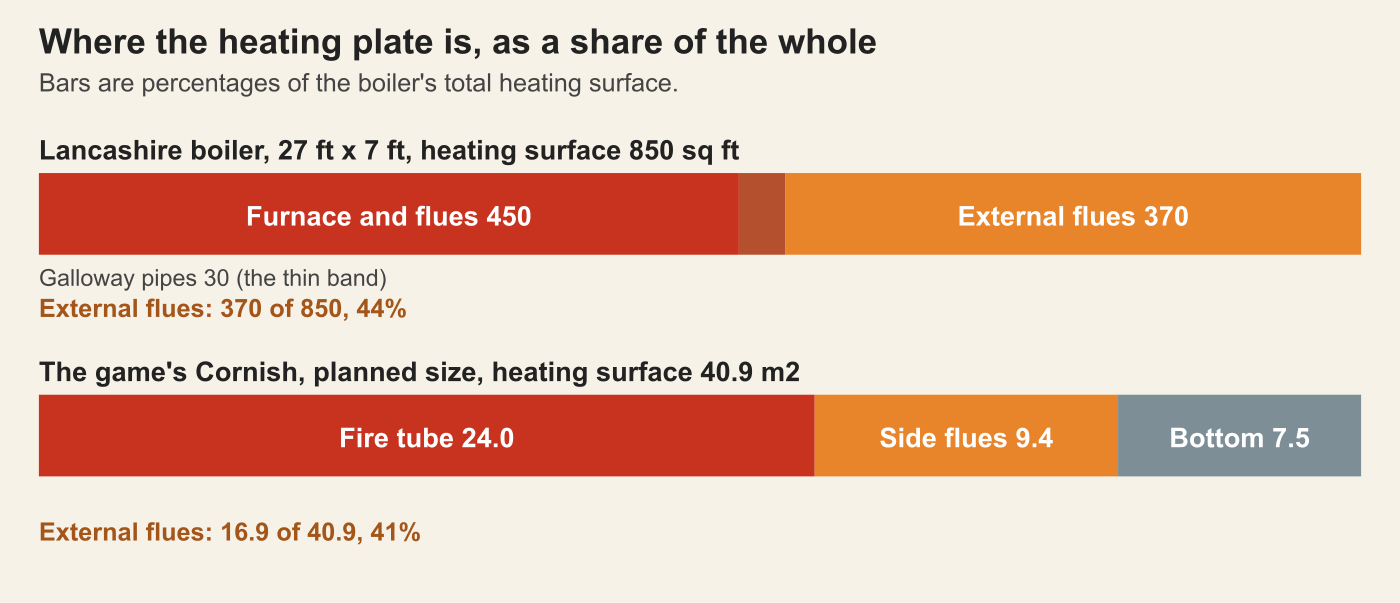
Long flues cost draught, and the chimney alone pushes the gas. Lengthening the run without a stronger draught brings "a decided falling off in the speed of evaporation" (Wilson p. 293), and the Wigan trials of 1868 ran a Lancashire and Galloway boiler with its outside flues cut out and lost only a little economy (Wilson p. 293). The flues pay most on a boiler driven hard (Wilson p. 294).
How it was really fired and kept
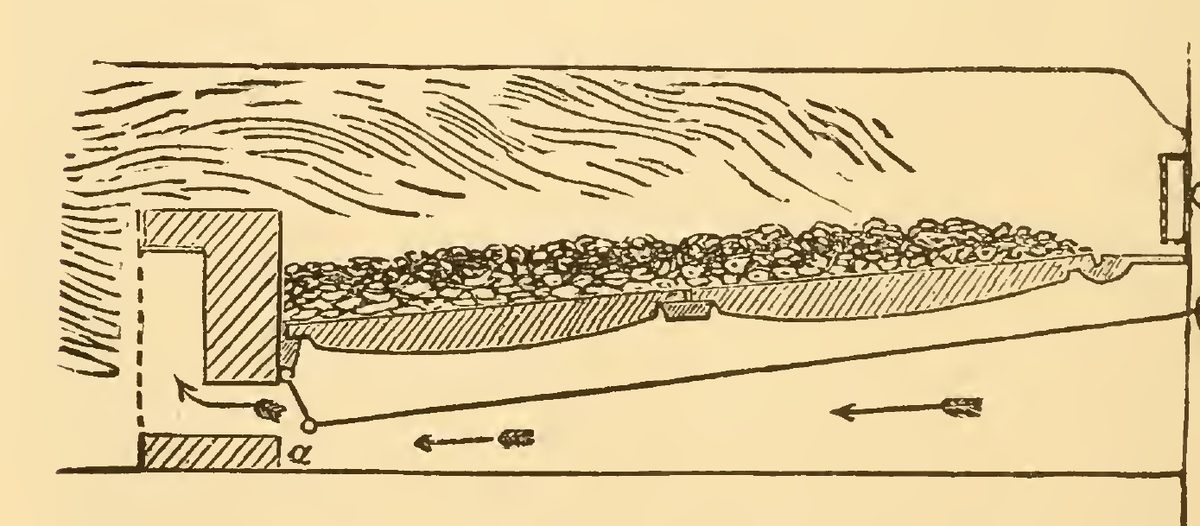
Hawkins gives the fireman's day (Hawkins p. 27): begin charging at the bridge end and work to within a few inches of the dead plate; keep three to five inches of clean burning fuel, spread evenly; keep the bars covered at the sides and the bridge, where it burns fastest; break large coals to a man's fist; clear the ash pit before hot cinders burn the bars. The usual rate in a Cornish was about 12 lb of coal a square foot of grate an hour (Wilson p. 300).
Water was watched as closely. Three try cocks on the boiler front, the lowest at about three inches above the highest point of the fire line, were tried many times each day, and the fireman could tell water from steam by the sound (Hawkins p. 176). Water stayed at one height all day and steam was blown off once or twice a day as the feed required (Hawkins p. 44).
The masonry had its own rules. A new setting stood two weeks before a fire if it could, then a small fire, and three full days before any steam at all (Hawkins p. 28). A boiler was not emptied while the brick was hot (Hawkins p. 44). Two iron doors in the front of the setting opened the lower flues for cleaning, as on Hawkins's Lancashire (Hawkins p. 59), and the flues had to be wide enough for a person: soot on the plate makes a useless blanket, and narrow flues defeat themselves (Wilson p. 156). Damp was worse. Wilson blames building a boiler in with a mass of brickwork for the greatest part of the external corrosion he met, hidden from the flue under the bricks (Wilson pp. 198-199).
Period basis, and what is the game's own
- Period: the shell with one furnace tube a little over half its diameter, gas through the tube, back by two side flues and away by the bottom flue (Hawkins p. 54), in a setting faced with fire-brick (Hawkins p. 236, Wilson p. 156). The game draws this: masonry base, grate, bridge wall, tube, side and bottom flues and flue doors, in Hawkins's order.
- Period: the fireman set the draught with a damper (Hawkins p. 53, Wilson p. 157). The game plans a damper handle at the front, banking the fire when shut.
- Period: soot blanketed the plate and the flues were cleaned by hand through their doors (Wilson p. 156, Hawkins p. 59). The game plans the two side flues fouling as the bed burns, cleared with a shovel through the door when the fire is out. The loss is the game's own, as no book gives a figure.
- The game's own: the base game's boiler is a liquid container heated by a firepit that feeds a condenser, with no steam and no pressure. See vanilla against reality.
- The game's own: the boiler brings its brick. It is laid by the player in construction stages and nothing is walled in around it, so a boiler cannot be set wrongly. A real setting was laid to drawings (Hawkins p. 87), and could vary the coal burned by as much as one-fifth (Hawkins p. 236).
- The game's own: today the flues are drawn and not simulated, and the steam rate does not follow the route. The fire draws through a chimney or smoke stack on its exhaust pipe and chokes without one, the chimney's period job kept as a plain rule.
- The game's own: the brick does not rust the shell, a new setting needs no curing, and the bearings need no inspection.
The numbers
Boilers keep period figures rather than the fuel factor of the iron furnaces (see the scaling page), drawn at true size (scale and units). "Planned" is the rating in design; values without that word are what the game has now.
| In the game | Period figure | How it was scaled | Game value |
|---|---|---|---|
| Shell | 6 ft across (Wilson p. 301), four diameters long (Wilson p. 300) | Whole voxels at true size, length 3.75 diameters | 2.0 m x 5.0 m; planned 2.0 m x 7.5 m |
| Furnace tube | "a little greater than half" the shell (Hawkins p. 54); set low, 6 in of water under it (Wilson p. 300) | Whole voxels at true size | 1.0 m across; planned to the shell's length, less 4 voxels, and set low |
| Grate | Width 0.94 of the tube (Wilson p. 300), length to about 5 ft (Wilson p. 300) | Whole voxels at true size | 1.22 m2; planned 1.53 m2 (16.4 sq ft) |
| Heating surface | 12 sq ft a nominal horse-power (Courtney p. 87), 323 sq ft at the planned size | Drawn plate, more than the rule gives | 27.0 m2 drawn; planned 40.9 m2 (440 sq ft) |
| Nominal power | Length x diameter in feet / 6 (Courtney p. 85) | The rule at face value | Planned 26.9 nhp |
| Plate | 3/8 in, mill boiler shells (Fairbairn Useful p. 301) | Plate at true thickness | 3/8 in today; planned 10 mm |
| Coal, usual firing | 12 lb a sq ft of grate an hour (Wilson p. 300) | Grate area x period rate | Planned 89 kg/h |
| Coal, damper shut to open | 4 to 18 lb a sq ft an hour (Wilson p. 272) | Grate area x period rate | Planned 30 to 134 kg/h |
| Steam per kg of coal | 7.25 lb a lb of coal, his worked Cornish (Wilson p. 300) | By heating surface to coal burnt (Wilson p. 296) | Planned 7.72 at the usual rate, 7.08 open, 8.60 shut |
| Steam, usual firing | 1 cu ft of water from 16 sq ft an hour, Galloway Cornish (Wilson p. 300) | Coal rate x steam per kg | Planned 0.192 kg/s, 691 kg/h; the boiler today makes 64 L/s |
| Working pressure | Plate rule, P = t x 11,140 / D (Bourne p. 325), Wilson's factor of 6 (Wilson p. 310) | The rule at face value | Planned 3.8 atm double-riveted, 3.0 single; the boiler today runs to 5.0 atm |
| Test pressure, the burst | "6 and 3", working and testing (Wilson pp. 213, 310) | A third of the shell's bursting pressure | Planned 7.5 atm |
| Working water | Lowest try cock 3 in over the fire line (Hawkins p. 176) | The drawn shell; levels inferred from Wilson p. 300 | Planned 11,284 L, low water 9,081 L; the boiler today holds 1,600 L in all |
| Raising steam | None given | The game's own heat balance, counted in game hours | Planned about 3.5 game hours at the usual rate |
Open, and what you can tell us
The books at hand disagree on the order. Hawkins and Rankine send the gas along the sides first and the bottom last (Hawkins p. 54, Rankine p. 472); Wilson wants the gas under the shell first and the sides after, to warm the feed at the bottom and keep it circulating (Wilson p. 157), and calls that the best way to stop the leaks and grooving a cold bottom brings (Wilson p. 204). Hawkins himself takes the Lancashire bottom first (Hawkins p. 59). The books also do not say who first set a Cornish boiler this way, or when. If you know a source that dates the split-draught setting or says which order was common in a district, we would like to read it.
Picture credits
- Cornish boiler, Otterburn Mill, Northumberland: Rosser1954, CC BY 4.0, cropped.
- Cornish boiler of 1851: Chris Allen, CC BY-SA 2.0, cropped.
- Cornish boiler, Fig. 26: Rankin Kennedy, The Book of Modern Engines and Power Generators, vol. VI (1912 edition of the 1905 book), public domain, scanned by Andy Dingley.
- Figs. 14 and 15, 16 and 17, and 1: Hawkins, Maxims and Instructions for the Boiler Room, pp. 52, 54 and 26, Library page.
- The gas path in three views: drawn for this site from Hawkins pp. 54, 59 and 81 and his Figs. 16 to 18, and Rankine p. 472.
- The plate shares: drawn for this page from Hawkins p. 60.
- The game's boiler: the mod's planned drawing.
Comment or suggest something in the Expanded thread on the Vintage Story Discord