
Bearings and grease
A shaft has to turn in something that holds it still, and every turn rubs. The plain bearing is the period's answer: a cast block, a lining and a film of oil or fat between lining and shaft. How power moves through a works in the game is in the shaft power guide, and the part itself is in the catalogue. This page is about the real thing and what the game keeps of it.
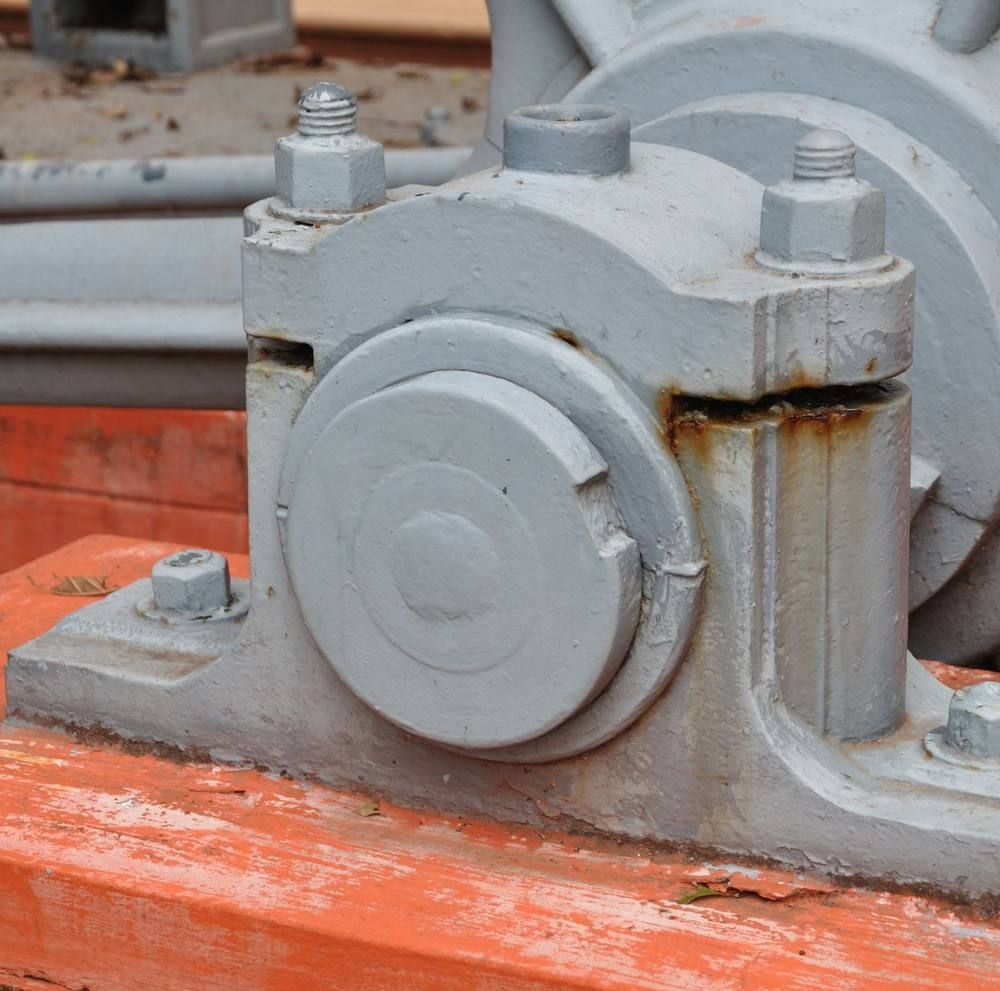
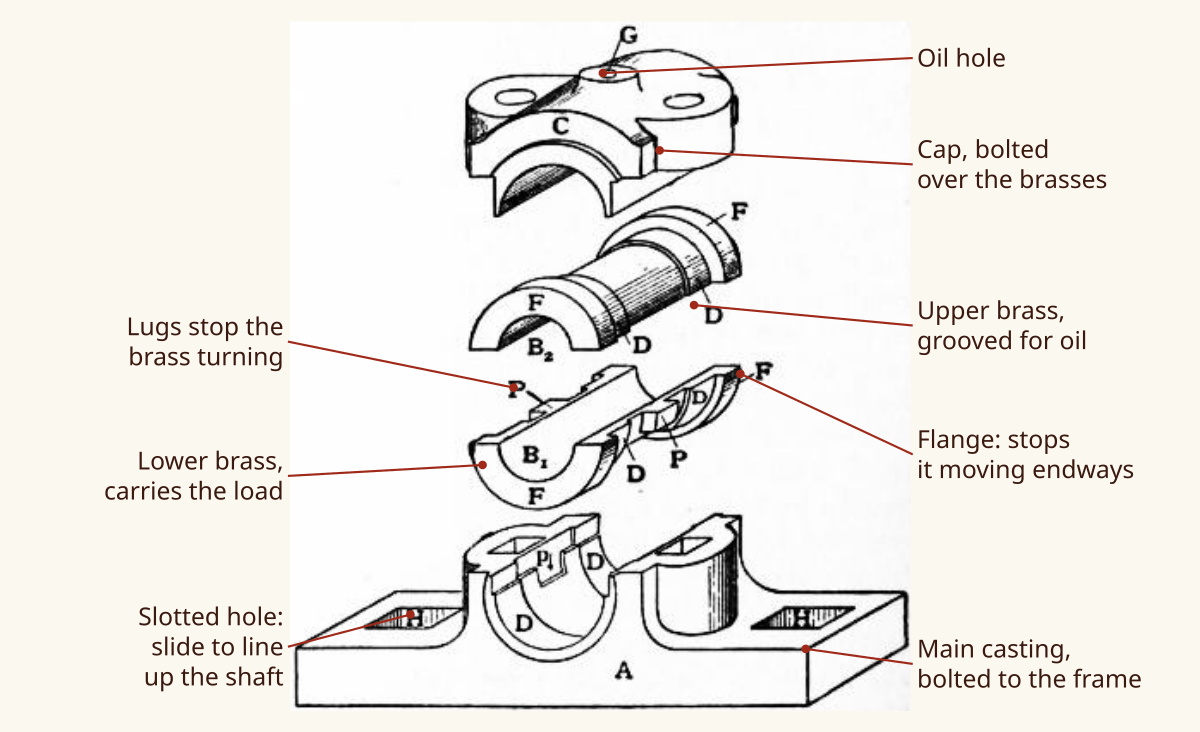
There is no drawing of the game's plain bearing as a placed machine: it is an item, paid into the machines that run on one.
How the real one worked, and why it was built so
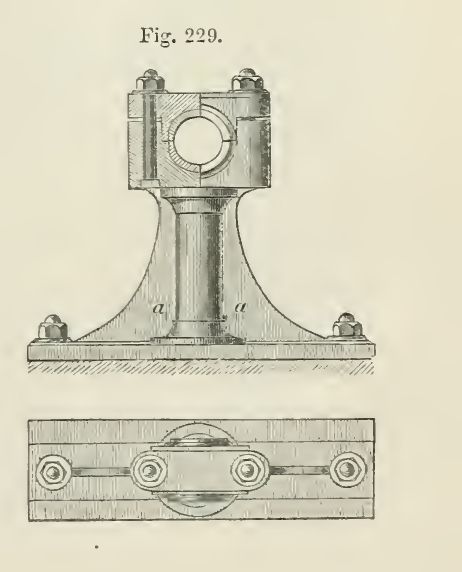
A mill shaft was held up in three ways, "on foundation stones in the floor, beneath beams suspended from the ceiling, and to the walls" (Fairbairn Mills II p. 93), and each way has its own casting around the same two brasses. The shafts themselves are on the line shafting page.
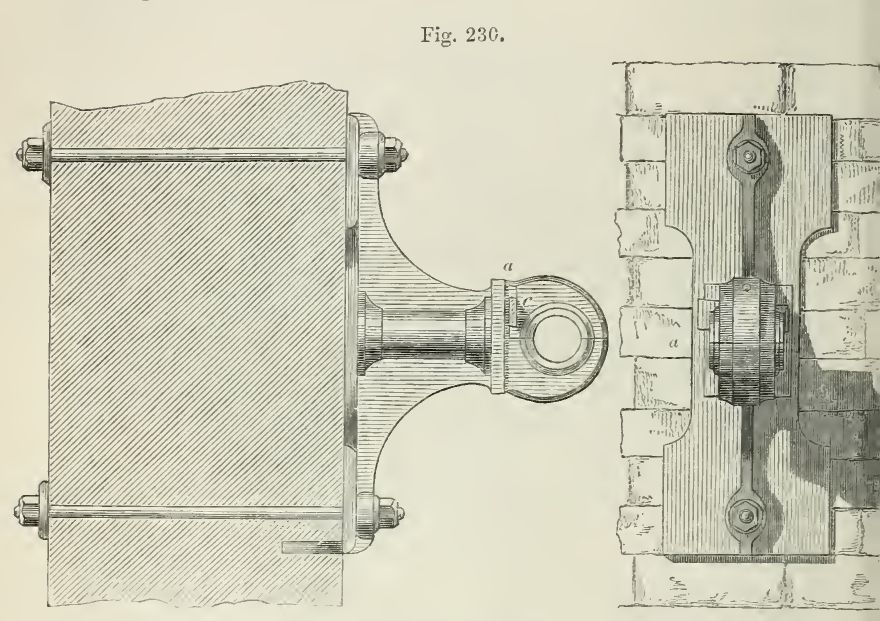
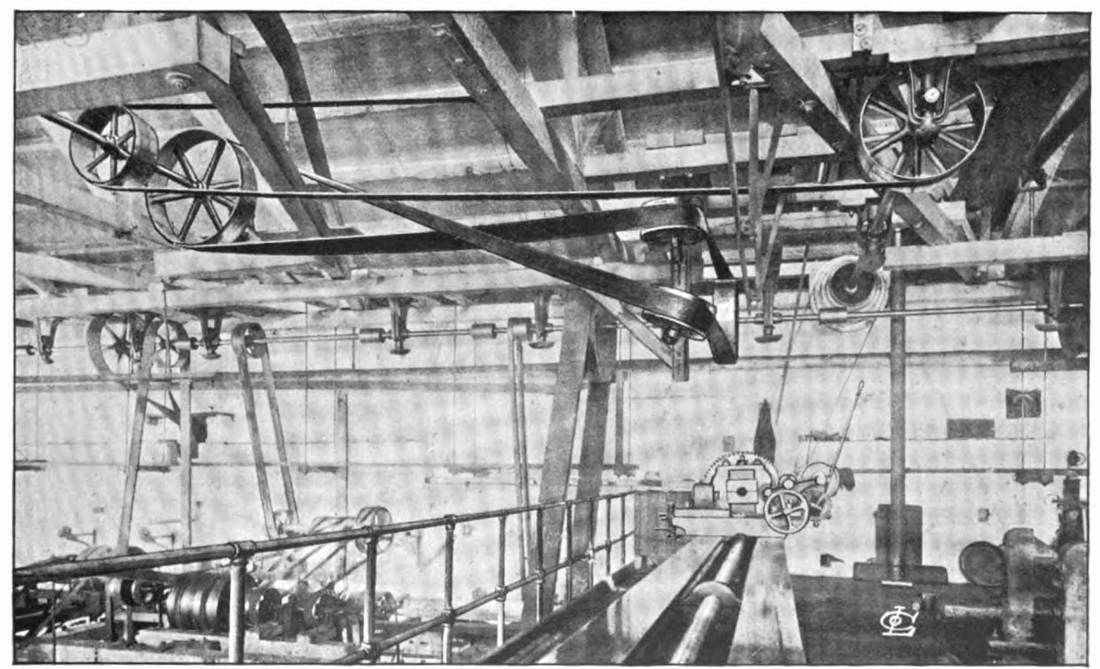
Two numbers ruled a journal: how long it was and how hard it was pressed. Fairbairn made it one and a half diameters long on a cast-iron shaft and one and three quarters on wrought (Fairbairn Mills II p. 73). His table runs from 20 to 40 lb on each square inch of bearing for a horizontal line, to 178 for a fly-wheel shaft and 243 for the toe of a vertical shaft (p. 73). Even at the top figure it was "difficult to keep the shafts cool" (p. 74), and any dust or sand in the step was a danger (p. 74). The shoulder of a journal was hollowed, never cut square, because a square corner cost the shaft much of its strength (p. 74).
Sellers made his boxes far longer, four diameters, and hung each on a ball and socket so that it could follow a shaft that had deflected or settled and still carry the load along its whole length (Sellers 1895 p. 380).
What grease does
Morin's experiments at Metz, in 1831 to 1833, are the ones Fairbairn leans on (Fairbairn Mills II p. 74). Dry, friction goes with the load and does not care about the area touching (pp. 74-75). With a continuous film between the surfaces it depends "rather upon the nature of the unguent than upon that of the surfaces" (p. 75), so that lard or olive oil gave a coefficient of 0.07 to 0.08 on wood or on metal alike, and tallow 0.10 between metals (p. 75). Rennie found the harder unguents, tallow and soft soap, better under weight, and the softer oils and lard worse, so the choice "must be accommodated to the pressure" (pp. 75-76).
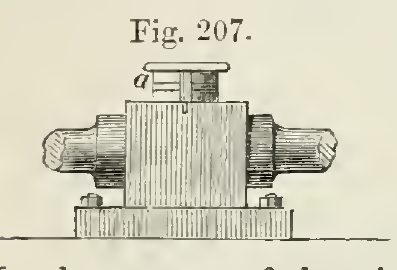
The saving was real and easily lost. In large cotton mills a change in the quality of the oil took up ten to fifteen horse-power, and a mill that had stood cold over Sunday needed more power on Monday morning than on any other day (Fairbairn Mills II p. 77). An indicator on an engine of 50 horse-power put its whole friction at 5 (p. 77). Fairbairn names pure sperm and olive oils as the best, and says that they were to be applied sparingly (Fairbairn Mills II p. 77).
The job itself was held in low regard: oiling was "generally left to the most negligent and most untidy person in the establishment" (Fairbairn Mills II p. 77). The result, in his words, was that "every opening for the oil to get to the bearings is plugged up, the brass steps are cut by abrasion, and the necks or journals of the shafts destroyed" (Fairbairn Mills II p. 78). Pouring it on was no cure, since nine tenths ran to the floor or hardened on the hangers (Fairbairn Mills II p. 77). This is what wear meant in a bearing: not a part reaching the end of a set life, but a film that failed.
By 1895 Sellers's boxes came two ways: an ordinary box, oiled by hand or by a drop feeder, with two cups on top for grease or candle lubricators, and a self-oiling box in which rings or chains hanging into a bath carried oil up to the journal, a single charge lasting for several months (Sellers 1895 pp. 380, 382).
What the bearing was lined with
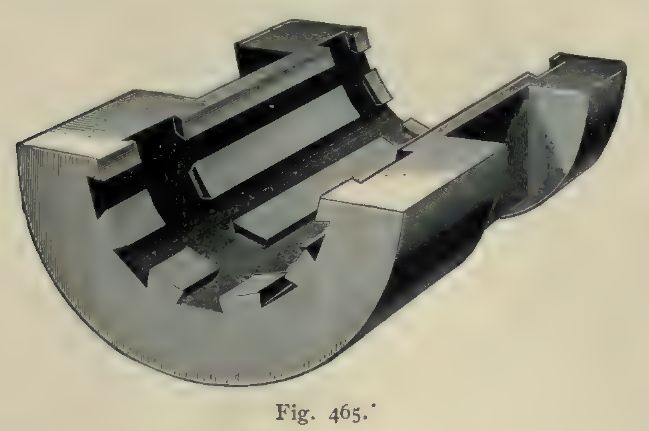
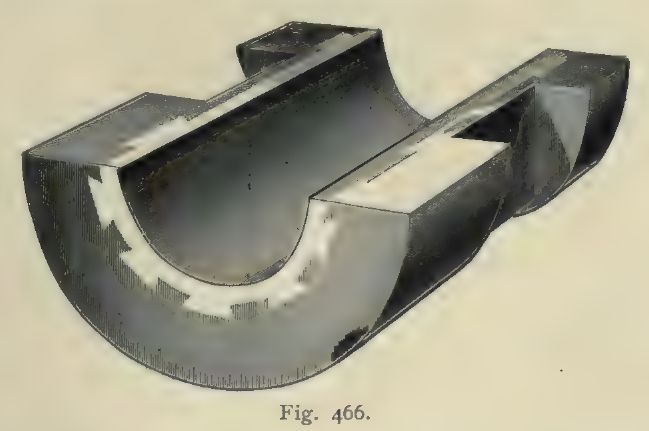
The steps of Fairbairn's mill pedestals are brass (Fairbairn Mills II p. 93). The toe of a vertical shaft needs "the very best quality of gun metal" (p. 74). By the later century a machine shop lined its boxes with Babbitt (Rose p. 124), and the 1911 Encyclopaedia Britannica lists gun metal and phosphor bronze for brasses. Sellers went the other way for ordinary hangers: cast iron bored true, which his firm found "superior to other metals as a material for boxes", with Babbitt, brass or bronze made to order (Sellers 1895 p. 382).
Period basis, and what is the game's own
- Period: a cast pedestal with a lower step and a cap carrying the upper one (Fairbairn Mills II p. 93). The game's plain bearing is a cast block and its cap, cast apart in one pour, with a brass bush between them, assembled at the bench.
- Period: Fairbairn names pure sperm and olive oils as the best lubricants (Fairbairn Mills II p. 77). The game takes one grease at the fit: vanilla's rendered fat or a half litre of its olive or flax oil, whichever the player has.
- The game's own: a single brass, where a period block had two or one with a grease cap (Fairbairn Mills II pp. 93-94). A bearing that is only a bore in a larger casting takes a bare bush, and the same bush goes in a gland.
- The game's own: grease is paid once, when the fit is made, and nothing that runs consumes it. Today no bearing is oiled, runs hot or wears out, and a bearing is an item in a machine's making rather than a part that changes how it runs.
- The game's own, planned: oil cups drawn at a machine's bearings, filled from an oil can, a fill lasting days of running. A dry machine would draw more torque and run hot but would never break by itself, and a sight-feed lubricator on an engine would keep it oiled. The period's stakes, a cut step and a ruined journal (Fairbairn Mills II p. 78), are not planned.
- The game's own: vanilla has no bearing at all. Its axle only draws a stand where it finds itself unsupported, and its wooden axle takes fat in its recipe. See vanilla against reality.
- The game's own, planned: tooling wears, machines do not. Dies, roll sets, blades and cutters are planned to wear by the grade of their metal, breaking up into 80% bits and 20% mill scale when spent. Of all this only the wooden pattern wears today, after 240 impressions. Whether a bearing should ever become a wear part is undecided, and the working assumption is that it will not.
- The game's own, planned: a ball bearing in the steel-age mod, standing in for a plain one and required by the highest-pressure machines. The books at hand do not cover how balls were made or the industry that made them.
The numbers
Bearing figures are period reference only: the game does not simulate a journal's pressure, its length or its coefficient, so nothing below is scaled (see the scaling page and scale and units).
| In the game | Period figure | How it was scaled | Game value |
|---|---|---|---|
| Length of a journal | 1.5 diameters on cast iron, 1.75 on wrought (Fairbairn Mills II p. 73); 4 diameters in a swivel box (Sellers 1895 p. 380) | Not modelled | None |
| Pressure on a journal | 20 to 40 psi on a horizontal shaft, 178 on a fly-wheel shaft, 243 on a vertical toe (Fairbairn Mills II p. 73) | Not modelled | None |
| Friction with an unguent | 0.07 to 0.08, oil or lard; 0.10, tallow on metal (Fairbairn Mills II p. 75) | Not modelled in the bearing | None; the shaft network has its own running friction, not tied to any bearing |
| Lost in an engine | 5 of 50 hp (Fairbairn Mills II p. 77) | Not modelled | None |
| Grease at a running fit | No book gives a quantity for a fit | The game's own | One rendered fat, or 0.5 L of olive or flax oil |
| Life of a wooden pattern | None given | The game's own | 240 impressions |
| A spent tool, planned | None given | The game's own | Planned 80% back as bits, 20% as mill scale |
Open, and what you can tell us
The books at hand do not explain why the lining was brass or a white metal rather than iron, and Sellers's preference for bored cast iron (Sellers 1895 p. 382) sits oddly beside Fairbairn's brass steps. They also disagree on length by more than double, one and a half to four diameters. If you know a period source that argues the choice of lining, or that gives the running clearance or the rate at which brasses wore in service, it would be welcome.
Picture credits
- Plummer Block Bearing, Kolkata: Biswarup Ganguly, CC BY 3.0, cropped.
- 1911 Britannica, Bearings, small bearing: Encyclopaedia Britannica, 1911, public domain, labels added.
- Figs. 207, 229 and 230: Fairbairn Mills II, pp. 78, 93 and 94, Library page.
- Figs. 465 and 466: Rose, Modern Machine-Shop Practice, p. 125, Library page.
- Plate No. 229: Sellers, Machine Tools for Working Metal, 1895, p. 381, Library page.
Comment or suggest something in the Expanded thread on the Vintage Story Discord