
Hot blast
A blast furnace burns its fuel in air blown in at the bottom. Heating that air first looks like a small change to the furnace. Percy called it "one of the most important improvements ever made in metallurgy" (Percy p. 397). How to build and run the game's hot-blast plant is in the hot blast guide. This page follows what the works did and what it cost them, then says what the game keeps of it.
The belief it overturned
The ironmasters' conviction before 1828 was "the colder the blast the better", because furnaces made more iron in winter than in summer (Percy p. 397). Some works passed their blast over cold water in summer to chill it. The water made matters worse, since damp air was the real cause of the summer loss (Percy p. 397). Johnson puts that loss at about 20% more fuel in the most humid weather than in the driest, at a blast held at a constant temperature (Johnson Principles p. 38).
James Beaumont Neilson, manager of the Glasgow gas-works, patented the use of heated air in 1828 (Percy p. 394). The specification is under a page long and asks only for an air vessel kept hot between the blowing engine and the fire, "to a red heat, or nearly so" if possible (Percy p. 395). It was tried first at the Clyde Iron-works. Percy, who thought it "a lucky hit rather than an invention properly so called" (Percy p. 397), records that by 1835 it was at work in every Scottish ironworks but one, and going in at that one (Percy p. 395).
Heating the air in iron
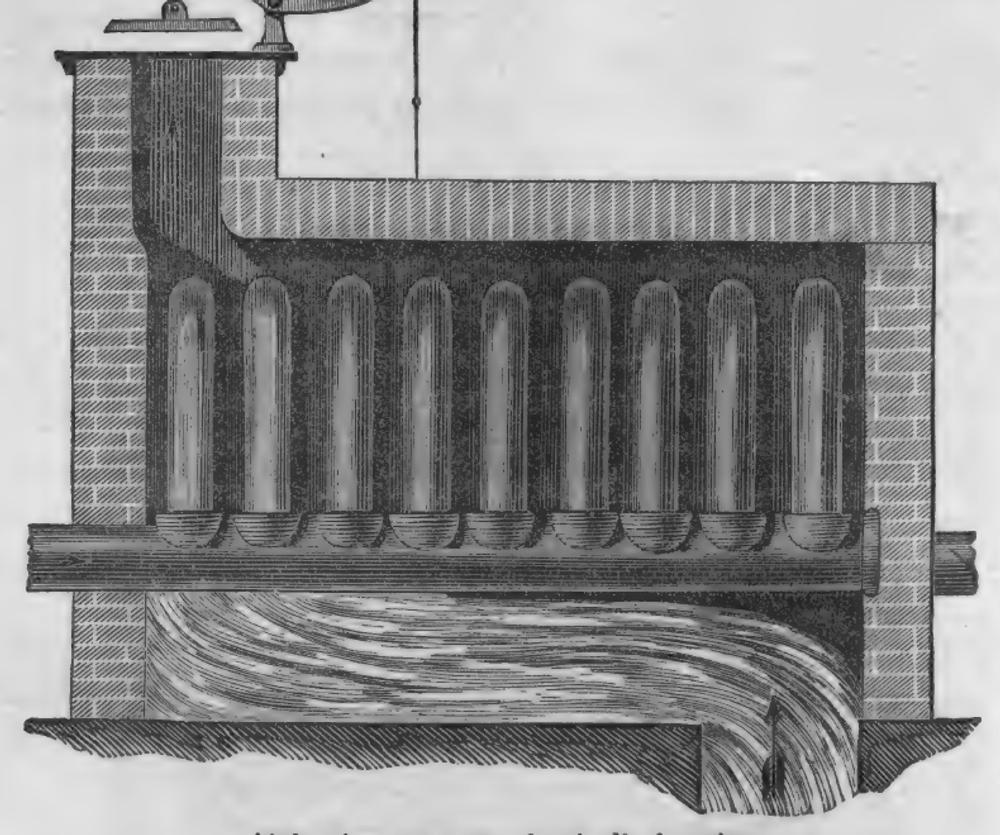
The first apparatus was a wrought-iron box about 4 ft long, set over a grate like a small boiler, one to each tuyere, and it warmed the blast to about 200 degrees F (Percy p. 399). The plate soon burnt away. A cast-iron vessel gave 280 degrees F (Percy p. 400), and long horizontal cast pipes passed 600 degrees F, hot enough to melt lead (Percy p. 400).
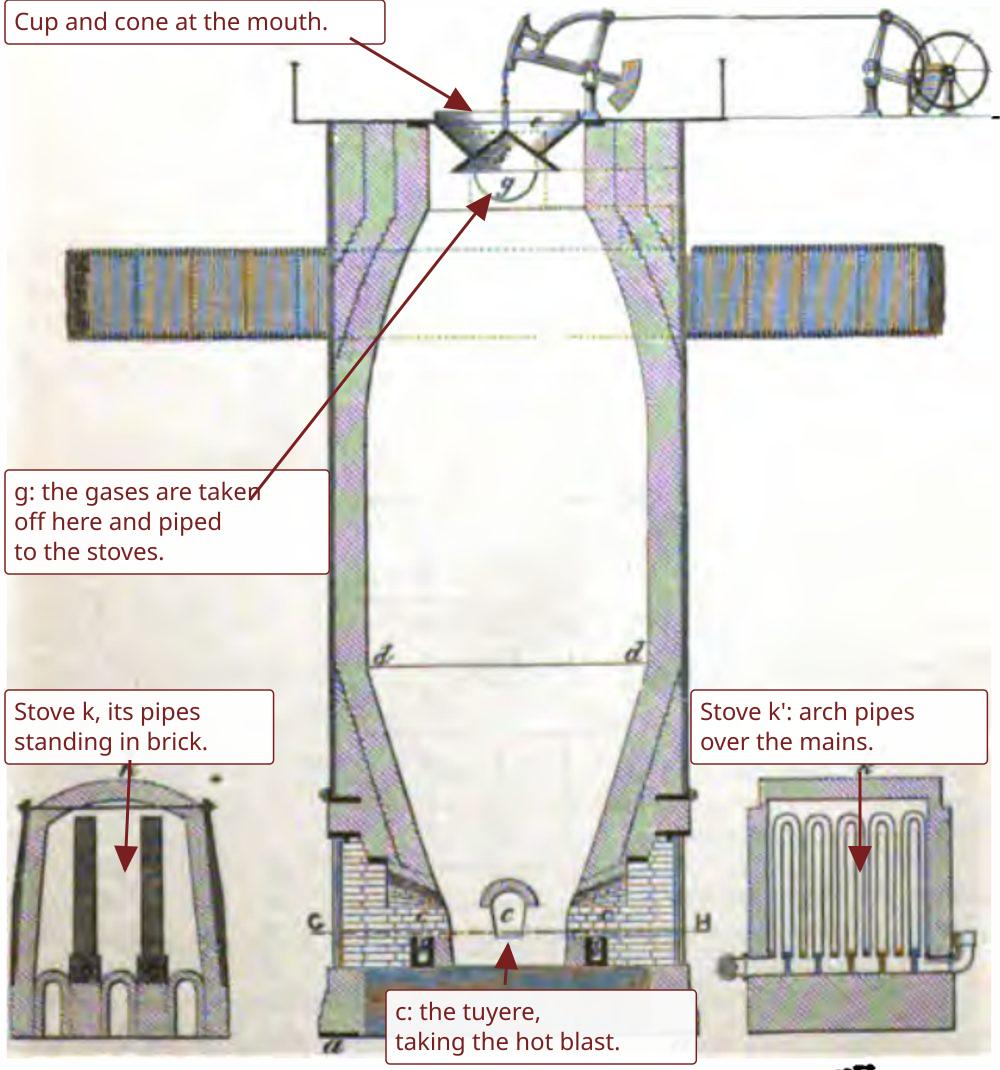
Those long pipes began the trouble that occupied a generation of furnace managers: hot iron grows, a long run of it grows unevenly, and the joints leak (Percy p. 400). Neilson's cure was to set arched pipes in sockets on two parallel mains, like syphons, which did away with flanged joints: the "cast-iron tubular oven", and every later pipe stove was a variation on it (Percy p. 401). It still leaked and cracked, it could not hold 600 degrees F for long without damage to the pipes, and a fire pressed too hard could burn "down the whole apparatus" (Percy p. 401). Set against the tuyere house, it roasted the men who had to work the tuyeres (Percy p. 402).
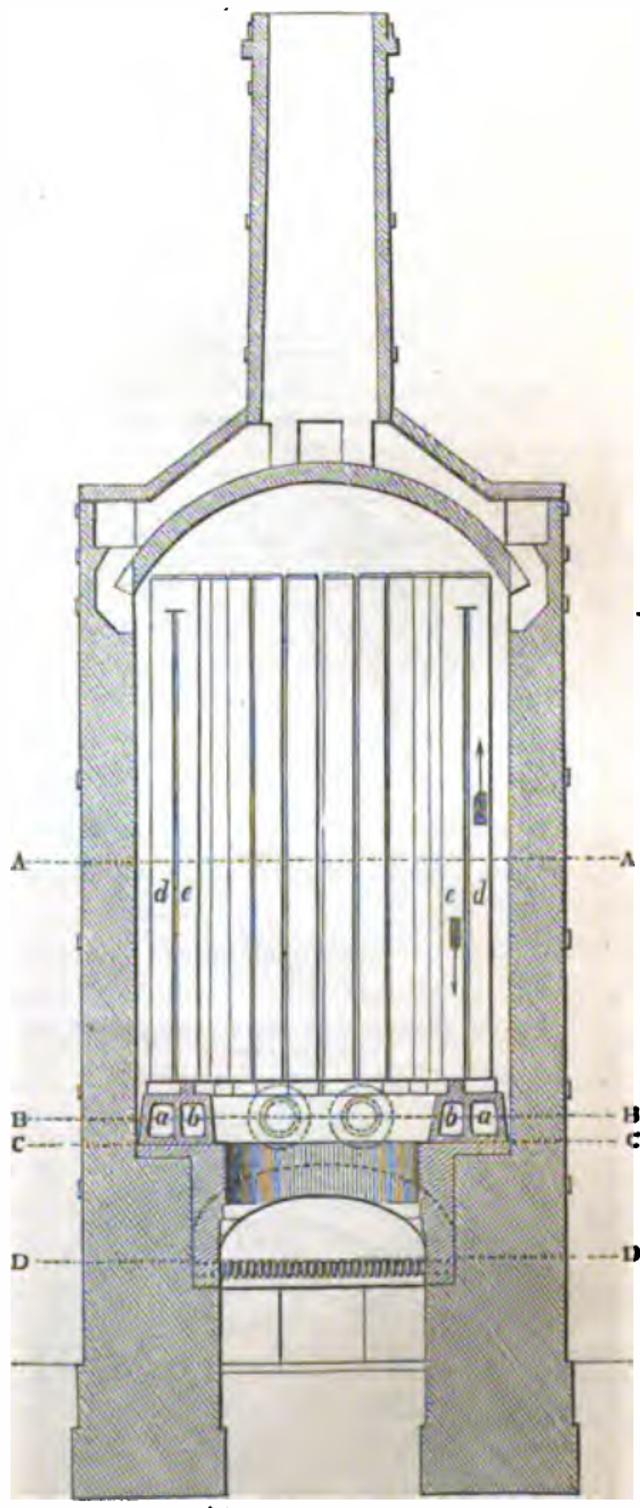
Hot air changed the furnace's front end as well. The leather bag between pipe and tuyere could not carry it, and the nozzle had to be all metal (Overman p. 416). A water-cooled tuyere became "essential where hot-blast is applied" (Percy p. 428). Thermometers broke at furnaces, so a small cup of lead or of an alloy with a known melting point was let down on a wire into the blast pipe (Overman p. 433).
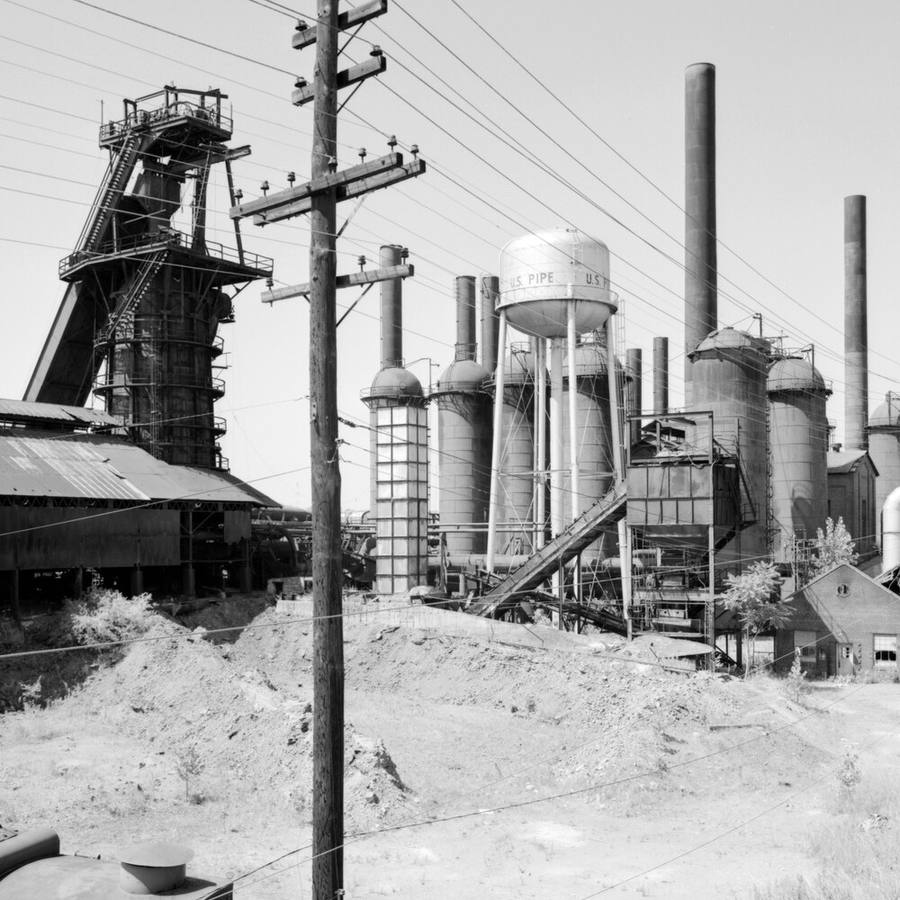
Later works gave up coal for the stoves. Percy watched the waste gas of the furnaces heating the ovens at Blaina and Ebbw Vale with undisguised pleasure, and was told it saved the Blaina works the equivalent of 600 tons of coal a week, boilers included (Percy p. 410). Stoves were first set at the furnace top, to catch the flame from the open mouth, and came down to ground level once the top was closed and the gas could be piped (Johnson Construction p. 191).
What it really saved
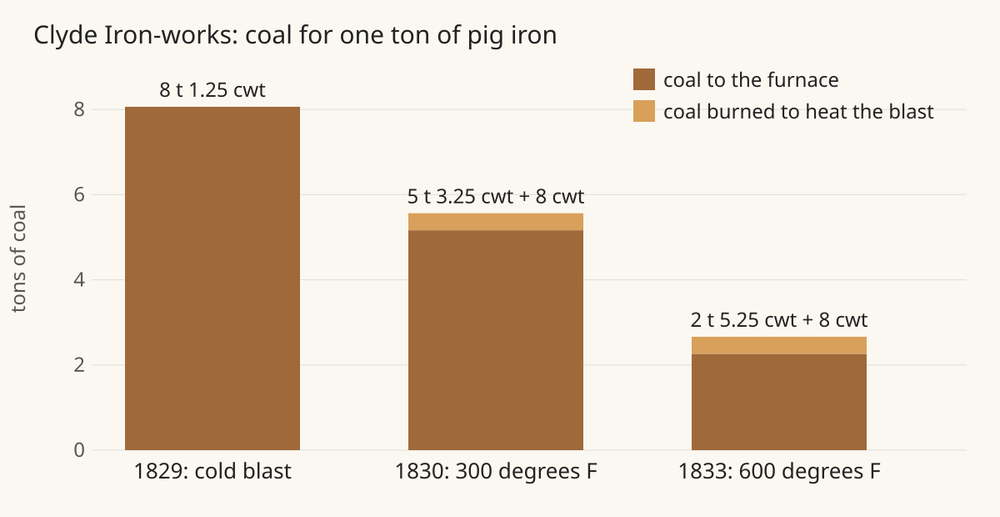
The Clyde figures were real and were also argued over. Truran held that the saving due to hot air was nearer five cwt than five tons, the rest being better ore, coke and engines. Percy answered that in 1829 and 1830, with all else alike, a warm blast alone took off nearly three tons of coal (Percy pp. 419-420). The books agree on the direction and the size of the effect on coke. Overman gives 30 to 60% of the fuel saved in anthracite and coke furnaces, nearly twice the iron in a given time, 20% saved on hard charcoal, and little on soft (Overman p. 442).
The puzzle was why the saving was so large. The heat carried in by the blast was only about 18% of the total made in the furnace, yet the fuel fell by more than half, "a preposterous state of affairs viewed only in the light shed by the heat balance" (Johnson Principles p. 31). Percy admitted he had no satisfactory answer (Percy p. 428). Johnson's answer is the critical temperature. Only heat above the point where the slag runs free, about 2750 degrees F, does the work of smelting. That band is only a fraction of what the burning fuel reaches, so a modest addition of heat widens it by a great deal (Johnson Principles pp. 31-32). His available heats at Clyde run 1 to 1.73 to 2.63 across the three years (Johnson Principles p. 39). It was also widely observed that the top of the furnace ran cooler the more the blast was heated (Johnson Principles p. 33). Charcoal, whose slag runs free at a much lower temperature (Johnson Principles p. 50), gained much less (Johnson Principles p. 47).
More on the arithmetic of air and heat is on the blast and heat page, and more on the daily work of the furnace is in running a blast furnace.
From pipes to brick
Cast iron set the ceiling. Iron-pipe stoves failed fast above about 900 degrees F, and could be destroyed in an hour or two if fired with no blast running through them to carry the heat off (Johnson Construction p. 191).
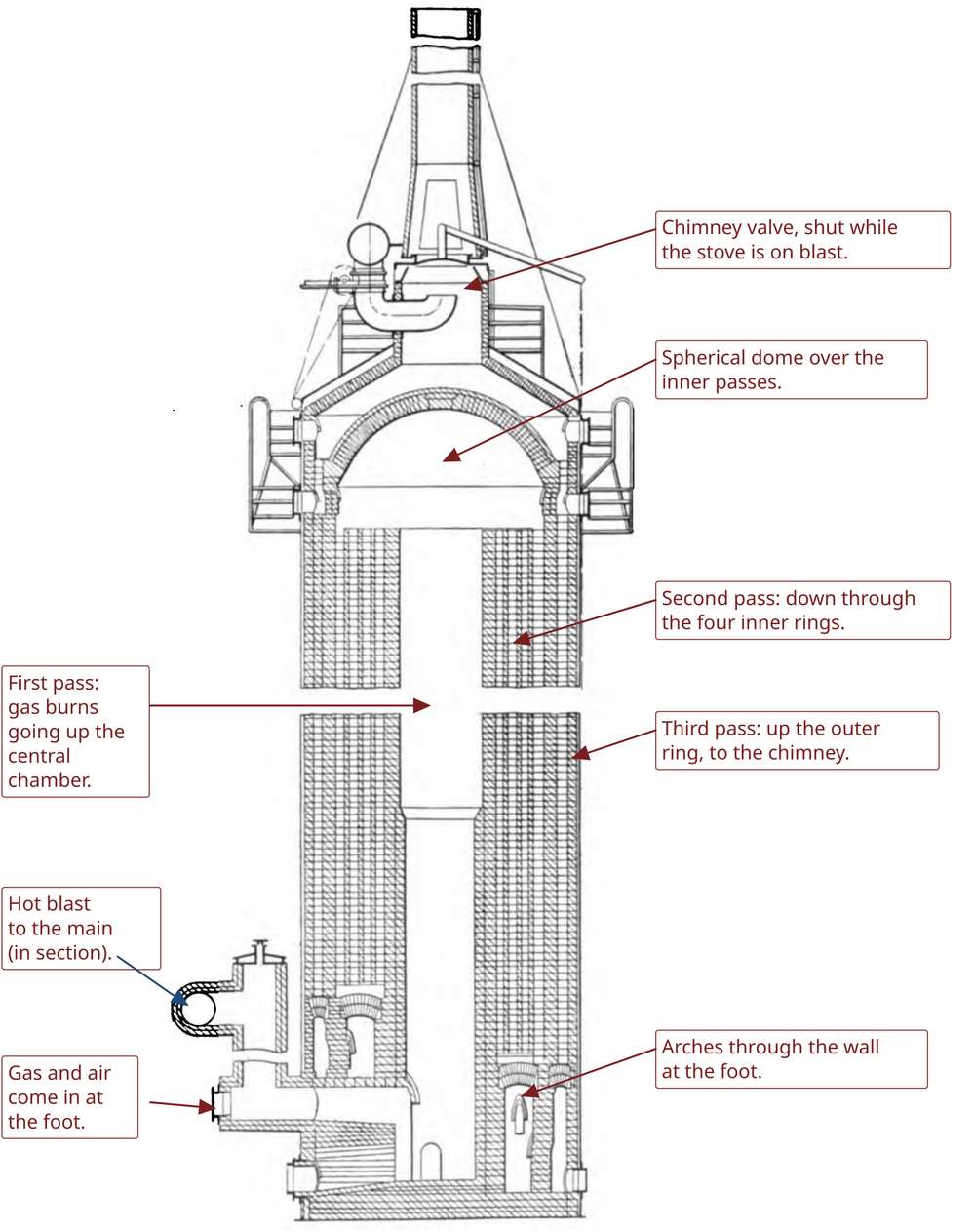
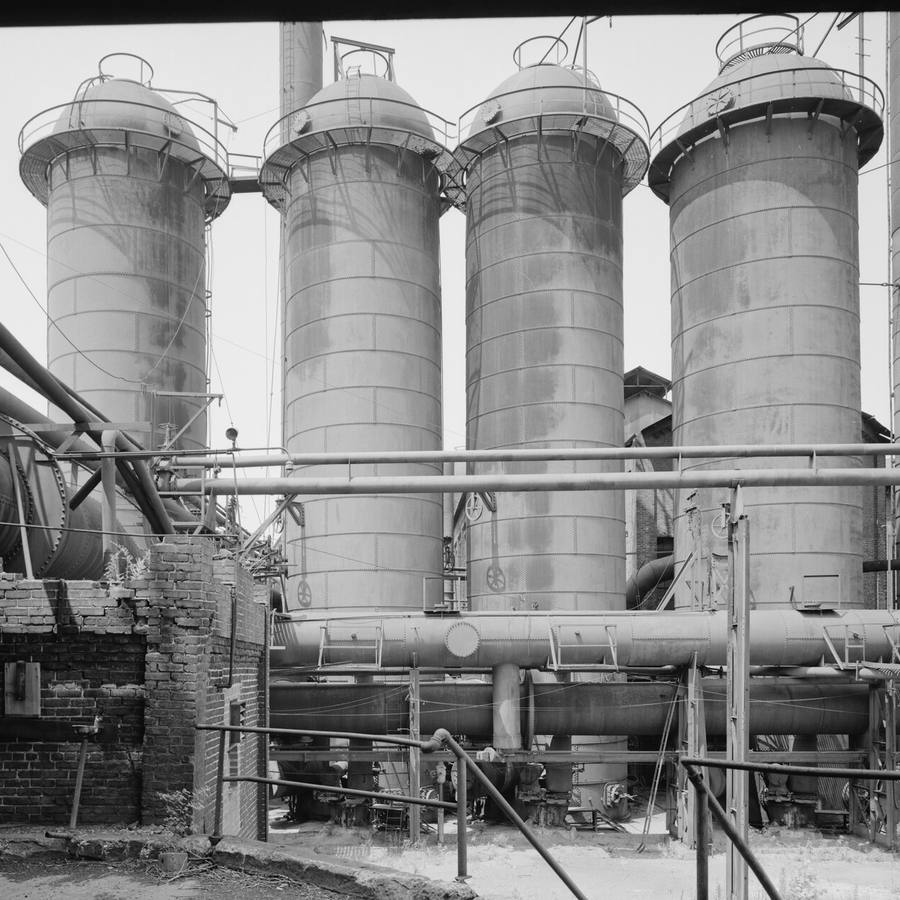
The answer was the regenerator: a chamber full of brick that is heated, then shut off and blown through. Johnson credits the idea to Whitwell, adapting Siemens's steel-melting chambers (Johnson Construction p. 191). Percy notes Cowper's stoves working at Ormesby for over two years by 1864, with a blast "considerably above redness", 5 cwt less coke a ton and a third more iron (Percy p. 428, footnote). Siemens's own stoves at the Clarence works brought no advantage and were abandoned, the dust choking their chambers (Percy p. 428). Blast could not be heated first and compressed after, since the blowing engines could not handle it hot, so each stove had to be a riveted pressure vessel (Johnson Construction p. 192). It ran about 50% hotter than the iron-pipe stove, at 1000 degrees F or so (Johnson Construction p. 192).
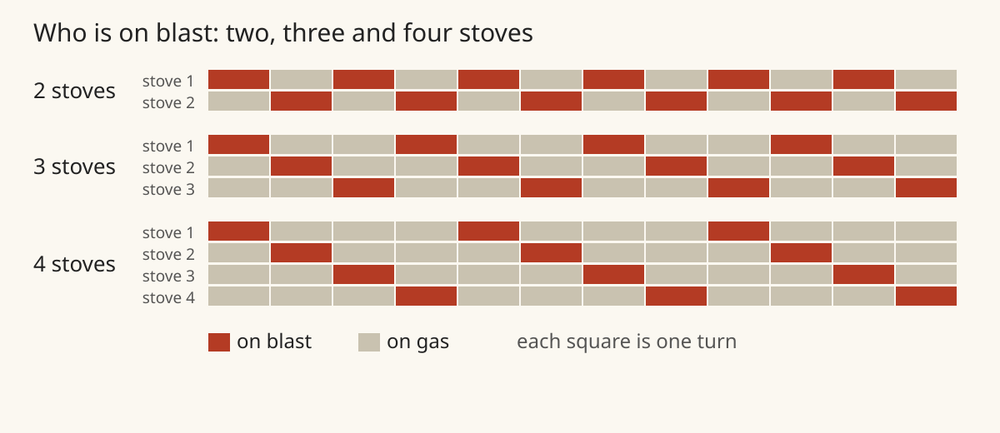
That is the cost of a hotter furnace: a row of towers about as wide as the furnace bosh and at least as tall as the furnace (Johnson Construction p. 228). Each one has four openings to be shut in turn, gas, chimney, cold blast and hot blast, and metal parts round them that needed water cooling (Johnson Construction p. 192). The blast cooled through each turn, falling 50 to 150 degrees F between putting a stove on and taking it off, and a stove tender trimming a cold-air valve or a small checker-filled equalizer smoothed it (Johnson Construction pp. 227-228). Dust from the gas settled on the checkers and cut what a stove could heat (Johnson Construction p. 228). In the pipe-stove days the same care kept the furnace safe: with the engine stopped, the hot main had to be shut off from the furnace, or furnace gas would come back into the apparatus and explode (Percy p. 418).
Period basis, and what is the game's own
- Period: the hot blast saved 30 to 60% of the fuel in coke and anthracite furnaces (Overman p. 442). The game makes the same trade, though it counts heat, not coal: a stove's hot blast raises the furnace's process temperature, and that margin lets a charge run on less carbon.
- Period: the stove burns the furnace's own waste gas (Percy p. 410, Johnson Construction p. 191), cleaned of dust and swapped by hand on valves (Johnson Construction pp. 192, 226-227). The game plans this cycle: a dust catcher, gas firing, and stoves heated and blown in turn, by valves the player works.
- Period: iron-pipe stoves held to about 900 degrees F, brick stoves about 50% more (Johnson Construction pp. 191-192). The game plans two stoves on that line, the pipe stove and the Cowper.
- Period: stoves need more turns on gas than on blast, and more stoves give a steadier blast (Johnson Construction p. 226). The game's plan is a stove that takes about twice as long to heat as to blow, with no number named anywhere: a player finds the count by watching the blast sag. Works ran it the other way, choosing stove numbers first.
- The game's own: the planned stove has no drawing yet, so no render appears here.
- The game's own: the stove in today's build does not burn anything. It soaks heat out of piped furnace exhaust, and a coal pile under its intake sets how fast, unlit and never spent. That model is a placeholder until the gas loop exists; no real stove worked so.
- The game's own: the hot blast counts only as heat at the hearth, and changes nothing else in the furnace's arithmetic. Vanilla has no hot blast at all (vanilla against reality).
The numbers
Temperatures in the game are in Celsius. How figures from books become game values is on the scaling page. "Planned" marks what is in design and not built.
| In the game | Period figure | How it was scaled | Game value |
|---|---|---|---|
| Pipe stove blast | Over 600 F, Neilson's tubular oven (Percy p. 400); limit about 900 F (Johnson Construction p. 191), 500 F by Overman (p. 435) | Period limit, rounded | Planned about 500 C |
| Cowper blast | "Considerably above redness" (Percy p. 428, footnote); about 50% above the pipe stove (Johnson Construction p. 192) | The game's own, hotter than the books | Planned 700 to 800 C |
| Stoves to a furnace | 2 at first, 3 the least, 4 ordinary (Johnson Construction p. 226) | Same counts, not stated in game | Planned 2 sags, 3 holds, 4 steady |
| Time on gas against blast | 3 to 1 with four stoves (Johnson Construction p. 226) | Fixed ratio; the count follows | Planned about 2 to 1 |
| Heat from the blast | Blast heat about 18% of the total (Johnson Principles p. 31) | The game's own coefficient | 0.35 C per degree of blast above the air; a 950 C blast on a 20 C day adds 325.5 C |
| Fuel saved | 30 to 60%, coke and anthracite (Overman p. 442); Clyde, about two thirds with stove coal counted (Percy p. 398) | The game's own, by heat | Cold blast needs 23.94% carbon to melt iron; with a 950 C blast 10% coke melts it with 106 C to spare |
| Effect on a standard charge | Nearly twice the iron (Overman p. 442) | The game's own | 20% coke runs 1420 C cold, below the 1482 C melt line; 1745.5 C on a 950 C blast |
Open, and what you can tell us
The books at hand name different inventors of the brick stove: Johnson credits Whitwell's adaptation of Siemens (Johnson Construction p. 191), and Percy names Cowper's stove at Ormesby (Percy p. 428), with no date for either that settles who came first. The game's stove takes Cowper's name. If you can date the first blast furnace stove of firebrick, or know how long a stove stayed on blast at a works before about 1880, we would like to read it.
Picture credits
- Sloss Furnaces, general view (HAER ALA,37-BIRM,4-22): Jack E. Boucher, Historic American Engineering Record, public domain, cropped.
- Sloss Furnaces, stoves 11-14 (HAER ALA,37-BIRM,4-93): Jack E. Boucher, Historic American Engineering Record, public domain, cropped.
- Fig. 51, labelled, and Fig. 66: Percy, Metallurgy: Iron and Steel, pp. 367 and 411, Library page.
- Fig. 144: Overman, The Manufacture of Iron, p. 430, Library page.
- Fig. 130, labelled: Johnson, Blast-Furnace Construction in America, p. 202, Library page.
- The Clyde chart: drawn for this page from Percy p. 398 and Johnson Principles p. 39.
- The stove turns: drawn for this page from Johnson Construction p. 226.
Comment or suggest something in the Expanded thread on the Vintage Story Discord