
Cowper stove
A Cowper stove is a tall iron cylinder full of brick, with no fire of its own and nothing moving inside it. It burns the furnace's waste gas until the brick is hot, then the gas is shut off and the blast is sent through the same brick. How to run the game's stoves is in the hot blast guide, and why a hot blast saves so much fuel is on Hot blast: why heating the air saves fuel. This page is about the stove itself. The game's gas-fired stove is designed and not built, and it has no finished drawing to show yet.
Why the blast could not simply run through iron pipes
The first hot-blast stoves ran the air through iron pipes over a fire (Johnson Construction p. 191). The air could only be as hot as the pipe could stand, and the pipe gave out at about 900 degrees F; fired with no blast passing through to cool them, the pipes could be destroyed in an hour or two (Johnson Construction p. 191).
Brick stands far hotter. The idea of storing heat in brick and passing the gases through it in turn came from the Siemens regenerator, first used on furnaces melting crucible steel (Johnson Construction pp. 191-192). There the checkers differed from the atmosphere by only a few inches of water, and masonry was tight enough (Johnson Construction p. 192). On a blast furnace the blowing engines could not handle air already at 1000 degrees F or so, so the blast has to be compressed first and heated afterwards, and the stove has to hold the full blast pressure (Johnson Construction p. 192). That is why the shell is riveted plate and the top is domed, and why the hot brick stands inside a sealed drum rather than in a masonry chamber as in a steel furnace.
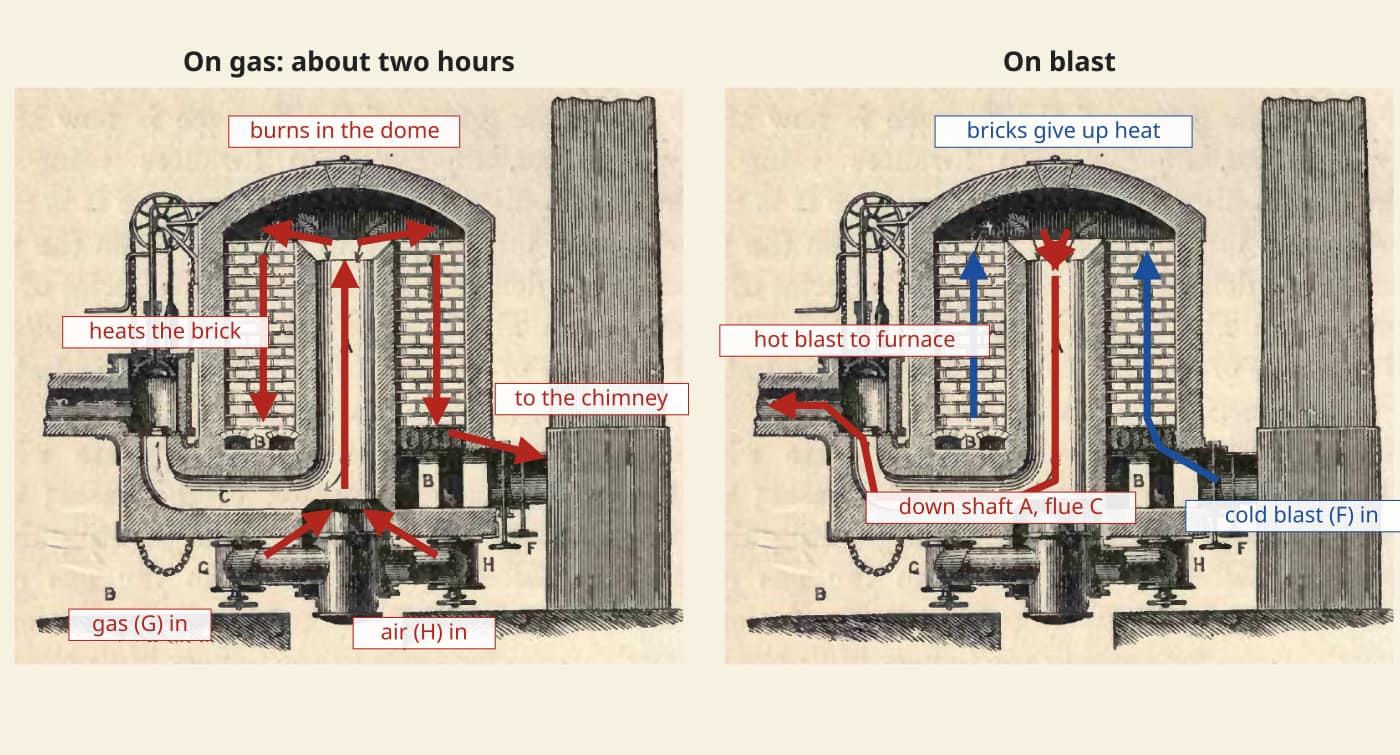
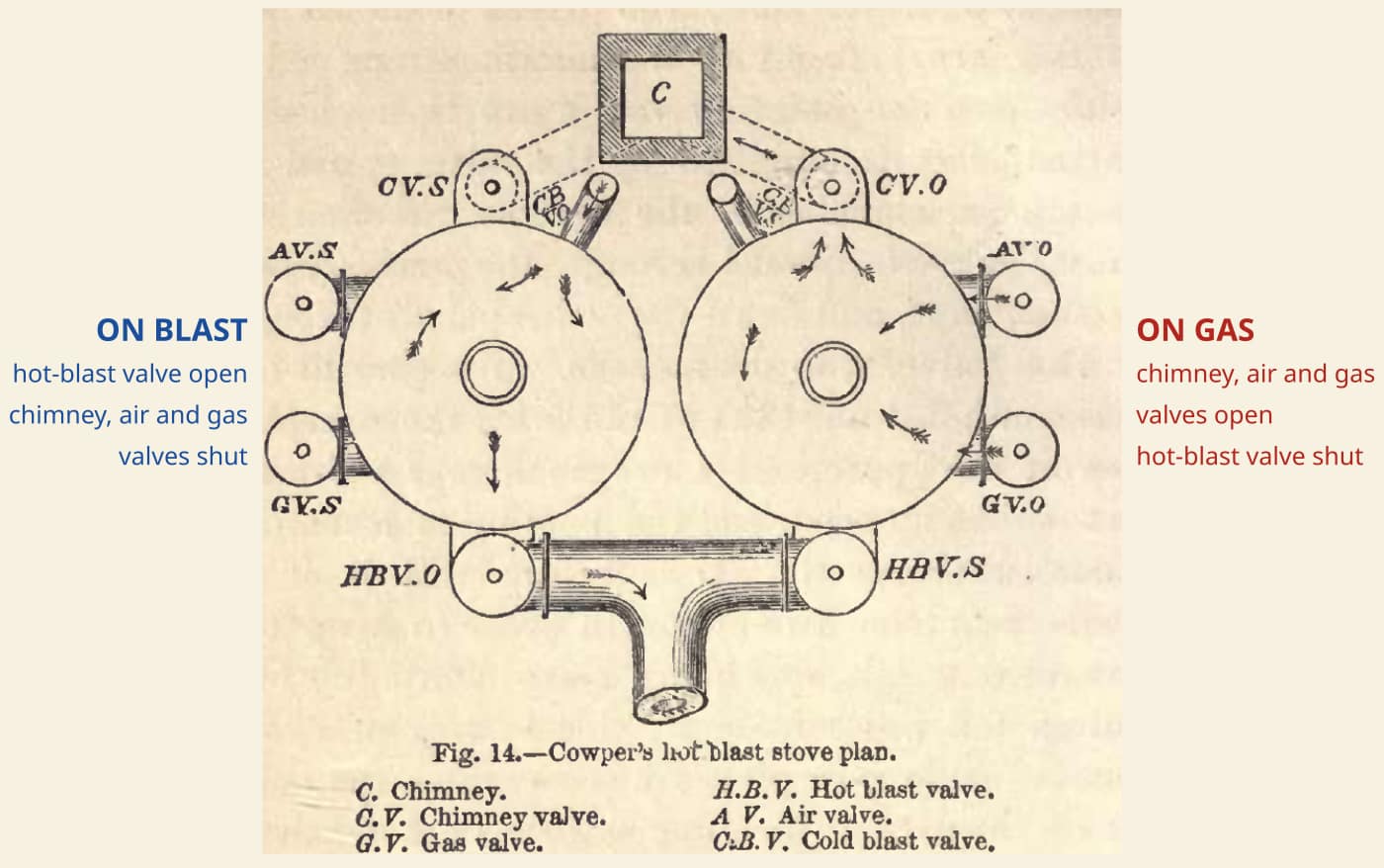
A furnace also makes gas that is combustible but not hot, where a steel furnace's waste is hot and already burned. So a stove needs a burner and a combustion space of its own, and four openings in all: the gas burner, the stack, the cold blast and the hot blast (Johnson Construction p. 192). Each opens and shuts at frequent intervals against temperatures that destroy metal, so the metal round them had to be water-cooled (Johnson Construction p. 192); the hot-blast valve in Bauerman was cast iron with double walls, water-cooled "like an ordinary hot blast twyer" (Bauerman p. 169).
The return for all this was heat that a pipe stove threw away. Gas left a Cowper's chimney at not much above the boiling point of water, 100 to 120 C, while the blast was visibly red-hot and melted antimony with ease, 700 to 800 C (Bauerman p. 169). A parallel-current pipe stove of the Durham type had to send its chimney gases off at twelve hundred degrees or more, which lost over 50% of the heat in the gas (Johnson Construction p. 226). Johnson puts the blast from a firebrick stove at about 50% hotter than from pipes (Johnson Construction p. 192).
Tall, then taller
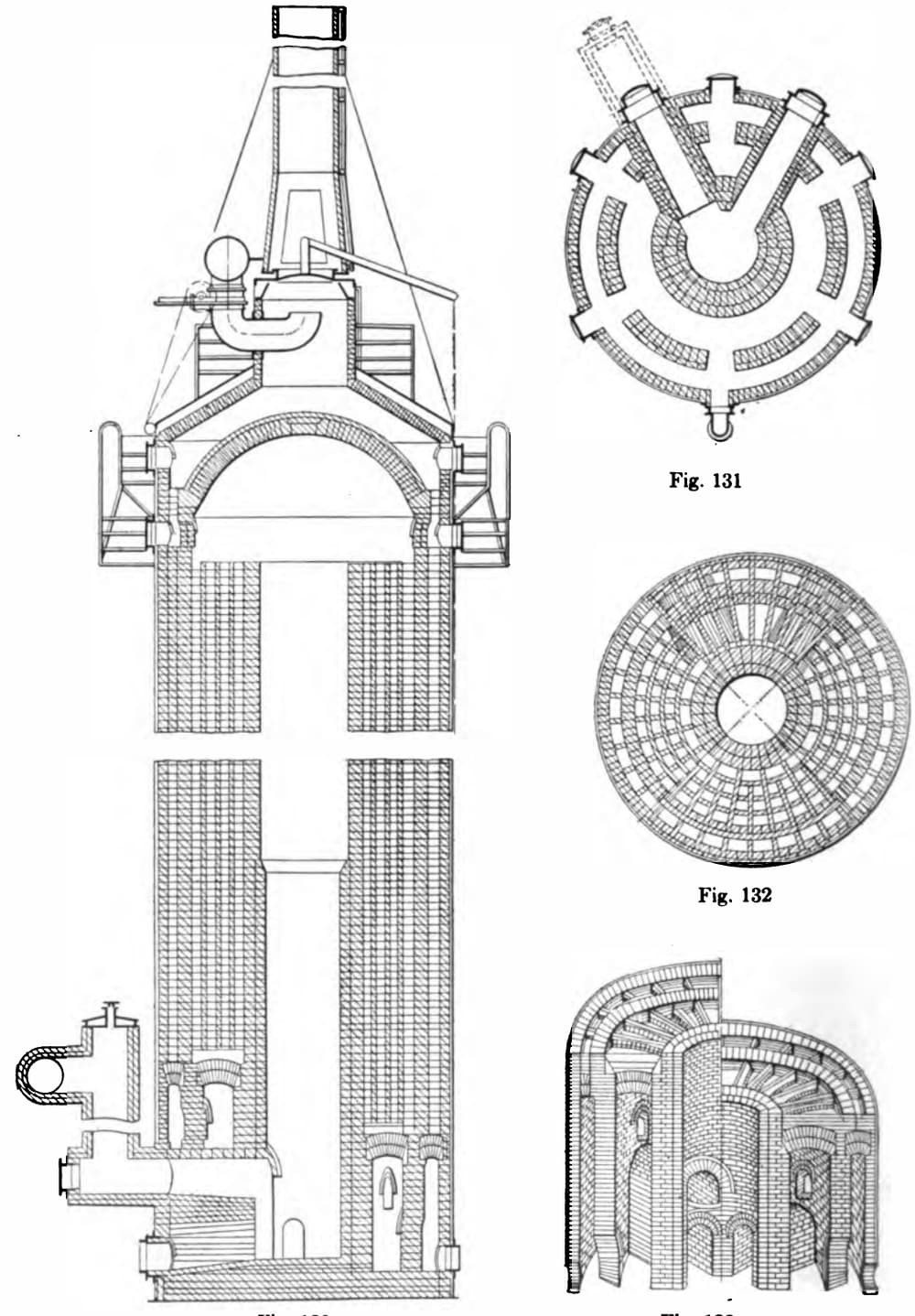
The early firebrick stoves were wide and had four passes of gas up and down. As the fourth pass was found to add little, and each pass cost space for walls, the count came down to three, to two and finally to one, while the stove grew to four or five times its diameter (Johnson Construction p. 200). In Johnson's rule of thumb a stove stands about as wide as the furnace bosh, and at least as tall as the furnace, up to 20 to 25% more (Johnson Construction p. 228).
Dust
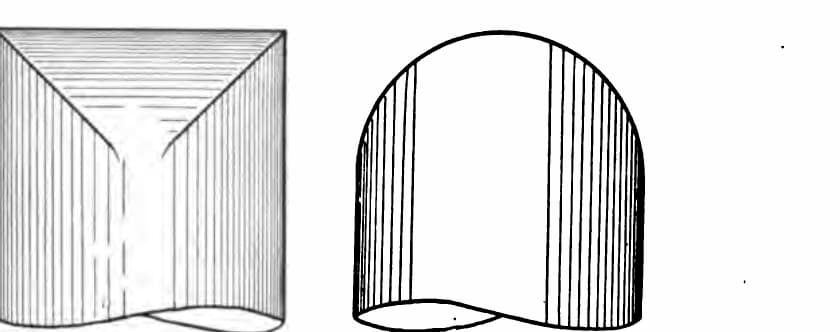
The brick's first enemy was the dust the gas carried out of the furnace. Percy records a trial of Siemens's own brick stoves at the Clarence Iron-works: great inconvenience from the dust in the regenerative chambers, no advantage from the heat, and the stoves were abandoned (Percy p. 428). A footnote added while his book was in type has the answer: Cowper told him his stoves had worked for upwards of two years at Cochrane and Co.'s Ormesby works, with a saving of 5 cwt of coke a ton of iron and a make up by more than a third, and the blast "considerably above redness" (Percy p. 428).
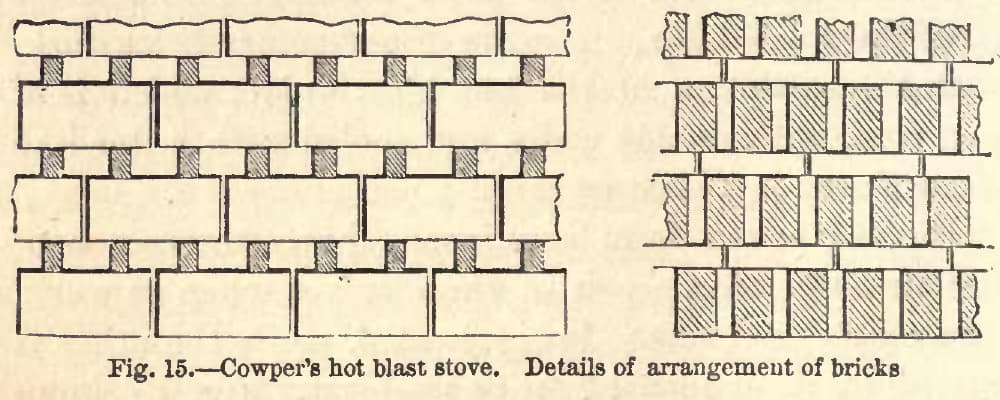
The problem did not go away. Bauerman says the small rectangular openings are the reason for Whitwell's plain walls: the piles of brick "are liable to become choked by the deposit of flue dust" (Bauerman pp. 169-170). Johnson's 9-inch checker openings were kept wide because anything smaller could not be kept open with gas that dirty, and the dust that settled on the brick was a good non-conductor. He had the walls of a combustion chamber slag away and last only eight or nine months (Johnson Construction p. 224). Cleaning meant cooling the stove until men could go into the dome and drop weights through the checkers on a rope or chain, and the stove stayed out of use for one to two weeks (Johnson Construction p. 224).
How many stoves
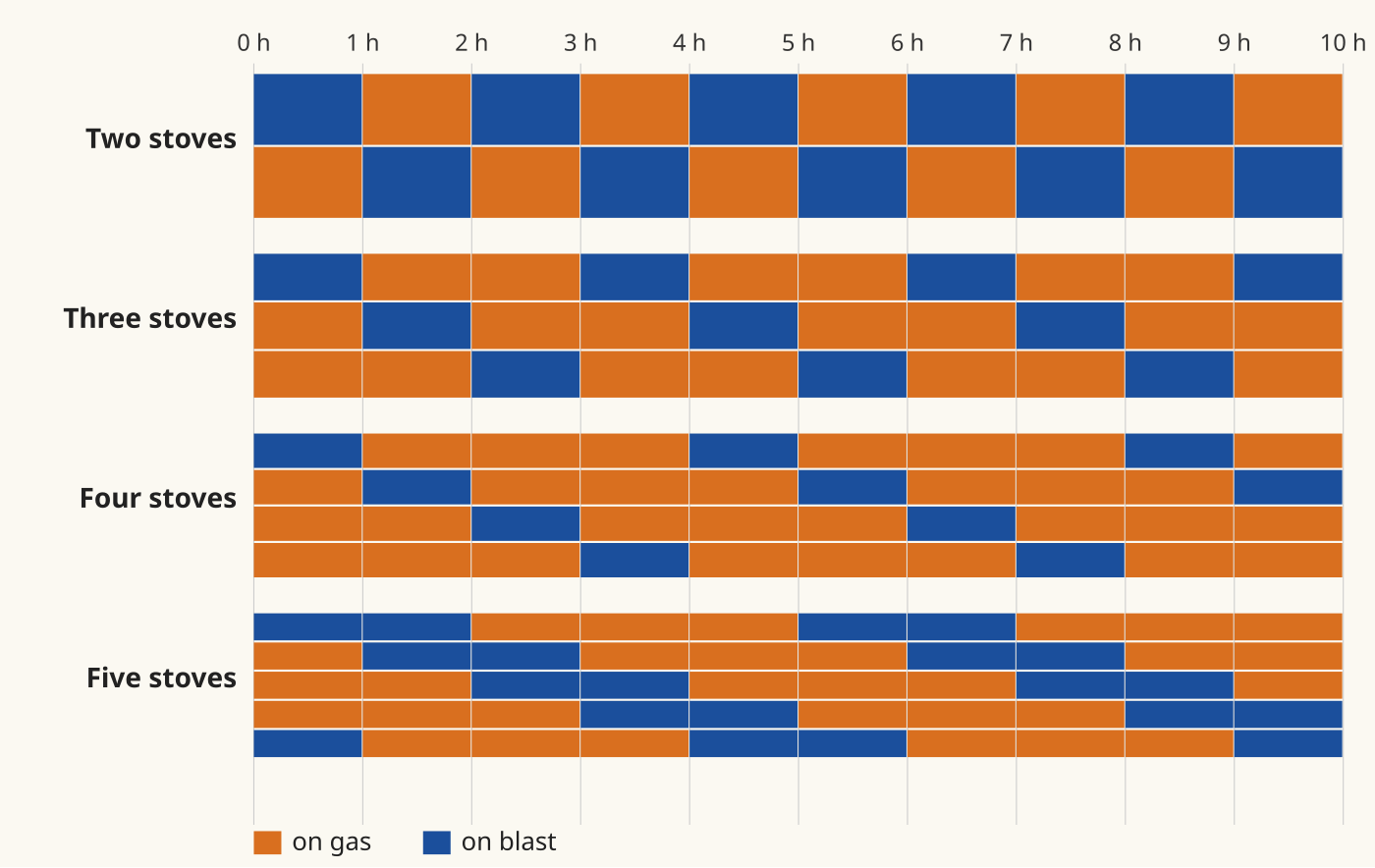
A firebrick stove cannot heat and blow at once, so one stove is impossible. Bauerman, writing while they were new, calls two necessary to keep the blast continuous (Bauerman p. 169). Practice left that behind: "Less than three are never contemplated, four is only ordinary good practice," and five had given extremely satisfactory results at some plants (Johnson Construction p. 226).
Each stove begins its turn hot and cools as it works, so the blast sags until the next stove takes over. The blast fell some 50 to 150 degrees F between putting a stove on and taking it off, depending on the number of stoves and how they are handled (Johnson Construction p. 228), and with only two stoves "these variations are so great as to cause serious irregularities" in the furnace (Johnson Construction p. 226). A third stove doubles the relative time on gas and allows a "soaking heat", and a fourth lets one be away for repair while three keep the work going (Johnson Construction p. 226). Works could also mix a little cold blast into the hot main to trim the peak, at the price of holding the blast at its lowest temperature and of constant attention from the stove tender (Johnson Construction p. 228).
Period basis, and what is the game's own
- Period: a plate cylinder under a dome, filled with stacked firebrick, with a central flue where the gas burned, and valves for gas, air, chimney, cold blast and hot blast, turned by hand on a schedule (Bauerman pp. 167-170, Johnson Construction pp. 192, 202). Planned in the game: a tall stove drawn this way, brick checkers in a riveted plate shell, four to five diameters tall, and at least as high as the hot furnace (Johnson Construction pp. 200, 228).
- Period: two stoves at first, three the least that held the blast, four the ordinary plant (Johnson Construction p. 226). The game plans the reverse order. Heating takes about twice as long as blowing, so three stoves run one on blast and two on gas, and two stoves let the blast visibly sag between swaps. The number is never stated in the game: it falls out of watching the blast.
- Period: the gas came from the furnace and carried its dust with it (Percy p. 428, Johnson Construction p. 224). The game plans a dust catcher on the furnace exhaust, whose dust goes back into the burden, and a full catcher chokes the gas and leaves the stoves cold.
- The game's own: swapping stays with the player on valves, as it was with the stove tender (Johnson Construction p. 228), and there is no switch on the stove. A proposed change reduces a bank's swap to one reversing lever.
- The game's own: a stove hot enough inside lights its gas by itself, and a cold one needs a torch through a side hatch, with the gas already flowing. The game takes about 600 to 650 C as the temperature at which the gas lights. The pages read for this article do not say how a cold firebrick stove was first lit, or at what temperature. The pipe stoves in Bauerman kept a small fire by the jets so the gas could not go out and let air back into the main (Bauerman p. 167).
- The game's own: dust does not clog the checkers and no one is sent in with weights, and the gas is neither poisonous nor explosive.
- The game's own, as it stands today: the shipped stove burns nothing. It soaks heat out of the furnace exhaust piped into it, stores it in metal heat sinks rather than brick, and hands it to the blast. A coal pile below the intake, unburnt and never used up, sets how fast it charges, and two stoves are swapped by valves. All of this goes when the gas-fired stove is built. See vanilla against reality for what the base game has in its place: no blast furnace and no hot blast.
The numbers
"Planned" is the design; the rest is what the shipped stove does now. Scaling is explained on the scaling page; sizes are in blocks at the game's scale.
| In the game | Period figure | How it was scaled | Game value |
|---|---|---|---|
| Hot blast from a brick stove | 700 to 800 C (Bauerman p. 169) | Period figure at face value | Planned 700 to 800 C; the shipped stove stores up to 1,240 C and is swapped below 800 C |
| Hot blast from an iron-pipe stove | 850 to 1000 F, limit of the pipes about 900 F (Johnson Construction pp. 191-200) | Period figure rounded | Planned about 500 C, a second stove type |
| What a hot blast is worth to the hearth | Hot blast changes the heat at the tuyere, no single figure (see the numbers) | The game's own heat sum | 0.35 C of hearth heat a degree of blast above the air; 950 C blast adds 325.5 C on a 20 C day; planned 700 to 800 C blast adds 238 to 273 C |
| Time on gas against on blast | Two thirds on gas with three stoves, three hours to one with four (Johnson Construction p. 226) | The three-stove share, as a fixed rule | Planned heating about twice as slow as blowing |
| Stove count | Two at first, three the least, four ordinary, five at the best plants (Johnson Construction p. 226) | Follows from the fixed heating rate | Planned 2 sags, 3 steady, 4 with one in reserve; the shipped stove runs in pairs |
| Size | Height four or five diameters (Johnson Construction p. 200), wide as the bosh, tall as the furnace or a little over (Johnson Construction p. 228) | Whole blocks | Planned about 3 blocks across and 11 to 12 tall |
Open, and what you can tell us
The books disagree on who deserves the credit, and none gives the date of the first working blast-furnace stove. Johnson gives the regenerator's application to the blast furnace to Whitwell (Johnson Construction p. 191), where Bauerman calls it Cowper's stove and calls Whitwell's a later, simpler form (Bauerman pp. 169-170), and Percy reports Siemens's own trial failing before Cowper's success at Ormesby (Percy p. 428). If you have a source that dates the first stove that worked on a blast furnace, we would like to read it.
The game has not settled whether a hot stove should say more than its own temperature: a target to aim for or an automatic changeover are both open.
Picture credits
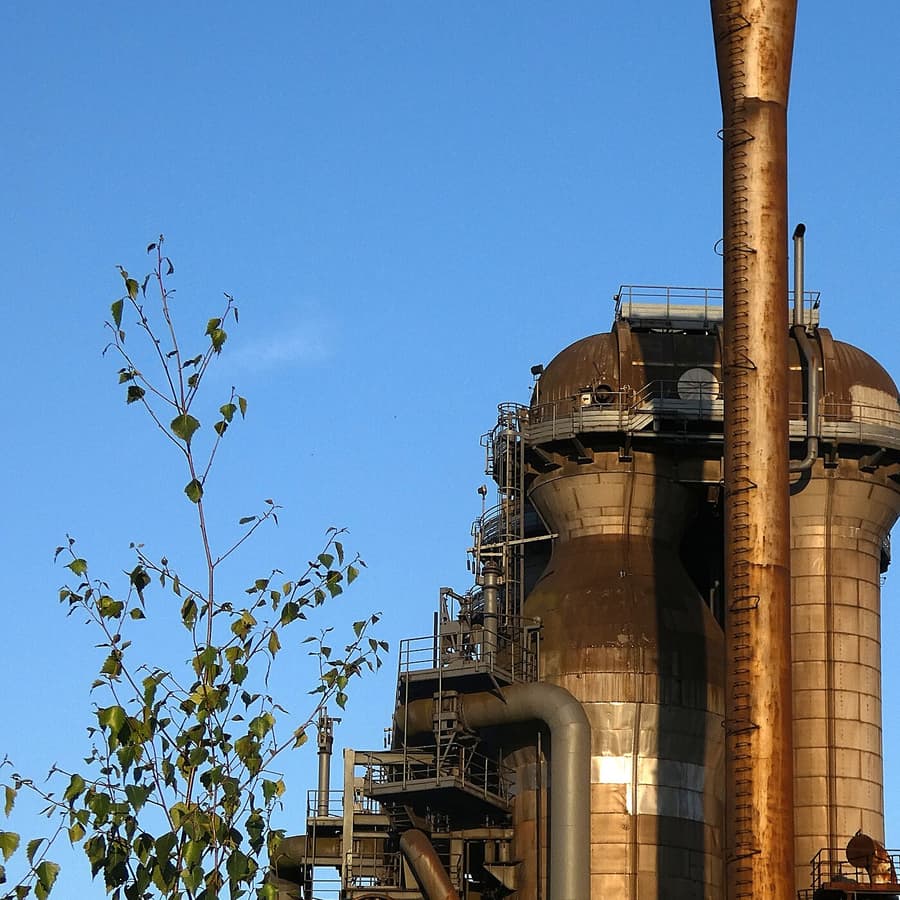
- Lapadu Cowper Stoves: Tetzemann, CC0, cropped.
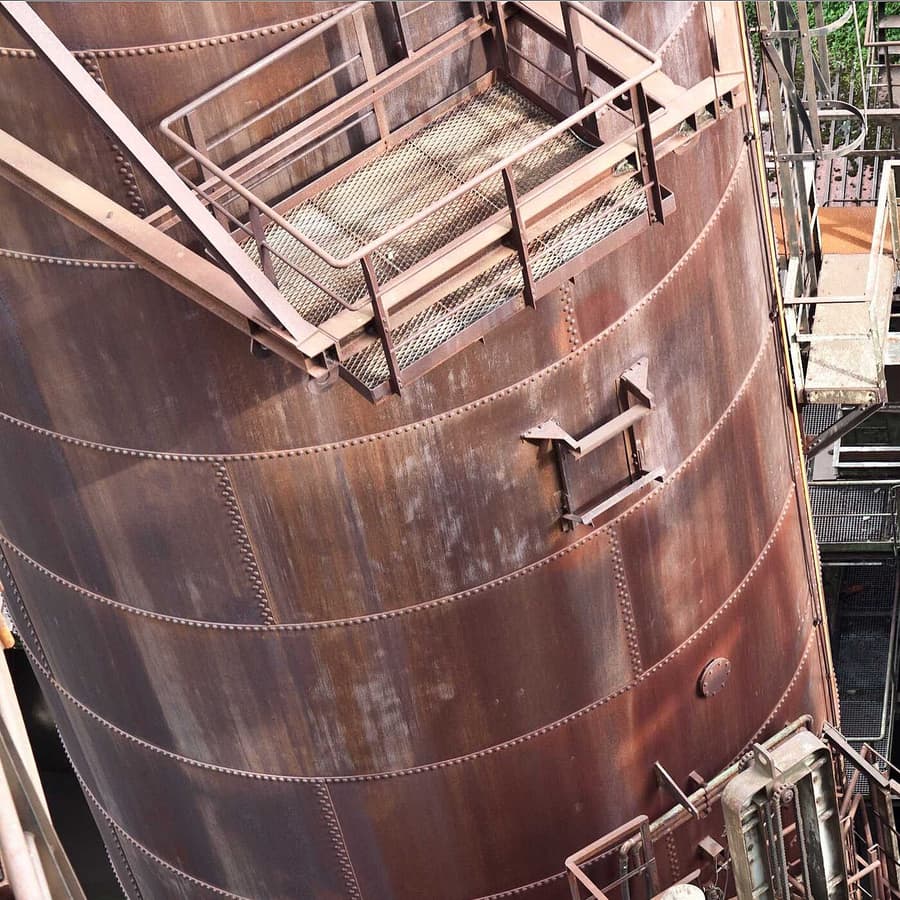
- Henrichshutte Hattingen Winderhitzer: int2k, CC BY 2.0, cropped.
- Figs. 13, 14 and 15: Bauerman, A Treatise on the Metallurgy of Iron, pp. 168 and 170, Library page. Words and paths of the gas and air drawn over Figs. 13 and 14 for this site.
- Figs. 130 to 133 and 161: Johnson, Blast-Furnace Construction in America, pp. 202 and 223, Library page.
- Who is on gas and who on blast: drawn for this page from Johnson Construction pp. 226-227.
Comment or suggest something in the Expanded thread on the Vintage Story Discord