
Bessemer converter
A Bessemer converter is an iron egg lined with ganister, hung on two trunnions, with holes in its bottom. Melted pig iron goes in, cold air is blown up through it, and the carbon and silicon in the iron burn away and keep the metal hotter than it came in. No fuel is added. How to run the game's converter is in the Bessemer guide, and its parts are in the catalogue. This page is about the real one and how the game's follows it. The game's converter is an older build being redesigned, and the redesign has no finished drawing to show yet.
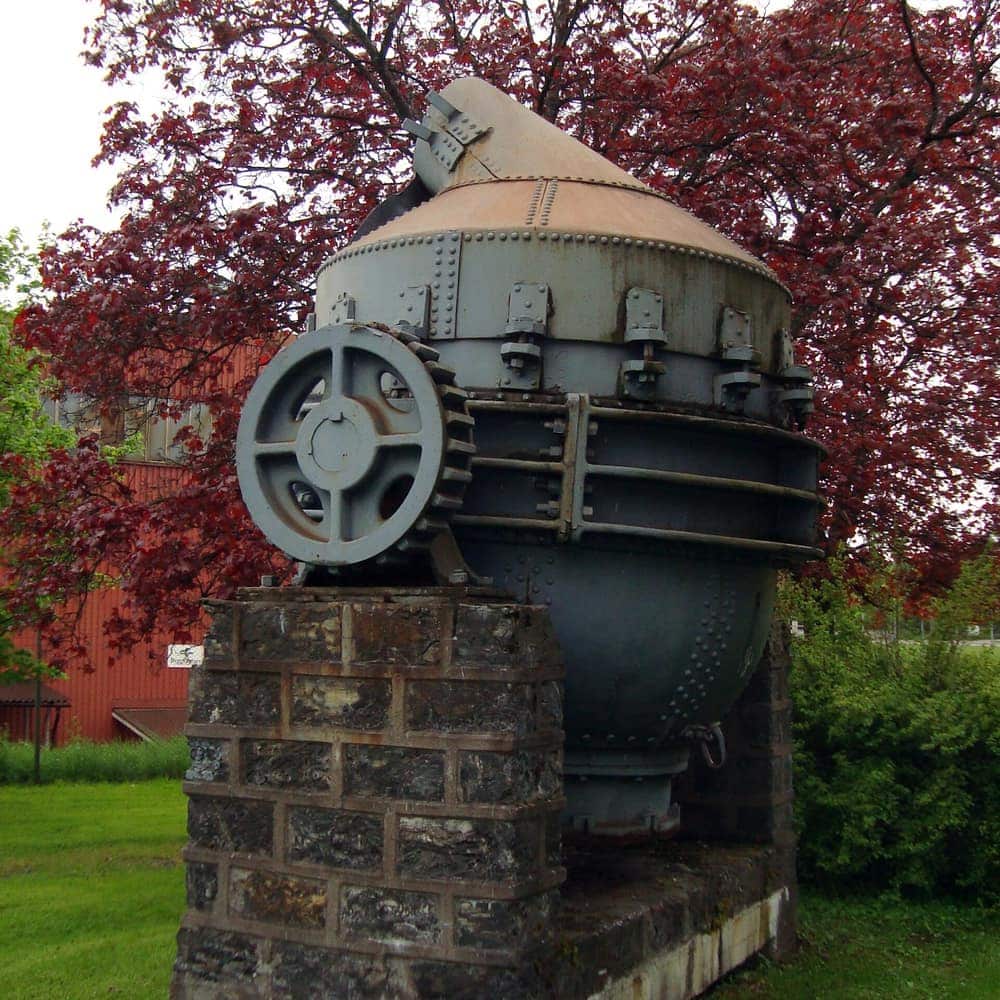
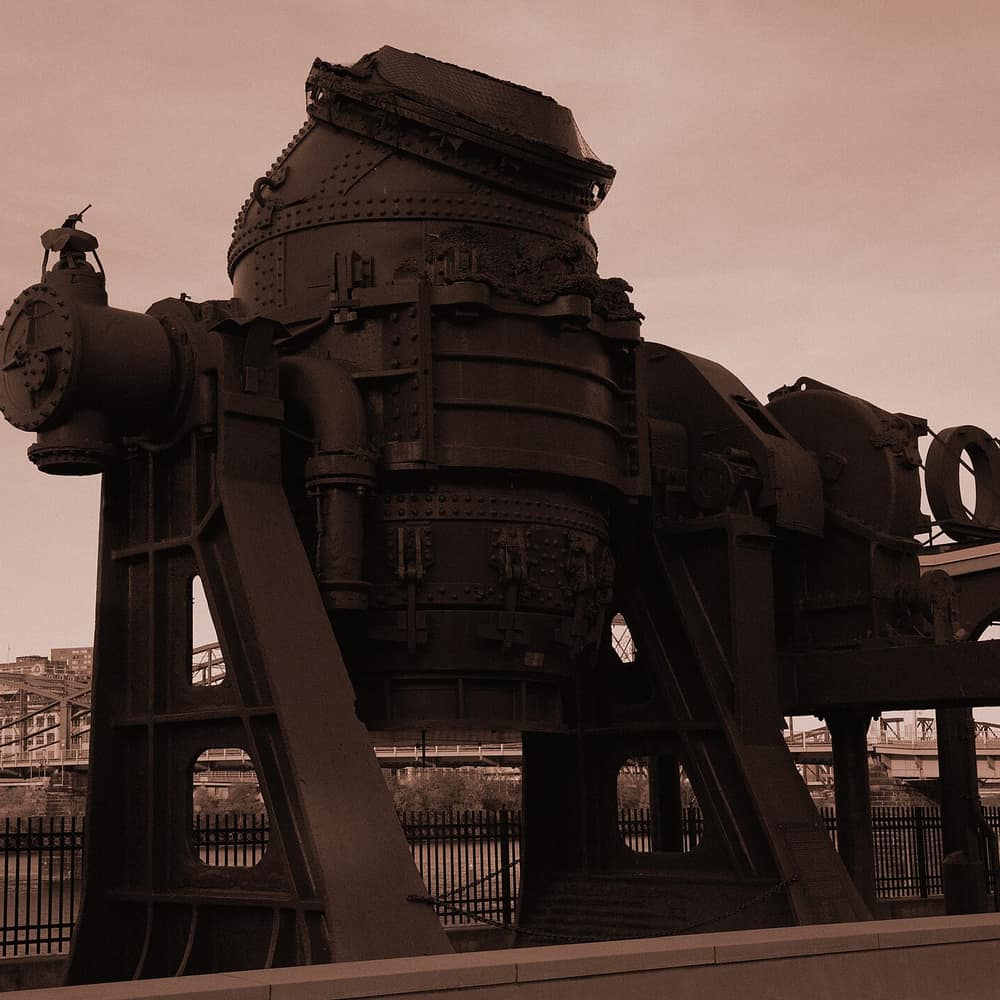
How the real one worked, and why it was built so
Bessemer's first vessels did not move. His first trial vessel was a flat-topped cylinder about 4 ft high inside, with six horizontal tuyeres near the bottom, a blast of 10 to 15 lb and 7 cwt of pig run in through a hopper (Bessemer p. 143). He describes what it did: about ten quiet minutes of sparks, then "a voluminous white flame" and "a succession of mild explosions", and "in ten minutes more the eruption had ceased, the flame died down, and the process was complete" (Bessemer pp. 143-144).
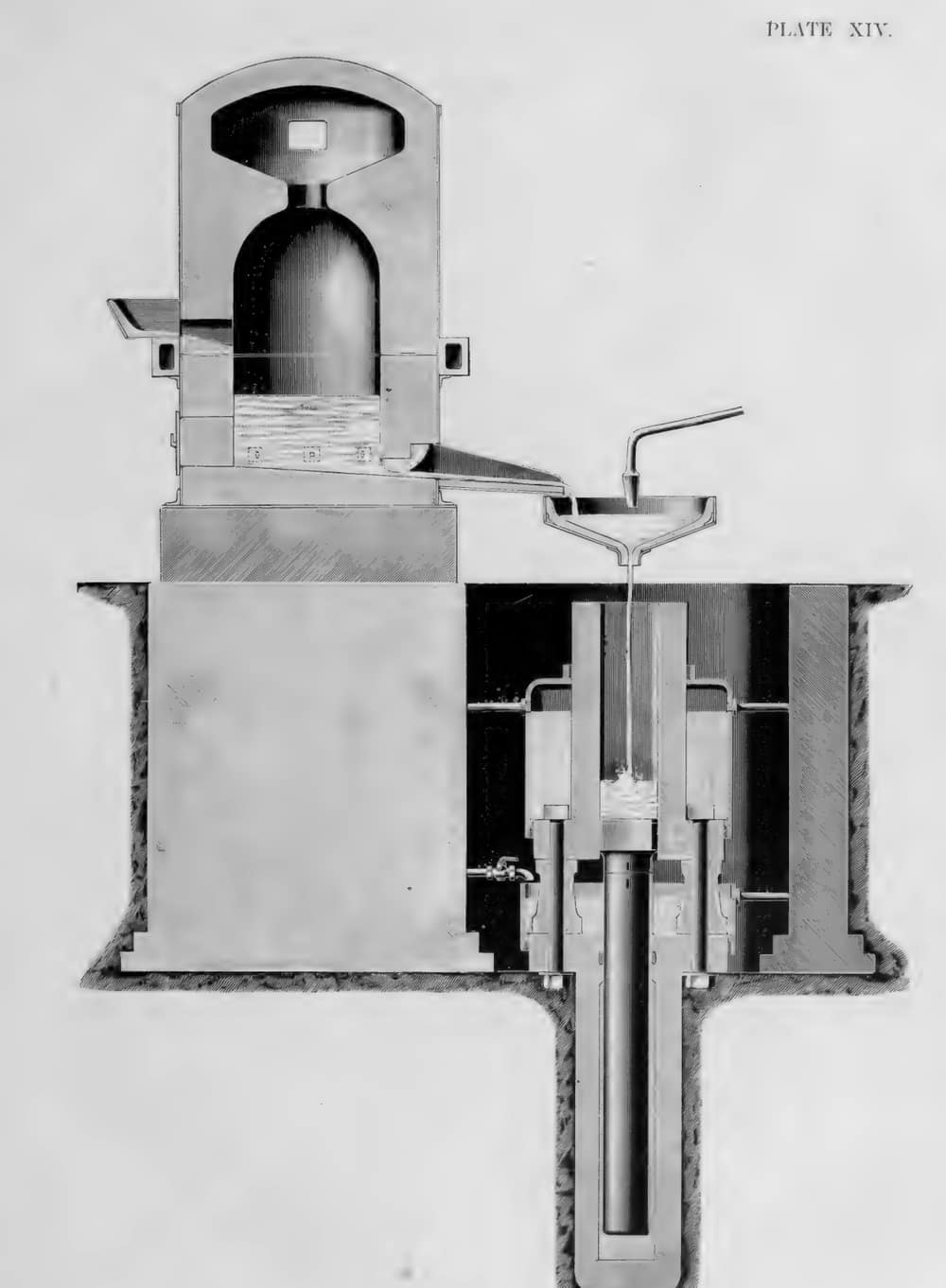
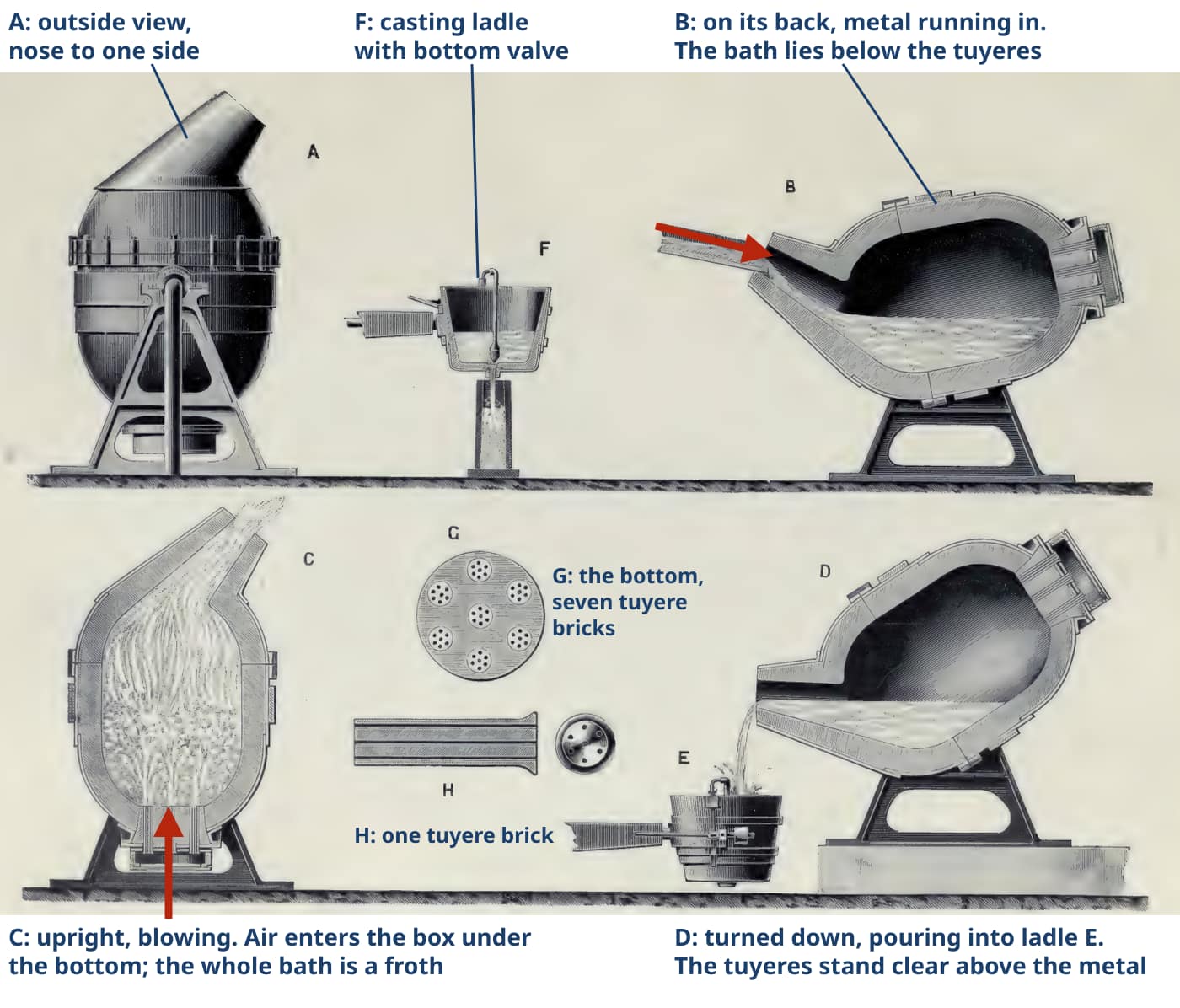
The fixed vessel had one fault that could not be engineered out. It blew while the iron ran in and again while it was tapped, for an uncertain time, and it could not be stopped if the blowing engine failed or a tuyere gave way (Bessemer p. 148). Air had to be on before the metal arrived, or the metal entered the tuyeres (Bessemer p. 158). Mounting the vessel on axes solved all of it at once: laid on its side the tuyeres stand above the metal, so the blow starts all at once when the vessel is raised, stops for the discharge, and can be stopped at any time to change a tuyere (Bessemer p. 148). Campbell still gives the same reason half a century later (Campbell p. 100).
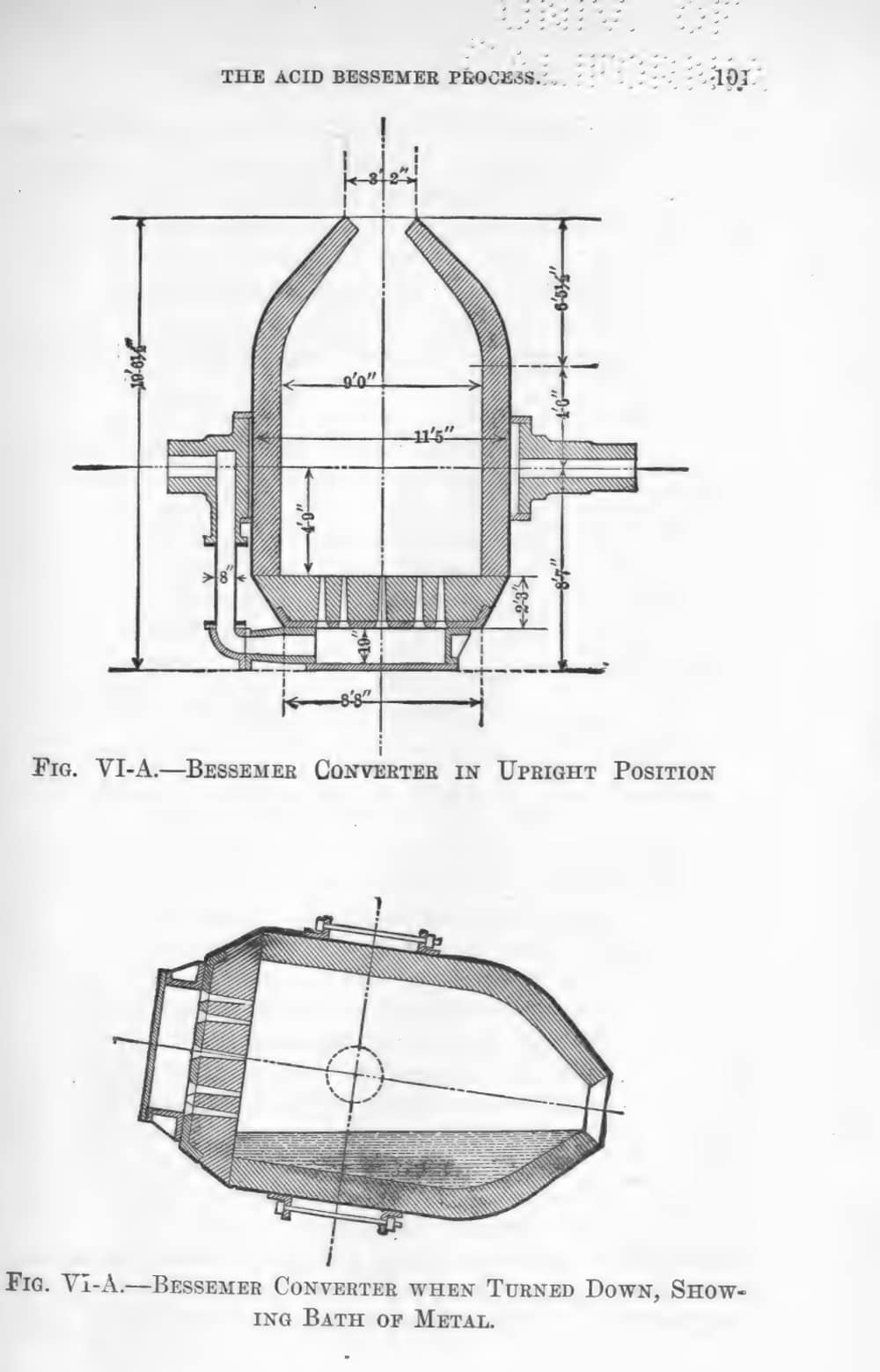
The egg shape is for the same reasons. It is arched in all directions so the lining holds upside down, with "some eight or nine feet in height for the metal to throw itself about in", and the mouth points to one side so the sparks go away from the casting pit (Bessemer p. 148). Large vessels left 8 to 10 ft above the bath for the eruption (Bessemer p. 145).
Cold air should chill melted iron. It does the opposite because silicon and carbon burn: Campbell's heat balance gives silicon the largest share of the surplus, carbon a little less, and iron the rest (Campbell pp. 108-109). The pig came in at about 1400 C and the blow ended near 1679 C, a rise of about 280 C (Campbell pp. 108-109). The speed is not optional. Fewer tuyeres or a weaker blast "only resulted in a reduction of the necessary temperature", and "rapidity of action, ending in a violent eruption, is an absolutely necessary condition of success" (Bessemer p. 145). A vessel with too little air can freeze: one trial failed to bring on the boil in an hour and three quarters and two thirds of the charge set solid. A fresh charge of fluid iron "had the effect of entirely remelting the former charge" (Bessemer p. 159).
How a heat was run
The vessel was laid on its side and the charge run in. Bessemer wanted the vessel "so near to the discharge hole of the blast furnace as to allow the iron to flow along a gutter into it" (Bessemer p. 157). Sweden and Austria worked that way (Bessemer p. 276, Campbell p. 104), an ingot cast "within fifteen minutes of its leaving the blast furnace" (Bessemer pp. 224, 278). Holley's American plants melted the pig in cupolas in place of reverberatories (Bessemer p. 341); steadier furnace practice and the mixer, an enlarged receiving ladle, later made direct metal practicable (Campbell pp. 108-110). The game's direct route, from the blast furnace down a canal to the vessel, is the Swedish one.
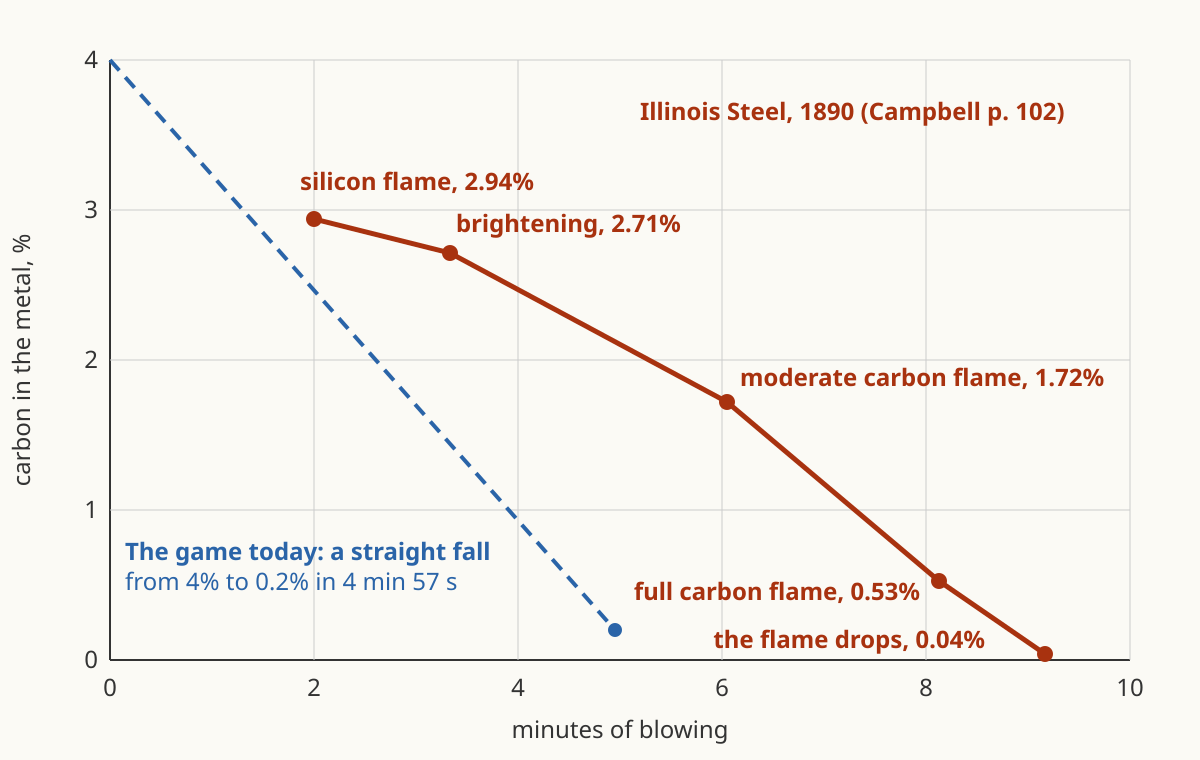
Then the blast went on and the vessel stood up. Silicon burned first, "very undemonstrative, a few sparks and hot gases"; after ten or twelve minutes the carbon gave "a voluminous white flame", and the drop "took place almost suddenly" (Bessemer pp. 152-153). Bessemer gives blows from ten to thirty minutes (Bessemer pp. 153, 174, 224, 231), Campbell 7 to 12 (Campbell p. 102). The drop came "with unerring certainty" when the carbon was gone (Bessemer p. 207). Blowing on burned iron: 2 to 3% more iron went than when steel was made, and the metal was left "very much overcharged with oxygen" (Bessemer p. 268).
Temperature was the blower's other worry. A cold charge, from low silicon, a low starting temperature or a newly repaired vessel, was heated by blowing with the vessel partly tipped, at the cost of iron and lining (Campbell p. 106). A hot one was cooled with scrap or steam (Campbell p. 103). A hundred pounds of scrap in a 7-ton charge shows, and is worth 13 C (Campbell p. 111).
What came out was not steel yet. A blow takes out the carbon and the manganese, and blown iron without manganese is red-short (Campbell pp. 8, 22): it "crumbled away under the hammer" at a welding heat (Bessemer p. 281). Mushet's patent of 22 September 1856 added molten spiegeleisen to the blown metal (Percy p. 814), usually 5 to 10%, and the blow was resumed for five minutes (Percy p. 823). Later practice threw solid ferromanganese into the ladle while it filled (Campbell p. 112). Swedish pig, rich in manganese, needed none of it (Bessemer pp. 174, 276). The early licensees' failures were a different problem again: their pig carried phosphorus, which nothing he tried would remove (Bessemer pp. 170-172). The ladle page follows the metal onward.
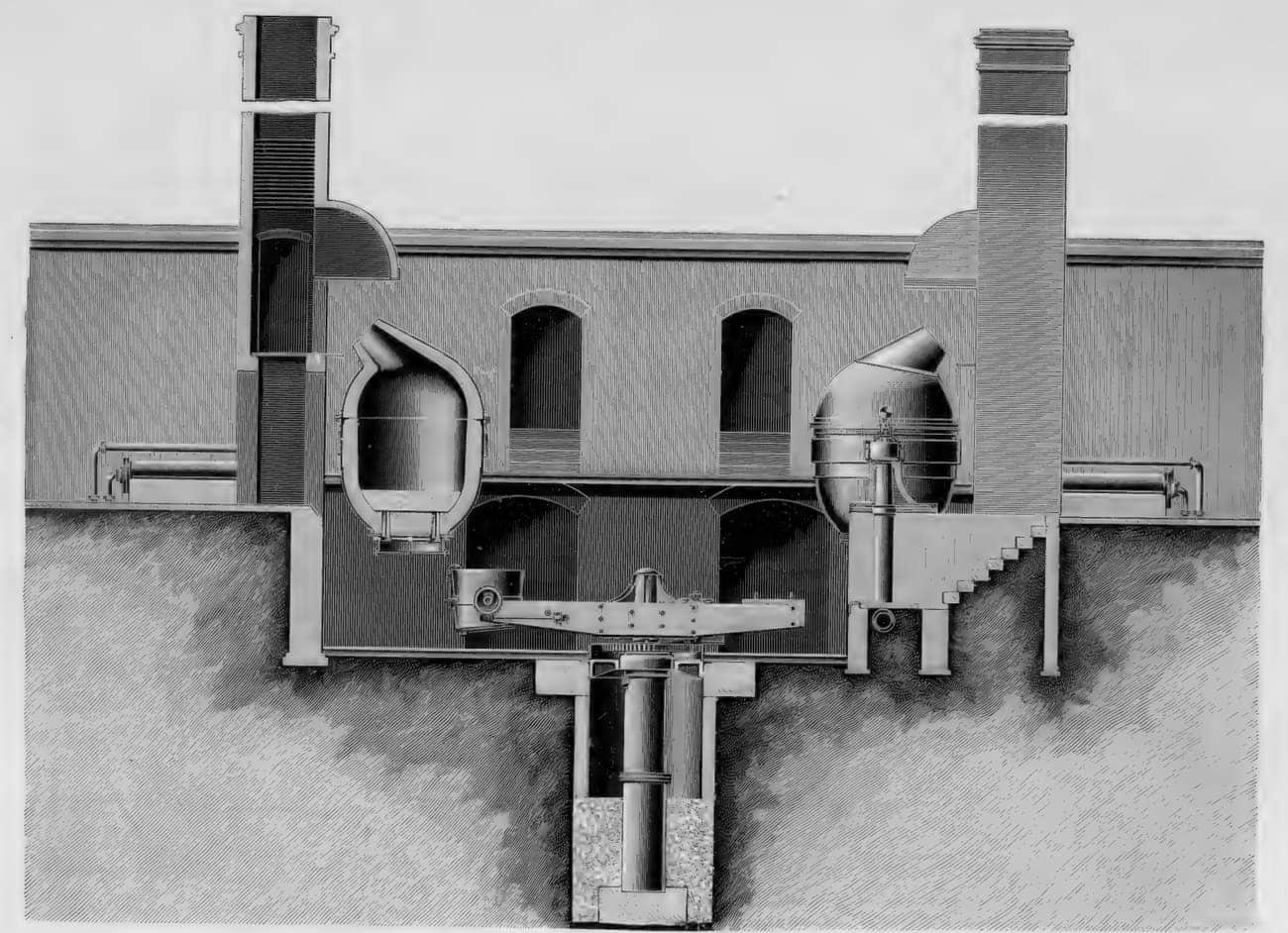
Everything round the vessel existed to get a heat out quickly. A hydraulic crane carried the ladle over each mould in the pit, and one workman on an elevated stand governed the blast and the cranes (Bessemer p. 149). A pair of 10-ton vessels made eight heats an hour (Campbell p. 106). For the wider story of blowing against the open hearth, see steel in bulk; for what went into the vessel, see pig iron.
Period basis, and what is the game's own
- Period: the tilting vessel, tuyeres above the metal while it runs in, the blow started and stopped by turning it (Bessemer p. 148, Campbell p. 100). The game keeps this: fill tilted, blow upright, pour by tilting.
- Period: no fuel, the heat from the pig's own silicon and carbon (Campbell pp. 108-109). The game keeps it, and a charge chilled below the refining temperature stalls and can freeze.
- Period: scrap as a coolant (Campbell pp. 103, 111). The game charges scrap by hand, and there is no fixed limit: too much of it stops the heat.
- Period: a frozen charge remelted by fresh fluid iron (Bessemer p. 159), and a cold charge blown partly tipped (Campbell p. 106). Both are planned.
- Period: blown iron needs manganese (Campbell pp. 8, 22, Percy pp. 814, 823). Planned: the blow yields blown iron with no uses of its own, finished at the ladle with spiegeleisen or ferromanganese. Today the blow yields finished steel directly.
- Period: the vessel lined with ganister, the acid process (Bessemer p. 203). The game's is acid too, and there is no lime and no phosphorus problem.
- The game's own: vanilla has no converter or steelmaking vessel of any kind. See vanilla against reality.
- The game's own: the mod's pig carries no manganese, so every blow needs the ladle; Swedish pig has no counterpart.
- The game's own: the vessel turns from a shaft, where Bessemer rejected shafting and straps because the load reverses as the metal runs to the nose, and "the converter might swing itself round" (Bessemer pp. 149-150). His first Sheffield vessel was hand-geared (Bessemer p. 150).
- The game's own: the carbon falls in a straight line, the blow length does not depend on the size of the charge, and silicon is not tracked. The grade of Bessemer steel that keeps it out of pressure work is a game rule.
The numbers
Units follow scale and units, and the rules for scaling are in the scaling page. "Planned" is the design; other values are what the game has now.
| In the game | Period figure | How it was scaled | Game value |
|---|---|---|---|
| Charge | 5 tons small, 10 to 20 tons large (Campbell p. 100) | The game's own, set by what the casting pours need | 4800 u; planned 6000 u |
| Carbon in the pig | About 3% (Bessemer pp. 152-153) | The game's own round figure | 4% |
| Carbon when steel | 0.04% at the flame drop, recarburised after (Campbell p. 102) | The game's own, a target rather than an ending | 0.2%; soft iron below 0.05% |
| Length of the blow | 7 to 12 min (Campbell p. 102), 15 to 20 min (Bessemer p. 174) | Shortened, the game's own | 4 min 57 s; soft iron about 12 s later |
| Temperature rise | About 280 C, 1400 C to 1679 C (Campbell pp. 108-109) | The period figure taken as it stands | Today the bath is held at 1800 C at full blast; planned about 280 C over the arrival temperature |
| Refining floor | None given | The game's own | 1500 C |
| Blast pressure | 8 to 10 lb (Bessemer p. 157), 20 to 30 psi (Campbell p. 102) | The game's own minimum | 2.5 atm |
| Steel out of the pig | Loss 10 to 11% on cupola iron, nearly 10% direct (Campbell p. 107), 12.5% (Bessemer p. 158), about 20% in small vessels (Campbell p. 411) | The game's own, within the period range | 90%; planned 85% |
| Slag | 120 tons a 1000 tons of pig, 12% (Campbell p. 107) | The period figure | 6%; planned 12% |
| Over-blowing | 2 to 3% more iron burned (Bessemer p. 268) | The period figure | Planned 2 to 3% of the charge to slag |
| Scrap cooling | 13 C for 100 lb in 7 tons, about 18 C a 1% (Campbell p. 111) | The game's own coefficient, close to the period rate | 0.35 C a unit, about 17 C for 1% of a 4800 u charge |
| Spiegeleisen | 5 to 10% (Percy p. 823), at 4 to 4.5% C (Bessemer p. 273) | The period figure | Planned about 10%, at 4.5% C |
Open, and what you can tell us
Two things about the blow are not settled. The first is whether the planned rise of about 280 C should follow the air blown or the carbon burned. The books give the start and the end (Campbell pp. 108-109), and Campbell's table shows the two chief fuels burning at different times (Campbell pp. 102-103), but the game has to choose one rule, and the choice decides whether a charge that arrives too cold can start at all. The second is whether the blow should take longer for a bigger charge. Campbell gives tuyere area per ton of charge, 2.0 to 2.5 sq in (Campbell p. 102), which suggests a larger vessel simply got more air and blew in about the same time, and that is what the game does today. If you know a source that gives blow times against vessel size, we would like to read it.
Picture credits
- Bessemer converter, Langshyttan: Calle Eklund/V-wolf, CC BY-SA 3.0, cropped.
- Bessemer Converter, Pittsburgh: David Brossard, CC BY-SA 2.0, cropped.
- Fig. 43, Plate XV (Bessemer p. 148), labelled for this site; Fig. 42, Plate XIV (Bessemer p. 146); Fig. 45, Plate XVII (Bessemer p. 150): An Autobiography, plates facing those pages, Library page.
- Fig. VI-A: Manufacture and Properties of Iron and Steel (Campbell p. 101), Library page.
- The carbon chart: drawn for this page from Table VI-A (Campbell p. 102), with the game's values.
Comment or suggest something in the Expanded thread on the Vintage Story Discord